Discover how the Hermit Kingdom celebrates the Korean Lunar New Year. From ancestral rites to traditional foods and folk games, explore the fascinating world of Seollal in North Korea.
What is Seollal and Why Does North Korea Celebrate It?
Seollal (설날) is the Korean Lunar New Year. It marks the first day of the Korean lunisolar calendar. This ancient celebration is one of the most important traditional holidays for ethnic Koreans worldwide. Both North Korea and South Korea observe this holiday alongside the Korean diaspora.
The word “Seollal” holds deep meaning. “Seol” (설) means “year of age” in Middle Korean. “Nal” (날) translates to “day.” Together, they represent the day when Koreans traditionally grow one year older.
In North Korea, Seollal carries a unique cultural significance. The regime encourages celebration to emphasize Korean folk traditions. The state broadcasts historical programs on television. Local authorities organize mandatory activities. These include kite flying and spinning tops.
| Aspect | North Korea | South Korea |
|---|---|---|
| Name for the Holiday | Seollal (설날) | Seollal (설날) |
| Importance Ranking | Second to January 1st | Most Important Holiday |
| Traditional Greeting | “새해를 축하합니다” | “새해 복 많이 받으세요” |
| Travel Freedom | Severely Restricted | Mass National Movement |
| State Involvement | Mandatory Activities | Family-Centered |
The History of Seollal in Korean Culture and North Korean Society
The origins of Seollal trace back to ancient Korea. The earliest records appear in 7th-century Chinese historical works. The Book of Sui and Old Book of Tang contain excerpts about national rituals in the Silla Kingdom.
Korea’s traditional holiday customs survived for centuries. They passed through the Goryeo Dynasty and Joseon Dynasty. The celebrations emphasized Confucian values of respect, family unity, and ancestor worship.
Japanese Colonial Rule and the Suppression of Seollal
The Japanese occupation (1910-1945) attempted to erase Korean traditions. Japanese rulers prohibited Seollal celebrations. They forced Koreans to follow the Japanese New Year on January 1st of the Gregorian calendar.
This created two distinct terms:
- Sinjeong (신정): The “new” New Year on January 1st
- Gujeong (구정): The “old” Lunar New Year
North Korea’s Complex Relationship with Seollal
After Korea’s liberation in 1945 and subsequent division, the two Koreas took different paths.
North Korea abolished Seollal in the 1960s. The regime cited the need to eradicate “feudal practices.” Traditional holidays were replaced with socialist celebrations.
However, Seollal was revived in 1989 under former leader Kim Jong-il. This move aimed to ease public discontent over economic difficulties. Since then, North Korean families have gathered on Lunar New Year to share food and enjoy traditional folk games.
“North Korea abolished Lunar New Year’s Day or Seollal in the 1960s in the name of eradicating feudal practices. But Seollal was revived in 1989 under the instruction of former leader Kim Jong-il in a move to ease public discontent over economic difficulties.”
— Global Security
When is Seollal Celebrated in North Korea?
Seollal follows the Korean lunisolar calendar. It falls on the first day of the Lunar New Year. This typically occurs in late January or early February on the Western calendar.
The celebration lasts three days:
- The day before Seollal
- Seollal itself
- The day after Seollal
Upcoming Seollal Dates
| Year | Date | Animal |
|---|---|---|
| 2025 | January 29 | Year of the Snake |
| 2026 | February 17 | Year of the Horse |
| 2027 | February 6 | Year of the Sheep |
| 2028 | January 26 | Year of the Monkey |
During this period, North Koreans receive a three-day rest from work. This is highly anticipated. Work schedules in North Korea are demanding. The break allows families to gather and celebrate together.
How North Koreans Celebrate Seollal: Traditional Customs and Rituals
North Korean Seollal celebrations blend ancient Korean traditions with state-organized activities. The holiday maintains its cultural roots while operating within the regime’s ideological framework.
Morning Rituals and Ancestral Rites
North Korean families begin Seollal with morning rituals. They prepare traditional foods. They honor their ancestors through ceremonies passed down through generations.
Unlike South Korea’s elaborate charye (차례) ancestral rites, North Korean practices are simpler. The regime has modified traditional Confucian ceremonies. However, many families still prepare food offerings and pay respects to deceased relatives.
The Sebae Tradition: Bowing to Elders
Sebae (세배) is one of the most beloved Seollal traditions. Younger family members perform a deep bow to their elders. They kneel on the ground. Their hands touch the floor.
In South Korea, the traditional greeting is:
- “새해 복 많이 받으세요” (May you receive many blessings in the New Year)
In North Korea, the greeting differs:
- “새해를 축하합니다” (Congratulations on the New Year)
Key difference: In North Korea, Sebae is often performed on January 1st rather than during Seollal. This reflects the regime’s emphasis on the Gregorian New Year.
After receiving sebae, elders give sebaetdon (세뱃돈). This is New Year’s money placed in colorful envelopes. Elders also share words of wisdom and blessings.
State-Organized Activities During Seollal
The North Korean government organizes mandatory activities during Seollal. Local authorities ensure participation. These include:
- Kite flying competitions
- Top-spinning contests
- Folk game tournaments
- Historical television programs
The state uses these activities to emphasize Korean ethnicity. They reinforce national pride while maintaining control over celebrations.
Traditional North Korean Seollal Food: What Families Eat During Lunar New Year
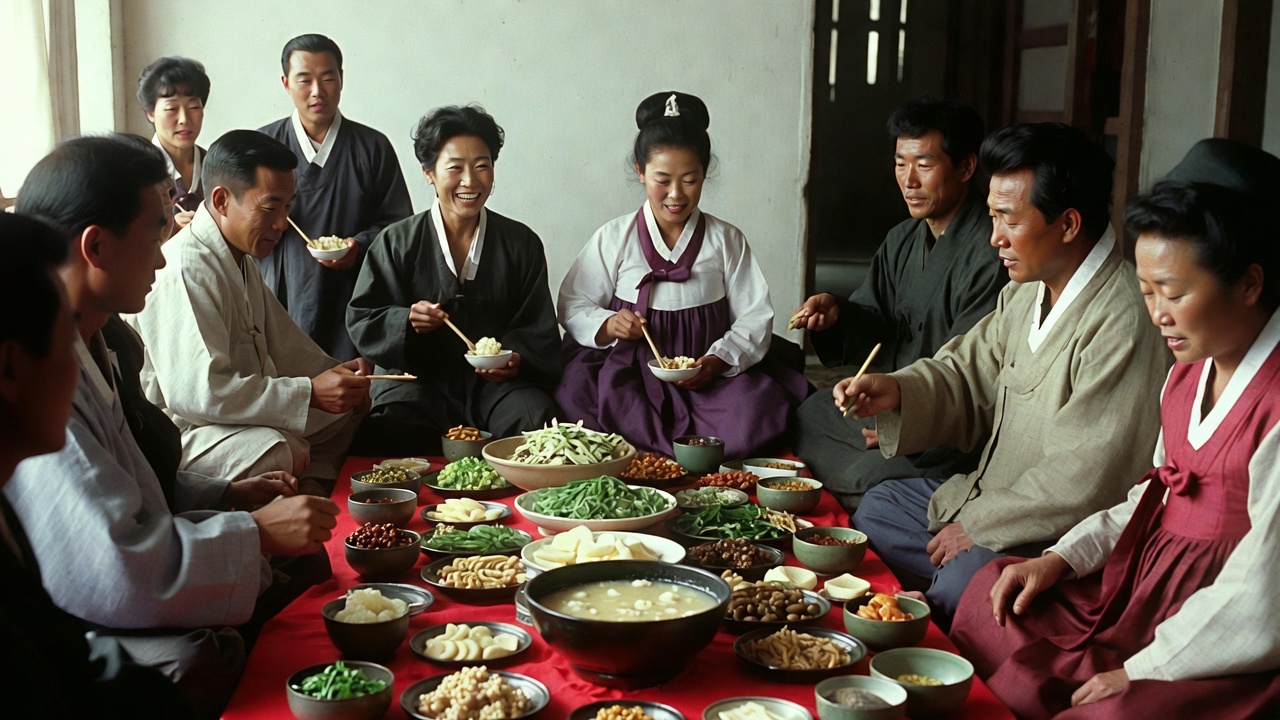
Food is central to Seollal celebrations. North Korean families prepare special dishes. These foods carry symbolic meaning and connect generations.
Tteokguk: The Essential Rice Cake Soup
Tteokguk (떡국) is the most important Seollal dish. This rice cake soup symbolizes growing one year older. Koreans believe eating tteokguk adds a year to their age.
The soup contains:
- Garaetteok: Long, cylindrical rice cakes sliced into coin shapes
- Beef broth: Made from brisket or other cuts
- Egg ribbons: Julienned cooked eggs
- Gim: Roasted seaweed
- Green onions: For garnish
The symbolism runs deep:
- White color: Represents purity and new beginnings
- Coin-shaped rice cakes: Symbolize prosperity and wealth
- Long rice cake strips: Represent expanding good fortune
“The white tteok signifying purity and cleanliness have been eaten during that specific day and it became a ritual to start off the New Year for good fortune.”
— Historian Choe Nam-seon in “The Customs of Joseon”
Regional Variations in North Korea
North Korean tteokguk varies by region:
| Region | Variation |
|---|---|
| Pyongyang Area | Traditional beef broth tteokguk |
| Northern Regions | Manduguk: Dumpling soup instead of tteokguk |
| Kaesong | Jogaengi tteokguk: Gourd-shaped rice cakes |
| Coastal Areas | Seafood-based broth |
Other Traditional Foods Enjoyed During Seollal
Beyond tteokguk, North Korean families prepare:
- Manduguk (만두국): Korean dumpling soup
- Dwejigukbap (돼지국밥): Pork soup with rice
- Songpyeon (송편): Crescent-shaped rice cakes
- Nokdujijim (녹두지짐): Mung bean pancakes
- Japchae (잡채): Stir-fried glass noodles with vegetables
- Jeon (전): Savory Korean pancakes
Food availability in North Korea varies significantly. During Seollal, families traditionally received extra rations from the state. These included luxury items like meat and eggs. The holiday was described as the North Korean equivalent of Christmas in terms of food abundance.
However, economic difficulties have changed this tradition. Many families now rely on Jangmadang (black markets) to obtain ingredients.
Traditional Dress: Chosŏn-ot vs. Hanbok
Traditional Korean clothing holds special significance during Seollal. The garments differ in name between the two Koreas.
Understanding the Terminology
- South Korea: Hanbok (한복) — meaning “Korean clothing”
- North Korea: Chosŏn-ot (조선옷) — meaning “Joseon clothes”
This linguistic difference is ideological. North Korea uses “Chosŏn” to refer to itself. This aligns with the Juche-based national narrative. The term connects to the historical Joseon Dynasty, emphasizing Korean ethnicity.
Design Differences Between North and South
| Feature | North Korean Chosŏn-ot | South Korean Hanbok |
|---|---|---|
| Style | Conservative, standardized | Modern, diverse |
| Colors | Muted (white, pink, blue, beige) | Vibrant, varied |
| Purpose | State ceremonies, propaganda | Daily wear option, fashion |
| Patterns | Plain, simple | Elaborate embroidery |
| Ideology | Emphasizes modesty, collectivism | Personal expression |
When North Koreans Wear Chosŏn-ot
Traditional dress in North Korea is reserved for special occasions:
- Political events and national holidays
- Birthdays of Kim Il-sung and Kim Jong-il
- Weddings and milestone birthdays (60th, 70th)
- Mass performances and propaganda events
- Kim Jong-suk’s birthday (mother of Kim Jong-il)
Interestingly, there is no “seolbim” culture in North Korea. Seolbim refers to wearing new traditional clothes specifically for Seollal. This practice is common in South Korea but largely absent in the North.
Female university students in North Korea wore white jeogori and black skirts as uniforms in the early 2000s. This reinforced the regime’s emphasis on Korean ethnicity.
Components of Traditional Korean Dress
Both hanbok and chosŏn-ot share the same basic structure:
- Jeogori (저고리): Upper garment or jacket
- Chima (치마): Wraparound skirt for women
- Baji (바지): Baggy trousers for men
- Goreum (고름): Coat strings that tie the jeogori
- Durumagi (두루마기): Overcoat worn in cold weather
Traditional Games Played During Seollal in North Korea
Folk games are an essential part of Seollal celebrations. They bring families together. They preserve cultural heritage. In North Korea, the state organizes many of these activities.
Yutnori: Korea’s Beloved Board Game
Yutnori (윷놀이) is the most popular traditional game. It is played during Seollal across both Koreas.
How to play:
- Two teams compete
- Players throw four wooden sticks called yut
- The sticks are curved on one side and flat on the other
- How the sticks land determines movement
- Teams move tokens (yut mal) around a board
- First team to return all tokens wins
The stick combinations have special names:
| Name | Result | Animal Meaning | Spaces Moved |
|---|---|---|---|
| Do (도) | 1 flat, 3 round | Pig | 1 |
| Gae (개) | 2 flat, 2 round | Dog | 2 |
| Geol (걸) | 3 flat, 1 round | Sheep | 3 |
| Yut (윷) | All flat | Cow | 4 |
| Mo (모) | All round | Horse | 5 |
Yutnori creates fierce but friendly competition. Families spend hours playing. Arguments and laughter fill the room.
“I grew up with a lot of aunts and uncles and they all lived in the same area, so on Seollal… everyone would get together to make rice cakes, noodles, and dumplings. After making a lot of food, we’d play Yutnori and everyone would start squabbling.”
— Hannah, North Korean defector (escaped in 2015)
Yeonnalligi: Traditional Kite Flying
Yeonnalligi (연날리기) is a traditional winter game. It holds special significance during Seollal.
Koreans fly rectangular or stingray-shaped kites. The activity has deep symbolism. Participants write bad luck or unfortunate wishes from the past year onto the kite. They then cut the string at sunset. This symbolizes sending away misfortune.
The Sino-Korean phrase “Songaegyeongbok” (송액영복) means “send off bad luck and greet good fortune.”
In North Korea, kite flying is a state-organized activity during Seollal. Local authorities arrange competitions and events.
Other Traditional Games
| Game | Description |
|---|---|
| Jegichagi (제기차기) | Kicking a shuttlecock-like object; similar to hacky sack |
| Neolttwigi (널뛰기) | Seesaw jumping; traditionally played by women |
| Tuho (투호) | Arrow throwing into a narrow jar |
| Paengi Chigi | Top-spinning competitions |
| Hwatu (화투) | Korean card games; adults play for hours |
The Key Differences: Seollal in North Korea vs. South Korea
While Seollal is celebrated in both Koreas, significant differences exist. These reflect the political, economic, and social divisions between the two nations.
Travel and Family Reunions
In South Korea:
- Seollal triggers a mass exodus from cities
- Millions travel to their hometowns
- Bus, train, and plane tickets sell out months ahead
- Roads become extremely congested
- It’s one of the largest annual migrations in the world
In North Korea:
- No widespread travel during Seollal
- Freedom of movement is severely restricted
- Citizens need permission to travel between cities
- Required documentation includes:
- Stated purpose for travel
- Proper identification
- Approval from neighborhood watch (inminban)
- Local People’s Committee approval
- District office approval
- Police officer authorization
- Restricted areas (Pyongyang, border regions) require complex permits
This fundamental difference transforms the nature of celebrations. North Korean families typically celebrate with those living nearby rather than distant relatives.
Prioritization of New Year Celebrations
| Celebration | North Korea Priority | South Korea Priority |
|---|---|---|
| January 1st (Solar New Year) | More Important | Modern Celebration |
| Seollal (Lunar New Year) | Traditional Holiday | Most Important |
| Juche New Year (April 15) | Largest Holiday | Not Observed |
North Korea places greater emphasis on January 1st. This is when:
- The New Year’s Address is delivered (now typically a letter since 2024)
- Sebae is performed
- Major state celebrations occur
- People gather in Kim Il Sung Square
Seollal in North Korea is a time for family and rest. But it does not trigger the same national focus as in the South.
The Juche Calendar and Day of the Sun
North Korea operates on the Juche calendar. This calendar begins with the birth of Kim Il-sung on April 15, 1912.
The Day of the Sun (Kim Il-sung’s birthday) is considered the biggest holiday in North Korea. It far surpasses both the solar and lunar New Year celebrations.
Citizens receive:
- Two days off work
- Extra rations of luxury foods
- Mass performances and exhibitions
- Fireworks displays
What Daily Life is Like in North Korea During Seollal
Understanding Seollal in North Korea requires context about daily life in the country.
The Anticipation of a Three-Day Rest
North Koreans eagerly anticipate the Seollal holiday. Work schedules are demanding. A three-day rest is precious. Families use this time to:
- Gather with loved ones
- Prepare and share special foods
- Play traditional games
- Exchange stories
- Watch television (state programming)
- Attend organized activities
Television Programming During Seollal
North Korean television broadcasts special programming during Seollal:
- Historical dramas
- Folk performances
- Traditional music
- Revolutionary films
- Cultural documentaries
One notable tradition involves watching “Our Warm House” (우리 따뜻한 집), a romantic television drama.
Food Preparation and Family Gatherings
Despite economic challenges, Seollal remains a time for special meals. Families work together to prepare traditional dishes.
“North Korea is a very communal society, so everyone gets together on Lunar New Year. The adults would play card games and Yutnori, we’d eat delicious food, and spend time together until the sun went down.”
— North Korean defector testimony
The Role of the State
Even during celebrations, the state maintains presence:
- Organized activities are mandatory in some areas
- Citizens may visit monuments and statues
- Flower exhibitions at the Kimilsungia-Kimjongilia center
- Local Party officials oversee celebrations
Comparing Seollal Greetings: North vs. South Korean Phrases
Language differences extend to Seollal greetings. These reflect broader linguistic divergence between the two Koreas.
Common Seollal Greetings
| Korean | Transliteration | Meaning | Usage |
|---|---|---|---|
| 새해 복 많이 받으세요 | Saehae bok mani badeuseyo | “Receive many New Year blessings” | South Korea |
| 새해를 축하합니다 | Saehaereul chukahamnida | “Congratulations on the New Year” | North Korea |
Vocabulary Differences
| English | South Korean | North Korean |
|---|---|---|
| Traditional dress | Hanbok (한복) | Chosŏn-ot (조선옷) |
| New Year’s money | Sebaetdon (세뱃돈) | Same term used |
| Rice cake soup | Tteokguk (떡국) | Same term used |
The linguistic differences are part of broader language divergence. North Korea has eliminated many foreign loanwords. It has developed distinct vocabulary and pronunciation patterns over decades of separation.
Ancestral Rites and Spiritual Practices During Seollal
Traditional Korean Seollal included elaborate ancestral worship rituals. These practices have evolved differently in the two Koreas.
The Traditional Charye Ceremony
In traditional Korean culture, charye (차례) is a memorial ceremony honoring ancestors. Families:
- Set up a low table
- Arrange dishes meticulously
- Place offerings to ancestors
- Perform deep bows
- Express gratitude for guidance and protection
How North Korea Modified Ancestral Practices
The North Korean regime has modified traditional practices:
- Confucian rituals were seen as “feudal”
- Religious practices are strictly controlled
- Ancestor worship competes with leader worship
- Citizens are expected to honor Kim Il-sung statues during holidays
However, family-level traditions persist. Many families still prepare food offerings. They pay respects to deceased parents and grandparents. These practices happen privately within homes.
The State Religion of Juche
North Korea officially promotes atheism. Religious activities are illegal. The Juche philosophy (self-reliance) functions as a state ideology.
During holidays, citizens are expected to:
- Visit monuments and statues
- Lay flowers at Kim Il-sung memorials
- Express loyalty to the ruling family
- Participate in organized activities
This creates a dual reality. Traditional Seollal customs exist alongside mandatory political observances.
The Symbolism of Seollal Foods and Traditions
Every element of Seollal carries symbolic meaning. Understanding this symbolism reveals the holiday’s spiritual depth.
Tteokguk Symbolism
| Element | Symbolism |
|---|---|
| White color | Purity, cleanliness, fresh start |
| Coin-shaped rice cakes | Prosperity, wealth |
| Long garaetteok strips | Expanding fortune |
| Clear broth | Clarity for the new year |
| Eating a bowl | Growing one year older |
Color Symbolism in Seollal
Traditional Korean colors hold meaning based on yin-yang theory:
| Color | Element | Meaning |
|---|---|---|
| White | Metal | Purity, cleanliness |
| Red | Fire | Passion, good fortune |
| Blue | Wood | Growth, harmony |
| Black | Water | Wisdom, depth |
| Yellow | Earth | Center, royalty |
Children traditionally wore bright colors. Married women wore muted tones. The upper classes displayed vibrant hues.
Kite Flying Symbolism
The act of cutting a kite string represents:
- Releasing misfortune from the past year
- Welcoming good fortune for the new year
- Spiritual cleansing and renewal
Modern Challenges: Seollal During Economic Hardship
North Korea faces significant economic challenges. These affect how families celebrate Seollal.
Food Scarcity and Seollal
During the Arduous March (1990s famine), traditional celebrations became difficult. Families could not obtain ingredients for special dishes.
Today, food availability varies:
- Pyongyang residents have better access
- Rural areas face greater scarcity
- Jangmadang (black markets) fill gaps
- State rations are often insufficient
The World Food Programme has documented:
- Daily rations of only 300-400g per person
- This is 50% of UN-recommended amounts
- Seollal may bring slightly better rations
Economic Marketization
North Korea has experienced gradual marketization. This affects Seollal celebrations:
- Families can save money for holiday foods
- Markets offer ingredients previously unavailable
- Some households prepare more elaborate meals
- Economic inequality creates different experiences
Visiting North Korea During Seollal: What Tourists Experience
For the rare foreign visitors to North Korea, Seollal offers unique cultural insights.
Tourist Access During Seollal
Tourism to North Korea is heavily restricted:
- All visits must be through authorized tour operators
- Independent travel is impossible
- Guides accompany tourists everywhere
- Interaction with locals is limited
During Seollal, tourists may observe:
- Families dressed in traditional clothing
- Street celebrations and activities
- Folk game demonstrations
- Special television programming
- A quieter atmosphere as families gather
What Tour Companies Report
Several tour companies operate in North Korea:
- Young Pioneer Tours
- Koryo Tours
- KTG Tours
These operators report that Seollal is a family-focused time. Public celebrations are less prominent than other holidays. The atmosphere is quieter than during political holidays like the Day of the Sun.
Current Travel Restrictions
As of 2025, travel to North Korea remains extremely limited:
- Borders closed since the COVID-19 pandemic
- Few tourists have entered since 2020
- U.S. citizens are prohibited from travel
- Most governments advise against all travel
The Future of Seollal Traditions in North Korea
Traditions evolve over time. Seollal in North Korea continues to adapt.
Preservation of Korean Identity
The North Korean regime uses Seollal to reinforce Korean ethnicity. This serves political purposes:
- Distinguishes Korea from foreign influences
- Creates pride in Korean heritage
- Maintains cultural continuity
- Supports state ideology
Former leader Kim Jong-il emphasized chosŏn-ot for women. He stated it was “worth showing off to the world.”
Generational Changes
Younger North Koreans experience Seollal differently:
- Less knowledge of traditional practices
- More exposure to state-organized activities
- Different relationship with ancestor worship
- Growing influence of market economy
The Role of Defector Testimonies
North Korean defectors provide valuable insights:
- They share memories of Seollal celebrations
- They describe how traditions have changed
- They reveal private family practices
- They compare experiences before and after defection
These testimonies help us understand the lived reality of Seollal in North Korea.
Seollal Food Recipes: Traditional Dishes You Can Make
Experience Korean Lunar New Year culture by preparing traditional dishes.
Basic Tteokguk Recipe
Ingredients:
- 1 pound sliced rice cakes (tteokguk tteok)
- 8 cups beef broth
- ½ pound beef brisket
- 2 eggs
- 3 cloves garlic
- 2 stalks green onion
- 1 sheet roasted seaweed (gim)
- Korean soup soy sauce (guk-ganjang)
- Salt and pepper to taste
Instructions:
- Prepare the broth: Simmer beef brisket with garlic in water for 45 minutes
- Soak rice cakes: If frozen, soak in cold water for 30 minutes
- Season the broth: Add Korean soup soy sauce and salt
- Cook rice cakes: Add to boiling broth until soft (3-5 minutes)
- Prepare garnish: Separate egg yolks and whites, fry thin, julienne
- Serve: Top with egg strips, seaweed, and green onions
Mandu (Korean Dumplings)
For the filling:
- 1 pound ground pork
- 2 cups chopped kimchi
- 1 block firm tofu, crumbled
- 4 cups bean sprouts, blanched
- Green onions
- Garlic, sesame oil, soy sauce
Instructions:
- Mix all filling ingredients thoroughly
- Place filling on dumpling wrappers
- Fold and seal edges
- Steam, boil, or pan-fry
Key Takeaways: Understanding Seollal in North Korea
Seollal in North Korea represents a complex intersection of tradition and ideology.
Summary Points
- Seollal is observed in North Korea, but differently than in the South
- January 1st receives greater emphasis than the Lunar New Year
- Travel restrictions prevent the mass family reunions seen in the South
- Traditional foods like tteokguk remain central to celebrations
- Folk games like yutnori and kite flying are state-organized activities
- Traditional dress (chosŏn-ot) reflects ideological differences
- Ancestral rites have been modified but persist privately
- Economic challenges affect how families celebrate
- State involvement shapes all aspects of the holiday
Cultural Significance
Despite political control, Seollal remains meaningful to North Koreans. It provides:
- Family connection during a rare break from work
- Cultural identity rooted in Korean heritage
- Traditional practices passed through generations
- Communal celebration in a collectivist society
Frequently Asked Questions About Seollal in North Korea
Do North Koreans celebrate Lunar New Year?
Yes, North Koreans celebrate Seollal (Lunar New Year). However, January 1st is considered more important. The regime revived Seollal in 1989 after banning it in the 1960s.
What do North Koreans eat during Seollal?
Common foods include:
- Tteokguk (rice cake soup)
- Manduguk (dumpling soup)
- Jeon (savory pancakes)
- Songpyeon (rice cakes)
- Dwejigukbap (pork soup with rice)
Can tourists visit North Korea during Seollal?
Tourism to North Korea is currently heavily restricted. When open, visitors could observe Seollal celebrations through organized tours. Independent travel is not permitted.
What games do North Koreans play during Seollal?
Traditional games include:
- Yutnori (board game with wooden sticks)
- Yeonnalligi (kite flying)
- Jegichagi (shuttlecock kicking)
- Neolttwigi (seesaw jumping)
- Paengi chigi (top spinning)
How is Seollal different in North Korea compared to South Korea?
Key differences include:
- Less emphasis on Lunar New Year vs. January 1st
- No mass travel due to movement restrictions
- State-organized activities vs. family-centered celebrations
- Modified greetings and traditional practices
- Different terminology (Chosŏn-ot vs. hanbok)
Conclusion: The Enduring Spirit of Seollal in the Hermit Kingdom
Seollal in North Korea represents the resilience of Korean cultural identity. Despite decades of political control and ideological modification, the essence of the holiday survives.
Families still gather. Traditional foods are prepared with care. Folk games create laughter and competition. Elders receive respect through deep bows.
The holiday operates within a unique context. State involvement shapes celebrations. Travel restrictions prevent reunions. Economic challenges affect food availability. Yet the core values of family, respect, and renewal persist.
For researchers, travelers, and those curious about Korean culture, understanding Seollal in North Korea provides invaluable insights. It reveals how traditions adapt to political systems. It shows how cultural identity survives division.
As the Korean peninsula remains divided, Seollal stands as a reminder of shared heritage. The same moon rises over Pyongyang and Seoul. The same rice cake soup symbolizes a fresh start. The same wooden sticks are thrown in yutnori matches.
One day, perhaps, families separated for generations will reunite during Seollal. Until then, the holiday continues—adapted but unbroken—in both Koreas.
The Importance of Seollal in Preserving Korean Cultural Heritage
Seollal serves as a cultural anchor for Koreans worldwide. Despite political divisions, the holiday connects people to their ancestral roots.
Shared Heritage Across Borders
Both North and South Korea share:
- Ancient traditions dating back millennia
- Confucian values emphasizing respect and filial piety
- Culinary heritage passed through generations
- Folk games that have entertained families for centuries
- Seasonal rituals tied to the lunar calendar
This shared heritage exists despite 70+ years of separation. The division occurred in 1945. Yet cultural practices established over centuries persist.
How Tradition Adapts to Political Systems
The North Korean experience demonstrates cultural resilience. Traditional practices adapt to new contexts:
- Ancestral rites become family remembrances without formal religious elements
- Traditional dress gains new ideological significance
- Folk games become state-organized activities
- Holiday greetings reflect linguistic divergence
- Food traditions persist despite economic challenges
This adaptation is not unique to North Korea. Cultures worldwide modify traditions while preserving their essence.
The Korean Diaspora and Seollal
Koreans living abroad also celebrate Seollal:
- Korean-American communities hold cultural events
- Koryo-saram in former Soviet states maintain traditions
- Korean communities in China preserve chaoxianfu dress
- Korean immigrants worldwide gather for traditional foods
The holiday creates global Korean unity. It transcends national borders and political systems.
Understanding the Songbun System’s Impact on Seollal
North Korea’s Songbun system affects all aspects of life, including holiday celebrations.
What is Songbun?
Songbun is North Korea’s social classification system. It assigns citizens a level of perceived political loyalty.
| Class | Status | Population |
|---|---|---|
| Core (Haeksim) | Loyal | ~25-30% |
| Wavering (Dongyo) | Neutral | ~50-55% |
| Hostile (Jeokdae) | Unreliable | ~20-25% |
How Songbun Affects Seollal
A family’s songbun determines:
- Where they live (Pyongyang vs. rural areas)
- Food access and quality of rations
- Employment and income
- Travel permissions for family visits
- Quality of housing and heating during winter holidays
Elite families in Pyongyang experience a very different Seollal than those in remote provinces.
The Three Generations Rule
North Korea practices collective punishment. If one family member commits a political crime, three generations can be affected.
This creates fear and conformity. During Seollal, families must:
- Avoid political discussions
- Display proper loyalty
- Participate in organized activities
- Follow all regulations
Television and Media During Seollal in North Korea
North Korean media plays a significant role during Seollal celebrations.
State Television Programming
Korean Central Television (KCTV) broadcasts special content:
- Historical dramas about Korean heritage
- Revolutionary films celebrating the regime
- Folk music performances featuring traditional instruments
- Documentary programs about Korean culture
- News broadcasts with holiday announcements
The Famous “Pink Lady”
Ri Chun-hee is North Korea’s most famous news anchor. Known as the “pink lady” for her traditional chosŏn-ot outfits, she has delivered major announcements since the 1970s.
During Seollal and other holidays, she may appear for:
- Special holiday greetings
- Important announcements
- Military news (when relevant)
Limited Access to Outside Information
North Koreans have extremely limited access to foreign media:
- Radios are fixed to state frequencies
- Television receives only state channels
- Internet access is essentially non-existent
- Foreign content possession is severely punished
During Seollal, families watch state programming together. This reinforces shared narratives and cultural norms.
The Economics of Seollal: Gift-Giving and Market Dynamics
Seollal involves economic exchanges that reveal much about North Korean society.
Sebaetdon: New Year’s Money
After performing sebae, children receive sebaetdon (New Year’s money). This practice exists in both Koreas.
In North Korea:
- Amounts vary based on family economic status
- Market economy has enabled more cash gifts
- Some families give small amounts of North Korean won
- Elite families may give larger sums
Gift-Giving Traditions
Seollal gift exchanges in North Korea differ from the South:
| South Korea | North Korea |
|---|---|
| Elaborate gift sets (ginseng, beef) | Simpler exchanges |
| Corporate gift-giving culture | Less commercialized |
| Expensive brand items | Practical items |
| Department store shopping | Market purchases |
The Jangmadang Economy
Jangmadang (black markets) have transformed Seollal:
- Families can purchase ingredients unavailable through rations
- Traditional foods become more accessible
- Economic inequality creates different celebrations
- Market vendors see increased business
This informal economy has become essential for many North Korean families’ Seollal preparations.
Weather and Seasonal Considerations During Seollal
Seollal occurs during winter in Korea. Weather significantly impacts celebrations.
Winter Conditions in North Korea
During late January/early February:
- Temperatures can drop to -13°C (8.5°F) or lower
- Snow covers much of the country
- Heating is often unreliable outside Pyongyang
- Coal burning is common for warmth
Staying Warm During Seollal
North Korean families face challenges:
- Electricity is unstable in many areas
- Ondol (floor heating) requires fuel
- Coal must be obtained and stored
- Warm clothing is essential
The cold weather keeps families indoors. This naturally encourages:
- Playing indoor games like yutnori
- Gathering around food preparation
- Sharing warmth through proximity
- Watching television together
Seasonal Foods and Preservation
Winter timing affects Seollal foods:
- Kimchi fermented during autumn is ready
- Dried ingredients stored for winter use
- Preserved foods supplement fresh ingredients
- Warm soups like tteokguk provide comfort
The Role of Children in Seollal Celebrations
Children hold a special place in Seollal traditions.
Children’s Traditional Dress
In traditional Korean culture, children wore bright, colorful clothing during Seollal:
- Saekdong (multicolored stripes) on sleeves
- Kkachi durumagi (“magpie’s overcoat”) for boys
- Gulle (decorative headgear) for girls
These vibrant colors wished children long life and happiness.
Games and Activities for Children
Children eagerly anticipate Seollal games:
- Jegichagi: Kicking a shuttlecock
- Paengi chigi: Spinning tops
- Yeonnalligi: Flying kites
- Neolttwigi: Jumping on seesaws
In North Korea, local authorities organize these activities. Children participate as part of community celebrations.
Growing a Year Older
Traditionally, eating tteokguk marked growing one year older. Children would sometimes eat multiple bowls, hoping to age faster.
This tradition connects children to:
- Korean age-counting systems
- Family heritage
- Cultural identity
Seollal and Korean Identity in a Divided Peninsula
Seollal raises profound questions about Korean identity.
One Culture, Two Nations
North and South Korea share:
- Language (with growing differences)
- History (interpreted differently)
- Traditions (adapted separately)
- Cultural heritage (claimed by both)
Seollal embodies this shared yet divided identity.
The Hope for Reunification
For many Koreans, Seollal evokes thoughts of reunification:
- Families separated during the Korean War
- Relatives unable to visit across borders
- Shared traditions practiced separately
- Dreams of celebrating together
Cultural Diplomacy
Occasional inter-Korean exchanges have occurred:
- Joint cultural performances
- Family reunion events
- Shared acknowledgment of traditions
These moments remind both Koreas of their common heritage.
Practical Tips for Experiencing Korean Lunar New Year Culture
Whether visiting Korea or celebrating at home, you can experience Seollal culture.
Attending Cultural Events
Many cities worldwide host Seollal events:
- Korean cultural centers
- Korean churches and community organizations
- Museums with Korean collections
- Universities with Korean studies programs
Preparing Traditional Foods at Home
Try making Seollal dishes:
- Start with tteokguk – the essential dish
- Add mandu for a hearty meal
- Prepare jeon (savory pancakes)
- Include japchae (glass noodles)
Learning Traditional Games
Experience Korean games:
- Purchase a yutnori set online
- Learn the rules from Korean friends
- Play with family during gatherings
- Teach children about the traditions
Understanding the Cultural Context
Approach Seollal with:
- Respect for Korean traditions
- Curiosity about cultural differences
- Awareness of political sensitivities
- Appreciation for shared human experiences
Have you experienced Korean Lunar New Year celebrations? Share your thoughts and experiences in the comments below.
Sources: Wikipedia – Korean New Year, Liberty in North Korea, Global Security, Korea.net, Asia Society