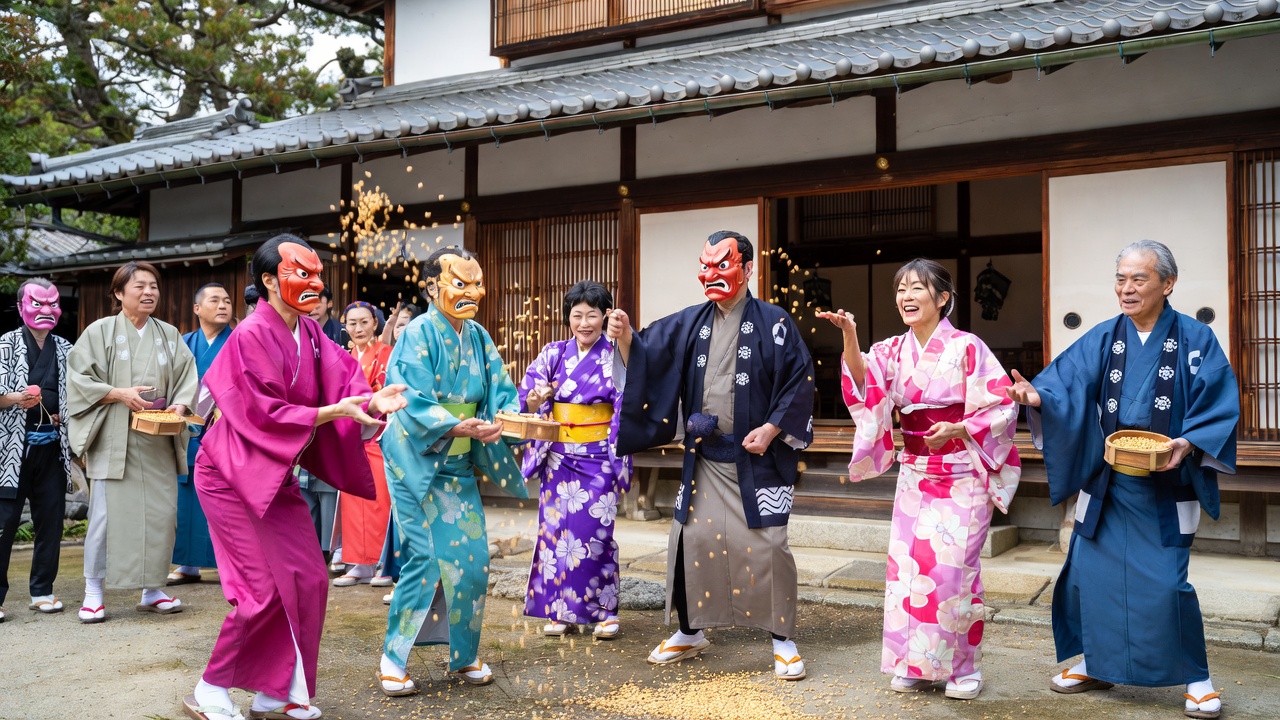
Every year, on the cusp of spring, Japan comes alive with a ritual that is equal parts ancient and playful. Handfuls of roasted soybeans fly through the air. Children squeal in delight—and maybe a little fear—as a family member stomps around in a horned demon mask. The chant “Oni wa soto! Fuku wa uchi!” (Demons out! Good fortune in!) rings from living rooms, shrine grounds, and temple courtyards across the archipelago. This is Setsubun (節分), and in 2026, it falls on Tuesday, February 3.
Setsubun is far more than a quaint folklore relic. It is a living, breathing celebration that connects modern Japanese families to centuries of spiritual practice, seasonal awareness, and communal joy. Whether you are a first-time visitor timing your trip around this festival, a long-term resident in Japan looking to deepen your cultural knowledge, or simply a curious reader fascinated by world traditions, this guide covers everything you need to know about Setsubun 2026—from the correct way to throw beans to the best temples and shrines hosting public celebrations this year.
What Is Setsubun? Meaning, Date, and Cultural Significance in 2026
The word Setsubun (節分) translates literally to “seasonal division.” In Japan’s traditional lunisolar calendar, each of the four seasons had its own setsubun—a day marking the boundary between one season and the next. Over time, however, the term became strongly associated with just one transition: the passage from winter into spring.
Setsubun takes place on the day before Risshun (立春), the first day of spring according to the old calendar. In most years, that means February 3. In 2026, the date is confirmed as February 3 (Tuesday). Occasionally the date shifts to February 2 or 4 depending on astronomical calculations—this happened as recently as 2021 and 2025, when Setsubun landed on February 2—but 2026 follows the more common pattern.
Why does the arrival of spring matter so much? In traditional Japanese thought, seasonal transitions were considered spiritually vulnerable moments. People believed that the boundary between seasons created openings through which malevolent forces—illness, misfortune, and bad luck—could slip into the human world. Setsubun rituals developed as a way to seal those openings, purge accumulated negativity from the previous year, and welcome fresh fortune into the household.
Today, Setsubun sits alongside New Year’s celebrations and Obon as one of the most widely observed traditional events in Japan. It is not a national public holiday, so offices and schools remain open. But in homes, daycare centers, kindergartens, shrines, and temples from Hokkaido to Okinawa, the day buzzes with festive energy.
History and Origins of Japan’s Bean-Throwing Festival
Setsubun’s roots reach back more than 1,300 years to an ancient Chinese exorcism rite called Tsuina (追儺). According to the historical chronicle Shoku Nihongi, Tsuina was first performed at the Japanese imperial court in 706 CE, during the Nara period. At that time, the ceremony took place on New Year’s Eve under the lunisolar calendar. Court officials decorated palace gates with clay figures, and shamans used peach-wood bows and reed arrows to symbolically drive away pestilence.
A key figure in the original Tsuina ceremony was the Hōsōshi (方相氏), a shaman who wore a fearsome golden mask with four eyes. The Hōsōshi’s job was to chase demons out of the palace. Ironically, as centuries passed, people began confusing the masked shaman with the very demons he was meant to expel. By the medieval period, the Hōsōshi figure had been recast as an oni—one of the creatures being driven away rather than doing the driving. This mix-up is a fascinating example of how folk traditions can invert their own symbolism over time.
Bean-throwing as we know it today took shape during the Muromachi period (1336–1573). Households of the aristocratic and samurai classes began scattering roasted soybeans from their homes into the open air. A Muromachi-era dictionary called the Ainōshō records a legend from the 10th century, during the reign of Emperor Uda, in which a monk on Mount Kurama in Kyoto escaped misfortune by throwing roasted beans into the eyes of an oni. The Japanese word for bean, mame (豆), sounds like mame (魔目, “demon’s eye”), and also resembles mametsu (魔滅, “to destroy the devil”). These linguistic coincidences helped solidify the association between beans and demon-slaying.
From the Edo period (1603–1867) onward, bean-throwing spread beyond the elite into ordinary households, local shrines, and Buddhist temples. This was also when the custom of Hiiragi Iwashi—decorating doorways with sardine heads skewered on holly branches—became widespread. By the time Japan entered the modern era, Setsubun had transformed from a solemn court ritual into a cheerful family tradition embraced by people of all social classes.
How to Do Mamemaki at Home: Step-by-Step Bean-Throwing Ritual Guide
Mamemaki (豆撒き), meaning “bean scattering,” is the heart of the Setsubun celebration. If you want to perform the ritual properly at home in 2026, here is a step-by-step guide rooted in traditional practice.
What You Need
- Roasted soybeans (fukumame / 福豆, meaning “fortune beans”). These are sold in bags at every supermarket, convenience store, and even 100-yen shops across Japan from mid-January onward. Many packages come with a paper oni mask included.
- A wooden measuring cup (masu / 枡) for holding the beans. This is optional but traditional.
- An oni mask for one family member to wear.
The Ritual, Step by Step
- Prepare the beans during the day. Place the roasted soybeans in a masu and set them on your household shrine (kamidana) or, if you don’t have one, on a clean, elevated surface covered with white paper. This consecrates the beans.
- Wait until evening. Traditionally, oni emerge at night, so mamemaki is performed after dark when all family members are home.
- Assign someone as the oni. Usually, the father of the household puts on the demon mask. In some traditions, the person who throws the beans should be the toshiotoko (年男) or toshionna (年女)—someone born in the year of the current Chinese zodiac animal. The year 2026 is the Year of the Horse in the Chinese zodiac.
- Open all doors and windows. Start from the room farthest from the front entrance and work your way toward the door.
- Throw beans outward while chanting “Oni wa soto!” (鬼は外! / “Demons out!”). Aim for the doorway or at the person wearing the oni mask.
- Close the doors and windows after throwing, then scatter beans inside the room while chanting “Fuku wa uchi!” (福は内! / “Good fortune in!”).
- Repeat room by room until you reach the front entrance, where you throw the final handful of beans outside and quickly shut the door—sealing fortune inside your home.
- Eat your fortune beans. After mamemaki, each family member eats the same number of roasted soybeans as their age, plus one extra bean for good luck in the coming year. If that number is hard to manage (especially for older family members), you can drink fukucha (福茶)—a tea made by steeping roasted soybeans with pickled plum and kelp in hot green tea—as a gentler alternative.
Regional Variations of the Mamemaki Chant
The standard chant is “Oni wa soto! Fuku wa uchi!” but Japan is full of local twists:
| Location | Chant | Meaning |
|---|---|---|
| Most of Japan | Oni wa soto! Fuku wa uchi! | Demons out! Fortune in! |
| Aizuwakamatsu, Fukushima | Oni no medama buttsubuse! | Crush the demons’ eyeballs! |
| Sensoji Temple, Tokyo | Senshū Banrai, Fuku wa Uchi! | Eternal prosperity, fortune in! |
| Naritasan Shinshoji, Chiba | Fuku wa uchi! (only) | Fortune in! |
At Sensoji Temple in Asakusa, the usual “Oni wa soto” part is omitted entirely. The temple’s reasoning is poetic: because the compassion of the Kannon Bodhisattva enshrined there is so powerful, even demons repent and become good. There are no demons to chase out. Similarly, at Naritasan Shinshoji Temple in Chiba, only “Fuku wa uchi” is chanted, because the temple’s principal deity, Fudo Myoo, is believed to have the power to reform oni rather than simply banish them.
Ehomaki 2026 Lucky Direction: How to Eat the Setsubun Sushi Roll
If mamemaki is the oldest Setsubun custom, ehomaki (恵方巻) is the trendiest. This thick, uncut sushi roll has become so popular that it now rivals bean-throwing as the most visible symbol of the festival—and it generates billions of yen in retail sales each year.
What Is Ehomaki?
Ehomaki literally means “lucky direction roll.” It is a type of futomaki (thick sushi roll) traditionally made with seven fillings, representing the Shichifukujin (七福神)—Japan’s Seven Gods of Good Fortune. Common ingredients include thick egg omelet (tamagoyaki), simmered shiitake mushroom, dried gourd shavings (kanpyo), cucumber, eel or anago, sakura denbu (sweet fish flakes), and shrimp. However, there are no strict rules about fillings, and modern ehomaki come in wild varieties—from premium seafood rolls stuffed with tuna, salmon, scallops, and roe to family-friendly versions with fried shrimp or tuna mayo.
The Lucky Direction for 2026
Each year, the eho (恵方)—the auspicious compass direction—changes based on the position of the deity Toshitokujin (歳徳神), the guardian spirit of the year. In 2026, the lucky direction is south-southeast (南南東). Face this direction when eating your ehomaki to receive the deity’s blessing.
Three Rules for Eating Ehomaki
Eating ehomaki is governed by three simple but strict rules:
- Do not cut the roll. Cutting it is believed to “sever” your good fortune. Eat it whole, in one continuous effort.
- Face the lucky direction. In 2026, that means south-southeast. Use a compass app on your phone if needed.
- Eat in silence. Make a wish in your heart as you eat. Speaking is said to let your luck escape.
These rules create a comically intense scene at the dinner table—entire families lined up facing the same direction, silently stuffing their mouths with oversized sushi rolls, trying not to laugh.
Where Did Ehomaki Come From?
The origins of ehomaki are debated, but most historians trace it back to Osaka’s merchant districts during the late Edo or early Meiji period. Merchants in the Senba district ate thick sushi rolls on Setsubun eve to pray for business prosperity. The custom remained a regional Kansai tradition for over a century.
The nationwide explosion happened in 1989, when the convenience store chain 7-Eleven began marketing the rolls as “ehomaki” and selling them across Japan. Other major chains—Lawson, FamilyMart, and supermarket giant AEON—quickly followed. By the early 2000s, ehomaki had become a national phenomenon. Today, convenience stores and department stores across Japan compete fiercely to offer the most impressive ehomaki lineups, with pre-orders opening as early as December.
For 2026, AEON made headlines by unveiling the Gokubutomaki (“Super-Thick Roll”)—a massive ehomaki packed with 26 different fillings and priced at ¥6,458 (about $42). Eating that one in silence, without cutting it, would certainly require determination.
Best Setsubun Festivals and Bean-Throwing Events in Japan 2026
While many families celebrate Setsubun quietly at home, Japan’s shrines and temples host spectacular public events that attract thousands—sometimes hundreds of thousands—of visitors. Here are the most notable celebrations to attend in 2026.
Tokyo Setsubun Events
Sensoji Temple, Asakusa Sensoji is the single largest Setsubun gathering in Tokyo. Approximately 100,000 people pack the temple grounds on February 3. The festivities begin in the morning, when local kindergarten children perform Setsubun songs and conduct their own miniature mamemaki. The highlight is the Fukujyu no Mai (Dance of the Seven Lucky Gods), a choreographed performance in which dancers dressed as the seven deities appear one by one, acting out short dances that represent wealth, happiness, and long life. Bean-throwing sessions feature celebrities and community leaders tossing packets of roasted soybeans from a raised stage near the main hall. Sessions typically run from 11:30 a.m. to 1:30 p.m., with additional rounds at 2 p.m. and 4 p.m.
- Date: February 3, 2026
- Time: 10:00 a.m. – 4:00 p.m.
- Admission: Free
- Access: 5-minute walk from Asakusa Station (Ginza Line)
Takahata Fudoson Temple, Hino Located in western Tokyo, this temple brings a star-studded atmosphere to Setsubun. The 2026 guest list includes actress Rei Kikukawa, comedian Tsunoda☆Hiro, and entertainer Shinya Owada, plus appearances by Hello Kitty, Miss Japan, and maiko dancers. Bean-throwing sessions run throughout the day, and arriving early gives you a chance to see the celebrity parade through the grounds.
- Date: February 3, 2026
- Time: 10:00 a.m. – 4:00 p.m.
- Admission: Free
Chiba Prefecture
Naritasan Shinshoji Temple This is arguably the most famous Setsubun event in all of Japan. Located near Narita Airport, Shinshoji’s Special Tsuina Bean-Throwing Ceremony (特別追儺豆まき式) regularly features television personalities, kabuki actors, and sumo wrestlers. The event is a fixture on national TV news broadcasts every February 3. Remember: at Naritasan, only “Fuku wa uchi!” is chanted. The temple’s principal deity is considered so powerful that even demons reform in his presence—there are no demons to send away.
- Date: February 3, 2026
- Admission: Free
- Access: 10-minute walk from JR/Keisei Narita Station
Kyoto Setsubun Festivals
Kyoto, as Japan’s ancient capital, hosts an extraordinary density of Setsubun events. The most iconic include:
Yoshida Shrine One of the most famous Setsubun festivals in all of Japan. Approximately 500,000 visitors attend over the three-day festival period, and roughly 800 food and souvenir stalls line the approach to the shrine. The centerpiece is the Tsuina ritual, a dramatic exorcism ceremony descended from Heian-period imperial court practices, which begins at 6:00 p.m. on February 2. A performer wearing the ancient four-eyed golden Hōsōshi mask drives away rampaging oni in a theatrical display that feels transported directly from the 10th century.
- Dates: February 2–4, 2026
- Main Tsuina ritual: February 2 at 6:00 p.m.
Yasaka Shrine (Gion) Yasaka Shrine’s Setsubun celebration is famous for its performances by geiko and maiko—the Kyoto terms for trained geisha and apprentice geisha. Over two days, these elegant performers execute devotional dances in full kimono before scattering beans to the crowd. On the second day, a lion dance (shishimai) is added to the program.
- Dates: February 2–3, 2026
- Time: 11:00 a.m. – 4:00 p.m.
Rozanji Temple Rozanji is celebrated for its Oni Odori (Demon Dance). At 3:00 p.m. on February 3, three oni—red, green, and black—emerge onto a specially built stage. The red oni symbolizes greed and carries a torch and sacred sword. The green oni represents ill will and wields a great axe. The black oni embodies confusion and holds a maul. They dance wildly to the sounds of taiko drums and conch shells before being driven away through the power of Buddhist prayer.
Mibudera Temple This temple is home to Mibu Kyogen, a 700-year-old form of silent theater performed entirely through movement and gesture. A special Setsubun performance teaches the importance of diligence and virtue. The wordless format makes it uniquely accessible to international audiences.
Fukuoka and Western Japan
Kushida Shrine, Hakata During Setsubun, Kushida Shrine displays a giant Otafuku mask—said to be the largest in Japan—at its entrance. Visitors walk through the wide-open mouth of the mask, which is believed to bring blessings of household safety and business success. Bean-throwing sessions run every 30 minutes from 10:00 a.m. to 4:00 p.m.
- Date: February 3, 2026
- Admission: Free
Tochoji Temple, Hakata Tochoji hosts what is considered the oldest Setsubun festival in Fukuoka. The highlight is the Shofuku Mamemaki ceremony, during which beans, rice cakes, mikan oranges, and sweets are all scattered to the crowd. The Seven Lucky Gods also make an appearance, drawing large numbers of visitors.
- Dates: February 2–3, 2026 (Grand Setsubun Festival on Feb. 3)
Summary Table: Major Setsubun Events 2026
| Venue | Location | Date(s) | Key Feature | Admission |
|---|---|---|---|---|
| Sensoji Temple | Tokyo (Asakusa) | Feb. 3 | Dance of Seven Lucky Gods, celebrity mamemaki | Free |
| Takahata Fudoson | Tokyo (Hino) | Feb. 3 | Celebrity guests, Hello Kitty appearance | Free |
| Naritasan Shinshoji | Chiba (Narita) | Feb. 3 | Sumo wrestlers, TV stars, “Fuku wa uchi” only | Free |
| Yoshida Shrine | Kyoto | Feb. 2–4 | Ancient Tsuina exorcism, 800 food stalls | Free |
| Yasaka Shrine | Kyoto (Gion) | Feb. 2–3 | Geiko and maiko performances | Free |
| Rozanji Temple | Kyoto | Feb. 3 | Three-color Oni Odori (Demon Dance) | Free |
| Kushida Shrine | Fukuoka (Hakata) | Feb. 3 | Giant Otafuku mask gate | Free |
| Tochoji Temple | Fukuoka (Hakata) | Feb. 2–3 | Oldest Fukuoka Setsubun festival, Seven Lucky Gods | Free |
| Dazaifu Tenmangu | Fukuoka (Dazaifu) | Feb. 3 | Otafuku gate, purification rites | Free |
Oni Demons in Japanese Culture: What Do They Symbolize at Setsubun?
No Setsubun celebration would be complete without oni (鬼). These horned, fierce-looking creatures are among the most recognizable figures in Japanese folklore. But what exactly are they, and why are they chased away with beans?
The Nature of Oni
Oni are not “devils” in the Western religious sense. They are better understood as supernatural beings that embody misfortune, disaster, illness, and negative energy. In traditional belief, oni were invisible forces responsible for plagues, crop failures, earthquakes, and other calamities. Over time, they were given a physical form in art and storytelling—typically depicted as hulking figures with red or blue skin, wild hair, horns, fangs, and tiger-skin loincloths. They carry iron clubs (kanabō) and are associated with raw destructive power.
At Setsubun, the “demons” being chased away are symbolic. When a father puts on a paper oni mask and his children pelt him with soybeans, the family is enacting an ancient drama of purification. The oni represents everything unwanted—lingering illness from winter, financial worries, personal setbacks—and the beans represent the power to overcome those troubles.
The Three Oni of Rozanji Temple
At Kyoto’s Rozanji Temple, the symbolism becomes explicit. The three oni that appear in the annual Demon Dance represent the Three Poisons of Buddhism:
- Red oni → Greed (tonyoku / 貪欲)
- Green oni → Ill will or anger (shinni / 瞋恚)
- Black oni → Ignorance or confusion (guchi / 愚痴)
By driving away these three demons, the ceremony symbolizes the conquest of humanity’s deepest spiritual obstacles.
Otafuku: The Face of Good Fortune
Alongside oni, you will often see images of Otafuku (お多福), a round-faced, smiling woman who represents happiness and good fortune. The pairing of Otafuku and oni in Setsubun imagery comes from a traditional Kyogen comedy skit in which Otafuku’s kindness persuades an oni to change its ways. She embodies the “Fuku wa uchi” half of the chant—the good fortune that enters once evil has been expelled.
In Fukuoka, several shrines construct enormous Otafuku face gates for Setsubun. Walking through the wide, smiling mouth is believed to bring blessings for the year ahead.
Hiiragi Iwashi: The Sardine Head and Holly Branch Tradition
One of the more unusual Setsubun customs, especially to foreign eyes, is Hiiragi Iwashi (柊鰯)—the practice of hanging a grilled sardine head on a holly branch at the entrance of the home.
How It Works
The logic is straightforward in the context of Japanese folk belief. Oni are thought to have an acute sense of smell, and the pungent odor of roasted sardine repels them. Meanwhile, the sharp, prickly leaves of the holly branch (hiiragi) would stab the oni’s eyes if they tried to approach the door. Together, the combination creates a sensory barrier that no self-respecting demon would dare cross.
Historical Roots
The earliest recorded form of this custom appears in the Tosa Nikki (土佐日記), a diary compiled in 934 CE during the Heian period. The diary describes a sacred rope (shimenawa) hung at a house gate during the New Year, with a mullet head pierced by a holly sprig attached to it. Over the centuries, the fish species shifted from mullet to sardine, but the underlying idea—using pungent smells and sharp objects to ward off evil—remained unchanged.
Today, Hiiragi Iwashi is most commonly seen in western Japan, particularly the Kansai region. In Tokyo and eastern Japan, the practice has become less common, though some traditional households still observe it. If you are staying in Kyoto or Osaka around Setsubun, keep your eyes open for these curious little talismans dangling beside doorways.
Regional Setsubun Foods: What Japanese People Eat Beyond Ehomaki
Ehomaki dominates convenience store shelves nationwide, but Japan’s food traditions for Setsubun are far more diverse than a single sushi roll. Here is a sampling of regional Setsubun dishes:
| Food | Region | Significance |
|---|---|---|
| Roasted soybeans (fukumame) | Nationwide | Eaten after mamemaki; one per year of age plus one |
| Peanuts (in shell) | Hokkaido, Tohoku, parts of Kyushu | Easier to pick up after throwing; cleaner than soybeans |
| Setsubun soba | Parts of Nagano and other regions | Soba (buckwheat noodles) were traditionally eaten as a year-end food; since Setsubun was the old New Year’s Eve, the custom persists |
| Kenchin-jiru | Kanto region | A hearty vegetable soup made with root vegetables, tofu, and sesame oil |
| Shimotsukare | Northern Kanto (Tochigi, Gunma) | A fermented stew of salmon head, soybeans, daikon radish, and sake lees |
| Sardines (iwashi) | Western Japan | Grilled sardines eaten as a main dish—using the “reject” from Hiiragi Iwashi |
| Konnyaku | Parts of Shikoku | Called “stomach broom” (onaka no houki); believed to cleanse the body |
| Fukucha | Nationwide (alternative) | Tea made from roasted soybeans, pickled plum, and kelp; a gentler substitute for eating beans |
The diversity of Setsubun food traditions is a reminder that Japanese culture is deeply regional. Even a single holiday can look and taste completely different depending on whether you are in Sapporo, Tokyo, Osaka, or Fukuoka.
Setsubun Safety Tips for Families with Small Children
Setsubun is one of the most family-friendly festivals in Japan. Children adore the excitement of throwing beans at a “demon” parent, and many kindergartens and daycare centers hold their own mamemaki events. However, there is one serious safety issue that parents and caregivers should know about.
Choking Hazards: Beans and Young Children
Roasted soybeans are a documented choking hazard for young children. Japan’s Consumer Affairs Agency and the National Center for Child Health and Development issue a caution every year ahead of Setsubun, urging parents not to give whole beans to children under five years of age. There have been cases of children as young as nine months being hospitalized after choking on beans, and tragically, a four-year-old boy died after choking on a soybean during a daycare Setsubun event in Shimane Prefecture in 2020. Health officials note that a small soybean can lodge in a child’s bronchial tract and go undetected for one to two days.
Safety Recommendations
- Children under five should not eat whole roasted soybeans or peanuts during Setsubun.
- Supervise children closely during mamemaki events. Toddlers may pick up beans from the floor and put them in their mouths.
- For young children, consider using soft, wrapped candies or small rice crackers as a fun, safer alternative to throw and catch.
- If your child does eat beans, ensure they are seated, calm, and chewing thoroughly. Avoid giving beans while running, laughing, or lying down.
- Learn basic back-blow and abdominal-thrust techniques (appropriate to the child’s age) before Setsubun, just in case.
Many modern daycares and schools have already shifted to safer alternatives. Some use felt or paper “beans” for throwing and reserve the real soybeans for older children only.
Ehomaki and Japan’s Food Waste Problem: A Sustainability Concern
The rise of ehomaki from a quiet Kansai custom to a nationwide commercial phenomenon has created an unintended consequence: massive food waste.
The Scale of the Problem
Because ehomaki is a perishable sushi roll meant to be eaten specifically on Setsubun day, anything that goes unsold by the evening of February 3 is discarded. Journalist and food-loss expert Rumi Ide has researched this issue extensively. She estimated that in 2023, approximately 2.56 million ehomaki rolls went unsold and were thrown away, representing about ¥1.28 billion (roughly $8.5 million) in wasted food. A single ehomaki requires roughly 120 liters of water to produce and generates about 528 grams of carbon emissions.
The problem stems from the same aggressive retail culture that made ehomaki popular in the first place. Convenience store chains and supermarkets stock their shelves to overflowing on Setsubun day, creating an image of abundance that drives impulse purchases—but also guarantees significant surplus.
What Is Being Done?
The situation has improved in recent years thanks to a combination of government intervention and industry self-correction:
- Japan’s Ministry of Agriculture, Forestry and Fisheries (MAFF) launched an annual campaign in 2019 urging retailers to curb overproduction. As of their latest survey, roughly 90% of participating food firms reported improvement in reducing ehomaki disposal, with 31% achieving over 60% waste reduction.
- Major convenience stores now heavily promote pre-order systems with early-booking incentives. Lawson, for example, offers discounts or a free bottle of tea for advance reservations.
- Retailers like Co-op Kyushu have introduced half-size ehomaki rolls that are easier for children and smaller households to finish, reducing the chance of leftovers.
- Chains like AEON and Shell Garden supermarkets use real-time sales tracking to redistribute stock between stores throughout the day, minimizing surplus at closing time.
What You Can Do
If you are buying ehomaki in 2026, consider these small steps:
- Pre-order your ehomaki from a convenience store or supermarket rather than buying on impulse.
- Choose an appropriate size. Half-size rolls and mini ehomaki are widely available.
- Buy only what your household will eat. Resist the marketing pressure to purchase multiple premium rolls.
- If you have leftover ingredients, make ehomaki at home using exactly the amount you need.
How to Celebrate Setsubun at Home If You Are Not in Japan
You don’t need to be in Japan to enjoy the spirit of Setsubun. Here’s how to bring the tradition into your own home, wherever you are in the world.
Materials
- Roasted soybeans (available at Asian grocery stores, health food shops, or online). If you can’t find Japanese-style roasted soybeans, dry-roasted edamame or even peanuts in the shell will work—Hokkaido and Tohoku regions use peanuts, after all.
- A simple oni mask. Print one from a free template online, or have children craft their own from paper plates, paint, and construction paper. Making the mask is half the fun for kids.
- Sushi roll ingredients for making your own ehomaki. You can follow the traditional seven-filling formula or improvise with whatever you enjoy.
Simplified Home Celebration
- Craft oni masks together as a family activity in the afternoon.
- As evening falls, designate one person as the oni. Have them put on the mask and playfully “invade” the home.
- Everyone else throws soybeans (or peanuts) at the oni, chanting “Oni wa soto! Fuku wa uchi!” Work from the back of the home toward the front door.
- After the oni has been “expelled,” close the front door and eat your age-plus-one beans while making a wish for good health.
- Prepare and eat ehomaki facing south-southeast. Remember: no cutting, no talking.
- Optional: Hang a small holly sprig with a piece of grilled sardine at your front door. If that’s too adventurous, simply display some holly as a nod to the tradition.
Even a simplified version captures what makes Setsubun special: the playful confrontation with life’s difficulties, the communal laughter that follows, and the quiet hope for a good year ahead.
The Watanabe Exception: Why Some Japanese Families Skip Bean-Throwing
One of the most delightful pieces of Setsubun trivia involves the surname Watanabe (渡辺). According to legend, some families with this surname have traditionally skipped mamemaki entirely—because oni are already afraid of them.
The story goes back to the Heian period and a warrior named Watanabe no Tsuna (渡辺綱), a retainer of the famous general Minamoto no Yorimitsu. Watanabe no Tsuna is legendary for having defeated some of the most powerful oni in Japanese mythology, including Shuten-dōji and Ibaraki-dōji—terrifying demons that terrorized the Kyoto region. Because of his fearsome reputation among oni-kind, the belief arose that demons instinctively avoid anyone named Watanabe.
This is more than a niche bit of folklore. Watanabe is the fifth most common surname in Japan, with roughly 1.08 million people bearing the name. While most Watanabe families today participate in Setsubun like everyone else, the legend persists as a charming example of how folklore weaves itself into everyday life.
Setsubun Obake: Shimokitazawa’s Unique “Japanese Halloween” Tradition
In the trendy Tokyo neighborhood of Shimokitazawa, Setsubun takes an unexpected turn. The Setsubun Obake de Oiran Dochu (Setsubun Ghost Courtesan Procession) transforms the Azuma Shopping Street into something resembling a Japanese Halloween parade.
The tradition of Setsubun Obake (“Setsubun ghosts”) is actually rooted in old Kyoto customs, where people would dress in disguise on Setsubun eve to confuse evil spirits and prevent them from recognizing their targets. In Shimokitazawa’s modern revival, participants don traditional costumes, and the highlight is an elegant Oiran Procession—a recreation of the stately parade of high-ranking courtesans from the Edo period. Children’s parades fill the morning hours, followed by a dramatic Tengu (long-nosed goblin) parade at midday and the main Oiran procession in the afternoon.
This event is a perfect example of how Japanese traditions continuously evolve. Setsubun is not a frozen museum piece. It is a living festival that absorbs new ideas, new aesthetics, and new communities while keeping its core meaning intact.
Frequently Asked Questions About Setsubun 2026
Q: When is Setsubun 2026? A: Tuesday, February 3, 2026. This is the most common date for Setsubun, falling the day before Risshun (the traditional first day of spring).
Q: What is the lucky direction (eho) for eating ehomaki in 2026? A: South-southeast. Face this direction while eating your ehomaki in silence.
Q: Is Setsubun a public holiday in Japan? A: No. Schools, offices, and shops remain open as usual. However, many temples, shrines, and schools hold special events.
Q: Can I use peanuts instead of soybeans for mamemaki? A: Yes. Several regions of Japan—especially Hokkaido, Tohoku, and parts of Kyushu—traditionally use peanuts (in the shell). They are easier to pick up afterward and stay cleaner on the floor.
Q: Are Setsubun temple events free to attend? A: Most are free and open to the public. Some smaller events may require numbered tickets, and popular venues like Sensoji and Naritasan Shinshoji can become extremely crowded—arrive early.
Q: Why do some temples only chant “Fuku wa uchi” without “Oni wa soto”? A: Temples enshrining particularly compassionate deities—such as Kannon at Sensoji or Fudo Myoo at Naritasan—believe their deities have the power to reform demons rather than simply expel them. Since no demons remain in the presence of such powerful compassion, there are no demons to chase out.
Q: Is it safe for young children to eat roasted soybeans? A: Children under five should not eat whole roasted soybeans. They are a documented choking hazard. Use softer alternatives or fukucha tea instead.
Q: Can foreigners participate in Setsubun events at shrines and temples? A: Yes. Visitors of all nationalities are welcome at public Setsubun events. You can catch thrown beans, eat them for good luck, and enjoy festival foods. Dress modestly and be respectful of the sacred setting.
Practical Travel Tips for Visiting Japan During Setsubun 2026
If you are planning to be in Japan around Setsubun, here are some practical considerations:
Weather: Early February in Tokyo and Kyoto is cold and dry, with temperatures typically between 2°C and 10°C (36°F to 50°F). Dress in warm layers. Northern regions like Hokkaido may have snow.
Crowds: Major temple events draw enormous crowds. Sensoji can see 100,000 visitors on February 3 alone, and Yoshida Shrine in Kyoto draws around 500,000 over its three-day festival. Arrive at least 30–60 minutes before scheduled mamemaki sessions if you want a good viewing spot.
Transport: Setsubun is not a public holiday, so trains and buses run on regular weekday schedules. This is actually an advantage—you won’t face holiday-level transit congestion outside the immediate vicinity of major shrine events.
Food shopping: If you want to buy ehomaki, convenience stores and supermarkets stock them heavily from late January through February 3. Pre-ordering is recommended for premium options. After February 3, they disappear completely from shelves.
Souvenirs: Look for Setsubun-themed goods at variety stores like 3COINS and Daiso, which sell decorative oni masks, masu wooden cups, and small bags of fukumame at very affordable prices.
Conclusion: Why Setsubun Matters in 2026
In a world that often feels fragmented and uncertain, there is something deeply reassuring about Setsubun. It asks us to do something simple: face the things that frighten us, name them aloud, and chase them away with handfuls of beans and shared laughter. Then it asks us to sit down, face a hopeful direction, eat in silence, and make a wish for the people we love.
Setsubun is not about grand gestures or expensive rituals. It is, at its heart, a family tradition—one that unfolds in millions of Japanese living rooms, daycare classrooms, and neighborhood shrine grounds every February. The father in the oni mask pretending to be scary. The children shrieking with joy. The grandmother quietly eating her fukumame. The teenager silently inhaling an entire ehomaki while trying not to giggle.
These small moments, repeated year after year across generations, are how culture stays alive. Not in museums or textbooks, but in the warmth of homes and the laughter of children throwing beans at their fathers.
If you have the chance to experience Setsubun in Japan—or even to recreate a small version of it wherever you are—take it. Let the beans fly. Welcome the spring. And may 2026 bring nothing but good fortune through your door.
Oni wa soto. Fuku wa uchi.