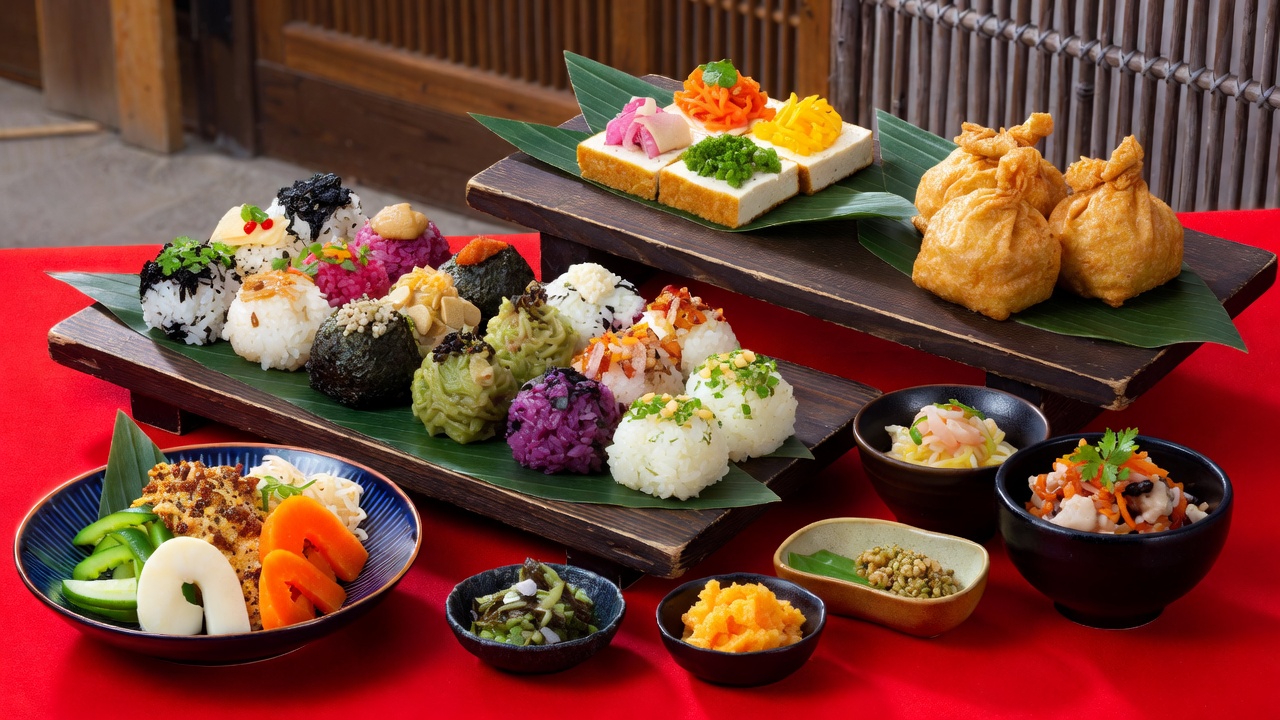
Every winter in Japan, just when the cold feels most stubborn, a quiet shift happens. Families gather around kitchen tables. Supermarket shelves fill with fat sushi rolls and bags of roasted soybeans. Children rehearse a chant they have known since kindergarten: “Oni wa soto! Fuku wa uchi!” — Demons out! Good fortune in!
This is Setsubun (節分), and in 2026 it falls on Tuesday, February 3. It is not a public holiday. There are no fireworks or parades. Yet it is one of the most quietly beloved days on the Japanese calendar — a day built entirely around food, family, and the hopeful idea that a handful of beans can chase winter away and pull spring a little closer.
Setsubun food is not random. Every dish carries meaning. The roasted soybeans that fly through doorways, the oversized sushi roll eaten in utter silence, the grilled sardine head pinned to a holly branch beside the front door — each one tells a story about how the Japanese have understood the turning of seasons for over a thousand years.
This guide walks you through every traditional Setsubun food, from the most iconic to the barely known regional dishes. Whether you are planning a trip to Japan this February or simply want to bring a piece of this tradition into your own kitchen, here is everything you need to know.
What Is Setsubun and Why Does Japan Celebrate It on February 3?
The word Setsubun literally means “seasonal division.” Under the old Japanese lunar-solar calendar, the year was split into twenty-four seasonal markers called nijūshi sekki (二十四節気). Four of those markers — the starts of spring, summer, autumn, and winter — were especially significant. The day before each of these four beginnings was technically a setsubun.
Over the centuries, however, only one survived as a major cultural event: the eve of Risshun (立春), the first day of spring. Because Risshun was once treated as the start of a new year, Setsubun was essentially the old New Year’s Eve — a threshold moment when the boundary between the spirit world and the physical world was believed to thin.
In 2026, Risshun falls on February 4. That makes February 3 the day of Setsubun. It is worth noting that the date can occasionally shift. In both 2021 and 2025, for example, Setsubun fell on February 2. But February 3 is the most common date, and it is the date for this year.
The roots of Setsubun trace back to an ancient Chinese court ritual called Tsuina (追儺). According to the Shoku Nihongi, one of Japan’s oldest historical texts, Tsuina was first performed at the Japanese imperial court in the year 706 CE. In those early ceremonies, officials used peach-wood bows, reed arrows, and clay figures of cows and children to ward off pestilence-bringing spirits at the palace gates.
By the Muromachi period (1336–1573), the ritual had transformed into something closer to what we see today. Aristocrats and samurai families began throwing roasted soybeans from their homes into the open air. The custom gradually spread to ordinary households during the Edo period (1603–1867), and it became the lively family tradition that modern Japan still practices.
Today, Setsubun is celebrated in homes, kindergartens, temples, and shrines across the country. At the famous Sensō-ji Temple in Tokyo’s Asakusa district, nearly 100,000 people gather each year for the bean-throwing ceremony. Celebrities and sumo wrestlers are invited to throw beans from elevated platforms into the roaring crowd. But the heart of Setsubun has always been in the home — and on the dinner table.
Fukumame: Why Japanese Families Eat Roasted Soybeans on Setsubun
If Setsubun has a single defining food, it is fukumame (福豆), which translates directly to “fortune beans.” These are dry-roasted soybeans, golden brown and satisfyingly crunchy, with a faintly sweet and nutty flavor.
The role of fukumame in mamemaki
Fukumame serve a double purpose on Setsubun. First, they are the ammunition for mamemaki (豆撒き), the famous bean-throwing ritual. A family member — traditionally the male head of household or the toshiotoko (a man born under the current year’s zodiac sign) — throws the beans while chanting: “Oni wa soto! Fuku wa uchi!” (“Demons out! Fortune in!”). The beans are hurled either out the front door, out the windows, or directly at another family member wearing a paper oni (demon) mask.
Second, after the throwing is done and the door is slammed shut, the beans become a snack. Everyone in the household eats the same number of beans as their age, plus one extra to secure good health for the year ahead. If you are thirty-five, you eat thirty-six beans. Simple as that.
Why soybeans and not something else?
The connection between beans and Setsubun runs deep into Japanese wordplay. The Japanese word for bean, mame (豆), sounds like mame (魔目), meaning “demon’s eye.” Throwing beans is, in a poetic sense, throwing them at the eyes of evil. There is also a resemblance to the word mametsu (魔滅), which means “to destroy demons.”
Beyond wordplay, soybeans hold a practical place in Japanese spiritual thought. As one of the five staple grains, they represent vitality and sustenance. Using them in a purification ritual felt natural. The beans must be roasted, never raw. An old superstition warns that if a raw bean is left on the floor and forgotten, it might sprout — and a sprouted bean after Setsubun is considered a bad omen.
Before the mamemaki ceremony, the fukumame are traditionally placed in a masu (枡), a small wooden measuring box, and offered at the household shrine or set on an elevated, clean surface. This brief offering sanctifies the beans before they are used.
Regional variations: Peanuts in Hokkaido and Tōhoku
Not all of Japan uses soybeans. In the Hokkaido and Tōhoku regions of northern Japan, families throw unshelled peanuts instead. The reasoning is practical: peanuts in their shells are easier to find and pick up afterward, and the edible nut inside stays clean even after rolling across the floor. In some areas, the peanuts are coated in a sweet, crunchy glaze, making them a treat that children especially love.
| Bean Type | Region | Why It’s Used |
|---|---|---|
| Roasted soybeans (fukumame) | Most of Japan | Traditional; tied to wordplay and spiritual symbolism |
| Unshelled peanuts | Hokkaido, Tōhoku, parts of Niigata | Easier cleanup; nut stays clean inside the shell |
| Sugar-coated peanuts | Parts of Tōhoku | Appeals to children; festive sweetness |
Whether you throw soybeans or peanuts, the message is the same: scatter the bad, gather the good.
Ehomaki Sushi Roll: How to Eat the Lucky Direction Roll on Setsubun 2026
If fukumame represent the ancient heart of Setsubun, then ehomaki (恵方巻き) represent its modern soul. This thick, uncut sushi roll has become the single most commercially visible Setsubun food in Japan — and one of the most fascinating examples of how a regional folk custom can become a national phenomenon in just a few decades.
What is ehomaki exactly?
Ehomaki is a type of futomaki (thick sushi roll). The name breaks down like this: eho (恵方) means “lucky direction,” and maki (巻き) means “roll.” So ehomaki is literally a “lucky direction roll” — a sushi roll you eat while facing the year’s most auspicious compass direction.
A proper ehomaki is made with seven ingredients, a number chosen to honor the Shichifukujin (七福神), Japan’s Seven Gods of Good Fortune. The idea is that by rolling seven blessings into a single tube of rice and seaweed, you are literally wrapping up good luck for the year.
There is no strict rulebook for which seven ingredients must go inside. Classic fillings include:
- Kanpyō (dried gourd strips) — representing longevity
- Shiitake mushrooms (simmered) — symbolizing health
- Thick egg omelet (tamagoyaki) — representing wealth (the golden color)
- Eel or conger eel (anago/unagi) — symbolizing success
- Sakura denbu (sweet pink fish flakes) — representing joy
- Cucumber — representing freshness and good health
- Ebi (shrimp or prawn) — symbolizing longevity (the curved shape resembles an elderly person’s bent back)
Three rules for eating ehomaki the right way
Eating ehomaki is not casual. There is a specific ritual, and serious practitioners follow three rules:
- Face the lucky direction for the year. In 2026, the lucky direction is south-southeast (南南東やや南). This direction is determined annually by the position of Toshitokujin, the deity believed to reside in that year’s most auspicious compass point.
- Eat the entire roll without cutting it. Cutting the roll would symbolically “cut off” your good fortune, your relationships, or your blessings. You eat it whole, from one end to the other.
- Eat in complete silence. Speaking while eating your ehomaki is said to let your luck escape. You should hold your wish in your mind and concentrate on it until the last bite is gone.
If you have ever watched a Japanese family on Setsubun evening, you have seen one of the quietest dinner scenes imaginable — everyone facing the same direction, chewing through a thick sushi roll, saying absolutely nothing.
How ehomaki went from a Kansai custom to a national craze
The ehomaki tradition is widely believed to have originated in Osaka, most likely in the Senba merchant district during the late Edo or early Meiji period. One popular theory traces it to a playful game among geisha and businessmen, who ate oversized sushi rolls whole for entertainment and good luck. Another theory credits Osaka flower district workers with starting the custom as a prayer for business success.
For most of the twentieth century, ehomaki remained a regional practice in the Kansai area (Osaka, Kyoto, Kobe). The word “ehomaki” itself was not even widely used. People called them futomakizushi (thick sushi rolls) or marukaburi-zushi (in-one-go sushi rolls).
The turning point came in 1989, when the convenience store chain 7-Eleven began selling ehomaki at its Kansai-area stores. The campaign was a hit. By the mid-1990s, other major convenience chains — Lawson, FamilyMart, and supermarket operators like AEON — had joined in. Aggressive marketing spread the tradition across the entire country within roughly a decade. Today, ehomaki is as strongly associated with Setsubun as chocolate is with Valentine’s Day in Japan — another tradition that owes much of its modern form to retail marketing.
Seven Lucky Ingredients Inside a Traditional Ehomaki Sushi Roll
The seven-ingredient rule is not legally binding, of course. It is a folk custom, and there is plenty of room for creativity. But understanding the traditional seven gives you a sense of just how much meaning the Japanese pack into a single roll.
| Ingredient | Japanese Name | Associated God of Fortune | Symbolic Meaning |
|---|---|---|---|
| Conger eel / Eel | Anago / Unagi | Ebisu (prosperity) | Career success and upward movement |
| Thick egg omelet | Tamagoyaki | Daikokuten (commerce) | Financial abundance (golden color) |
| Shiitake mushroom | Shiitake | Bishamonten (warriors) | Resilience and good health |
| Dried gourd strips | Kanpyō | Benzaiten (arts, beauty) | Long life (long, thin shape) |
| Sweet fish flakes | Sakura denbu | Jurōjin (longevity) | Happiness and celebration |
| Shrimp / Prawn | Ebi | Hotei (fortune, children) | Longevity (curved back shape) |
| Cucumber | Kyūri | Fukurokuju (wisdom) | Freshness and vitality |
In the modern marketplace, the seven-ingredient rule has become more of a loose guideline. High-end ehomaki from department store food halls (depachika) might include wagyu beef, Hokkaido scallops, or even truffle salt. Budget-friendly versions from convenience stores might swap in crab stick and mayonnaise-dressed tuna. In 2026, 7-Eleven Japan is offering six varieties of ehomaki, ranging from a classic seven-ingredient roll at ¥540 to a premium grilled eel version at ¥1,320. There is even a Korean-inspired kimbap-style ehomaki, reflecting the increasing cultural exchange in Japan’s food scene.
What matters more than the exact ingredients is the spirit of the practice: wrapping good wishes into something you can hold in your hands and eat together.
Ehomaki Lucky Direction 2026: Which Way Should You Face This Year?
Every year, the lucky direction — called eho (恵方) — changes. It is determined by the year’s Earthly Branch in the Chinese zodiac and the position of the deity Toshitokujin (歳徳神), who is believed to govern good fortune from a particular compass point each year.
In 2026, the lucky direction is south-southeast (南南東やや南).
If you are sitting at a dinner table, this means you should angle your body toward roughly south-southeast and eat your ehomaki facing that way. Many Japanese households use a smartphone compass app to find the precise direction. Some even mark it with tape on the floor — a small detail that shows how seriously many families take this tradition, even in good humor.
Here is a quick reference for recent and upcoming ehomaki directions:
| Year | Lucky Direction (Eho) |
|---|---|
| 2024 | East-northeast |
| 2025 | West-southwest |
| 2026 | South-southeast |
| 2027 | North-northwest |
Only four compass directions are ever used for the eho — north-northwest, south-southeast, east-northeast, and west-southwest — and they rotate on a ten-year cycle tied to the zodiac. Once you know the pattern, you can predict the direction for any year.
Hiiragi Iwashi: The Sardine Head and Holly Branch That Ward Off Demons
Of all Setsubun customs, hiiragi iwashi (柊鰯) is the one most likely to confuse a first-time visitor to Japan. Picture this: a grilled sardine head, charred and pungent, skewered on a sprig of holly (hiiragi) and hung beside the front door.
It looks strange. It smells strong. And that is entirely the point.
Why sardines and holly keep demons away
The logic behind hiiragi iwashi comes from two beliefs about oni (demons):
- Oni hate strong smells. The sharp, fishy odor of a grilled sardine head is thought to be so repulsive to demons that they will not approach the house.
- Oni fear sharp objects. The spiny leaves of the holly bush are believed to prick the eyes of any demon foolish enough to get close.
Together, the sardine and the holly create a double barrier — a stink bomb and a thorn fence — that keeps evil spirits from crossing your threshold as the seasons change.
This custom has very old roots. The earliest recorded form appears in the Tosa Nikki (土佐日記), a diary compiled in 934 CE during the Heian period. The diary describes a mullet head pierced with holly and attached to a sacred rope (shimenawa) at the gate of a house during the New Year holiday. Over time, the mullet was replaced by the sardine, and the practice became specifically linked to Setsubun.
Sardines as Setsubun food, not just decoration
Beyond the doorway ornament, grilled sardines are eaten as a Setsubun dish in many parts of Japan, particularly in the Kansai region. Some families grill whole sardines for dinner on Setsubun evening. Others prepare sardines simmered in soy sauce and ginger. In regions where displaying the head is less common, eating the sardine itself carries the same protective symbolism.
The tradition of sardines on Setsubun also appears alongside kombu tea (kobucha) in Kansai. The combination of sardines and kelp tea is considered especially auspicious, as kombu is associated with the word yorokobu (喜ぶ), meaning “to rejoice.”
Setsubun Soba Noodles: The Lucky Noodles That Connect Seasons
Most people associate soba noodles with New Year’s Eve, when families across Japan eat toshikoshi soba (“year-crossing soba”) just before midnight. But there is an older tradition of eating soba on Setsubun as well — and it predates the modern New Year’s Eve custom.
Why soba on Setsubun?
Under the old lunar calendar, Setsubun was effectively New Year’s Eve. The tradition of eating soba on the last night of the year transferred naturally to this date. Even after Japan adopted the Gregorian calendar in 1873 and the official New Year moved to January 1, some households in parts of the Kantō and Shinshū (Nagano) regions kept the Setsubun soba habit alive.
Soba noodles carry several layers of good-luck symbolism:
- Long, thin shape → longevity and endurance
- Easy to cut → symbolizes cutting away the misfortunes of the past year
- Made from buckwheat → buckwheat is a hardy, resilient plant, representing strength
There are no special rules for how to prepare Setsubun soba. It is typically served hot, in a simple dashi broth with soy sauce, topped with green onions and perhaps a piece of tempura. The point is the act of eating it on this transitional evening — a quiet ritual of release and renewal.
Kenchin-Jiru: The Warming Temple Soup Eaten on Setsubun in Kantō
If you spend Setsubun in the Kantō region — around Tokyo, Kanagawa, and Saitama — you may encounter a hearty vegetable soup called kenchin-jiru (けんちん汁) on the table alongside the beans and sushi rolls.
What is kenchin-jiru?
Kenchin-jiru is a clear soup made with root vegetables (daikon radish, carrots, burdock root, taro), tofu, and konnyaku (a jelly-like block made from konjac yam), sautéed in sesame oil and simmered in a soy sauce-based broth. In its original form, it is a shōjin ryōri (精進料理) dish — meaning it is fully plant-based, with no meat or fish. The broth is made from kombu (dried kelp) and shiitake mushrooms rather than bonito flakes.
The temple origin story
The name “kenchin” is believed to come from Kenchō-ji Temple in Kamakura, Kanagawa Prefecture, one of the great Zen temples of Japan. According to tradition, the soup was created when an abbot rescued a block of tofu dropped by a training monk, washed it, crumbled it, and added it to a vegetable broth. The dish became a staple of temple cuisine and eventually spread throughout the Kantō region as monks trained at Kenchō-ji dispersed to temples across the country.
Japan’s Ministry of Agriculture, Forestry and Fisheries (MAFF) recognizes kenchin-jiru as a representative regional dish of the Kantō area. The ministry notes that Kenchō-ji has been serving the soup for over 700 years, and that it is still offered to participants of the temple’s annual Setsubun bean-throwing ceremony.
Kenchin-jiru makes perfect sense as a Setsubun food. February in the Kantō region is bitterly cold. A steaming bowl of root vegetable soup warms the body at exactly the moment when the calendar says spring is about to begin. It is practical, nourishing, and grounded in centuries of temple tradition — everything that Setsubun food aspires to be.
Regional Setsubun Food Traditions Across Japan You May Not Know About
One of the most fascinating things about Setsubun is how much the food traditions vary from region to region. While ehomaki and fukumame now dominate the national conversation, many local customs quietly endure.
Whale meat in the San’in region
In the San’in region (the Sea of Japan coast of western Honshu, including Shimane and Tottori prefectures), some families eat whale meat on Setsubun. The logic is that large creatures represent large blessings. Eating the meat of the biggest animal available is a way of praying for abundant good fortune. This custom has become rarer in recent decades but has not disappeared entirely.
Konjac in Shikoku
On the island of Shikoku, konjac (konnyaku) is a traditional Setsubun food. Konjac is sometimes called a “stomach broom” in Japanese folk medicine because its high fiber content is thought to sweep impurities from the digestive system. Eating it on Setsubun is a form of internal purification — cleansing the body at the same time the mamemaki cleanses the home.
Shimotsukare in Tochigi and northern Kantō
Shimotsukare is a pungent, simmered dish made from salmon heads, soybeans, grated daikon radish, carrots, and sake lees (sakekasu). It is a specialty of Tochigi Prefecture and parts of northern Kantō, traditionally made for the Hatsu-uma festival in February but also served around Setsubun. It is not a dish that wins beauty contests — it looks rough and smells intense — but its flavor is deep and complex, and locals treasure it.
Sea cucumber in the Oki Islands
In the remote Oki Islands off the coast of Shimane Prefecture, sea cucumber (namako) is eaten on Setsubun. Sea cucumber has long been considered a delicacy in Japan’s coastal communities, and eating it during the seasonal transition is thought to bring good health for the coming year.
Fukucha — Lucky tea
In many households across Japan, particularly in the Kansai region, people drink fukucha (福茶), or “lucky tea,” on Setsubun. This simple beverage is made by dropping fukumame (roasted soybeans), a pickled umeboshi (plum), and a piece of kombu (kelp) into a cup of hot water or green tea. Each ingredient carries its own symbolism of health, joy, and celebration. It is a quiet, warm way to end the evening after the excitement of mamemaki.
| Region | Setsubun Food | Symbolic Meaning |
|---|---|---|
| Kansai | Sardines, kombu tea | Warding off evil; rejoicing |
| Kantō | Kenchin-jiru, soba | Warmth; longevity; cutting away misfortune |
| Hokkaido / Tōhoku | Peanuts (instead of soybeans) | Same as fukumame; easier cleanup |
| San’in | Whale meat | Large blessings and abundance |
| Shikoku | Konjac (konnyaku) | Internal purification |
| Tochigi | Shimotsukare | Deep nourishment; waste-free cooking |
| Oki Islands | Sea cucumber | Health and resilience |
| Nationwide | Fukucha (lucky tea) | Overall good fortune |
Where to Buy Setsubun Foods in Japan: Convenience Stores, Depachika, and Sushi Shops
If you are visiting Japan around Setsubun, finding seasonal food is effortless. The entire retail ecosystem gears up for this day.
Convenience stores (konbini)
Japan’s three major convenience store chains — 7-Eleven, Lawson, and FamilyMart — all sell ehomaki and fukumame in the weeks leading up to February 3. Reservations are strongly recommended for premium ehomaki rolls, as popular varieties sell out quickly. In 2026, 7-Eleven is offering six types of ehomaki, with prices ranging from approximately ¥390 for a mini salad-style roll to ¥1,320 for a premium grilled eel version.
Most convenience stores also sell small bags of fukumame — often bundled with a free paper oni mask for children.
Department store food halls (depachika)
For a more luxurious experience, head to the depachika (basement food floor) of any major department store. Here you will find ehomaki from renowned sushi restaurants, featuring ingredients like Hokkaido scallops, bluefin tuna, salmon roe, and wagyu beef. These premium rolls can cost ¥2,000 to ¥5,000 or more, and they often require advance reservation. Supermarket chains like Maruetsu have also expanded their ehomaki lineups with specialty collaborations in 2026, including rolls supervised by Edomae sushi craftsmen.
Sushi restaurants and takeout shops
Local sushi shops produce some of the finest ehomaki available. Because these businesses have a better sense of local demand, they tend to produce just the right amount — meaning less waste and fresher rolls. Food-loss expert Rumi Ide has specifically recommended buying ehomaki from local sushi specialists rather than large chains for this reason.
100-yen shops (Daiso, Seria)
For decorations, oni masks, and small bags of fukumame, Daiso and Seria are treasure troves. Setsubun-themed items appear on their shelves in early January and sell through quickly as February approaches.
Ehomaki and Food Waste: A Growing Sustainability Concern in Japan
The rise of ehomaki from a regional custom to a national retail event has brought a serious side effect: food waste.
Because ehomaki must be fresh on February 3 and has a very short shelf life, convenience stores and supermarkets tend to overproduce. Rolls that do not sell by the end of the day are thrown away. The numbers are striking.
According to research by journalist and food-loss expert Rumi Ide, approximately 2.56 million ehomaki worth an estimated ¥1.28 billion went unsold and were discarded in 2023 alone. As Nippon.com reported, Ide’s analysis found that overproduction has persisted even as the initial ehomaki boom has shown signs of leveling off. Earlier data, from a 2022 study by Ide reported through SoraNews24, estimated approximately 1.4 million wasted rolls valued at over ¥1 billion for that year. That study also calculated that each ehomaki requires roughly 120 liters of water to produce and generates about 528 grams of carbon emissions.
The issue has not gone unnoticed. Japan’s Ministry of Agriculture, Forestry and Fisheries (MAFF) has led an annual movement since 2019 to reduce ehomaki waste. MAFF’s program encourages retailers to shift to pre-order sales systems rather than speculative mass production. The ministry reported that among participating businesses, about 90% have seen improvements in reducing unsold ehomaki, with 31% achieving waste reductions of over 60%.
In 2026, the shift toward reservation-based purchasing is more visible than ever. All three major convenience store chains are emphasizing advance ordering through apps and in-store sign-up sheets. This is a positive development, though the problem is far from solved. For consumers, the simplest thing you can do is pre-order your ehomaki or buy from a local sushi shop that produces only what it expects to sell.
How to Celebrate Setsubun at Home with Traditional Foods
You do not need to be in Japan to celebrate Setsubun. The rituals are simple, family-friendly, and adaptable to any kitchen.
Step 1: Prepare your fukumame
Buy dried soybeans and roast them in a dry skillet over medium heat until they turn golden brown, about 10 to 15 minutes. You can also roast them in an oven at 180°C (350°F) for 15 to 20 minutes. Let them cool. If you cannot find soybeans easily, unshelled peanuts work perfectly well — this is what millions of families in Hokkaido do.
Step 2: Hold a mamemaki ceremony
Assign one family member the role of the oni. A simple mask printed from the internet works fine. The rest of the family throws the roasted beans at the oni while shouting, “Oni wa soto! Fuku wa uchi!” Then throw some beans out the front door to clear the area of lingering bad luck, and shut the door firmly.
After the throwing, everyone eats the number of beans matching their age, plus one.
Step 3: Make or buy your ehomaki
If you are making ehomaki at home, here is a basic approach:
Ingredients (for one roll):
- 1 sheet of nori (roasted seaweed)
- 1.5 cups of sushi rice (seasoned with rice vinegar, sugar, and salt)
- Choose seven fillings: tamagoyaki (thick egg omelet), cucumber strips, simmered shiitake, kanpyō (dried gourd strips), cooked shrimp, sakura denbu, and grilled eel or imitation crab
Method:
- Lay the nori on a bamboo rolling mat.
- Spread the sushi rice evenly across the nori, leaving a 2 cm border at the top edge.
- Arrange all seven fillings in a line across the center.
- Roll tightly from the bottom, using the mat to compress the roll firmly.
- Do not cut. This is important — the roll stays whole.
Step 4: Eat facing south-southeast
Use a compass or a smartphone app to find south-southeast. Sit facing that direction. Hold the roll in both hands. Close your eyes, make a wish, and eat the entire roll in silence. No talking until the last bite is swallowed.
Step 5: Enjoy the rest of the Setsubun meal
Round out the evening with any combination of traditional sides: grilled sardines, kenchin-jiru, Setsubun soba, or a cup of fukucha (lucky tea) made with roasted soybeans, umeboshi, and kombu.
Setsubun Foods for Children: Making the Festival Fun for Young Families
One of the reasons Setsubun endures is that children love it. The demon masks, the bean throwing, the shouting — it all feels like a game. But getting small children to eat a full-size ehomaki in silence is, to put it gently, a challenge.
Japanese families have adapted. In recent years, mini ehomaki have become hugely popular. These are shorter rolls (about 8 to 9 cm compared to the standard 13 to 18 cm) with kid-friendly fillings like shrimp tempura, tuna mayonnaise, and crab stick. Convenience stores now sell these at accessible price points — around ¥390 to ¥450 for a mini roll.
Some families have moved the bean-throwing part of the celebration to kindergarten or daycare, where teachers organize group mamemaki sessions. At home, the focus shifts to eating ehomaki together as a family — a quieter, cozier version of the tradition that still preserves its spirit.
For very young children, some parents substitute small paper pellets or wrapped candy for the beans, making cleanup easier and preventing any choking hazard. The result is the same: the child learns the chant, experiences the ritual, and begins to understand the meaning behind the seasonal change.
Setsubun Sweets and Modern Twists on Traditional Festival Snacks
Walk into any Japanese confectionery shop or bakery in late January, and you will notice a wave of Setsubun-themed sweets. These are not ancient traditions — they are modern inventions that show how the festival continues to evolve.
Popular Setsubun sweets include:
- Oni-shaped wagashi (traditional Japanese sweets) — small mochi or manjū molded into demon faces, often with red or blue bean paste filling
- Setsubun roll cakes — sponge cake rolls filled with cream, designed to mimic the shape of an ehomaki
- Demon-faced cookies and chocolates — sold at bakeries and convenience stores, often marketed toward children
- Mame-daifuku — mochi stuffed with sweetened red bean paste and whole roasted soybeans
These products reflect a broader pattern in Japanese food culture: traditional festivals provide the emotional framework, and the modern food industry fills it with creative, commercially viable products. Whether this is cultural enrichment or commercialization depends on your perspective. But the fact that Setsubun continues to inspire new foods — rather than fading away — suggests that the festival’s core appeal remains strong.
Ginger Sake and Lucky Tea: Setsubun Drinks You Should Try
Food is not the only thing consumed on Setsubun. Two traditional beverages deserve mention.
Shōgazake (ginger sake)
Shōgazake (生姜酒) is a sake brewed or infused with ginger. It has been drunk on Setsubun for centuries. Ginger was believed to have purifying and warming properties — fitting for a night when you are symbolically cleansing your home of winter spirits. In practice, it also simply feels good to drink a warm, ginger-laced sake on a cold February evening.
Fukucha (lucky tea)
As mentioned earlier, fukucha is a simple hot drink made with roasted soybeans (fukumame), pickled plum (umeboshi), and kombu seaweed. It requires no special preparation — just drop the ingredients into a cup of hot water or green tea. The three ingredients together represent health, happiness, and celebration, making fukucha a gentle closing ritual for the Setsubun meal.
Frequently Asked Questions About Setsubun Festival Foods
What date is Setsubun in 2026? Setsubun 2026 falls on Tuesday, February 3.
What direction do you face when eating ehomaki in 2026? The lucky direction (eho) for 2026 is south-southeast (南南東やや南).
Can you cut ehomaki into pieces? Traditionally, no. Cutting the roll is said to sever your good luck. The whole point is to eat the entire roll uncut.
What happens if you talk while eating ehomaki? According to tradition, speaking lets your good fortune escape. You should eat in silence while concentrating on your wish.
Is Setsubun a public holiday in Japan? No. Setsubun is a cultural observance, not an official public holiday. Schools and businesses operate on a normal schedule.
Why do some families use peanuts instead of soybeans? In northern Japan (Hokkaido, Tōhoku), peanuts are easier to clean up and the nut inside stays hygienic even after being thrown on the ground. This practical advantage has made them the regional standard.
What are the five oni colors and their meanings? The five Setsubun oni correspond to the Five Hindrances of Buddhism: red (greed and desire), blue (anger and hatred), yellow (mental disturbance and anxiety), green (laziness and lethargy), and black (doubt and complaint). Throwing beans at the oni symbolizes overcoming these inner obstacles.
Final Thoughts: Why Setsubun Food Matters Beyond February 3
Setsubun is not the flashiest Japanese festival. It has no cherry blossoms, no fireworks, no elaborate parades. What it has is something quieter and more personal: the belief that the food you eat on a single evening can set the tone for the entire year ahead.
Every Setsubun dish carries a wish. The fukumame wish for the evil to stay outside. The ehomaki wishes for blessings to stay rolled up tight. The sardine wishes for protection at the threshold. The soba wishes for the old year to be cleanly cut away. The kenchin-jiru wishes for warmth as the cold season loosens its grip.
These are not grand wishes. They are household-scale hopes — for health, for stability, for a little luck. And perhaps that is why Setsubun, after more than a thousand years, still resonates. It asks nothing extravagant. Just a handful of beans, a sushi roll, and the willingness to believe that spring is already on its way.
If you find yourself in Japan on February 3, 2026, step into any convenience store or neighborhood sushi shop. Pick up an ehomaki. Face south-southeast. Make a wish. And eat in silence.
The spring is almost here.
Enjoyed this guide? Share it with fellow travelers and food lovers planning a winter trip to Japan. For more in-depth explorations of global festival food traditions, subscribe to our blog.