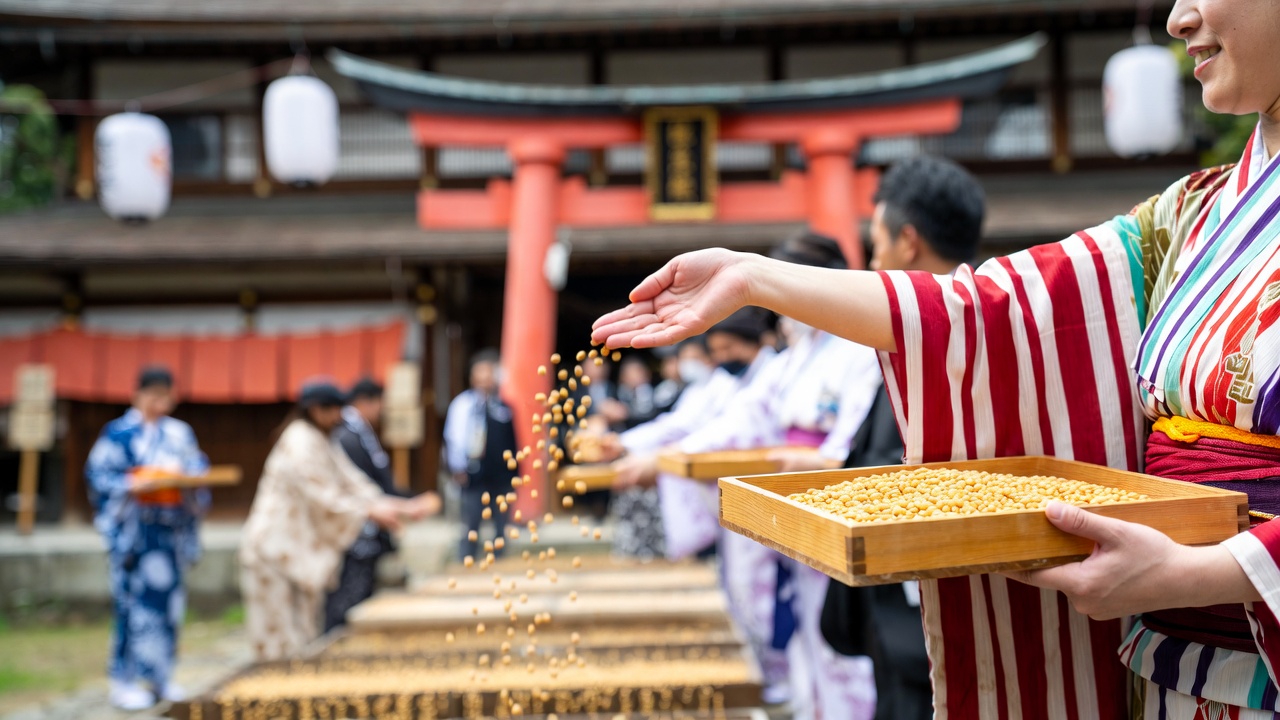
There is a moment every year when Japan decides it has had enough of winter. It doesn’t arrive quietly. It arrives with fistfuls of roasted soybeans, a thunderous chant of “Oni wa soto! Fuku wa uchi!” (“Demons out! Fortune in!”), and a thick sushi roll eaten in complete silence. This moment is Setsubun (節分) — one of the most joyful, family-friendly, and deeply symbolic traditions in the Japanese calendar.
If you have never heard of Setsubun, or if you have only seen photos of people throwing beans at someone in a horned mask, you are in for a treat. Setsubun is not a somber religious observance. It is a spirited, noisy, and surprisingly fun celebration that marks the last day of winter before spring officially begins. And in 2026, it falls on Tuesday, February 3.
Whether you are planning a trip to Japan, living here as an expat, or simply want to bring a slice of Japanese seasonal culture into your home abroad, this guide covers everything you need to know. From the centuries-old origins of bean throwing to the proper way to eat an ehomaki sushi roll, from the best temple festivals in Tokyo and Kyoto to easy crafts for kids — this is your complete, beginner-friendly roadmap to Setsubun.
Let’s chase those demons out together.
What Is Setsubun and When Is It Celebrated in 2026?
Setsubun (節分) literally means “seasonal division.” The word itself is made up of two kanji characters: 節 (setsu, meaning “season” or “joint”) and 分 (bun, meaning “divide” or “part”). In the broadest sense, every change of season in the old Japanese calendar had its own setsubun. There were originally four throughout the year — one before each season’s official start.
Over time, however, only one survived as a major cultural event: the day before Risshun (立春), the first day of spring. This is what Japanese people today simply call “Setsubun.”
In 2026, Setsubun falls on Tuesday, February 3. The following day, February 4, is Risshun. It is worth noting that the date is not permanently fixed. Because Risshun is determined by the traditional lunisolar calendar, Setsubun occasionally shifts to February 2 or February 4. In both 2021 and 2025, for example, it landed on February 2. But February 3 is by far the most common date, and that is the case again this year.
Setsubun is not a national public holiday. Schools, offices, and shops operate on their regular schedules. But the observance is deeply ingrained in everyday Japanese life. You will see evidence of it everywhere — from bags of roasted soybeans stacked in convenience stores starting in mid-January, to paper oni masks crafted by kindergarteners, to long queues at sushi counters for the year’s freshest ehomaki rolls.
At its heart, Setsubun is a day to drive away bad luck and welcome good fortune for the new season ahead. In the old calendar, the start of spring was essentially the start of a new year. This made the eve of spring a powerful symbolic threshold — a moment when the boundary between the old year and the new one was thought to be thin and vulnerable.
People believed that evil spirits, illness, and misfortune could slip through during this transitional period. Setsubun rituals were created to guard against these unseen dangers and to send the household into the new season with a clean slate.
Here is a quick overview of the key facts:
| Detail | Information |
|---|---|
| Japanese name | 節分 (Setsubun) |
| 2026 date | Tuesday, February 3 |
| Day after Setsubun | Risshun (立春), first day of spring — February 4 |
| Public holiday? | No |
| Main customs | Bean throwing (mamemaki), eating ehomaki, displaying hiiragi iwashi |
| 2026 lucky direction (ehō) | South-southeast |
| Who celebrates? | Families, schools, temples, shrines — essentially all of Japan |
The Ancient History and Origins of the Setsubun Bean Throwing Festival
The story of Setsubun stretches back well over a thousand years. Its roots are tangled with Chinese court rituals, Buddhist beliefs, and native Japanese folklore — a fascinating blend that reveals how cultural traditions evolve across borders and centuries.
From China to the Imperial Court
The practice of driving away evil spirits on the eve of a new season did not originate in Japan. It traces back to an ancient Chinese ritual called Tsuina (追儺), which was a ceremony of exorcism performed on the last day of the year in the Chinese court.
According to the Shoku Nihongi, an early Japanese historical chronicle, Tsuina was first performed in Japan in the year 706 CE. At that time, it was a court ceremony held at the imperial palace on the final day of the year under the old lunisolar calendar. The ritual involved decorating the palace gates with clay figures and using peach branches to ward off the spirits believed to bring disease and disaster.
This early version of the ceremony was quite different from the Setsubun we know today. There were no soybeans, no oni masks, and no chanting. It was a formal, aristocratic affair reserved for the imperial court.
The Muromachi Period: Bean Throwing Takes Root
The custom of mamemaki — the bean-throwing ritual that defines modern Setsubun — became firmly established during the Muromachi period (1336–1573). According to the Ainōshō, a dictionary compiled during this era, the tradition of hurling roasted soybeans during Setsubun traces back to a legend from the 10th century. The story holds that a monk on Mount Kurama near Kyoto escaped misfortune by blinding an oni with roasted beans.
This tale gave rise to a powerful folk etymology. The Japanese word for bean, mame (豆), can also be written with different kanji as “demon’s eye” (魔目). Throwing beans at the eyes of the demon, then, was literally an act of blinding evil. A related reading, mametsu (魔滅), means “to destroy demons.” Through these layers of wordplay and belief, beans became the weapon of choice against spiritual threats.
During the Muromachi period, every household of the aristocratic and samurai class practiced throwing roasted beans out their doors. It was a household-level act of spiritual protection — intimate, personal, and intensely meaningful.
The Edo Period: Setsubun Goes Nationwide
It was during the Edo period (1603–1867) that Setsubun bean throwing expanded beyond the elite and spread to ordinary people across Japan. Shrines, temples, and private homes all adopted the custom. This was also the era that gave rise to another Setsubun tradition: the practice of hanging hiiragi iwashi — roasted sardine heads skewered on prickly holly branches — at household gates to repel demons.
The custom of throwing beans at Shinto shrines and Buddhist temples became a popular community event. Festivals grew in size and spectacle, incorporating processions, performances, and eventually celebrity appearances — a tradition that continues at major temples to this day.
The Transformation of Oni
One of the most interesting aspects of Setsubun’s history is how the figure of the oni came to be associated with the holiday. Originally, the Tsuina ceremony did not involve oni at all. The central figure was a Hōsōshi (方相氏) — a shaman whose role was to drive away evil spirits. But the Hōsōshi wore a fearsome four-eyed mask and brandished a spear. Over time, people began to confuse the frightening appearance of the exorcist with the evil he was meant to banish.
By the Muromachi period, the Hōsōshi had been fully reinterpreted as an oni, and the ritual of chasing him away became the central drama of Setsubun. The red, blue, and green demons seen at temples and in family celebrations today are descendants of this historical misunderstanding — a striking example of how traditions can transform through the centuries while retaining their emotional core.
How to Do Mamemaki Bean Throwing at Home Step by Step
Mamemaki (豆撒き) is the heart of Setsubun. The word literally means “bean scattering,” and the practice is simple enough for a toddler to join in — which is exactly what happens in households across Japan every February 3.
Here is how to do it properly, whether you live in Tokyo, Toronto, or anywhere else in the world.
What You Need for Setsubun Bean Throwing
- Roasted soybeans (fukumame / 福豆): These are sold everywhere in Japan starting in mid-January, often packaged with a paper oni mask. If you are outside Japan, roasted soybeans are available at Asian grocery stores or online. The beans must be roasted, not raw. There is a folk belief that if a raw bean is left behind and sprouts, it will bring bad luck.
- An oni mask: Paper masks are often included in soybean packages. You can also make your own — a fun craft project for families. One household member (usually a parent) wears the mask and plays the oni.
- A masu box (optional): A small, square wooden box traditionally used to measure rice. Many families use one to hold the beans before throwing. It adds an authentic touch, but any container will do.
Step-by-Step Guide to Mamemaki
Step 1: Prepare the beans. If you have a home altar (kamidana), tradition calls for placing the roasted soybeans there earlier in the day. This is believed to add spiritual power to the beans. If you do not have a kamidana, simply set the beans aside in a clean place.
Step 2: Choose the oni. Typically, a parent — often the father — puts on the oni mask. In some families, the person born in the unluckiest zodiac year takes the role. But there are no strict rules. The key is that someone plays the demon so the rest of the household can drive them away.
Step 3: Open the doors and windows. The oni needs an exit route. Open the front door or a window so the “evil” has somewhere to go when it is chased out.
Step 4: Throw the beans and chant. All household members throw soybeans at the oni and toward the open doors, calling out:
“Oni wa soto! Fuku wa uchi!” (鬼は外!福は内!) “Demons out! Fortune in!”
Throw the beans with enthusiasm. This is not a quiet ceremony — it is supposed to be loud, energetic, and joyful. Children especially love this part.
Step 5: Close the doors quickly. After the beans have been thrown and the oni has fled, close the doors and windows immediately. This traps the good fortune inside and prevents evil from sneaking back in.
Step 6: Eat beans equal to your age. After the throwing is done, each person eats the same number of roasted soybeans as their age — or, in some traditions, one extra bean for good luck in the coming year. This is called toshi no kazu dake mame wo taberu (年の数だけ豆を食べる). It is a quiet, personal ritual believed to promote health and longevity.
Regional Variations in Bean Throwing
Not every household in Japan follows the exact same script. In some regions, unshelled peanuts are used instead of soybeans. This is common in the Tōhoku region (northern Honshū) and Hokkaido, where peanuts are easier to find and clean up afterward.
There is also a charming exception for families with the surname Watanabe. According to legend, Watanabe no Tsuna, a warrior from the Heian period, was so feared by oni that demons have avoided anyone named Watanabe ever since. Some Watanabe families, taking the legend at face value, skip bean throwing entirely — they simply do not need it.
Ehomaki Lucky Direction Sushi Roll: What to Eat on Setsubun 2026
If mamemaki is the noisiest Setsubun tradition, ehomaki (恵方巻き) is the quietest. This thick sushi roll is eaten in complete silence, facing a specific lucky direction, on the evening of Setsubun. No talking, no cutting, no looking away. Just you, the roll, and your wish for the year ahead.
What Is Ehomaki and Where Did It Come From?
The word ehomaki combines ehō (恵方, “lucky direction”) and maki (巻き, “roll”). The tradition of eating a lucky direction sushi roll on Setsubun is believed to have originated among merchants and geisha in Osaka’s Senba district during the late Edo to Meiji period. It was a playful custom associated with prayers for business success.
For decades, ehomaki remained a regional Kansai tradition — familiar in Osaka and Kyoto but largely unknown elsewhere in Japan. That changed dramatically in 1989, when a major convenience store chain — widely reported to be Seven-Eleven — rebranded the rolls as “ehomaki” and began selling them nationwide. The marketing campaign was wildly successful. By the late 1990s, ehomaki had become a nationwide Setsubun staple.
Today, the ehomaki market is enormous. Convenience stores like Seven-Eleven, Lawson, and FamilyMart all launch elaborate ehomaki campaigns weeks before Setsubun. Department store food halls (depachika) offer premium versions stuffed with wagyu beef, crab, and uni. In 2026, FamilyMart’s lineup includes rolls supervised by the restaurant Sanpi-Ryoron and a special collaboration with the video game Touken Ranbu ONLINE. The creative variety on offer reflects how a local folk custom has become a full-fledged commercial and cultural event.
The 2026 Lucky Direction (Ehō) Is South-Southeast
Each year, the lucky direction is determined by the position of Toshitokujin (歳徳神), the deity of good fortune for that year. The direction rotates on a cycle tied to the Chinese zodiac. In 2026, the ehō is south-southeast — or, to be more precise, south-southeast slightly south (南南東やや南).
When eating your ehomaki on the evening of February 3, face south-southeast, and do not look away until you have finished.
How to Eat Ehomaki Properly: The Three Rules
There are three essential rules for eating ehomaki. Breaking them is said to diminish or “cut off” your good fortune.
- Do not cut the roll. Eat it whole, without slicing. Cutting the ehomaki symbolizes cutting your ties to good luck. This can be challenging with a thick roll, but that is part of the fun.
- Face the lucky direction (south-southeast in 2026). Orient yourself toward the ehō before you take your first bite. Stay facing that direction throughout the meal.
- Eat in complete silence. Do not speak until you have finished the entire roll. Focus on your wish for the year. Speaking is believed to let your luck escape.
Traditional Ehomaki Fillings and Their Meanings
A traditional ehomaki contains seven ingredients, symbolizing the Shichifukujin (七福神) — the Seven Gods of Good Fortune in Japanese mythology. Rolling seven fillings together is said to “roll up good fortune.” Here are the classic ingredients and what they represent:
| Ingredient | Japanese Name | Symbolic Meaning |
|---|---|---|
| Conger eel (anago) | 穴子 | Success and rising fortune |
| Shrimp or prawns | 海老 | Longevity (the curved shape resembles an elderly person’s back) |
| Dried gourd strips | かんぴょう (kanpyō) | Long life and strong bonds |
| Shiitake mushroom | 椎茸 | Protection from harm |
| Rolled omelet | 伊達巻 / 玉子焼き | Financial luck (due to its golden color) |
| Cucumber | きゅうり | Nine benefits (the number nine, ku, is embedded in the name) |
| Sakura denbu (fish floss) | 桜田麩 | Joy and celebration (pink color) |
That said, modern ehomaki have broken free of tradition. In 2026, you can find rolls filled with salmon, tuna, avocado, roast beef, tempura shrimp, and even Korean-style kimbap ingredients. The rule is flexible: choose seven fillings you enjoy. The symbolic spirit matters more than strict adherence to the classic recipe.
Where to Buy Ehomaki in Japan
If you are in Japan during Setsubun, finding an ehomaki is effortless. Here are the most common places:
- Convenience stores (konbini): Seven-Eleven, Lawson, and FamilyMart all sell ehomaki, often with reservation systems for premium versions. Reservations typically close a few days before February 3, so plan ahead.
- Supermarkets: Large chains like AEON and Ito-Yokado stock ehomaki in abundance. AEON’s 2026 lineup includes a massive “Gokubutomaki” priced at ¥6,458, packed with luxurious ingredients.
- Depachika (department store food halls): For a high-end experience, visit the basement food floors of Isetan, Takashimaya, or Mitsukoshi. Expect artisanal rolls and long queues.
- Sushi chains and takeout shops: Many sushi restaurants offer ehomaki by reservation. These are often made to order for peak freshness.
Hiiragi Iwashi: The Sardine and Holly Decoration That Keeps Demons Away
There is a third Setsubun tradition that is less famous than bean throwing or ehomaki but equally fascinating. It is called hiiragi iwashi (柊鰯), and it involves hanging a grilled sardine head on a sprig of holly at the entrance of your home.
Why Sardines and Holly?
The logic is delightfully practical, if you accept the premise that demons have sensitive noses and eyes. Oni are believed to despise two things: the pungent smell of grilled sardines and the sharp prickles of holly leaves. By combining both on a single talisman and placing it at the household entrance, you create a kind of spiritual security system that stops evil spirits at the door.
This tradition is also known as yaikagashi (焼い嗅がし), roughly meaning “grilling and sniffing” — a reference to the strongly scented sardine heads used in the charm.
Historical Roots
The custom of using sardines and sharp plants to ward off evil dates back centuries. The earliest known reference appears in the Tosa Nikki, a literary diary compiled in 934 CE during the Heian period. This suggests that some version of the tradition has been practiced for over a thousand years, making hiiragi iwashi one of the oldest surviving Setsubun customs.
During the Edo period, the practice of decorating gates with sardine heads on holly became widespread alongside mamemaki. In some regions, the sardine is eaten as part of the Setsubun meal rather than displayed, while in others, the head is replaced with a different ingredient — but the protective spirit of the custom remains the same.
How to Make Hiiragi Iwashi
- Grill or roast the head of a sardine until it is cooked through and fragrant. The stronger the smell, the better — you are trying to repel demons, after all.
- Thread the sardine head onto a sprig of holly (hiiragi). The sharp, spiny leaves are essential; they are believed to poke the eyes of any oni that comes too close.
- Hang the finished charm at your front door or gate. In traditional practice, it remains there until the charm has served its purpose.
In modern Japan, hiiragi iwashi is less commonly practiced than mamemaki or ehomaki, especially in urban apartments where hanging a fish head on the front door might raise eyebrows. But you can still see it in more traditional households and rural areas, and it remains a beloved part of Setsubun lore.
Best Setsubun Festivals at Temples and Shrines in Japan 2026
While many families celebrate Setsubun at home, some of the most spectacular Setsubun experiences take place at temples and shrines across Japan. These public events feature large-scale mamemaki ceremonies, celebrity guest bean throwers, traditional performances, and enormous crowds.
Here are the top spots to experience Setsubun in 2026.
Tokyo: Where Celebrities Throw Beans to Thousands
Sensoji Temple (浅草寺) — Asakusa, Taito-ku
Sensoji holds a special place in Setsubun history. It was the first temple in Japan to hold a large-scale Setsubun ceremony open to the general public, bringing what had been a private, household ritual into the public square. Today, roughly 10,000 people attend the annual event, and the atmosphere is electric.
Because Sensoji enshrines the Buddhist goddess of mercy, Kannon, it is believed that no demons can exist on the temple grounds. For this reason, the traditional chant is modified: participants do not shout “Oni wa soto” but instead call out only “Fuku wa uchi!” — welcoming good fortune without needing to expel evil.
The festivities include the Fukuju-no-Mai — the “Dance of the Seven Lucky Gods” — in which performers dressed as each of the Shichifukujin dance on a special stage. After the dance, celebrities and local figures throw beans into the packed crowd.
- Date: February 3, 2026
- Time: Main events from approximately 11:30 AM to 4:00 PM
- Access: 5-minute walk from Asakusa Station (Ginza Line)
- Admission: Free
Zojoji Temple (増上寺) — Shiba Park, Minato-ku
Located at the base of Tokyo Tower in Shiba Park, Zojoji is historically linked to the Tokugawa shogunate. Its Setsubun festival is one of the most popular in central Tokyo, attracting over 4,000 visitors each year. The bean throwing features a colorful roster of celebrities, sumo wrestlers, politicians, and athletes. A designated family area makes it accessible for parents with young children.
- Date: February 3, 2026
- Time: From approximately 12:20 PM
- Access: Nearest stations include Onarimon, Daimon, and Hamamatsucho
- Admission: Free
Ikegami Honmonji (池上本門寺) — Ota-ku
This massive temple in southern Tokyo hosts one of the city’s most established Setsubun celebrations, drawing over 10,000 attendees annually. The main mamemaki takes place on a 50-meter stage — one of the largest in the region. The lineup typically includes sumo wrestlers, television personalities, and athletes. The temple is also famous for its five-story pagoda, the oldest of its kind in Tokyo, and its renowned kuzumochi (arrowroot mochi).
- Date: February 3, 2026
- Time: Procession from 1:00 PM; main bean throwing from approximately 3:00 PM
- Access: Ikegami Station (Tokyu Ikegami Line)
- Admission: Free
Kyoto: Ancient Rituals and Geisha Bean Throwing
Kyoto’s Setsubun celebrations are steeped in history and grandeur. A beloved local custom called Yomomairi (四方参り) involves visiting four specific shrines and temples in sequence, following the legendary path of a fleeing demon. The oni is said to appear first at Yoshida Shrine in the northeast, then flee to Yasaka Shrine in the southeast, Mibudera Temple in the southwest, and finally Kitano Tenmangu Shrine in the northwest, where it is trapped. Visiting all four is believed to bring especially strong blessings.
Yoshida Shrine (吉田神社) — Sakyo-ku
Yoshida Shrine hosts the largest and most famous Setsubun festival in Kyoto. Founded in 859, the shrine is considered a guardian of the kimon (demon gate) — the northeastern direction from which evil is believed to approach. The festival runs for three days, with the main event on February 3. In a typical year, some 500,000 visitors attend, and around 800 food stalls line the approach to the shrine.
The highlight is the Tsuina-shiki ceremony on the evening of February 2, a ritual descended directly from the ancient Chinese-influenced court ceremonies of the Heian period. A figure called Hōsōshi, wielding a massive spear and shield, drives away red, blue, and yellow oni who roam freely through the shrine grounds. The following day features the Karo-sai, a massive bonfire in which visitors’ old talismans are burned for purification.
- Dates: February 2–4, 2026
- Access: 20-minute walk from Demachiyanagi Station (Keihan Line)
- Admission: Free
Yasaka Shrine (八坂神社) — Gion
Yasaka Shrine’s Setsubun celebration is famous for the participation of Kyoto’s geiko (trained geisha) and maiko (apprentice geisha), who perform traditional dance offerings before throwing beans to the assembled crowd. Dressed in colorful, elegant attire, they bring a uniquely Kyoto elegance to the proceedings. Over two days, there are a total of eight dance performances from different kagai (geisha districts).
Visitors can also purchase fukumame (lucky bean bags) that come with lottery tickets. Prizes range from bicycles and electronics to restaurant vouchers — adding an element of excitement to the tradition.
- Dates: February 2–3, 2026
- Access: 5-minute walk from Gion-Shijo Station (Keihan Line)
- Admission: Free (Fukumame: ¥300)
Mibudera Temple (壬生寺) — Nakagyo-ku
Mibudera is famous for its connection to the Shinsengumi, the samurai police force of the late Edo period. But its Setsubun claim to fame is the Mibu Kyogen — a 700-year-old form of pantomime theater performed entirely without speech. During the Setsubun festival, the comic play about Setsubun itself is staged eight times a day on both February 2 and 3. Admission to the kyogen is free, though photography is not permitted.
- Dates: February 2–4, 2026
- Access: 7-minute walk from Omiya Station (Hankyu Line)
- Admission: Free
Near Tokyo: Naritasan Shinshoji Temple
Naritasan Shinshoji Temple (成田山新勝寺) — Narita, Chiba
Located near Narita Airport, Shinshoji is arguably the most famous Setsubun venue in all of Japan. Each year, roughly 40,000 people attend the ceremony, which features an extraordinary quantity of beans: reportedly around 860 kilograms of soybeans and 400 kilograms of peanuts are thrown. Celebrity guests — including sumo wrestlers, actors, and television personalities — add star power to the event.
Like Sensoji, Naritasan follows the tradition of chanting only “Fuku wa uchi!” without saying “Oni wa soto.” The temple’s principal deity, Fudō Myōō, is considered so powerful that even oni reform in his presence — so there is no need to drive them away.
- Date: February 3, 2026
- Access: 10-minute walk from JR Narita Station or Keisei Narita Station
- Admission: Free
At-a-Glance: Top Setsubun Festivals in Japan 2026
| Venue | Location | Date(s) | Unique Feature |
|---|---|---|---|
| Sensoji Temple | Tokyo (Asakusa) | Feb 3 | Dance of the Seven Lucky Gods; no “Oni wa soto” chant |
| Zojoji Temple | Tokyo (Shiba Park) | Feb 3 | Celebrity bean throwers; family-friendly area |
| Ikegami Honmonji | Tokyo (Ota-ku) | Feb 3 | 50-meter bean-throwing stage; sumo wrestlers |
| Yoshida Shrine | Kyoto (Sakyo-ku) | Feb 2–4 | Ancient Tsuina ceremony; 800 food stalls |
| Yasaka Shrine | Kyoto (Gion) | Feb 2–3 | Geiko and maiko dance performances; lucky lottery |
| Mibudera Temple | Kyoto (Nakagyo-ku) | Feb 2–4 | 700-year-old Mibu Kyogen pantomime |
| Naritasan Shinshoji | Chiba (Narita) | Feb 3 | 40,000+ attendees; 860 kg of beans thrown |
| Mt. Takao Yakuoin | Tokyo (Hachioji) | Feb 3 | Mountain temple; goma fire ritual before bean throwing |
| Kasuga Taisha | Nara | Feb 3 | 3,000+ stone and hanging lanterns illuminated |
How to Celebrate Setsubun with Kids and Family at Home
Setsubun is one of the most child-friendly celebrations in the Japanese cultural calendar. The combination of mask-making, playful “fighting,” bean throwing, and sushi eating makes it a natural fit for families with young children. Here are practical ways to bring the tradition to life at home, whether you are in Japan or abroad.
Make Your Own Oni Masks
Crafting oni masks is a staple kindergarten and preschool activity throughout Japan. All you need is colored paper (red, blue, or green), scissors, glue, and some imagination. For younger children, use a paper plate as the base and let them glue on horns made from rolled paper, cotton-ball eyebrows, and a mouth cut from construction paper. The more colorful and wild the mask, the better.
If you prefer a shortcut, many 100-yen shops in Japan (Daiso, Seria, Can Do) stock ready-made Setsubun kits with masks, bean cups, and small bags of fukumame. Stores like 3COINS also carry seasonal Setsubun items each year at affordable prices.
Family Mamemaki Tips
- Assign roles: Let one parent be the oni while the children do the throwing. Switch roles so everyone gets a turn.
- Use peanuts for smaller children. In-shell peanuts are easier for small hands to grip, cleaner to pick up afterward, and pose less of a choking risk than individual soybeans.
- Keep it contained. If throwing beans indoors sounds messy, do the mamemaki in a hallway or near the front door. Some families throw beans outside from the doorway, then close the door and eat their age-count of beans inside.
- Sing the Setsubun song. Many Japanese children learn a simple mamemaki song at school. The lyrics go: “Oni wa soto, fuku wa uchi, para para para para mame no oto, oni wa kossori nige te iku” — describing how the beans scatter and the oni sneaks away. Singing it together makes the whole experience more festive.
Ehomaki with Kids
Eating a thick sushi roll in complete silence can be a challenge for small children (and, honestly, for some adults). Here are a few tips:
- Make mini ehomaki. Instead of one large roll, prepare thin rolls that small mouths can handle. The seven-ingredient rule is flexible — use whatever your children enjoy.
- Turn direction-finding into a game. Use a compass app on your phone and let the kids figure out which way is south-southeast. They will feel like explorers.
- Keep the silence rule playful. Frame it as a “quiet challenge” rather than a strict rule. See who can stay silent the longest. Younger kids inevitably giggle, and that is perfectly fine — the point is participation, not perfection.
Setsubun Regional Customs and Unique Traditions Across Japan
Japan is a country of remarkable regional diversity, and Setsubun is no exception. While mamemaki and ehomaki are practiced nationwide, individual communities have developed their own distinctive twists on the celebration.
Soybeans vs. Peanuts: The Great Bean Divide
In the Kantō region (Tokyo and surrounding prefectures) and the Kansai region (Osaka, Kyoto), roasted soybeans are the standard ammunition for mamemaki. But travel north to Tōhoku or Hokkaido, and you will find families throwing unshelled peanuts instead. The practical advantages are obvious: peanuts are larger, easier to find after throwing, and can be eaten right off the floor since the shell keeps them clean. Some areas in Kyushu also prefer peanuts.
Setsubun Soba, Kenchin-jiru, and Regional Foods
Ehomaki may dominate the national conversation, but it is not the only Setsubun food. In some areas, particularly in the Nagano and Shimane prefectures, families eat Setsubun soba — buckwheat noodles served on the eve of spring, echoing the tradition of eating soba on New Year’s Eve. Because Setsubun was historically the “real” New Year in the old calendar, the soba tradition carried over.
In the Kantō region, a hearty root vegetable soup called kenchin-jiru (けんちん汁) is a popular Setsubun meal. Made with taro, daikon, carrot, burdock, and tofu simmered in soy-based broth, it is the perfect warming dish for a February evening.
Sardine dishes are also common in some regions, connecting back to the hiiragi iwashi tradition. Rather than simply displaying the fish head, families grill and eat the whole sardine as part of the Setsubun dinner.
Kyoto’s Yomomairi: The Four-Shrine Demon Chase
As described in the temple section above, Kyoto has a unique Setsubun custom called Yomomairi — visiting four sacred sites that correspond to the four cardinal directions around the old imperial palace. The tradition follows the mythical escape route of an oni being chased from shrine to shrine until it is finally captured. Devoted practitioners visit all four on Setsubun day, offering prayers and collecting charms at each.
The Shimokitazawa Tengu Festival
In Tokyo’s trendy Shimokitazawa neighborhood, Setsubun takes on a different flavor entirely. The local Setsubun festival features a Tengu parade — a procession through the streets led by figures wearing the long-nosed masks of tengu, mythical mountain spirits from Japanese folklore. The event has been described as a “Japanese Halloween” and draws crowds of both locals and visitors to the neighborhood’s narrow lanes and independent shops.
Obake: Setsubun’s Hidden Dress-Up Tradition
In some parts of Kyoto and Osaka, there is an old Setsubun custom called Obake (お化け), in which people dress in unusual or cross-gender clothing on the evening of Setsubun. The idea is that by disguising yourself, you can confuse evil spirits so they cannot find you. While largely faded from mainstream practice, the Obake tradition has been revived in certain neighborhoods and among fans of traditional culture, giving Setsubun an unexpected carnival quality.
Modern Setsubun Trends and What Is New in 2026
Setsubun has proven remarkably adaptable. While its core rituals remain intact after centuries, the ways in which Japanese people engage with the holiday continue to evolve. Here are some of the notable trends shaping Setsubun in 2026.
Ehomaki Innovation
The ehomaki market has become a showcase for culinary creativity and brand collaboration. In 2026, convenience stores and supermarkets are competing fiercely with premium, limited-edition rolls. FamilyMart has partnered with the acclaimed restaurant Sanpi-Ryoron and the long-established meat shop Kakiyasu for its lineup, and is also offering a limited-quantity ehomaki in collaboration with the video game Touken Ranbu ONLINE, packaged in a special design box.
AEON, Japan’s largest supermarket chain, is selling a massive “Gokubutomaki” (super-thick roll) priced at ¥6,458, packed with luxurious ingredients and far more than any one person could eat alone.
Meanwhile, sushi chains and independent restaurants offer reservation-only artisanal ehomaki that sell out days before February 3. The message is clear: ehomaki has graduated from humble folk custom to full-fledged gourmet event.
Family-Friendly and Flexible Celebrations
According to recent trend coverage by LIVE JAPAN, 2026 reflects a continued shift toward family-friendly and convenient Setsubun celebrations. Many families with young children now focus their home celebrations on eating ehomaki together, while experiencing mamemaki at kindergarten, daycare centers, or public events. Ready-made ehomaki from convenience stores allow busy households to participate without extensive preparation.
Setsubun on Social Media
Every year, Setsubun trends on Japanese social media, with families sharing photos of their oni-masked parents, homemade ehomaki, and children mid-throw. The hashtags #節分 and #恵方巻 flood platforms like X (formerly Twitter) and Instagram on February 3. In 2026, look for posts showing creative oni costumes, pet reactions to bean throwing, and the perennial challenge of eating a full ehomaki in silence.
Sustainability Conversations
In recent years, there has been growing public awareness of ehomaki food waste. Large quantities of unsold ehomaki end up discarded each year due to overproduction by retailers eager to capitalize on the one-day demand window. This has sparked conversations about pre-order systems, smaller production runs, and consumer responsibility. If you are buying ehomaki, reserving in advance is the most sustainable choice — it helps stores produce only what will be sold.
Setsubun Etiquette Tips and Practical Advice for First-Time Visitors
If you are visiting Japan during Setsubun for the first time, here are some tips to make the most of the experience.
At Temples and Shrines
- Arrive early. Popular events like those at Sensoji, Yoshida Shrine, and Naritasan draw enormous crowds. Arriving one to two hours before the main mamemaki gives you a better position and time to explore the grounds.
- Dress warmly. Early February in Japan is cold, especially if you are standing outdoors for an extended period. Layers, warm shoes, and a hat are essential.
- Be prepared for crowds. Major Setsubun festivals can be intense. Stay aware of your surroundings, keep a secure hold on bags and cameras, and follow the guidance of event staff and police.
- Catch, don’t grab. When beans are thrown into the crowd, catch what comes your way. Do not take beans that land near someone else or that others have caught. Politeness is paramount.
- Photography is usually welcome, but check for restrictions. At Mibudera’s Mibu Kyogen performance, for example, photography is not allowed.
At Home or With Friends
- Clean up after mamemaki. Stray beans left on the floor can attract pests. Sweep up promptly after the fun is over.
- Store leftover fukumame properly. Roasted soybeans can be snacked on for days after Setsubun. Keep them in an airtight container.
- Respect the silence during ehomaki. If you are eating with Japanese friends or family, follow their lead on the silence rule. Even if it feels funny, taking it seriously shows respect for the tradition.
- Don’t worry about perfection. Setsubun is a joyful, relaxed occasion. There is no wrong way to participate as long as you approach it with good humor and respect.
For Visitors Outside Japan
You do not need to be in Japan to celebrate Setsubun. Here is what you can do from anywhere:
- Source roasted soybeans from an Asian grocery store or online. In a pinch, any roasted, unsalted soybean will work.
- Make ehomaki at home. Use sushi rice, nori, and seven fillings of your choice. There are countless recipes available online, including excellent step-by-step guides from sites like Sudachi Recipes.
- Face south-southeast (for 2026) while eating your roll. Use a compass app if needed.
- Craft oni masks with your family. It is a wonderful way to introduce children to Japanese culture through hands-on activity.
Frequently Asked Questions About Setsubun in Japan
Is Setsubun a Public Holiday in Japan?
No. Setsubun is not a public holiday. Schools, businesses, and government offices operate on their normal schedules. However, many schools — especially kindergartens and elementary schools — incorporate Setsubun activities into the day’s program.
Why Do Japanese People Throw Beans on Setsubun?
Bean throwing, or mamemaki, is a ritual to drive away oni (demons representing bad luck, illness, and misfortune) and invite good fortune. The custom became established during the Muromachi period and is rooted in the belief that roasted soybeans carry the spiritual power to repel evil. The Japanese word for bean (mame) has phonetic associations with “demon’s eye” and “destroying demons,” adding layers of symbolic meaning.
Can I Celebrate Setsubun If I Am Not Japanese?
Absolutely. Setsubun is a cultural celebration, not a religious rite restricted to practitioners. Temples and shrines warmly welcome visitors of all backgrounds to their public mamemaki events. At home, anyone can participate in bean throwing, ehomaki eating, and mask making. The celebration is meant to be inclusive, fun, and accessible.
What Is the Lucky Direction for Eating Ehomaki in 2026?
The lucky direction for 2026 is south-southeast (南南東). Face this direction while eating your ehomaki roll on February 3.
Do I Have to Eat Soybeans? What About Allergies?
If you have a soy allergy, you can use peanuts — a common substitute in several Japanese regions — or simply skip the bean-eating portion and focus on other traditions like ehomaki or hiiragi iwashi. Safety always comes first.
What Does “Oni Wa Soto, Fuku Wa Uchi” Mean?
It means “Demons out! Fortune in!” It is the standard chant shouted during mamemaki. Some temples modify the phrase slightly. At Sensoji, for example, only “Fuku wa uchi” is used because the temple’s deity is believed to prevent any demons from entering the grounds.
Is Setsubun Related to the Chinese New Year?
Not directly, though both are connected to the lunisolar calendar traditions of East Asia. Setsubun marks the eve of Risshun (the start of spring), which was effectively the start of the new year under the old Japanese calendar. Chinese New Year is determined differently and usually falls on a different date, though both celebrations share themes of renewal, purification, and welcoming good fortune.
Final Thoughts: Why Setsubun Matters Beyond Japan
There is something universally appealing about Setsubun. At its core, it is about acknowledging the end of a hard season and choosing to believe that something better is coming. It is about gathering with the people you love, making noise, eating good food, and actively — physically — throwing the bad stuff out the door.
In a world that can feel overwhelming, there is genuine comfort in the simplicity of Setsubun’s message. Fill your hands with beans. Face the right direction. Make a wish. Eat in grateful silence.
Whether you mark the day at Sensoji Temple amid ten thousand strangers, at your kitchen table with your children, or alone in your apartment with a store-bought ehomaki and a south-southeast bearing on your phone — you are participating in something that the people of Japan have practiced for over a millennium.
And that is a beautiful way to welcome spring.