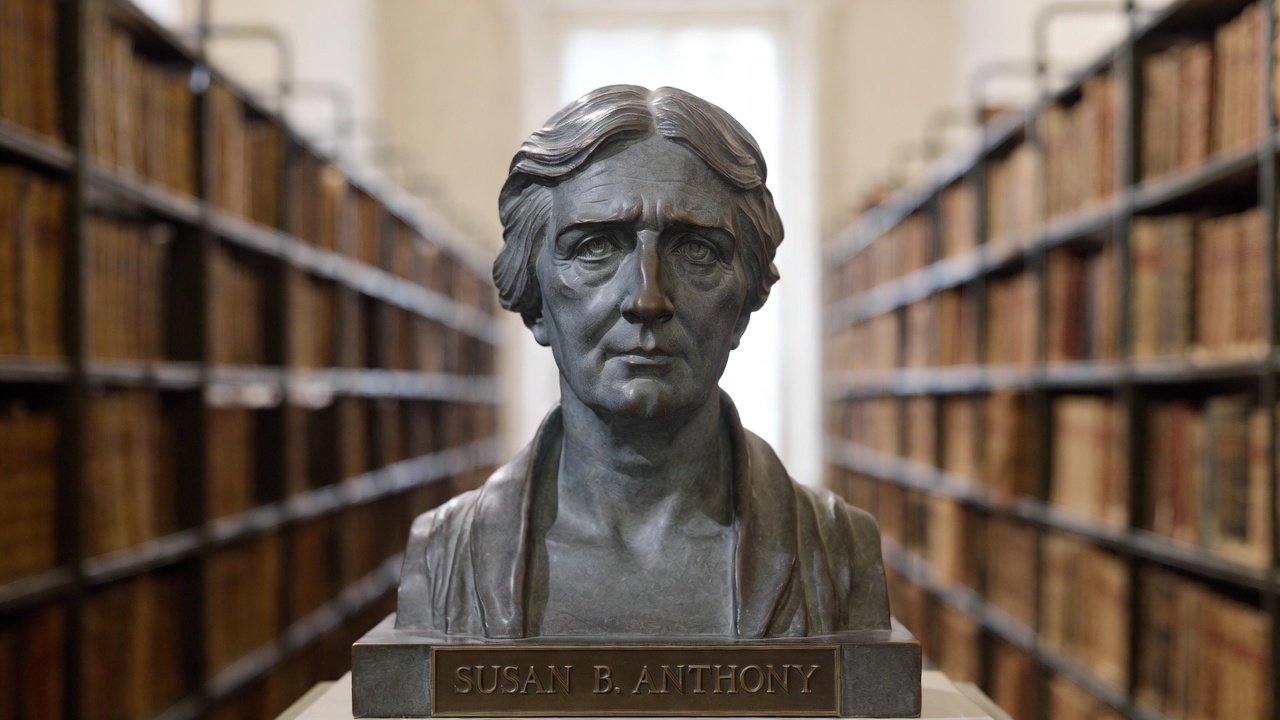
She was arrested for voting. In 1872, Susan B. Anthony walked into a polling station in Rochester, New York, and cast a ballot. It was illegal. She did it anyway.
Now imagine her walking into 2026 America. What would she think? What would she say? And most importantly—would she be satisfied with how far we’ve come?
Who Was Susan B. Anthony and Why Does She Still Matter Today?
Susan Brownell Anthony wasn’t born a revolutionary. She became one.
Born in 1820 to a Quaker family in Massachusetts, Anthony grew up believing in equality. Her father treated his daughters the same as his sons. Education mattered. Hard work mattered. Gender didn’t.
But the world outside her home told a different story.
Women couldn’t vote. They couldn’t own property after marriage. They couldn’t sign legal contracts. They were, in the eyes of the law, shadows of their husbands.
Anthony refused to accept this. She spent 50 years fighting for women’s suffrage. She gave over 100 speeches per year. She traveled constantly. She never married. She never stopped.
She died in 1906—fourteen years before the 19th Amendment finally gave American women the right to vote.
Why does Susan B. Anthony matter in 2026? Because the battles she fought aren’t over. They’ve just changed shape.
The 19th Amendment Anniversary: Celebrating Women’s Right to Vote
The 19th Amendment turned 106 years old in 2026. That sounds like a long time. It isn’t.
Consider this: there are women alive today whose grandmothers couldn’t vote. The fight for women’s suffrage in America ended within living memory.
| Milestone | Year | Years Since 2026 |
|---|---|---|
| Susan B. Anthony arrested for voting | 1872 | 154 years |
| Anthony’s death | 1906 | 120 years |
| 19th Amendment ratified | 1920 | 106 years |
| First woman elected to Congress | 1916 | 110 years |
| Equal Pay Act signed | 1963 | 63 years |
Anthony would likely celebrate the 19th Amendment’s existence. But she’d probably ask: “What took so long after I died?”
And then she’d ask harder questions.
What Would Susan B. Anthony Think About the Gender Pay Gap?
Let’s be direct. The gender pay gap still exists in 2026.
Women earn approximately 84 cents for every dollar men earn. For women of color, that number drops further. Progress has happened. But it’s been glacially slow.
Anthony fought for economic independence. She believed financial freedom was inseparable from political freedom. “Independence is happiness,” she once wrote.
If Susan B. Anthony were alive today, she would likely point out uncomfortable truths:
- The Equal Pay Act passed in 1963—over 60 years ago
- Full pay equity still hasn’t been achieved
- Women still face motherhood penalties in the workplace
- Negotiating for raises remains harder for women
She was never one to sugarcoat reality. She probably wouldn’t start now.
Women in Politics 2026: Progress and Persistent Barriers
Anthony spent her life trying to get women into voting booths. She never imagined them in the Oval Office—or did she?
“Failure is impossible,” she declared in 1906. She meant it about voting rights. But the sentiment applies to representation too.
Current statistics on women in American government:
| Position | Women’s Representation |
|---|---|
| U.S. Congress | ~28% |
| State Legislatures | ~32% |
| Governorships | Varies by election cycle |
| Fortune 500 CEOs | ~10% |
Anthony would see this and ask the obvious question: why only 28%? Why not 50%?
She’d probably also notice that progress comes in waves. Two steps forward. One step back. Sometimes one and a half steps back.
Voting Rights Challenges in Modern America
Here’s where Anthony might get truly frustrated.
She went to jail for voting. She assumed that sacrifice would settle the matter forever. It didn’t.
Current voting rights debates include:
- Voter ID requirements
- Mail-in ballot access
- Early voting availability
- Gerrymandering concerns
- Voter roll purges
Anthony believed voting was sacred. She called it “the pivotal right.” Without it, all other rights meant nothing.
She’d likely be alarmed that access to the ballot box remains contested in 2026. She fought this battle 150 years ago. Why is it still being fought?
Susan B. Anthony’s Legacy in the Modern Feminist Movement
The feminist movement has evolved dramatically since Anthony’s era. She focused almost exclusively on suffrage. Today’s equality battles span dozens of issues.
Modern equality topics Anthony never directly addressed:
- Reproductive rights
- LGBTQ+ equality
- Workplace harassment
- Digital privacy
- Parental leave policies
- Childcare accessibility
Would she embrace these causes? History suggests she might be complicated.
Anthony had blind spots. She sometimes prioritized white women’s suffrage over broader coalition-building. She made strategic choices that excluded others. She was a product of her time—and ahead of it simultaneously.
The honest answer: we don’t know exactly what she’d say about every modern issue. But we know her method. She’d study the facts. She’d identify injustice. She’d get to work.
How to Honor Susan B. Anthony’s Fight for Equality Today
Anthony didn’t just talk. She acted. She knocked on doors. She wrote letters. She organized. She showed up.
Practical ways to continue her legacy:
| Action | Impact |
|---|---|
| Register to vote | Exercise the right she fought for |
| Research candidates | Make informed choices |
| Support equality legislation | Write to representatives |
| Educate young people | Share suffrage history |
| Visit historical sites | Connect with the movement |
| Volunteer for causes | Put beliefs into action |
The Susan B. Anthony Museum and House in Rochester, New York, remains a pilgrimage site for those interested in women’s history. Her grave in Mount Hope Cemetery sees visitors year-round—especially on Election Day, when people leave “I Voted” stickers on her headstone.
Famous Susan B. Anthony Quotes That Resonate in 2026
Anthony was quotable. She knew how to land a point. These words still hit hard:
“Failure is impossible.”
“Cautious, careful people, always casting about to preserve their reputations… can never effect a reform.”
“I declare to you that woman must not depend upon the protection of man, but must be taught to protect herself.”
“Independence is happiness.”
“The day will come when men will recognize woman as his peer.”
That last one is the question, isn’t it? Has that day come? Or is it still arriving?
The Unfinished Business of American Equality
Susan B. Anthony died believing the vote was coming. She was right. But she also understood something deeper.
Equality isn’t a destination. It’s a practice.
Every generation inherits unfinished business. Anthony inherited it from earlier abolitionists and women’s rights pioneers. We inherited it from her. Future generations will inherit it from us.
What would Susan B. Anthony say about today’s equality battles?
Probably something like this: “You’ve come far. Not far enough. Keep going. Failure is impossible—but only if you keep working.”
She’d remind us that rights, once won, require defending. She’d tell us that progress isn’t linear. She’d point out that every generation faces its own version of the same fundamental question: who counts as fully human? Who gets full participation in democracy?
And then she’d roll up her sleeves and ask: “What’s the plan?”
Visiting Susan B. Anthony Historic Sites in 2026
For those wanting to walk in her footsteps, several locations preserve her memory:
National Susan B. Anthony Museum & House
17 Madison Street, Rochester, NY
Her home from 1866 until her death
Mount Hope Cemetery
1133 Mount Hope Avenue, Rochester, NY
Her final resting place
Women’s Rights National Historical Park
136 Fall Street, Seneca Falls, NY
Where the movement began
These sites offer powerful reminders that history was made by real people making difficult choices.
Final Thoughts: Lessons From Susan B. Anthony for Modern Activists
Susan B. Anthony worked for 50 years on a single cause. She didn’t live to see it succeed. She kept working anyway.
That’s the lesson.
Not every battle gets won in one lifetime. Not every effort produces immediate results. But the work matters. The showing up matters. The refusal to accept injustice—that matters most of all.
In 2026, equality battles continue. They look different than they did in 1872. But the fundamental question remains: are all people treated with equal dignity and given equal opportunity?
Anthony’s answer was clear. She spent her life trying to make it reality.
The question now is: what’s our answer?