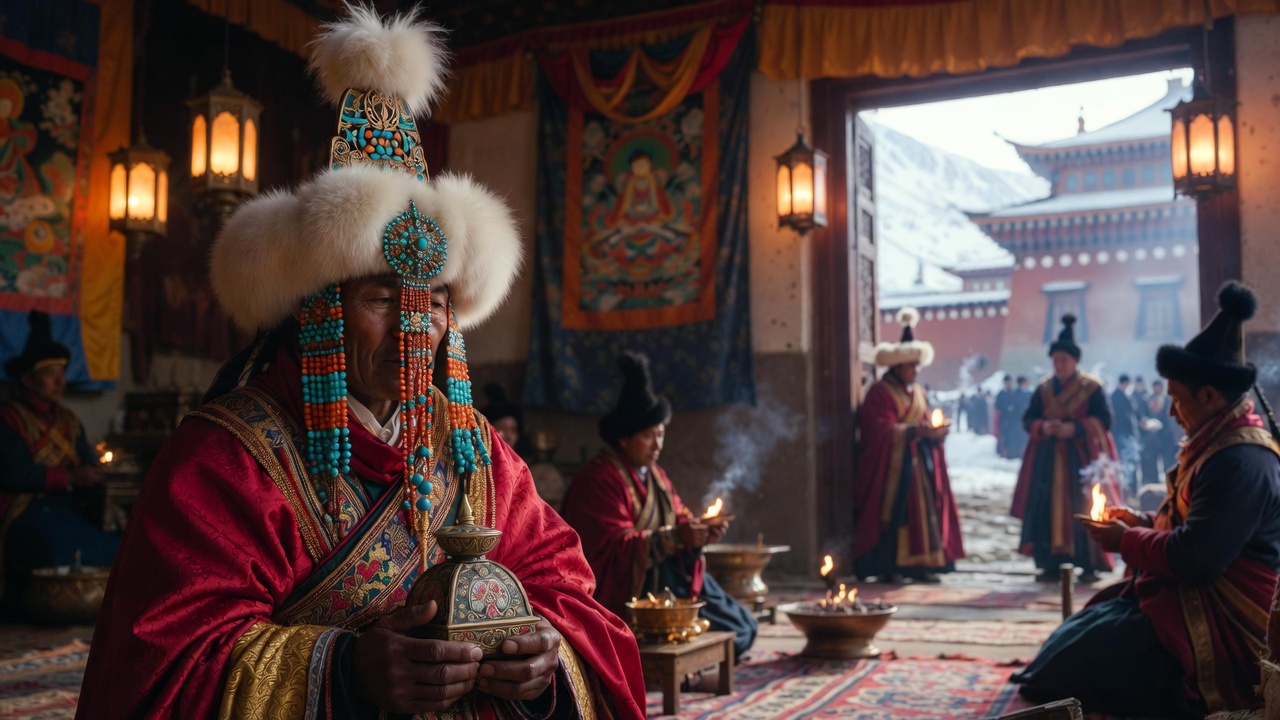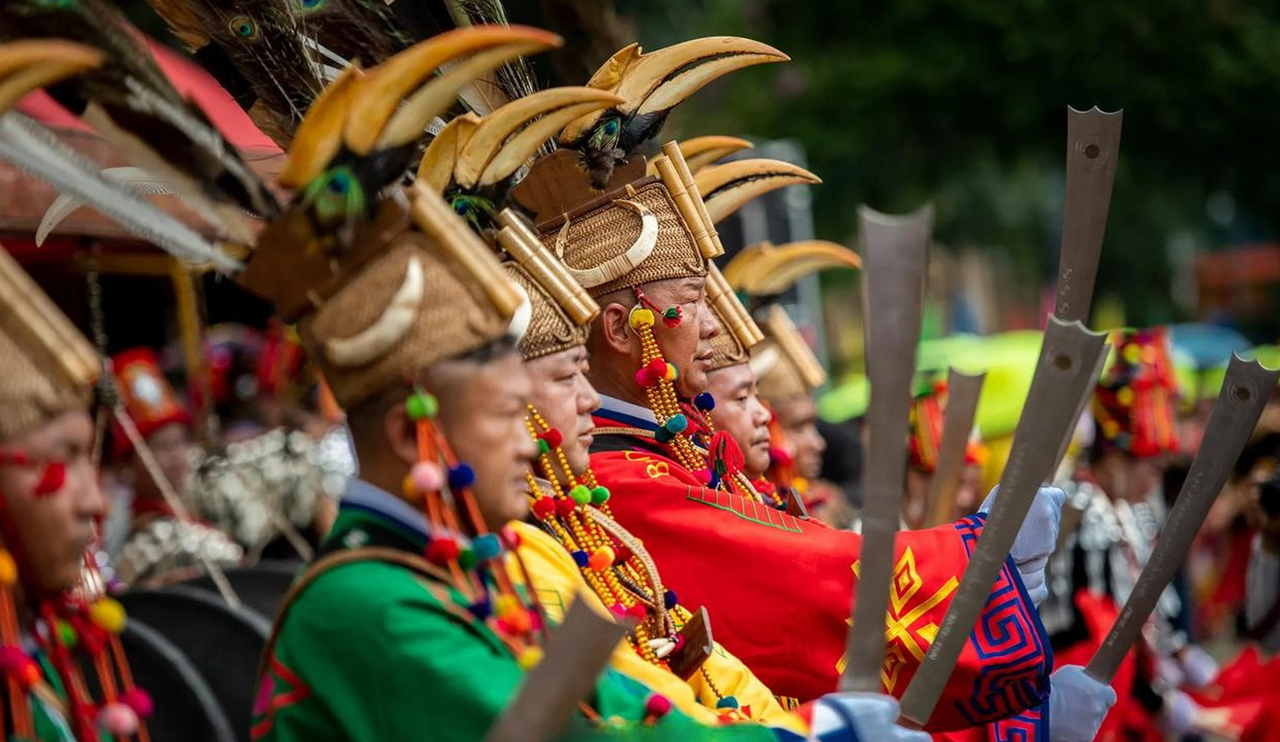
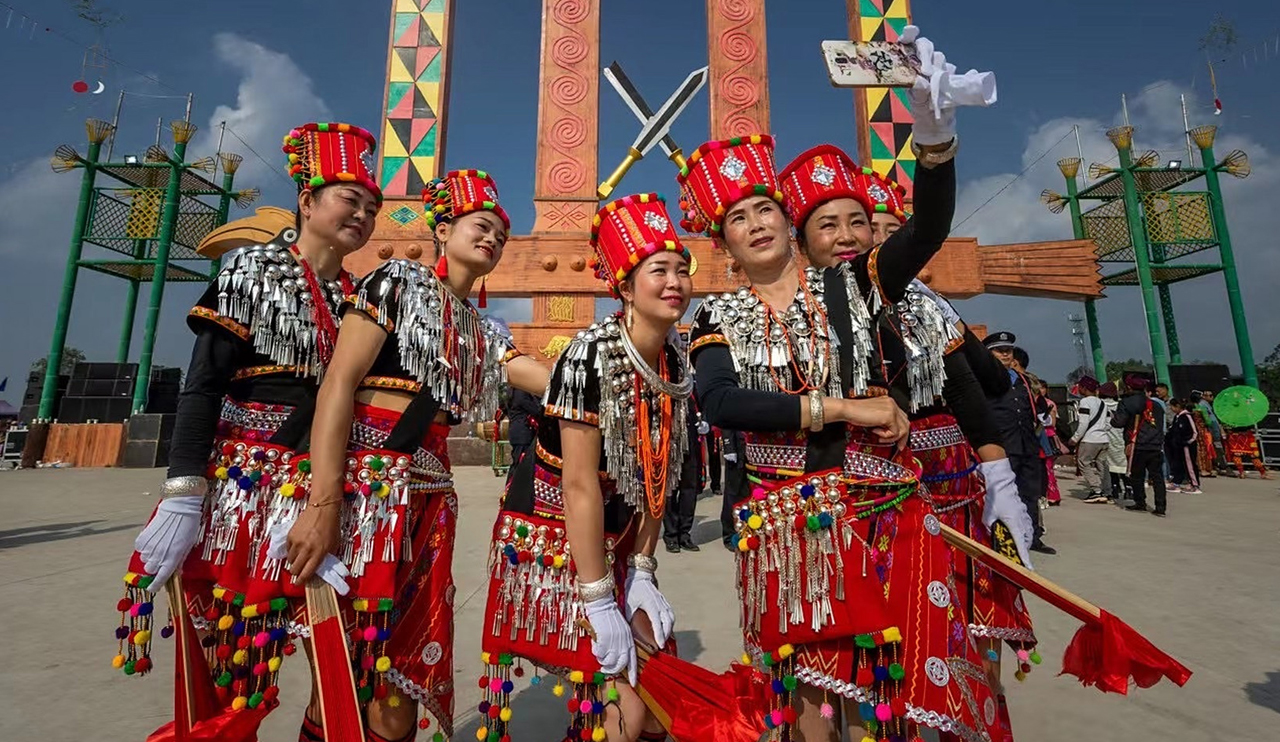
Deep in the misty mountains of southwestern Yunnan Province, where the monsoon forests give way to terraced hillsides and bamboo groves, a thunderous drumbeat sends ripples through the cool February air. Tens of thousands of dancers — dressed in black jackets stitched with gleaming silver ornaments, wielding swords and fans — move as one body across a vast open square. At the center of it all stand four towering wooden poles, carved with ancient symbols that tell the story of an entire people’s journey across centuries and continents.
This is Munao Zongge (目瑙纵歌), the grandest festival of the Jingpo ethnic group. It is not just a dance. It is a living archive. A prayer. A homecoming. And it has been beating, without interruption, since the days when warriors danced before marching to battle.
For travelers seeking authentic cultural experiences beyond China’s well-trodden tourist circuits, the Munao Zongge festival offers something rare: a chance to witness a tradition that has survived the passage from tribal warfare to national heritage — and that, in 2026, continues to grow stronger each year.
What Is the Munao Zongge Festival and Why Is It Celebrated?
In the Jingpo language, “Munao Zongge” carries a beautifully simple meaning: “everyone dancing together.” Some scholars also translate it as “dance in paradise” or “mass revelry dance.” The name captures the spirit of the event perfectly. This is not a performance staged for an audience. It is a collective act. Everyone present — young or old, Jingpo or visitor — is expected to join the winding columns of dancers.
The festival takes place every year around the 15th day of the first month on the Chinese lunar calendar, which typically falls in February. It lasts between three and five days, depending on the host village. The main celebration is held in Longchuan County (陇川县) in Dehong Dai and Jingpo Autonomous Prefecture, the area with the largest concentration of Jingpo people in China. However, smaller Munao Zongge events are also held in Mangshi, Ruili, Yingjiang, and other towns across Dehong.
At its heart, the festival serves several purposes at once. It is a prayer for a good harvest. It is a tribute to ancestral spirits. It is a chance for Jingpo communities scattered across the highlands to reunite and reaffirm their shared identity. And in recent decades, it has become a powerful vehicle for cultural preservation — a way for younger generations to learn the dances, songs, and stories that define who they are.
In 2006, the Chinese State Council added the Munao Zongge festival to the National List of Intangible Cultural Heritage, formally recognizing its importance not only to the Jingpo people but to the broader cultural tapestry of China.
The Jingpo People: A Tibeto-Burman Ethnic Group with Roots in the Himalayas
To understand Munao Zongge, you must first understand the people who created it. The Jingpo (景颇族) are a Tibeto-Burman ethnic group whose homeland spans three countries: China, Myanmar, and India. In Myanmar, they are called the Kachin. In India’s Assam and Arunachal Pradesh states, they are known as the Singpho. Despite these different names, they share a common language, kinship system, and set of origin myths.
According to both oral tradition and scholarly research, the Jingpo trace their origins to the Qinghai-Tibet Plateau. Over many centuries, they migrated southward through the eastern Himalayas. By the time of China’s Yuan and Ming dynasties (roughly the 13th to 17th centuries), they had settled in the mountains of what is now western Yunnan. From there, some groups continued south into the Kachin Hills of northern Myanmar.
| Key Facts About the Jingpo People | |
|---|---|
| Population in China | Approximately 150,000 (2010 census) |
| Primary location in China | Dehong Dai and Jingpo Autonomous Prefecture, Yunnan |
| Population in Myanmar (Kachin) | Estimated 630,000+ |
| Language family | Sino-Tibetan, Tibeto-Burman branch |
| Subgroups in China | Jingpo, Zaiwa, Leqi, Lang’e (Langsu), Bola |
| Traditional religion | Animism (spirit worship) |
| Intangible heritage recognition | National-level, 2006 |
The Jingpo in China are divided into five linguistic subgroups: Jingpo proper, Zaiwa, Leqi, Lang’e, and Bola. Of these, the Zaiwa are the most numerous. Though these groups speak different dialects — some not mutually intelligible — they share the same festival traditions, clan structures, and cultural practices.
For centuries, the Jingpo were highland dwellers. They practiced shifting cultivation of hill rice, supplemented by hunting and the collection of forest products such as mushrooms, wild vegetables, and medicinal herbs. The sword (nhtoi) was an essential part of daily life. Men carried long knives at all times — a custom reflected in the Munao Zongge dance itself, where male dancers wield blades as they move.
Their traditional religion is a form of animism. The Jingpo believe that spirits (nats) inhabit every part of the natural world: the sun, the rivers, the forests, even individual animals. A complex system of sacrificial rituals, presided over by shamans, governs the relationship between humans and these spirits. Munao Zongge, at its oldest, was one of these rituals.
How the Munao Dance Originated: The Legend of the Sun God’s Palace
Every great festival has its origin story. For Munao Zongge, that story involves birds, the sun, and a heavenly dance.
According to the most widely told Jingpo legend, in the ancient past, the King of the Sun invited all creatures on Earth to attend a grand carnival in the Sun Palace. Hundreds of bird species accepted the invitation and flew to the celestial court. There, they witnessed a magnificent collective dance unique to paradise — a dance of winding, spiraling columns that moved in perfect harmony.
Spellbound by this heavenly choreography, the birds learned its steps. On their return journey to Earth, they stopped in a forest filled with golden fruit. Overwhelmed with joy, they performed the dance they had learned in the Sun Palace right there among the trees.
A group of Jingpo girls happened to pass by the forest. They were captivated by the birds’ graceful movements and memorized the steps. When they returned to their village, they taught the dance to their families and neighbors. And so, the Munao dance was born — a gift passed from the heavens, through the birds, to the Jingpo people.
Another version of the legend tells a more martial tale. A fearsome demon terrorized the Jingpo homeland, devouring children and destroying crops. A brave man named Leipan rallied his people and, with the aid of the sun god, defeated the demon. To celebrate their victory, the Jingpo held a great singing and dancing gathering. This celebration became the first Munao Zongge.
Both versions share a common thread: the dance is not mere entertainment. It is a sacred act — a bridge between the human world and the spirit world, between the present and the ancestral past.
From Vows of War to Harvest Prayers: The Twelve Types of Munao Zongge Dance
One of the most remarkable aspects of the Munao Zongge tradition is its range of ceremonial applications. This is not a single dance for a single occasion. The Jingpo developed twelve distinct types of Munao, each tied to a specific life event or communal purpose.
| Type of Munao | Jingpo Name | Purpose |
|---|---|---|
| Harvest Celebration | Su Munao (苏目瑙) | Giving thanks for a bountiful crop |
| Victory Celebration | Ba Dang Munao (巴当木脑) | Honoring a triumph in battle |
| New Home Celebration | Dingshuan Munao (定栓目瑙) | Marking completion of a new residence |
| Vows of War | Deru Munao (德如目瑙) | Rallying warriors before battle |
| Foundation Celebration | Tingre Munao (亭热目瑙) | Celebrating a site selection or groundbreaking |
| Recreation | Naosai Munao (瑙赛目瑙) | General entertainment and socializing |
| Marriage Celebration | Kenran Munao (肯然目瑙) | Honoring a wedding |
| Friendship | Tingran Munao (亭然目瑙) | Forging or strengthening bonds between groups |
| Welcoming Guests | Kelong Munao (克龙目瑙) | Hosting visiting dignitaries or allies |
| Divorce | Gongran Munao (宫然目瑙) | Ritually marking a separation |
| Funeral | Zhu Munao (朱目瑙) | Honoring the deceased and guiding the spirit |
This taxonomy reveals how deeply embedded Munao Zongge is in Jingpo life. It is not a seasonal indulgence. It is a total cultural system — a way of marking every significant transition, from birth to death, from peace to war.
The wartime forms — Deru Munao (vows of war) and Ba Dang Munao (victory celebration) — are particularly significant for understanding the festival’s ancient origins. In the era before modern governance, the Jingpo were a warrior people. Highland clans raided lowland valleys. Border skirmishes with neighboring groups were common. Before a raiding party set out, the community would gather to perform a Munao dance, invoking the protection of ancestral spirits and steeling the warriors’ resolve.
After 1949, with the establishment of the People’s Republic of China, the martial function of Munao Zongge naturally faded. Today, the festival focuses on harvest gratitude, cultural pride, and community togetherness. But the warrior spirit lives on in the choreography. The swords the men carry, the fierce precision of the footwork, the disciplined columns of dancers — all of these elements echo the ritual’s battlefield origins.
The Sacred Munao Poles: Decoding the Symbols Carved into the Heart of the Festival
If the dance is the body of Munao Zongge, the Munao poles (目瑙示栋) are its soul. Erected at the center of every dance ground, these four towering wooden pillars serve as both spiritual axis and choreographic guide. Without them, there is no Munao.
The poles are elaborately carved and painted with a rich vocabulary of symbols. Each image tells a piece of the Jingpo story. Understanding these symbols is like reading a compressed history book.
Key symbols found on the Munao poles include:
- The Himalayas — Depicted on a horizontal board at the top of the pole, representing the legendary birthplace of the Jingpo people. This image connects every dancer to the distant mountains their ancestors once called home.
- Fern fronds — Fern sprouts resemble clenched fists, and their unfurling leaves look like arrows pointing forward. They symbolize unity and progress.
- Swords and spears — Placed beside the poles or carved into them, these represent the Jingpo values of bravery and resilience.
- Crops and livestock — Symbols of the people’s aspiration for prosperity and a better future.
- Gongs and musical instruments — Representing auspiciousness and joy.
- A wooden toucan and peacock — Carved on the crosspieces at either end of the pole, these birds recall the origin legend of the dance learned from the birds of the Sun Palace.
- A living bamboo pole — Erected in front of the wooden poles and topped with a horizontal board bearing the image of mountains, this represents the evergreen tree of life.
At the base of the poles, swords and spears are arranged to symbolize the bold and unyielding character of the Jingpo people. The overall effect is striking. Standing beneath the poles, surrounded by the roar of drums and the flash of silver costumes, a visitor can feel the weight of centuries pressing down through the carved wood.
Chinese scholar Shi Rui has argued that the pictograms on the Munao poles may represent a form of pictographic language once used in Jingpo religious ceremonies. Each symbol, he contends, is not isolated but part of a coherent text that guided shamans through ritual narratives. If this theory is correct, the Munao poles are not merely decorative. They are a pre-literate writing system, carved in wood rather than written on paper.
The Naoshuang and Naoba: The Sacred Lead Dancers Who Guide the Mass Dance
A Munao Zongge gathering is not a free-for-all. Despite involving tens of thousands of dancers, the event follows strict choreographic rules laid down over centuries. The key to maintaining this extraordinary order lies with two groups of ritual leaders: the Naoshuang (瑙双) and the Naoba (瑙巴).
The Naoshuang are the most important figures in the Munao dance. Traditionally, there are four of them. They are not merely skilled dancers — they are ritual specialists, often shamans or men of high spiritual authority. Their role is to lead the sacred dance itself, performing the movements that connect the human world with the spirit world.
The Naoshuang dress in striking ceremonial regalia:
- Feathered crest-like caps that tower above the crowd
- Imperial-style robes of red and green silk cloth
- Silver-colored cloaks that catch the sunlight
- Long ceremonial knives held in both hands as they dance
The four Naoshuang are arranged in two pairs. The two at the front of the dance formation are called the military pair, a direct echo of the festival’s martial origins. The two at the rear are the civil pair. Together, they represent the dual pillars of Jingpo society: strength and wisdom, war and peace.
The Naoba serve a different function. They are the dance directors, the crowd managers. While the Naoshuang perform the sacred choreography at the head of the procession, the Naoba move through the body of the dance, guiding participants to follow the correct steps and patterns. Their movements are freer and more lively than those of the Naoshuang.
The dancers themselves form two long, winding columns that spiral around the Munao poles. Men typically carry long swords or bows and arrows. Women carry fans or handkerchiefs. The columns snake forward, backward, and around, tracing patterns on the ground that are said to represent the migratory journey of the Jingpo people from the Himalayas to their present home.
The Jingpo take the discipline of the Munao dance seriously. A chaotic dance formation or out-of-step movements are considered bad omens — signs that misfortune may befall the village. Every step matters. Every pattern has meaning. This is sacred geometry, performed by thousands of bodies in motion.
What to Wear to a Jingpo Festival: Traditional Costumes and Silver Ornaments
No description of Munao Zongge is complete without discussing the breathtaking Jingpo traditional costume. The festival is, among other things, a showcase for one of the most visually striking textile traditions in all of East Asia.
Women’s Festival Attire
Jingpo women’s festival dress is an art form in itself. The standard ensemble includes:
- A black front-opening jacket densely studded with silver bubbles, plates, and tassels. The silver catches the light and creates a shimmering, almost liquid effect when the wearer moves.
- A colorful woven tube skirt (longyi-style), typically in bold patterns of red, black, and white. These skirts are made from hand-woven brocade, and the geometric patterns carry symbolic meaning passed down through generations.
- Six or seven silver neck rings, worn stacked to create a dramatic collar effect.
- Long silver earrings and thick, engraved silver bracelets.
- A string of bell-shaped silver chains that produce a distinctive jingling sound during the dance.
- A red jacquard headscarf made of wool.
Many Jingpo women also wear lacquered rattan rings around the waist, painted in red or black. It is a Jingpo belief that the more rattan rings a woman wears, the more beautiful she is — a unique beauty standard that reflects the resourcefulness of mountain life.
Men’s Festival Attire
Jingpo men’s festival costume is less ornate but no less meaningful:
- A white or black turban (white for young men, black for elders)
- A round-collared shirt in dark colors
- Short black trousers
- The ever-present tongpa (woven backpack) slung over one shoulder
- A long knife (nhtoi) at the hip — the defining accessory of a Jingpo man
During the Munao dance, the long knives are held aloft and wielded with practiced skill. The blades flash in unison as the columns of men advance and retreat, a visual reminder that this was once a warrior’s ritual.
Munao Zongge Festival Schedule and Rituals: What Happens During the Four-Day Celebration
The Munao Zongge festival in Longchuan County typically spans four to five days, from the 15th to the 19th of the first lunar month. Each day follows a rough sequence of events, though the energy and spontaneity of the celebration ensure no two years are identical.
Day One: Opening Ceremony and Sacrificial Rites
The festival opens with a sacrificial ceremony (jisai) led by Jingpo shamans and village elders. Offerings are made to ancestral spirits and to Madai, one of the most important spirits in the Jingpo animist tradition. Buffalo may be slaughtered as part of the offering. The ceremony is intended to seek the spirits’ blessing for the festivities ahead and to ensure prosperity for the coming year.
After the sacrificial rites, the Naoshuang are officially crowned. Their ceremonial regalia is presented to them, and they take their positions at the head of the dance ground. This “crowning” is a solemn ritual. Being chosen as a Naoshuang is considered a great honor.
Days Two and Three: The Grand Munao Dance
These are the core days of the festival. The Munao dance sessions typically take place in the morning and afternoon, with each session lasting around two hours. Thousands of dancers fill the square, forming two great spiraling columns around the Munao poles.
The air is thick with the sound of wooden drums, gongs, cymbals, and bamboo flutes. The rhythm is insistent and hypnotic — a deep, pounding beat that enters the body and compels movement. As Jingpo cultural promoter Zhao Baozhong has noted, the Jingpo people like to welcome the lunar new year with joyful singing and dance.
Anyone can join the dance at any point. There is no ticket, no reservation, no skill requirement. You simply step into the column and follow the person in front of you. This radical openness is central to the philosophy of Munao Zongge. It is a dance for the people, by the people.
Between dance sessions, the festival ground becomes a marketplace and social hub. Vendors sell Jingpo specialties like zhutongfan (rice cooked in fresh bamboo tubes), grilled meats, fermented rice wine, and local fruits. Craft stalls display handwoven textiles, silver jewelry, and traditional Jingpo knives.
Day Four: Closing Ceremonies and Cultural Performances
The final day often includes cultural performances beyond the Munao dance itself: folk singing contests, displays of traditional crafts, athletic competitions, and modern entertainment. In recent years, organizers have added elements like ethnic fashion shows and documentary screenings to broaden the festival’s appeal.
The closing ceremony typically includes a final Munao dance, this one tinged with the bittersweet feeling of farewell. The drums slow. The columns tighten. And then, with a final crescendo of gong and cymbal, the festival draws to a close for another year.
How Munao Zongge Became a National Intangible Cultural Heritage in China
The inclusion of Munao Zongge on China’s National List of Intangible Cultural Heritage in 2006 was a watershed moment for the festival and for the Jingpo people. This designation, granted by the State Council, recognizes the festival as a cultural practice of exceptional historical, artistic, and social value.
The recognition was not merely symbolic. It came with concrete commitments to document, preserve, and promote the tradition. Longchuan County, as the historical heartland of Munao Zongge, was designated the primary area of transmission. Local and provincial governments have since invested in maintaining the Munao dance grounds, training young Naoshuang, and recording the oral histories of elder practitioners.
The heritage designation also identified specific representative inheritors — individuals recognized for their mastery of the Munao tradition. These inheritors, such as Shang Deguang at the provincial level, serve as living links to the festival’s past. They teach the dances, explain the symbolism of the Munao poles, and ensure that the twelve types of Munao continue to be practiced correctly.
For the Jingpo, the recognition affirmed what they had always known: that Munao Zongge is not just a party. It is a comprehensive cultural system that integrates music, dance, sculpture, painting, costume design, architecture, religious ritual, and oral literature into a single, coherent expression of identity.
Munao Zongge in 2026: A Living Tradition Embracing New Visitors
The Munao Zongge festival has grown significantly in recent years. What was once a purely internal Jingpo affair has become an increasingly popular cultural tourism event, drawing visitors from across China and beyond.
During the 2023 festival in Longchuan County, for example, local authorities reported that more than 200,000 tourists visited the county during the festival period, with 60,000 people directly participating in the celebrations. These numbers represent a major increase from previous decades, when the festival was attended almost exclusively by Jingpo communities.
The cross-border dimension of the festival has also grown. Dehong Prefecture shares a 503-kilometer border with Myanmar, and many Jingpo people live on both sides. Kachin communities from Myanmar have been known to cross the border to participate in the Munao Zongge celebrations. In recent years, ethnic groups from other regions — including indigenous communities from Taiwan — have been invited to join, creating opportunities for inter-ethnic cultural exchange.
Shang Deguang, a provincial-level inheritor of Munao Zongge, has observed this shift firsthand. He has noted that the festival was once celebrated only by Jingpo people, but in recent years it has attracted people from all over the world to dance together in this grand carnival.
In 2026, the festival continues to evolve. Local organizers are exploring ways to use social media and livestreaming to share the Munao Zongge experience with audiences who cannot travel to Dehong in person. At the same time, there is a strong commitment among Jingpo cultural leaders to ensure that the sacred core of the tradition — the Munao poles, the Naoshuang rituals, the twelve types of Munao dance — remains intact and authentic.
The Jingpo Connection to Myanmar’s Kachin People: A Shared Heritage Across Borders
One of the most fascinating dimensions of Munao Zongge is its transnational significance. The Jingpo in China and the Kachin in Myanmar are, in many ways, the same people — separated by a political border but united by language, kinship, and culture.
The Kachin in Myanmar number an estimated 630,000 or more, making them a significantly larger population than the approximately 150,000 Jingpo in China. They inhabit Kachin State in northern Myanmar, a mountainous region rich in jade, timber, and gold. The Kachin have their own version of the Munao dance, which they call Manau — the same word, spelled differently.
In Kachin State, the Manau festival serves similar purposes to its Chinese counterpart: honoring ancestors, celebrating harvests, and reinforcing communal bonds. The Manau poles, carved with the same symbols found in Dehong — the Himalayas, the ferns, the swords — stand at the center of Kachin dance grounds just as they do in Longchuan.
The shared tradition of Munao/Manau is a powerful reminder that ethnic cultures do not respect national boundaries. For the Jingpo and Kachin, the dance is a common language that transcends the political complexities of the China-Myanmar border region.
Kachin participants from Myanmar have attended the Dehong celebrations on multiple occasions. As one Kachin singer from Myanmar told CGTN after attending the festival, it was his third time participating in the Munao Zongge festival in Dehong, and he expressed his hope to return again.
Traditional Jingpo Food You Must Try During the Munao Zongge Festival
No festival experience is complete without food, and Munao Zongge offers a delicious introduction to Jingpo cuisine — one of the least known but most flavorful culinary traditions in Yunnan.
Jingpo food reflects the people’s highland origins and their close relationship with the forest. Fresh ingredients, bold flavors, and inventive cooking methods define the cuisine. Here are the must-try dishes:
Zhutongfan (竹筒饭) — Rice cooked inside a fresh bamboo tube, then roasted over an open flame until the tube turns brown. The bamboo imparts a sweet, fragrant flavor to the rice. This is the signature dish of the Jingpo people and a staple at every Munao Zongge gathering.
Shaokao (烧烤) — Grilled meats and vegetables prepared over charcoal. Jingpo grilling tends to be bold, using local herbs and chili-based marinades that reflect the influence of both Yunnan and Southeast Asian flavor profiles.
Gui Niu Rou (鬼牛肉) — Buffalo meat prepared in various ways, often as part of the sacrificial feast that precedes the Munao dance. The meat is slow-cooked and seasoned with forest herbs.
Jingpo Rice Wine — A fermented rice beverage served at every celebration. It is mildly sweet, slightly sour, and dangerously easy to drink. Sharing rice wine is a core social ritual among the Jingpo.
Wild forest greens and bamboo shoots — Gathered from the surrounding mountains and prepared as side dishes, these reflect the Jingpo tradition of foraging and their deep knowledge of the local ecosystem.
How to Travel to Dehong for the Munao Zongge Festival: A Practical Guide for 2026
Dehong Dai and Jingpo Autonomous Prefecture is located in the far west of Yunnan Province, close to the Myanmar border. Getting there requires some planning, but the journey itself is part of the adventure.
By Air
The most convenient way to reach Dehong is by flying into Dehong Mangshi International Airport (IATA: LUM). The airport receives flights from major Chinese cities including Kunming, Beijing, Shanghai, Shenzhen, Chengdu, Chongqing, and Xi’an. The flight from Kunming takes approximately 45 minutes. Multiple airlines serve the route, including China Eastern Airlines, Kunming Airlines, and Ruili Airlines.
The airport is located about 6.5 kilometers from downtown Mangshi. A taxi ride to the city center costs roughly 30–50 yuan and takes about 15–20 minutes. Airport shuttle buses are also available for approximately 3 yuan.
By Road
For travelers who prefer the scenic route, the G56 Hangrui Expressway connects Kunming to Mangshi, a distance of roughly 530 kilometers. The drive takes approximately 8–9 hours and passes through some of Yunnan’s most dramatic mountain scenery.
From Mangshi, Longchuan County — the main venue for Munao Zongge — is approximately 60 kilometers further west. Regular buses connect the two towns.
By Rail
As of early 2026, there is no direct rail service to Mangshi. The Dali-Ruili Railway, which will pass through Mangshi, has been under construction and is expected to open in the coming years. Once completed, it will significantly improve access to the Dehong region.
Accommodation
Mangshi offers a range of hotels from budget guesthouses to mid-range business hotels. During the festival period, rooms fill up quickly, so booking well in advance is essential. Longchuan County has more limited accommodation options, and some travelers choose to stay in Mangshi and commute to the festival grounds by bus or taxi.
Best Time to Visit
The Munao Zongge festival falls in mid-to-late February most years (around the 15th of the first lunar month). Dehong’s climate is subtropical, and February is one of the most pleasant months to visit — warm days, cool evenings, and minimal rain. Daytime temperatures typically range from 15°C to 25°C (59°F to 77°F), though mornings and evenings can be cool, so a light jacket is recommended.
Respectful Travel Tips for Attending the Munao Zongge Festival
As with any sacred cultural event, visitors to the Munao Zongge festival should approach the experience with respect, humility, and genuine curiosity. Here are some practical tips:
Do join the dance. The Jingpo people actively welcome outsiders to participate. Stepping into the dance column is the highest form of respect you can show. Follow the person in front of you, match the rhythm, and let the drums do the work.
Do not touch the Munao poles. These are sacred objects, not props. Observe them closely, photograph them freely, but maintain a respectful distance.
Do ask before photographing individuals. Most Jingpo dancers are happy to be photographed, especially in their festival finery. But a polite request goes a long way. A smile and a nod are universal languages.
Do try the food. Accepting food and drink that are offered to you is an important social gesture in Jingpo culture. If someone hands you a cup of rice wine, accept it graciously.
Do dress modestly. While there is no formal dress code, wearing something respectful and comfortable (avoiding very revealing clothing) shows awareness of the cultural context.
Do not disrupt the sacrificial ceremonies. The opening-day rituals are the most sacred part of the festival. If you are fortunate enough to witness them, observe quietly from a distance.
The Future of Munao Zongge: Preserving Heritage in a Changing World
The Munao Zongge festival stands at an interesting crossroads. On one hand, it has never been more visible or more popular. Government support, heritage designations, media coverage, and growing tourism have brought the festival to the attention of millions who might never have heard of the Jingpo people.
On the other hand, the forces that threaten all indigenous cultural traditions — urbanization, migration, generational change, and the pull of mainstream culture — are also at work in Dehong. Young Jingpo people move to cities for education and employment. The Jingpo language, while still spoken, competes with Mandarin Chinese in daily life. The number of elders who possess deep knowledge of the twelve types of Munao and the full symbolism of the Munao poles diminishes each year.
The heritage inheritor system established after the 2006 designation has been one response to this challenge. By formally identifying and supporting master practitioners, the system creates a chain of transmission that does not depend on the old structures of village life alone.
Another response has been the expansion of the festival itself. By welcoming tourists and non-Jingpo participants, organizers are building a broader base of people who care about the tradition’s survival. When a visitor from Beijing or Tokyo or Los Angeles dances at Munao Zongge, that person becomes a stakeholder in the festival’s future — someone who will remember the drums, the silver, the spiraling columns, and perhaps return one day with friends.
The Jingpo community itself remains deeply committed. As Xu Liehong, a young Jingpo man, told CGTN, he hopes that Jingpo culture and traditions can be preserved and inherited by future generations. This sentiment is widely shared. The Munao dance is not just a performance for the Jingpo. It is who they are.
Why Munao Zongge Deserves a Place on Every Traveler’s Bucket List
In a world where authentic cultural experiences are increasingly rare, the Munao Zongge festival is the real thing. It is not a reenactment staged for tourists. It is not a sanitized theme-park version of tradition. It is a living, breathing, evolving ceremony that has carried the Jingpo people through centuries of migration, warfare, political upheaval, and social change.
What makes it extraordinary is its radical inclusiveness. This is a festival that was born on the battlefield, refined in the ritual chamber, and opened — with genuine warmth — to anyone willing to follow the drumbeat. The moment you step into the dance column, you are no longer a spectator. You are part of the story.
The Munao poles still stand at the center of the square, carved with the same symbols that have guided the Jingpo since their ancestors walked south from the Himalayas. The Naoshuang still don their feathered caps and silk robes. The drums still pound. The silver still shines.
And if you listen carefully — beneath the crash of gongs and the shouts of joy — you can still hear the echo of those heavenly birds, dancing in the Sun Palace, teaching the people of the mountains a dance that would carry them through all the ages to come.
Have you attended the Munao Zongge festival, or are you planning a trip to Dehong in 2026? Share your experiences and questions in the comments below.
Quick Reference: Munao Zongge Festival at a Glance
| Detail | Information |
|---|---|
| Full name | Munao Zongge (目瑙纵歌) |
| Meaning | “Everyone dancing together” / “Dance in paradise” |
| Ethnic group | Jingpo (景颇族) |
| Location | Longchuan County, Dehong Prefecture, Yunnan, China |
| Timing | 15th of the first lunar month (~February) |
| Duration | 3–5 days |
| Heritage status | China National Intangible Cultural Heritage (2006) |
| Nearest airport | Dehong Mangshi International Airport (LUM) |
| Key features | Mass dance, Munao poles, Naoshuang rituals, Jingpo cuisine |
| Estimated annual visitors | 200,000+ (Longchuan County) |