There is a small island in the middle of the Mediterranean Sea where a shipwreck changed everything. Not the coastline. Not the harbor. Everything — the language of prayer, the shape of community, the very soul of a nation. That island is Malta. And the shipwreck belongs to Saint Paul the Apostle.
Every year on February 10, the Maltese celebrate this event as a national holiday. In Valletta, the capital, brass bands march through narrow limestone streets. Strong men hoist a towering statue of the apostle onto their shoulders. Fireworks crack over Grand Harbour before breakfast. Old women toss confetti from wrought-iron balconies. The holiday is called San Pawl Nawfragu — the Feast of Saint Paul’s Shipwreck — and it is, without exaggeration, the founding story of Maltese identity.
But what really happened nearly two thousand years ago? Was the shipwreck a historical event or a theological invention? Where exactly did the ship go down? And why does it still matter in 2026?
These are questions worth asking. The answers take us through ancient scripture, Mediterranean storms, first-century Roman law, underwater archaeology, and the living faith of one of Europe’s most devoutly Catholic nations.
Who Was the Apostle Paul and Why Was He Sailing to Rome?
Before we talk about the wreck, we need to talk about the man.
Paul of Tarsus — originally named Saul — was born around 5 AD in what is now southeastern Turkey. He was a Roman citizen by birth and a devout Pharisee by training. His early career was defined by a fierce campaign against the followers of Jesus of Nazareth. He was, by his own admission, a persecutor of the early Church.
Then came his dramatic conversion on the road to Damascus, one of the most pivotal moments in Christian history. After that experience, Paul became Christianity’s most tireless missionary. He crossed thousands of miles of Roman territory by land and sea. He planted churches in cities from Antioch to Corinth. He wrote letters that would become foundational texts of the New Testament — Romans, Corinthians, Galatians, Philippians.
But Paul also made powerful enemies. In Jerusalem around 57–58 AD, he was arrested following riots at the Temple. As a Roman citizen, he exercised his legal right to appeal his case to Caesar in Rome. This was not a casual request. Under Roman law, a citizen’s appeal to the emperor was binding. The local governor had no choice but to send him to the imperial capital for trial.
And so, sometime around 60 AD, Paul was placed aboard a ship bound for Rome. He was a prisoner, guarded by a centurion named Julius. But he was not alone. Traveling with him was his companion Luke — a physician, a careful observer, and the man who would write down everything that happened next.
What Does the Bible Say About Saint Paul’s Shipwreck in Malta?
The account of the shipwreck is found in Acts of the Apostles, chapters 27 and 28. It is one of the most detailed travel narratives in all of ancient literature. Luke, the author of Acts, wrote with a precision that has impressed historians for centuries.
Here is what the text describes.
The Voyage Begins
Paul, Luke, and a fellow believer named Aristarchus boarded a merchant vessel at Caesarea on the coast of modern Israel. They sailed north along the coast of modern Turkey, stopping at the port of Myra in the province of Lycia. There, the centurion Julius transferred the prisoners to a large Alexandrian grain freighter bound for Italy.
These grain ships were the cargo giants of the Roman world. They carried wheat from Egypt to feed the population of Rome. Ancient records suggest that the largest of them could carry several hundred passengers along with their cargo. Luke notes that there were 276 people aboard — a figure that scholars consider plausible for a vessel of this type.
The Storm Called Euroclydon
The ship crept westward along the southern coast of Crete. It was already late in the sailing season — past the autumnal equinox, when Mediterranean voyages became treacherous. Paul warned the crew and the centurion that continuing would end in disaster. They ignored him.
Shortly after leaving the port of Fair Havens in Crete, a violent northeastern storm struck. Luke calls it Euroclydon (sometimes rendered as Euraquilo), a term that modern meteorologists identify as a fierce wind blowing from the east-northeast. This type of storm — sudden, powerful, relentless — is well documented in Mediterranean weather patterns during October and November.
The crew lost control. The wind seized the ship and drove it southwest. They passed the small island of Cauda (modern Gavdos), south of Crete. The sailors hauled in the ship’s dinghy, wrapped ropes under the hull to reinforce it, and lowered the sea anchor. They were terrified of being driven onto the Syrtis sandbars off the Libyan coast — a notorious ship graveyard in the ancient world.
Fourteen Days of Darkness
For two full weeks, the storm raged. The crew threw cargo and tackle overboard to lighten the ship. Neither the sun nor the stars appeared for many days. Luke writes that “all hope of our being saved was at last abandoned.”
Then Paul stood up and told the crew that an angel had visited him during the night. The angel said: every person aboard would survive. The ship would be lost, but they would wash up on an island.
The Approach to Land
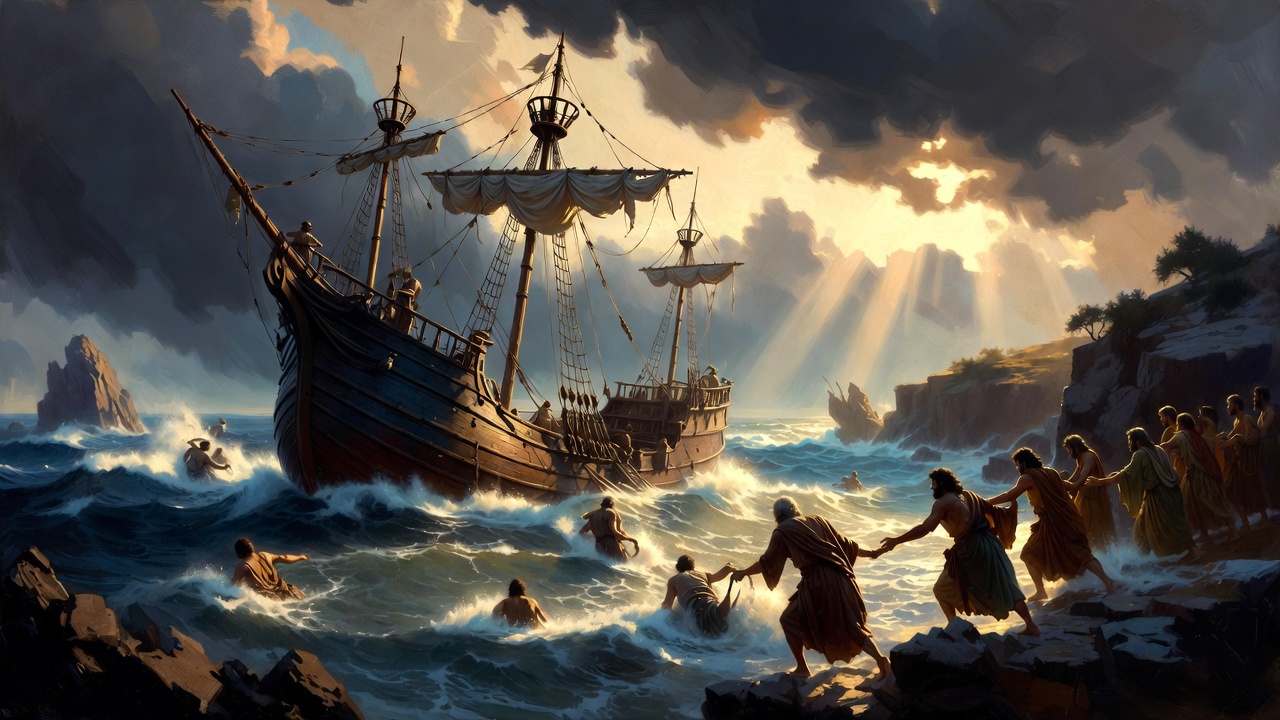
On the fourteenth night, around midnight, the sailors sensed land. They took depth soundings and measured twenty fathoms (about 120 feet). A short time later, they measured again — fifteen fathoms (about 90 feet). The seabed was rising fast.
Fearing rocks in the darkness, they dropped four anchors from the stern and waited for dawn. Some sailors tried to escape in the ship’s boat, but Paul warned the centurion, and the soldiers cut the ropes and let the boat fall away.
At daylight, they saw a bay with a beach. They cut the anchor ropes, loosened the rudder, raised the foresail, and aimed for shore. But the ship struck a sandbar — a place where, as Luke writes, “two seas met” — and ran aground. The bow jammed fast. The stern began breaking apart under the pounding waves.
The soldiers wanted to kill the prisoners to prevent escape. But the centurion Julius, wanting to save Paul, stopped them. He ordered those who could swim to jump first. The rest clung to planks and pieces of the ship.
All 276 people reached shore alive.
The Island Is Called Malta
Acts 28:1 delivers the critical line: “Once safely on shore, we found out that the island was called Melita.”
Melita is the ancient Greek and Latin name for Malta.
Where Did Saint Paul’s Ship Actually Run Aground in Malta?
This is where things get interesting — and where scholars, archaeologists, and armchair detectives have argued for centuries.
The Traditional Site: Saint Paul’s Bay
For roughly 500 years, the accepted location of the shipwreck has been St. Paul’s Bay (Il-Bajja ta’ San Pawl) on the northeastern coast of Malta. This tradition dates to around 1575 and is deeply embedded in Maltese culture. A carved statue of Saint Paul stands on the small island just offshore — St. Paul’s Island, also known as Selmunett — and was erected in 1845. Pope John Paul II visited the island by boat during his trip to Malta in 1990.
The bay is beautiful, historically significant, and beloved by the Maltese. But there is a problem.
No physical evidence from the shipwreck has ever been found at St. Paul’s Bay.
Despite extensive underwater searches by professional divers and archaeologists, no anchors, no ship timbers, no Roman-era artifacts have surfaced at this location. This is not for lack of trying. The seabed has been thoroughly surveyed.
Furthermore, several details in Luke’s account do not align well with the geography of this bay. The northern coast of Malta features many harbors that Roman sailors would have recognized — making it unlikely that the crew “did not recognize the land,” as Acts 27:39 states. The coastline on the north and west of Malta is also dominated by cliffs, which contradicts the description of a bay with a sandy beach.
The Alternative Site: Saint Thomas Bay
In recent decades, a compelling alternative has emerged. Former Los Angeles crime scene investigator Bob Cornuke, working with the Biblical Archaeology Search and Exploration (BASE) Institute, spent more than a decade investigating a different location: St. Thomas Bay (Il-Bajja ta’ San Tumas) on the southeastern coast of Malta.
Cornuke approached the biblical text the way he would approach a cold case. He identified four criteria from Acts 27 and 28 that the true shipwreck site must satisfy:
| Biblical Criterion | Description |
|---|---|
| A bay with a beach | The crew saw a bay with a sandy shore at dawn |
| A reef or sandbar where “two seas meet” | The ship struck a place where currents collide |
| Correct depth soundings | Twenty fathoms, then fifteen fathoms as they approached |
| A location unfamiliar to the sailors | The crew did not recognize the island from this angle |
St. Thomas Bay, Cornuke argued, satisfies all four criteria. It faces the open Mediterranean to the southeast — the direction from which a ship driven by a northeast storm from Crete would approach Malta. The bay has a sandy beach. Just offshore lies the Muxnar Reef, a dangerous sandbar where cross-currents converge — a textbook location for a place where “two seas meet.”
And then came the anchors.
The Mystery of the Four Lost Anchors from Paul’s Shipwreck
The most dramatic piece of evidence in this investigation involves the anchors. According to Acts 27:29, the crew dropped four anchors from the stern. When dawn came, they cut the anchor ropes and let the anchors sink to the bottom (Acts 27:40). Those anchors should still be out there — somewhere on the Maltese seabed.
At St. Paul’s Bay, despite decades of searching, no anchors have been found.
But near St. Thomas Bay, something remarkable turned up.
Cornuke met a Maltese diver named Ray Ciancio who told him that back in the early 1960s, he and fellow divers had recovered four anchors from the seabed just outside St. Thomas Bay, near the Muxnar Reef. The anchors were found at approximately 90 feet of depth — exactly matching the fifteen-fathom sounding recorded in Acts 27:28. All four were found within a 40-yard radius of each other, consistent with anchors dropped from a single ship’s stern.
The anchors were later donated to Malta’s National Maritime Museum. Expert analysis confirmed that they were Roman-era anchor stocks, dating to the correct historical period. Professor Anthony Bonanno of the University of Malta’s Department of Classics and Archaeology examined one of the preserved stocks and confirmed it was consistent with first-century Roman anchoring equipment used on Alexandrian grain ships.
Does this prove these were Paul’s anchors? Certainty is impossible at a distance of nearly two millennia. But the convergence of evidence is striking:
- Four anchors, matching the biblical number
- Found at the correct depth recorded by Luke
- Located near a reef where two seas meet
- Adjacent to a bay with a sandy beach
- Dating to the correct century
- On the southeastern shore of Malta — the only approach consistent with a ship driven by a northeast gale from Crete
As Cornuke put it, solving this was like working a crime scene with the Bible as the case file.
Is the Biblical Account of Paul’s Shipwreck Historically Accurate?
This is a question that has fascinated scholars for generations. And the evidence, it must be said, is remarkably strong.
Classical historian Colin Hemer, in his landmark study The Book of Acts in the Setting of Hellenistic History, identified 84 historically verifiable facts in the final sixteen chapters of Acts. From chapters 27 alone — the shipwreck narrative — Hemer confirmed 16 specific details that align with what we know from independent historical and geographical sources.
These include:
- The correct names of ports and islands along the route
- The proper identification of prevailing wind patterns in the eastern Mediterranean
- The accurate use of the Greek nautical term bolisantes for taking depth soundings
- The correct depth of the water approaching Malta
- The appropriate position for a ship driven before an easterly gale
- The accurate description of Roman military law regarding the liability of guards who let prisoners escape
Luke, it must be remembered, did not have access to modern charts or satellite imagery. He was writing from direct observation aboard a storm-battered ship. The precision of his narrative has led many historians — including non-religious ones — to conclude that this is genuine eyewitness testimony.
Meteorological analysis supports the account as well. Maritime weather expert Dr. Graham Hutt, who studied Mediterranean storm patterns for over 30 years, concluded that a ship leaving Crete and driven by a sustained northeast gale would drift on a compass bearing of approximately west-northwest — directly toward Malta. The distance from the island of Cauda to Malta is roughly 477 nautical miles. At the drift rate Luke’s account implies, the crossing would take approximately fourteen days — exactly the duration recorded in Acts 27:27.
The shipwreck account in Acts is not a parable. It is not a metaphor. It reads like a ship’s log — because, in all likelihood, that is precisely what it is.
Was Saint Paul Really Shipwrecked on Malta or on Another Island?
Not everyone agrees that Malta is the correct island. Over the centuries, two main alternative theories have been proposed.
The Mljet (Croatia) Theory
During the medieval period, some scholars argued that the “Melite” mentioned in Acts 28:1 was not Malta but rather Mljet — a small island in the Adriatic Sea off the coast of modern Croatia. This theory was most fully developed in 1730 by the Ragusan scholar Ignjat Đurđević in a book-length argument that used linguistic, historical, and geographical analysis to challenge Malta’s claim.
Đurđević pointed out that Luke describes the ship as sailing in the Adriatic Sea (Acts 27:27). In the modern sense, the Adriatic lies between Italy and the Balkan coast — far from Malta. However, ancient geographers used the term “Adria” much more broadly. First-century writers, including the Jewish historian Josephus, used “Adria” to describe the entire open sea between Crete, Sicily, Italy, and North Africa. This broader ancient usage is now well established among scholars, and it effectively undermines the Mljet theory’s strongest argument.
Furthermore, Mljet’s location creates problems for the onward journey described in Acts 28. After leaving the island, Paul sailed to Syracuse in Sicily — a route that makes perfect geographic sense from Malta but is awkward and illogical from Mljet.
The Kefalonia (Greece) Theory
A more recent challenge came from German theologian Heinz Warnecke, whose 1987 doctoral dissertation argued that Paul was shipwrecked not on Malta but on the Greek island of Kefalonia in the Ionian Sea. Warnecke noted that a promontory on Kefalonia bore the ancient name Melite, and he argued that the island’s cooler, rainier autumn climate better matched Luke’s description of the castaways warming themselves by a fire in the rain.
Warnecke’s thesis generated scholarly attention. His doctoral supervisor called it “a groundbreaking contribution,” and some reviewers praised the rigor of his analysis. However, the theory has not gained broad acceptance. The navigational details in Acts — the compass bearing, the drift duration, the depth soundings, the subsequent voyage to Syracuse — all point more naturally to Malta than to Kefalonia.
The Scholarly Consensus
The overwhelming majority of biblical scholars, historians, and maritime experts continue to identify Malta as the island described in Acts 28. The name Melita, the navigational data, the archaeological context, and nearly two millennia of continuous local tradition all support this conclusion.
Malta’s claim is not perfect — no historical claim at this distance ever is. But it is far stronger than any alternative.
Saint Paul’s Miracles in Malta: The Viper and the Healing of Publius
The shipwreck was only the beginning of Paul’s story in Malta. What happened after he came ashore cemented his place in the island’s memory forever.
The Snake That Did Not Kill
According to Acts 28:2, the islanders showed the survivors “unusual kindness.” They built a fire on the beach because it was cold and raining. As Paul gathered brushwood and placed it on the fire, a viper emerged from the heat and fastened onto his hand.
The Maltese onlookers assumed Paul was a murderer — a man whose guilt the gods had caught up with at last, even after he survived the sea. They waited for his hand to swell or for him to drop dead.
Neither happened. Paul shook the snake off into the fire and suffered no harm.
The locals changed their minds. They decided he must be a god.
A note on snakes in Malta: Modern Malta has no native venomous snakes, which has led some critics to question this detail. However, the ecology of the island has changed dramatically over two thousand years. Deforestation, agricultural development, and habitat loss could easily have eliminated species that once thrived there. Several scholars have pointed out that neighboring Mediterranean islands still host viper populations, and there is no reason to assume Malta’s ancient fauna was identical to its modern one.
The Healing of Publius’s Father
Paul’s most significant miracle on Malta involved a man named Publius, whom Luke describes as “the chief man of the island” (protos tes nesou in Greek). This title has been independently confirmed by archaeology — inscriptions found in Malta use the Latin equivalent primus to describe the island’s leading Roman official.
Publius welcomed Paul and his companions, hosting them for three days. His father was suffering from fever and dysentery — possibly malaria, which was endemic in the Mediterranean at the time. Paul prayed for the old man, laid hands on him, and healed him.
Word spread. Other sick islanders came to Paul, and he healed them too. In gratitude, when Paul finally left Malta three months later, the islanders supplied him with everything he needed for the onward voyage to Rome.
Publius is traditionally honored as the first Bishop of Malta, making the Maltese islands one of the earliest Christian communities in the Roman Empire. According to tradition, Publius later served as Bishop of Athens and was martyred under Emperor Hadrian around 125 AD.
How Saint Paul’s Shipwreck Shaped Malta’s Christian Identity for 2,000 Years
It is difficult to overstate what this event means to Malta.
The shipwreck did not just bring a man to the island. It brought a faith. And that faith became — and remains — the defining feature of Maltese civilization.
An Unbroken Christian Heritage
Malta’s Christian tradition stretches back to Paul’s three-month stay in 60 AD, making it one of the oldest continuous Christian communities in the world. According to a 2021 survey by the University of Malta, 88% of respondents identified as Catholic. A separate 2021 State of the Nation survey found that 93% of Maltese said they believe in God. The island has over 360 churches spread across its tiny territory — roughly one church per square kilometer.
The Constitution of Malta declares that “the religion of Malta is the Roman Catholic Apostolic Religion.” This is not a dusty legal formality. It reflects a lived reality. Catholicism shapes Maltese law, education, social customs, and public holidays.
Survival Through Centuries of Upheaval
Malta’s Christian identity has survived extraordinary challenges. The islands were under Arab Muslim rule from 870 to 1091 AD. While some scholars once questioned whether Christianity survived this period, archaeological evidence — including Roman-era artifacts and early Christian catacombs — suggests that a Christian community persisted even during Islamic governance.
The Norman conquest of 1091 restored Catholicism as the official religion. The arrival of the Knights of St. John in 1530 transformed Malta into a bastion of Christian military power in the Mediterranean. The Knights held the island until Napoleon’s invasion in 1798, after which Malta eventually came under British control.
Through all of these transitions — Arab, Norman, Spanish, French, British — the Maltese clung to the story of Paul. It was their origin myth, their founding narrative, their spiritual anchor.
The Church of Saint Paul’s Shipwreck in Valletta: History and Sacred Relics
In the heart of Malta’s capital city of Valletta, on West Street (Triq il-Punent), stands the Collegiate Parish Church of Saint Paul’s Shipwreck (Il-Knisja Parrokkjali Kolleġġjata tan-Nawfraġju ta’ San Pawl). It is one of the oldest churches in Valletta, dating to 1570 — just five years after the city was founded following the Great Siege.
The church is the spiritual epicenter of the annual feast on February 10. Its interior is richly decorated in the Baroque style that defines Maltese sacred architecture. But the church’s greatest treasures are its relics:
- A portion of Saint Paul’s right wrist bone, housed in a gilded reliquary
- A marble column from Rome, traditionally associated with Paul’s martyrdom by beheading under Emperor Nero
- The titular painting depicting the shipwreck, which dominates the main altar
These relics are brought out during the feast day procession, carried through the streets of Valletta alongside the massive wooden statue of the apostle.
The church has undergone several restorations over the centuries but retains its original character — a monument built not to impress tourists, but to honor a debt that the Maltese feel they owe to a man who washed up on their shore two thousand years ago.
Saint Paul’s Grotto in Rabat: The Cave Where the Apostle Lived and Preached
If the Shipwreck Church in Valletta is the public face of Paul’s legacy, then Saint Paul’s Grotto in the town of Rabat is its intimate heart.
Rabat sits just outside the walls of Mdina, the ancient walled city that was known in Roman times as Melite — the same name Luke used for Malta itself. According to long-standing tradition, Paul lived and preached in a small cave beneath what is now the Basilica of Saint Paul during his three-month stay on the island.
The grotto is small, damp, and unpretentious. It is exactly the kind of place a shipwrecked prisoner might shelter in during a Mediterranean winter. A statue of Paul, donated by Grand Master Pinto in 1748, stands inside the cave. A silver vessel, created in 1960 for the 1,900th anniversary of the shipwreck, marks the occasion of Paul’s arrival.
The site has attracted pilgrims for centuries. Notable visitors include:
| Visitor | Year(s) |
|---|---|
| Fabio Chigi (later Pope Alexander VII) | 17th century |
| Admiral Lord Nelson | 1800 |
| Pope John Paul II | 1990 and 2001 |
| Pope Benedict XVI | 2010 |
| Pope Francis | 2022 |
The grotto is connected to the Wignacourt Museum, which houses the chaplains’ residence built by Grand Master Alof de Wignacourt in the early 1600s. Below the museum lie Punic and Roman-era catacombs — underground burial chambers that offer some of the earliest archaeological evidence of Christianity in Malta. These catacombs were also used as air-raid shelters during World War II, adding another layer of history to this already ancient site.
A popular local belief holds that the rock of the grotto possesses healing powers, owing to Paul’s presence. For centuries, devout Maltese would grind small amounts of stone from the cave walls and dissolve them in water, drinking the mixture as a cure for illness. Remarkably, despite centuries of this practice, the grotto is said to have remained the same size — a detail that believers attribute to divine intervention.
The Basilica of Saint Paul above the grotto was elevated to the rank of Minor Basilica in 2020, reflecting its continued importance to Maltese spiritual life.
Saint Paul’s Catacombs in Rabat: Archaeological Evidence of Early Christianity
Just a few hundred meters from the grotto lie the St. Paul’s Catacombs — one of Malta’s most significant archaeological sites and a powerful piece of evidence for the early spread of Christianity on the islands.
These catacombs represent the earliest and largest archaeological evidence of Christianity in Malta, according to Heritage Malta, the national agency responsible for the country’s cultural heritage. They served as burial grounds from the Punic, Roman, and Byzantine periods and remained in use as late as the 7th or 8th century AD.
The complex consists of more than 30 underground burial chambers (hypogea), interconnected by narrow passageways carved from the living rock. The main halls feature pillars resembling Doric columns and circular stone tables — triclinia — carved from single blocks of limestone. These tables were likely used for agape meals, the commemorative feasts that early Christians held to honor their dead.
The catacombs were investigated in 1894 by Dr. A.A. Caruana, a pioneer of Christian-era archaeology in Malta. Recent research has shown that the burial site formed part of a large cemetery just outside the ancient city of Melite, with a history of use stretching back to at least the 3rd or 4th century BC.
While the catacombs are not directly linked to Paul himself, they provide tangible proof that Christianity took deep root in Malta within a few centuries of his visit — exactly as the biblical narrative would predict.
How Malta Celebrates the Feast of Saint Paul’s Shipwreck on February 10
The Feast of Saint Paul’s Shipwreck is not just a religious observance. It is a national event — a public holiday, a family gathering, and a citywide spectacle rolled into one.
The feast falls on February 10 every year. In 2026, it lands on a Tuesday. It is the first major outdoor celebration of the Maltese calendar year, arriving before the warmer months that bring the island’s summer festi season.
What to Expect During the Feast
Here is what a typical February 10 looks like in Valletta:
Morning: The day begins with an early Mass at the Church of Saint Paul’s Shipwreck, often at 8:00 AM. Following the service, fireworks explode over Grand Harbour — a tradition that shocks first-time visitors who are not expecting pyrotechnics before breakfast. But in Malta, fireworks are essential to every celebration, religious or otherwise. Multiple Masses are held throughout the day.
Afternoon: An English-language Mass is typically held around 3:45 PM, welcoming the island’s international community. At approximately 5:30 PM, the first procession begins. The towering wooden statue of Saint Paul is carried out of the church on the shoulders of Valletta’s strongest men. The procession winds through the narrow streets, accompanied by brass bands in full regalia, costumed participants, and cheering crowds.
Evening: A second, larger procession takes place around 9:30 PM, accompanied by more music, more fireworks, and a palpable sense of communal joy. The day concludes with a Solemn Mass inside the Shipwreck Church.
The Human Texture of the Feast
What makes the feast special is not just the spectacle. It is the texture — the smell of roasted chestnuts and street food drifting from the stalls, the sound of the Maltese language echoing off Valletta’s honey-colored stone, the sight of elderly women leaning from balconies draped in red and gold bunting, tossing confetti as the statue passes below.
This is not a performance staged for tourists. Tourists are welcome — encouraged, even — but the feast belongs to the Maltese. It is an act of collective memory. Every procession, every prayer, every firecracker says the same thing: We remember. We are grateful. We have not forgotten the man who came to us from the sea.
Planning Your Visit to Malta for Saint Paul’s Shipwreck Feast Day 2026
If you are considering a trip to Malta for the feast, here is what you need to know.
Essential Travel Information
| Detail | Information |
|---|---|
| Date | February 10, 2026 (Tuesday) |
| Location | Valletta, Malta (main celebrations) |
| Holiday Status | National public holiday — many shops and businesses closed |
| Weather | Mild Mediterranean winter — expect 10–15°C (50–59°F), possible rain |
| Language | Maltese and English (both official) |
| Currency | Euro (€) |
| Getting There | Malta International Airport (MLA), well served by European airlines |
Key Sites to Visit
- Church of Saint Paul’s Shipwreck, Valletta — The heart of the feast. Arrive early for a seat at Mass. The church is located on West Street, a short walk from the city gate.
- Saint Paul’s Grotto, Rabat — Open daily, 9:30 AM to 5:00 PM (last admission 4:00 PM). Admission is approximately €5–6 for adults, with discounts for students and seniors. An audio guide is available in multiple languages and is highly recommended.
- Saint Paul’s Catacombs, Rabat — A separate site about 200 meters from the grotto. Open daily, 9:00 AM to 5:00 PM. Admission is approximately €5.
- Saint Paul’s Island (Selmunett) — Visible from the coast of Mellieħa in northern Malta. The statue of Saint Paul stands on the island, which is about 100 meters offshore. The island is uninhabited and can be viewed from the mainland.
- Mdina — The ancient walled city adjacent to Rabat. Once the Roman capital of Melite, it offers a stunning window into Malta’s layered history.
Practical Tips
- Book accommodations well in advance. February 10 is a major holiday, and Valletta hotels fill up.
- Dress modestly if attending Mass or visiting churches. Shoulders and knees should be covered.
- Bring an umbrella. Maltese winters are mild but can be rainy — a detail that, as Luke might note, is perfectly consistent with the biblical account.
- Try the local food. Look for pastizzi (flaky pastries filled with ricotta or peas), ħobż biż-żejt (Maltese bread with tomato and olive oil), and imqaret (date-filled pastries). Street vendors near the procession route will have plenty to offer.
The Debate Over Paul’s Shipwreck Location: Saint Paul’s Bay vs. Saint Thomas Bay
For visitors who want to dig deeper into the archaeological mystery, it is worth understanding the geography of the debate.
St. Paul’s Bay on the northeastern coast is the traditional and emotionally important site. It is the location that most Maltese identify with the shipwreck, and it is surrounded by churches, chapels, and shrines dedicated to the apostle. The bay is scenic, accessible, and deeply woven into Maltese religious life.
St. Thomas Bay on the southeastern coast is the archaeologically stronger candidate. The biblical narrative’s details — the direction of approach, the depth soundings, the reef, the sandy beach, the crew’s failure to recognize the land — all align more precisely with this location. The discovery of first-century Roman anchors near the Muxnar Reef adds material weight to the case.
For the Maltese people, the debate is less important than the event itself. Whether the ship struck ground in the north or the south, Paul came to Malta. That is what matters. The anchors are fascinating, but the faith is the point.
Still, for history enthusiasts and biblical archaeology buffs, visiting both sites offers a rich and thought-provoking experience. St. Paul’s Bay is a 20-minute drive from Valletta. St. Thomas Bay is about 25 minutes to the south. Both can easily be visited in a single day.
Why Luke’s Account of Paul’s Voyage Is Considered One of the Most Reliable Ancient Texts
It is worth pausing to appreciate just how extraordinary Luke’s narrative is from a purely literary and historical standpoint.
Ancient sea voyage accounts are rare. Detailed ones are rarer still. Luke’s description of the journey from Caesarea to Malta — covering ship types, crew decisions, weather patterns, navigational techniques, Roman military protocols, and the psychology of men facing death at sea — is considered by many classical scholars to be one of the finest surviving accounts of ancient Mediterranean sailing.
Luke was not a professional sailor. He was a physician. But he observed with the trained eye of a scientist, and he wrote with the spare precision of a man who understood that details matter.
Consider what Luke gets right:
- The type of ship — an Alexandrian grain freighter, the workhorse of Rome’s grain supply chain
- The sailing season — the dangerous window after the Day of Atonement, when Mediterranean voyages were considered risky
- The wind patterns — the northeast gale called Euraquilo, consistent with documented autumn storm systems
- The drift trajectory — west-northwest from Crete, which leads directly to Malta
- The soundings — twenty fathoms, then fifteen fathoms, matching the underwater topography off Malta’s coast
- The title of Publius — protos, confirmed by Roman-era inscriptions found on the island
No detail in Luke’s account has been conclusively disproven. This does not mean every element can be verified with certainty — it means that nothing he wrote contradicts what we know from independent sources. For a text written nearly two thousand years ago, that is a remarkable track record.
Malta’s Patron Saint: How Paul’s Legacy Lives On in Maltese Culture Today
Paul spent only three months on Malta. But his impact has lasted two millennia.
He is the island’s patron saint. His image appears on stamps, coins, and church walls across the archipelago. He is also, perhaps fittingly, the patron saint of snakebite victims — a title earned by his encounter with the viper on the beach.
Maltese culture is saturated with Pauline references. The capital city’s name, Valletta, was chosen by the Knights of St. John, but the spiritual foundation of the island predates them by fifteen centuries. When Maltese children learn their national story, the shipwreck is chapter one.
The influence extends beyond the religious sphere. Malta’s legal system, its educational curriculum, its public holidays, and its architectural landscape all bear the imprint of a Christian identity that traces directly back to Paul’s arrival.
In 2010, during his apostolic visit to Malta, Pope Benedict XVI captured this relationship in a single sentence. Speaking to the Maltese people, he declared that Paul’s arrival was the greatest gift their islands had ever received. It was a statement that resonated deeply — not because the Maltese needed to be told, but because it affirmed what they already knew.
Frequently Asked Questions About Saint Paul’s Shipwreck in Malta
When did Saint Paul’s shipwreck in Malta happen? The shipwreck occurred around 60 AD, during the reign of Emperor Nero. Paul was being transported to Rome as a prisoner to stand trial before Caesar.
How many people survived the shipwreck? All 276 people aboard the ship survived, according to Acts 27:37 and 28:1. This includes passengers, crew, soldiers, and prisoners.
How long did Paul stay in Malta? Paul remained on Malta for three months (Acts 28:11), departing on another Alexandrian ship that had wintered on the island.
Where is the Church of Saint Paul’s Shipwreck? The Collegiate Parish Church of Saint Paul’s Shipwreck is located on West Street (Triq il-Punent) in Valletta, Malta’s capital city. It was built in 1570.
Is February 10 a public holiday in Malta? Yes. The Feast of Saint Paul’s Shipwreck is a national public holiday. Schools, government offices, and many businesses close for the day.
Are there venomous snakes in Malta today? No. Modern Malta has no native venomous snakes. However, the island’s ecology has changed significantly over two thousand years, and venomous species may have existed in antiquity.
Can you visit Saint Paul’s Grotto? Yes. The grotto is located beneath the Basilica of Saint Paul in Rabat and is open daily. Access is through the Wignacourt Museum. Admission costs approximately €5–6.
Did Paul convert the Maltese to Christianity? According to tradition, Paul preached the Gospel during his three-month stay and converted many islanders. Publius, the chief official, is traditionally considered Malta’s first Christian bishop.
Final Thoughts: Why the Story of Saint Paul’s Shipwreck Still Matters in 2026
There is a reason this story endures.
It is not just because it is dramatic — though it is. A storm at sea, a ship breaking apart, 276 souls clinging to wreckage, a prisoner who turns out to be a healer. That is a story worth telling in any century.
It endures because it speaks to something deeper. It is a story about what happens when the worst possible thing — a shipwreck, a disaster, a complete loss of control — becomes the vehicle for something transformative. Paul did not choose to go to Malta. The sea chose for him. And from that accident of wind and wave came a faith that has outlasted empires.
For the Maltese, this is not ancient history. It is present tense. When they carry the statue of Paul through the streets of Valletta on February 10, they are not reenacting the past. They are living it. The faith that Paul brought to their shore is the same faith that fills their churches, shapes their families, and defines their national character.
And for visitors — whether you come as a believer, a historian, a traveler, or simply someone who loves a good story — Malta offers something rare. It offers a place where the ancient and the modern are not in tension. Where a two-thousand-year-old shipwreck is not a relic in a museum case but a living, breathing, firework-exploding, confetti-throwing, brass-band-marching part of everyday life.
Go to Malta on February 10. Stand in the crowd. Listen to the music. Watch the statue sway above the shoulders of the men who carry it.
And remember: it all started with a storm.