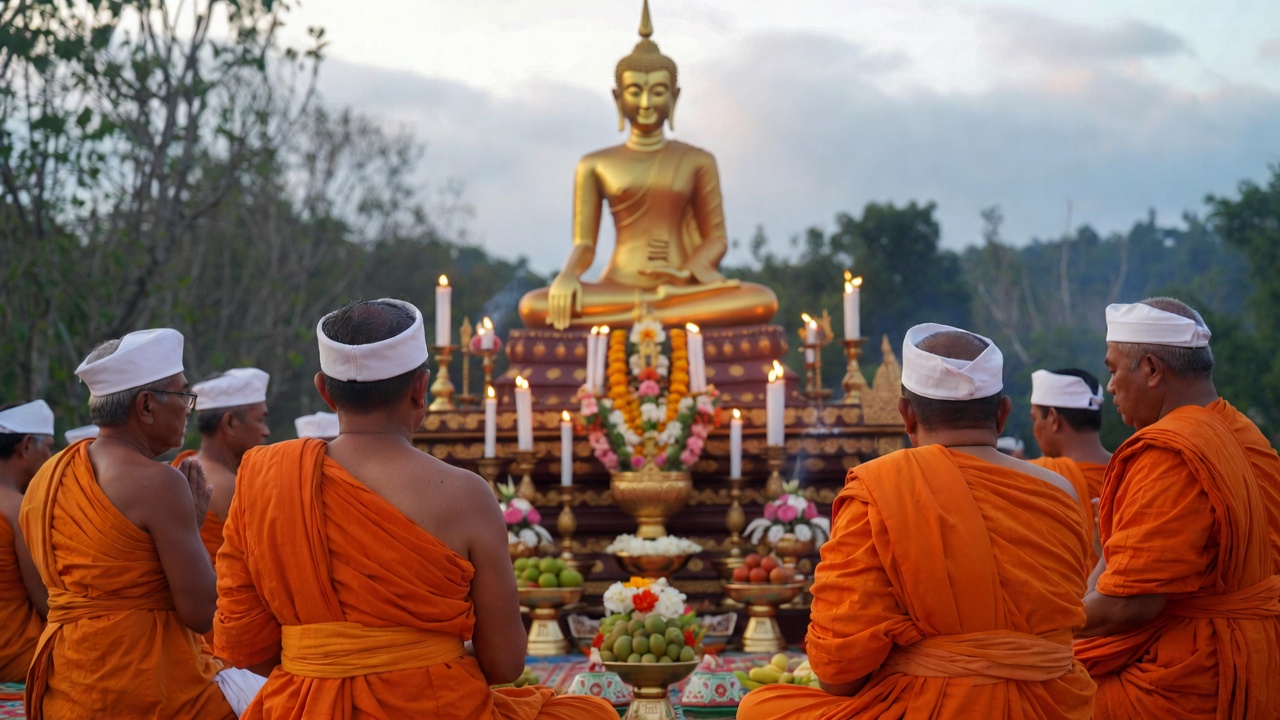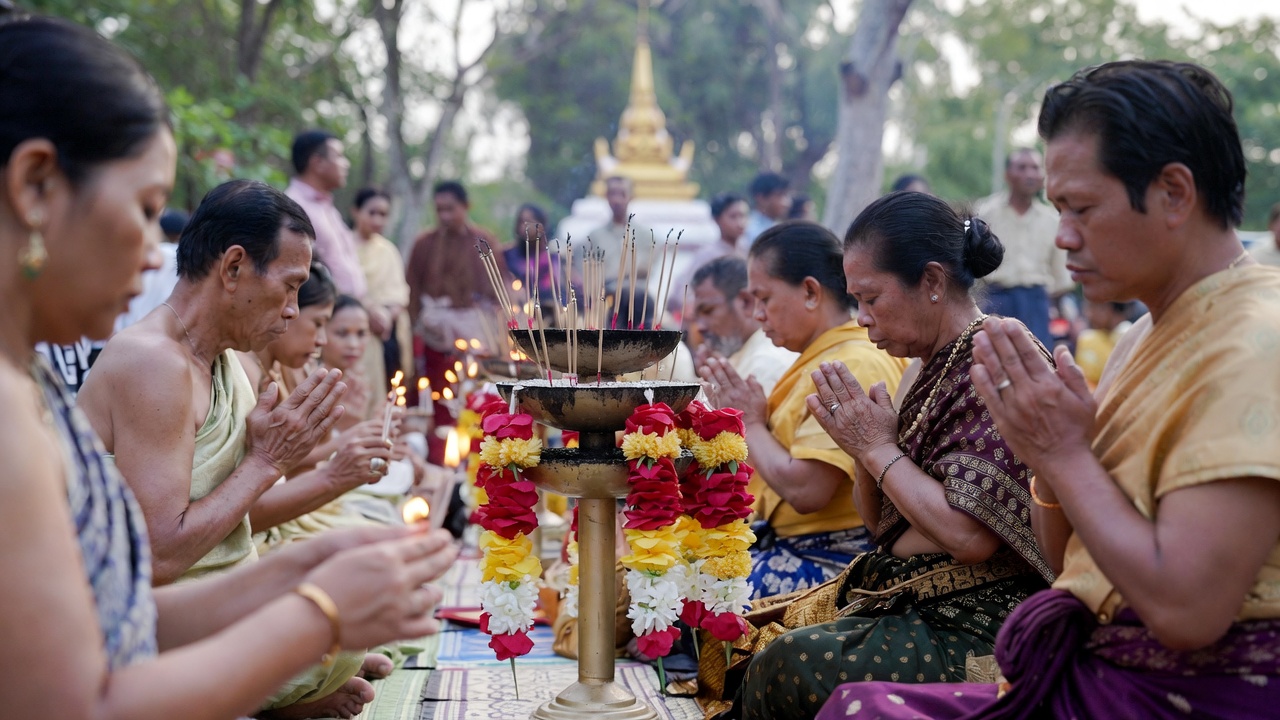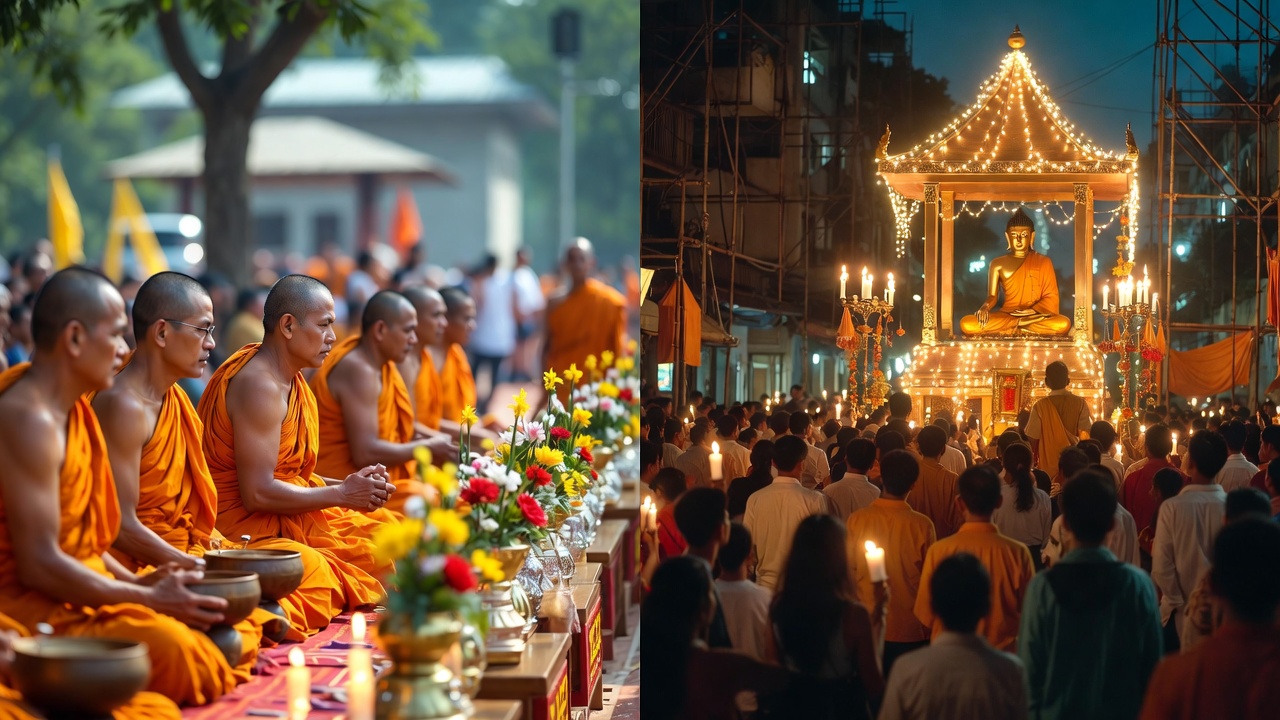
Imagine a warm evening in Southeast Asia. The full moon hangs low and heavy over a golden temple spire. Thousands of people dressed in white walk slowly in a circle, each holding a lit candle, a stick of incense, and a lotus flower. The air smells of jasmine and sandalwood. Soft chanting fills the silence between footsteps. This is Makha Bucha Day — one of the most sacred nights on the Buddhist calendar — and its roots stretch back more than 2,500 years to a single, miraculous gathering in an ancient bamboo grove in northern India.
But what exactly happened on that moonlit night so long ago? What is the “Fourfold Assembly” that gives this holy day its other name? And why does it still matter to millions of people across Thailand, Cambodia, Laos, Myanmar, and Sri Lanka today?
This guide will answer all of those questions and more. Whether you are a traveler planning to visit Southeast Asia during this festival, a student of Buddhist philosophy, or simply someone curious about the living traditions of the world, you will find everything you need to know about Makha Bucha Day right here.
What Is Makha Bucha Day and Why Is It Called the Fourfold Assembly?
Makha Bucha Day, also known as Māgha Pūjā, is the second most important Buddhist festival after Vesak (Visakha Bucha). It is observed every year on the full moon day of the third lunar month, which usually falls in February or March on the Western calendar. In 2026, Makha Bucha Day falls on Tuesday, March 3 in Thailand, while Cambodia observed its equivalent, Meak Bochea, on February 2, 2026.
The word “Makha” comes from the Pali term “Māgha,” referring to the third lunar month. “Bucha” (or “Pūjā”) means “to honor” or “to worship.” So the name simply translates as “worship on the full moon of the third month.”
But the festival also carries a second, more evocative title: Fourfold Assembly Day — in Pali, Cāturaṅgasannipāta. This name refers to four extraordinary conditions that all came together on that single full-moon evening over two millennia ago. These four conditions were so rare and so perfectly aligned that Buddhist tradition regards them as nothing short of a miracle.
Here are the four factors of the Fourfold Assembly:
| Factor | Description |
|---|---|
| 1. Spontaneous Gathering | Exactly 1,250 disciples came to see the Buddha without any prior invitation or appointment. |
| 2. All Were Arahants | Every one of the 1,250 monks had already attained arahantship — full enlightenment. |
| 3. All Ordained by the Buddha | Each disciple had been personally ordained by the Buddha himself — they were his direct spiritual heirs. |
| 4. Full Moon Day | The gathering took place on the full moon of the month of Māgha, the third month of the lunar calendar. |
Because four remarkable conditions converged at once, the event earned the name “Fourfold Assembly.” It is this assembly — and the teaching the Buddha delivered during it — that Makha Bucha Day honors every year.
The Historical Origins of Makha Bucha Day in Buddhist Scripture
To truly understand Makha Bucha, you need to step back in time. The story begins about nine to ten months after the Buddha’s enlightenment under the Bodhi tree in Bodh Gaya. By this time, Siddhartha Gautama — now the awakened Buddha — had already begun teaching the Dharma. He had delivered the famous Fire Sermon. He had converted many followers, including the three Kassapa brothers and their combined following of one thousand monks. He had also gained two of his most celebrated disciples: Sāriputta and Moggallāna, each of whom brought an additional 250 followers.
Where the Fourfold Assembly Took Place: Veluvana Bamboo Grove Near Rajgir
The miraculous gathering occurred at the Veḷuvana (Bamboo Grove Monastery), located near the ancient city of Rājagaha — present-day Rajgir in the state of Bihar, northeastern India. This park had been gifted to the Buddha by King Bimbisāra of the Magadha kingdom. Surrounded by tall walls of bamboo, the grove was quiet, peaceful, and close enough to the city for the monks to collect their daily alms. The Buddha spent several of his early rainy-season retreats here, and many important early discourses were preached at this very site.
According to Buddhist sources, the Bamboo Grove was selected because it was “not too near the city, calm by day and night, free from biting insects, and having mild air and tanks of cool water.” It was, in every way, ideal for meditation and teaching.
Today, the Veḷuvana remains a place of pilgrimage. Visitors to Rajgir can still walk through a green park with a large central pond, clusters of bamboo, and stone markers indicating the ancient history beneath their feet. It is one of eight great pilgrimage sites associated with the life of the historical Buddha.
Why 1,250 Monks Gathered Without Being Called
What makes the Fourfold Assembly so remarkable — and so sacred in Buddhist memory — is that none of these 1,250 monks were summoned. There was no letter, no messenger, no arrangement. Each of them, independently, felt moved to travel to the Bamboo Grove on the same full-moon evening.
Who were these monks? Buddhist commentaries identify the majority as followers of the recently converted three Kassapa brothers — Uruvelā Kassapa, Nadī Kassapa, and Gayā Kassapa — who together brought about one thousand monks. The remaining 250 were followers of the elders Sāriputta (known for his supreme wisdom) and Moggallāna (known for his extraordinary psychic powers). All 1,250 had achieved the state of arahant, meaning they had freed themselves from all mental defilements and would not be reborn.
Their unprompted arrival, all on the same day and at the same place, is regarded in Theravāda Buddhism as a profound demonstration of the Sangha’s spiritual unity and devotion. It was as if the collective gravity of the Buddha’s enlightenment had drawn them together like iron filings to a magnet.
What Is the Ovādapātimokkha: The Buddha’s Core Teaching on Makha Bucha Day
Once the 1,250 arahants had gathered before him in the Bamboo Grove, the Buddha delivered one of the most important teachings in the entire Pali Canon. This sermon is known as the Ovādapātimokkha (sometimes spelled Ovāda Pāṭimokkha), and it is often described as a summary of the heart of Buddhism in just three stanzas of verse.
The teaching is recorded in the Dhammapada commentary and other Pali texts. Its central message can be distilled into three principles that every Buddhist — monk or layperson — is called to follow:
- Sabbapāpassa akaraṇaṃ — “Cease from all evil.”
- Kusalassūpasampadā — “Do what is good.”
- Sacittapariyodapanaṃ — “Purify your own mind.”
These three lines are known as the “Teaching of All Buddhas” because, according to tradition, every fully awakened Buddha in every age has taught these same principles.
The full text of the Ovādapātimokkha continues with further guidance for the monastic community:
“Patience and forbearance are the highest austerity. The awakened ones say nibbāna is the highest. One is certainly not a wanderer if one injures others; one is not an ascetic if one harms another.”
And:
“Not abusing, not injuring, and restraint under the rules of discipline, and knowing moderation in eating, and secluded lodgings, and exertion in respect of higher thought — this is the teaching of the awakened ones.”
These verses, just 16 lines in Pali, served as a kind of constitution for the early Sangha. They outlined not only the moral foundation of Buddhism but also the practical code of conduct that monks would carry with them as they spread the Dharma across the Indian subcontinent and, eventually, across all of Asia.
The Ovādapātimokkha is still chanted today in temples across Thailand, Cambodia, Laos, Myanmar, and Sri Lanka on the evening of Makha Bucha Day, keeping alive a continuous thread of recitation that stretches back to the very beginning of the Buddhist monastic tradition.
Makha Bucha Day and the Buddha’s Announcement of His Passing
There is a second, more somber event that gives Makha Bucha Day an additional layer of meaning. According to Theravāda tradition, it was also on a full-moon day of the month of Māgha — 45 years after the Fourfold Assembly — that the Buddha, then residing at Vesālī (present-day Vaishali in Bihar), made a stunning announcement.
He told his disciples that in three months’ time, he would enter Parinibbāna — the final passing beyond death and the cycle of rebirth. Tradition records that after this announcement, the earth itself trembled.
While these two events — the Fourfold Assembly and the announcement of the Buddha’s death — occurred decades apart, both took place on the same lunar date: the full moon of Māgha. Their convergence on the calendar binds together a message of beginning and ending, of teaching and letting go. On Makha Bucha, Buddhists remember both the moment the Dharma was first summarized for the Sangha and the moment when the teacher himself prepared to leave the world behind.
This duality gives Makha Bucha a unique emotional texture. It is a day of celebration and gratitude for the gift of the Buddha’s teaching, but also a day of reflection on impermanence — one of Buddhism’s most fundamental truths.
How King Rama IV Established Makha Bucha as a Modern Thai Celebration
For centuries, the way traditional Buddhist societies in Southeast Asia marked this lunar date varied widely. Little is known about how pre-modern communities in Lan Na (northern Thailand), Lan Xang (Laos), or the Khmer kingdoms observed it. Some evidence suggests that in northern and northeastern Thailand, Buddhists worshiped sacred relics during the Māgha period, but there was no standardized national celebration.
The modern observance of Makha Bucha Day as a formal ceremony can be traced to the reign of King Mongkut, Rama IV of Thailand (1804–1868). A scholar-monk who spent 27 years in the monastic order before ascending the throne, Rama IV recognized the deep religious significance of the Fourfold Assembly. He reasoned that the miraculous gathering was “a foundation of faith and a sense of urgency” — an event so important that it deserved formal recognition and honor.
In 1851, Rama IV instituted the first formal Makha Bucha ceremony. It was held in the Temple of the Emerald Buddha (Wat Phra Kaew) within the Grand Palace in Bangkok. That first celebration was relatively intimate: 31 monks from the royal temples of Wat Bowonniwet Vihara and Wat Ratchapradit gathered in the evening to recite the Ovādapātimokkha in both Pali and Thai. Lanterns were lit around the ordination hall, and the king or his representative attended annually.
A recitation text used for this first ceremony is attributed to Rama IV himself. His successor, King Chulalongkorn, Rama V (1853–1910), expanded the practice further. As part of his broader campaign to centralize and standardize Thai Buddhism, Rama V organized Makha Bucha as a national celebration centered on the Temple of the Emerald Buddha. In 1913, it was officially designated as a public holiday, ensuring that ordinary Thais across the kingdom — not just those in the royal court — could participate.
Makha Bucha has remained a public holiday in Thailand ever since. In Buddhist Era year 2569 (2026 CE), it continues to be one of the most widely observed religious events in the country.
How Makha Bucha Day Is Celebrated in Thailand in 2026
In 2026, Makha Bucha Day falls on Tuesday, March 3. As a national public holiday, all schools, government offices, and most banks will be closed. Many private businesses also close or operate on reduced hours.
The day’s observances generally follow a pattern that moves from morning merit-making to evening candlelight procession.
Morning: Almsgiving and Temple Visits
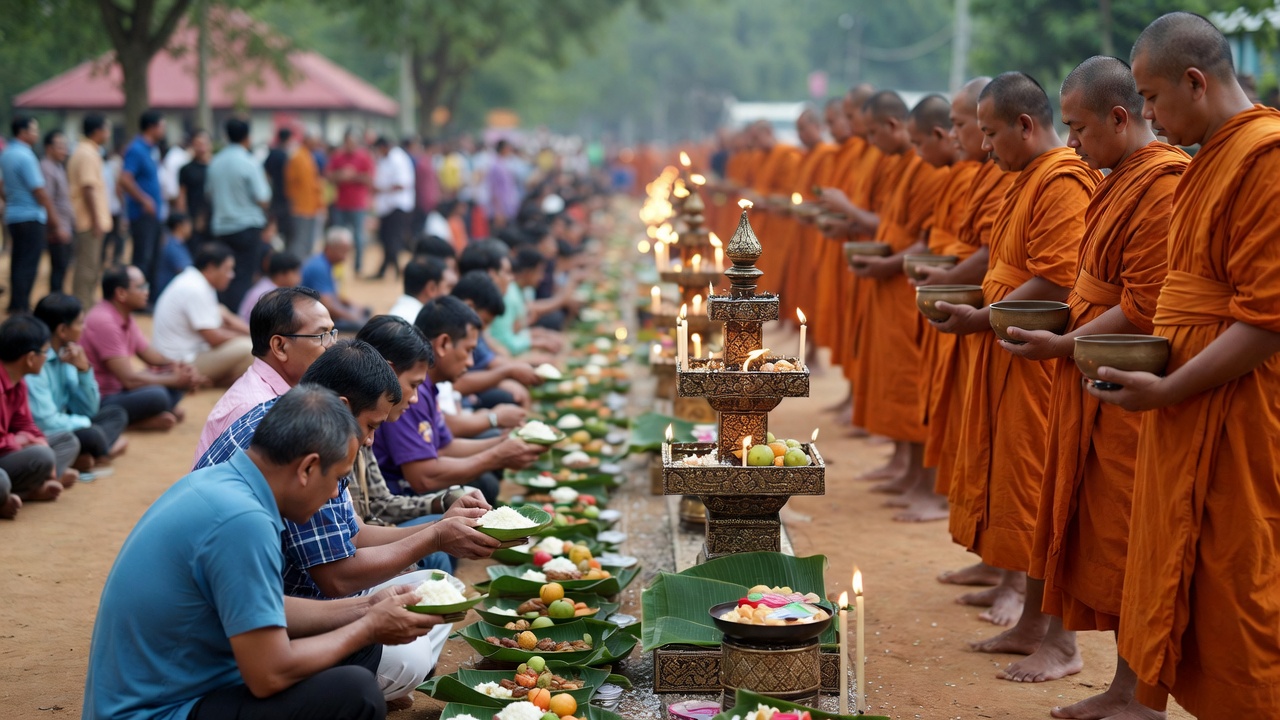
Thai Buddhists traditionally rise early on Makha Bucha morning to prepare food for the monks. Families gather at their local temples to offer cooked rice, curries, fruits, and other items to the Sangha. This practice of dāna (generosity) is considered one of the most powerful ways to generate good karma.
After the almsgiving, many devotees stay at the temple to listen to sermons, practice meditation, and observe the Five Precepts — the basic ethical guidelines that all lay Buddhists strive to follow. Some practitioners go further, taking on the Eight Precepts for the day. These additional vows include eating only before noon, avoiding entertainment, and sleeping on a simple mat — essentially living for one day as a monk.
Evening: The Wian Thian Candlelight Procession
The most visually striking element of Makha Bucha is the Wian Thian — a candlelight circumambulation that takes place at temples across Thailand after sunset. “Wian” means “to walk around” and “Thian” means “candle.”
Here is how it works:
- Devotees gather in the temple courtyard, each carrying a lit candle, three sticks of incense, and a lotus flower or garland.
- Led by monks, the congregation walks clockwise around the main ordination hall (ubosot) three times.
- Each circuit honors one of the Three Jewels of Buddhism: the first for the Buddha, the second for the Dharma (his teachings), and the third for the Sangha (the monastic community).
- The walk is done in silence or with soft chanting, creating a meditative atmosphere as hundreds or thousands of flickering candles move slowly through the darkness.
The scene is profoundly moving. Under the full moon, with only candlelight illuminating the faces of the walkers, the Wian Thian feels timeless — as if you could be witnessing the same act of devotion that has been performed for generations.
The Nationwide Alcohol Ban on Makha Bucha Day
As one of Thailand’s five major Buddhist holidays, Makha Bucha Day carries a ban on the sale of alcohol. This prohibition has been in effect since 2015 and applies to shops, restaurants, convenience stores, and bars across the country.
However, the rules were updated in May 2025 when Prime Minister Paetongtarn Shinawatra signed new regulations allowing limited exceptions. Under the updated rules — published in the Royal Gazette on May 9, 2025 — alcohol may now be sold on Buddhist holidays at:
- International airport terminals
- Licensed entertainment venues in designated tourist zones
- Hotels registered under the Hotel Act
- Venues hosting national or international events
For the majority of shops, restaurants, and local bars, however, the ban still applies. Travelers visiting Thailand during Makha Bucha should plan accordingly. Most experienced travelers see the alcohol-free day as an opportunity to fully immerse themselves in the spiritual atmosphere rather than a restriction.
Thailand’s “National Day of Gratitude”
In 2006, the Thai government declared Makha Bucha Day to be a “National Day of Gratitude” — a day to celebrate spiritual love, family bonds, and thankfulness. This rebranding was partly designed as a culturally rooted alternative to Valentine’s Day, which Thai authorities had associated with risky behavior among young people.
A 2017 poll by the National Institute of Development Administration (NIDA) found that 58 percent of Thai respondents did not know the religious significance behind Makha Bucha, and 75 percent were unaware of its designation as a Day of Gratitude. At the same time, a separate Dusit Poll showed that 75 percent of respondents could correctly identify that Makha Bucha marks the day the Buddha taught the Ovādapātimokkha, and 66 percent knew it commemorated the spontaneous gathering of 1,250 disciples.
These findings suggest that while many Thais may not articulate the theological details, the broad cultural memory of Makha Bucha remains strong.
Best Temples to Visit for Makha Bucha Day Celebrations in Thailand
Not all temple celebrations are alike. Some are grand spectacles drawing tens of thousands; others are quiet neighborhood affairs. Here are some of the most noteworthy places to experience Makha Bucha in Thailand:
Wat Phra Dhammakaya, Pathum Thani (Near Bangkok)
The Dhammakaya Temple is famous for staging the most visually spectacular Makha Bucha celebration in all of Thailand — and perhaps the entire Buddhist world. In 2025, Wat Phra Dhammakaya celebrated Makha Bucha by lighting over 100,000 lanterns around its massive, UFO-shaped cetiya. Over 5,000 monks and 35,000 lay devotees attended the evening ceremony. The temple also hosted the 42nd Path of Progress Contest and the 18th World-PEC awards, with 31 international Buddhist organizations in attendance.
The sheer scale of the event — with its sea of flickering lanterns reflected in the metallic surface of the giant dome — is something that photographs cannot fully capture. If you can attend only one Makha Bucha event, this is the one that will leave the deepest impression.
Wat Phra Kaew (Temple of the Emerald Buddha), Bangkok
As the temple where King Rama IV first established the modern Makha Bucha celebration in 1851, Wat Phra Kaew carries deep historical significance. Located within the Grand Palace complex, it is Thailand’s most sacred Buddhist site. The evening Wian Thian ceremony here is attended by senior monks, government officials, and often members of the royal family.
Wat Saket (The Golden Mount), Bangkok
Perched atop a forested hill in the old quarter of Bangkok, Wat Saket offers one of the most atmospheric Makha Bucha settings in the capital. The candlelight procession winds around the base of the golden chedi, with panoramic views of the city spreading out below. Entry is typically free on Makha Bucha night.
Chiang Mai Temples: Wat Phra Singh, Wat Umong, Wat Chedi Luang
In Thailand’s northern cultural capital, Makha Bucha was only introduced in the 1960s by a monk named Paññananda Bhikkhu. While the celebrations here are generally quieter and more intimate than in central Thailand, they offer a different kind of beauty. At Wat Umong, a forest temple built into tunnels beneath a hillside, the atmosphere is especially contemplative. At Wat Phra Singh and Wat Chedi Luang, you can join local families in the Wian Thian under centuries-old temple walls.
Buddhamonthon, Nakhon Pathom
Located about 45 minutes west of Bangkok, Buddhamonthon is a vast Buddhist park centered on a towering bronze statue of the walking Buddha — over 15 meters high. The Makha Bucha procession here draws large crowds and takes on a particularly grand feel thanks to the open landscape and monumental scale of the site.
How Makha Bucha Is Celebrated Across Southeast Asia: Cambodia, Laos, Myanmar, and Sri Lanka
While Thailand has the most well-known Makha Bucha traditions, the festival is observed — with distinct local character — in several other Theravāda Buddhist nations.
Meak Bochea in Cambodia
In Cambodia, the festival is known as Meak Bochea (មាឃបូជា). It was once a national public holiday, but in 2019, the Cambodian government removed it from the official holiday list in an effort to reduce the total number of paid days off and improve economic competitiveness.
Despite losing its public holiday status, Meak Bochea remains deeply important to Cambodian Buddhists. In 2026, Meak Bochea was observed on February 2 at pagodas throughout the country. In Siem Reap, significant ceremonies were held at historic temples like Wat Damnak and Wat Bo. In Phnom Penh, the observance centered on Wat Phnom and Wat Ounalom, as well as the sacred hilltop site of Oudong.
Cambodian Meak Bochea carries special emotional weight because of the country’s history. During the Khmer Rouge era (1975–1979), Buddhist practices were brutally suppressed, monasteries were destroyed, and monks were killed or defrocked. The revival of celebrations like Meak Bochea after the fall of the regime became a powerful symbol of cultural resilience and religious freedom.
Cambodian celebrations tend to be quieter and more family-oriented than their Thai counterparts. Devotees dress in white, offer food and robes to monks in the morning, listen to Dharma talks in the afternoon, and join the candlelight circumambulation (known as Bochea Broteab) after sunset. Some communities also release captive animals — birds, fish, or turtles — as acts of merit.
Maka Busa Day in Laos
In Laos, the festival is called Maka Busa Day (or Boun Makha Bouxa). Like in Thailand, it is celebrated with almsgiving, temple visits, and candlelight processions. The observance is part of the broader rhythm of the Lao Buddhist year, which closely mirrors the Thai calendar but with its own local traditions and regional customs.
Tabaung Full Moon in Myanmar
In Myanmar (Burma), the equivalent observance falls on the full moon of Tabaung, the final month of the Burmese calendar. The celebrations are marked by public sermons, alms distribution, pagoda festivals, and acts of community service. Many Burmese Buddhists use the occasion to donate to charity, serve food to the poor, and sponsor the ordination of young monks.
Medin Poya in Sri Lanka
Sri Lanka observes the full moon of the month of Medin, which corresponds roughly to the same lunar date. In the Sri Lankan tradition, this day is considered the occasion when the Buddha appointed Sāriputta and Moggallāna as his two chief disciples. Temples hold special meditation sessions, and devotees perform acts of merit throughout the day.
The Ovādapātimokkha and Its Relevance to Modern Buddhist Practice
At its core, the Ovādapātimokkha — the teaching delivered during the Fourfold Assembly — is a call to ethical simplicity. Its three principles — cease from evil, do good, purify the mind — sound almost deceptively basic. And yet, as many Buddhist teachers point out, the simplicity of these words is the whole point.
In a world of complexity, distraction, and moral ambiguity, the Ovādapātimokkha cuts through everything. It does not demand elaborate rituals or philosophical sophistication. It asks three things, and it asks them of everyone — monks and laypeople, scholars and farmers, the learned and the unlettered.
The teaching is also notable for what it does not say. It does not prescribe belief in any particular doctrine. It does not require faith in supernatural beings or cosmological systems. Instead, it focuses entirely on action and intention: what you do, and the state of mind from which you do it.
For many modern practitioners, this makes the Ovādapātimokkha feel remarkably timeless. Whether you live in a rural village in Isan or a high-rise apartment in downtown Bangkok, the challenge is the same: to live with greater kindness, greater integrity, and greater awareness.
On Makha Bucha Day, when these words are chanted again in temples across Southeast Asia, they carry the weight of over 2,500 years of continuous practice. The monks who recite them today are, in a very real sense, participating in the same act of transmission that began when the Buddha spoke to those 1,250 arahants in the Bamboo Grove at Rajgir.
Makha Bucha Day 2026: Practical Travel Tips for Visitors
If you are planning to be in Southeast Asia during Makha Bucha in 2026, here is what you need to know:
Key Dates for 2026
| Country | Local Name | Date in 2026 | Public Holiday? |
|---|---|---|---|
| Thailand | Makha Bucha (มาฆบูชา) | Tuesday, March 3 | Yes |
| Cambodia | Meak Bochea (មាឃបូជា) | Monday, February 2 | No (removed in 2019) |
| Laos | Maka Busa / Boun Makha Bouxa | Varies (full moon, 3rd lunar month) | Yes |
| Myanmar | Tabaung Full Moon | Varies (full moon of Tabaung) | Yes |
| Sri Lanka | Medin Poya | Varies (full moon of Medin) | Yes |
What to Wear
If you plan to visit a temple on Makha Bucha Day, dress modestly. Cover your shoulders and knees. Many Thai and Cambodian devotees wear all-white clothing to symbolize purity. While this is not required for foreign visitors, it is a respectful choice. Remove your shoes before entering any temple building.
What to Bring
- A white candle (often available at the temple entrance for a small donation)
- Three sticks of incense
- A lotus flower or small garland
These items are used during the Wian Thian circumambulation. Most temples will have vendors or donation stations where you can easily obtain them.
Photography Etiquette
You are generally welcome to photograph the Wian Thian procession, but be discreet and respectful. Avoid using flash during chanting or meditation. Do not position yourself between monks and the Buddha image. When in doubt, observe what local devotees are doing and follow their lead.
Alcohol Awareness
Remember that in Thailand, the sale of alcohol is restricted on Makha Bucha Day. While the 2025 regulations introduced exceptions for hotels, airports, and licensed entertainment venues in tourist zones, most shops, convenience stores, and local restaurants will not sell alcohol. If you want to enjoy a drink, purchase it the day before or dine at a hotel restaurant.
Getting to Temples
In Bangkok, the BTS Skytrain and MRT subway can get you close to many major temples. Wat Saket is accessible from MRT Hua Lamphong station (about a 10-minute walk). For Wat Phra Dhammakaya in Pathum Thani, free shuttle buses are often arranged from designated meeting points during the Makha Bucha celebration. Check the temple’s website or social media for details.
In Chiang Mai, most of the key temples — Wat Phra Singh, Wat Chedi Luang, and Wat Umong — are located within or near the old city moat and are easily reachable by bicycle, songthaew, or a short tuk-tuk ride.
Understanding the Five Precepts and Eight Precepts on Makha Bucha Day
Many Buddhists use Makha Bucha as an opportunity to recommit to the moral foundations of their practice. The Five Precepts (Pañcasīla) are the baseline ethical code for all lay Buddhists:
- Refrain from taking life — Do not kill any living being.
- Refrain from stealing — Do not take what is not given.
- Refrain from sexual misconduct — Act with integrity in relationships.
- Refrain from false speech — Do not lie.
- Refrain from intoxicants — Avoid alcohol and drugs that cloud the mind.
On Makha Bucha, some devout practitioners go further and observe the Eight Precepts (Aṭṭhasīla), which add:
- Refrain from eating after noon.
- Refrain from entertainment, cosmetics, and adornment.
- Refrain from sleeping on high or luxurious beds.
These additional vows give the layperson a taste of monastic discipline for one day. By stripping away comforts and distractions, the practitioner creates space for deeper meditation, self-reflection, and spiritual growth.
The Difference Between Makha Bucha, Visakha Bucha, and Asalha Bucha
For travelers and newcomers to Thai Buddhism, the three major Buddhist holidays can be confusing. Here is a clear comparison:
| Holiday | What It Commemorates | Typical Date |
|---|---|---|
| Makha Bucha | The Fourfold Assembly: 1,250 arahants gather; the Buddha delivers the Ovādapātimokkha | Full moon, 3rd lunar month (Feb–Mar) |
| Visakha Bucha (Vesak) | The Buddha’s birth, enlightenment, and death (Parinibbāna) — all on the same date | Full moon, 6th lunar month (May–Jun) |
| Asalha Bucha | The Buddha’s first sermon (Dhammacakkappavattana Sutta) at the Deer Park in Sarnath | Full moon, 8th lunar month (Jul–Aug) |
All three are public holidays in Thailand. All three involve morning almsgiving, daytime merit-making, evening Wian Thian processions, and a ban on alcohol sales. But each commemorates a different milestone in the Buddha’s life and teaching.
Visakha Bucha is considered the most sacred of the three because it marks the three pivotal events of the Buddha’s existence. Makha Bucha focuses specifically on the Sangha — the community of practitioners — and the ethical foundation laid down in the Ovādapātimokkha. Asalha Bucha honors the moment when the Buddha first “turned the wheel of the Dharma,” setting the teaching in motion.
Frequently Asked Questions About Makha Bucha Day
Is Makha Bucha Day only celebrated in Thailand? No. It is observed in Thailand, Cambodia, Laos, Myanmar, and Sri Lanka, as well as by Buddhist communities around the world. However, it is most prominent in Thailand, where it is a national public holiday with widespread participation.
Can non-Buddhists participate in Makha Bucha ceremonies? Yes. Temples in Thailand, Cambodia, and other Theravāda countries are generally welcoming to visitors of all faiths. You are invited to observe, join the Wian Thian procession, and offer candles and flowers. Simply dress respectfully and follow the lead of the local community.
Why do the dates for Makha Bucha change every year? Because the festival is based on the lunar calendar, its date shifts from year to year on the Western (Gregorian) calendar. It always falls on the full moon of the third lunar month, but that full moon might land anywhere from late January to early March.
What is the significance of walking three times around the temple? Each of the three circuits represents one of the Three Jewels (Triratna) of Buddhism: the Buddha, the Dharma (teaching), and the Sangha (community). Walking around the temple is a form of paying respect and generating merit.
Is Makha Bucha related to Valentine’s Day? In an interesting cultural crossover, Makha Bucha sometimes falls near February 14. In 2006, the Thai government promoted it as a “National Day of Gratitude” to offer a Buddhist alternative focused on spiritual love, family appreciation, and kindness — as a contrast to the commercialized aspects of Valentine’s Day.
The Enduring Meaning of the Fourfold Assembly in a Modern World
Makha Bucha Day is more than a holiday. It is a living link to one of the founding moments of the Buddhist tradition. Every candle lit on this night, every step taken around a temple, every recitation of the Ovādapātimokkha echoes back to that evening in the Bamboo Grove when 1,250 enlightened monks gathered, unasked, to sit at the feet of their teacher.
The message the Buddha delivered that night was simple and universal. Cease from evil. Do good. Purify the mind. Two and a half millennia later, in a world of smartphones and satellite communication, these words have lost none of their power.
For the millions of Buddhists who observe Makha Bucha across Southeast Asia, the Fourfold Assembly is not just a historical event. It is a model for how a community should be: unified, disciplined, compassionate, and devoted to wisdom. It is a reminder that the Dharma was never meant to be hoarded by a single teacher but was always intended to be shared — carried outward into the world by those who had received it.
If you find yourself in Thailand, Cambodia, Laos, or Myanmar on this sacred full-moon night, step away from the tourist trail for a few hours. Walk to the nearest temple. Light a candle. Join the procession. Feel the warm night air on your skin, listen to the chanting, and watch the full moon rise above the temple spire.
In that moment, across the distance of 2,500 years, the Bamboo Grove and the modern temple are one and the same.
Makha Bucha Day 2026 falls on Tuesday, March 3 in Thailand. Plan your trip, pack your white clothes, and prepare to witness one of Southeast Asia’s most beautiful and meaningful Buddhist traditions.