A journey through 3,000 years of the Persian New Year celebration, from Zoroastrian fire temples to modern-day festivities across the globe
Spring arrives with the scent of hyacinths, the sound of families gathering, and the promise of renewal. For over 300 million people worldwide, this moment means one thing: Nowruz. The Persian New Year, which translates to “New Day,” is far more than a calendar observance. It is a living bridge connecting ancient Persia to the modern world.
Every year on the vernal equinox (March 20 or 21), communities from Tehran to Toronto set elaborate tables, jump over fires, and embrace loved ones. But how did this celebration begin? What spiritual beliefs shaped its rituals? And how has Nowruz survived conquests, political upheavals, and the passage of millennia?
This guide explores the complete history of Nowruz—from its roots in Zoroastrian cosmology to its recognition as a UNESCO Intangible Cultural Heritage. Along the way, we will examine the mythology, the traditions, and the remarkable cultural resilience that keeps this ancient festival alive.
What Is Nowruz? Understanding the Persian New Year Festival
Nowruz (also spelled Novruz, Navruz, Nooruz, or Nauryz) marks the first day of the Iranian calendar. The word comes from Persian: Now means “new” and Ruz means “day.” Together, they describe the essence of this celebration—a fresh beginning aligned with nature’s awakening.
The holiday falls on the spring equinox, the precise astronomical moment when day and night are equal in length. This timing is not accidental. Ancient Persians built observatories to calculate this exact instant. Today, official announcements still mark the second when the new year begins.
Key facts about Nowruz:
| Aspect | Details |
|---|---|
| Meaning | “New Day” in Persian |
| Date | March 20 or 21 (vernal equinox) |
| Duration | 13 days of celebrations |
| Practitioners | Over 300 million people globally |
| Origin | Zoroastrian Persia, over 3,000 years ago |
| UNESCO Status | Inscribed in 2009; International Nowruz Day declared March 21, 2010 |
| Countries | Iran, Afghanistan, Azerbaijan, Central Asia, parts of Balkans, and diaspora communities |
Unlike the Gregorian New Year on January 1, Nowruz connects human celebration directly to cosmic rhythms. The sun crosses the celestial equator. Warmth overtakes cold. Nature awakens. For those who celebrate, this is not metaphor—it is lived experience.
Ancient Zoroastrian Origins of Nowruz Celebration
The roots of Nowruz reach deep into the soil of Zoroastrianism, one of the world’s oldest monotheistic religions. Founded by the prophet Zarathushtra (Zoroaster), likely around 1500–1000 BCE, this faith shaped Persian identity for centuries.
Zoroastrianism centers on a cosmic struggle between Ahura Mazda (the god of light, truth, and goodness) and Angra Mainyu (the spirit of darkness and chaos). This dualism permeates every aspect of the faith, including its calendar and festivals.
The Spiritual Significance of Spring in Zoroastrian Belief
For Zoroastrians, the spring equinox carried profound meaning. The return of warmth and light was not merely pleasant weather—it was a triumph of good over evil. Winter represented the forces of Angra Mainyu. Spring signaled their retreat.
According to Encyclopaedia Britannica, Nowruz is tied closely to Rapithwin, the personification of summer and noon in Zoroastrian tradition. During winter, Rapithwin retreats underground, driven away by the Spirit of Winter. On Nowruz, at noon, Rapithwin returns. The celebrations honor this symbolic victory.
This belief resonates with Zoroastrian eschatology. The faith foretells an eventual apocalypse followed by a return to divine peace. Nowruz, with its theme of renewal, offers a yearly preview of that final restoration.
The Zoroastrian Calendar and Sacred Number Seven
The Zoroastrian calendar organized time around religious observances. Nowruz was the most significant festival, marking one of the holiest days of the year.
The number seven holds sacred meaning in Zoroastrian cosmology. Seven represents the Amesha Spentas (Holy Immortals)—divine beings who embody aspects of Ahura Mazda’s creation:
- Sky
- Earth
- Water
- Plants
- Animals
- Fire
- Humans
This reverence for seven directly influenced Nowruz traditions. The Haft-Sin table (seven items beginning with “S”) that families prepare today echoes this ancient numerological significance.
Fire: The Sacred Element of Nowruz Rituals
Fire holds unique importance in Zoroastrianism. It represents purity, divine light, and the spark of wisdom. Zoroastrian priests maintained eternal flames in fire temples. These flames were never polluted—not by breath, not by cooking, not by disposal of refuse.
Nowruz rituals incorporate fire prominently. The Chaharshanbe Suri fire festival, held on the last Tuesday before the new year, involves jumping over bonfires. However, as Pasargad Tours notes, modern fire-jumping differs from strict Zoroastrian practice. A devout Zoroastrian would never leap over sacred fire for entertainment. The contemporary celebration represents a folk evolution of ancient reverence.
The Mythology of King Jamshid and the Origin of Nowruz
Every great festival needs a founding story. For Nowruz, that story belongs to King Jamshid (also known as Yima or Jam), a legendary ruler from Persian mythology.
The Legend of Jamshid in the Shahnameh
The Shahnameh (Book of Kings), written by the poet Ferdowsi around 1000 CE, records the epic history of Persian kings—both mythical and historical. According to this text, Jamshid was the fourth king of the mythical Pishdadian dynasty.
Jamshid’s reign was a golden age. He conquered demons, organized society into classes, invented medicine, and taught humans to weave silk and forge iron. Under his rule, there was no disease, no death, no deception.
But Jamshid’s greatest act was creating Nowruz itself.
The Throne That Lit the Sky
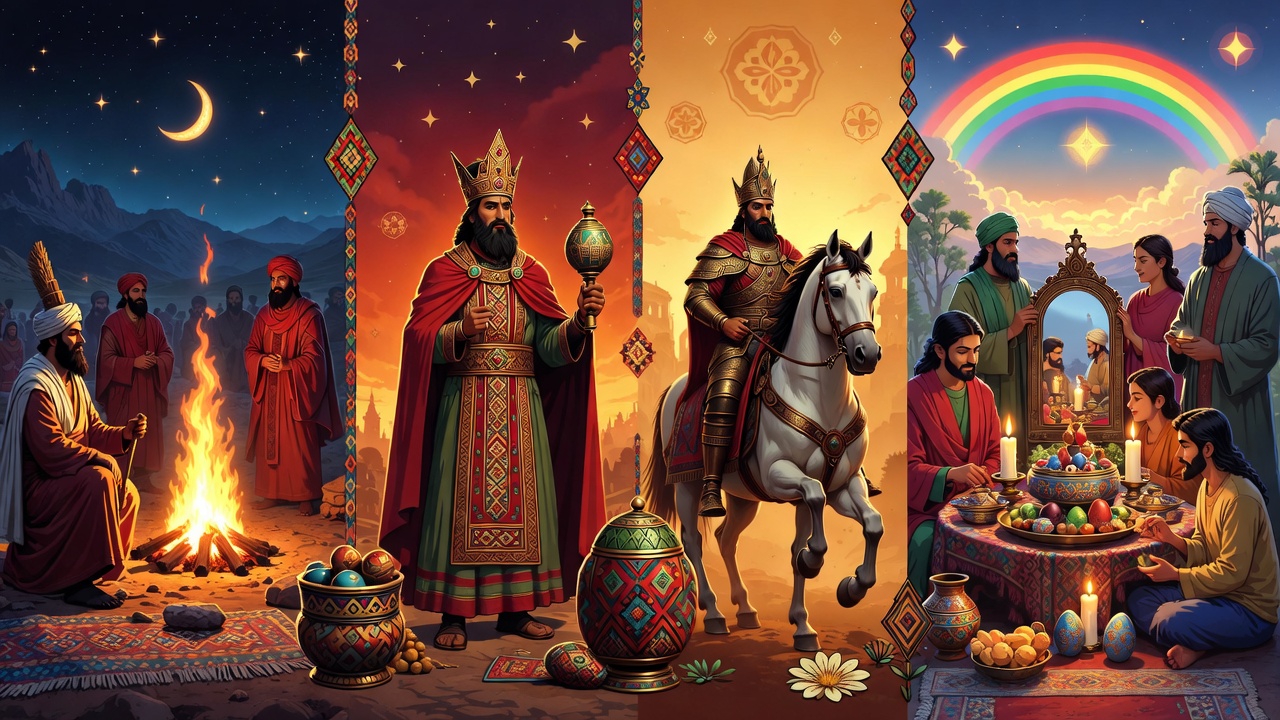
The legend tells that Jamshid commanded demons to build him a magnificent throne, encrusted with precious gems. Once completed, he ordered the demons to lift this throne into the sky.
As Jamshid rose toward the heavens, sunlight struck the jewels. The throne blazed with color, illuminating the world below. Plants turned green. Trees bloomed. Life itself seemed to awaken.
The people, amazed by this radiance, declared the moment a “New Day”—Nowruz. They showered their king with even more treasures and established the tradition of celebrating this day each year.
The Deeper Meaning Behind the Myth
This story is not meant as literal history. Rather, it encodes important cultural values:
- Light conquers darkness: Jamshid, shining like a second sun, represents the triumph of illumination over obscurity.
- Human agency in creation: The king does not passively receive blessings; he actively creates the conditions for renewal.
- Community celebration: The people recognize the New Day together, making Nowruz a collective experience.
The myth also contains a cautionary element. Jamshid eventually became arrogant. He demanded worship as a god, forgetting that his blessings came from Ahura Mazda. He lost his divine grace (farr) and was overthrown by the tyrant Zahhak. This downfall reminds celebrants that Nowruz is about humility before nature and the divine—not personal glorification.
How Nowruz Was Celebrated at Persepolis During the Achaemenid Empire
If mythology provides Nowruz with its founding story, archaeology offers concrete evidence of its ancient splendor. Persepolis, the ceremonial capital of the Achaemenid Empire, stands as testimony to how Persian kings honored the New Year.
Persepolis: The Ceremonial Capital of Ancient Persia
Darius the Great founded Persepolis around 515 BCE in what is now Fars Province, Iran. The city was not an administrative center for daily governance. Rather, according to historical research, it served primarily for celebrating Nowruz and receiving tribute.
The ruins that survive today reveal:
- The Apadana Palace: A vast audience hall where the King of Kings received delegations
- The Gate of All Nations: A grand entrance symbolizing the empire’s diversity
- Elaborate stone reliefs: Depicting representatives from across the empire bringing gifts
The Grand Nowruz Ceremonies at Persepolis
Each spring, nobles from all provinces of the Achaemenid Empire journeyed to Persepolis. They came from Egypt and India, from Babylon and Central Asia. Regardless of their ethnicity or religion, they participated in Nowruz celebrations.
The stone reliefs carved into the Apadana stairs show this procession vividly. Twenty-three delegations appear, each wearing distinctive clothing and bearing unique gifts:
- Babylonians with bulls and cloth
- Medes with bowls and swords
- Ethiopians with ivory and okapi
- Lydians with horses and gold vessels
These images suggest that Nowruz was a unifying political event, not merely a religious observance. The king demonstrated his authority by receiving tribute. Subject peoples demonstrated their loyalty by presenting gifts. And everyone participated in the renewal that spring promised.
The Lion and Bull Symbol
One famous relief at Persepolis shows a lion attacking a bull. Art historians interpret this image as a Nowruz symbol. The lion represents the sun (or the constellation Leo). The bull represents the earth (or the constellation Taurus).
At the spring equinox, the sun “defeats” winter and darkness. The lion overwhelming the bull thus becomes a visual metaphor for the cosmic transition that Nowruz celebrates. According to UCI’s Jordan Center for Persian Studies, this scene may symbolize the end of winter and the beginning of spring.
Royal Generosity During Nowruz
Achaemenid kings used Nowruz to demonstrate their justice and generosity. During the festival, they would:
- Pardon prisoners convicted of minor crimes
- Forgive debts
- Distribute gifts to subjects and servants
- Release captives
These acts were not merely charitable gestures. They enacted the spiritual meaning of Nowruz—the renewal of order, the restoration of balance, the fresh start that spring represents.
The Evolution of Nowruz After the Arab Muslim Conquest of Persia
The year 651 CE marked a turning point. The Sasanian Empire, the last great Persian dynasty before Islam, fell to Arab Muslim forces. Zoroastrianism lost its status as the state religion. Many Persians converted to Islam.
Yet Nowruz survived.
Why Nowruz Persisted Under Islamic Rule
The persistence of Nowruz is remarkable. Many pre-Islamic traditions disappeared after the conquest. Why did this one endure?
Several factors contributed:
Cultural depth: By 651 CE, Nowruz had been celebrated for over a millennium. It was too embedded in daily life to erase.
Secular adaptability: Although rooted in Zoroastrianism, Nowruz could function as a civil holiday. Families could celebrate spring’s arrival without necessarily invoking Zoroastrian theology.
Agricultural necessity: For farmers, the spring equinox marked the beginning of planting season. No political or religious change could alter this practical reality.
Persian identity: As Islam spread, Persians sought ways to maintain their distinctive culture. Nowruz became a marker of ethnic and linguistic identity—a way of being Muslim and Persian simultaneously.
Documentation by Islamic Scholars
Interestingly, some of our best historical records of Nowruz come from Muslim scholars. Al-Biruni (973–1052 CE), the great polymath, documented Nowruz practices in detail. So did Omar Khayyam (1048–1131 CE), the poet-astronomer famous for the Rubaiyat.
In the 11th century, Omar Khayyam participated in calendar reform that fixed Nowruz precisely at the vernal equinox. The resulting Jalali calendar was extraordinarily accurate—more so than the Julian calendar used in Europe at the time. This reform ensured that Nowruz would not drift through the seasons as calendars fell out of sync with astronomical reality.
The Buyid and Safavid Revivals
After the initial shock of conquest, Iranian dynasties gradually reasserted themselves. The Buyids (945–1055 CE) revived many Sasanian traditions, including elaborate Nowruz celebrations at court.
Later, the Safavids (1501–1736 CE) made Nowruz a centerpiece of royal ceremony. The French traveler Jean Chardin, visiting Iran in the 17th century, described spectacular celebrations:
- Court astronomers announced the exact moment of the equinox
- Cannons and firecrackers sounded
- Musicians and dancers entertained the crowd
- Gilded eggs were exchanged as gifts
- The air was scented with wild rue (esfand) burning on braziers
These accounts show that Nowruz not only survived Islamic rule—it flourished.
Understanding the Haft-Sin Table: Symbols and Traditions of Persian New Year
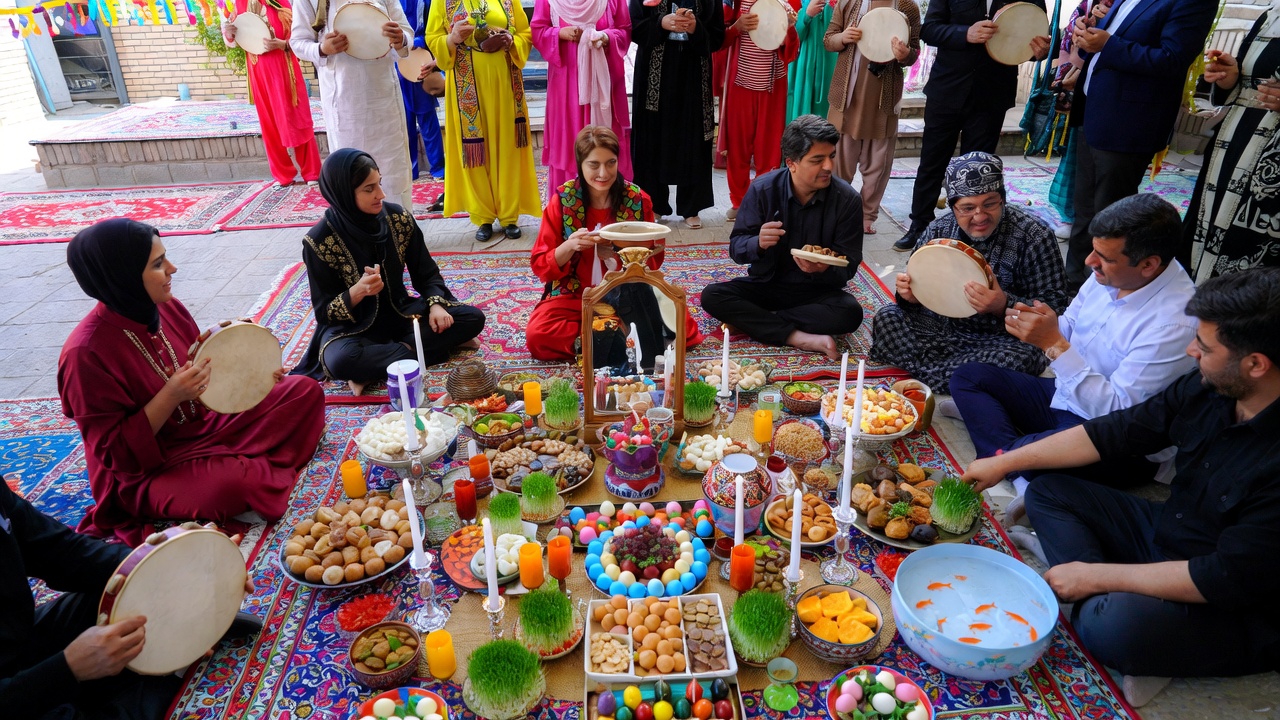
No Nowruz celebration is complete without the Haft-Sin—a ceremonial table displaying seven items whose names begin with the Persian letter “س” (pronounced “seen,” equivalent to “S”).
The Seven Essential Items of the Haft-Sin Display
Each element carries symbolic meaning:
| Item | Persian Name | Symbolism |
|---|---|---|
| Sprouted greens | Sabzeh | Rebirth, renewal, new life |
| Sweet pudding | Samanu | Abundance, fertility, wealth |
| Dried oleaster fruit | Senjed | Love, affection, compassion |
| Garlic | Seer | Health, medicine, protection |
| Apple | Sib | Beauty, health, vitality |
| Sumac spice | Somaq | Sunrise, the color of dawn, patience |
| Vinegar | Serkeh | Age, wisdom, patience |
The sprouted greens (sabzeh) are particularly important. Families plant wheat, lentils, or barley seeds several weeks before Nowruz, nurturing them until they form a lush green display. On Sizdah Bedar (the 13th day), these sprouts are thrown into running water—returning life to nature.
Additional Items on the Nowruz Table
Beyond the essential seven, families often add:
- A mirror: Representing the sky and self-reflection
- Candles: Symbolizing light and enlightenment
- Painted eggs: Representing fertility and creation
- A goldfish: Symbolizing life and the last month of the old year
- Coins: Representing prosperity
- A holy book: The Quran for Muslims, the Avesta for Zoroastrians, or poetry by Hafez
The goldfish tradition is particularly beloved. Children often name their fish and care for them long after Nowruz ends.
The Historical Evolution from Haft-Shin to Haft-Sin
According to some historical accounts, the original table may have been called Haft-Shin (“Seven Sh’s”) during the Sasanian era. One of the “Shin” items was sharab (wine), which played a role in Zoroastrian ritual.
After the Islamic conquest, wine became forbidden. Iranians adapted by replacing sharab with serkeh (vinegar)—a product made from wine but permissible under Islamic law. This clever substitution allowed the tradition to continue.
Whether this origin story is historically accurate remains debated. What is certain is that the Haft-Sin represents a living tradition, continuously adapted across centuries.
How Families Prepare the Haft-Sin
Preparation begins weeks in advance:
- Grow the sabzeh: Seeds are soaked, spread on a dish, and watered daily.
- Clean the house: The tradition of khaneh tekani (shaking the house) involves thorough spring cleaning.
- Buy new clothes: Families purchase new garments to wear on the first day.
- Cook special foods: Sabzi polo ba mahi (herbed rice with fish) is traditional.
- Arrange the table: Items are displayed on a special cloth, often with great artistic care.
As the exact moment of the equinox approaches, family members gather around the Haft-Sin. When the new year is announced—often by radio or television—everyone exchanges hugs, kisses, and gifts.
Chaharshanbe Suri: The Persian Fire Festival Before Nowruz
The most dramatic prelude to Nowruz occurs on the last Tuesday evening of the old year. This is Chaharshanbe Suri (literally “Red Wednesday” or “Wednesday Feast”)—a night of fire, feasting, and symbolic purification.
The Ancient Roots of Fire Jumping Tradition
Chaharshanbe Suri traces back to Zoroastrian belief in fire as a purifying element. The ancient Iranians celebrated a festival called Hamaspathmaedaya to honor the dead and prepare for the new year. Fire rituals cleansed participants spiritually.
By the Sasanian period, celebrations included lighting bonfires on this specific night. The tradition persisted through the Islamic era, evolving into the vibrant street festival Iranians celebrate today.
The Ritual of Jumping Over Fire
As sunset falls on the last Tuesday of the year, families build bonfires in their yards, on rooftops, or in the streets. One by one, participants leap over the flames, chanting:
“Zardi-ye man az to, sorkhi-ye to az man” (“My yellowness [sickness] is yours, your redness [health] is mine”)
This chant encapsulates the ritual’s meaning. Yellow represents illness, weakness, and the troubles of the past year. Red represents energy, vitality, and the strength of fire. By jumping over flames, people symbolically transfer their afflictions to the fire and receive warmth and health in return.
Other Chaharshanbe Suri Traditions
Ghashogh-zani (Spoon-banging): Children dress in disguises and go door-to-door, banging spoons against bowls or pots. Neighbors give them sweets and nuts. This tradition resembles Halloween trick-or-treating.
Kuze-shekani (Pot-smashing): Families fill old clay pots with salt, charcoal, and coins, then throw them from rooftops. The shattered pot symbolizes breaking free from the old year’s troubles.
Ajil-e Chaharshanbe Suri: A special mixture of nuts and dried fruits is prepared and eaten throughout the evening. Each ingredient carries symbolic meaning—sweetness for joy, saltiness for resilience.
Regional Variations Across Iran
Chaharshanbe Suri practices vary significantly across Iran:
- In East Azerbaijan, families splash rose water on each other for good luck
- In Bushehr, people celebrate near the sea and dip their feet in the water after jumping over fire
- In Kerman and Shiraz, special rice dishes are prepared with long noodles (symbolizing longevity)
- In Urmia, families bring ajil to the home of their oldest relative
These variations demonstrate how Chaharshanbe Suri, like all living traditions, adapts to local culture while maintaining its essential meaning.
Sizdah Bedar: The 13th Day Nature Picnic Tradition Explained
Nowruz celebrations do not end on the first day. For thirteen days, families visit relatives, exchange gifts, and enjoy festive meals. The final day—Sizdah Bedar—takes everyone outdoors.
The Meaning of Sizdah Bedar (Nature Day)
Sizdah means “thirteen” in Persian. Bedar means “toward the outdoors” or “getting rid of.” Together, the name suggests going outside on the thirteenth day—and also ridding oneself of the unlucky number thirteen.
In many cultures, thirteen is considered unlucky. Persian tradition holds that spending this day indoors invites misfortune. By going into nature, families avoid bad luck and celebrate spring’s fullness.
The official Iranian calendar designates this day as “Nature Day” (Ruz-e Tabiat), emphasizing its environmental significance.
Traditional Activities During Sizdah Bedar
Picnicking: Families pack elaborate meals and spread them on blankets in parks, gardens, or countryside meadows. Traditional foods include:
- Ash-e reshteh (noodle soup)
- Kookoo sabzi (herb frittata)
- Kebabs and grilled meats
- Sekanjabin (a sweet-sour mint drink, traditionally eaten with lettuce)
Throwing Sabzeh into Water: The sprouted greens from the Haft-Sin table are taken to a river or stream. Families throw them into the flowing water, symbolizing:
- The release of negative energy absorbed during the old year
- The return of life to nature
- Renewal spreading across the earth
Tying Knots in the Sabzeh: Young unmarried people—especially women—tie the blades of grass together while making wishes for love and marriage. The knot represents binding a future partner to oneself.
Playing Games: Traditional activities include horse riding, wrestling, volleyball, and board games. Families sing, dance, and tell jokes. Laughter is believed to clear away evil thoughts for the new year.
The “Lie of the Thirteenth”
Sizdah Bedar also features a tradition similar to April Fools’ Day. Called “Dorugh-e Sizdah” (Lie of the Thirteenth), it involves playing pranks and telling harmless lies. Friends and family try to fool each other, creating an atmosphere of playful mischief.
Since Sizdah Bedar often falls on or near April 1, some researchers speculate that this Persian tradition may have influenced—or been influenced by—the European custom.
Which Countries Celebrate Nowruz? A Global Persian New Year Guide
Nowruz is not solely Iranian. The festival spans an enormous geographical and cultural range, uniting people across political boundaries.
Countries Where Nowruz Is a Public Holiday
Iran: The heart of Nowruz celebrations. All businesses close for at least the first four days, and many families take the full thirteen days off.
Afghanistan: Known as Nawroz, it marks both the New Year and Farmer’s Day (Jashn-e Dehqan). The Guli Surkh (Red Flower Festival) in Mazar-i-Sharif features tulip blooms, horse riding, and poetry recitations. Families prepare Haft Mewa (seven fruits) rather than Haft-Sin.
Azerbaijan: Called Novruz, the celebration features public festivals, fireworks, and traditional foods like shekerbura (pastries) and pakhlava (baklava). The characters Kosa and Kechal appear in street performances as comedic heralds of spring.
Central Asian nations: Kazakhstan, Kyrgyzstan, Tajikistan, Turkmenistan, and Uzbekistan all observe Nowruz as a public holiday. Each country adds distinctive traditions:
| Country | Local Name | Special Traditions |
|---|---|---|
| Kazakhstan | Nauryz | Building yurts, preparing nauryz kozhe soup |
| Kyrgyzstan | Nooruz | Horse games, epic storytelling, filling vessels with water |
| Tajikistan | Navruz | Sumalak preparation, public concerts |
| Turkmenistan | Nowruz | Horse racing, traditional wrestling |
| Uzbekistan | Navruz | Sumalak cooked in communal pots, street festivals |
Kurdish regions: For the over 30 million Kurds worldwide, Nowruz holds special significance. The legend of Kawa the blacksmith defeating the tyrant Zahhak is central to Kurdish identity. Celebrations feature large bonfires on hillsides—symbolizing Kawa’s victory signal.
The Parsi Community in India and Pakistan
When Arab armies conquered Persia, some Zoroastrians fled eastward. They settled in western India, where their descendants are known as Parsis. This community maintains Zoroastrian traditions, including Nowruz.
Parsi Nowruz celebrations feature:
- Prayers in fire temples
- Charitable giving
- Festive meals blending Persian and Indian flavors
- Visiting relatives and community gatherings
Nowruz in the Diaspora
Iranian, Afghan, and Central Asian communities worldwide maintain Nowruz traditions. Major celebrations occur in:
- Los Angeles (home to the largest Iranian diaspora in the United States)
- London
- Toronto
- Sydney
- Dubai
In 2019, California Governor Gavin Newsom issued a proclamation declaring March 19 as Nowruz Day in the state. Similar recognitions have occurred across North America and Europe.
How Nowruz Gained UNESCO World Heritage Recognition
The international recognition of Nowruz culminated in two significant milestones:
UNESCO Inscription in 2009
In 2009, UNESCO inscribed Nowruz on its Representative List of the Intangible Cultural Heritage of Humanity. The inscription noted that Nowruz:
“promotes values of peace and solidarity between generations and within families as well as reconciliation and neighborliness.”
The nomination was jointly submitted by multiple countries: Iran, Afghanistan, Azerbaijan, India, Kazakhstan, Kyrgyzstan, Pakistan, Tajikistan, Turkey, Turkmenistan, and Uzbekistan. This collaboration itself demonstrated Nowruz’s unifying power.
United Nations International Nowruz Day
In 2010, the United Nations General Assembly passed a resolution declaring March 21 as International Nowruz Day. The resolution recognized the festival’s:
- Long history spanning over 3,000 years
- Celebration across multiple regions and nations
- Promotion of peace, solidarity, and intercultural dialogue
Each year, the UN Secretary-General issues a statement honoring Nowruz and its values of renewal and hope.
The Modern Revival and Continuing Significance of Persian New Year
Today, Nowruz faces both challenges and opportunities. Economic pressures, political tensions, and cultural globalization all affect how people celebrate.
Nowruz in Contemporary Iran
In Iran, Nowruz remains the most important holiday of the year. Schools and businesses close. Highways fill with families traveling to visit relatives. Television broadcasts special programming—including the countdown to the exact moment of the equinox.
However, the holiday has faced occasional political controversy. Some Islamic clerics have criticized Nowruz for its Zoroastrian origins. The government has at times emphasized its secular, national character rather than any religious dimension.
Despite these tensions, popular enthusiasm for Nowruz never wavers. For most Iranians, the holiday represents family, identity, and hope—values that transcend political ideology.
Preserving Traditions in the Digital Age
Modern technology has transformed how people celebrate:
- Video calls allow diaspora families to share the Haft-Sin moment across continents
- Social media spreads images of elaborate tables, fire-jumping, and Sizdah Bedar picnics
- Online shopping makes it easier to obtain traditional items abroad
- YouTube tutorials teach younger generations how to prepare sabzeh and samanu
These tools help maintain traditions even as communities scatter globally.
Environmental Consciousness and Sizdah Bedar
In recent years, environmental organizations in Iran have promoted a “greener” Sizdah Bedar. Campaigns encourage:
- Avoiding disposable plastic
- Cleaning up picnic sites completely
- Releasing goldfish into appropriate waters (rather than polluting them)
- Minimizing firework use during Chaharshanbe Suri
These efforts connect Nowruz’s ancient reverence for nature with contemporary ecological awareness.
Conclusion: Why the History of Nowruz Matters Today
Nowruz is more than a holiday. It is a living archaeological site—layers of belief, practice, and meaning accumulated over three millennia.
From Zoroastrian fire temples where priests calculated the equinox with astronomical precision…
To Achaemenid Persepolis where delegations from across the known world gathered to honor the King of Kings…
Through Islamic empires where scholars documented traditions even as religious practice shifted…
To modern cities where families set Haft-Sin tables in apartments while watching satellite television…
Nowruz has adapted continuously. Yet its core meaning endures: renewal, hope, and the triumph of light over darkness.
In a world often divided by politics, religion, and nationality, Nowruz offers a remarkable counter-example. It belongs to no single country. It serves no single faith. It speaks to a universal human longing—the desire to shed the past and embrace new beginnings.
As spring arrives once again, over 300 million people worldwide will clean their homes, grow their sabzeh, jump over fires, and gather with loved ones. They will continue a tradition that has outlasted empires, survived conquests, and crossed oceans.
Nowruz piruz—may your New Year be victorious.
Frequently Asked Questions About Nowruz History and Traditions
How old is Nowruz?
Nowruz has been celebrated for over 3,000 years. Archaeological and textual evidence suggests organized celebrations date to at least the Achaemenid Empire (550–330 BCE), though the festival’s roots may be even older.
Is Nowruz a religious or secular holiday?
Nowruz originated within Zoroastrianism but has evolved into a largely secular celebration. For Zoroastrians and Bahá’ís, it retains religious significance. Most Muslims who celebrate observe it as a cultural and national tradition.
What is the difference between Nowruz and the Chinese New Year?
Both are spring festivals marking the new year, but they differ significantly:
| Aspect | Nowruz | Chinese New Year |
|---|---|---|
| Calendar | Solar (vernal equinox) | Lunisolar (new moon) |
| Date | March 20-21 | Late January–February |
| Origin | Zoroastrian Persia | Ancient China |
| Duration | 13 days | 15 days |
Why do Iranians jump over fire before Nowruz?
Fire-jumping during Chaharshanbe Suri symbolizes purification. By leaping over flames and chanting, participants transfer illness and misfortune to the fire and receive energy and health in return.
What foods are traditional for Nowruz?
Common Nowruz foods include:
- Sabzi polo ba mahi: Herbed rice with fried fish
- Kookoo sabzi: Herb frittata
- Samanu: Sweet wheat pudding
- Ash-e reshteh: Noodle soup
- Ajil: Mixed nuts and dried fruits
Why is the number 13 significant in Nowruz?
Nowruz celebrations last thirteen days, ending with Sizdah Bedar. The number 13 is considered unlucky in Persian culture, so spending the day outdoors avoids bringing that bad luck into the home.
Traditional Nowruz Foods and Their Cultural Significance
Food forms the heart of every Nowruz celebration. Beyond mere sustenance, each dish carries symbolic meaning and connects families to centuries of tradition.
Sabzi Polo ba Mahi: The Quintessential New Year Dish
Sabzi polo ba mahi (herbed rice with fish) appears on virtually every Iranian table during Nowruz. The dish combines several meaningful elements:
The herbs: Fresh dill, cilantro, parsley, chives, and fenugreek are chopped finely and mixed into basmati rice. Green symbolizes spring’s renewal and nature’s reawakening.
The fish: Traditionally fried whitefish (often carp or trout) represents life, movement, and the zodiac sign Pisces—the final sign before the new astrological year begins.
Together, the green rice and golden fish create a visual representation of spring: verdant growth emerging from waters of life.
Kookoo Sabzi: The Herbed Frittata of Renewal
Kookoo sabzi is a dense, green frittata packed with fresh herbs. Families prepare it before Nowruz, often eating it during the holidays with fresh bread and yogurt.
The key to authentic kookoo sabzi lies in the herb ratio. Traditional recipes use:
- 1 kilogram of mixed fresh herbs (parsley, cilantro, dill, chives, fenugreek)
- 6-8 eggs
- Walnuts and dried barberries for texture
- Turmeric for color
The verdant color makes kookoo sabzi a visual celebration of spring. Its preparation—chopping massive quantities of herbs—becomes a family ritual, with multiple generations working together in the kitchen.
Samanu: The Sweet Pudding of Patience
Samanu holds unique status among Nowruz foods. This sweet pudding, made from germinated wheat, requires days of preparation and constant stirring over low heat.
The process begins two weeks before Nowruz:
- Wheat is soaked and spread on a tray
- Over several days, it sprouts
- The sprouts are ground into a pulp
- The pulp is mixed with flour and water
- The mixture cooks for 12-24 hours, with continuous stirring
Traditionally, women gather in groups to prepare samanu, taking turns stirring through the night while singing folk songs and telling stories. The communal labor transforms cooking into ceremony.
The finished samanu is dark brown, sweet without added sugar (the sweetness comes from enzymatic conversion of starch), and extraordinarily smooth. It symbolizes:
- Patience: The long preparation teaches endurance
- Abundance: The transformation of simple grain into sweetness represents prosperity
- Community: The shared labor builds bonds between families
Reshteh Polo: Noodles for Long Life
Reshteh polo (rice with noodles) features toasted Persian noodles mixed into fluffy rice, often served with raisins, dates, and sometimes chicken.
The long strands of noodles symbolize longevity and the thread of life. In some regions, families measure their noodles against their height—eating long noodles supposedly brings a long life in the coming year.
Ash-e Reshteh: The Soup of Transitions
Ash-e reshteh is a thick, hearty soup perfect for Sizdah Bedar picnics. It contains:
- Persian noodles (reshteh)
- Legumes (lentils, chickpeas, kidney beans)
- Fresh herbs (parsley, cilantro, spinach)
- Kashk (dried whey) for creaminess
- Fried onions and dried mint for garnish
The word “reshteh” also means “thread” or “connection.” Eating ash-e reshteh before a journey or at transitions is thought to ensure that connections remain strong and paths remain clear.
The Role of Poetry and Literature in Nowruz Celebrations
Persian culture reveres poetry. During Nowruz, this reverence finds full expression. Families recite verses, gift poetry collections, and even divine the future through random readings.
The Divan of Hafez: Fortune-Telling Through Poetry
Hafez (c. 1315-1390) is perhaps the most beloved Persian poet. His collected works, the Divan-e Hafez, appear on countless Haft-Sin tables alongside holy books.
Nowruz tradition includes fal-e Hafez—fortune-telling through his poetry. The process is simple:
- Hold the closed book and concentrate on a question
- Open randomly to any page
- Read the ghazal (lyric poem) on that page
- Interpret its meaning as guidance for the coming year
Hafez’s verses are so richly layered with imagery and meaning that almost any poem seems to speak directly to the questioner’s concerns. This practice continues throughout the year but holds special significance at Nowruz.
Ferdowsi’s Shahnameh and National Identity
The Shahnameh (Book of Kings) by Ferdowsi recounts the mythological and historical kings of Persia. Completed around 1010 CE, it preserved Persian language and identity during centuries of Arab cultural dominance.
During Nowruz, particularly in educated households, selections from the Shahnameh are read aloud. The story of Jamshid establishing Nowruz is naturally popular, but so are the epic battles of Rostam and the wisdom of legendary kings.
Ferdowsi himself acknowledged Nowruz’s importance. His description of Jamshid’s throne ascending to the sky remains the defining literary account of the festival’s mythological origin.
Nowruz Poetry Across Cultures
The poetic tradition extends beyond Iran. In Afghanistan, poets compose special Nowruzi verses celebrating spring. In Central Asia, traditional bards called bakhshi (in Uzbekistan) and akyns (in Kyrgyzstan) improvise poetry about renewal and hope.
This literary dimension distinguishes Nowruz from many other new year celebrations. The festival is not merely about food and family—it is also about beauty, meaning, and the power of language to capture human experience.
The Musical Traditions of Nowruz Celebrations
Music accompanies every stage of Nowruz, from the fires of Chaharshanbe Suri to the picnics of Sizdah Bedar.
Traditional Instruments in Nowruz Music
Tar and setar: These stringed instruments provide melodic lines in classical Persian music. Their intricate scales (dastgah) can evoke everything from joy to longing.
Daf and tombak: Percussion instruments drive celebratory rhythms. The daf (frame drum) creates the driving beat for dancing.
Ney: The Persian flute adds haunting beauty to musical ensembles, its breathy tone suggesting both sorrow and hope.
Regional Folk Songs for the New Year
Each region has distinctive Nowruz songs:
“Molla Mohammad Jan”: This beloved Afghan folk song originated in Mazar-i-Sharif and spread throughout the Persian-speaking world. Its melody is inseparable from Nowruz celebrations.
Azerbaijani Nowruz songs: Traditional performers sing about the arrival of spring, often accompanied by the kamancha (bowed string instrument) and nagara (drum).
Kurdish songs: Fire-jumping during Chaharshanbe Suri is accompanied by distinctive Kurdish melodies celebrating Kawa the blacksmith and the defeat of tyranny.
The Haji Firuz Character
Haji Firuz is the traditional herald of Nowruz in Iran. This character appears in streets and markets, face painted red or black, wearing bright clothing, singing and dancing to announce the approaching new year.
The origins of Haji Firuz are debated. Some scholars connect him to ancient rituals involving blackened faces (representing the dead returning during transitional periods). Others see him as a purely celebratory figure—the clown who signals that serious work can pause for festivity.
Regardless of origin, Haji Firuz’s songs are instantly recognizable to Iranians:
“Haji Firuz-e, sal-i ye ruz-e…” (“It’s Haji Firuz, it’s once a year…”)
His music marks the transition from everyday life into the special time of Nowruz.
Contemporary Challenges Facing Nowruz Traditions
Despite its resilience, Nowruz faces pressures in the modern world.
Urbanization and Changing Lifestyles
In traditional villages, Nowruz was inseparable from agricultural rhythms. Families grew their own sabzeh, kept livestock for meat, and drew water from wells for ritual purposes.
Urban apartment dwellers lack these connections. Many must purchase pre-grown sabzeh from street vendors. Finding space for bonfires during Chaharshanbe Suri becomes impossible in high-rise neighborhoods.
Yet urbanization also brings adaptations. Rooftop celebrations, community-organized Chaharshanbe Suri events in parks, and online ordering of Haft-Sin items all represent creative responses to changed circumstances.
Economic Pressures
Nowruz celebrations require significant expenditure: new clothes, special foods, gifts for children, travel to visit relatives. During economic downturns, these costs strain family budgets.
In recent years, many Iranian families have scaled back celebrations. Some forego travel entirely. Others simplify their Haft-Sin tables or reduce gift-giving.
Despite these constraints, the core rituals persist. Even the simplest sabzeh—wheat seeds in a shallow dish—carries full symbolic weight. Nowruz’s meaning does not depend on lavish spending.
Diaspora Challenges
For Iranians, Afghans, and Central Asians living abroad, maintaining Nowruz traditions requires extra effort. Specialized ingredients may be hard to find. Work schedules rarely accommodate thirteen days of celebration. Children raised in foreign countries may feel disconnected from customs they do not fully understand.
Diaspora communities respond by organizing public celebrations—often on the weekend nearest to Nowruz rather than the exact day. These events bring together families who might otherwise celebrate alone, creating community bonds that sustain traditions across generations.
The Universal Appeal of Nowruz in the Modern World
What makes Nowruz resonate beyond its historical homelands? Several factors contribute to its growing international recognition.
The Alignment with Natural Rhythms
The spring equinox is a global phenomenon. Every culture in the northern hemisphere experiences lengthening days, warming temperatures, and nature’s reawakening. Nowruz makes this experience central to celebration.
In an era when many people feel disconnected from natural cycles—living in climate-controlled buildings, eating imported foods year-round—Nowruz offers reconnection. The simple act of growing sabzeh puts hands in soil and attention on plant growth.
The Emphasis on Family and Community
Nowruz celebrations center on home and loved ones. There are no elaborate pilgrimages or expensive temple offerings. The Haft-Sin table sits in the family living room. Visitors come to the family home. Children receive gifts from grandparents.
This domestic focus makes Nowruz accessible. Any family can participate, regardless of wealth or social status.
The Message of Renewal and Hope
Perhaps most fundamentally, Nowruz speaks to universal human needs. Every person, every community, every nation sometimes feels burdened by the past. The promise of a fresh start—embodied in the very name “New Day”—resonates across cultures.
When UNESCO recognized Nowruz, it emphasized precisely this universal dimension. The festival promotes “peace and solidarity between generations and within families as well as reconciliation and neighborliness.”
In a world too often divided, Nowruz reminds us that new beginnings are always possible.