There is a moment each year when the chill of the Indian winter loosens its grip. Mustard fields across the northern plains erupt in sheets of gold. The air turns soft. And in homes, temples, and schoolrooms from Varanasi to Kolkata, the color yellow takes center stage. That moment is Vasant Panchami — one of the most beloved and deeply meaningful festivals in the Hindu calendar.
I first witnessed Vasant Panchami in a narrow lane in Shantiniketan, West Bengal. A young girl in a bright yellow sari was placing her schoolbooks at the feet of a clay idol of Goddess Saraswati. Her grandmother stood behind her, whispering a mantra. It was a scene of such tender reverence that it stayed with me for years. This festival is not about grand spectacles. It is about beginnings — the beginning of spring, the beginning of knowledge, and the quiet hope that wisdom will light our path.
In 2026, Vasant Panchami falls on Friday, January 23. The Panchami Tithi begins at 2:28 AM on January 23 and ends at 1:46 AM on January 24, with the most auspicious window for Saraswati Puja observed between 7:15 AM and 12:50 PM.
This guide dives deep into every layer of this festival — its mythology, its rituals, its regional flavors, and its place in the modern world.
What Is Vasant Panchami and Why Is It Celebrated Every Year?
Vasant Panchami (also spelled Basant Panchami) is a Hindu festival that marks the preparation for the arrival of spring. The name itself tells you everything: Vasant means “spring” in Sanskrit, and Panchami means “the fifth day.” The festival falls on the fifth day of the bright fortnight (Shukla Paksha) in the Hindu lunar month of Magha, which typically lands in late January or February on the Gregorian calendar.
But this is far more than a seasonal marker. Vasant Panchami carries three layers of meaning:
- Seasonal: It signals the transition from winter to spring. In the Indian agricultural cycle, this is the time when Rabi crops begin to mature and mustard flowers bloom across the fields.
- Spiritual: It is the principal day for worshipping Goddess Saraswati, the Hindu deity of knowledge, music, art, and wisdom.
- Social: It is considered one of the most auspicious days in the Hindu calendar for starting new ventures — whether that means beginning a child’s education, launching a business, or getting married.
In ancient Indian texts, spring is called “Rituraj” — the king of all seasons. It represents fertility, energy, love, and beauty. Vasant Panchami is the festival that welcomes this king. According to Wikipedia, the Vasant Utsava on Panchami is celebrated forty days before spring reaches full bloom, because the transition period of any Indian season lasts about forty days. This timing also connects Vasant Panchami to Holi, the festival of colors, which arrives roughly forty days later.
The Mythological Origin Story Behind Vasant Panchami and Goddess Saraswati
Every Hindu festival carries a story, and Vasant Panchami’s origin is one of the most poetic in all of Hindu mythology.
According to the Puranas, after Lord Brahma created the physical universe, he looked upon his creation and felt something was missing. The world existed, but it was silent. There was no sound, no speech, no music, and no learning. The universe felt lifeless despite being alive.
Brahma then sprinkled water from his kamandalu (sacred vessel) to infuse consciousness into the world. From that divine act, Goddess Saraswati appeared — radiant in white, seated on a lotus, holding a veena (a stringed instrument similar to a sitar) in two of her four hands, and sacred scriptures and a lotus in the other two. The moment she played the veena, sound and speech flooded the universe. Birds sang. Rivers flowed with melody. Human beings found voice and thought.
This is why Saraswati is revered as the Goddess of knowledge, music, art, science, and all forms of learning. Her four hands symbolize ego (ahamkara), intellect (buddhi), alertness (chitta), and the conditioned mind (manas). Her white swan represents the ability to discern good from bad. Her white clothing stands for purity.
There is a second mythological thread woven into Vasant Panchami — the story of Kamadeva, the Hindu god of love. According to legend, the great sages once asked Kamadeva to interrupt Lord Shiva’s deep yogic meditation. They wanted Shiva to open his eyes to the world and accept Goddess Parvati as his wife. Kamadeva agreed and shot an arrow made of flowers and bees at Shiva. The arrow worked — Shiva stirred — but in his fury at being disturbed, Shiva opened his third eye and burned Kamadeva to ashes. This story ties Vasant Panchami to themes of love, passion, and the awakening of earthly desire, which is why the festival is also known as “Madana Panchami” in some regions.
When Is Vasant Panchami in 2026? Date, Tithi, and Auspicious Puja Timings
For those planning their observances, here are the confirmed details for 2026:
| Detail | 2026 Information |
|---|---|
| Date | Friday, January 23, 2026 |
| Hindu Calendar Position | Magha Shukla Paksha, Panchami Tithi |
| Panchami Tithi Begins | 2:28 AM on January 23 |
| Panchami Tithi Ends | 1:46 AM on January 24 |
| Best Time for Saraswati Puja | 7:15 AM to 12:50 PM |
| Madhyahna (Midday) Moment | Approximately 12:50 PM |
Note: Exact timings may vary slightly by city due to India’s geographical diversity. It is always wise to consult a local panchang or priest.
The morning hours after sunrise are considered to carry the strongest sattvic (pure) energy, which supports focus, clarity, and spiritual openness. This is why schools, temples, and homes traditionally schedule their Saraswati Puja ceremonies during the Purvahna Kala — the time between sunrise and midday.
Many astrologers also consider the entire day of Vasant Panchami to be an “Abujha” day — a term meaning that every hour is auspicious. This makes it an ideal day for weddings, housewarming ceremonies (Griha Pravesh), starting a new business, or beginning any important work.
Why Do Hindus Worship Goddess Saraswati on Vasant Panchami Day?
At its heart, Vasant Panchami is Saraswati’s day. While the festival celebrates spring and renewal, the worship of Saraswati is what gives it spiritual depth.
Saraswati is one of the Tridevi — the three great goddesses of Hinduism, alongside Lakshmi (goddess of wealth) and Parvati (goddess of power). She is the consort of Lord Brahma, the creator. Her domain is everything that elevates the human mind: language, literature, music, science, mathematics, art, and craftsmanship.
The reason she is worshipped specifically on Vasant Panchami relates to the mythological story of her appearance. Hindu scriptures hold that Goddess Saraswati manifested on this very day to bring knowledge and consciousness to an otherwise silent creation.
This is why Vasant Panchami holds such deep meaning for students, teachers, writers, musicians, artists, and scholars. On this day:
- Students place their textbooks, notebooks, and pens at the feet of Saraswati’s idol, seeking blessings for academic success.
- Musicians offer their instruments — sitars, tablas, veenas, flutes — to the goddess before playing them.
- Artists and writers begin new creative projects, believing that work started on this day carries divine grace.
- Schools and universities organize special puja ceremonies, cultural programs, and prayer gatherings.
In West Bengal, one of the most striking customs is that students abstain from reading or writing on Vasant Panchami itself. This is not laziness — it is a gesture of humility. By stepping away from study for one day, devotees acknowledge that knowledge is not merely a product of personal effort. It is also a gift of grace.
The Deep Symbolism of Yellow Color in Vasant Panchami Celebrations
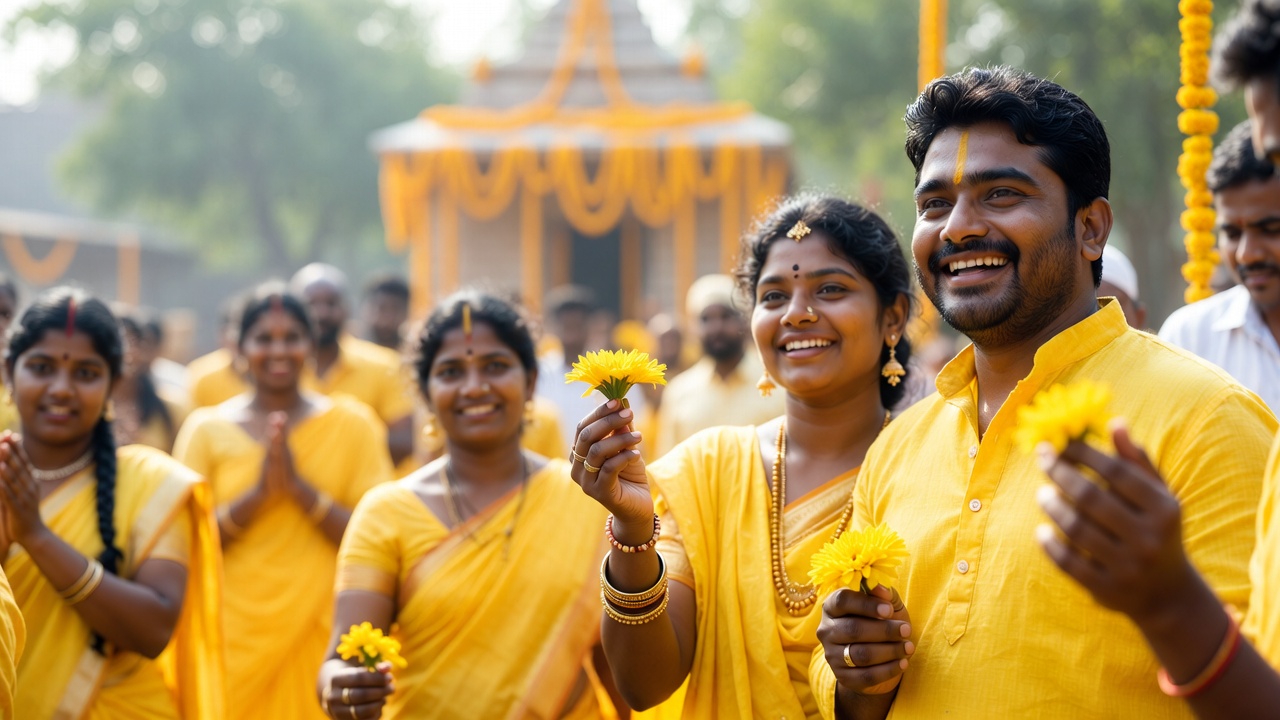
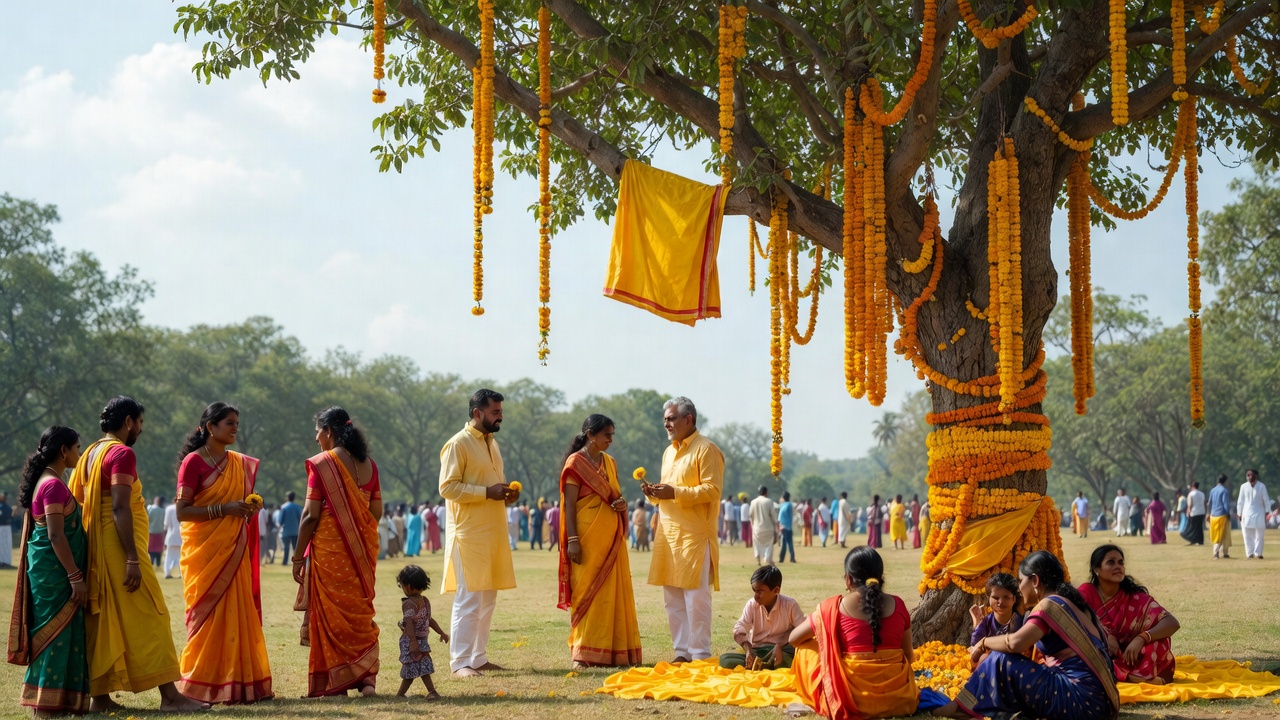
If there is one color that defines Vasant Panchami, it is yellow. Walk through any Indian city or village on this day, and you will see it everywhere — in clothes, in flowers, in food, and in the landscape itself.
The symbolism of yellow works on several levels:
Agricultural significance. Across northern India, the mustard crop reaches peak bloom during this period. Vast fields turn a brilliant gold, creating one of the most spectacular natural displays in the Indian subcontinent. Yellow is literally the color of the season.
Spiritual meaning. In Hindu tradition, yellow represents knowledge, prosperity, positive energy, and auspiciousness. It is associated with the solar plexus chakra (Manipura), which governs intellect and personal power. Wearing yellow on Vasant Panchami is an act of alignment with these qualities.
Connection to Saraswati. While Goddess Saraswati is often depicted in white (representing purity), the yellow of Vasant Panchami represents the vibrancy of active knowledge — knowledge applied, knowledge shared, knowledge that transforms.
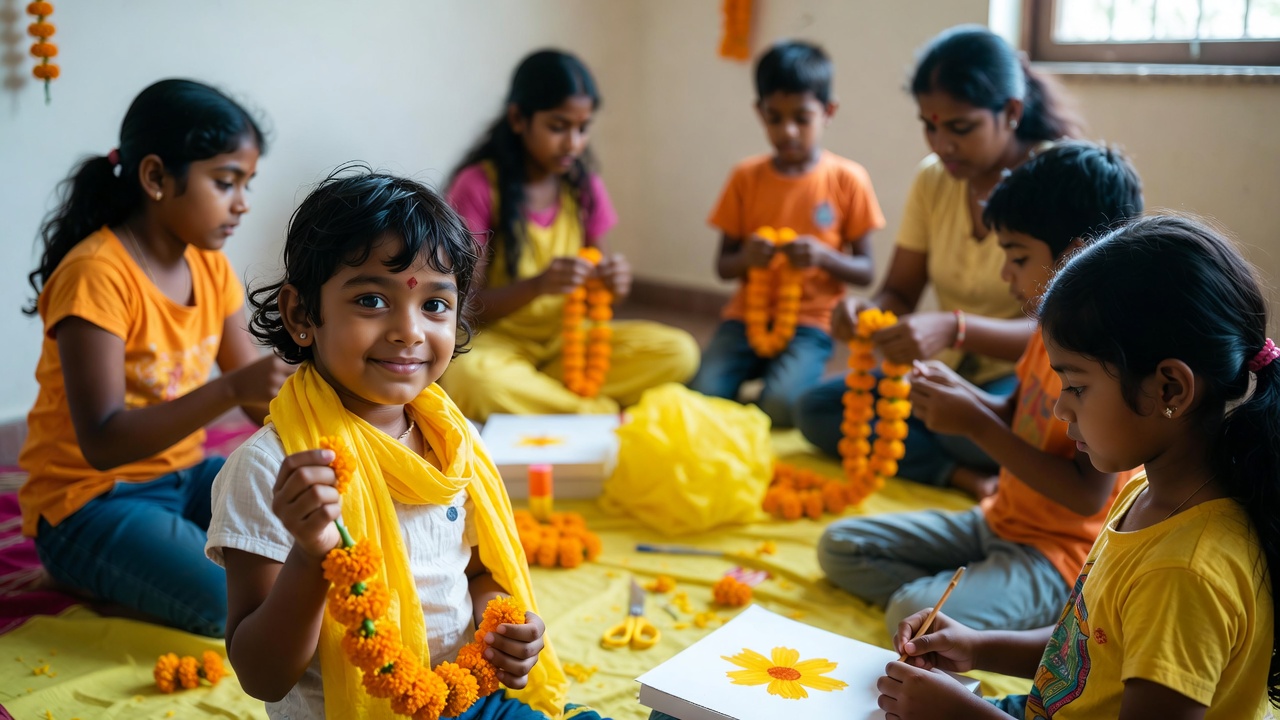
On this day, devotees wear yellow clothing and offer yellow flowers (marigolds, chrysanthemums, and mustard blossoms) to the goddess. Families prepare yellow-themed foods such as kesar halwa (a saffron-infused sweet made from flour, sugar, nuts, and cardamom), sweet saffron rice, and boondi laddoos. Even the turmeric paste applied during morning baths carries this golden hue.
How Saraswati Puja Is Performed: Rituals and Traditions on Vasant Panchami
The Saraswati Puja performed on Vasant Panchami follows a time-honored structure, though details vary by family, community, and region. Here is a general guide to the traditional observance:
Morning preparation. Devotees rise early and bathe. A traditional practice involves applying a paste of mustard oil and turmeric (haldi) before bathing, which is believed to please Goddess Saraswati.
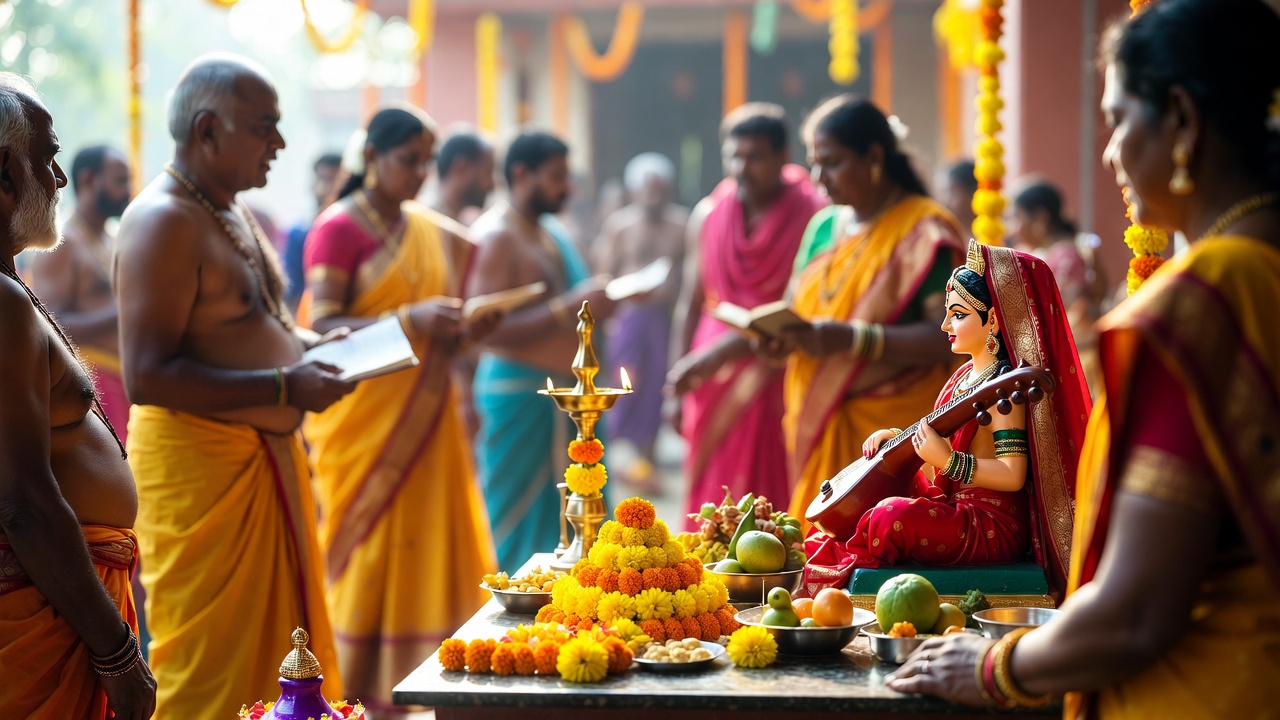
Setting up the altar. An idol or image of Goddess Saraswati is placed on a clean, elevated platform. The idol is draped in yellow or white cloth and adorned with garlands of yellow and white flowers. A Puja Kalash (sacred water vessel) is placed before the idol.
Offerings. Devotees offer sandalwood paste, turmeric, saffron, akshat (unbroken rice), yellow flowers, fruits, and yellow-colored sweets. Books, notebooks, musical instruments, pens, and tools of one’s trade are placed near the idol to receive blessings.
Prayers and mantras. The puja begins with an invocation of Lord Ganesha (the remover of obstacles), followed by Saraswati mantras and the Saraswati Vandana. This ancient Sanskrit hymn describes the goddess as radiant, pure, and seated upon a white lotus. It is recited in schools across India as part of morning prayers throughout the year.
Prasad distribution. After the puja concludes, the blessed food (prasad) — typically saffron-tinged sweets — is distributed among family members and neighbors.
Immersion. In many communities, particularly in West Bengal and Odisha, clay idols of Saraswati are immersed in a river or water body the following day, in a procession accompanied by music and chanting. This mirrors the visarjan (immersion) tradition of Durga Puja.
Vidyarambham: Why Vasant Panchami Is the Most Auspicious Day to Start Education
One of the most touching rituals associated with Vasant Panchami is Vidyarambham (also called Aksharabhyasam or Haate-Khori in Bengali). This is the ceremony of introducing young children — typically aged three to five — to the world of formal learning.
During Vidyarambham, a child is guided by a parent, grandparent, or teacher to write their very first letters. In some traditions, the child traces the sacred syllable “Om” or the word “Shri” on a plate of rice grains. In others, the child writes on a slate with chalk. The act is performed at the feet of Goddess Saraswati, with the belief that beginning education on this day ensures the child receives the goddess’s lifelong blessing of wisdom.
This ceremony is observed across India under different names:
| Region | Name of the Ceremony |
|---|---|
| West Bengal | Haate-Khori |
| Kerala | Vidyarambham |
| Andhra Pradesh & Telangana | Aksharabhyasam |
| Odisha | Khadi-Chuan or Vidya-Arambha |
| Tamil Nadu | Akshar-Abhyasam |
In West Bengal, where Saraswati Puja is celebrated on a grand scale, the Haate-Khori ceremony is one of the most cherished family traditions. Parents dress their children in traditional clothing and bring them before the idol with great pride and emotion. It is a day that many Bengali families remember for a lifetime.
In Kerala, Vidyarambham is more commonly performed on Vijayadashami (Dussehra), but Vasant Panchami is also considered a highly favorable day for the ritual, especially at temples like the Dakshina Mookambika Saraswati Temple.
The underlying philosophy is simple and profound: knowledge is sacred, and its pursuit should begin with reverence.
How Vasant Panchami Is Celebrated Across Different Regions of India
One of the most beautiful things about Vasant Panchami is how its celebrations change color and flavor as you travel across India. The core devotion to Saraswati and the welcoming of spring remain constant, but the regional expressions are wonderfully diverse.
West Bengal, Assam, Tripura, and Odisha: Grand Saraswati Puja Celebrations
In eastern India, Vasant Panchami is known primarily as Saraswati Puja, and it is one of the biggest festivals of the year — second only to Durga Puja in communal scale. Schools and colleges organize elaborate puja ceremonies on their premises. Students dress in traditional attire: girls wear yellow basanti saris and boys wear dhoti-kurta. Community pandals (temporary structures) are built in neighborhoods, and beautifully crafted clay idols of Saraswati are installed and worshipped.
In West Bengal, devotees offer Bel leaves, marigold flowers, Palash blossoms, and sandalwood paste to the goddess. A beloved seasonal tradition is eating Topa Kul (a type of jujube fruit) along with Khichuri (a comfort dish of rice and lentils) and Lubra (a mixed vegetable dish). Many people wait until this day to taste the season’s first Kul fruit, offering it first to Saraswati before eating it themselves.
Punjab and Haryana: Mustard Fields and Kite-Flying Festivals
In the northwestern states, Vasant Panchami coincides with the peak bloom of mustard (sarson) fields, turning the landscape into an ocean of gold. People celebrate with outdoor gatherings, folk songs, and the joyous tradition of kite flying. Rooftops across cities like Amritsar and Chandigarh come alive with colorful kites soaring against blue winter skies.
The Basant kite-flying tradition has deep historical roots. During the 19th century, Maharaja Ranjit Singh held an annual Basant fair in Lahore that lasted ten days, featuring kite competitions, military displays, and communal feasting. He and his queen would dress in yellow and fly kites from the rooftops, setting a tradition that lives on across the Punjab region to this day.
In a notable 2026 development, the Basant kite festival returned to Lahore, Pakistan after a nearly two-decade ban. The Punjab government of Pakistan promulgated the Punjab Regulation of Kite Flying Ordinance 2025, allowing a regulated three-day festival from February 6–8, 2026 with strict safety mandates including cotton-only strings and QR-coded registration.
Gujarat and Kutch: Love, Flowers, and Kamadeva
In the western state of Gujarat, particularly in the Kutch region, Vasant Panchami is celebrated as a festival of love and emotional anticipation — in keeping with the mythology of Kamadeva. People prepare bouquets and garlands of flowers set with mango leaves and gift them to loved ones. Families dress in saffron, pink, or yellow and visit each other. Songs about Krishna’s playful love with Radha fill the air, mirroring the Kama-Rati (love-desire) theme of the day.
South India: Sri Panchami and Temple Rituals
In Andhra Pradesh and Telangana, the festival is known as Sri Panchami, where “Sri” refers to Saraswati as a manifestation of Goddess Devi. Celebrations focus on temple rituals, classical music performances, and Vidyarambham ceremonies. The Sri Vidya Saraswathi Temple in Warangal and the famous Gnana Saraswati Temple in Basar, Telangana, draw thousands of devotees and families performing Aksharabhyasam.
In Karnataka, the Shringeri Sharada Temple — one of the four mathas (monastic seats) established by the 8th-century philosopher Adi Shankaracharya — holds special significance as a center of Saraswati worship on this day.
Uttarakhand: Worship of Shiva and Parvati
In Uttarakhand, the festival takes a different spiritual direction. Here, Goddess Parvati and Lord Shiva are worshipped as the divine parents of the earth. The emphasis is on the renewal of nature and the sacred bond between the divine couple, reflecting the region’s deep Shaivite traditions.
Vasant Panchami Beyond India: Celebrating Saraswati Puja in Nepal, Bangladesh, and Indonesia
Vasant Panchami is not limited to India. Its spirit crosses borders.
Nepal celebrates Saraswati Puja with great devotion, particularly in the Kathmandu Valley. Students and educators visit Saraswati temples, and schools organize special prayers and cultural events.
Bangladesh observes the festival with particular enthusiasm. Major universities, including Dhaka University, traditionally declare a holiday for Saraswati Puja. Students organize elaborate processions, cultural programs, and community gatherings.
On the Indonesian island of Bali, the festival is known as Hari Raya Saraswati (Great Day of Saraswati). It is celebrated with prayers in family compounds, educational institutions, and public venues from morning until noon. Teachers and students wear brightly colored clothes instead of their usual uniforms. Remarkably, Hari Raya Saraswati also marks the beginning of the 210-day Balinese Pawukon calendar, making it a day of both spiritual and calendrical significance.
Sikh communities also observe the day. Historically, Namdhari Sikhs have celebrated Basant Panchami as a spring festival. Gurdwaras organize langars (community kitchens) serving free meals, marking the new crop season. Maharaja Ranjit Singh himself gave 2,000 rupees to the Harmandir Sahib Gurdwara in Amritsar in 1825 to distribute food on this day.
Among the Indian diaspora worldwide, Bengali and Tamil associations in cities like London, New York, and Toronto organize Saraswati Pujas, cultural shows, and community gatherings, keeping the tradition alive far from home.
Traditional Foods and Recipes Prepared During Vasant Panchami Festival
Food is central to any Indian festival, and Vasant Panchami is no exception. The guiding principle is simple: everything should be yellow. Here are the most common traditional dishes:
| Dish | Description | Region |
|---|---|---|
| Kesar Halwa | A rich sweet made from flour, sugar, nuts, cardamom, and saffron strands that give it a golden color and gentle fragrance | Pan-India |
| Sweet Saffron Rice (Kesari Bhaat / Zarda) | Rice cooked with saffron, sugar, nuts, and raisins | North and West India |
| Boondi Laddoo | Round sweets made from chickpea flour droplets soaked in sugar syrup | North India |
| Khichuri | A comforting one-pot dish of rice and lentils, often served with mixed vegetables | Bengal and Eastern India |
| Kheer | A sweet rice pudding cooked with milk, sugar, and cardamom | Punjab, Haryana, UP |
| Kesar Pista | A saffron-and-pistachio sweet confection | Punjab and Haryana |
| Topa Kul Chutney | A tangy-sweet chutney made from jujube fruit, a seasonal delicacy | West Bengal |
The use of turmeric, saffron, and yellow lentils in cooking on this day is not merely culinary — it is a spiritual practice. The golden color on your plate mirrors the golden fields outside and the golden light of knowledge within.
How Vasant Panchami Connects to Holi: The Forty-Day Spring Countdown
Many people do not realize that Vasant Panchami and Holi are linked by a forty-day thread. According to Hindu tradition, Vasant Panchami marks the beginning of the spring transition, and Holi arrives roughly forty days later to celebrate spring in full bloom.
This forty-day countdown is not arbitrary. In the Indian understanding of seasons, any seasonal change takes about forty days to complete. Vasant Panchami is the announcement; Holi is the arrival. The quiet devotion and golden hues of Vasant Panchami gradually build into the explosive reds, greens, and blues of Holi.
In some communities, this connection is made tangible. On Vasant Panchami, a log is placed in a public space, and over the following forty days, people add sticks, twigs, and combustible materials to the pile. On the eve of Holi, this pile becomes the Holika bonfire, symbolizing the burning of evil and the triumph of good.
Why Vasant Panchami Is Considered an Auspicious Day for Weddings and New Beginnings
Beyond worship and celebration, Vasant Panchami holds deep practical significance in Hindu life. The day is classified as a Sarva Siddhi Muhurat — a time when all auspicious activities are believed to bear fruit.
This is why Vasant Panchami is one of the most popular dates for Hindu weddings. According to tradition, Lord Rama and Sita were married on this day, lending it an extra layer of divine blessing for couples.
The day is also favored for:
- Griha Pravesh (housewarming ceremonies)
- Launching new businesses or ventures
- Starting construction projects or Bhoomi Puja (ground-breaking rituals)
- Beginning a new course of study or artistic training
- Anna Daan (food donations), which are believed to give multiplied spiritual benefits on this day
Because the entire day is considered Abujha (free from inauspicious moments), families have the flexibility to schedule ceremonies at any time, making it especially convenient for large gatherings.
Famous Saraswati Temples in India You Can Visit During Vasant Panchami
For travelers and pilgrims looking to experience Vasant Panchami at its most spiritually intense, here are some of India’s most revered Saraswati temples:
| Temple | Location | Significance |
|---|---|---|
| Gnana Saraswati Temple | Basar, Telangana | One of the only two temples in India dedicated solely to Saraswati; famous site for Aksharabhyasam ceremonies |
| Sri Vidya Saraswathi Temple | Warangal, Telangana | Managed by the Kanchi Shankar Mutt; a major center of Saraswati worship |
| Saraswati Temple | Pushkar, Rajasthan | The only Brahma temple in India also features an adjacent Saraswati shrine; honors the goddess as a sacred river |
| Shringeri Sharada Temple | Shringeri, Karnataka | Established by Adi Shankaracharya in the 8th century; one of the four original mathas and a timeless seat of learning |
| Dakshina Mookambika Temple | Kollur, Karnataka | A prominent center for Vidyarambham ceremonies and Saraswati worship |
Visiting these temples during Vasant Panchami offers a deeply moving experience. The combination of mass devotion, elaborate rituals, classical music performances, and the sight of thousands of young children beginning their education makes for an unforgettable journey.
How Modern India Celebrates Vasant Panchami in Schools, Colleges, and Urban Communities
Vasant Panchami has evolved with the times while holding its spiritual core intact. In modern urban India, the festival has expanded beyond homes and temples to become a vibrant community event.
Schools and universities remain the primary hubs of celebration. From elite private institutions in Delhi to government schools in rural Bihar, Saraswati Puja is organized on campus. Students participate in art competitions, poetry readings, music recitals, debate contests, and cultural performances. Teachers wear yellow, and classrooms are decorated with marigold garlands and rangoli designs.
Community organizations and cultural associations host public celebrations that blend traditional puja with modern festivities — think potluck dinners, literary events, and digital tribute concerts. In cities like Kolkata, neighborhoods compete to build the most beautiful Saraswati pandal, much like the Durga Puja tradition.
Social media has also become a space for celebration. Millions of people share Vasant Panchami wishes, photos of their puja setups, and videos of Vidyarambham ceremonies on platforms like Instagram, WhatsApp, and Facebook. The festival’s visual appeal — all that gorgeous yellow — makes it particularly suited to the digital age.
Yet beneath the modern adaptations, the ancient message endures: honor knowledge, respect your teachers, and begin each season with gratitude and hope.
Frequently Asked Questions About Vasant Panchami and Saraswati Puja
Q: What is the difference between Vasant Panchami and Saraswati Puja? They refer to the same day. “Vasant Panchami” emphasizes the seasonal aspect (the arrival of spring), while “Saraswati Puja” emphasizes the devotional aspect (the worship of Goddess Saraswati). In eastern India, the term Saraswati Puja is more common. In northern India, Vasant Panchami or Basant Panchami is preferred.
Q: Is Vasant Panchami a national holiday in India? Vasant Panchami is classified as an optional holiday at the national level. However, it is observed as a gazetted holiday in some states, including West Bengal, Haryana, Odisha, and Tripura. Private offices generally remain open, though schools often close for Saraswati Puja.
Q: Can Vasant Panchami be celebrated at home? Absolutely. Many families perform Saraswati Puja at home with a simple altar, an idol or image of the goddess, yellow flowers, sweets, and heartfelt prayers. The sincerity of the devotion matters far more than the scale of the celebration.
Q: Why do some people avoid reading or writing on Vasant Panchami? In West Bengal and parts of eastern India, students avoid studying on this day as a sign of respect. The idea is that knowledge is a divine gift, and by pausing from academic work, devotees honor the goddess who makes all learning possible. Books and instruments are offered to Saraswati and not touched until after the puja concludes.
Q: Is Vasant Panchami only for Hindus? While rooted in Hindu tradition, the festival’s themes of knowledge, spring, and renewal are universal. Sikh communities celebrate Basant Panchami, Jain communities observe the day, and in Indonesia, it is part of the Balinese Hindu calendar. The kite-flying tradition in Punjab crosses religious boundaries entirely.
Final Thoughts: What Vasant Panchami Teaches Us About Knowledge, Nature, and New Beginnings
In a world that moves at the speed of algorithms, Vasant Panchami asks us to slow down. It asks us to notice the mustard fields blooming. To place a book at the feet of wisdom. To dress a child in yellow and guide their hand as they write their first word.
This festival reminds us that knowledge is not a commodity — it is a sacred inheritance. That spring is not merely a season — it is a state of mind. And that every ending carries within it the seed of a new beginning.
Whether you are a student seeking clarity before exams, a musician hoping to deepen your art, a parent watching your child take their first step into learning, or a traveler drawn to the golden fields of northern India — Vasant Panchami has something for you.
As the ancient Saraswati Vandana says, the goddess sits serene and radiant, ready to illuminate anyone who seeks her. All you have to do is ask.
Jai Maa Saraswati. 🙏