Updated for 2026 — Your definitive guide to San Marino’s Liberation Day, the Feast of Saint Agatha, and the remarkable history of freedom behind one of Europe’s most unique national holidays.
Every year on February 5, the tiny Republic of San Marino pauses to celebrate a defining moment in its long and extraordinary history. The streets of its medieval capital fill with solemn processions. Flags bearing the word “Libertas” wave proudly from stone balconies. The Captains Regent, San Marino’s dual heads of state, lead a formal march from the Palazzo Pubblico through narrow cobblestone lanes. This is Liberation Day — or, to use its full official title, the Anniversary of the Liberation of the Republic from Alberonian Occupation (1740) and the Feast of Saint Agatha, Patron Saint, along with San Marino.
It is a holiday that weaves together two powerful threads: the memory of political freedom regained and the devotion to a beloved patron saint. For the Sammarinese — the roughly 33,000 citizens of this landlocked microstate perched atop Monte Titano — Liberation Day is far more than a day off work. It is a declaration of identity. It is a reminder that their republic, founded in 301 AD, has survived more than 1,700 years of invasions, empires, and political upheaval by choosing courage, diplomacy, and an unshakable commitment to liberty.
This article tells the full story behind that remarkable day.
Why Does San Marino Celebrate Liberation Day on February 5?
To understand Liberation Day, you must first understand San Marino itself. This is the world’s oldest surviving sovereign state and the oldest constitutional republic still in existence. It occupies just 61 square kilometers of rugged Apennine mountain terrain, entirely surrounded by Italy. Its capital city sits atop Monte Titano, roughly 750 meters above sea level, offering sweeping views all the way to the Adriatic coastline.
Despite its small size — it is the fifth-smallest country in the world by land area — San Marino has maintained its independence for over seventeen centuries. That fact alone makes it extraordinary. But what makes Liberation Day especially meaningful is the specific event it honors: the moment in 1740 when Pope Clement XII formally restored San Marino’s sovereignty after a brazen and unauthorized military occupation by a powerful cardinal.
February 5 was chosen because it was on this exact date that the Pope issued his ruling. By sheer coincidence, February 5 is also the feast day of Saint Agatha of Sicily, one of the most revered martyrs in Christian history. The Sammarinese took this as a sign of divine protection. Saint Agatha was promptly declared a co-patron saint of the republic, alongside Saint Marinus, the stonemason who founded the community in 301 AD.
The holiday therefore carries a double significance: civic pride in national independence and spiritual gratitude toward a saint believed to have interceded on behalf of the republic.
The History of San Marino: How the World’s Oldest Republic Was Founded in 301 AD
No discussion of Liberation Day is complete without understanding how San Marino came to exist in the first place. The republic’s founding legend is one of the most compelling origin stories of any nation on earth.
According to tradition, a Christian stonemason named Marinus (later venerated as Saint Marinus) emigrated from the Dalmatian island of Rab — off the coast of present-day Croatia — around 297 AD. He came to the Italian peninsula to work on the reconstruction of the city walls of Rimini. At the time, Emperor Diocletian was conducting some of the most brutal persecutions of Christians the Roman Empire had ever seen.
Seeking safety from these persecutions, Marinus retreated to the steep and isolated heights of Monte Titano. There, he established a small monastic community dedicated to Christian principles of peace, liberty, and communal self-governance. Over time, other Christians followed him up the mountain. What began as a hermit’s refuge gradually evolved into an organized, self-governing settlement.
According to the hagiographic legend recorded in a 12th-century text, Saint Marinus died on September 3, 301 AD. His final words to his followers have become the founding motto of the republic:
“Relinquo vos liberos ab utroque homine.” (“I leave you free from both men” — meaning free from both the Emperor and the Pope.)
These words set the tone for everything San Marino would become. Freedom was not merely a political aspiration. It was a sacred inheritance, bequeathed by the republic’s founder.
Over the centuries, the small mountain community grew. By the 13th century, San Marino had developed into a functioning commune with democratic institutions, including its distinctive system of two Captains Regent who serve as co-heads of state for six-month terms — a practice that began in 1243 and continues to this day. The republic’s borders were finalized in 1463 when it expanded to include the communities of Faetano, Fiorentino, Montegiardino, and Serravalle. They have remained unchanged ever since.
The Borgia Invasion of 1503: San Marino’s First Major Threat to Independence
San Marino’s first serious threat came in 1503, when Cesare Borgia — the infamous son of Pope Alexander VI and a key inspiration for Niccolò Machiavelli’s The Prince — invaded the republic. Borgia, known by the name Valentino, was aggressively expanding his territorial holdings across central Italy. San Marino, small and seemingly defenseless, appeared to be easy prey.
Borgia occupied the republic, but his hold was short-lived. His father, Pope Alexander VI, died in 1503, and Cesare’s political power quickly unraveled. By 1507, he was dead, and San Marino’s independence was restored without the republic needing to fire a single shot.
This first occupation lasted only a few months, but it left a deep mark on the Sammarinese national memory. It proved that even the mightiest conquerors could be defeated — not necessarily by force of arms, but by patience, resolve, and the turning of fortune.
The Alberoni Occupation of 1739: The Crisis That Led to Liberation Day
The event that Liberation Day specifically commemorates occurred more than two centuries after the Borgia episode. It was the second — and final — foreign military occupation in San Marino’s entire history.
Who Was Cardinal Giulio Alberoni?
Cardinal Giulio Alberoni was a powerful and ambitious Italian churchman who served as the papal legate (governor) of Ravenna. Born in 1664 in Piacenza, Alberoni had already lived an extraordinary and controversial life by the time he turned his attention toward San Marino. He had served as the chief minister of Spain under King Philip V before being expelled from the Spanish court in 1719. Now, at the age of 75, he was determined to expand the territorial reach of the Papal States in the Romagna region.
How Did the Invasion Happen?
On the morning of October 17, 1739, Alberoni crossed the borders of San Marino with a small military force. He arrived in three coaches, accompanied by armed soldiers. The operation was swift and overwhelming. The tiny republic, with no standing army to speak of, was in no position to resist a military occupation by a representative of the Papal States.
Once in control, Alberoni acted quickly to dismantle San Marino’s institutions. He imposed a new constitution and attempted to force the Sammarinese to submit to the direct government of the Papal States. His aim was nothing less than the total annexation of the republic.
There is strong evidence that Alberoni acted without the full authorization of Pope Clement XII. The cardinal was pursuing his own political agenda, using his position as papal legate to expand his personal power base. This unauthorized nature of the invasion would prove to be his undoing.
How Did the Sammarinese Resist?
The Sammarinese response to Alberoni’s occupation is one of the most remarkable chapters in the history of nonviolent resistance. Rather than taking up arms — which would have been futile against papal forces — the people of San Marino employed a strategy of civil disobedience.
They refused to comply with Alberoni’s new constitutional orders. They maintained their loyalty to their own institutions. And, most critically, they organized a covert campaign to appeal directly to the Pope. Clandestine letters were smuggled out of the occupied republic and delivered to Rome, pleading with Pope Clement XII to intervene and restore justice.
The strategy worked. The Pope investigated the situation and concluded that Alberoni had acted beyond his authority. On February 5, 1740 — just three and a half months after the occupation began — Clement XII issued a formal decree recognizing San Marino’s rights and restoring its full independence.
According to The Market San Marino, Cardinal Enriquez was dispatched by the Holy See to personally oversee the restoration of San Marino’s autonomy and freedom.
The date of liberation — February 5 — happened to fall on the feast day of Saint Agatha. The Sammarinese interpreted this as a divine sign. From that moment forward, Saint Agatha became a co-patron saint of the republic, sharing the honor with Saint Marinus himself.
Who Was Saint Agatha? The Patron Saint of San Marino’s Liberation
Saint Agatha of Sicily (c. 231 – c. 251 AD) is one of the most venerated martyrs in Christian history. Born in Catania, Sicily, she was a young woman of noble birth who consecrated her life to God. Her refusal to renounce her faith and her rejection of the advances of the Roman official Quintianus led to her imprisonment, torture, and eventual death during the persecution of Emperor Decius around 251 AD.
Saint Agatha’s story is one of extraordinary courage in the face of brutality. Her steadfastness in defending her faith made her a powerful symbol of resistance against unjust authority — a symbolism that resonated deeply with the Sammarinese people.
She is the patron saint of multiple places and causes, including:
| Patronage | Details |
|---|---|
| Cities & Nations | Catania, Palermo, Malta, San Marino, Gallipoli |
| Professions | Bell founders, nurses, bakers, jewelers |
| Medical Conditions | Breast cancer patients, rape survivors |
| Natural Disasters | Protection against fire, earthquakes, volcanic eruptions |
| Religious Tradition | Feast Day is February 5 |
Her connection to San Marino is specific and historical. She became the republic’s patron saint precisely because Pope Clement XII restored the nation’s independence on her feast day. The Sammarinese saw her as their protector — the saint who had interceded on their behalf during their darkest hour.
How Do Sammarinese Celebrate Liberation Day in 2026?
Liberation Day is a public holiday in San Marino. Government offices, schools, and most businesses close. The celebrations blend civic ceremony with religious devotion, reflecting the holiday’s dual significance.
The Grand Procession from Borgo Maggiore to San Marino City
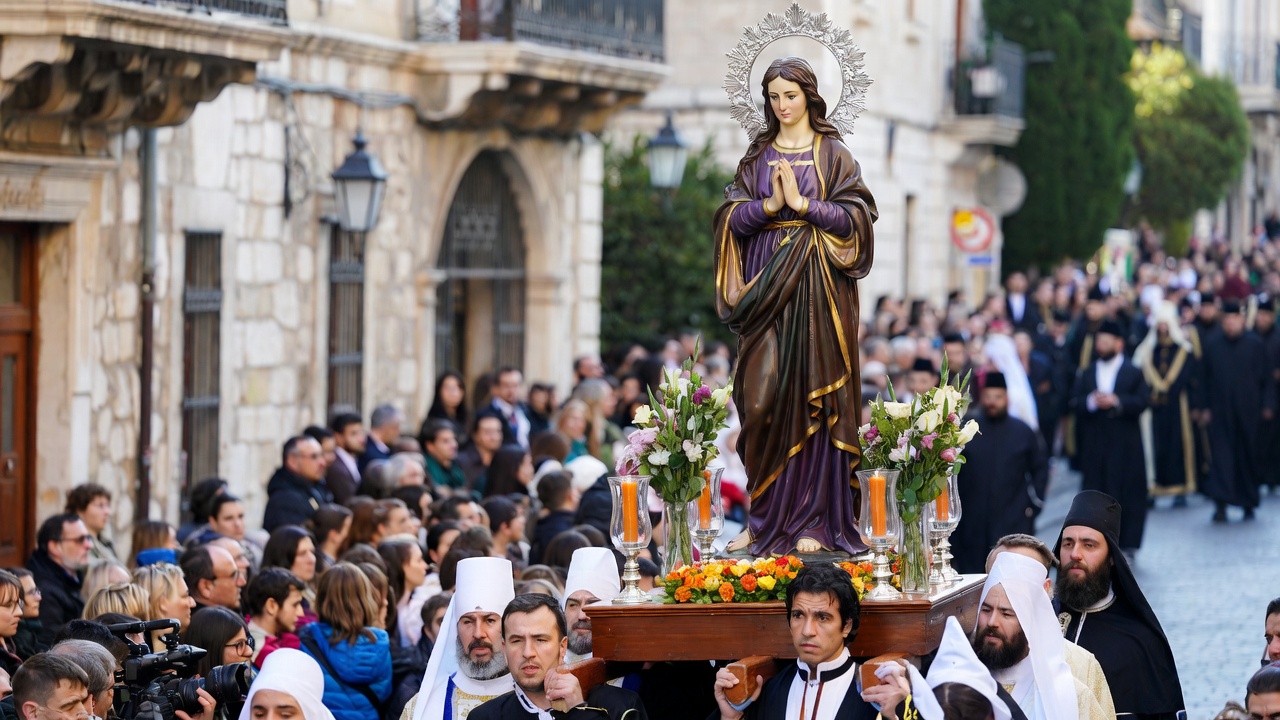
The centerpiece of Liberation Day is a solemn public procession. Led by the Captains Regent — San Marino’s two co-heads of state — the procession departs from the Palazzo Pubblico in the capital. It then winds through the streets from the town of Borgo Maggiore up to the Basilica di San Marino in the historic center atop Monte Titano.
This procession follows strict ceremonial protocol that has been observed for centuries. The Captains Regent are accompanied by members of the Great and General Council (San Marino’s parliament of 60 members), the Guard of the Great and General Council, and other civic officials. The military militias also participate in full dress uniform.
The Military Ceremony at Piazza della Libertà
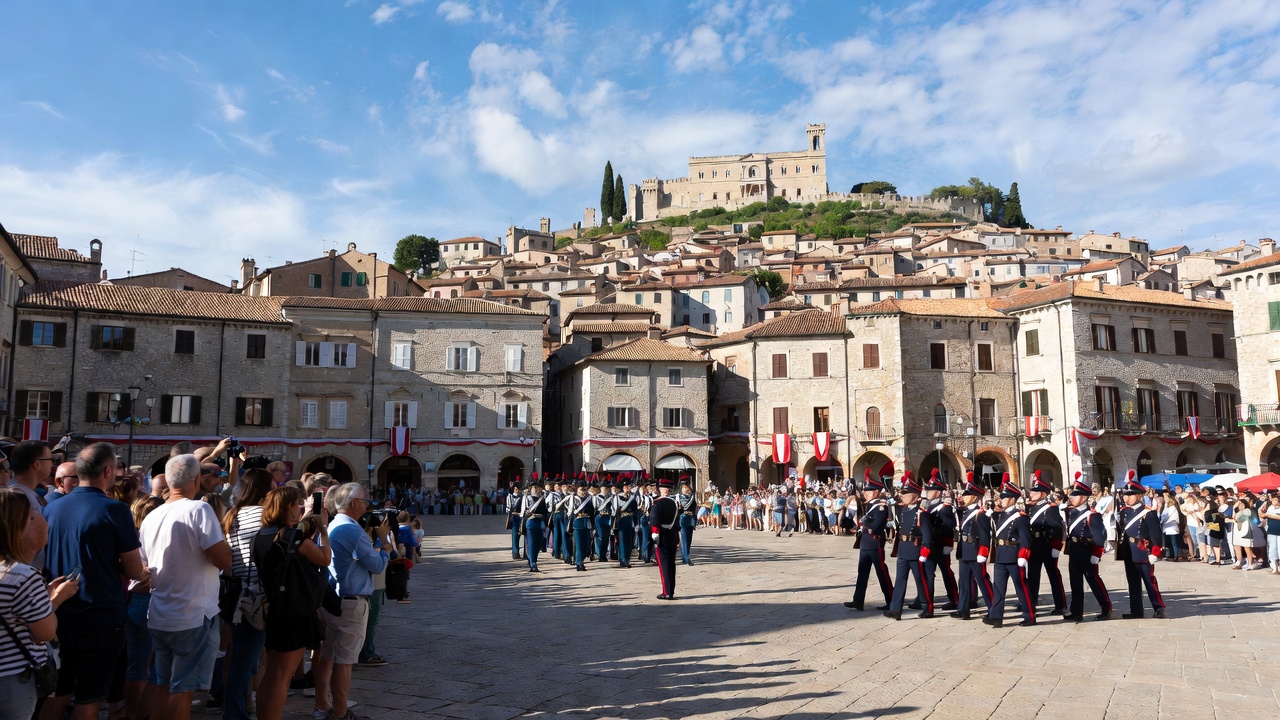
A particularly stirring moment occurs at Piazza della Libertà, the main square in front of the Palazzo Pubblico. Here, the Military Militias of San Marino stand in formation. Arms are presented to the Captains Regent. Official speeches are delivered. New military recruits take their oath of service, and medals are awarded to distinguished members.
A laurel wreath is laid at the base of the Ara dei Volontari — the monument honoring San Marino’s volunteers and soldiers who died in all wars.
Religious Services at the Basilica
The religious component of Liberation Day includes a solemn Mass at the Basilica di San Marino, the 19th-century neoclassical church that stands at the heart of the historic center. The service honors Saint Agatha and gives thanks for the republic’s continued independence.
Residents attend the Mass in large numbers. The church is adorned with flowers and banners. The atmosphere combines spiritual reverence with national pride in a way that is distinctly Sammarinese.
Community Celebrations and Festive Atmosphere
Beyond the formal ceremonies, Liberation Day is a time for community gathering. The streets of the historic center are decorated with the blue-and-white flags of the republic. Families come together for festive meals. Local bars and restaurants serve traditional Sammarinese dishes. Musicians and cultural performers add to the celebratory mood.
For visitors, it is a rare chance to see San Marino at its most authentic — a small nation celebrating its heritage with genuine emotion and pride.
Traditional San Marino Food to Enjoy During Liberation Day Celebrations
Food is central to any Sammarinese celebration. The cuisine of San Marino is closely related to that of the neighboring Italian regions of Emilia-Romagna and Marche, but it retains its own distinctive character rooted in centuries of rural mountain life.
Here are the essential dishes to seek out during Liberation Day:
Piadina — The Beloved Flatbread of San Marino
Piadina is the quintessential Sammarinese street food. This thin flatbread, made from flour, lard (or olive oil), salt, and water, is cooked on a griddle and served warm with a variety of fillings. The most traditional filling combines stracchino cheese, arugula, and prosciutto crudo. In San Marino, the piadina is slightly thicker than the paper-thin Rimini version, but still thinner than the ones found in Ravenna or Cesena.
Piadina has been part of the region’s culinary heritage since at least 1317, when it first appeared in written records. Originally known as the bread of the poor, it is now a beloved staple enjoyed at every level of Sammarinese society.
Torta Tre Monti — The National Cake
No trip to San Marino is complete without tasting Torta Tre Monti, the republic’s iconic national dessert. Named after the Three Towers (Guaita, Cesta, and Montale) that crown Monte Titano, this cake consists of thin wafer layers filled with a rich chocolate-hazelnut cream and coated in dark chocolate.
The cake has been produced since 1942 by La Serenissima, a confectionery company based in the municipality of Domagnano. It has earned the official Mark of Origin and Typicality of the Republic of San Marino. Visitors can purchase it at bakeries throughout the historic center, often packaged in the distinctive bright blue box featuring the Three Towers.
Other Traditional Dishes
| Dish | Description |
|---|---|
| Fagioli con le cotiche | A hearty bean and bacon soup, traditionally served at Christmas |
| Pasta e ceci | Chickpea and noodle soup with garlic and rosemary |
| Nidi di rondine | “Swallow’s nests” — rolled pasta sheets with ham, cheese, and béchamel |
| Coniglio in porchetta | Roast rabbit with wild fennel, a classic main course |
| Bustrengo | A dense fruit cake made with cornmeal, honey, nuts, and dried fruit |
| Passatelli in brodo | A rustic pasta made from breadcrumbs, Parmesan, and eggs, served in broth |
| Cappelletti | Ring-shaped stuffed pasta served in broth or with meat sauce |
Sammarinese Wine
San Marino produces its own wines, protected by the Consorzio Vini di San Marino (San Marino Wine Consortium). The most notable grape is Sangiovese, the same variety that produces Chianti and Brunello di Montalcino in Tuscany. Local vintages tend to be fresh, medium-bodied reds that pair beautifully with the hearty mountain cuisine.
San Marino’s UNESCO World Heritage Historic Center and Mount Titano
If you are traveling to San Marino for Liberation Day, you will be visiting one of Europe’s most remarkable UNESCO World Heritage Sites. The Historic Centre and Mount Titano were inscribed on the World Heritage List in 2008.
According to UNESCO, the site covers 55 hectares and is recognized as a testimony to the continuity of a free republic since the Middle Ages. The inscription specifically honors San Marino as an outstanding example of representative democracy based on civic autonomy and self-governance.
The Three Towers of San Marino
The Three Towers — Guaita, Cesta, and Montale — are the most iconic landmarks of the republic. They stand on the three peaks of Monte Titano and have been symbols of San Marino’s independence for centuries. They appear on the national flag, the coat of arms, and even on the Torta Tre Monti.
- Guaita (also called the First Tower) is the oldest, dating to the 11th century. It served as a fortress and prison for centuries.
- Cesta (the Second Tower) sits on the highest peak of Monte Titano. Built in the 13th century, it now houses the Museum of Ancient Arms.
- Montale (the Third Tower) is the smallest, dating to the 14th century. It remains privately owned and is not open to visitors, but its silhouette against the sky is unmistakable.
Palazzo Pubblico
The Palazzo Pubblico (Public Palace) stands in Piazza della Libertà and serves as the seat of San Marino’s government. Built in the late 19th century in a neo-Gothic style, it is the location where the Captains Regent are inaugurated and where Liberation Day ceremonies reach their climax.
The Basilica di San Marino
The Basilica di San Marino is a neoclassical church built in the early 19th century on the site of an earlier church. It houses relics of Saint Marinus, the republic’s founder. During Liberation Day, the basilica is the destination of the grand procession and the site of the solemn Mass honoring Saint Agatha.
How San Marino Has Maintained Its Independence for Over 1,700 Years
One of the most frequently asked questions about San Marino is simple but profound: how has such a tiny country survived for so long?
The answer lies in a combination of geography, diplomacy, and cultural identity.
Geographic Advantage
Monte Titano is a natural fortress. At 750 meters above sea level, with steep cliffs on multiple sides, the mountain was extremely difficult to attack using medieval military technology. This geographic advantage gave San Marino a defensive edge far beyond what its small population could otherwise sustain.
Diplomatic Skill
The Sammarinese have consistently demonstrated remarkable diplomatic intelligence. When Napoleon swept through Italy in 1797, the republic’s regent Antonio Onofri managed to win the French emperor’s respect and friendship. Napoleon offered to extend San Marino’s territory to include access to the sea. The Sammarinese politely declined, wisely fearing that accepting territorial expansion could provoke future conflicts with neighboring states.
When Giuseppe Garibaldi, the hero of Italian unification, sought refuge in San Marino in 1849 while fleeing Austrian forces, the republic granted him sanctuary. This act of courage won the lasting gratitude of the Italian national movement and helped ensure that San Marino would remain independent even as the modern Italian state took shape around it.
In 1861, U.S. President Abraham Lincoln was made an honorary citizen of San Marino. He responded with a letter praising the republic, calling it proof that government founded on republican principles could endure.
Cultural Identity
Perhaps most importantly, the Sammarinese have maintained a fierce and unbroken sense of cultural identity. The word “Libertas” (Liberty) — which appears on the republic’s coat of arms — is not merely a slogan. It is the defining principle of Sammarinese civilization, passed down from Saint Marinus himself.
Practical Travel Tips: How to Visit San Marino for Liberation Day 2026
Planning a trip to San Marino for February 5, 2026? Here is what you need to know.
How to Get to San Marino
San Marino has no airport or railway station. The easiest approach is to fly into Federico Fellini International Airport in Rimini, Italy, which is about 22 kilometers from San Marino. From Rimini, you can reach the republic by:
- Bus: Regular bus services run from Rimini’s train station to San Marino. The journey takes roughly 40 minutes.
- Car: The drive from Rimini takes about 30 minutes via the SP72 road. Parking is available at several lots near the historic center, including the large lot at Borgo Maggiore, from where a cable car (funivia) carries visitors up to the old town.
- Taxi/Private Transfer: Available from Rimini airport or city center.
Where to Stay
San Marino has a range of hotels and guesthouses, though options are limited compared to a major city. Many visitors choose to stay in Rimini and make a day trip. However, staying overnight in San Marino — especially during Liberation Day — offers a far richer experience. You will be able to attend the evening celebrations and enjoy the historic center without the daytime tourist crowds.
Weather in February
February in San Marino is cold and often windy, especially on the exposed heights of Monte Titano. Temperatures typically range from 0°C to 8°C (32°F to 46°F). Snow is possible. Dress warmly in layers, wear sturdy walking shoes suitable for cobblestone streets, and bring a windproof jacket.
Currency and Language
San Marino uses the euro (€) as its currency. The official language is Italian, though many residents also speak Romagnol, a regional language of the Emilia-Romagna area. English is spoken in tourist areas but is less common than in major Italian cities.
Entry Requirements
There are no border controls between San Marino and Italy. If you are able to enter Italy (whether visa-free or with a valid Italian/Schengen visa), you can enter San Marino freely. However, San Marino does operate its own tourist office, and visitors can obtain a commemorative passport stamp at the tourism office in the historic center — a popular souvenir.
San Marino’s Five Official National Holidays: A Complete Calendar
Liberation Day is one of five major national holidays in San Marino, each celebrating a significant moment in the republic’s history:
| Date | Holiday | Significance |
|---|---|---|
| February 5 | Liberation Day & Feast of Saint Agatha | Restoration of independence from Alberoni (1740); patron saint feast day |
| March 25 | Anniversary of the Arengo | Marks the 1906 democratic reforms that established the modern parliamentary system |
| April 1 | Investiture of the Captains Regent | Swearing-in ceremony for the new co-heads of state (spring term) |
| October 1 | Investiture of the Captains Regent | Swearing-in ceremony for the new co-heads of state (autumn term) |
| September 3 | Feast of Saint Marinus / Foundation Day | Celebrates the founding of the republic in 301 AD; the most important national holiday |
Each of these holidays reflects a key element of Sammarinese identity: independence, democracy, governance, and historical memory.
What Is the Equestrian Order of Saint Agatha and Why Was It Created?
One of the most distinctive legacies of Liberation Day and the cult of Saint Agatha in San Marino is the Equestrian Order of Saint Agatha. Established by the Great and General Council on June 5, 1923, this is a state order of merit named directly after the patron saint whose feast day coincides with the republic’s liberation.
The Order is awarded to foreign nationals who have made outstanding contributions to San Marino or to humanity through charitable, political, artistic, humanitarian, or sporting accomplishments. It has five ranks, following the tradition of European orders of chivalry.
According to the Consulate of San Marino to the UK, the Order was reformed by decrees in September 1923 and June 1925. Notable recipients over the decades have included military leaders, diplomats, and even members of European royal families.
The existence of this Order reflects something important about the Sammarinese worldview. For them, Saint Agatha is not merely a religious figure. She is a political symbol — a reminder that their freedom was restored on her feast day and under her protection. By creating a state order in her name, San Marino fused religious devotion with civic honor in a way that is uniquely Sammarinese.
San Marino During World War II: A Tradition of Neutrality and Refuge
San Marino’s commitment to liberty and neutrality extends well beyond the events of 1740. During World War II, the republic officially declared neutrality and opened its borders to those fleeing the conflict. At one point during the war, San Marino sheltered an estimated 100,000 refugees — roughly eight times the country’s own population at the time.
This extraordinary act of generosity was consistent with a long tradition. In 1849, San Marino gave refuge to Giuseppe Garibaldi and his followers when they were being pursued by Austrian forces during the Italian wars of unification. Garibaldi laid down his weapons upon entering San Marino, respecting the republic’s neutrality, and departed before Austrian forces could surround the territory.
The republic also maintained neutrality during World War I, though Italy viewed this neutrality with suspicion and even hostility. Despite the political pressure, San Marino held firm to its principles.
These episodes are remembered alongside Liberation Day as part of a broader national narrative. The Sammarinese understand their history as a continuous thread of choosing peace over conflict and offering shelter to the persecuted — values that trace back to Saint Marinus himself, a refugee who fled religious persecution to build a community on Monte Titano.
The Role of the Captains Regent in San Marino’s Liberation Day Ceremony
The Captains Regent (Capitani Reggenti) hold a unique place in San Marino’s political system and in its Liberation Day celebrations. These two co-heads of state are elected by the Great and General Council and serve for just six months each. The system dates back to 1243 — making it one of the oldest continuous democratic institutions in the world.
On Liberation Day, the Captains Regent play the central ceremonial role. They lead the procession, preside over the military review, and deliver the official speeches. Their presence is a living symbol of San Marino’s unbroken tradition of shared, democratic governance.
The idea of having two leaders instead of one was a deliberate safeguard against tyranny. Each Captain Regent has the power to check the other, preventing any single individual from accumulating too much authority. This principle of power-sharing is fundamental to the Sammarinese political identity and directly connects to the values celebrated on Liberation Day — the rejection of authoritarian rule and the defense of collective self-governance.
The investiture ceremonies for the Captains Regent are held on April 1 and October 1 each year, and they are national holidays in their own right. But it is on Liberation Day that the Captains Regent are most visibly connected to the republic’s founding ideals.
Why Liberation Day Matters Beyond San Marino: Lessons in Civil Disobedience and National Resilience
The story of San Marino’s liberation in 1740 carries lessons that reach far beyond the republic’s tiny borders. It is a story about the power of nonviolent resistance, the importance of institutional memory, and the capacity of a small community to defend its principles against overwhelming force.
The Sammarinese did not defeat Cardinal Alberoni with armies. They defeated him with petitions, patience, and principle. Their clandestine letters to the Pope were acts of extraordinary courage — any one of them, if intercepted, could have brought severe punishment. Yet the citizens persisted, driven by a conviction that their freedom was just and that the highest authority in Christendom would recognize it.
This approach to resistance — grounded in law, morality, and appeals to legitimate authority rather than violence — places the Sammarinese liberation of 1740 in the same moral tradition as many later movements for civil rights and self-determination.
It is also a reminder that size does not determine significance. San Marino covers barely 61 square kilometers. Its population is smaller than many towns. Yet its commitment to republican governance and individual liberty has endured for over 1,700 years — longer than any empire, any dynasty, and any superpower in recorded history.
Frequently Asked Questions About San Marino Liberation Day
Is Liberation Day a public holiday in San Marino? Yes. February 5 is an official public holiday. Government offices, banks, and most businesses are closed.
Can tourists attend the Liberation Day celebrations? Absolutely. The processions and civic ceremonies are public events, and visitors are welcome. The atmosphere is festive but respectful.
Is Liberation Day the same as San Marino’s Independence Day? Not exactly. San Marino’s official Foundation Day is September 3, which commemorates the founding of the republic in 301 AD. Liberation Day specifically marks the restoration of independence after the Alberoni occupation of 1739–1740.
Why is Saint Agatha associated with Liberation Day? Because Pope Clement XII restored San Marino’s independence on February 5, 1740, which happened to be the feast day of Saint Agatha. The Sammarinese adopted her as their co-patron saint in gratitude.
How long did the Alberoni occupation last? Approximately three and a half months, from October 17, 1739, to February 5, 1740.
What language is spoken during the celebrations? Italian is the official language. Ceremonies, speeches, and religious services are conducted in Italian. Some older residents also speak Romagnol.
Conclusion: The Enduring Spirit of Libertas in the World’s Oldest Republic
Every year on February 5, the people of San Marino gather to remember a simple but powerful truth: freedom is never guaranteed. It must be defended — sometimes with armies, but more often with wisdom, patience, and an unwavering commitment to justice.
The liberation of 1740 was not a military victory. It was a moral one. A community of ordinary citizens, armed with nothing but pens and conviction, defeated one of the most powerful churchmen in Europe. They did so by appealing to a higher authority — not with weapons, but with words.
That is the real story behind Liberation Day. And it is the reason why, more than 285 years later, the Sammarinese still march through the streets of their ancient capital every February 5 — not in triumph, but in gratitude.
The coat of arms of San Marino bears a single word: Libertas. It has been there for centuries. After 1,725 years of unbroken sovereignty, it has more than earned its place.
If you ever have the chance to visit this extraordinary republic during its Liberation Day celebrations, take it. Walk the cobblestone streets. Listen to the church bells. Watch the procession wind its way up Monte Titano. Taste the piadina and the Torta Tre Monti. And remember that you are standing in the oldest republic on earth — a place where the idea of freedom is not an abstraction but a living, breathing, daily reality.
Buona festa della Liberazione. Viva la Repubblica di San Marino.
How Does San Marino’s Liberation Day Compare to Other European National Holidays?
San Marino’s Liberation Day is unique among European national holidays in several ways. While many European countries celebrate liberation from foreign occupation — France has Bastille Day (July 14), the Netherlands celebrates Liberation Day (May 5), and Norway marks May 17 — San Marino’s holiday stands apart for three key reasons.
First, the scale of the nation. San Marino is the smallest republic in Europe by both area and population. Its Liberation Day is correspondingly intimate. There are no massive military parades or fireworks displays on a national scale. Instead, the celebrations are personal, community-driven, and deeply rooted in local tradition.
Second, the method of liberation. San Marino did not win its freedom through revolution or armed conflict. It achieved liberation through civil disobedience and legal appeal. This makes its story more comparable to the traditions of Mahatma Gandhi or Martin Luther King Jr. than to the storming of a fortress or a battlefield victory.
Third, the fusion of religious and civic commemoration. While many European countries separate church and state in their national celebrations, San Marino’s Liberation Day is inseparably linked to the Feast of Saint Agatha. Religious services are not a secondary element of the day — they are central to it. This reflects San Marino’s unique position as a republic whose founding saint was a Christian hermit and whose liberation was blessed by a pope.
For travelers interested in experiencing a truly authentic and uncommercialized European national holiday, San Marino’s Liberation Day offers something rare: a celebration that has not been shaped by tourism marketing or mass media, but by centuries of genuine local tradition.
Have you visited San Marino during Liberation Day or any other national holiday? Share your experience in the comments below. For more festival guides, travel tips, and deep dives into global cultural traditions, explore the rest of our blog.