
Every February, millions of cards change hands. Hearts flutter. Smiles spread. But have you ever wondered how this tradition began?
Why Do We Exchange Valentine’s Day Cards? The Origins Explained
The Valentine card tradition stretches back centuries. It didn’t start in a Hallmark factory. It began with handwritten love notes passed between secret admirers.
The earliest known Valentine card dates to 1415. Charles, Duke of Orleans, penned a love poem to his wife while imprisoned in the Tower of London. He called her his “very gentle Valentine.” The tradition stuck.
By the 1700s, exchanging handwritten Valentines was common in England. Lovers crafted elaborate paper creations. They used lace, ribbons, and pressed flowers. Each card was unique. Each carried deep personal meaning.
How Valentine Cards Came to America: A Brief Timeline
| Year | Milestone |
|---|---|
| 1700s | Handmade Valentines arrive with European settlers |
| 1840 | Esther Howland creates first mass-produced American Valentines |
| 1850s | Valentine card exchanges become mainstream |
| 1913 | Hallmark begins producing Valentine’s Day cards |
| 1990s | E-cards emerge with internet popularity |
| 2010s | Digital cards and social media greetings explode |
Esther Howland deserves special mention. Known as the “Mother of the American Valentine,” she spotted an English Valentine card in her father’s stationery shop. She thought, “I can make these.” She was right.
Howland imported lace and fine papers from England. She assembled cards with help from friends. Her first year? She earned $5,000—a fortune in the 1840s. She built an empire on paper hearts.
Types of Valentine Cards: Which One Should You Send?
Not all Valentine cards serve the same purpose. Choosing the right style matters. Here’s your guide:
Romantic Valentine Cards for Your Spouse or Partner
These cards express deep love. They often feature:
- Heartfelt poetry or quotes
- Rich colors like deep red and burgundy
- Elegant designs with gold foil accents
- Space for personal handwritten messages
Pro tip: The card matters less than what you write inside. Skip the pre-printed message. Write from your heart.
Funny Valentine Cards That Make Them Laugh
Humor builds connection. Funny Valentine cards work perfectly for:
- Long-term couples who appreciate inside jokes
- Friends you want to celebrate
- Office Valentine exchanges
- Anyone who needs a good laugh
The best funny cards balance wit with warmth. They tease gently. They never mock.
Friendship Valentine Cards: Galentine’s Day and Beyond
Leslie Knope made “Galentine’s Day” famous on Parks and Recreation. The concept caught fire. Now, celebrating platonic love on February 13th (or 14th) is mainstream.
Friendship Valentine cards typically feature:
- Bright, cheerful colors
- Playful designs
- Messages celebrating the bond you share
- Less romantic imagery, more celebration
Kids’ Valentine Cards for Classroom Exchanges
Classroom Valentine exchanges remain an American institution. These cards follow specific rules:
- Keep them inclusive – Every classmate gets one
- Stay age-appropriate – Simple designs work best
- Add small treats – Stickers, temporary tattoos, or candy
- Make them easy to sign – Kids write dozens of names
Popular themes include superheroes, animals, cartoon characters, and sports.
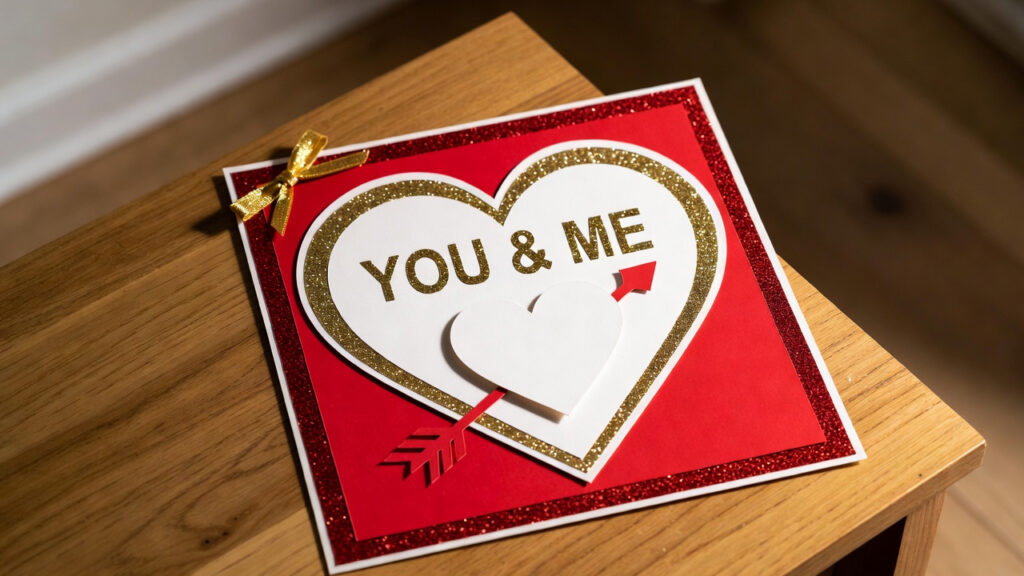
DIY Valentine Card Ideas: Handmade Cards Never Go Out of Style
Handmade Valentine cards carry extra meaning. They show time and effort. They demonstrate genuine care.
Simple Handmade Valentine Card Techniques
| Technique | Difficulty | Materials Needed |
|---|---|---|
| Paper hearts | Easy | Colored paper, scissors, glue |
| Watercolor wash | Easy | Watercolor paper, paints, brush |
| Collage style | Medium | Magazines, photos, decorative paper |
| Pop-up cards | Medium | Cardstock, craft knife, ruler |
| Embroidered paper | Advanced | Cardstock, needle, embroidery thread |
| Paper quilling | Advanced | Quilling strips, slotted tool, glue |
What to Write in a Valentine Card: Message Ideas That Work
Stuck on what to write? Start simple:
For romantic partners:
- “You make ordinary days feel extraordinary.”
- “Choosing you was the best decision I ever made.”
- “My favorite place is next to you.”
For friends:
- “Life is better with you in it.”
- “Thanks for being my person.”
- “Here’s to another year of adventures together.”
For family members:
- “You taught me what love means.”
- “Grateful for you, today and always.”
- “Thanks for being my biggest supporter.”
The Psychology Behind Valentine Card Giving: Why Cards Still Matter
In an age of instant messaging, why do physical cards endure?
Science offers answers. Studies show that handwritten notes activate different brain regions than digital messages. They feel more personal. More intentional. More real.
A card is a tangible object. It can be held. Kept. Treasured. That text message from 2019? Probably deleted. But your grandmother’s Valentine card from 1975? Still in a shoebox somewhere.
Cards also require deliberate action. You must choose one. Buy it. Write in it. Address it. Mail or deliver it. Each step represents effort. Recipients recognize this effort. They value it.
Valentine Card Etiquette: Unwritten Rules You Should Know
Who Should Receive a Valentine Card?
Traditional etiquette suggests sending cards to:
- Romantic partners (obviously)
- Close family members
- Dear friends
- Teachers (from students)
- Colleagues (in offices that celebrate)
Should You Sign Valentine Cards to Non-Romantic Recipients?
Always clarify the relationship. Sign cards to friends with your name. Add context like “Your friend always” or “With love from your buddy.” This prevents awkward misunderstandings.
When Should You Mail Valentine’s Day Cards?
The timeline:
- One week before – Ideal for local delivery
- Two weeks before – Necessary for cross-country mail
- Three weeks before – Required for international recipients
Mail delays happen. Plan accordingly. A late Valentine card loses impact.
The Rise of Digital Valentine Cards: E-Cards and Beyond
Digital Valentine cards exploded in the early 2000s. Sites like Blue Mountain and American Greetings offered free animated options. They were convenient. They were instant. They were… often forgotten.
Today’s digital landscape looks different. Options include:
- Video messages – Personal and shareable
- Custom digital illustrations – Commissioned from artists
- Instagram stories – Public declarations of affection
- Spotify playlists – Curated songs with personal meaning
- Digital gift cards – Practical but less romantic
Digital cards work best as supplements. They shouldn’t replace physical cards entirely. The ideal approach? Send both.
Valentine Card Collecting: A Growing Hobby
Antique Valentine cards command serious money. Collectors prize certain characteristics:
What Makes a Valentine Card Valuable?
- Age – Pre-1900 cards fetch premium prices
- Condition – No tears, stains, or fading
- Maker – Esther Howland cards are highly sought
- Design complexity – Mechanical or layered cards impress
- Materials – Real lace, silk, or feathers add value
- Historical significance – Cards with documented provenance
A rare Esther Howland Valentine sold for over $4,000 at auction. Even common vintage cards from the 1920s-1950s sell for $10-$50 each.
Valentine Card Traditions Around the World
Americans aren’t alone in exchanging Valentine cards. The tradition varies globally:
| Country | Unique Tradition |
|---|---|
| Japan | Women give chocolates; men return gifts on “White Day” (March 14) |
| Finland | “Ystävänpäivä” (Friend’s Day) emphasizes friendship over romance |
| Wales | Carved wooden spoons traditionally replace cards |
| Denmark | Pressed snowdrops accompany “gaekkebrev” (joker letters) |
| South Korea | Multiple love-related holidays throughout the year |
Each culture adds its own twist. The core remains constant: expressing affection matters.
How to Start Your Own Valentine Card Tradition
Traditions take time to build. But you can start this year.
Ideas for couples:
- Exchange cards at the same special location each year
- Write predictions for the coming year; read last year’s
- Hide cards for each other to find throughout the day
Ideas for families:
- Create a Valentine mailbox for household card exchanges
- Make cards together as a craft activity
- Read favorite cards from previous years aloud
Ideas for friend groups:
- Host an annual card-making party
- Draw names for a Valentine card exchange
- Start a Galentine’s Day brunch tradition
The best traditions feel natural. They evolve organically. Start small. See what sticks.
Final Thoughts: The Enduring Power of Valentine Cards
Valentine cards have survived centuries. They’ve outlasted countless fads. They’ll likely outlast us all.
Why? Because humans crave connection. We want to know we matter. A Valentine card—whether elaborate or simple, expensive or handmade—says “I thought of you. You’re important to me.”
That message never goes out of style.
This February, skip the generic text. Put pen to paper. Choose a card that speaks to your relationship. Write something real inside.
Your Valentine will thank you.
Have a favorite Valentine card tradition? Share it in the comments below. And don’t forget to subscribe for more holiday guides and cultural deep-dives throughout the year.