Every year, the crescent moon brings with it a quiet wave of anticipation. Kitchens are scrubbed clean. Pantries are stocked with dates, lentils, and fragrant spices. Prayer mats are unrolled. And across the world — from the minarets of Istanbul to the suburban mosques of Toronto — nearly two billion Muslims prepare to enter the holiest month of the Islamic calendar.
Ramadan 2026 (1447 AH) is here, and this year, it carries a special quality. For the first time in over a decade, the blessed month falls squarely in late winter for the Northern Hemisphere. That means shorter, more manageable fasting hours for the majority of the world’s Muslim population. It also means the preparation window is unique — and the checklist you need looks a little different than it did five years ago.
Whether you are a lifelong observer or someone fasting for the first time, this guide will walk you through every practical, spiritual, and nutritional step to make your Ramadan as smooth and meaningful as possible.
When Does Ramadan 2026 Start and End? Key Dates You Must Know
The most important first step is marking your calendar.
Based on astronomical calculations and moon-sighting confirmations from Saudi Arabia, the first day of fasting for Ramadan 2026 began on Wednesday, February 18, 2026 in most Arab countries. In South Asia, including Pakistan, India, and Bangladesh, fasting started on Thursday, February 19, 2026, due to regional moon-sighting variations.
Here are the essential dates:
| Event | Expected Date (2026) |
|---|---|
| First Taraweeh Prayer | Evening of Tue, Feb 17 / Wed, Feb 18 |
| First Day of Fasting | Wed, Feb 18 (Arab countries) / Thu, Feb 19 (South Asia) |
| Laylat al-Qadr (27th Night) | Approx. March 16–17 |
| Last Day of Fasting | Wed, March 18 / Thu, March 19 |
| Eid al-Fitr | Thu, March 19 / Fri, March 20 |
Important: The Islamic calendar is lunar. Each month begins when the first crescent of a new moon is sighted. Dates may shift by one day depending on your location. Always confirm with your local mosque or national moon-sighting committee.
The corresponding Islamic year is 1447 AH (After Hijra). Ramadan is the ninth month of the Hijri calendar, and because the lunar year is roughly 10 to 11 days shorter than the Gregorian solar year, Ramadan migrates through the seasons over a 33-year cycle.
How Long Is the Ramadan 2026 Fast? Fasting Hours by Country
One of the most-asked questions every year: How many hours will I be fasting?
The answer depends entirely on where you live. Since Ramadan 2026 falls close to the spring equinox, fasting durations are more balanced globally than in recent years. According to Al Jazeera’s Ramadan 2026 coverage, the dawn-to-dusk fast ranges from roughly 11.5 to 15.5 hours worldwide.
Here is a breakdown of expected fasting hours at the start of Ramadan 2026:
| Region / City | Approx. Fasting Hours (Day 1) |
|---|---|
| Scandinavia (Oslo, Stockholm) | ~11.5–12 hours |
| London, UK | ~12–12.5 hours |
| Paris, France | ~12–12.5 hours |
| Istanbul, Turkey | ~12–12.5 hours |
| New York, USA | ~12.5–13 hours |
| Dubai, UAE | ~12 hours 46 min |
| Riyadh, Saudi Arabia | ~12.5–13 hours |
| Islamabad, Pakistan | ~12.5–13 hours |
| Jakarta, Indonesia | ~13 hours |
| Cape Town, South Africa | ~14–14.5 hours |
| Auckland, New Zealand | ~15–15.5 hours |
Key takeaway for 2026: If you live in the Northern Hemisphere, this is one of the most comfortable Ramadan fasting windows you will experience for several years. Fasting hours will gradually lengthen as the month progresses and spring approaches. According to Morocco World News, Europe sees some of the shortest fasting hours this year, while Australia and New Zealand record the longest — up to 15.5 hours on day one.
For Muslims living in extreme northern latitudes (parts of Scandinavia, northern Canada, Iceland), where daylight can be exceptionally long or short, Islamic scholars advise following the fasting schedule of Makkah or the nearest city with moderate hours. This ruling reflects the Islamic principle of ease (yusr) in worship.
How to Prepare Your Body for Ramadan Fasting: A Physical Health Guide
Jumping into a full day of fasting without preparation is like running a marathon without training. Your body needs time to adjust. Start at least two to three weeks before Ramadan with these steps.
Gradually Reduce Caffeine and Sugar Intake
This is the single most important physical preparation tip. Caffeine withdrawal headaches are the number one complaint during the first days of Ramadan. If you drink coffee or tea daily, cut your intake by half each week in the lead-up to the month. Switch to smaller cups. Try herbal tea as a substitute.
The same principle applies to refined sugar. Reduce sweets, sodas, and processed snacks so that your body does not crash when these are suddenly unavailable during the day.
Adjust Your Sleep Schedule Early
Ramadan changes your sleep cycle significantly. You will wake up before dawn for suhoor (the pre-dawn meal) and may stay up late for Taraweeh prayers. Start shifting your bedtime earlier in 15- to 20-minute increments in the weeks before the month begins.
Short daytime naps — known as Qailulah in the prophetic tradition — of 20 to 30 minutes can help maintain alertness during fasting hours.
Hydration Training
Begin increasing your water intake to 8 to 10 glasses per day well before Ramadan. During the month itself, you will need to drink most of your water between iftar and suhoor. Training your body to hydrate efficiently during a condensed window makes a measurable difference.
Consult Your Doctor if You Have Health Conditions
If you manage diabetes, hypertension, kidney disease, or any chronic illness, speak with your physician before fasting. Many health systems in Muslim-majority countries and Western cities with large Muslim populations run pre-Ramadan health clinics specifically for this purpose. Do not skip this step. Your health is a trust (amanah), and Islam explicitly exempts those for whom fasting poses a significant health risk.
Ramadan Meal Prep Ideas for Suhoor and Iftar: A 30-Day Nutrition Plan
Food is at the heart of Ramadan — not in excess, but in intention. The Prophet Muhammad (peace be upon him) advised filling one-third of the stomach with food, one-third with water, and leaving one-third empty. That wisdom is remarkably aligned with modern nutritional science.
What to Eat at Suhoor: Slow-Burning Fuel for the Day
Suhoor is your lifeline. A strong suhoor keeps you energized, hydrated, and focused until sunset. Prioritize:
- Complex carbohydrates: Steel-cut oats, whole wheat bread, brown rice
- Lean protein: Eggs, yogurt, cottage cheese, legumes
- Healthy fats: Avocado, nuts, chia seeds, olive oil
- Hydrating fruits: Watermelon, cucumber, oranges, berries
Avoid highly salty foods (pickles, processed meats, salty cheeses), which cause intense thirst the next day. Also skip fried or greasy foods that cause sluggishness.
Pro tip: Prepare overnight oats or egg muffins the night before. Suhoor comes early, and no one wants to cook at 4:00 AM.
What to Eat at Iftar: Breaking the Fast with Balance
The Sunnah (prophetic tradition) is to break the fast with dates and water. Dates are nature’s perfect fast-breaker — they provide quick natural sugar, fiber, potassium, and magnesium.
After dates, move to a light soup (lentil, chicken, or vegetable), then a balanced main meal:
- Grilled chicken or fish with roasted vegetables
- Hearty stews with chickpeas, lamb, or beef
- Fresh salads like tabbouleh or fattoush
- Whole grain sides like quinoa, bulgur, or brown rice
Avoid the temptation to overeat at iftar. A rushed, heavy meal leads to discomfort during Taraweeh prayers. Eat slowly. Give your body 15 to 20 minutes to register fullness before reaching for seconds.
Batch Cooking and Freezer-Friendly Meals
One of the best-kept secrets of experienced Ramadan observers is batch cooking. Prepare and freeze the following before the month starts:
- Soups and stews (lentil soup, harira, minestrone)
- Marinated proteins (shish tawook, kafta, grilled chicken)
- Samosas, spring rolls, and pastries (freeze uncooked for freshness)
- Sauces and bases (tomato sauce, curry paste, stock)
This approach saves hours of kitchen time and lets you focus on worship rather than cooking.
How to Set Spiritual Goals for Ramadan 2026: A Worship Preparation Guide
Ramadan is, above all, a spiritual journey. The Quran says: “O you who believe, fasting is prescribed for you, as it was prescribed for those before you, so that you may be mindful of God” (Surah Al-Baqarah, 2:183).
Before the month starts, sit down and write out your spiritual goals. Here is a framework to help:
Create a Quran Reading Plan
A common goal is to complete the entire Quran during Ramadan. The Quran has 30 sections (juz), one for each day. That requires reading roughly 20 pages per day. If that feels ambitious, set a smaller but consistent goal — even one page a day is a meaningful commitment.
Many mosques organize khatm al-Quran (complete recitation) programs during Taraweeh, where a hafiz (one who has memorized the Quran) leads the congregation through the entire text over 30 nights.
Establish a Daily Dhikr and Dua Routine
Set aside time each day for dhikr (remembrance of Allah) and dua (personal supplication). Write down a personal dua list — prayers for yourself, your family, your community, and the global ummah. The period just before iftar is considered one of the most powerful times for accepted prayers.
Understand the Three Phases of Ramadan
Scholars traditionally divide the month into three spiritual stages:
| Phase | Days | Focus |
|---|---|---|
| Days of Mercy (Rahmah) | Days 1–10 | Seeking Allah’s compassion and settling into routine |
| Days of Forgiveness (Maghfirah) | Days 11–20 | Deep repentance and purification of the heart |
| Days of Salvation (Najah) | Days 21–30 | Intensified worship, seeking Laylat al-Qadr |
The last ten nights are the crown jewel of Ramadan. Laylat al-Qadr (the Night of Power), which the Quran describes as being better than a thousand months, falls on one of the odd-numbered nights in this final stretch. Many Muslims dedicate themselves to I’tikaf — a spiritual retreat in the mosque — during these last ten days.
Ramadan Charity and Zakat Checklist: How to Give Before the Month Ends
Generosity is one of the defining features of Ramadan. The Prophet Muhammad was described as being more generous than a swift wind during this month. Two major forms of giving shape the Ramadan experience:
Zakat (Obligatory Annual Charity)
Zakat is one of the Five Pillars of Islam. It requires every Muslim whose wealth exceeds a minimum threshold (nisab) to donate 2.5% of their qualifying assets annually. Many Muslims choose to pay their Zakat during Ramadan because rewards for good deeds are believed to be multiplied during this month.
Before Ramadan begins, calculate your Zakat by tallying up your savings, gold, silver, investments, and business assets. Then subtract your debts. If the remainder exceeds the nisab, you owe Zakat on it. Many Islamic charities, including Islamic Relief and Muslim Aid, offer online Zakat calculators and ensure your donations reach those who need them most.
Zakat al-Fitr (End-of-Ramadan Charity)
This is a separate, smaller obligatory charity due before the Eid al-Fitr prayer. It is traditionally the equivalent of one sa’ (approximately 2.5 to 3 kg) of a staple food — such as rice, wheat, or barley — given on behalf of every member of your household, including children.
The purpose of Zakat al-Fitr is to ensure that every person in the community, including the poorest, can participate in the joy of Eid. You can pay this in advance during the last week of Ramadan, but it must be distributed before the Eid prayer.
Sadaqah (Voluntary Charity)
Beyond obligatory giving, Ramadan is a time to increase voluntary charity — feeding a fasting person their iftar, donating to food banks, supporting refugees, or volunteering at community kitchens. Even a smile is counted as charity in Islam.
How to Create a Ramadan-Ready Home: Cleaning, Decorating, and Organizing
The physical space in which you observe Ramadan matters more than you might think. A calm, organized home supports focused worship.
Deep Clean Before Day One
Many Muslim families follow a tradition of thorough house cleaning before Ramadan — similar in spirit to spring cleaning. Clear out clutter. Organize the kitchen. Donate clothes and items you no longer need. This is both practical and symbolic: you are making space for something sacred.
Set Up a Dedicated Prayer Corner
Choose a quiet spot in your home for a dedicated prayer area. Lay out a clean prayer mat. Place a Quran and Quran stand there. Add a tasbeeh (prayer beads), a dua book, and soft lighting. Some families add a small shelf for Islamic books. This designated space becomes an anchor for your daily worship routine.
Stock Your Ramadan Pantry
Before the month begins, stock up on essentials:
- Dates (Medjool, Ajwa, or Deglet Noor are popular choices)
- Dried goods: Lentils, chickpeas, rice, oats, flour
- Spices: Cumin, turmeric, cinnamon, cardamom, black seed
- Nuts and dried fruits: Almonds, walnuts, raisins, apricots
- Frozen items: Pre-made samosas, bread, marinated meats
- Beverages: Herbal teas, Rooh Afza (South Asian rose syrup), Jallab (Levantine date syrup drink), Qamar al-Din (apricot juice, popular in Egypt and the Levant)
Each region has its own beloved Ramadan staples. In Southeast Asia, it might be kolak (banana and sweet potato in coconut milk). In North Africa, the quintessential Ramadan soup is harira — a rich, warming blend of tomatoes, lentils, chickpeas, and lamb. In the Gulf, harees (a porridge of wheat and meat) and luqaimat (fried dumplings drizzled with date syrup) grace iftar tables from Dubai to Doha.
How to Plan Your Work and School Schedule Around Ramadan 2026
Ramadan does not pause the rest of life. Bills still need paying. Exams still happen. Meetings do not cancel themselves. The key is proactive planning.
Communicate Early with Your Employer or School
Let your manager, teachers, or colleagues know about Ramadan well in advance. Many workplaces in Muslim-majority countries adjust hours during the month, but if you live in a Western country, you may need to request:
- Flexible start times to accommodate early mornings
- A quiet space for prayer during the workday
- Adjusted meeting schedules to avoid late-afternoon low-energy periods
Front-Load Your Most Demanding Tasks
Your energy will be highest in the morning hours after suhoor. Schedule your most complex or demanding work for that window. Save lighter tasks — emails, administrative work, organizing — for the afternoon, when energy naturally dips.
Plan Around Key Ramadan Nights
Block out the last ten nights on your calendar now. If you plan to observe I’tikaf or attend extended night prayers, arrange coverage at work and communicate this with your family. These nights are too precious to leave to last-minute planning.
How to Prepare Children for Ramadan: Age-Appropriate Tips for Families
Ramadan is one of the most formative experiences in a Muslim child’s life. With the right approach, it becomes a month of excitement, belonging, and gentle learning.
Start with Storytelling
Tell your children about the revelation of the Quran. Explain why Muslims fast — not as punishment, but as an act of love, gratitude, and self-discipline. Use age-appropriate books, colorful Ramadan calendars, and daily countdown charts.
Introduce Fasting Gradually
Young children are not required to fast. But many Muslim families introduce half-day fasts for older children (around 7 to 10 years old). Let them fast from suhoor until noon, or until the afternoon. Celebrate their achievement at iftar with their favorite meal.
Include Them in Preparation
Let children help decorate the house, prepare iftar, pack charity boxes, and choose which mosque to attend for Taraweeh. Giving them an active role builds ownership and joy.
Create a Ramadan Activity Chart
Consider creating a daily Ramadan chart with activities like:
- Read one short surah
- Say one kind thing to a sibling
- Help set the iftar table
- Put a coin in the charity jar
- Learn one new Arabic word
These simple habits plant seeds that grow for a lifetime.
Ramadan Around the World: How Different Cultures Prepare for the Holy Month
Ramadan is universal in its spiritual core, but beautifully diverse in its cultural expression.
- Indonesia — the world’s largest Muslim-majority nation — marks the start of Ramadan with unique local traditions. On the island of Java, many believers bathe in holy springs in a ritual called Padusan. The city of Semarang holds the Dugderan carnival, featuring a parade of the warak ngendog, a mythical horse-dragon figure.
- Egypt lights up its streets with colorful fanous (lanterns), a tradition dating back to the Fatimid era. Children carry lanterns through the neighborhoods singing Ramadan songs. The mesaharati (the Ramadan drummer) still walks through some Egyptian streets before dawn, banging his drum to wake families for suhoor.
- Turkey has a long Ottoman tradition of Ramadan. The mahya — illuminated messages strung between minarets — lights up the sky above Istanbul’s great mosques. Street vendors sell pide (special Ramadan bread) and güllaç (a rose-water and milk dessert made only during this month).
- Morocco centers its Ramadan around harira, the beloved chickpea-lentil soup served at every iftar table. Families gather around communal bowls of chebakia (sesame and honey pastries) and glasses of fresh orange juice.
- The Gulf States (UAE, Saudi Arabia, Qatar, Kuwait) transform their cities during Ramadan. Public tents (khayam al-iftar) offer free meals to workers and travelers. Shopping hours shift. Television programming changes entirely, with special Ramadan series (musalsalat) dominating the airwaves.
- South Asia (Pakistan, India, Bangladesh) sees a particular emphasis on community iftars at mosques and shrines. Streets come alive at sunset with food stalls selling pakoras, fruit chaat, samosas, and rooh afza. The call to prayer echoes from thousands of loudspeakers, and the rhythm of the month is unmistakable.
Understanding these cultural expressions enriches the Ramadan experience — whether you are observing it yourself or living alongside neighbors who do.
Essential Ramadan Apps and Digital Tools You Should Download in 2026
Technology has become a valuable companion during Ramadan. Here are some tools worth having on your phone:
- Prayer time apps (like Muslim Pro, Athan, or Al-Moazin) that provide accurate suhoor and iftar times based on your GPS location
- Quran apps (like Quran.com or iQuran) with translations, audio recitations, and progress trackers
- Ramadan calendar generators (such as ConnectMazjid or Al Adhan) that let you create printable, city-specific timetables
- Zakat calculators offered by charities like Muslim Aid and Islamic Relief
- Meal planning apps to organize your suhoor and iftar menus for the full 30 days
- Habit trackers for logging daily Quran reading, prayers, and dhikr
Many mosques now also use digital platforms to manage Taraweeh sign-ups, volunteer shifts, and community iftar registrations. Check with your local masjid to see what digital tools they are using this year.
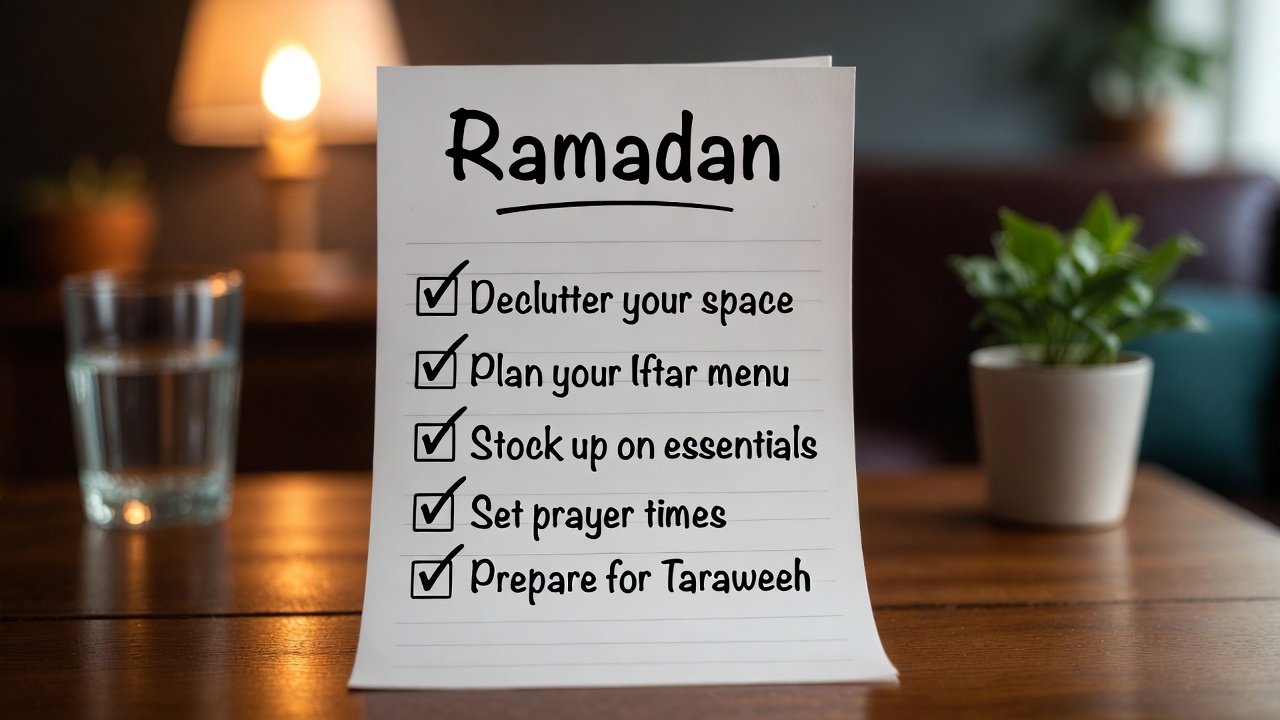
Your Complete Ramadan 2026 Preparation Checklist at a Glance
Here is your printable checklist. Aim to complete these items at least one week before the first day of fasting:
Spiritual Preparation
- [ ] Set your Ramadan spiritual goals (Quran, prayer, dhikr)
- [ ] Write a personal dua list
- [ ] Review and repent for past shortcomings
- [ ] Plan your Taraweeh schedule (mosque or home)
- [ ] Mark Laylat al-Qadr nights on your calendar
Physical Preparation
- [ ] Reduce caffeine and sugar intake (start 2–3 weeks early)
- [ ] Adjust your sleep schedule gradually
- [ ] Increase daily water intake
- [ ] Consult your doctor if you have any health conditions
- [ ] Stock up on vitamins and supplements if needed
Kitchen and Meal Preparation
- [ ] Plan a 30-day suhoor and iftar meal schedule
- [ ] Stock your pantry with Ramadan staples
- [ ] Batch cook and freeze soups, stews, and snacks
- [ ] Buy fresh dates in advance
- [ ] Prepare overnight suhoor options
Home Preparation
- [ ] Deep clean your home
- [ ] Set up a prayer corner
- [ ] Decorate with Ramadan lanterns, banners, or lights
- [ ] Organize your wardrobe for Eid (plan Eid outfits early)
- [ ] Donate unused clothing and household items
Financial and Charitable Preparation
- [ ] Calculate your Zakat for the year
- [ ] Budget for Zakat al-Fitr for every household member
- [ ] Set up recurring Sadaqah donations
- [ ] Research local food drives and volunteer opportunities
- [ ] Plan Eid gifts for children and family
Work and Social Preparation
- [ ] Inform your employer or school about Ramadan
- [ ] Request schedule adjustments if needed
- [ ] Front-load demanding projects
- [ ] Block out the last ten nights on your calendar
- [ ] Arrange community iftar plans with friends and neighbors
Final Thoughts: Entering Ramadan 2026 with Peace and Purpose
Preparation for Ramadan is itself an act of worship. Every item you check off this list — from reducing your caffeine intake to writing your dua list — is a step toward a month lived with greater clarity, compassion, and closeness to Allah.
This year, with fasting hours that are manageable for most of the world and a blessed month that arrives in the gentle transition from winter to spring, the conditions are set for a deeply rewarding Ramadan.
Do not aim for perfection. Aim for consistency. A small, sincere act repeated every day for 30 days will transform you far more than a single grand gesture.
From our team to yours — Ramadan Mubarak. May this month bring peace, forgiveness, and light to your home and to every corner of the ummah.