Every February, Mexico pauses to honor one of the most important legal documents in the Western Hemisphere. Día de la Constitución, or Constitution Day, is far more than a date on the calendar. It is a day that celebrates the legal backbone of a nation shaped by revolution, social struggle, and an enduring dream of justice.
Whether you are planning a trip to Mexico, studying Latin American history, or simply curious about global civic traditions, this guide walks you through the top 10 facts about Mexico Constitution Day that every traveler and culture enthusiast should know. From the dramatic origins of the 1917 Constitution to the lively puente weekend traditions that sweep the country each year, this article gives you a deep, honest, and well-researched look at one of Mexico’s most important national holidays.
1. What Is Mexico Constitution Day and Why Is It Celebrated Every Year?
Mexico Constitution Day (Día de la Constitución) is a federal statutory holiday that commemorates the promulgation of the Political Constitution of the United Mexican States (Constitución Política de los Estados Unidos Mexicanos) on February 5, 1917. The document was approved by the Constituent Congress in the city of Santiago de Querétaro, in the state of Querétaro, at the tail end of the Mexican Revolution.
This is not a minor civic gesture. Constitution Day is one of only seven mandatory rest days recognized under Mexico’s Federal Labor Law (Ley Federal del Trabajo). Under Article 74 of this law, employers across the country must give workers a paid day off. If an employee is required to work on this day, they are legally entitled to triple their normal daily wage.
The holiday serves as a moment for Mexicans to reflect on the principles that hold the nation together: democracy, social justice, workers’ rights, and public education. It is both a day of national pride and a practical reminder that the freedoms many citizens enjoy today were not given freely — they were fought for, debated over, and written into law more than a century ago.
For visitors in Mexico during early February, the holiday offers a unique window into the country’s civic soul. It is quieter than the Independence Day celebrations of September, but it carries a weight and a warmth that are distinctly Mexican.
2. When Is Mexico Constitution Day in 2026 and How the Date Has Changed
One of the most common questions travelers and researchers ask is: When exactly is Mexico Constitution Day? The answer is simple, but it comes with a twist.
The historical date of Constitution Day is February 5, the anniversary of the document’s promulgation in 1917. For decades, Mexico celebrated the holiday on that exact date, no matter which day of the week it fell on. However, in 2006, the Mexican Congress passed a reform to the Federal Labor Law that changed this tradition permanently.
Under the new rule, Constitution Day — along with two other national holidays, Benito Juárez’s Birthday and Revolution Day — was moved to a fixed Monday. Constitution Day now falls on the first Monday of February every year. The goal was to create guaranteed long weekends, known in Mexico as puentes (bridges), to promote domestic tourism and give workers predictable three-day breaks.
Here is a quick reference table for Constitution Day dates:
| Year | Official Observed Date (Monday) | Historical Anniversary |
|---|---|---|
| 2025 | Monday, February 3 | Wednesday, February 5 |
| 2026 | Monday, February 2 | Thursday, February 5 |
| 2027 | Monday, February 1 | Friday, February 5 |
| 2028 | Monday, February 7 | Saturday, February 5 |
In 2026, Constitution Day is observed on Monday, February 2. The historical anniversary, February 5, falls on a Thursday that year. Most closures, parades, and public celebrations happen on the Monday, not the Thursday.
This shift has been a boon for Mexico’s tourism industry. According to Mexico’s Ministry of Tourism, long-weekend holiday periods can boost domestic travel activity by as much as 25 percent during peak years. Popular destinations like Cancún, Puerto Vallarta, Los Cabos, and the country’s charming Pueblos Mágicos (Magic Towns) see a surge in visitors every time a puente weekend rolls around.
3. The Mexican Revolution and How the 1917 Constitution Was Born
You cannot understand Mexico Constitution Day without understanding the Mexican Revolution — a decade-long conflict (1910–1920) that reshaped the nation from top to bottom.
The Fall of Porfirio Díaz
The story begins with General Porfirio Díaz, who ruled Mexico for over 30 years (1876–1911, with a brief interruption). Under his presidency, known as the Porfiriato, Mexico experienced rapid economic growth. But that growth benefited a tiny elite while the vast majority of Mexicans — farmers, laborers, and indigenous communities — lived in poverty. Land was concentrated in the hands of wealthy hacienda owners and foreign investors. Workers had almost no legal protections.
The pressure for change finally boiled over in 1910, when Francisco I. Madero, a wealthy reformer, challenged Díaz in the presidential election. When Díaz had Madero imprisoned and declared himself the winner, the call for armed revolution spread across the country.
The Revolutionary Leaders
The revolution drew together an unlikely alliance of fighters. Emiliano Zapata led agrarian rebels in the south, demanding land redistribution under the famous slogan “Tierra y Libertad” (Land and Liberty). Pancho Villa commanded a powerful army in the north. Venustiano Carranza, a former senator and governor, emerged as the political leader who would ultimately steer the country toward a new legal framework.
After years of bloody fighting and political upheaval — including the assassination of Madero in 1913 and a series of shifting alliances — Carranza consolidated enough power to call for a Constitutional Congress in late 1916.
The Constituent Congress in Querétaro
The Congress convened in Santiago de Querétaro, a colonial city in central Mexico. Carranza chose this location for its symbolic importance: it was where Emperor Maximilian of Mexico had been executed in 1867, marking the end of French intervention. Others have suggested that Querétaro was simply a quiet, stable alternative to the politically charged capital.
The delegates were a diverse group — lawyers, professors, journalists, military officers, and revolutionary leaders from across the country. Carranza originally intended only to update the liberal Constitution of 1857, but the delegates had bigger ideas. The debates were intense and lasted several months. What emerged was not a simple revision but an entirely new document — one far more radical and socially progressive than anything Carranza had imagined.
The delegates worked under extraordinary pressure. The convention formally opened in November 1916, and the final draft was approved just a few months later. Unlike the earlier congresses that had produced the 1824 and 1857 Constitutions over longer periods, the 1916–1917 congress moved with remarkable speed. The urgency reflected the reality on the ground: Mexico was still at war, and the country desperately needed a new legal foundation to bring stability.
The debates were heated and often personal. Issues like anticlericalism, land redistribution, and labor protections produced sharp divisions among the delegates. One of the most contentious areas was the relationship between Church and State. The Catholic Church had wielded enormous political and economic power in Mexico for centuries. Many delegates viewed the Church as an obstacle to progress and national sovereignty. The resulting articles restricting Church influence were so strict that they eventually contributed to the Cristero War (1926–1929), a violent uprising by Catholic rebels against the government’s enforcement of the constitutional provisions.
Despite these tensions, the final product was a document that went far beyond what anyone had expected — a constitution that would become a model for progressive governance around the world.
On February 5, 1917, the new Constitution was promulgated. Venustiano Carranza became the first president to serve under its terms. The date has been commemorated as a national holiday ever since.
4. Why the Mexican Constitution of 1917 Was the First to Include Social Rights
This is arguably the single most important fact about the Mexican Constitution, and it deserves to be stated clearly: the Mexican Constitution of 1917 was the first national constitution in the world to enshrine social rights.
This achievement is often overlooked outside of Latin America, but its global significance is enormous. The Mexican document predated the Russian Soviet Constitution of 1918 and the Weimar Constitution of Germany in 1919, both of which are frequently cited as early examples of social constitutionalism.
According to the Library of Congress, the 1917 Constitution “insisted on complete separation of Church and State, the division of large haciendas into ejidos, national ownership of national subsoil, and the right of labor to organize, strike, and receive compensation for workplace accidents.” It was, in the words of many scholars, the legal triumph of the Mexican Revolution.
What Made It So Progressive?
The 1917 Constitution did not simply list abstract rights. It laid out specific, concrete obligations for the government. Unlike many constitutions of its era that took a hands-off approach to economics and labor, the Mexican document declared that the state has an active duty to promote the social, economic, and cultural well-being of its citizens. As Britannica notes, the constitution “completely overturned the widely held belief that the Mexican government should take only a limited, passive role.”
This was revolutionary thinking. In the United States, comparable labor protections did not arrive until President Franklin Roosevelt’s New Deal in the 1930s — nearly two decades later. The Mexican Constitution set a precedent that would echo through constitutions across Latin America and the world for the rest of the twentieth century.
5. The Three Most Important Articles in the Mexican Constitution Explained
The 1917 Constitution contains 136 articles organized into ten thematic titles. But three articles, in particular, form the heart and soul of the document. These are Articles 3, 27, and 123 — and understanding them is essential to understanding modern Mexico.
Article 3: The Right to Free, Secular Education
Article 3 established the foundation for free, mandatory, and secular public education in Mexico. It stripped the Catholic Church of its traditional control over schools and placed education firmly under the authority of the state.
This was a bold move. For centuries, the Church had been the primary provider of education in Mexico. The revolutionaries saw this as a tool of social control. Article 3 declared that education should be guided by scientific progress and should fight against “ignorance, servitude, fanaticism, and prejudice.”
Today, Article 3 remains a cornerstone of Mexican public life. It guarantees education from preschool through secondary school as a universal right for every Mexican citizen.
Article 27: Land Reform and National Sovereignty Over Natural Resources
Article 27 is perhaps the most consequential — and the most debated — article in the entire Constitution. It declared that the nation holds original ownership of all lands and waters within the national territory and has the right to transfer that ownership to private individuals, but always subject to the public interest.
In practice, this meant several things:
- Large estates (latifundios) could be broken up and redistributed to peasant communities.
- A system of communal landholding called ejidos was created, giving farming communities collective title to their land.
- Subsoil resources — including oil and minerals — were declared the property of the nation, not of private landowners.
- Foreigners were prohibited from owning land within 100 kilometers of a national border or 50 kilometers of the coast.
Article 27 was the legal instrument that fulfilled the agrarian promises of the revolution. As Dr. William Beezley of the University of Arizona has noted, “In the U.S. Constitution, property ownership is a right; in the Mexican Constitution, property ownership is a social responsibility.”
The article was significantly amended in 1992 under President Carlos Salinas de Gortari, allowing ejido land to be privatized and sold. This change was designed to attract foreign investment and modernize agriculture, but it remains a source of debate to this day.
Article 123: The Magna Carta of Mexican Labor Rights
Article 123 is often called the “Magna Carta of Labor” — and for good reason. It established an extraordinary set of worker protections that were far ahead of their time:
| Protection | Detail |
|---|---|
| Maximum workday | 8 hours |
| Maximum workweek | 6 days |
| Minimum wage | Guaranteed by law |
| Equal pay | For equal work, regardless of gender or nationality |
| Right to organize | Workers could form unions |
| Right to strike | Legally protected |
| Workplace accident compensation | Employers held responsible |
| Protections for women and children | Special provisions for pregnant workers and minors |
As Britannica explains, Article 123 “gave social status to labour and destroyed the concept of it as an economic commodity to be bought at the lowest rates to maximize profits.” It also outlined a comprehensive system of social security, including public health and welfare programs.
Together, these three articles transformed Mexico from a nation ruled by elites into one with a constitutional commitment to social justice. They are the reason the Constitution of 1917 is remembered not just as a legal document, but as a statement of revolutionary ideals.
6. How Do Mexicans Celebrate Constitution Day with Parades and Ceremonies?
Unlike the explosive fireworks and raucous parties of Mexican Independence Day (September 16) or the colorful altars and marigold-strewn streets of Día de los Muertos (November 1–2), Constitution Day is a more civic and reflective holiday. But that does not mean it lacks life.
Official Ceremonies and Presidential Events
The day typically begins with official government ceremonies. The President of Mexico usually leads a formal event at the National Palace in Mexico City or at a symbolic location in Querétaro. These ceremonies feature speeches about the importance of the rule of law, the legacy of the revolutionaries, and the ongoing work of Mexican democracy.
State governors, mayors, and local officials hold similar events in their jurisdictions. The Mexican flag is raised at public buildings, and there are often moments of silence honoring the delegates who drafted the Constitution.
Parades, Music, and Community Gatherings
Across the country, cities and towns host civic parades. These are typically smaller and more orderly than Independence Day celebrations, but they carry their own charm. You might see:
- School children marching in uniform, carrying the Mexican flag
- Military detachments in formal dress
- Local marching bands playing patriotic music
- Cultural groups performing traditional dances in regional costumes
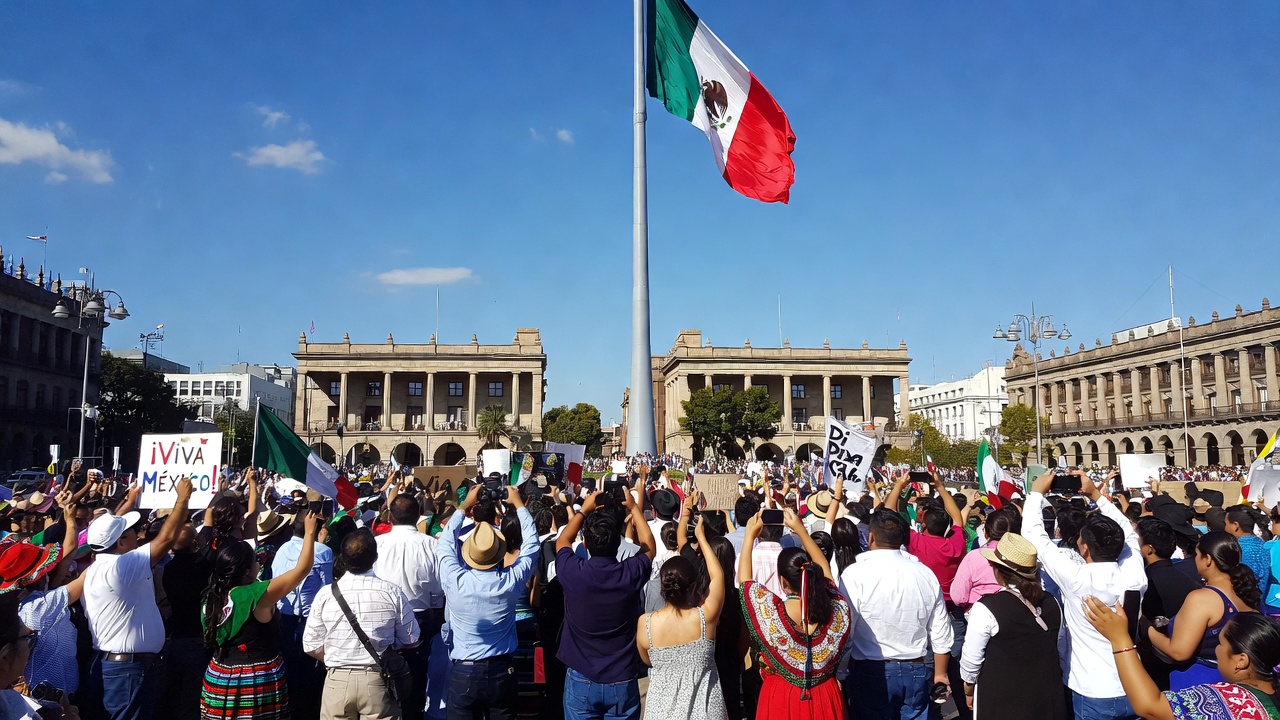
The atmosphere is communal and family-oriented. Families gather in public parks and zócalos (main town squares) to enjoy street food, including tamales, pozole, tacos, and elote (grilled corn). Vendors sell small Mexican flags and patriotic souvenirs. Children run through the crowd with balloons in the national colors of green, white, and red.
Querétaro: The Heart of Constitution Day Celebrations
The most elaborate celebrations naturally take place in Querétaro, the city where the Constitution was drafted. In the days leading up to the holiday, Querétaro hosts a full schedule of events:
- Cultural performances and concerts in public plazas
- Theatrical reenactments of the Constitutional Congress and the signing of the document
- Art exhibitions showcasing revolutionary-era artwork and photography
- Academic forums and panel discussions about constitutional law
- Flag-raising ceremonies at the historic Teatro de la República, the very building where the Constitution was debated and signed
For history enthusiasts and cultural travelers, a visit to Querétaro during Constitution Day week is one of the most rewarding experiences Mexico has to offer. The city itself is a UNESCO World Heritage Site, and its colonial architecture provides a stunning backdrop to the celebrations.
A Day for Travel, Rest, and Family
For the average Mexican citizen, the real magic of Constitution Day is the puente — the long weekend. Because the holiday always falls on a Monday, millions of people use the three-day break to travel. Beach destinations fill up. Colonial towns like San Miguel de Allende, Guanajuato, Oaxaca, and Taxco see a wave of domestic tourists. Highways out of Mexico City are notoriously congested on the Friday before and the Monday evening after.
Many families simply stay home and enjoy a day of rest — cooking a big meal together, visiting with relatives, or watching civic programming on television. It is a day for appreciating what Mexico has built, and for taking a well-earned break.
7. Mexico Constitution Day Is a Federal Public Holiday — Here Is What Closes
If you are visiting Mexico during the first puente of the year, it helps to know exactly what opens and what closes on Constitution Day. As a statutory holiday (día de asueto obligatorio), the closures are widespread.
What Closes on Mexico Constitution Day
| Sector | Status on Constitution Day |
|---|---|
| Banks and financial institutions | Closed |
| Government offices | Closed |
| Public schools | Closed |
| Private schools | Closed (most follow the SEP calendar) |
| Post offices | Closed |
| Stock exchange | Closed |
| Museums | Most closed (museums in Mexico typically close on Mondays) |
What Stays Open
| Sector | Status on Constitution Day |
|---|---|
| Restaurants | Most open, especially in tourist areas |
| Shopping malls and retail | Most open |
| Grocery stores | Most open (hours may vary) |
| Hotels and resorts | Open |
| Tourist attractions | Generally open (check individual schedules) |
| Public transit | Operates on a reduced or holiday schedule |
Worker Rights on Constitution Day Under Mexican Labor Law
If you are working in Mexico under a formal employment contract and your employer requires you to work on the statutory holiday of Monday, February 2, 2026, you are entitled to special compensation. Under Article 75 of Mexico’s Federal Labor Law, employees who work on a mandatory rest day must receive their regular daily wage plus double pay — meaning they effectively earn triple their normal salary for that day.
This protection applies to all workers in Mexico, including those employed by foreign companies operating in the country. The rule underscores a principle that runs through the entire Constitution: work is not merely an economic activity, but a social right deserving of legal protection.
Important Tips for Travelers
- Plan transportation early. Bus terminals and airports get busy during the puente weekend. Book tickets in advance if you are traveling between cities.
- Check museum schedules. Since Constitution Day always falls on a Monday, and most Mexican museums close on Mondays, you may find many cultural institutions shut for the day.
- Expect traffic. If you are driving, be prepared for heavy traffic leaving major cities on Friday and returning on Monday evening.
- Alcohol is generally available. Unlike election days, which often trigger a Ley Seca (dry law) restricting alcohol sales, Constitution Day does not typically involve alcohol restrictions. However, individual municipalities may set their own rules, so it is wise to check locally.
8. The Mexican Constitution Has Been Amended Over 700 Times Since 1917
Here is a fact that surprises many people: despite being formally classified as a “rigid” constitution (one that is difficult to change), the Mexican Constitution has been amended with remarkable frequency. According to research published in Comparative Political Studies, the Constitution has been amended over 700 times since 1917.
Why So Many Amendments?
Several factors explain this high rate of change:
The length and detail of the document itself. At 136 articles, the Mexican Constitution is far more detailed than, say, the U.S. Constitution (which has only 27 amendments in over 230 years). The Mexican document addresses not just the structure of government, but specific policies on education, labor, land, energy, indigenous rights, and much more. This level of detail means that policy changes often require constitutional amendments rather than simple legislative action.
One-party dominance for most of the 20th century. From 1929 to 2000, the Institutional Revolutionary Party (PRI) controlled the presidency and held overwhelming majorities in Congress and state legislatures. Amending the Constitution was essentially a matter of party discipline. Between 1917 and 1989, there were 117 amendments in 72 years, as documented by the Mexican Law Review.
The transition to multiparty democracy did not slow things down. Many scholars expected that as Mexico’s political system became more competitive, constitutional amendments would become rarer. The opposite happened. Between 2000 and 2015, there were 326 successful amendments out of more than 4,000 attempts.
Recent Constitutional Reforms
The most dramatic recent chapter in the Constitution’s evolution came in 2024, when outgoing President Andrés Manuel López Obrador (commonly known as AMLO) submitted a sweeping package of 18 constitutional amendments to Congress on February 5, 2024 — Constitution Day itself.
The most controversial reform was the judicial overhaul, which changed how judges are selected in Mexico. Under the new system, all judicial positions — from the Supreme Court to district courts — would become elected positions rather than appointed ones. This reform, which was approved by Congress in September 2024, affects more than 7,000 judicial posts across the country. According to the Wilson Center, the reform package also proposed eliminating several autonomous oversight agencies, consolidating the National Guard under military control, and enshrining social programs into constitutional rights.
President Claudia Sheinbaum, who took office on October 1, 2024, has expressed support for continuing these constitutional reforms, making the Constitution a living, evolving document — just as its framers intended.
9. How Mexico Commemorated the 100th Anniversary of Its Constitution in 2017
The year 2017 was a landmark year for Mexico’s Constitution. The country marked the centenary of the document’s promulgation with a range of civic, cultural, and economic commemorations.
A Special Banknote and Coin
One of the most tangible and collectible commemorations came from the Bank of Mexico (Banco de México). To honor the centenary, the bank issued:
- A limited-edition 100-peso banknote featuring President Venustiano Carranza and Luis Manuel Rojas, the chairman of the Constituent Congress, depicted during the solemn closing session of the assembly. The note was printed in dark maroon and tan tones and entered circulation on February 5, 2017 — the exact anniversary date. According to CoinWorld, it was Mexico’s first commemorative banknote since 2009.
- A limited-edition 20-peso bimetallic coin with designs referencing the constitutional anniversary.
Both items remain legal tender in Mexico, though they have become sought-after collector’s pieces. If you find one in your change during a visit to Mexico, hold on to it — it is a small piece of history.
Civic Events Across the Country
The centenary was celebrated with special ceremonies in Querétaro, Mexico City, and across the country. Museums mounted exhibitions about the revolution and the constitutional congress. Universities hosted academic conferences. Television networks aired historical documentaries. The Teatro de la República in Querétaro — the building where the Constitution was debated and signed — was the centerpiece of the celebrations.
The centenary was also a moment for national reflection. Many commentators used the occasion to assess how well Mexico had lived up to the ideals of the 1917 document — its promises of land reform, labor rights, universal education, and social justice. The consensus was mixed: significant progress had been made, but much work remained.
10. Why Mexico Constitution Day Still Matters for Travelers and Culture Enthusiasts in 2026
Constitution Day is sometimes overshadowed by Mexico’s more dramatic holidays. Independence Day in September has its Grito de Dolores and fireworks. Día de los Muertos in November has its iconic altars and face paint. Cinco de Mayo (which, contrary to popular belief abroad, is not Mexico’s biggest holiday) has its battles and beer promotions. Constitution Day, by contrast, is often described as a “quiet” holiday.
But that quietness is part of what makes it meaningful. Here is why Constitution Day should matter to anyone visiting or studying Mexico in 2026:
It Connects You to the Real Mexico
The Constitution is not an abstract document for most Mexicans. Its articles shape daily life in direct, tangible ways. The right to free public education, the protections for workers earning a minimum wage, the rules about land ownership near the coast — all of these come from the Constitution. Understanding the document helps you understand the country.
It Offers a Unique Travel Experience
If you are in Mexico during the first weekend of February, you will experience the country in a distinctive mood. Streets are quieter in some areas, livelier in others. Querétaro becomes a center of cultural activity. Beach towns fill with domestic tourists enjoying their puente. It is a wonderful time to explore the country alongside Mexicans themselves, rather than in the shadow of international tourist seasons.
It Reminds Us That Democracy Requires Maintenance
The Mexican Constitution has been amended over 700 times. It is not a sacred, unchangeable text — it is a living document that evolves with the nation. The recent judicial reforms of 2024 are the latest example of this ongoing negotiation between the ideals written in Querétaro and the realities of modern governance.
For travelers and international observers, this dynamism can be surprising. Many people assume constitutions are fixed, untouchable documents. Mexico’s experience shows a different model — one where the foundational law of the nation is treated as a work in progress, constantly updated to reflect new challenges, new rights, and new realities.
The 2026 celebration carries special weight because it takes place in the wake of the most significant constitutional changes Mexico has seen in decades. With the judicial election reforms taking effect and a new presidential administration in place, the Constitution is more alive — and more debated — than ever.
Constitution Day is a reminder that the work of building a just society is never finished. It is an invitation to celebrate what has been achieved, and to stay engaged with what still needs to change.
How Mexico Constitution Day Compares to Constitution Days Around the World
Mexico is not the only country that celebrates a Constitution Day, but its version has some unique characteristics. Here is a quick comparison:
| Country | Constitution Day | Year of Constitution | Key Feature |
|---|---|---|---|
| Mexico | First Monday of February | 1917 | First constitution with social rights; movable holiday |
| United States | September 17 | 1787 | Not a federal holiday; primarily educational observance |
| India | November 26 | 1950 | Honors the adoption of the world’s longest constitution |
| Norway | May 17 | 1814 | One of the world’s oldest constitutions; major national celebration |
| Japan | May 3 | 1947 | Part of Golden Week holiday period |
| South Korea | July 17 | 1948 | Was a public holiday until 2008; now only a national memorial day |
What sets Mexico apart is the combination of civic importance and practical impact. The holiday is a mandatory paid day off. It creates a long weekend that shapes travel patterns, economic activity, and family life across the country. And it celebrates a document that, for all its imperfections, truly changed the course of a nation.
Essential Travel Tips for Visiting Mexico During Constitution Day Weekend
Planning to be in Mexico during the first puente of 2026? Here are some practical tips to help you make the most of the experience:
Book accommodations early. Hotels in popular domestic tourism destinations fill up fast during long weekends. If you want to stay in Querétaro, San Miguel de Allende, Oaxaca, or any major beach town, reserve your room well in advance.
Embrace the local spirit. Visit the zócalo (main square) of whatever city or town you are in. You will likely find families enjoying street food, children playing, and a relaxed, festive atmosphere. This is Mexico at its most genuine.
Visit a historical site. Many archaeological sites and some museums remain open on Constitution Day. Consider visiting places like the Museo Nacional de Historia in Mexico City’s Chapultepec Castle, or the Teatro de la República in Querétaro, to connect with the history of the day.
Try traditional food. Constitution Day falls in February, which is still a cool-weather month in many parts of Mexico. Warm dishes like pozole (hominy stew), tamales, atole (a thick corn-based drink), and champurrado (chocolate atole) are perfect for the season.
Respect the day. While Constitution Day is not a solemn or somber holiday, it is a civic occasion. Mexicans take pride in their constitutional heritage. A genuine interest in the day’s meaning will be warmly received.
Frequently Asked Questions About Mexico Constitution Day
Is Mexico Constitution Day the same as Cinco de Mayo? No. Constitution Day (February) celebrates the 1917 Constitution. Cinco de Mayo (May 5) commemorates the Battle of Puebla in 1862, when the Mexican army defeated French forces. Cinco de Mayo is actually a civic holiday, not a mandatory day off in Mexico.
Is February 5 a holiday in Mexico? February 5 is the historical anniversary of the Constitution’s promulgation. However, since 2006, the official holiday has been observed on the first Monday of February to create a long weekend.
Can I still find stores and restaurants open on Constitution Day? Yes. While banks, schools, and government offices close, most restaurants, shopping malls, and retail stores remain open, especially in tourist areas.
Is Constitution Day celebrated differently in different parts of Mexico? The most elaborate celebrations are in Querétaro, where the Constitution was signed. Other cities host parades and civic events, but the intensity varies. Many Mexicans treat the day primarily as a welcome long weekend for travel and family time.
What is a puente in Mexico? A puente (bridge) is a long weekend created when a holiday falls on or is moved to a Monday or Friday. The term refers to the “bridge” between the holiday and the weekend, creating an extended break. Constitution Day always falls on a Monday, making it a guaranteed three-day puente.
Final Thoughts: Celebrating the Living Legacy of Mexico’s Constitution
The Mexican Constitution of 1917 is not a relic. It is a living, breathing document that shapes laws, policies, and daily life in Mexico more than a century after it was first debated in the halls of Querétaro. It was born from revolution, refined through decades of political change, and continues to evolve in response to the needs and demands of the Mexican people.
Constitution Day, observed on Monday, February 2, 2026, is an invitation to remember that legacy. Whether you celebrate it by watching a parade in Querétaro, relaxing on a beach in Puerto Vallarta, or simply learning something new about Mexican history, you are connecting with one of the most important political documents of the twentieth century.
¡Viva la Constitución!