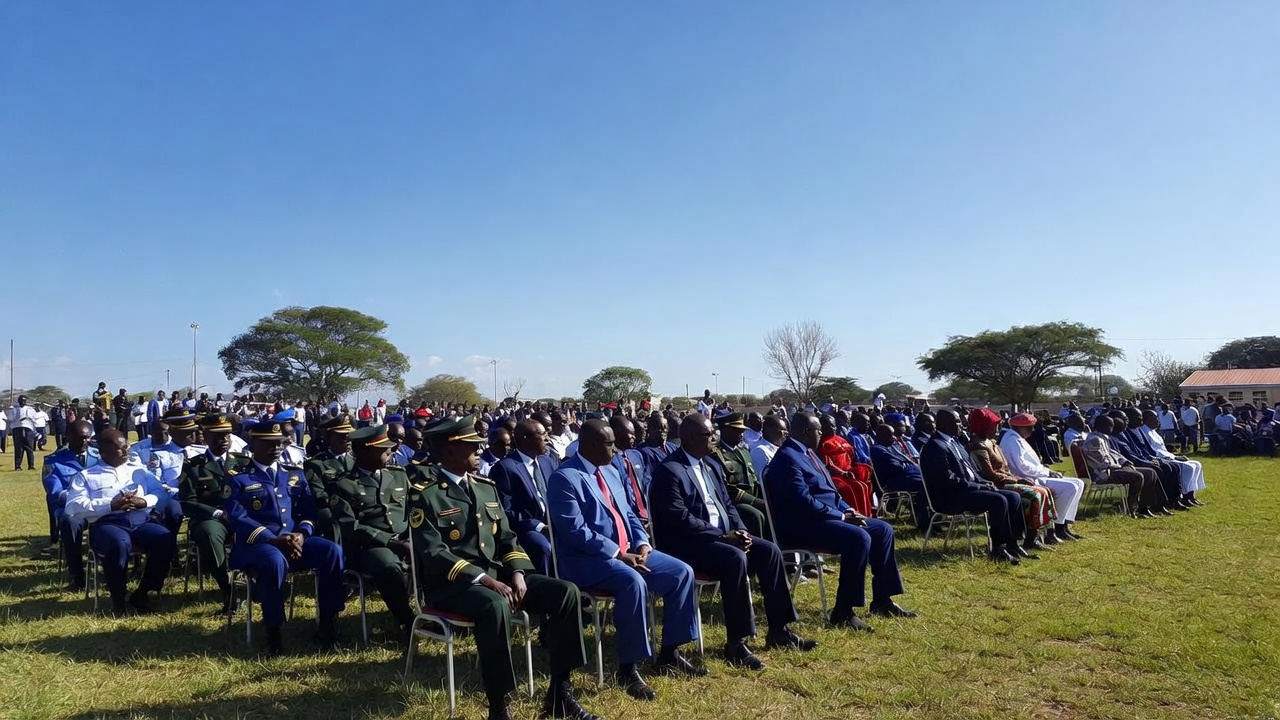
Every year on February 3, the Republic of Mozambique pauses. Schools close. Businesses shut their doors. Military parades fill the streets. Political leaders deliver speeches at monuments. Families gather to remember the men and women who gave everything for a free Mozambique. This day is Dia dos Heróis Moçambicanos — Mozambican Heroes’ Day.
But behind the parades and ceremonies lies a history far richer, more complex, and more surprising than most people realize. This is not just a day off work. It is the anniversary of an assassination. It is a day tied to a man who left a career at an American university to lead a guerrilla war. It is a celebration that honors poets alongside soldiers, and women alongside men. And in 2026, it carries new political weight as Mozambique navigates a turbulent chapter in its young democracy.
Whether you are planning a trip to Maputo, studying Southern African history, or simply curious about how nations remember their heroes, these ten facts about Mozambique Heroes’ Day will change how you understand this powerful holiday.
1. Why Is Mozambique Heroes’ Day on February 3? The Assassination That Changed a Nation
Most national holidays celebrate a victory, a birth, or a founding moment. Mozambique Heroes’ Day is different. It marks the date of a death — specifically, the assassination of Eduardo Chivambo Mondlane, the founder and first president of the Mozambique Liberation Front, known worldwide by its Portuguese acronym, FRELIMO.
On February 3, 1969, Mondlane was at the home of an American friend, Betty King, in Dar es Salaam, Tanzania. A package arrived. It looked like a book. When Mondlane opened it, the device hidden inside detonated. The explosion killed him instantly. He was 48 years old.
The choice of this date as Heroes’ Day was deliberate. The government of independent Mozambique did not want citizens to remember only victories. They wanted the nation to remember what independence cost. By anchoring the holiday to Mondlane’s murder, the founders of post-colonial Mozambique ensured that sacrifice — not triumph — would define the national memory.
Key details about the assassination:
| Detail | Fact |
|---|---|
| Date | February 3, 1969 |
| Location | Dar es Salaam, Tanzania |
| Weapon | Bomb concealed inside a book |
| Victim | Eduardo Mondlane, FRELIMO President |
| Age at death | 48 |
| Suspects | Portuguese secret police (PIDE), internal FRELIMO rivals, others |
The identity of the assassin has never been proven in court. However, former agent of Portugal’s International and State Defense Police (PIDE), Oscar Cardoso, later claimed that PIDE Agent Casimiro Monteiro planted the bomb. Other theories point to internal rivals within FRELIMO or even Tanzanian political actors. Historians continue to debate the matter. George Roberts, in a 2017 article published in Cold War History, examined FRELIMO’s internal politics and the complex web of exile relationships in Dar es Salaam that may have played a role.
What is beyond dispute is the impact. Mondlane’s death did not stop the independence movement. It accelerated it. His successor, Samora Machel, drove the struggle forward. Within six years, Mozambique was free.
2. Eduardo Mondlane Was a PhD Anthropologist and American University Professor Before He Became a Revolutionary
Here is a fact that surprises almost everyone who hears it for the first time: the father of Mozambican independence was, by profession, an academic anthropologist.
Eduardo Mondlane was born on June 20, 1920, in the village of N’wajahani, in the Gaza Province of what was then Portuguese East Africa. He was the fourth of sixteen sons of a chief of the Bantu-speaking Tsonga people. Until the age of twelve, he worked as a shepherd. His formal education began in Swiss-Presbyterian mission schools.
His academic journey took him across continents. He attended the University of Witwatersrand in Johannesburg, South Africa, but was forced to leave after only one year — the new apartheid government expelled him. He then studied at the University of Lisbon in Portugal. Finding discrimination there as well, he secured a scholarship to Oberlin College in Ohio, where he earned a bachelor’s degree in sociology and anthropology in 1953.
Mondlane then completed a PhD in sociology at Northwestern University in Illinois. He went on to work as a research officer in the Trusteeship Department of the United Nations, which allowed him to travel extensively in Africa. In 1961, he accepted a faculty position at Syracuse University in New York, where he helped develop the East African Studies Program.
He gave all of this up.
In June 1962, Mondlane flew to Dar es Salaam, Tanzania, where he helped unite several groups of exiled Mozambican nationalists into FRELIMO. He was elected the organization’s first president. In early 1963, he resigned from Syracuse and moved his family to Tanzania permanently.
As he wrote at the time: “Although I loved university life above all, I decided to devote the rest of my life to the war of liberation of my country, until it receives independence.”
Today, Oberlin College honors his memory with the Eduardo Chivambo Mondlane Scholarship, available to students from sub-Saharan Africa. The main university in Mozambique’s capital, Maputo, also bears his name — Eduardo Mondlane University.
3. The Star-Shaped Monument at Heroes’ Square Serves as a National Pantheon and Burial Ground
If you visit Maputo during Heroes’ Day, you will see the heart of the celebrations unfold at one location: Praça dos Heróis Moçambicanos, or Heroes’ Square. It sits along Avenida Acordos de Lusaka in the KaMaxaquene district of the capital, not far from the airport.
This is not an ordinary public square. It is a national pantheon — a burial ground for Mozambique’s most revered figures.
The monument at its center is star-shaped, a design created by the renowned Mozambican architect José Forjaz. Construction began in November 1976, just over a year after independence. Fifty workers from three Mozambican companies built the structure. It was completed and inaugurated on February 3, 1977 — the first celebration of Heroes’ Day as a national holiday.
Beneath the star-shaped structure lies a crypt. Over the decades, more than 200 individuals have been interred there. Among the most prominent are:
- Eduardo Mondlane — founder of FRELIMO
- Samora Machel — first president of independent Mozambique
- José Craveirinha — Mozambique’s most celebrated poet
- Justino Chemane — beloved national composer
A 95-meter-long mural surrounds the site. It tells the story of Mozambique’s long struggle for freedom, from colonial oppression through armed resistance to independence. The mural was created by José Craveirinha and has been restored over the years — most recently in a 2013–2014 renovation that cost approximately 20 million meticais (about $400,000 at the time).
Visiting Heroes’ Square is restricted. The crypt and inner grounds are generally open to the public only on significant national holidays, including Heroes’ Day (February 3) and Independence Day (June 25). At all other times, permission must be obtained through the Bureau de Informação Pública. Photography inside the monument is typically prohibited.
For travelers planning a visit, the square is accessible by chapa (minibus) from central Maputo. The fare is typically around 10–20 MZN (Mozambican meticais). The monument is clearly visible from the surrounding roads, so it is hard to miss.
4. The Independence War Lasted a Decade and Cost an Estimated 10,000 Mozambican Lives
Heroes’ Day does not honor a single person. It honors all Mozambicans who died in the fight for independence from Portuguese colonial rule — a war that lasted nearly a decade and devastated communities across the northern half of the country.
The armed conflict officially began on September 25, 1964, when FRELIMO launched its first guerrilla attack against a Portuguese garrison at Chai, in the northern province of Cabo Delgado. The war ended with a ceasefire on September 8, 1974, following the Carnation Revolution in Portugal. Mozambique formally gained independence on June 25, 1975.
Timeline of the Mozambican War of Independence:
| Year | Event |
|---|---|
| 1962 | FRELIMO founded in Dar es Salaam, Tanzania |
| 1964 | Armed struggle begins at Chai, Cabo Delgado |
| 1969 | Eduardo Mondlane assassinated; Samora Machel rises to leadership |
| 1970–1973 | Portuguese launch massive Operation Gordian Knot; it fails |
| 1974 | Carnation Revolution in Portugal; ceasefire signed in Lusaka |
| 1975 | Mozambique gains independence on June 25 |
The human cost was enormous. Estimates suggest that approximately 10,000 Mozambicans lost their lives during the conflict. Portugal deployed roughly 60,000 troops to Mozambique at the height of the war. FRELIMO’s guerrilla forces were vastly outnumbered, but their knowledge of the terrain, support from local communities, and classic guerrilla tactics — ambushes, sabotage of infrastructure, hit-and-run attacks — allowed them to sustain the struggle.
The Portuguese response was brutal. Reports from the period describe massacres of civilians, including the infamous Wiriyamu massacre in the Tete Province. The colonial military used napalm, forcibly relocated populations into controlled settlements, and destroyed homes and farms.
The international dimension of the war was significant. FRELIMO received military training, weapons, and financial support from the Soviet Union, China, Cuba, and several African nations. The Organization of African Unity (OAU) provided backing. Educational and humanitarian funds came from the World Council of Churches, Scandinavian countries, and private groups in the United States. Meanwhile, Portugal received military equipment and strategic support from its NATO allies.
It was not FRELIMO’s military strength alone that won independence. The decisive moment came not on Mozambican soil, but in Lisbon. On April 25, 1974, a group of young Portuguese military officers, exhausted by the colonial wars in Mozambique, Angola, and Guinea-Bissau, overthrew the Portuguese government in what became known as the Carnation Revolution. The new government moved quickly to negotiate independence for all Portuguese colonies in Africa.
On September 7, 1974, the Lusaka Accord was signed between FRELIMO and the Portuguese government, formally ending military hostilities. On June 25, 1975, Samora Machel entered Maputo triumphantly from Dar es Salaam, and the flag of an independent Mozambique was raised for the first time at the Machava sports stadium on the outskirts of the capital.
5. Mozambique Heroes’ Day Also Honors Women Freedom Fighters and the Destacamento Feminino
One of the most powerful — and least known — aspects of Mozambique’s independence struggle is the role of women in combat. Heroes’ Day honors these women alongside their male counterparts.
In October 1966, FRELIMO’s Central Committee made a groundbreaking decision: women would receive political and military training to participate fully in the armed struggle. In early 1967, the first group of women from Cabo Delgado and Niassa provinces began training. This led to the creation of the Destacamento Feminino — the Women’s Detachment.
The driving force behind this initiative was Josina Abiatar Muthemba Machel (1945–1971), a young revolutionary from Inhambane Province. Josina was among the first 25 women to complete three months of military training at the Nachingwea camp in southern Tanzania. She rose rapidly within FRELIMO, becoming head of the Department of Social Affairs. She established childcare centers, educational programs, and orphanages in the liberated zones of northern Mozambique.
In 1969, Josina married Samora Machel, who would become Mozambique’s first president. Tragically, she died of liver cancer on April 7, 1971, at the age of just 25. In her honor, FRELIMO declared April 7 as Mozambican Women’s Day — a national holiday still observed today.
The Women’s Detachment went far beyond a symbolic gesture. Its members served as:
- Combat soldiers in guerrilla operations
- Political educators who mobilized rural communities
- Health workers providing first aid in field clinics
- Teachers running literacy campaigns and primary schools
- Social welfare workers caring for orphans and displaced families
As Josina Machel herself wrote: “At first this was merely an experiment to discover just what contribution women could make to the revolution. The experiment proved highly successful.”
When you see the parades and speeches on Heroes’ Day in Maputo, Beira, or Nampula, remember: the heroes being honored include the women of the Destacamento Feminino, whose courage helped shape a nation.
6. Samora Machel, Mozambique’s First President, Is Buried at Heroes’ Square — and His Widow Later Married Nelson Mandela
No figure looms larger on Heroes’ Day than Samora Moisés Machel (1933–1986), the man who took over FRELIMO’s leadership after Mondlane’s assassination and became the first president of independent Mozambique.
Machel was born on September 29, 1933, in the village of Chilembene, Gaza Province. His family were farmers. Under Portuguese colonial rule, his parents were forced to grow cotton for export instead of food for their own family. In the 1950s, their farmland was seized and given to Portuguese settlers. These personal experiences radicalized Machel long before he ever read Marx.
Machel trained as a nurse — one of the few professional occupations available to Black Mozambicans at the time. He protested wage discrimination between Black and white nurses. In 1962, he abandoned nursing and joined FRELIMO. He received military training in Algeria and led FRELIMO’s first guerrilla attack against Portugal in northern Mozambique in 1964.
After Mondlane’s assassination in 1969, Machel was elected to a three-man presidential council and then, in May 1970, became FRELIMO’s president. When Mozambique gained independence on June 25, 1975, Machel became the country’s first head of state.
His presidency was transformative but turbulent. He nationalized land, healthcare, and education. He abolished private schools and clinics. He redistributed urban housing to Black Mozambicans. He built public schools and health clinics for the poor across the country. But these ambitious reforms faced immediate challenges.
Mozambique’s economy was fragile at independence. Over 90% of the population was illiterate. Most of the Portuguese professional class had fled, leaving the state administration in the hands of inexperienced FRELIMO cadres. And almost immediately, the government faced a devastating civil war against RENAMO (the Mozambican National Resistance), a rebel group initially created and funded by Rhodesia’s secret service in 1977 and later backed by apartheid South Africa. RENAMO’s campaign of terror targeted rural civilians, destroyed schools and hospitals, and blew up railway lines and hydroelectric facilities. The civil war would last until 1992 and claim over one million lives.
On October 19, 1986, Machel died when his presidential aircraft, a Soviet-made Tupolev Tu-134, crashed in the Lebombo Mountains near Mbuzini, South Africa. Twenty-four others aboard also perished. Many Mozambicans and international observers suspected South African involvement, though Pretoria denied responsibility.
Machel’s remains were interred in the star-shaped crypt at Praça dos Heróis Moçambicanos. Every Heroes’ Day, his memory is central to the national ceremony.
There is one more remarkable chapter to this story. Machel’s second wife, Graça Machel (née Simbine), served as Mozambique’s Minister of Education and Culture. In 1998, twelve years after Samora’s death, she married Nelson Mandela, the president of South Africa. Graça Machel thus became the only woman in modern history to have been First Lady of two different countries — a fact that bridges the independence narratives of both Mozambique and South Africa.
7. Heroes’ Day Honors Poets and Artists — Not Just Soldiers and Politicians
There is a common assumption that national heroes’ days celebrate only military figures and political leaders. In Mozambique, the definition of “hero” is broader than that.
Among those interred at Praça dos Heróis Moçambicanos are two figures who wielded pens and musical instruments rather than weapons:
José Craveirinha (1922–2003): The Poet of Mozambique
José Craveirinha is widely regarded as the greatest poet in Mozambican history. Born in Maputo (then Lourenço Marques) in 1922 to a Portuguese father and a Ronga mother, Craveirinha wrote in Portuguese but drew deeply from the rhythms, imagery, and oral traditions of Mozambican life.
His poetry gave voice to the suffering of colonized people and became a literary weapon in the struggle for independence. He was imprisoned by the Portuguese colonial government for his writings and his association with FRELIMO. After independence, his work continued to explore themes of identity, justice, and the lived experience of ordinary Mozambicans.
In 1991, Craveirinha became the first African writer to receive the Prémio Camões, the most prestigious literary award in the Portuguese-speaking world. When he died in 2003, his remains were laid to rest at Heroes’ Square — a testament to the idea that culture is as essential to nationhood as military victory.
Justino Chemane (1935–2001): The Composer of the Nation
Justino Chemane was a composer and musician whose work shaped the soundtrack of post-independence Mozambique. His burial at Heroes’ Square alongside soldiers and presidents underscores an important principle: Mozambique’s heroes are defined not solely by their sacrifice in war, but by their contribution to national identity and culture.
The inclusion of artists in the national pantheon is not without controversy. Some Mozambicans have questioned whether the criteria for “hero” status have been applied consistently or whether political connections have played a role. Nevertheless, the principle itself — that a poet or a composer can be a national hero — reflects a powerful vision of what heroism means.
8. The Portuguese Secret Police (PIDE) Played a Central Role in the Colonial Conflict Mozambicans Remember on Heroes’ Day
To understand why Heroes’ Day carries such emotional weight, you need to understand what Mozambicans were fighting against. At the center of Portuguese colonial oppression in Mozambique was an institution called PIDE — the Polícia Internacional e de Defesa do Estado (International and State Defense Police).
PIDE was not an ordinary law enforcement agency. It was a secret police force modeled partly on authoritarian security services in Europe. In Mozambique, PIDE served several functions:
- Surveillance of the indigenous population, especially educated Mozambicans suspected of nationalist sympathies
- Infiltration of anti-colonial organizations, including FRELIMO
- Arrest, imprisonment, and torture of political dissidents
- Assassination and targeted killing of independence leaders
PIDE created what historians describe as a “true police state” in colonial Mozambique. The agency used a network of informers to monitor communities. It arrested family members to pressure suspects. And it operated with near-total impunity.
PIDE’s reach extended beyond Mozambique’s borders. The agency tracked Mozambican exiles across Africa and Europe. It is widely believed to have been involved in the assassination of Eduardo Mondlane in Dar es Salaam. And in Mozambique itself, PIDE’s operations were so effective that nearly every anti-colonial organization formed inside the country between 1940 and 1960 was infiltrated and destroyed. This is the primary reason that most of Mozambique’s independence leaders — Mondlane, Machel, Chissano — were forced to operate from outside the country, primarily from Tanzania.
The colonial system that PIDE protected was deeply exploitative. Under Portuguese rule:
- Black Mozambican farmers were forced to grow cash crops like cotton and rice for export, leaving little for their own families.
- By 1960, over 250,000 Mozambicans were pressured to work in coal and gold mines in neighboring territories, primarily South Africa.
- Only 4,353 out of 5,733,000 Mozambicans had been granted the right to vote by the colonial government as of 1950.
- Access to education was almost entirely restricted to European settlers.
When Mozambicans gather on February 3 to honor their heroes, they are remembering not just the fighters who took up arms. They are remembering the system those fighters were struggling to dismantle — a system enforced by PIDE, built on forced labor, and sustained by nearly five centuries of colonial rule.
9. President Daniel Chapo Used Heroes’ Day 2025 to Call for Economic Independence and Fight Against Corruption
Heroes’ Day is not frozen in the past. Every year, the sitting president of Mozambique uses the occasion to deliver a major speech that connects the legacy of the independence struggle to the country’s present challenges. In 2025, that speech carried particular weight.
Daniel Francisco Chapo, who was inaugurated as Mozambique’s fifth president on January 15, 2025, delivered his first Heroes’ Day address just weeks after taking office. The ceremony marked the 56th anniversary of Eduardo Mondlane’s assassination.
Speaking at the official commemorations, Chapo emphasized that achieving “economic independence” required the best efforts of every Mozambican. He singled out corruption, nepotism, and sycophancy as destructive practices that must be rejected. He called for “respect for the dignity of the human person, for fundamental rights and duties, for impartiality, honesty and transparency.”
This was significant for several reasons. Chapo took office during one of the most turbulent periods in Mozambique’s post-independence history. The October 2024 presidential election was marred by allegations of widespread fraud. Opposition candidate Venâncio Mondlane (no direct relation to Eduardo Mondlane) disputed the official results and sparked the largest protests against FRELIMO in the country’s history. International observers, including the European Union, criticized irregularities in the electoral process.
Chapo, 48 at the time of his inauguration, is notable as Mozambique’s first president born after independence. He graduated in law from Eduardo Mondlane University and previously served as governor of Inhambane Province.
At the Heroes’ Day ceremony, Chapo also pledged to expand the political dialogue to include civil society organizations, private businesses, academic institutions, and religious bodies. He framed the conversation in the language of national unity: “Together we can find solutions for the Mozambique we want, as one people and one nation.”
Conspicuously absent from both the political dialogue and the Heroes’ Day ceremonies was Venâncio Mondlane. The opposition figure instead broadcast a message on social media, where he made a provocative demand: that Heroes’ Day be moved from February 3 to March 18, which he said was the anniversary of the death of Edson da Luz — the prominent Mozambican rapper known by his stage name Azagaia. The suggestion sparked heated debate about who qualifies as a hero in modern Mozambique.
10. Heroes’ Day’s Meaning Is Being Debated and Contested in Modern Mozambique
Perhaps the most important thing to understand about Mozambique Heroes’ Day in 2026 is that its meaning is not settled. It is a living, evolving holiday — and its significance is being actively debated by Mozambicans across the political spectrum.
For the ruling FRELIMO party, which has governed Mozambique since independence in 1975, Heroes’ Day is fundamentally about the liberation struggle. The holiday reinforces FRELIMO’s founding narrative: that the party led the fight against colonialism, sacrificed its leaders, and delivered freedom. Every Heroes’ Day speech, every wreath laid at the Praça dos Heróis, every military parade reinforces this connection between FRELIMO and the birth of the nation.
But a growing number of Mozambicans — particularly younger citizens who have no personal memory of the independence war — are asking difficult questions:
- Who decides who is a “hero”? The criteria for burial at Heroes’ Square are determined by the government, which has been controlled by FRELIMO for the country’s entire existence.
- Should the holiday evolve? Some argue that Mozambique needs to honor heroes of the present, not just the past — including activists, journalists, teachers, healthcare workers, and ordinary citizens who contribute to the nation’s progress.
- Is FRELIMO’s narrative the complete story? Critics note that the official version of the independence struggle can downplay the contributions of figures who later broke with the party, or the suffering of communities caught between FRELIMO and RENAMO during the devastating civil war (1977–1992) that followed independence.
The opposition figure Venâncio Mondlane’s 2025 proposal to change the date of Heroes’ Day — from February 3 (Eduardo Mondlane’s assassination) to March 18 (the death of rapper Azagaia) — was symbolic of this generational tension. Whether or not one agrees with the proposal, it reflects a real debate about national identity, memory, and who gets to define heroism in a country where over 60% of the population is under 25 years old.
This debate is not unique to Mozambique. Across Africa and around the world, nations grapple with how to honor the past without being imprisoned by it. But in Mozambique, where the legacy of the independence struggle is inseparable from the ruling party’s hold on power, the stakes are particularly high. FRELIMO has governed the country continuously since 1975 — nearly half a century. The party’s legitimacy is built, in significant part, on the narrative that it delivered freedom. When that narrative is questioned, the political implications are profound.
The 2024 election crisis, which saw deadly protests, allegations of fraud, and a deeply divided electorate, brought these tensions into sharp relief. For many young Mozambicans, the heroes of 1964 are distant historical figures. The challenges they face — unemployment, corruption, a jihadist insurgency in the oil-rich northern province of Cabo Delgado that has killed thousands and displaced millions — feel far removed from the liberation war. Yet the symbolic power of Heroes’ Day remains immense, precisely because it asks the most fundamental question a nation can ask: What are we willing to sacrifice for each other?
When you observe Heroes’ Day in Mozambique in 2026, you are witnessing more than a commemoration. You are watching a nation negotiate its identity in real time.
How Mozambique Celebrates Heroes’ Day: Traditions and Customs You Should Know
If you are visiting Mozambique on February 3 or simply want to understand how the holiday is observed, here is what you can expect.
Heroes’ Day is a public holiday. All government offices, schools, and most businesses are closed. It is a day off for the entire country.
Official Ceremonies
The central event takes place at Praça dos Heróis Moçambicanos in Maputo. Government officials, military officers, foreign diplomats, and invited guests gather for a formal ceremony that includes:
- Wreath-laying at the national pantheon
- Military parades featuring the Mozambican armed forces
- Speeches by the president and other political leaders
- Cultural performances including traditional music and dance
Similar ceremonies are held in provincial capitals across the country, including Beira, Nampula, Quelimane, and Inhambane.
Community Observances
Outside the formal events, Mozambicans mark the day in various ways:
- Family gatherings where stories of the independence struggle are shared with younger generations
- School activities (in the days before and after the holiday) that teach students about national history
- Community discussions and neighborhood events, particularly in areas that were directly affected by the independence war
- Social media engagement, especially among younger Mozambicans who use platforms like Facebook and TikTok to discuss the meaning of heroism
What Visitors Should Know
| Tip | Detail |
|---|---|
| Date | February 3 (every year) |
| Status | National public holiday |
| Services affected | Banks, government offices, schools, many shops closed |
| Best location | Praça dos Heróis Moçambicanos, Maputo |
| Cultural etiquette | Dress respectfully; be mindful that this is a solemn occasion |
| Photography | Generally prohibited inside the Heroes’ Square crypt |
| Transport | Chapas (minibuses) still run but on reduced schedules |
The Broader Context: Mozambique’s National Holidays and the Calendar of Remembrance
Heroes’ Day does not exist in isolation. It is part of a broader calendar of national holidays that together tell the story of Mozambique’s journey from colony to nation. Understanding this context helps you appreciate why February 3 matters so deeply.
Mozambique’s major national holidays:
| Date | Holiday | Significance |
|---|---|---|
| January 1 | New Year’s Day | Universal celebration |
| February 3 | Heroes’ Day | Honors independence fighters; anniversary of Mondlane’s assassination |
| April 7 | Mozambican Women’s Day | Honors Josina Machel and women in the liberation struggle |
| May 1 | International Workers’ Day | Labor rights |
| June 25 | Independence Day | Marks 1975 independence from Portugal |
| September 7 | Victory Day | Celebrates the end of armed struggle |
| September 25 | Armed Forces Day | Honors the military; anniversary of the first guerrilla attack in 1964 |
| October 4 | Peace and Reconciliation Day | Marks the 1992 peace agreement ending the civil war |
| December 25 | Family Day | Secular version of Christmas |
Notice how the calendar tells a story. It moves from sacrifice (Heroes’ Day) through struggle (Women’s Day, Armed Forces Day) to victory (Victory Day, Independence Day) and finally to peace (Peace and Reconciliation Day). Each holiday reinforces a narrative arc of suffering, resistance, liberation, and reconciliation.
Heroes’ Day sits at the beginning of this arc. It is the holiday that asks: What did freedom cost?
Why Heroes’ Day Matters Beyond Mozambique: Lessons for the World
Mozambique’s Heroes’ Day is more than a national event. It is part of a broader global pattern of nations grappling with how to remember colonial struggles and honor those who fought for self-determination.
Across Africa, similar holidays exist:
- Angola celebrates National Heroes’ Day on September 17, the birthday of Agostinho Neto.
- Cape Verde observes Heroes’ Day on January 20, honoring Amílcar Cabral.
- Namibia marks Heroes’ Day on August 26.
- Rwanda observes National Heroes’ Day on February 1.
What makes Mozambique’s version distinctive is its unflinching focus on loss. Many national holidays emphasize victories. Mozambique chose to anchor its Heroes’ Day to an assassination — to the murder of a man who never lived to see his country free. This is a holiday that says: freedom is not given; it is paid for.
There is also something deeply Mozambican about the way the holiday is observed. Mozambique is a country of great cultural diversity, with over 40 ethnic groups speaking dozens of languages. The Portuguese language, inherited from the colonial period, serves as the main language of government and education. But beneath the official ceremonies, local customs and oral traditions shape how communities remember their heroes. In the northern provinces of Cabo Delgado and Niassa, where the guerrilla war was fought, families pass down stories of specific battles and specific losses. In the south, where Maputo draws people from across the country, Heroes’ Day takes on a more formal, state-directed character. These regional variations are part of what makes the holiday a living tradition rather than a static ritual.
In an era when democratic institutions are under pressure around the world, that message resonates far beyond the borders of Mozambique.
Frequently Asked Questions About Mozambique Heroes’ Day
What is the official name of Heroes’ Day in Mozambique? The holiday is officially called Dia dos Heróis Moçambicanos, which translates to “Day of the Mozambican Heroes.”
When is Mozambique Heroes’ Day 2026? In 2026, Heroes’ Day falls on Tuesday, February 3.
Is Heroes’ Day a public holiday in Mozambique? Yes. It is a national public holiday. Schools, banks, government offices, and most businesses are closed.
Who was Eduardo Mondlane? Eduardo Mondlane (1920–1969) was a Mozambican revolutionary, anthropologist, and the founder of FRELIMO. He led the independence movement until his assassination on February 3, 1969. Heroes’ Day falls on the anniversary of his death.
Where is the main Heroes’ Day celebration held? The principal ceremony takes place at the Praça dos Heróis Moçambicanos (Heroes’ Square) in Maputo, the capital of Mozambique.
Can tourists visit Heroes’ Square? The square is open year-round, but the inner crypt and grounds are typically accessible to the public only on major national holidays like Heroes’ Day and Independence Day. Special permission from the Bureau de Informação Pública may be required on other dates.
What happened at the 2025 Heroes’ Day celebrations? President Daniel Chapo, newly inaugurated in January 2025, delivered his first Heroes’ Day address. He called for economic independence and condemned corruption. Opposition figure Venâncio Mondlane was absent and proposed changing the holiday’s date.
Who is buried at Heroes’ Square in Maputo? Notable figures interred at the Praça dos Heróis include Eduardo Mondlane, Samora Machel (Mozambique’s first president), poet José Craveirinha, and composer Justino Chemane, among over 200 others.
Final Thoughts: What Heroes’ Day Teaches Us About Memory and Nation-Building
Standing at the Praça dos Heróis Moçambicanos on a February morning, with the tropical heat settling over Maputo, it is impossible not to feel the weight of history. The star-shaped crypt beneath your feet holds the remains of men and women who believed in something larger than themselves. The 95-meter mural that surrounds you tells a story of centuries of exploitation, decades of resistance, and the hard-won birth of a nation.
Mozambique Heroes’ Day is many things at once. It is a day of mourning for the fallen. It is a celebration of courage. It is a political event, shaped by the party that has governed the country since independence. And it is a site of debate, as a new generation asks what heroism means in the 21st century.
For those of us who come from outside Mozambique, the holiday offers something else: a reminder that every free nation stands on the shoulders of people who paid the highest price. The story of Eduardo Mondlane — a shepherd’s son who became a scholar, a professor who became a revolutionary, a leader who was murdered before his dream was realized — is one of the great stories of the 20th century. It deserves to be known far beyond the borders of Mozambique.
On February 3, 2026, take a moment to remember.
Viva os heróis moçambicanos. Long live the Mozambican heroes.
Did you find this guide helpful? Share it with fellow travelers and history enthusiasts. If you’re planning a visit to Mozambique around Heroes’ Day, be sure to check local travel advisories and book accommodations in Maputo well in advance — the holiday is a popular time for both domestic and international visitors.