Zhengzhou rarely tops the list of Chinese cities that Western travelers dream about. Beijing has its Forbidden City. Shanghai has the Bund. Chengdu has its pandas. But Zhengzhou — the capital of Henan Province and the geographic heart of China — holds something far older and, in many ways, far more profound. This is where Chinese civilization was born. The Yellow River bends past its northern edge. The world’s oldest known musical instruments were unearthed from its soil. And at the dead center of the city, a twin-towered monument tells a story of railway workers who changed the course of modern Chinese history.
If you are planning a trip to central China in 2026, Zhengzhou deserves more than a quick stopover on the way to the Shaolin Temple. The city has reinvented itself in recent years, blending 3,600 years of recorded history with a surging modern energy that includes immersive theater parks, world-class museums, and a street food scene that could rival any city in the country.
This guide covers the top 10 things to do in Zhengzhou, with a special focus on why Erqi Memorial Tower — the city’s most recognizable landmark — should be on every traveler’s bucket list. Whether you are a history lover, a foodie, or simply someone who wants to see a side of China that most tourists miss, read on.
Good news for international travelers in 2026: China’s 30-day visa-free policy has been extended through December 31, 2026, covering citizens of dozens of countries. A 10-day visa-free transit option is also available for travelers from over 50 nations, including the United States, the United Kingdom, and Canada.
Why Should You Visit Zhengzhou? A Quick Guide to China’s Ancient Capital
Before we get into the list, a brief word on why Zhengzhou matters.
Zhengzhou sits on the southern bank of the Yellow River in the north-central part of Henan Province. It is one of the Eight Ancient Capitals of China, a distinction it earned because of the Shang Dynasty capital that was built here around 1600 BCE. That makes the city’s urban roots roughly 3,600 years old — older than Rome, older than Athens, older than nearly every continuously inhabited city in the Western world.
Today, Zhengzhou is a major transportation hub. The city lies at the junction of China’s two most important railway arteries: the Beijing–Guangzhou line (running north to south) and the Longhai line (running east to west). High-speed rail connects Zhengzhou to Beijing in about 2.5 hours, to Xi’an in under 2 hours, and to Shanghai in about 4 hours. The Zhengzhou Xinzheng International Airport (CGO) offers both domestic and international flights.
The city’s population exceeds 12 million people. It is the political, economic, and cultural center of Henan, China’s most populous province. Yet it remains remarkably affordable and uncrowded compared to China’s eastern megacities.
| Quick Facts About Zhengzhou | |
|---|---|
| Province | Henan |
| Population | Over 12 million |
| Historical status | One of the Eight Ancient Capitals of China |
| Climate | Temperate continental; hot summers, cold winters |
| Best time to visit | April–May and September–November |
| Major airport | Zhengzhou Xinzheng International Airport (CGO) |
| Metro lines | 8+ operational lines as of 2025 |
| Language | Mandarin Chinese (local Henan dialect widely spoken) |
Now, on to the main event.
1. Erqi Memorial Tower: The Iconic Landmark at the Heart of Zhengzhou
If you visit only one place in Zhengzhou, make it Erqi Tower.
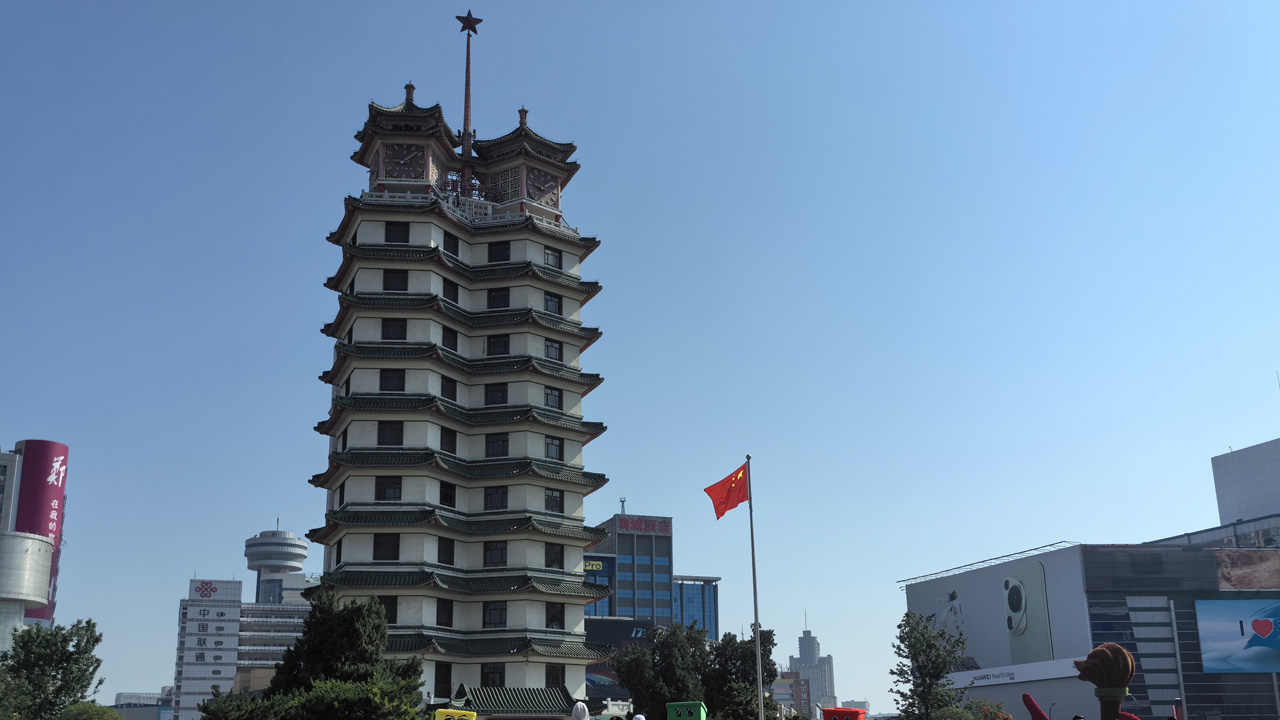
The Erqi Memorial Tower (二七纪念塔, Èrqī Jìniàntǎ) stands at the precise center of the city, in the middle of Erqi Square. It is, without exaggeration, the single most recognizable symbol of Zhengzhou. The tower appears on city maps, tourist brochures, local merchandise, and even some Henan license plates. For residents of Zhengzhou, Erqi Tower is what the Eiffel Tower is to Parisians — a point of pride, a meeting place, and a silent witness to the city’s modern story.
The History Behind the February 7th Strike Memorial
The tower commemorates the Great Strike of February 7, 1923, one of the most important events in modern Chinese labor history. On that day, workers building the Beijing–Hankou Railway (known in Chinese as the Jinghan Railway) launched a massive strike to demand better working conditions, fair wages, and the right to organize unions. The strike was one of the first large-scale industrial actions led by the Communist Party of China, which was then only two years old.
The response was violent. Warlord troops loyal to Wu Peifu attacked the striking workers. Two strike leaders — Lin Xiangqian in Wuhan and Shi Yang — were executed. In Zhengzhou, two other leaders, Wang Shengyou and Si Wende, were killed on the very spot where the tower now stands.
The original memorial was a modest 21-meter wooden structure built in 1951. After standing for 20 years, that structure collapsed in a rainstorm in 1971. The people of Zhengzhou rallied to rebuild it. The current reinforced concrete tower was completed in just 100 days, opening on September 29, 1971.
What Does Erqi Tower Look Like?
The tower’s design is distinctive and immediately memorable. It consists of two interconnected pentagonal towers, rising together to a height of 63 meters across 14 floors (including three underground levels). Viewed from the east or west, it appears to be a single tower. From the north or south, it reveals its twin structure.
Every floor features traditional Chinese-style eaves covered in green glazed tiles, creating an elegant contrast between the white cement exterior and the classical roofline. Red-painted square lattice windows line each side. At the very top sits a bell tower housing six bells, each 2.7 meters in diameter — a deliberate reference to the February 7th date. A 9-meter flagpole topped with a red five-pointed star crowns the entire structure.
Every hour on the hour, the bells ring and play music. For decades, the melody was The East Is Red, a well-known Chinese revolutionary song. The sound carries across the surrounding streets and is one of those sensory details that visitors remember long after leaving the city.
What Can You See Inside Erqi Tower?
Inside the tower, one half houses a winding spiral staircase that takes visitors to the upper floors and eventually to the top, where you can look out across the Zhengzhou skyline. The other half is an exhibition hall spread across 10 above-ground floors and 1 underground floor.
The exhibitions tell the full story of the 1923 railway workers’ strike through historical photographs, documents, artifacts, and written accounts. You can trace the cause of the strike (exploitation by foreign railway companies and domestic warlords), its dramatic unfolding, and its bloody aftermath. The displays are sobering and educational, offering a window into a chapter of Chinese history that many international visitors know nothing about.
Practical Tips for Visiting Erqi Memorial Tower in 2026
| Detail | Information |
|---|---|
| Address | Erqi Square, Erqi District, Zhengzhou |
| Opening hours | Tuesday–Sunday, 9:00 AM – 5:00 PM (closed Mondays) |
| Admission | Free (reservation required through the official WeChat page) |
| Metro access | Lines 1 and 3, Erqi Square Station, Exit D |
| Recommended visit time | 30–60 minutes for the tower; 2+ hours for the surrounding area |
| Best time to visit | Evening, when the tower is illuminated with lights |
Pro tip: The tower is beautiful during the day, but it transforms at night. The entire structure glows against the dark sky, and the surrounding square fills with locals taking evening strolls. If you want the best photographs, arrive around sunset and stay through the blue hour.
2. Henan Museum: Exploring 5,000 Years of Chinese History in Zhengzhou
A five-minute taxi ride north of Erqi Square takes you to one of the finest museums in all of China. The Henan Museum (河南博物院) is not merely a provincial collection — it is a national treasure house that chronicles the full sweep of Chinese civilization.
Why Henan Museum Is One of China’s Best Museums
The museum holds a collection of more than 170,000 cultural relics, spanning from the Paleolithic era to the Qing Dynasty. Many of these pieces were excavated from sites across Henan Province, which has served as the political and cultural center of China for much of the past 5,000 years. The collection is particularly strong in prehistoric artifacts, Shang and Zhou Dynasty bronze vessels, and ceramics from the Tang and Song eras.
The building itself is a landmark. Opened in 1998, the main structure takes the form of a crowned pyramid, inspired by a Yuan Dynasty astronomical observatory. The exterior walls are clad in yellow-brown stone, a deliberate reference to the loess plateau and the Yellow River that gave birth to Chinese civilization.
Must-See Artifacts at Henan Museum
Several pieces in the collection are recognized as national-level treasures:
- Jiahu Bone Flutes (贾湖骨笛): Dating back approximately 8,000–9,000 years, these are among the oldest playable musical instruments ever discovered. Carved from the wing bones of red-crowned cranes, they can produce a seven-note scale. Their existence rewrites the history of music.
- Duling Square Ding (杜岭方鼎): A massive bronze ritual vessel from the Shang Dynasty, this piece underscores Zhengzhou’s role as an early Shang capital and a center of bronze casting technology.
- Fu Hao Owl Zun (妇好鸮尊): A stunning bird-shaped bronze vessel from the late Shang Dynasty, connected to Lady Fu Hao, one of China’s earliest known female military commanders.
- Lotus Crane Vase (莲鹤方壶): A Spring and Autumn period bronze masterpiece featuring a crane perched on lotus petals, often considered a symbol of the transition from the solemn Shang ritual style to the more exuberant artistic expression of later periods.
The museum’s eight permanent exhibition halls are arranged chronologically, so you can walk through them in order and experience the story of central China from its earliest stirrings to the Song Dynasty.
Practical Information for Visiting Henan Museum
| Detail | Information |
|---|---|
| Address | No. 8 Nongye (Agricultural) Road, Jinshui District, Zhengzhou |
| Admission | Free (ID or passport required) |
| Recommended visit time | 2–4 hours |
| Metro | Line 2, Guanhutun Station |
| Tip | Avoid weekend mornings, when local families fill the galleries |
3. Shaolin Temple Day Trip from Zhengzhou: Birthplace of Kung Fu and Zen Buddhism
No visit to the Zhengzhou area is complete without a pilgrimage to the Shaolin Temple (少林寺), located about 90 kilometers southwest of the city in the town of Dengfeng, at the foot of Mount Song.
What Makes Shaolin Temple a Must-Visit Near Zhengzhou?
Shaolin Temple is the birthplace of Chinese Zen Buddhism and the cradle of Shaolin Kung Fu. Founded in 495 CE during the Northern Wei Dynasty, the temple has been a center of martial arts training and Buddhist practice for more than 1,500 years. In 2010, it was inscribed as part of the UNESCO World Heritage Site known as “The Historic Monuments of Dengfeng in ‘The Centre of Heaven and Earth.'”
The temple complex includes several key areas. The Main Hall houses statues of Sakyamuni Buddha. The Thousand Buddha Hall features faded but extraordinary murals depicting 500 arhats. Look down at the floor in this hall and you will see deep indentations worn into the stone — marks left by centuries of monks practicing their fighting stances.
The Pagoda Forest (塔林) behind the temple is a grove of over 240 stone and brick pagodas, each one a memorial to a deceased monk. Some date back to the Tang Dynasty (618–907 CE). Walking among them is a quiet, contemplative experience that contrasts with the energy of the Kung Fu performances.
Watching a Live Shaolin Kung Fu Performance
Several times each day, students from the nearby martial arts schools perform live Kung Fu demonstrations. These shows feature breathtaking acrobatics, weapons forms, and hard qigong feats. Performances typically last about 30 minutes and are included with your entry ticket.
How to Get from Zhengzhou to Shaolin Temple
| Transport | Details |
|---|---|
| Tour bus | Departs from Zhengzhou West Bus Station; about 1.5–2 hours |
| Private car | Approximately 1.5 hours via expressway |
| Guided tour | Many agencies in Zhengzhou offer full-day Shaolin Temple tours with English-speaking guides |
Budget about a full day for this trip if you want to see the temple, watch a performance, and explore the Pagoda Forest without rushing.
4. Yellow River Scenic Area: Where to See China’s Mother River in Zhengzhou
The Yellow River (黄河) is the second-longest river in China and one of the most symbolically important waterways on Earth. Chinese people call it the “Mother River” because its basin is considered the cradle of Chinese civilization. Zhengzhou happens to sit at a critical geographic point: the boundary between the river’s middle and lower reaches, and the starting point of the famous “suspended river” where the riverbed sits higher than the surrounding plain.
What to See at the Yellow River Scenic Area
The Zhengzhou Yellow River Scenic Area (黄河风景名胜区) is located about 20 kilometers northwest of downtown Zhengzhou. It covers more than 20 square kilometers and contains over 40 individual attractions spread across five scenic zones.
The Statues of Emperor Yan and Emperor Huang are the most dramatic sight. These two colossal stone heads, with a combined height of 106 meters, gaze out over the river. They represent the legendary ancestors of the Chinese people — Huangdi (the Yellow Emperor) and Yandi (the Flame Emperor). Nine large bronze ding vessels line the ceremonial approach. The scale is immense — think of it as Henan’s answer to Mount Rushmore.
Five Dragons Peak is the core scenic zone. Five winding mountain ridges overlook the river, dotted with pavilions and covered in pine and cypress trees. Climb to the Jimu Pavilion at the summit for a sweeping view of the Yellow River as it rolls eastward toward the sea.
Yueshan Temple offers a quieter experience. A rope suspension bridge spans a gorge here, and the Purple Golden Pavilion houses a large bell that rings during festivals, its sound mixing with the roar of the river below.
You can also take a cable car across the river or ride a hovercraft out to a sandbar in the middle of the channel. The hovercraft ride is especially memorable because it demonstrates just how shallow and sediment-laden the river is — the reason it earned the name “Yellow.”
Best Time to Visit Yellow River Scenic Area
Spring (March–May) and autumn (September–November) offer the most pleasant weather. However, the river is at its most dramatic between July and October, when water levels are highest and the current runs fast.
| Detail | Information |
|---|---|
| Admission | Approximately 45–60 RMB (check current prices) |
| Getting there | Bus No. 16 from downtown Zhengzhou; about 1–1.5 hours |
| Recommended visit time | Half day to full day |
| Highlights | Yan-Huang statues, Five Dragons Peak, cable car, hovercraft ride |
5. Only Henan · Drama Illusion City: The World’s Largest Immersive Theater Experience
If you think Zhengzhou is only about ancient history, Only Henan · Drama Illusion City (只有河南·戏剧幻城) will change your mind completely. This massive cultural park, located in Zhongmu County on the outskirts of Zhengzhou, is the largest immersive theater complex in the world.
What Is Only Henan and Why Is It So Popular?
Opened in June 2021, the park was created by renowned Chinese director Wang Chaoge, the creative mind behind the “Impressions” series of outdoor spectacles in places like West Lake and Dunhuang. The project covers 622 acres and required an investment of nearly 6 billion RMB (approximately $926 million USD).
The park contains 21 theaters of various sizes, 56 courtyards, and roughly 800 performers who stage more than 30 shows with a combined running time of nearly 700 minutes. There is no single entrance or set route. Instead, visitors wander freely through a self-guided maze of rammed-earth walls, wheat fields, and underground pit courtyards.
The Three Main Theaters You Should Not Miss
- Lijiacun Theater — Tells the story of an ordinary Henan village during the devastating 1942 famine, blending historical events with deeply personal human drama.
- Fantasy City Theater — A sweeping visual spectacle that compresses 5,000 years of Chinese civilization into a single immersive performance.
- Train Station Theater — Uses a marching, processional style of performance to depict the struggles and resilience of the people of Henan.
Beyond the main theaters, 18 smaller venues are scattered throughout the grounds. Each courtyard and corridor offers a different story, a different mood, and a different piece of Henan’s cultural identity.
Why Only Henan Matters for Cultural Travelers
This is not a theme park in the Disneyland sense. There are no roller coasters, no cartoon characters. Instead, the entire experience is built around emotional storytelling and cultural education. The architectural design uses local rammed earth as its primary material. The wheat fields that surround the complex are real — they grow, they are harvested, and they symbolize the relationship between the people of Henan and their land.
Visitors from abroad have called it one of the most moving cultural experiences they have ever had in China. Even if you do not understand every word of Chinese, the visual storytelling, the music, and the sheer scale of the production create a powerful experience.
| Detail | Information |
|---|---|
| Location | Zhongmu County, about 40 minutes east of downtown Zhengzhou |
| Getting there | Bus S606 from Zhengzhou East Station; or city rail to Lvboyuan Station + taxi |
| Ticket price | Approximately 300–400 RMB for a day pass (check current pricing) |
| Recommended visit time | Full day (many visitors recommend a two-day ticket to see all shows) |
| Tip | Arrive by early afternoon; many shows begin in late afternoon and evening |
6. Zhengzhou Shang Dynasty Ruins: Walking Through a 3,600-Year-Old Capital City
Right in the middle of modern Zhengzhou, beneath the apartment buildings and shopping malls, lies the archaeological remains of one of China’s oldest known cities. The Zhengzhou Shang Dynasty City Ruins (郑州商城遗址) are the remnants of what scholars believe was the first capital of the Shang Dynasty, founded around 1600 BCE.
Why Are the Shang Ruins Important for Understanding Chinese Civilization?
The Shang Dynasty (approximately 1600–1046 BCE) is the earliest Chinese dynasty supported by extensive archaeological evidence. While the ruins at Yin (near Anyang) represent the late Shang capital, the Zhengzhou site represents the early Shang capital, making it potentially older and arguably more significant for understanding how Chinese urban civilization began.
The site was discovered in 1950 by archaeologist Han Weizhou. Subsequent excavations revealed the outlines of a massive walled city. The inner city walls had a perimeter of nearly 7,000 meters and were estimated to have been 20 meters wide at the base and 8 meters tall. The total area inside the outer wall may have covered as much as 1,300 hectares.
Excavations have uncovered palace foundations, bronze-casting workshops, pottery kilns, bone-carving workshops, sacrificial pits, water wells, and residential areas. Bronze vessels unearthed from the site — including two large square ding cauldrons — confirmed the royal status of the settlement.
In 2023, archaeologists announced the discovery of what they described as China’s earliest known noble tomb complex within the Shang City ruins. The find included a shell-shaped gold “funeral mask,” turquoise ornaments, and jade wares.
Visiting the Shang Dynasty National Archaeological Site Park
In recent years, the site has been developed into the National Archaeological Site Park of Zhengzhou Shang Dynasty Capital Ruins. The park integrates the ancient wall remains with green spaces, walking paths, and the Zhengzhou Shang Dynasty Capital Ruins Museum. It is designed around the idea of “an ancient city in a park, and a park in an ancient city.”
You can walk along sections of the original rammed-earth walls, visit the museum, and see artifacts from the various excavation periods. The experience is more contemplative than thrilling — this is not a flashy tourist attraction — but for anyone interested in the deep roots of human civilization, it is unforgettable.
| Detail | Information |
|---|---|
| Location | Downtown Zhengzhou, Guancheng Hui District |
| Admission | Free |
| Metro | Accessible from multiple stations on Lines 1, 2, and 3 |
| Recommended visit time | 1–2 hours |
| Combine with | Nearby Zhengzhou Town God Temple and Confucian Temple |
7. Dehua Street Food Tour: Best Night Market and Street Food in Zhengzhou
If Erqi Tower is the architectural heart of Zhengzhou, then Dehua Street (德化街) is its culinary soul. This century-old commercial street runs south from Erqi Square, and when the sun goes down, it transforms into one of the most vibrant night markets in central China.
The History and Culture of Dehua Street
Dehua Street dates back to 1905, when it grew alongside the newly opened Jinghan Railway. In those early days, the street’s vendors sold what locals called the “Old Zhengzhou Three Treasures”: huimian noodles, Yellow River carp, and jujube cakes. More than a century later, many of those same traditions survive — though the menu has expanded dramatically.
The street has been renovated in recent years, blending Republican-era green-brick facades with modern pedestrian-friendly infrastructure. Young visitors in hanfu (traditional Chinese clothing) weave between stall owners who livestream their cooking on TikTok. The result is a place that feels both nostalgic and thoroughly modern.
Must-Try Street Foods on Dehua Street and Nearby Night Markets
Zhengzhou is a noodle city. It is a soup city. It is a city that takes its carbohydrates seriously. Here are the dishes you should not leave without trying:
Huimian (烩面) — This is the signature dish of Zhengzhou. Broad, chewy, hand-pulled wheat noodles swim in a milky-white broth that has been simmered for hours with lamb bones. A proper bowl comes loaded with slices of lamb, shredded kelp, glass noodles, tofu strips, and cilantro. Add chili oil and pickled garlic to taste. A bowl typically costs 15–30 RMB.
Hulatang (胡辣汤) — This peppery, thick soup is the breakfast of choice for millions of people across Henan. It is made with beef or lamb broth, thickened with starch, and filled with shredded tofu, wood ear mushroom, glass noodles, and peanuts. Locals pair it with youtiao (fried dough sticks) or shaobing (sesame flatbread).
Lao Cai Ji Steamed Dumplings — Located just off Erqi Square, this generations-old shop serves delicate steamed dumplings with thin, translucent skins and juicy fillings. It is a local institution.
Bianliang Roast Duck Rolls — A newer addition to the night market scene, these crispy duck rolls have become a viral sensation.
Almond Tea (杏仁茶) — A warm, sweet beverage made from ground almonds, traditionally served in ceramic bowls. It is a soothing end to a spicy night market crawl.
Practical Tips for Exploring Zhengzhou Night Markets
- Arrive around 7:00 PM for the best atmosphere.
- Thursday evenings are generally less crowded than weekends.
- Most vendors accept WeChat Pay and Alipay, but carrying some cash is wise.
- The last Metro Line 1 train departs at 11:30 PM. After that, take night bus Y12.
- For a more local, less tourist-oriented experience, consider Zhutun Night Market near City Center Hospital (Metro Line 5), where the stalls are grittier but the food is just as good.
8. Mount Song Hiking Guide: Climbing One of China’s Five Sacred Mountains
Mount Song (嵩山) is one of the Five Great Mountains of China and holds the distinguished title of “Central Peak” (中岳). It is located in Dengfeng, the same area as the Shaolin Temple, making it possible to combine both attractions in a single day trip — though giving each its own day is strongly recommended.
What Makes Mount Song Special Among China’s Sacred Mountains
Mount Song is composed of two main sections: Taishi Mountain to the east and Shaoshi Mountain to the west. Together, they contain 72 named peaks. The summit of Taishi Mountain, Junji Peak, rises to 1,491.7 meters above sea level.
The mountain is sacred to both Taoism and Buddhism. It is home to the Zhongyue Temple, one of the oldest Taoist temples in China, and to Songyang Academy, one of the four great ancient academies of Chinese learning. The astronomical observatory built here during the Yuan Dynasty (1276 CE) by the astronomer Guo Shoujing is a UNESCO World Heritage component site.
The sunrise from Junji Peak is famous across China. Hikers who make the pre-dawn ascent are rewarded with views of golden light spreading across the Central Plains below.
Hiking Routes and Difficulty
Most visitors hike the Taishi Mountain side, which has well-maintained stone steps and clear signage. The ascent from the base to Junji Peak takes approximately 3–4 hours for an average hiker. A cable car is available for those who prefer a faster ascent.
The Shaoshi Mountain side is steeper and less developed. It connects to the Shaolin Temple scenic area, and the paths are more rugged. This is a good option for experienced hikers who want a more challenging day.
| Detail | Information |
|---|---|
| Location | Dengfeng, about 80 km southwest of Zhengzhou |
| Elevation | Junji Peak: 1,491.7 meters |
| Difficulty | Moderate (Taishi); Challenging (Shaoshi) |
| Cable car | Available on Taishi side |
| Best time | April–May, September–November |
| Combine with | Shaolin Temple, Songyang Academy, Zhongyue Temple |
9. Zhengzhou Museum and Confucian Temple: Hidden Cultural Gems in the City Center
While the Henan Museum gets most of the attention, Zhengzhou Museum (郑州博物馆) and the nearby Zhengzhou Confucian Temple (郑州文庙) are quieter alternatives that offer a more intimate encounter with the city’s past.
Zhengzhou Museum: A Focused Look at the City’s Own Story
Zhengzhou Museum is dedicated specifically to the history and archaeology of the Zhengzhou area, rather than the province as a whole. Its collections include artifacts from the Shang Dynasty city ruins, tools from Neolithic sites in the region, and exhibits on the city’s development through the centuries.
The museum moved to a new, larger building on Zhongyuan East Road in recent years. The facility is modern, well-organized, and far less crowded than the Henan Museum. English signage is available for most exhibits. Admission is free.
Zhengzhou Confucian Temple: A Quiet Retreat from the City
Just a short walk from the Shang Dynasty ruins, the Zhengzhou Confucian Temple is one of the oldest surviving structures in the city. The temple is quiet, reflective, and rarely crowded. It provides a pleasant contrast to the bustle of Erqi Square and the commercial districts.
The temple grounds include traditional courtyards, ancient cypress trees, and ceremonial halls. During certain festivals, the temple hosts cultural events related to Confucian philosophy and classical Chinese music.
The Town God Temple Nearby
Not far away, the Zhengzhou Town God Temple (郑州城隍庙) is another hidden gem. This Taoist temple has undergone careful restoration and features fine examples of traditional Chinese wood carving and architectural detail. Like the Confucian Temple, it is a peaceful escape from the modern city.
10. Zhengdong New District: The Modern Skyline of Zhengzhou’s Future
For travelers who want to see the contrast between ancient and modern China at its most dramatic, spend an evening in Zhengdong New District (郑东新区), the city’s gleaming central business district.
A Modern CBD That Rivals Tier-1 Cities
Developed over the past two decades, Zhengdong New District features a striking collection of skyscrapers, convention centers, and modern cultural facilities clustered around Longzi Lake and the surrounding artificial waterways. The skyline includes the Zhongyuan Tower (a 388-meter observation tower), the Zhengzhou Convention and Exhibition Center (known locally as the “Big Corn” for its corn-cob shape), and the Henan Art Center.
At night, the lakeside promenade comes alive with colored lights reflected in the water. It is one of the best spots in the city for evening photography.
Longhu Financial Island
Longhu Financial Island has been called the “Lujiazui of Henan” — a reference to Shanghai’s famous financial district. The cluster of glass towers rising from the lake is an impressive sight, especially when lit up after dark. Several upscale restaurants and cafes line the waterfront.
What to Do in Zhengdong New District
- Walk or cycle around Longzi Lake.
- Visit the Henan Geological Museum, which is free and family-friendly, with excellent fossil displays and a 4D experience.
- Ride the Zhengzhou Eye, the city’s Ferris wheel, for panoramic views of the new district.
- Browse the bookstores and galleries in the Henan Art Center complex.
Best Zhengzhou Travel Itinerary: How to Spend 3 Days in China’s Central Plains
If you have three days in Zhengzhou, here is a suggested itinerary that covers the highlights:
Day 1: City Center and Cultural Landmarks
- Morning: Henan Museum (2–3 hours)
- Afternoon: Erqi Memorial Tower and Erqi Square, then walk to Dehua Street
- Evening: Dehua Street night market for dinner and street food
Day 2: Shaolin Temple and Mount Song Day Trip
- Morning: Depart early for Dengfeng (1.5–2 hours by bus or car)
- Midday: Shaolin Temple, Kung Fu performance, Pagoda Forest
- Afternoon: Hike part of Mount Song or visit Songyang Academy
- Evening: Return to Zhengzhou
Day 3: Yellow River and Modern Zhengzhou
- Morning: Yellow River Scenic Area (half day; Yan-Huang statues, Five Dragons Peak)
- Afternoon: Zhengzhou Shang Dynasty Ruins and Confucian Temple
- Evening: Zhengdong New District lakeside walk, dinner at a waterfront restaurant
For travelers with more time, add a fourth day for Only Henan · Drama Illusion City — it deserves a full day on its own.
How to Get Around Zhengzhou: Transportation Tips for First-Time Visitors
Zhengzhou has invested heavily in public transit. The city’s metro system now has over 8 lines, covering most major attractions. A single ride costs 2–5 RMB depending on distance. Taxis and ride-hailing apps (primarily Didi) are affordable, with most in-city rides costing 10–30 RMB.
For day trips to Shaolin Temple, the Yellow River Scenic Area, or Only Henan, consider hiring a private driver or joining a guided tour. Long-distance buses depart from Zhengzhou West Bus Station and Zhengzhou East Station.
| Transport Option | Best For | Cost Range |
|---|---|---|
| Metro | City center attractions | 2–5 RMB per ride |
| Taxi / Didi | Short trips, convenience | 10–30 RMB in-city |
| City bus | Budget travel, scenic routes | 1–2 RMB per ride |
| Long-distance bus | Shaolin Temple, Dengfeng, Mount Song | 30–60 RMB |
| High-speed rail | Arriving from Beijing, Xi’an, Shanghai | Varies by origin |
Where to Stay in Zhengzhou: Best Hotels Near Erqi Tower and Top Attractions
For first-time visitors, staying near Erqi Square puts you in the geographic and commercial center of the city. You will be within walking distance of Erqi Tower, Dehua Street, and the Shang Dynasty ruins, with easy metro access to the Henan Museum and Zhengdong New District.
Budget travelers can find clean, modern chain hotels (such as Home Inn, Hanting, or 7 Days Inn) near the railway station and Erqi Square for 150–300 RMB per night.
Mid-range options include international brands like Holiday Inn Express and Courtyard by Marriott in the Jinshui District, typically priced at 400–700 RMB per night.
For luxury stays, the JW Marriott Hotel Zhengzhou on Jinshui Road and the Crowne Plaza Zhengzhou in the High-Tech Zone offer full-service amenities and are well-reviewed by international guests.
What to Eat in Zhengzhou: A Food Lover’s Guide to Henan Cuisine
Henan cuisine (known as Yu cuisine, 豫菜) is one of the oldest culinary traditions in China. It emphasizes hearty flavors, wheat-based staples, and long-simmered broths. Zhengzhou, as the provincial capital, is the best place to sample the full range.
Top Zhengzhou Dishes You Must Try
| Dish | Description | Where to Try |
|---|---|---|
| Huimian (烩面) | Lamb broth noodles, Zhengzhou’s signature | He Ji, Xiao Ji Sanxian |
| Hulatang (胡辣汤) | Peppery breakfast soup | Fang Zhongshan (Shunhe Road flagship) |
| Steamed dumplings | Thin-skinned, juicy filling | Lao Cai Ji near Erqi Square |
| Zhengzhou roast duck | Crispy skin, served with flatbread | Zhengzhoukao Duck (Renmin Road) |
| Mutton soup (羊肉汤) | Milky-white lamb broth, no gamey taste | Gouguoyang or Baitang Lamb Soup |
| Almond tea (杏仁茶) | Warm, sweet ground-almond drink | Old Cui’s on Dehua Street |
A note on dining culture: In Zhengzhou, breakfast is a serious meal. Do not sleep in. Head to a neighborhood hulatang stall by 7:00 AM and order a bowl of the peppery soup with a shaobing (sesame flatbread) and a youtiao (fried dough stick). This is how the locals start every day, and it is one of the most authentic food experiences you can have in the city.
Best Time to Visit Zhengzhou: Weather, Festivals, and Seasonal Travel Tips
Zhengzhou has a temperate continental climate with four distinct seasons.
- Spring (March–May): Pleasant temperatures, cherry blossom season (peak bloom usually mid-March to mid-April), moderate crowds.
- Summer (June–August): Hot and humid, with temperatures regularly exceeding 35°C (95°F). This is also the rainy season. Not ideal for extended outdoor sightseeing.
- Autumn (September–November): The best season to visit. Cool, dry weather, golden foliage, and the Yellow River at its most dramatic.
- Winter (December–February): Cold and dry, with occasional snow. Indoor attractions like museums and Only Henan are good choices.
Cultural Events and Festivals
- Yellow Emperor Worship Ceremony (March/April): Held annually in Xinzheng, south of Zhengzhou, this ceremony attracts Chinese people from around the world who come to honor the legendary ancestor of the Chinese nation.
- Shaolin Martial Arts Festival (September/October): A celebration of Kung Fu culture held near the Shaolin Temple, featuring competitions, demonstrations, and cultural exchanges.
- Chinese New Year / Spring Festival: While Zhengzhou empties somewhat as residents return to their hometowns, the city’s temples, squares, and parks host colorful lantern displays and folk performances throughout the holiday period.
Is Zhengzhou Worth Visiting? Final Thoughts on China’s Most Underrated City
Zhengzhou will never have the instant name recognition of Beijing or Shanghai. It does not appear on most “Top 10 Chinese Cities” lists written by people who have never been there. But that, in a way, is exactly its charm.
This is a city where you can stand on a wall that was built 3,600 years ago, eat a bowl of noodles that tastes the same as it did a century ago, and look out over the Yellow River that gave birth to everything Chinese civilization has become. You can watch Kung Fu monks perform feats of impossible athleticism in the morning and sit in a darkened theater in the afternoon as 800 actors tell the story of a land and its people through immersive drama.
And at the center of it all stands Erqi Tower — not the tallest building, not the oldest structure, but somehow the one that ties it all together. It is a memorial to workers who fought for dignity. It is a clock that chimes every hour across the busiest square in the city. It is the place where every resident of Zhengzhou, whether they have lived here for generations or arrived last week, goes to feel that they belong to something larger than themselves.
Put Zhengzhou on your list. Put Erqi Tower at the top of it.
Frequently Asked Questions About Visiting Zhengzhou in 2026
How do I get to Zhengzhou from Beijing or Shanghai? High-speed trains from Beijing take approximately 2.5 hours; from Shanghai, about 4 hours. Flights are available from both cities to Zhengzhou Xinzheng International Airport (CGO).
Do I need a visa to visit Zhengzhou? As of 2026, China’s 30-day visa-free policy covers citizens of many countries. Citizens of over 50 nations (including the US, UK, and Canada) can also enter visa-free for up to 10 days if transiting through China.
Is English widely spoken in Zhengzhou? English is not widely spoken outside major hotels and the Henan Museum. Download a translation app (such as Google Translate or Baidu Translate) before your trip. Most signs in metro stations are bilingual.
Is Zhengzhou safe for solo travelers? Yes. Zhengzhou is considered very safe by Chinese standards. Petty crime is rare in tourist areas. The metro system is efficient and well-lit at all hours of operation.
How many days should I spend in Zhengzhou? A minimum of 3 days is recommended to cover the main city attractions and a day trip to Shaolin Temple. Add a fourth day for Only Henan · Drama Illusion City. Add a fifth day for a more relaxed pace and deeper exploration of the Yellow River area and Mount Song.
What is the best area to stay in Zhengzhou? The Erqi District (near Erqi Square) is the most convenient base for first-time visitors. The Jinshui District is quieter and closer to the Henan Museum and Zhengdong New District.
Have you been to Zhengzhou? Did Erqi Tower make your list? Share your experience in the comments below, and don’t forget to bookmark this guide for your next trip to central China.