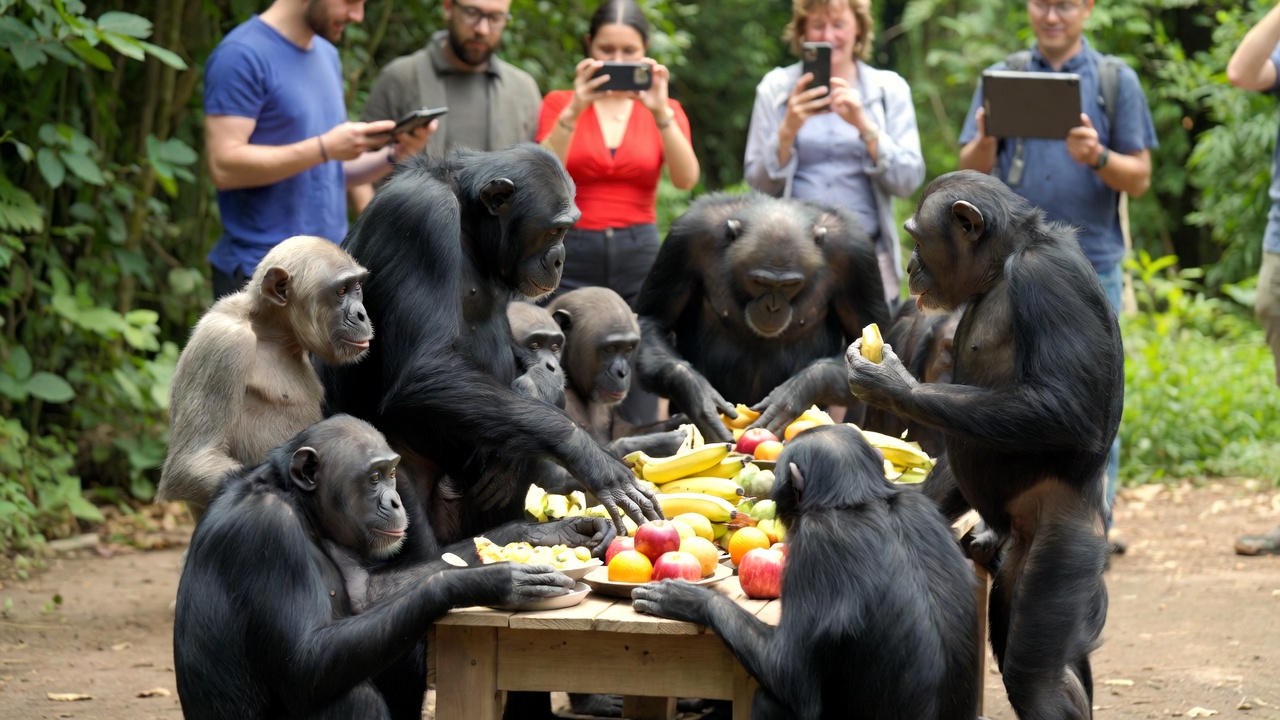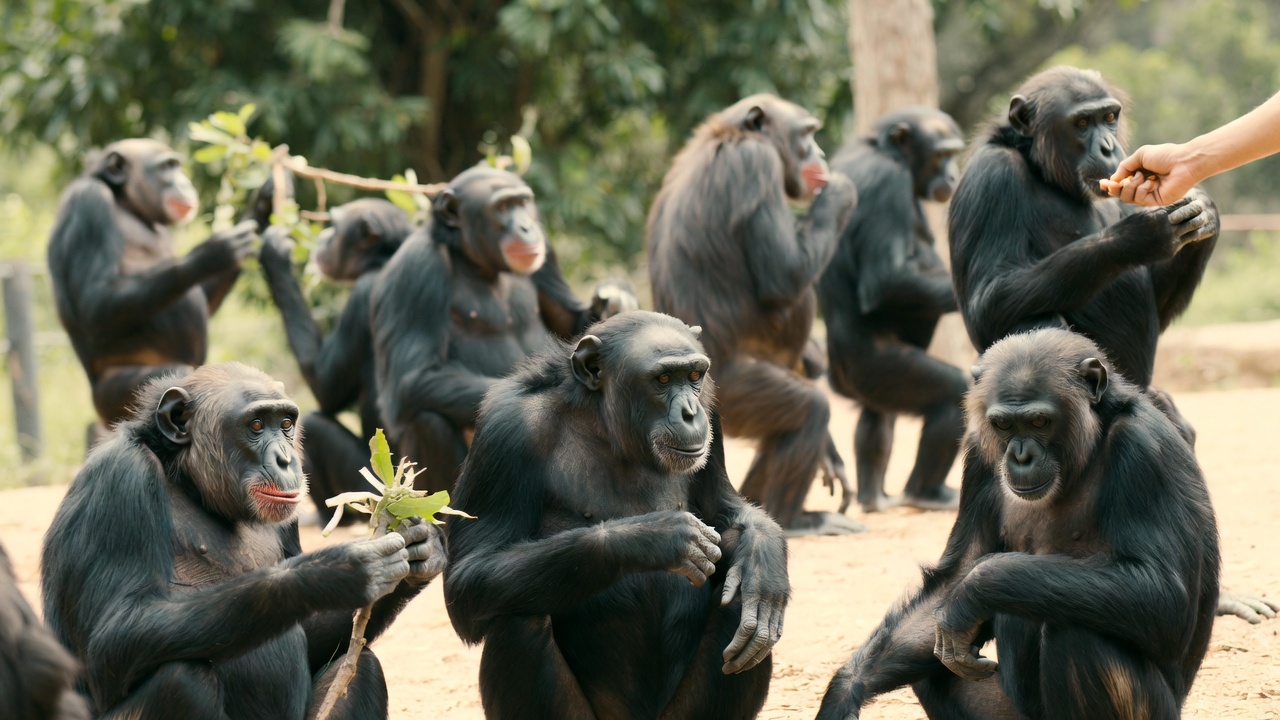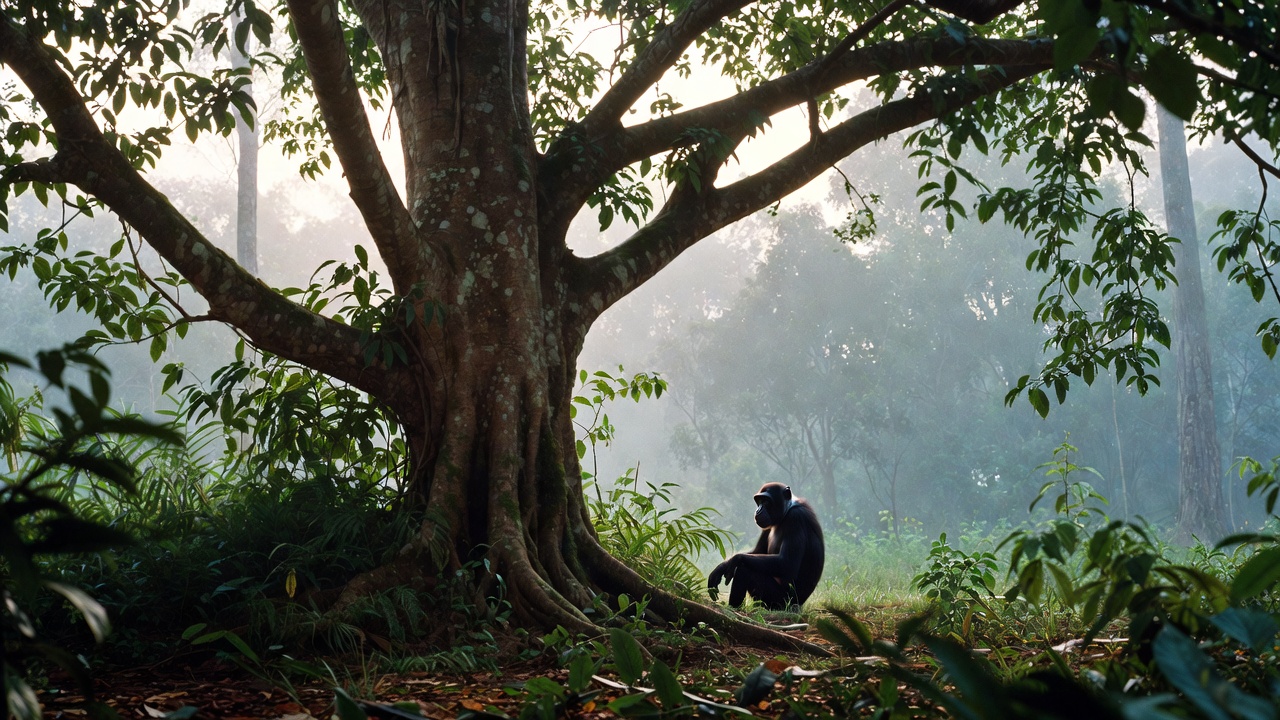
It is no accident that World Bonobo Day falls on Valentine’s Day. Bonobos are often called the “make love, not war” apes. They solve conflict through social bonding rather than aggression. They kiss, hug, and laugh. They live in female-led societies where cooperation beats competition. Of all the great apes, bonobos mirror the gentlest parts of what it means to be human.
Yet most people have never heard of them.
Bonobos (Pan paniscus) share roughly 98.7% of their DNA with humans, making them — along with chimpanzees — our closest living relatives. They are found in only one country on Earth: the Democratic Republic of the Congo (DRC). And they are in serious trouble. The IUCN Red List classifies bonobos as Endangered, with population estimates ranging from just 15,000 to 20,000 individuals in the wild — though some broader estimates put the figure between 29,500 and 50,000. The truth is, nobody knows the exact number. Much of their forest habitat has never been surveyed.
This World Bonobo Day — Saturday, February 14, 2026 — is a chance to change that silence into action. Below are ten practical, research-backed ways you can help protect humanity’s closest kin.
1. Donate to Bonobo Conservation Organizations Working in the Congo Basin
Money talks in conservation. The rainforests of central DRC are among the most remote and underfunded ecosystems on the planet. A few dedicated organizations channel donations directly into anti-poaching patrols, habitat protection, and community programs that keep bonobos alive.
Here are the most impactful groups to consider:
| Organization | Focus Area | Headquarters |
|---|---|---|
| Bonobo Conservation Initiative (BCI) | Wild habitat protection via the Bonobo Peace Forest | Washington, D.C. & DRC |
| Friends of Bonobos | Rescue, sanctuary care, and rewilding | DRC & USA |
| African Wildlife Foundation (AWF) | Community-driven reserves and ranger training | Nairobi, Kenya |
| World Wildlife Fund (WWF) | Anti-poaching and Salonga National Park co-management | Global |
The Bonobo Conservation Initiative deserves special mention. It is the only international organization solely dedicated to wild bonobo protection. BCI created the Bonobo Peace Forest — a network of community-managed reserves that now spans over nine million acres of protected habitat, with two million more in development.
Even small monthly contributions add up. A $10 recurring donation funds ranger patrols. A $25 gift can help supply field equipment. Conservation work in the Congo is lean and cost-effective — every dollar stretches further here than in almost any other region.
2. Symbolically Adopt a Bonobo to Fund Sanctuary Care and Rehabilitation
One of the most personal ways to support bonobo survival is through a symbolic adoption. Several organizations offer adoption programs that directly fund the care of specific bonobos — orphans who were rescued from the illegal bushmeat and pet trades.
Friends of Bonobos runs the adoption program linked to Lola ya Bonobo, the world’s only bonobo sanctuary. Located just outside Kinshasa, Lola ya Bonobo — which means “Paradise for Bonobos” in the Lingala language — is home to more than 70 rescued bonobos. Founded by Claudine André in 1994, the sanctuary pairs each orphaned infant with a human surrogate mother who provides round-the-clock physical contact, just as a wild bonobo mother would.
Why do baby bonobos need surrogate mothers? In the wild, bonobo mothers carry their infants constantly for four to five years. Without that contact, orphaned babies can literally die of heartbreak. The surrogate “Mamas” at Lola are not a luxury — they are a lifeline.
When you adopt a bonobo, your contribution funds veterinary care, food, surrogate mother salaries, and the eventual goal of rewilding — returning rehabilitated bonobos to the forest. Friends of Bonobos has already completed two successful rewildings at the Ekolo ya Bonobo Community Reserve, where more than 30 bonobos now live freely in protected Congo rainforest.
3. Recycle Your Old Electronics to Reduce Coltan Mining in Bonobo Habitat
This one surprises most people. Your old cell phone has a direct connection to bonobo extinction.
Coltan (columbite-tantalite) is a mineral used in the capacitors of smartphones, laptops, and gaming consoles. The DRC holds a significant share of the world’s coltan reserves, and much of it lies beneath the very forests where bonobos live. Mining operations — both legal and illegal — tear through rainforest habitat, and the roads they build give hunters easy access to previously isolated bonobo populations.
Here is what you can do right now:
- Recycle old phones, laptops, and tablets. Keeping coltan in circulation reduces demand for new mining. Programs like Call2Recycle and major electronics retailers accept old devices.
- Buy refurbished electronics when possible. A refurbished phone means one less unit of raw coltan extracted from the ground.
- Support companies with ethical mineral sourcing. Look for brands that participate in conflict-mineral traceability programs.
This is not abstract environmental advice. The Fort Worth Zoo’s conservation education team puts it bluntly: recycling your electronics is one of the simplest direct actions anyone can take to help bonobos survive.
4. Choose Sustainably Sourced Products to Protect Congo Rainforest Ecosystems
The Congo Basin rainforest is the second-largest tropical rainforest on Earth — a massive carbon sink that is critical to global climate stability. It is home to nearly half of all plant and animal species found on the African continent. And bonobos depend on it entirely.
But the forest is under growing pressure. According to the African Wildlife Foundation, roughly 99.2% of the bonobo’s range is suitable for palm oil production, making industrial agriculture a looming future threat. Slash-and-burn farming already drives agricultural activity deeper into the forest each planting cycle.
What does this mean for your shopping cart?
- Choose products with certified sustainable palm oil. Look for the RSPO (Roundtable on Sustainable Palm Oil) label on food, cosmetics, and cleaning products.
- Buy FSC-certified wood and paper products. The Forest Stewardship Council certification ensures timber comes from responsibly managed forests.
- Support fair-trade coffee and chocolate sourced from African cooperatives committed to zero-deforestation supply chains.
Consumer choices in Los Angeles, London, or Tokyo have downstream effects on forests in Équateur Province, DRC. That supply chain is real, and your purchasing power matters.
5. Spread Awareness on Social Media to Help the Least Known Great Ape
Bonobos are often called the “forgotten apes.” They were the last great ape species to be scientifically recognized — classified as a distinct species only in 1933 by German anatomist Ernst Schwarz. Even today, most people outside the primatology community could not distinguish a bonobo from a chimpanzee.
This lack of public awareness is itself a threat. Species that lack visibility receive less funding, less political protection, and less media coverage. World Bonobo Day exists precisely to change this.
How to make your social media count on February 14:
- Share a fact about bonobos using the hashtag #WorldBonoboDay and #BonoboLove. The Friends of Bonobos World Bonobo Day Social Media Toolkit offers ready-made graphics and messaging.
- Post a short video explaining why bonobos matter. Visual content dramatically outperforms text-only posts in reach and engagement.
- Tag friends who care about wildlife, Valentine’s Day, or Africa. Bonobos are the perfect Valentine’s story — love, cooperation, and empathy woven into a conservation message.
- Correct common myths. Bonobos are not “just chimpanzees.” They are a separate species with distinct behavior, social structure, and ecological needs.
Remember: bonobos cannot advocate for themselves. Every share, repost, or story that reaches a new audience is a small act of conservation.
6. Support Community-Based Conservation Programs in the Democratic Republic of Congo
Conservation that ignores local people fails. This is especially true in the DRC, where more than 90% of rural residents can afford only one meal a day. When families face that level of poverty, wildlife protection feels abstract — and bushmeat becomes survival.
The most effective bonobo conservation programs address both ecological and human needs simultaneously. The Bonobo Peace Forest model, developed by BCI in partnership with Congolese communities, is a prime example. It creates legally protected areas managed by local communities, supported by sustainable development initiatives.
What does community-based conservation look like in practice?
- Training and employing local rangers (eco-guards) to patrol reserves and monitor bonobo populations. This creates steady income for families who might otherwise turn to poaching.
- Microcredit programs and support for local enterprise. BCI provides supplies, equipment, and training for Congolese entrepreneurs building businesses that do not depend on forest destruction.
- Healthcare access. BCI and partners have built pilot health clinics in reserve areas — because people who are healthy and economically secure are better positioned to protect their environment.
- Education programs. Friends of Bonobos runs conservation education initiatives that target provinces where the bushmeat trade is most active. Studies have shown that children who visit Lola ya Bonobo show improved attitudes toward bonobos and wildlife conservation.
You can direct your donations specifically toward community development programs at BCI or Friends of Bonobos. This is conservation at its most humane — saving apes by saving the people who live alongside them.
7. Advocate for Stronger Wildlife Protection Laws and Anti-Poaching Efforts
Bushmeat hunting remains the single greatest threat to wild bonobo populations. In the DRC, it is illegal to kill a bonobo or keep one as a pet. But law enforcement is weak, and the bush is vast. Decades of civil unrest have flooded the region with modern weaponry, and the military has at times sanctioned bonobo hunting.
Poachers target bonobos because of their large body size — a single adult yields significant quantities of meat. The infants, too small to eat, are sold into the illegal pet trade. Nearly every bonobo at Lola ya Bonobo arrived as an orphan whose family was slaughtered for bushmeat.
How you can advocate for stronger protections:
- Contact your elected representatives and urge them to support international conservation funding, especially for the Congo Basin. U.S. citizens: the Congo Basin Forest Partnership, which has received millions in U.S. government funding since 2003, is a critical vehicle for this work.
- Support legislation that tightens controls on the illegal wildlife trade. Many countries already have such laws; the problem is enforcement and cross-border coordination.
- Sign petitions and join campaigns run by organizations like the International Primate Protection League that lobby for primate welfare internationally.
- Advocate for increased ranger funding. The Salonga National Park — Africa’s largest protected forest park, covering an area the size of Switzerland — relies on ranger patrols to deter poachers. A 2024 study published in the International Journal of Primatology confirmed that park rangers play a key role in maintaining stable bonobo populations in Salonga.
Advocacy is free. It requires only your voice and a few minutes of your time. And it can unlock millions in government funding that no individual donation could match.
8. Visit Lola ya Bonobo Sanctuary for Responsible Ecotourism in Kinshasa
If you ever find yourself in the DRC — and more travelers are discovering Kinshasa than many realize — a visit to Lola ya Bonobo is one of the most unforgettable wildlife experiences in Africa.
The sanctuary is open for day tours Tuesday through Sunday and offers overnight eco-lodge stays on the grounds of a former presidential retreat. Guided tours take visitors through densely forested enclosures where bonobos swing, play, and socialize in semi-wild conditions. You can watch feeding time from a boat on the river.
Important visitor guidelines:
- Visitors have no direct physical contact with the bonobos. Because humans and bonobos share such similar biology, even a common cold could devastate the sanctuary’s population.
- Professional camera equipment requires prior authorization.
- Overnight reservations should be made well in advance, as space is limited.
Why does ecotourism matter for conservation? Tourism revenue supports the sanctuary’s operations, creates local jobs, and demonstrates to the Congolese government that bonobos have economic value alive — not just as bushmeat. Every ticket sold makes the case that conservation and economic development can coexist.
For those who cannot travel to the DRC, virtual tours and educational videos are available through the Friends of Bonobos website and social media channels.
9. Educate Yourself and Others About Bonobo Behavior and Why Bonobos Matter
Understanding why bonobos matter goes beyond conservation statistics. These apes offer a mirror to humanity that is both humbling and hopeful.
Key facts every bonobo supporter should know:
| Fact | Detail |
|---|---|
| Closest living relative to humans | Share 98.7% of DNA with Homo sapiens |
| Only found in one country | Democratic Republic of the Congo, south of the Congo River |
| Matriarchal society | Females lead social groups; males rank below all females |
| Conflict resolution | Use social bonding — including grooming, play, and physical intimacy — instead of violence |
| Seed dispersers | A single bonobo disperses seeds of about 40% of tree species in their forest habitat |
| Three distinct genetic populations | A 2024 UCL study revealed that losing any one population would cause devastating genetic diversity loss |
| Theory of mind | A 2025 study found that bonobos can recognize when humans lack specific knowledge — a cognitive ability once thought unique to our species |
That last point bears emphasis. In February 2025, scientists published findings showing that bonobos, like humans, may possess theory of mind — the ability to understand that other beings have their own thoughts and knowledge. This discovery strengthens the case that bonobos are not just biologically close to us. They are cognitively close.
When we lose bonobos, we do not lose just another species. We lose a living reference point for understanding our own evolution — our capacity for empathy, cooperation, and peaceful coexistence.
Share these facts. Bring them into conversations. Teach them to your children. Knowledge is the foundation of every conservation movement that has ever succeeded.
10. Participate in World Bonobo Day Events and Host a Bonobo-Themed Fundraiser
World Bonobo Day was founded in 2017 by the Bonobo Conservation Initiative to give bonobos a dedicated day of global visibility. Every February 14, zoos, sanctuaries, schools, and conservation groups around the world host events that celebrate these extraordinary apes.
Ideas for celebrating World Bonobo Day 2026:
- Host a “Bonobo Love” party. Combine Valentine’s Day with a conservation twist. Serve fruit-heavy snacks (bonobos are primarily frugivorous), display bonobo facts, and screen a wildlife documentary. Consider the acclaimed PBS documentary on Lola ya Bonobo for a compelling visual story.
- Organize a fundraiser. Set up a donation page for BCI or Friends of Bonobos. Birthday fundraisers on Facebook and Instagram are an easy way to channel your personal network into meaningful donations.
- Visit a zoo with bonobos. Several accredited zoos in the United States house bonobo troops, including the Fort Worth Zoo, San Diego Zoo, and Columbus Zoo. Many offer special programming on World Bonobo Day.
- Wear your support. The Friends of Bonobos online store sells “98.7% Bonobo” and Bonobo Pop Art apparel. Wearing a conversation-starting shirt is a surprisingly effective form of daily advocacy.
- Teach a child about bonobos. Friends of Bonobos provides kid-friendly educational activities with stories, videos, and interactive content tailored for young learners.
The goal is not just awareness for its own sake. It is to build a global community of people who care — and who translate that caring into sustained action long after February 14 passes.
Why Saving Bonobos Means Saving the Congo Rainforest and Our Planet
Bonobo conservation is not a narrow cause. It is inseparable from some of the largest ecological challenges of our time.
The Congo Basin rainforest sequesters trillions of tons of carbon dioxide. Protecting it is not just an African priority — it is a global climate imperative. Bonobos play an irreplaceable role in this ecosystem as seed dispersers. Research shows that bonobos spread the seeds of approximately 40% of the tree species in their forest range. Without bonobos, these trees may not regenerate. Without those trees, the forest shrinks. And without the forest, one of the planet’s great carbon sinks disappears.
This is what ecologists call a trophic cascade, and it is already happening in forests where large frugivorous mammals have been hunted out — a phenomenon known as empty forest syndrome.
Saving bonobos, then, is not about saving one charismatic species. It is about preserving the structural integrity of an entire biome that the rest of the world depends on.
Final Thoughts: What Bonobos Teach Us About Being Human
Bonobos have survived for over a million years in the forests south of the Congo River. They built societies rooted in empathy, cooperation, and play. They resolve disputes with tenderness. They welcome strangers with curiosity rather than violence. They cherish their babies with a devotion that any human parent would recognize.
We share 98.7% of our DNA with these animals. The question is whether we share enough of their values to keep them alive.
This World Bonobo Day, choose at least one action from the list above. Donate. Recycle a phone. Share a post. Write a letter. Adopt a bonobo named Lombo or N’djili. Visit a sanctuary or a zoo. Teach a child.
The bonobos cannot ask for help. But they should not have to.
Have you celebrated World Bonobo Day before? Share your experience in the comments, and tag your posts with #WorldBonoboDay and #BonoboLove to join the global conversation.