Every year on November 9, Catholics around the world pause to honor a building that most people have never heard of. It is not St. Peter’s Basilica. It is not the Sistine Chapel. It is the Archbasilica of Saint John Lateran — the oldest church in the Western world and the true cathedral of Rome. The annual Feast of the Dedication of the Lateran Basilica marks the day in 324 AD when Pope Sylvester I consecrated this sacred structure, built at the request of Emperor Constantine.
For travelers planning a trip to the Eternal City in 2026, the Lateran anniversary celebrations offer a rare window into living Roman Catholic tradition. From solemn pontifical Masses to candlelit concerts beneath golden mosaics, the events surrounding this feast day draw pilgrims, historians, and curious visitors from every continent.
But the Lateran story does not end with a single feast day. February 11 marks the anniversary of the Lateran Treaty of 1929, the document that created the sovereign state of Vatican City. And throughout the calendar year, the Lateran complex hosts liturgical celebrations, musical performances, and cultural programs that bring this ancient site to vivid life.
This guide walks you through the seven most significant Lateran anniversary events you can experience in and around Vatican City in 2026. Whether you are a devout pilgrim, a history enthusiast, or a first-time traveler to Rome, these celebrations reveal a side of the Catholic world that tour buses rarely reach.
Why Is the Lateran Basilica Called the Mother and Head of All Churches in Rome?
Before exploring the specific events, it helps to understand why this particular building matters so much. The answer goes back more than 1,700 years.
In 313 AD, Emperor Constantine issued the Edict of Milan, which legalized Christianity across the Roman Empire. This was a turning point. For nearly three centuries, Christians had worshipped in secret. They met in private homes, underground catacombs, and hidden gathering places. Persecution was constant. Martyrdom was common.
Constantine changed everything. He donated the Lateran Palace — a grand estate on the Caelian Hill that once belonged to the powerful Laterani family — to Pope Miltiades. On this land, Constantine ordered the construction of a great basilica. It was consecrated by Pope Sylvester I on November 9, 324 AD, and dedicated to Christ the Most Holy Savior.
The basilica carried an inscription that still appears on its facade today: “Omnium urbis et orbis ecclesiarum mater et caput” — “Mother and head of all churches of the city and of the world.” This is not merely a title of honor. It is a statement of liturgical and ecclesial rank.
| Feature | St. John Lateran | St. Peter’s Basilica |
|---|---|---|
| Official Status | Cathedral of Rome; Pope’s seat as Bishop of Rome | Papal basilica; not a cathedral |
| Date of Consecration | November 9, 324 AD | November 18, 1626 |
| Architectural Style | Baroque interior (redesigned by Borromini, 1646) | Renaissance and Baroque |
| Obelisk | Tallest in Rome (32 meters, originally from Egypt) | 25.5 meters, from Heliopolis |
| Papal Residence | Served as papal home until the 14th century | Papal residence since the 15th century |
| Feast Day | November 9 (required feast in the universal Church) | November 18 (optional memorial) |
Art historian Elizabeth Lev, a college instructor and noted Roman tour guide, has described the basilica’s significance in direct terms. She explained that the building marks the precise moment when Christianity could make its public presence felt in the city of Rome. The church, she noted, was built on the witness of 250 years of people who were willing to die for their faith.
The Lateran Basilica has survived fires, earthquakes, Vandal invasions, and centuries of neglect. It was rebuilt and restored multiple times. The current interior, designed by the great Baroque architect Francesco Borromini in 1646 for the Holy Year of 1650, features twelve colossal statues of the Apostles standing in niches along the central nave. These marble figures, created under the supervision of Gianlorenzo Bernini, remain among the most impressive works of devotional sculpture in Rome.
Five Ecumenical Councils were held within the Lateran walls. The Lateran Treaty of 1929 was signed in the adjacent Lateran Palace. And until 1870, every pope was enthroned here. For all these reasons, the annual feast on November 9 is not just a local Roman holiday. It is a celebration that belongs to the entire Catholic world.
How to Experience the Solemn Pontifical Mass on the Feast of the Dedication November 9
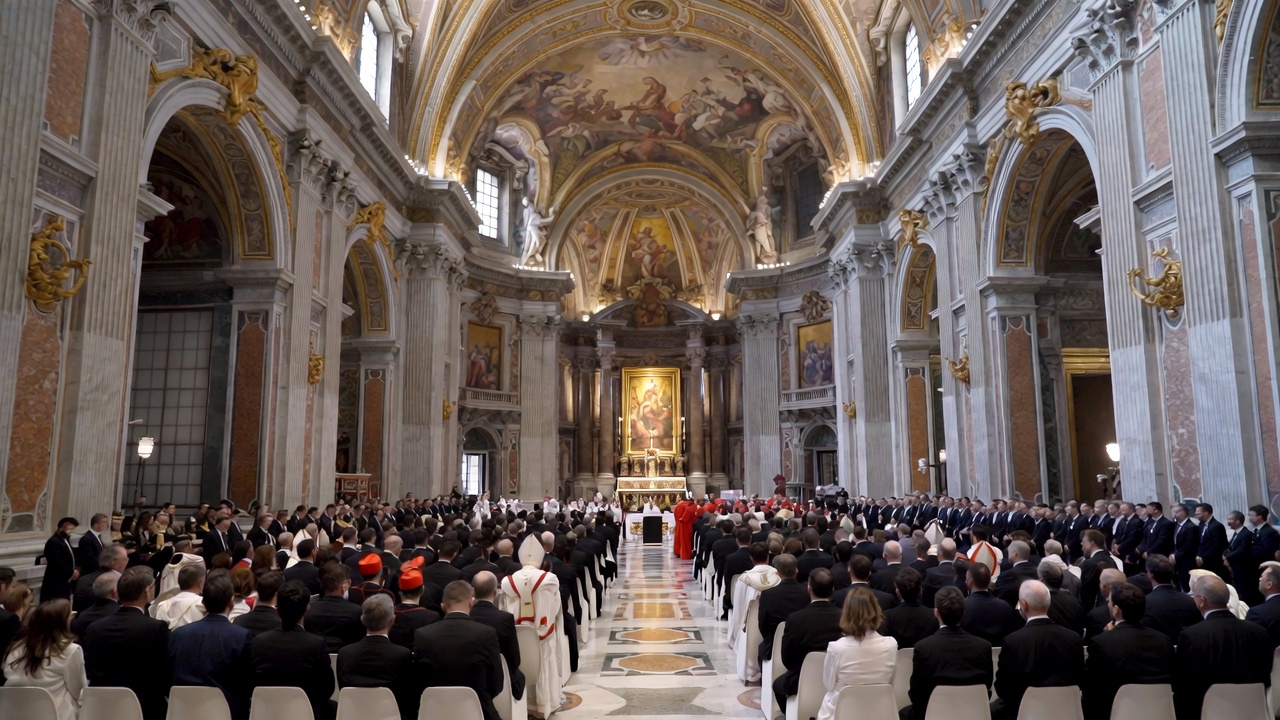
The centerpiece of the Lateran anniversary is the Solemn Pontifical Mass celebrated on November 9 inside the basilica. This is the single most important liturgical event of the Lateran calendar year. In 2026, this feast falls on a Monday, which means it will be celebrated with full liturgical solemnity as a Feast of the Lord — a rank that takes precedence even over the regular Sunday liturgy when it falls on a Sunday.
What happens during the Pontifical Mass?
The celebration is presided over by the Cardinal Vicar of Rome or by the basilica’s archpriest. In recent years, Cardinal Baldassare Reina, who serves as the Cardinal Vicar for the Diocese of Rome, has presided over this liturgy. The Mass typically begins at 5:30 PM local time and features the Choir of the Diocese of Rome, directed by the renowned liturgical composer Monsignor Marco Frisina.
Frisina has composed original musical pieces specifically for the feast of the Dedication. His choral works draw on centuries of Roman liturgical tradition while incorporating modern harmonic textures. The effect inside the basilica — with its soaring Baroque nave and golden apse mosaic — is deeply moving.
The liturgical readings for the feast are drawn from passages that connect the physical building with the spiritual reality of the Church as the Body of Christ. The Gospel reading (John 2:13-22) recounts the story of Jesus cleansing the Temple in Jerusalem and declaring, “Destroy this temple, and in three days I will raise it up.” The second reading from 1 Corinthians 3:9-11, 16-17 contains Paul’s famous question: “Do you not know that you are the temple of God?”
Practical tips for attending the Pontifical Mass:
- Arrive early. The basilica seats several thousand, but the Pontifical Mass draws large crowds of Roman faithful and visiting pilgrims. Plan to arrive at least 45 minutes before the scheduled start.
- Dress modestly. Shoulders and knees must be covered. This is a working cathedral, and the dress code is enforced.
- Expect security screening. Since the Jubilee Year of 2025, security protocols at Rome’s major basilicas have been tightened. Glass bottles and aerosol cans are prohibited.
- No tickets required. The Mass is free and open to all, regardless of faith background.
The feast day Mass is not a tourist attraction. It is a living act of worship in a building that has hosted prayer for more than seventeen centuries. For visitors who approach it with respect and genuine curiosity, it offers an experience that no museum tour can replicate.
What Happens During the Lateran Treaty Anniversary Celebration on February 11?
While November 9 is the great liturgical feast of the Lateran Basilica, February 11 is the great civic holiday of Vatican City. On this date in 1929, the Lateran Treaty was signed in the Lateran Palace, settling the so-called “Roman Question” and creating the sovereign state of Vatican City.
The story behind the treaty is one of the most dramatic episodes in modern European history. When the Kingdom of Italy unified in 1870, the new government seized the Papal States — a vast territory stretching across central Italy that the popes had governed for more than a thousand years. Pope Pius IX declared himself a “prisoner of the Vatican” and refused to recognize the legitimacy of the Italian state. For nearly sixty years, successive popes remained inside the Vatican walls, refusing to set foot on Italian soil.
The standoff ended on February 11, 1929, when Italian Prime Minister Benito Mussolini and Cardinal Secretary of State Pietro Gasparri (acting on behalf of Pope Pius XI) signed a set of three documents at the Lateran Palace:
- A Treaty of Conciliation — recognizing Vatican City as an independent sovereign state
- A Financial Convention — compensating the Holy See for the loss of the Papal States
- A Concordat — regulating relations between the Catholic Church and the Italian state
The result was the creation of the smallest sovereign state in the world: Vatican City, covering just 0.44 square kilometers (about 110 acres) with a current population of roughly 800.
How does the Vatican celebrate February 11 in 2026?
In 2026, Lateran Treaty Day falls on a Wednesday. It is an official public holiday in Vatican City. Most Vatican offices, including the Vatican Museums, may operate on adjusted schedules. The Swiss Guards and the Gendarmerie Corps participate in ceremonial observances. The flag of Vatican City flies from public buildings throughout the tiny state.
The day is also the Feast of Our Lady of Lourdes on the Catholic liturgical calendar, which adds a spiritual dimension to the civic commemoration. Special Masses may be celebrated at St. Peter’s Basilica and at the Lateran Basilica to mark the double significance of the date.
For travelers, February 11 is worth noting for both practical and cultural reasons. Some Vatican facilities may close or operate on reduced hours. But the ceremonial atmosphere around St. Peter’s Square and the Lateran district gives visitors a taste of Vatican civic pride that is normally invisible beneath the more familiar religious rituals.
| Lateran Treaty — Key Facts | |
|---|---|
| Date Signed | February 11, 1929 |
| Location | Lateran Palace, Rome |
| Signatories | Cardinal Pietro Gasparri (for the Holy See) and Benito Mussolini (for the Kingdom of Italy) |
| Result | Creation of Vatican City as a sovereign state |
| Area of Vatican City | 0.44 km² (110 acres) |
| Revised | 1984 (ended Catholicism as sole state religion of Italy) |
| Constitutional Status | Recognized in the 1948 Constitution of the Italian Republic |
How Did the 1700th Anniversary Transform Lateran Basilica Events in Recent Years?
The year 2024 was a milestone for the Lateran Basilica. It marked the 1,700th anniversary of the basilica’s original dedication on November 9, 324 AD. The Diocese of Rome organized a full year of commemorative events running from November 9, 2023, to November 9, 2024, and the energy from that celebration continues to shape the Lateran’s programming in 2025 and 2026.
Cardinal Angelo De Donatis, who served as Vicar General for the Diocese of Rome and Archpriest of the Lateran Basilica, described the significance of the anniversary in memorable terms. He noted that the cathedral of Rome holds a distinctive place for the Diocese and the Universal Church. He spoke of breathing the history of seventeen centuries inside its walls — a basilica built and rebuilt three times, the site of five Ecumenical Councils, the seat of the Chair of Peter.
The anniversary program included a rich calendar of events that set a template for future years:
Religious-Cultural Lecture Series — From November through December 2023, Monsignor Andrea Leonardo curated a series of talks on the theme “From Constantine to the Avignon Exile.” These presentations included special access to normally restricted areas of the Lateran Complex: the Loggias, the Apse, selected relics, and the archaeological excavations beneath the basilica.
Concerts by the Choir of the Diocese of Rome — Monsignor Marco Frisina directed multiple concerts throughout the anniversary year, including a Christmas concert in December 2023 and a concert titled In hoc signo (“In This Sign”) in November 2024 that explored the life of Constantine through music and visual art.
Solemn Pontifical Celebrations — Special Masses marked key dates on the calendar, including the Solemnity of the Ascension (celebrating the basilica’s original dedication to the Most Holy Savior), the Solemnity of Corpus Christi (marking the 50th anniversary of Perpetual Adoration at the basilica’s Adoration Chapel), and the Solemnity of the Birth of Saint John the Baptist on June 24.
Sunday of the Word of God — In January 2024, the basilica hosted special readings and distributed Bibles to families, encouraging household Scripture reading as part of the anniversary observance.
The legacy of the 1700th anniversary continues to influence the Lateran’s public programming. Visitors to Rome in 2026 may encounter ongoing exhibition content, restored spaces that were opened during the anniversary, and a renewed sense of purpose in the basilica’s role as the spiritual heart of the Diocese of Rome. The anniversary also coincided with the opening of the Lateran’s Holy Door during the 2025 Jubilee Year, further raising the basilica’s profile among international pilgrims.
What Are the Best Lateran Basilica Sacred Music Concerts and Cultural Nights to Attend?
One of the most enchanting ways to experience the Lateran anniversary celebrations is through sacred music. The basilica has a deep musical tradition that reaches back centuries, and the modern concert programming — led primarily by Monsignor Marco Frisina and the Choir of the Diocese of Rome — transforms the ancient nave into one of the most extraordinary concert venues in the world.
Frisina is not simply a church musician. He is a prolific composer who has written film scores, oratorios, and liturgical works performed across Italy and beyond. His compositions for the Lateran anniversary celebrations blend Gregorian chant influences with contemporary orchestral textures. When his choir performs inside the basilica, the sound reverberates off the marble walls and gilded ceilings in a way that no modern concert hall can reproduce.
Key musical events associated with the Lateran anniversary season:
The Dedication Concert (November 9 or nearby date) — This is the flagship musical event of the Lateran’s annual calendar. Performed on or around the feast of the Dedication, it typically features compositions written specifically for the occasion. During the 1700th anniversary, Frisina premiered new choral works that celebrated the basilica’s history and spiritual significance. Expect similar programming in 2026.
The Christmas Concert (December) — Each December, the Choir of the Diocese of Rome performs a major Christmas concert in the basilica. This event is free and open to the public, though seating fills quickly. The program typically includes traditional Italian carols (canti natalizi), selections from Frisina’s liturgical compositions, and classical choral works.
Holy Week Liturgical Music (March–April) — The Lateran Basilica plays a special role during Holy Thursday (Giovedì Santo), when the Pope traditionally celebrates Mass here as Bishop of Rome. The musical accompaniment for this liturgy is among the most elaborate of the year. In 2026, Easter falls on April 5, placing Holy Thursday on April 2.
Cultural Evenings and Lecture-Concerts — Throughout the year, the Lateran complex hosts evenings that combine short lectures on art or history with live musical performances. These events may focus on specific periods of the basilica’s history, individual works of art within the complex, or broader themes of Christian culture in Rome.
Tips for attending Lateran concerts:
- Most concerts are free of charge, but seating is limited. Arrive at least 30–60 minutes early.
- The basilica is not climate-controlled. In November, bring warm layers. In summer, the interior stays cool but not cold.
- Photography without flash is generally permitted, but always follow posted guidelines and respect the performers.
- Concert schedules are announced through the Diocese of Rome and the basilica’s official website. Check www.basilicasangiovanni.va for the latest updates.
For travelers who love music, attending a concert in the Lateran Basilica is an experience that ranks alongside performances in Vienna’s Musikverein or London’s Royal Albert Hall — but with an atmosphere that is entirely its own. The music does not merely fill the space. It seems to rise from the stones themselves.
How to Visit the Lateran Complex: Holy Stairs, Cloister, Baptistery, and Lateran Palace Tour
The annual Lateran anniversary celebrations offer an ideal occasion to explore the full Lateran Complex, which extends far beyond the basilica itself. Many visitors make the mistake of seeing only the main nave. But the surrounding structures — the Scala Santa (Holy Stairs), the 13th-century Cloister, the ancient Baptistery, and the Lateran Palace — contain some of the most sacred and historically significant spaces in all of Christendom.
The Scala Santa (Holy Stairs): Climbing on Your Knees to Touch History
Directly across the piazza from the basilica stands the Pontifical Sanctuary of the Holy Stairs (Pontificio Santuario della Scala Santa). According to Catholic tradition, these 28 white marble steps are the very stairs that Jesus Christ climbed when he was brought before Pontius Pilate for judgment in Jerusalem. Saint Helena, the mother of Emperor Constantine, is said to have transported the stairs from Jerusalem to Rome around 326 AD.
Pilgrims may ascend the Holy Stairs only on their knees, saying a prayer on each step. The stairs lead to the Sancta Sanctorum (“Holy of Holies”) — the ancient private chapel of the early popes, which houses one of the most venerated icons in Christianity: an image of Christ known as the Acheiropoieton (“not made by human hands”), traditionally attributed to Saint Luke and said to have been completed by an angel.
In 2019, during a major restoration, the wooden coverings that had protected the marble stairs since the 18th century were temporarily removed. For the first time in nearly 300 years, pilgrims could kneel on the original marble. Visitor numbers tripled during this period.
Practical details for the Scala Santa:
| Detail | Information |
|---|---|
| Location | Piazza di San Giovanni in Laterano, 14 |
| Hours | Daily, 9:00 AM – 5:00 PM (subject to change) |
| Admission | Free to climb the stairs; Sancta Sanctorum chapel: approximately €4 |
| Audio Guide | Available in multiple languages |
| Dress Code | Modest clothing required (shoulders and knees covered) |
| Accessibility | Side staircases available for those unable to kneel |
The Vassalletto Cloister: A Medieval Masterpiece in Marble
Adjacent to the basilica is a 13th-century cloister built by the Vassalletto family, one of the most skilled stonemason families in medieval Rome. The cloister measures approximately 36 meters on each side and features delicate twisted columns inlaid with colorful Cosmatesque mosaics — a distinctly Roman decorative tradition that uses small pieces of marble and glass to create geometric patterns.
The cloister is a place of extraordinary quiet. Even on busy days, when the basilica itself may be crowded with visitors, the cloister maintains an atmosphere of contemplation. It is one of the most photographed spaces in Rome, and for good reason.
Admission: A ticket is required and can be purchased inside the basilica. The cost is modest, and the experience is well worth the investment.
The Lateran Baptistery: The Oldest in the Western World
Behind the basilica stands the Lateran Baptistery, originally built by Constantine in the 4th century. This octagonal structure served as the prototype for baptisteries throughout the Christian world for centuries afterward. It has been in continuous use for its original purpose — baptism — since the day it was built. Not a single year has passed without baptisms being celebrated here.
The baptistery’s interior features frescoes and decorative work added by various artists over the centuries, including contributions from Borromini and Andrea Sacchi. A two-tier colonnade gives the interior an elegant octagonal shape.
Hours: Daily, 9:00 AM – 7:00 PM. No advance booking required. Free admission.
The Lateran Palace: Centuries of Papal Governance
The Lateran Palace (Palazzo Lateranense), which stands beside the basilica, was the official papal residence from the 4th century until the papacy’s move to Avignon in the 14th century. Today, the palace houses the offices of the Vicariate of Rome and is open to visitors on a limited schedule.
Tours of the Lateran Palace reveal rooms where popes governed the Church for a thousand years, where ecumenical councils were convened, and where the Lateran Treaty itself was signed in 1929. The palace is open Monday to Saturday from 9:00 AM to 5:00 PM, closed Sundays and during religious holidays. Group bookings can be arranged through the official website.
Planning Your Visit to the Full Lateran Complex
A thorough visit to the entire Lateran Complex takes approximately 2 to 3 hours. Here is a suggested itinerary:
- Begin inside the Basilica, taking time to admire the Borromini nave and the Apostle statues
- Visit the Cloister (accessible from inside the basilica, on the left-hand side)
- Walk behind the basilica to the Baptistery
- Cross the piazza to the Scala Santa and climb to the Sancta Sanctorum
- Pause at the Lateran Obelisk — the tallest Egyptian obelisk in Rome, standing at 32 meters
The basilica is located at Piazza di San Giovanni in Laterano, 4. The nearest Metro station is San Giovanni on Line A (and the newer Line C). Multiple bus routes also serve the area.
What Is the Connection Between the 2025 Jubilee Year and the Lateran Anniversary in 2026?
The 2025 Jubilee Year of Hope, which ran from December 24, 2024, to January 6, 2026, placed the Lateran Basilica at the center of global Catholic attention in a way it had not experienced in decades. Understanding this connection is essential for travelers visiting Rome in 2026, because the aftereffects of the Jubilee continue to shape the city’s religious and cultural landscape.
During the Jubilee, each of Rome’s four major papal basilicas opened a Holy Door (Porta Santa) through which pilgrims could pass to receive a plenary indulgence. The Holy Door of the Lateran Basilica was opened on December 29, 2024, by Cardinal Vicar Baldassare Reina. It was closed on December 27, 2025, in a solemn ceremony that Reina presided over, featuring the participation of the diocesan choir directed by Monsignor Frisina.
The 2025 Jubilee was historically significant for another reason. Pope Francis, who inaugurated the Holy Year on Christmas Eve 2024, passed away on Easter Monday 2025. His successor, Pope Leo XIV, was elected on May 8, 2025, becoming the first American-born pope. It was Pope Leo XIV who performed the final act of the Jubilee on January 6, 2026 — the Solemnity of the Epiphany — by closing the Holy Door of St. Peter’s Basilica, through which an estimated 30 million pilgrims had passed during the course of the year.
This transition from one pontificate to another during a Jubilee was only the third time in history that two popes had presided over a single Holy Year. The previous instances occurred during the Jubilee of 1390 (Urban VI and Boniface IX) and the Jubilee of 1700 (Innocent XII and Clement XI).
How does the Jubilee affect Lateran events in 2026?
The close of the Jubilee on January 6, 2026, marked the beginning of a new phase for the Lateran and for Rome as a whole. Several factors are shaping the post-Jubilee environment:
Infrastructure improvements. Rome invested billions of euros in preparation for the Jubilee, including improvements to public transport, monument restoration, and security upgrades. The Lateran area benefited from these investments. Rome’s new Metro Line C, which is designed to connect St. Peter’s Basilica and St. John Lateran through the historic center, continues its phased expansion.
Increased pilgrim awareness. The Jubilee introduced the Lateran Basilica to millions of pilgrims who might previously have visited only St. Peter’s. Many of these visitors encountered the Lateran’s history for the first time during their Holy Door pilgrimage, and the basilica’s international profile has risen significantly as a result.
Continued spiritual programming. Pope Leo XIV began a new pastoral year for the Diocese of Rome with a prayer service at the Lateran Basilica on September 19, 2025. This signaled the basilica’s ongoing centrality to the new pontificate’s vision for the local Church.
Vatican Museums restoration work. In early 2026, the Vatican Museums undertook extraordinary conservation work on Michelangelo’s Last Judgment fresco in the Sistine Chapel, expected to continue through March. While this does not directly affect the Lateran, it may redirect visitor traffic toward the Lateran complex during this period, making it an especially good time to explore the basilica and its surroundings.
For travelers, the post-Jubilee period offers a unique advantage. The massive investment in Rome’s infrastructure remains in place, but the peak Jubilee crowds have subsided. The Lateran Basilica is easier to visit in 2026 than it was during the crush of 2025, yet the facilities, security, and visitor services remain at the elevated standard established for the Holy Year.
What Are the Best Insider Tips for Planning a Lateran Anniversary Pilgrimage Trip to Rome?
Planning a visit to Rome around the Lateran anniversary celebrations requires some advance thought. The November 9 feast, the February 11 Lateran Treaty Day, and the broader liturgical calendar all present distinct opportunities — and logistical considerations. Here is a practical guide for making the most of your Lateran pilgrimage in 2026.
When to Visit: Choosing the Best Season for Lateran Events
November (for the Feast of the Dedication): November is one of the best months to visit Rome. The summer heat has broken, the worst of the tourist crowds have thinned, and the autumn light gives the city a warm, golden quality. Temperatures in early November typically range from 10°C to 18°C (50°F to 64°F). The November 9 feast falls on a Monday in 2026, so consider arriving on the preceding weekend to settle in and explore the neighborhood before the main celebration.
February (for Lateran Treaty Day): February is Rome’s quietest tourist month. The weather is cool — 5°C to 13°C (41°F to 55°F) — but the city is uncrowded and hotel prices are at their lowest. February 11 falls on a Wednesday in 2026.
Holy Week (for Holy Thursday at the Lateran): Holy Week in 2026 begins on March 29 (Palm Sunday), with Easter on April 5. The Pope celebrates Mass at the Lateran on Holy Thursday (April 2), making this one of the most significant liturgical events of the year at the basilica. Expect large crowds and plan accordingly.
Getting to the Lateran Basilica
The basilica is located in the San Giovanni district of Rome, southeast of the historic center. It is well-served by public transport:
| Transport | Details |
|---|---|
| Metro | San Giovanni station (Line A and Line C) — 2-minute walk |
| Tram | Line 3 — stops at Piazza di San Giovanni in Laterano |
| Bus | Lines 16, 81, 85, 87, 186, 650, 850 — various stops nearby |
| Walking | 20 minutes from the Colosseum; 30 minutes from Termini station |
Mass Schedule at the Lateran Basilica
The basilica celebrates Mass daily, with services available in Italian, Latin, and English:
- Weekdays: 7:00, 8:00, 9:00 (Italian), 12:00 (Latin), 18:00 (English)
- Saturday: 7:00, 8:00, 9:00 (Italian), 18:00 (English)
- Sunday: 7:00, 8:00, 9:00 (Italian), 10:30, 12:00 (Latin), 18:00 (English)
The availability of daily English-language Mass at 6:00 PM makes the Lateran Basilica particularly welcoming for English-speaking visitors — a significant advantage over St. Peter’s, where English Mass is not regularly scheduled.
Combining the Lateran with Nearby Attractions
The San Giovanni neighborhood offers several additional sites that pair well with a Lateran visit:
Basilica di San Clemente (850 meters away) — A fascinating three-level church built on top of a 4th-century basilica, which in turn sits atop a 1st-century Roman house. Archaeological layers reveal nearly 2,000 years of history.
The Colosseum (1.3 kilometers away) — Rome’s iconic amphitheater is a comfortable walk from the Lateran through the park surrounding the Arch of Constantine.
Basilica di Santa Croce in Gerusalemme (700 meters away) — One of Rome’s seven pilgrim churches, this basilica houses relics of the True Cross brought from Jerusalem by Saint Helena — the same Helena credited with transporting the Holy Stairs.
Baths of Caracalla (1.3 kilometers away) — The ruins of this enormous 3rd-century Roman bath complex offer a dramatic contrast to the Lateran’s Christian heritage.
Accommodation Near the Lateran
The San Giovanni neighborhood is an excellent base for exploring Rome. It is less expensive than the historic center but well-connected by Metro. Hotels and guesthouses in this area tend to be quieter and more residential in character than those near the Vatican or the Trevi Fountain. Many religious guesthouses and convents in the area also offer affordable rooms to pilgrims.
Dining in the San Giovanni District
The restaurants around Piazza di San Giovanni in Laterano serve authentic Roman cuisine at prices that are generally lower than those in the more touristic districts. Look for trattorias offering classic dishes such as cacio e pepe (pasta with pecorino cheese and black pepper), carbonara (with guanciale, egg, and pecorino), and supplì (fried rice balls filled with mozzarella). The neighborhood is also home to several excellent bakeries and gelaterias.
Essential Etiquette for Visiting the Lateran
The Lateran Basilica is an active place of worship, not a museum. Visitors should keep the following guidelines in mind:
- Silence is expected inside the basilica, especially during services.
- Photography without flash is generally permitted in the basilica and cloister. Photography is not allowed on the Holy Stairs.
- Mobile phones should be silenced upon entry.
- Respect for worshippers is paramount. If you encounter a Mass or prayer service in progress, observe quietly from the back or wait until it concludes.
- Say a prayer for the Pope — it is a centuries-old tradition when visiting the Pope’s cathedral.
Frequently Asked Questions About Lateran Anniversary Events in Vatican City
What is the Lateran anniversary? The term “Lateran anniversary” most commonly refers to the Feast of the Dedication of the Lateran Basilica, celebrated on November 9 each year. It commemorates the consecration of the Archbasilica of Saint John Lateran by Pope Sylvester I in 324 AD. The feast has been celebrated by the universal Catholic Church since 1565.
Is the Lateran Basilica inside Vatican City? No. The Lateran Basilica is located in the San Giovanni district of Rome, approximately 4 kilometers southeast of St. Peter’s Basilica. However, the basilica and the adjoining Lateran Palace enjoy extraterritorial status under the terms of the Lateran Treaty, meaning they are under the sovereignty of the Holy See, similar to an embassy. The basilica is technically part of Vatican territory but is not within the walls of Vatican City.
Can anyone attend the Feast of the Dedication Mass on November 9? Yes. The Mass is free and open to all visitors, regardless of religious affiliation. No tickets or reservations are required.
What is the Lateran Treaty Day? Lateran Treaty Day is observed on February 11 and marks the signing of the Lateran Treaty in 1929, which established Vatican City as an independent sovereign state. It is a public holiday in Vatican City.
How long does it take to visit the entire Lateran Complex? A thorough visit to the basilica, cloister, baptistery, Scala Santa, and Sancta Sanctorum takes approximately 2 to 3 hours. If you also visit the Lateran Palace, allow an additional hour.
Is the Lateran Basilica free to visit? Yes. Entry to the basilica itself is free of charge. The cloister and Sancta Sanctorum require modest admission fees. The Holy Stairs are free to climb.
What is the best time of day to visit the Lateran? Early morning (before 9:00 AM) or late afternoon (after 4:00 PM) offers the smallest crowds. The basilica is open daily from early morning until approximately 6:30 PM.
Who is the current Pope? As of early 2026, the Pope is Leo XIV, who was elected on May 8, 2025, following the death of Pope Francis. Pope Leo XIV closed the Holy Door of St. Peter’s Basilica on January 6, 2026, formally concluding the 2025 Jubilee Year of Hope.
A Final Reflection: Why the Lateran Matters More Than Ever in 2026
The Lateran Basilica stands at a crossroads of time. It is the oldest church in the Western world and the spiritual seat of the Bishop of Rome. It has survived destruction and rebuilding, invasion and earthquake, schism and reconciliation. It witnessed the signing of the treaty that created the world’s smallest sovereign state. And in 2025, it welcomed millions of Jubilee pilgrims through its Holy Door — a door that has now been sealed until the next Extraordinary Holy Year in 2033.
In 2026, the Lateran enters a new chapter. Under Pope Leo XIV, the Diocese of Rome has signaled a renewed focus on the basilica’s role as the true cathedral of the city. The infrastructure improvements from the Jubilee remain. The musical and cultural programs established during the 1700th anniversary continue to evolve. And the timeless rhythms of the liturgical calendar — November 9, February 11, Holy Thursday, Corpus Christi — continue to mark the passing of the sacred year.
For travelers, the Lateran offers something that the more famous Vatican sites cannot. St. Peter’s Basilica is magnificent, but it is also crowded, carefully managed, and in many ways a spectacle. The Lateran is quieter. It is more intimate. It is a place where you can sit in a pew while a Roman grandmother lights a candle for her grandchild, where the sound of the choir echoes off walls that Constantine’s workers raised, where the largest Egyptian obelisk in Rome casts its shadow across a piazza that has hosted popes and pilgrims for seventeen centuries.
The Lateran anniversary events are not on most tourist itineraries. That is precisely what makes them worth your time. If you visit Rome in 2026 and attend even one of these celebrations — a Pontifical Mass, a concert, a quiet hour in the cloister — you will have experienced something that connects you to the deepest roots of Western Christian civilization.
And you will understand, perhaps for the first time, why a building you may never have heard of is called the Mother and Head of all the churches in the world.
Planning your trip to Rome in 2026? Check the official Lateran Basilica website at basilicasangiovanni.va for the latest schedules and visitor information. For Vatican-wide event calendars, visit Vatican News.