Every year on February 12, people around the world pause to celebrate one of history’s most transformative thinkers. Darwin Day honors the birthday of Charles Robert Darwin, the English naturalist born in 1809 whose ideas forever changed how we see life on Earth. In 2026, Darwin Day falls on a Thursday, and communities from Sacramento to Cambridge are hosting lectures, museum exhibits, and science festivals to mark the occasion.
But you do not need a ticket to a gala to feel the power of Darwin’s mind. His words alone can do that. Whether scrawled in a letter to a friend, published in a groundbreaking book, or confided in his private autobiography, Darwin’s quotes carry a rare blend of scientific rigor and emotional depth. They speak to curiosity, humility, persistence, and wonder — qualities that feel as urgent today as they did in the Victorian era.
This guide brings together the most inspiring, thought-provoking, and historically significant Charles Darwin quotes for Darwin Day 2026. We will explore what Darwin actually said, what he meant, and why his words still matter. We will also clear up a few famous quotes he never wrote at all. Whether you are a biology teacher, a lifelong science enthusiast, or simply someone searching for a little intellectual inspiration this February, this collection is for you.
Who Was Charles Darwin? A Brief Biography of the Father of Evolution
Before we explore his words, it helps to know the man behind them.
Charles Robert Darwin was born on February 12, 1809, in Shrewsbury, England. He was the fifth of six children in a wealthy and well-connected family. His father, Robert Darwin, was a successful physician and financier. His grandfather, Erasmus Darwin, was a respected naturalist and poet.
Young Charles was not an obvious candidate for scientific greatness. He started medical school at the University of Edinburgh but dropped out — he could not stomach the sight of surgery performed without anesthesia. His father, disappointed, sent him to Christ’s College, Cambridge, to train as an Anglican clergyman. Darwin later recalled his father’s frustration: “You care for nothing but shooting, dogs, and rat-catching, and you will be a disgrace to yourself and all your family.”
But at Cambridge, Darwin found his calling. He fell in love with natural history, collecting beetles with obsessive enthusiasm. In 1831, at just 22, he boarded HMS Beagle as the ship’s naturalist for what became a five-year voyage around the world. The journey took him to South America, the Galápagos Islands, Australia, and beyond. What he observed during those years — the diversity of finch beaks, the distribution of fossils, the variation among tortoises — planted the seeds of his theory of evolution by natural selection.
Darwin spent the next two decades carefully building his case. He corresponded with hundreds of scientists. He bred pigeons. He studied barnacles for eight years. And finally, in 1859, he published On the Origin of Species, a book that would reshape biology, philosophy, and our understanding of ourselves.
He continued to write prolifically until his death on April 19, 1882, at age 73. He was buried with full honors in Westminster Abbey, near Sir Isaac Newton — a fitting resting place for a man whose ideas carried comparable weight.
What Is Darwin Day and Why Do We Celebrate It on February 12?
Darwin Day is an international celebration of science and reason, held each year on or around February 12. The date marks Darwin’s birthday and serves as a focal point for public events that promote scientific literacy, critical thinking, and education.
The tradition of honoring Darwin’s birthday stretches back to shortly after his death. In 1909, more than 400 scientists from 167 countries gathered at Cambridge to celebrate the centennial of Darwin’s birth and the 50th anniversary of On the Origin of Species. Over the following decades, scientists occasionally marked February 12 with “Phylum Feasts” — meals featuring foods from as many biological phyla as possible — and informal lectures.
The modern Darwin Day movement took shape in the 1990s. In Palo Alto, California, Dr. Robert Stephens and the Humanist Community began organizing annual events. In Tennessee, Professor Massimo Pigliucci launched Darwin Day celebrations that included teacher workshops on evolution education. In 2000, Stephens, Pigliucci, and Amanda Chesworth formed the Darwin Day Celebration, a nonprofit dedicated to science outreach.
The movement reached a political milestone in the United States when Delaware Governor Jack Markell declared February 12 as “Charles Darwin Day” in 2015, making Delaware the first U.S. state to formally recognize the occasion. The same year, House Resolution 67 was introduced in the U.S. Congress to designate February 12 as Darwin Day nationally.
In 2026, Darwin Day events are happening worldwide. The Paleontological Research Institution is hosting Darwin Days from February 10–14, exploring mollusk evolution. The SMUD Museum of Science and Curiosity in Sacramento holds its 29th annual Darwin Day celebration on February 13, featuring a marine evolutionary biologist. The National Center for Science Education is reprising its popular evolution symposium online on February 12. And Iowa City Darwin Day has expanded to a multi-day Science Fest in April 2026.
The spirit of the day is simple: celebrate curiosity, honor evidence, and remember that one person’s dedication to truth can change the world.
Best Charles Darwin Quotes About Evolution and Natural Selection
Darwin’s most powerful words often come from his scientific writings. These are the sentences that reshaped how humanity understands its place in the natural world.
“There Is Grandeur in This View of Life”
The most famous passage Darwin ever wrote appears at the very end of On the Origin of Species. It is his farewell note to the reader, and it reads like poetry:
“There is grandeur in this view of life, with its several powers, having been originally breathed into a few forms or into one; and that, whilst this planet has gone cycling on according to the fixed law of gravity, from so simple a beginning endless forms most beautiful and most wonderful have been, and are being, evolved.”
— Charles Darwin, On the Origin of Species (1859)
This closing sentence is remarkable for what it does and does not say. Darwin does not apologize for his theory. He does not hedge. Instead, he invites the reader to see beauty in the process of evolution. The phrase “endless forms most beautiful” has become a kind of motto for evolutionary biology. It captures Darwin’s conviction that understanding the natural world through science does not strip it of wonder — it deepens it.
Interestingly, in the second edition of Origin, Darwin added the words “by the Creator” before “into a few forms or into one.” He later regretted this concession. In a letter to botanist Joseph Hooker in 1863, Darwin wrote: “I have long regretted that I truckled to public opinion and used the Pentateuchal term of creation, by which I really meant ‘appeared’ by some wholly unknown process.”
“One General Law, Leading to the Advancement of All Organic Beings”
“One general law, leading to the advancement of all organic beings, namely, multiply, vary, let the strongest live and the weakest die.”
— Charles Darwin, On the Origin of Species (1859)
This quote distills the logic of natural selection into a single sentence. Organisms reproduce. They vary. Some variants survive better than others. Over time, the population changes. It is elegant, direct, and deeply challenging to any worldview that sees life as fixed or designed.
“Man Selects Only for His Own Good: Nature Only for That of the Being Which She Tends”
“Man selects only for his own good: Nature only for that of the being which she tends.”
— Charles Darwin, On the Origin of Species (1859)
Here Darwin draws a sharp line between artificial selection (what breeders do) and natural selection (what nature does). Human breeders choose traits that benefit humans — bigger fruits, tamer dogs, faster horses. But natural selection “cares” only about the organism’s own survival and reproduction. This distinction was central to Darwin’s argument and remains a cornerstone of modern biology.
“Natural Selection Is a Power Incessantly Ready for Action”
“Natural Selection, as we shall hereafter see, is a power incessantly ready for action, and is immeasurably superior to man’s feeble efforts, as the works of Nature are to those of Art.”
— Charles Darwin, On the Origin of Species (1859)
Darwin understood that human breeding experiments, impressive as they were, paled in comparison to what millions of years of natural selection could achieve. This quote reflects his awe at the scale and patience of natural processes — and his humility before them.
Inspirational Charles Darwin Quotes About the Value of Time and Life
Darwin was not just a scientist. He was a father, a husband, and a man who thought deeply about how to live well. Some of his most moving quotes come from his personal letters and autobiography.
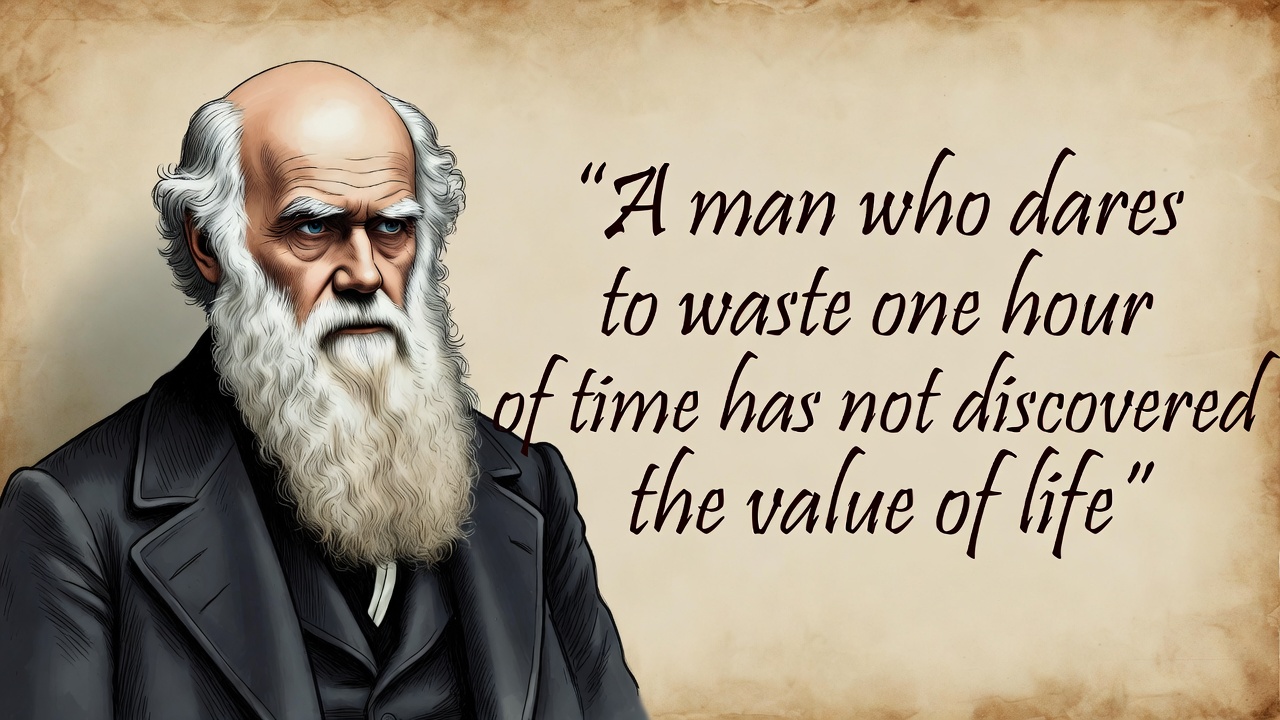
“A Man Who Dares to Waste One Hour of Time Has Not Discovered the Value of Life”
“A man who dares to waste one hour of time has not discovered the value of life.”
— Charles Darwin, The Life & Letters of Charles Darwin (1887)
This is perhaps Darwin’s most widely shared inspirational quote — and unlike some others attributed to him, he actually wrote it. The line appears in a letter and speaks to the urgency Darwin felt about his work. He battled chronic illness for much of his adult life and knew that time was precious. He worked methodically, rarely wasting a day, and this discipline produced an astonishing body of research.
For anyone celebrating Darwin Day 2026, this quote is a call to action. It says: do not wait. Pursue your questions. Make your hours count.
“If I Had My Life to Live Over Again, I Would Read Some Poetry and Listen to Some Music”
“If I had my life to live over again, I would have made a rule to read some poetry and listen to some music at least once every week.”
— Charles Darwin, The Autobiography of Charles Darwin, 1809–82
Late in life, Darwin confessed a bittersweet regret. He had become so absorbed in scientific work that he lost his taste for art, music, and poetry — pleasures that had delighted him in his youth. He wrote that his mind had become “a kind of machine for grinding general laws out of large collections of facts.” The loss of these aesthetic pleasures, he said, was “a loss of happiness, and may possibly be injurious to the intellect.”
This is a profoundly human admission. Even the greatest scientific mind of the 19th century warned against the dangers of too narrow a focus. It is a reminder that a full life requires balance — between reason and feeling, between data and beauty.
Famous Charles Darwin Quotes on Science, Knowledge, and Curiosity
Darwin’s approach to science was marked by patience, open-mindedness, and a willingness to follow the evidence wherever it led. His reflections on the scientific process remain relevant for researchers, students, and curious minds today.
“Ignorance More Frequently Begets Confidence Than Does Knowledge”
“Ignorance more frequently begets confidence than does knowledge: it is those who know little, not those who know much, who so positively assert that this or that problem will never be solved by science.”
— Charles Darwin, The Descent of Man (1871)
This observation, written more than 150 years ago, could have been published yesterday. Darwin noticed a pattern that modern psychologists would later formalize as the Dunning-Kruger effect: people with limited understanding of a topic tend to overestimate their own competence, while experts tend to be more cautious and uncertain.
Darwin wrote this in the introduction to The Descent of Man, where he addressed human evolution — a subject that attracted fierce resistance. His point was simple: the people most certain that science could not explain human origins were those who understood the least about it.
“I Have Steadily Endeavoured to Keep My Mind Free”
“I have steadily endeavoured to keep my mind free so as to give up any hypothesis, however much beloved, as soon as facts are shown to be opposed to it.”
— Charles Darwin, The Autobiography of Charles Darwin
This quote captures the essence of good scientific practice. Darwin was not dogmatic. He held his ideas tightly enough to develop them but loosely enough to abandon them when the evidence demanded it. He tested his hypotheses relentlessly and welcomed criticism.
In a world where people often cling to beliefs in the face of contradicting evidence, Darwin’s intellectual flexibility is a model worth following.
“False Facts Are Highly Injurious to the Progress of Science”
“False facts are highly injurious to the progress of science, for they often endure long; but false views, if supported by some evidence, do little harm, for every one takes a salutary pleasure in proving their falseness.”
— Charles Darwin, The Descent of Man (1871)
Darwin made a sharp distinction between false facts and false views. A wrong theory, he argued, is not so dangerous — other scientists will enjoy tearing it apart. But a wrong fact, once accepted, can persist for generations. This insight speaks directly to modern concerns about misinformation and the importance of rigorous data collection.
“It Is Always Advisable to Perceive Clearly Our Ignorance”
“It is always advisable to perceive clearly our ignorance.”
— Charles Darwin, The Expression of the Emotions in Man and Animals (1872)
Short, direct, and timeless. Darwin believed that recognizing what we do not know was the first step toward learning. This sentiment runs through all of his work, from his earliest notebooks to his final publications.
Charles Darwin Quotes About Nature, Beauty, and the Wonder of the Living World
Darwin was, above all, a naturalist — a person who spent his life observing the living world with care and fascination. His writings are filled with moments of genuine wonder.
“It Is Interesting to Contemplate a Tangled Bank”
“It is interesting to contemplate a tangled bank, clothed with many plants of many kinds, with birds singing on the bushes, with various insects flitting about, and with worms crawling through the damp earth, and to reflect that these elaborately constructed forms, so different from each other, and dependent upon each other in so complex a manner, have all been produced by laws acting around us.”
— Charles Darwin, On the Origin of Species (1859)
This passage, which immediately precedes the “grandeur in this view of life” conclusion, is Darwin at his most lyrical. He asks the reader to picture a simple English hedgerow — birds, insects, plants, worms — and then to consider the staggering complexity of the ecological relationships that sustain it. Every organism in that tangled bank arrived through millions of years of evolution. Every relationship between them was shaped by natural selection.
For Darwin, a muddy riverbank was not just a muddy riverbank. It was a library of evolutionary history, an ecosystem of breathtaking intricacy, and a testament to the power of natural laws.
“What Can Be More Curious Than the Hand of a Man?”
“What can be more curious than that the hand of a man, formed for grasping, that of a mole for digging, the leg of the horse, the paddle of the porpoise, and the wing of the bat, should all be constructed on the same pattern, and should include the same bones, in the same relative positions?”
— Charles Darwin, On the Origin of Species (1859)
This observation about homologous structures — body parts that share the same underlying anatomy despite serving very different purposes — was one of Darwin’s most powerful pieces of evidence for common descent. A human hand, a bat wing, and a whale flipper all contain the same bones arranged in the same pattern. The simplest explanation? They all inherited that pattern from a shared ancestor.
“We Can Allow Satellites, Planets, Suns, to Be Governed by Laws”
“We can allow satellites, planets, suns, universe, nay whole systems of universe, to be governed by laws, but the smallest insect, we wish to be created at once by special act.”
— Charles Darwin, Notebooks
Darwin wrote this provocative observation in his private notebooks. It highlights a double standard he noticed in his contemporaries: people were happy to accept that the physical universe operated according to natural laws, but they resisted applying the same logic to living organisms. If gravity could explain the motion of planets, why couldn’t natural selection explain the diversity of beetles?
Charles Darwin Quotes on Compassion, Morality, and the Human Condition
Darwin is sometimes wrongly portrayed as cold or indifferent to human suffering. In truth, his writings on morality and compassion are among his most stirring.
“If the Misery of the Poor Be Caused Not by the Laws of Nature, Great Is Our Sin”
“If the misery of the poor be caused not by the laws of nature, but by our institutions, great is our sin.”
— Charles Darwin, Voyage of the Beagle (1839)
Darwin wrote this during his round-the-world voyage, after witnessing the brutal conditions of slavery and poverty in South America. He was a passionate abolitionist. His family had strong ties to the anti-slavery movement — his grandfathers on both sides, Erasmus Darwin and Josiah Wedgwood, were outspoken opponents of the slave trade.
This quote reveals a side of Darwin that is often overlooked: his deep moral conviction that human institutions, not nature, are responsible for much of human suffering. It is a statement of social conscience that resonates powerfully in 2026.
“As Man Advances in Civilization, He Ought to Extend His Sympathies to All Nations and Races”
“As man advances in civilization, and small tribes are united into larger communities, the simplest reason would tell each individual that he ought to extend his social instincts and sympathies to all members of the same nation, though personally unknown to him. This point being once reached, there is only an artificial barrier to prevent his sympathies extending to the men of all nations and races.”
— Charles Darwin, The Descent of Man (1871)
In The Descent of Man, Darwin argued that the expansion of moral sympathy — from family, to tribe, to nation, to all of humanity — was a natural consequence of human social evolution. He saw compassion not as a weakness but as an evolved strength, a product of the same natural processes that shaped our bodies and brains.
“The Highest Stage in Moral Culture Is When We Recognise That We Ought to Control Our Thoughts”
“The highest stage in moral culture at which we can arrive, is when we recognise that we ought to control our thoughts.”
— Charles Darwin, The Descent of Man (1871)
This brief remark packs enormous philosophical weight. Darwin suggests that true moral maturity lies not just in controlling our actions but in disciplining our minds. It is a call for intellectual self-awareness that anticipates modern ideas about mindfulness and cognitive discipline.
Commonly Misattributed Charles Darwin Quotes You Should Know About
Not everything attributed to Darwin actually came from Darwin. Some of the most popular “Darwin quotes” on the internet are misattributions. If you are celebrating Darwin Day 2026, it is worth knowing the difference.
The Famous “Survival of the Fittest” Misattribution
The phrase “survival of the fittest” is so closely linked to Darwin that most people assume he coined it. He did not. The phrase was created by Herbert Spencer, an English philosopher, who used it in his 1864 book Principles of Biology to connect his own economic theories to Darwin’s work. Darwin did later adopt the phrase in the fifth edition of On the Origin of Species (1869), but he always credited Spencer.
“It Is Not the Strongest of the Species That Survives, but the Most Adaptable to Change”
This is probably the most widely shared Darwin quote on the internet — and Darwin never said it.
The Darwin Correspondence Project at the University of Cambridge has traced this quote to Leon C. Megginson, a professor of management at Louisiana State University. In a 1963 speech to the Southwestern Social Science Association, Megginson offered his own paraphrase of Darwin’s ideas:
“According to Darwin’s Origin of Species, it is not the most intellectual of the species that survives; it is not the strongest that survives; but the species that survives is the one that is able best to adapt and adjust to the changing environment in which it finds itself.”
Notice: Megginson did not use quotation marks. He was summarizing Darwin, not quoting him. Over the decades, his paraphrase was shortened, polished, and eventually attributed directly to Darwin. As Quote Investigator has documented, the quote evolved — becoming “shorter and more pithy” — in a process that the researcher Nick Matzke wryly called “survival of the pithiest.”
The California Academy of Sciences even had a version of this quote embedded in its stone floor, attributed to Darwin. The attribution has since been removed.
The lesson? Always verify your quotes. Even when the words sound exactly like something Darwin would say, check the source. The Darwin Correspondence Project maintains a helpful list of six things Darwin never said.
“In the Long History of Humankind, Those Who Learned to Collaborate Have Prevailed”
Another widely shared quote attributed to Darwin — especially popular in business contexts — reads: “In the long history of humankind (and animal kind, too) those who learned to collaborate and improvise most effectively have prevailed.”
This is sometimes cited as coming from The Descent of Man. According to the Darwin Correspondence Project, no one has found this passage in any of Darwin’s writings. Its true origin remains unknown.
Powerful Darwin Quotes About Doubt, Humility, and the Limits of Human Understanding
Darwin was not a man of bluster. He spent decades refining his ideas precisely because he took doubt seriously. His reflections on the limits of knowledge are among his most enduring contributions.
“I Feel Most Deeply That the Whole Subject Is Too Profound for the Human Intellect”
“I feel most deeply that the whole subject is too profound for the human intellect. A dog might as well speculate on the mind of Newton. Let each man hope and believe what he can.”
— Charles Darwin, letter to Asa Gray (1860)
This startlingly humble remark came in a letter to the American botanist Asa Gray. Darwin was discussing the theological implications of his theory — whether evolution was compatible with the existence of God. Rather than offering a definitive answer, Darwin admitted the question was beyond him. The comparison to a dog speculating on Newton’s mind is both funny and profound. It suggests that human understanding has real limits, and that intellectual honesty requires acknowledging them.
“I Am Almost Convinced That Species Are Not Immutable — It Is Like Confessing a Murder”
“I am almost convinced (quite contrary to the opinion I started with) that species are not (it is like confessing a murder) immutable.”
— Charles Darwin, letter to J.D. Hooker (January 11, 1844)
Darwin wrote this to his close friend and fellow scientist Joseph Hooker — and the parenthetical confession is electrifying. In 1844, fifteen years before On the Origin of Species was published, Darwin already suspected that species changed over time. But he understood the explosive nature of that idea. To suggest that species were not fixed — that they evolved — was to challenge the prevailing scientific and religious consensus. It felt, to Darwin, like confessing a crime.
This quote is a window into the years of psychological pressure Darwin endured as he slowly built his case. He knew his theory would face fierce opposition. He delayed publication for decades, partly out of scientific caution and partly out of fear.
“The Mystery of the Beginning of All Things Is Insoluble by Us”
“The mystery of the beginning of all things is insoluble by us; and I for one must be content to remain an agnostic.”
— Charles Darwin, The Autobiography of Charles Darwin
Near the end of his life, Darwin described his own position on religion with this characteristically measured statement. He did not claim certainty about the existence or nonexistence of God. He simply acknowledged that the question lay beyond what evidence could settle and chose to live with the uncertainty.
How to Use Charles Darwin Quotes to Celebrate Darwin Day 2026
Darwin Day is not just for scientists. It is for anyone who values curiosity, evidence, and the courage to question established ideas. Here are some practical ways to bring Darwin’s words into your Darwin Day 2026 celebration:
| Activity | Suggested Darwin Quote | How to Use It |
|---|---|---|
| Classroom discussion | “Ignorance more frequently begets confidence than does knowledge.” | Open a discussion about critical thinking and the Dunning-Kruger effect. |
| Social media post | “A man who dares to waste one hour of time has not discovered the value of life.” | Share with the hashtag #DarwinDay or #DarwinDay2026. |
| Science museum visit | “There is grandeur in this view of life.” | Use as a conversation starter while exploring evolution exhibits. |
| Book club meeting | “If I had my life to live over again, I would read some poetry.” | Discuss the balance between specialization and well-roundedness. |
| Nature walk | “It is interesting to contemplate a tangled bank.” | Read aloud at a local park or nature reserve. |
| Teacher workshop | “False facts are highly injurious to the progress of science.” | Frame a lesson on scientific literacy and misinformation. |
| Dinner party (Phylum Feast) | “Endless forms most beautiful and most wonderful.” | Toast with this line while serving foods from diverse biological phyla. |
Charles Darwin Quotes That Are Perfect for Students and Educators
Darwin’s words carry special power in educational settings. They can inspire young learners to embrace science and think more deeply about the world around them.
Quotes for Science Students
On perseverance:
“It is a cursed evil to any man to become as absorbed in any subject as I am in mine.” — Charles Darwin
Despite his self-deprecating tone, Darwin’s single-minded dedication produced one of the most important scientific theories in history. Students can learn that deep focus, even when it feels obsessive, can lead to groundbreaking discoveries.
On observation:
“I love fools’ experiments. I am always making them.” — Charles Darwin
Darwin valued experimentation — even when it seemed foolish. He was known for testing unusual hypotheses, like playing music to worms to see if they could hear. Not every experiment yields a Nobel Prize, but every experiment teaches something.
On humility:
“…it appears to me, the doing what little one can to increase the general stock of knowledge is as respectable an object of life, as one can in any likelihood pursue.” — Charles Darwin, The Autobiography of Charles Darwin
Not everyone will revolutionize a field. But contributing even a small piece of knowledge, Darwin argued, is a worthy way to spend a life.
Quotes for Educators
On challenging assumptions:
“I see no good reasons why the views given in this volume should shock the religious views of anyone.” — Charles Darwin, On the Origin of Species
Darwin was careful to separate his scientific claims from religious debates. Teachers can use this quote to model how science and personal belief can coexist in a classroom.
On the importance of evidence:
“I have called this principle, by which each slight variation, if useful, is preserved, by the term of Natural Selection.” — Charles Darwin, On the Origin of Species
Darwin named his concept clearly and defined it precisely. Educators can use this as a model for how to introduce complex ideas with clarity.
The Lasting Legacy of Charles Darwin’s Words in Modern Science
Darwin’s influence extends far beyond evolutionary biology. His ideas have shaped fields from ecology and genetics to psychology, immunology, and even computer science (where evolutionary algorithms mimic natural selection to solve complex problems).
In modern medicine, Darwin’s insights about variation and selection are essential for understanding antibiotic resistance — one of the most pressing public health challenges of our time. Bacteria that survive antibiotic treatment pass on their resistance genes, exactly as Darwin’s theory predicts. Doctors, epidemiologists, and pharmaceutical researchers work with evolutionary principles every day.
Darwin’s influence on conservation biology is equally profound. Understanding how species evolve and adapt helps scientists predict how they will respond to climate change, habitat loss, and pollution. As the 2026 Darwin Days at the Paleontological Research Institution highlight, mollusk evolution is one area where Darwin’s framework continues to illuminate new discoveries.
Even in the social sciences, Darwin’s ideas about cooperation, altruism, and moral evolution remain hotly debated. His suggestion that human sympathy would naturally expand from tribe to nation to all of humanity offers an optimistic vision for ethical progress — one that scholars of moral psychology continue to explore.
When we read Darwin’s quotes in 2026, we are not looking at dusty relics. We are reading the foundation stones of modern scientific thought.
A Quick-Reference Table of the Top Charles Darwin Quotes for Darwin Day
For easy reference, here is a summary table of the key quotes discussed in this article:
| Quote | Source | Year | Theme |
|---|---|---|---|
| “There is grandeur in this view of life…” | On the Origin of Species | 1859 | Evolution, wonder |
| “A man who dares to waste one hour of time has not discovered the value of life.” | The Life & Letters of Charles Darwin | 1887 | Time, purpose |
| “Ignorance more frequently begets confidence than does knowledge.” | The Descent of Man | 1871 | Knowledge, humility |
| “If I had my life to live over again, I would have made a rule to read some poetry…” | The Autobiography of Charles Darwin | Posthumous | Balance, regret |
| “If the misery of the poor be caused not by the laws of nature, but by our institutions, great is our sin.” | Voyage of the Beagle | 1839 | Social justice |
| “One general law… multiply, vary, let the strongest live and the weakest die.” | On the Origin of Species | 1859 | Natural selection |
| “False facts are highly injurious to the progress of science.” | The Descent of Man | 1871 | Scientific integrity |
| “It is interesting to contemplate a tangled bank…” | On the Origin of Species | 1859 | Nature, ecology |
| “I am almost convinced… that species are not immutable.” | Letter to J.D. Hooker | 1844 | Discovery, courage |
| “The mystery of the beginning of all things is insoluble by us.” | The Autobiography of Charles Darwin | Posthumous | Agnosticism, humility |
How Darwin Day 2026 Events Are Keeping Darwin’s Legacy Alive
Across the globe, communities are finding creative ways to celebrate Darwin’s birthday and promote science education this February. Here are some highlights:
United States:
- The National Center for Science Education (NCSE) is co-hosting the online evolution symposium “Journey into Darkness: The Allegory of the Cave” on February 12, 2026, in partnership with the National Association of Biology Teachers. NCSE is also promoting the hashtag #whyteachevolution on social media.
- The SMUD Museum of Science and Curiosity in Sacramento hosts its 29th annual Darwin Day Educational Gala on February 13, 2026, featuring a presentation on marine evolutionary biology and climate change.
- Iowa City Darwin Day: Science Fest expands to a multi-day format on April 10–11, 2026, with free public lectures.
United Kingdom:
- Down House, Darwin’s home in Kent, continues to welcome visitors year-round. The house and gardens, now managed by English Heritage, offer a window into the daily life of the man who wrote On the Origin of Species in his study there.
- The Darwin Correspondence Project at the University of Cambridge maintains one of the world’s great scholarly archives of Darwin’s letters — over 15,000 of them — and regularly publishes new findings.
Global:
- Museums, universities, and science centers on every continent hold lectures, film screenings, debates, and workshops. The Darwin Day Celebration registry lists events worldwide.
- The 21st annual Religion and Science Weekend coincides with Darwin Day 2026, encouraging dialogue between faith communities and scientists.
Frequently Asked Questions About Charles Darwin Quotes and Darwin Day
When is Darwin Day 2026? Darwin Day 2026 is on Thursday, February 12, 2026. The date always falls on February 12, the birthday of Charles Darwin.
What is the most famous Charles Darwin quote? The most famous quote from Darwin’s published work is the closing line of On the Origin of Species: “There is grandeur in this view of life, with its several powers, having been originally breathed into a few forms or into one; and that, whilst this planet has gone cycling on according to the fixed law of gravity, from so simple a beginning endless forms most beautiful and most wonderful have been, and are being, evolved.”
Did Darwin say “survival of the fittest”? No. The phrase was coined by Herbert Spencer in 1864. Darwin adopted it later but always credited Spencer.
Did Darwin say “It is not the strongest of the species that survives but the most adaptable to change”? No. This quote is a paraphrase by Leon C. Megginson, a Louisiana State University professor, from a 1963 speech. It has been widely misattributed to Darwin on the internet.
Is Darwin Day a public holiday? Darwin Day is not an official public holiday in most countries. However, Delaware became the first U.S. state to formally recognize it in 2015, and resolutions have been introduced in the U.S. Congress to designate it nationally.
How can I celebrate Darwin Day? You can celebrate Darwin Day by visiting a natural history museum, reading On the Origin of Species, attending a local event, hosting a Phylum Feast, sharing Darwin quotes on social media with the hashtag #DarwinDay, or simply spending time outdoors observing nature — just as Darwin himself would have done.
What books did Charles Darwin write? Darwin’s major works include On the Origin of Species (1859), The Descent of Man (1871), The Voyage of the Beagle (1839), The Expression of the Emotions in Man and Animals (1872), and his posthumously published Autobiography. He also wrote extensively about barnacles, orchids, earthworms, and coral reefs.
Final Thoughts: Why Charles Darwin’s Quotes Still Matter in 2026
Charles Darwin was not perfect. He was a man of his time, with the limitations and blind spots of the Victorian era. But his commitment to evidence, his willingness to follow facts wherever they led, and his deep capacity for wonder are qualities that transcend any century.
When you read Darwin’s words this February — whether chalked on a classroom board, projected on a museum wall, or scrolling across your phone — pause for a moment. Think about what it took for a quiet, chronically ill Englishman to look at the natural world and see what no one had seen before. Think about the decades of patience, the mountain of evidence, the courage to publish ideas that he knew would make him a target.
And then think about the tangled bank. The birds singing. The insects flitting about. The worms crawling through the damp earth. All of it produced by laws acting around us. All of it connected. All of it evolved.
There is grandeur in this view of life. And on Darwin Day 2026, there is no better time to remember it.