A comprehensive journey through the Himalayan highlands where ancient Buddhist traditions come alive during the most sacred celebration of the Tibetan calendar
There is a particular kind of magic that descends upon the Himalayan highlands when winter loosens its grip and the promise of spring whispers through mountain passes. This is the time of Losar—the Tibetan New Year—a celebration that transforms monasteries into kaleidoscopes of color, fills the thin mountain air with the deep resonance of ritual horns, and brings communities together in a tapestry of devotion, joy, and renewal that has endured for over a thousand years.
As someone who has spent decades documenting festivals across six continents, I can say without hesitation that experiencing Losar in its authentic Himalayan context ranks among the most profound cultural encounters available to the modern traveler. Unlike commercialized celebrations that have lost their soul to tourism, Losar remains a deeply spiritual observance where visitors are welcomed as honored guests into living traditions that predate written history.
This guide will take you through the best places to celebrate Tibetan New Year in Nepal and India, offering insider knowledge gleaned from years of personal experience, conversations with monks and local families, and the kind of practical wisdom that transforms a trip into a transformative journey.
What Is Losar and Why Should Travelers Experience This Tibetan Buddhist Festival?
Losar (Tibetan: ལོ་གསར་, meaning “new year”) represents far more than a simple calendar transition. It is the most important festival in the Tibetan Buddhist calendar, a fifteen-day celebration that combines ancient Bön shamanic practices with Buddhist rituals in a synthesis that reflects Tibet’s complex spiritual heritage.
The festival marks the beginning of the Tibetan lunisolar calendar, typically falling between late January and early March on the Western calendar. The exact date shifts annually based on lunar calculations, making advance planning essential for travelers hoping to witness the core ceremonies.
The Three Days of Losar: Understanding the Festival Structure
| Day | Tibetan Name | Significance | Key Activities |
|---|---|---|---|
| Day 1 | Lama Losar | Day of the Lamas | Offerings to spiritual teachers, monastery ceremonies |
| Day 2 | Gyalpo Losar | King’s Losar | Secular celebrations, family gatherings |
| Day 3 | Chokyong Losar | Day of Protector Deities | Prayers to dharmapalas, incense offerings |
What makes Losar particularly compelling for cultural travelers is its layered authenticity. Unlike festivals that exist primarily for spectators, Losar is a living religious observance where every ritual carries genuine meaning for participants. Visitors who approach with respect and curiosity find themselves not merely observers but welcomed participants in humanity’s oldest continuous spiritual traditions.
When Is Losar 2025 and How to Plan Your Tibetan New Year Trip
For travelers planning their Losar 2025 trip, the Tibetan New Year falls on February 28, 2025, marking the beginning of the Wood Snake Year (2152) in the Tibetan calendar. However, preparations and preliminary celebrations begin at least a week before this date, and festivities continue for fifteen days afterward.
Losar 2025-2027 Dates for Advance Planning
| Year | Losar Date | Tibetan Year | Animal Sign |
|---|---|---|---|
| 2025 | February 28 | 2152 | Wood Snake |
| 2026 | February 17 | 2153 | Fire Horse |
| 2027 | March 8 | 2154 | Fire Sheep |
The ideal travel window spans from approximately one week before Losar through the first week of celebrations—roughly a two-week period. This allows you to witness the preparatory rituals, the dramatic New Year’s Eve ceremonies, and the jubilant community celebrations that follow.
Pre-Losar Preparations Worth Witnessing
The days leading to Losar are equally fascinating for cultural travelers:
- Gutor (29th day of the 12th month): Dramatic monastery rituals to expel negative energies from the old year
- House cleaning ceremonies: Families thoroughly cleanse homes and whitewash walls
- Kitchen preparations: The making of traditional foods like khapse (fried pastries) and guthuk (special soup)
- Cham dances: Elaborate masked performances by monks
Booking accommodations three to four months in advance is strongly recommended, as rooms near major monasteries fill quickly during this period.
Top Places to Celebrate Losar in Nepal: A Complete Regional Guide
Nepal offers perhaps the most accessible Losar experience for international travelers. The country’s significant Tibetan refugee population, established following the 1959 diaspora, has created vibrant communities that maintain traditions with fierce devotion while remaining genuinely welcoming to respectful visitors.
Boudhanath Stupa: The Heart of Tibetan New Year Celebrations in Kathmandu
If you can visit only one location for Losar in Nepal, Boudhanath Stupa (Boudha) should be your destination. This UNESCO World Heritage Site represents the spiritual center of Nepal’s Tibetan community and transforms into a breathtaking celebration ground during Losar.
Why Boudhanath Is the Best Place for Losar in Kathmandu:
The great stupa—one of the largest in the world—sits at the center of a mandala-shaped neighborhood that is home to over 50 monasteries and thousands of Tibetan refugees. During Losar, the entire district pulses with devotional energy.
What to expect at Boudhanath during Losar:
- Dawn circumambulation: Thousands of devotees walking the kora (ritual circuit) around the stupa
- Prayer flag ceremonies: Fresh strings of lungta (wind horse) flags raised at dawn on New Year’s Day
- Butter lamp offerings: The stupa illuminated by thousands of flickering flames at dusk
- Monastery open houses: Visitors welcomed into normally closed ceremonial spaces
- Traditional performances: Tibetan opera, dance, and music in the plaza
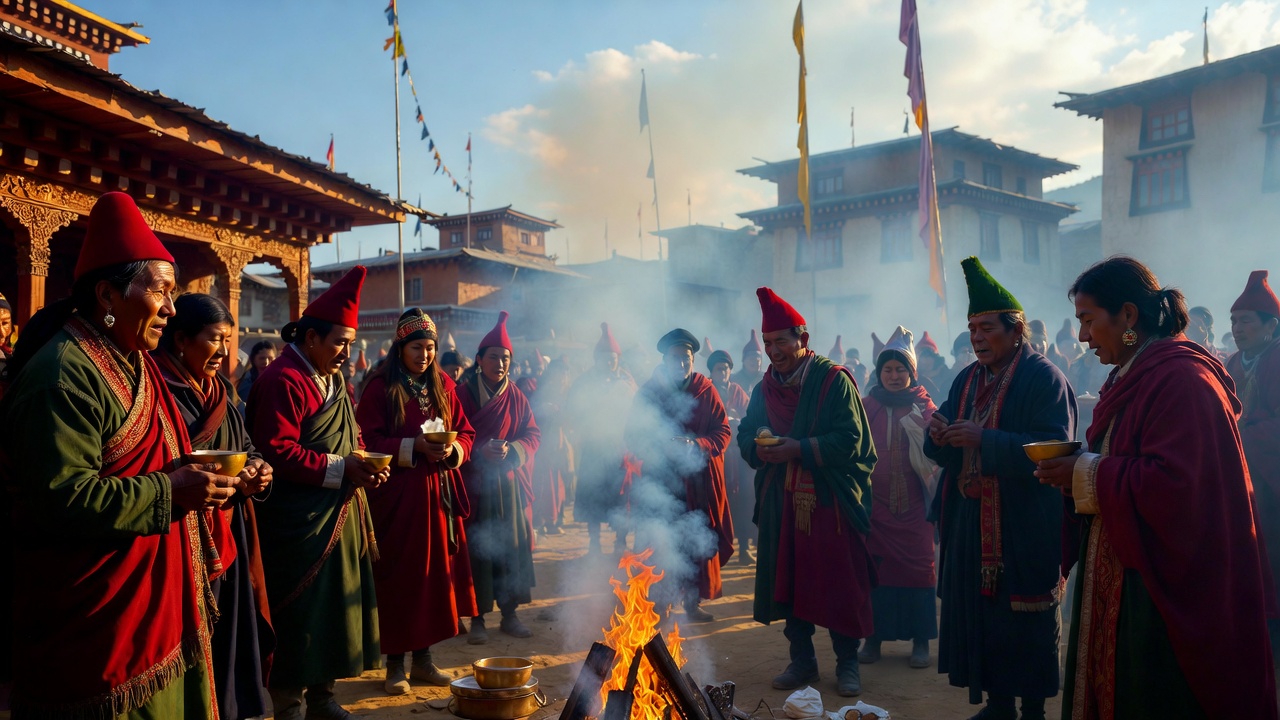
The atmosphere defies easy description. Imagine the scent of juniper incense mingling with the low murmur of mantras, the visual feast of monks in crimson robes against whitewashed walls, the sound of ritual drums and the joyful laughter of families dressed in their finest chuba (traditional robes).
Practical Information for Boudhanath Losar Visit:
- Entry fee: NPR 400 for foreign tourists (approximately USD 3)
- Best viewing times: Sunrise (6:00-8:00 AM) and sunset (5:00-7:00 PM)
- Recommended stay: 3-4 nights minimum during Losar
- Accommodation: Numerous guesthouses surrounding the stupa; book the Hotel Tibet International or Shechen Guest House for authentic atmosphere
Swayambhunath Temple: Ancient Hilltop Celebrations During Tibetan New Year
Perched atop a forested hill overlooking the Kathmandu Valley, Swayambhunath—known locally as the “Monkey Temple”—offers a complementary Losar experience to Boudhanath. The site’s antiquity (predating Buddhism itself, according to legend) adds a profound dimension to the celebrations.
The Swayambhunath Losar Experience:
- Panoramic setting: Watch the sunrise over Kathmandu from the temple’s summit
- Mixed traditions: Experience the synthesis of Buddhist, Hindu, and Bön elements
- Smaller crowds: Less overwhelming than Boudhanath while equally authentic
- Monastery ceremonies: Visit the adjoining Karma Raja Maha Vihar Monastery
The climb up the 365 ancient stone steps becomes a pilgrimage during Losar, with devotees of all ages ascending at dawn to make offerings. The view from the top—the great stupa surrounded by smaller chaityas with the Himalayan peaks shimmering on the northern horizon—creates an unforgettable backdrop for New Year celebrations.
Local Tip: Visit Swayambhunath for the early morning ceremonies, then descend to Boudhanath for evening celebrations. The two sites complement each other perfectly for a full Losar day.
Tibetan Refugee Settlements in Nepal: Authentic Losar Experiences Beyond Kathmandu
For travelers seeking deeper immersion, Nepal’s Tibetan refugee settlements offer intimate Losar experiences impossible to replicate in urban centers.
Jawalakhel Tibetan Settlement (Patan)
Located just south of Kathmandu in the ancient city of Patan, the Jawalakhel settlement was established in 1960 as one of the first refugee communities in Nepal. Today, it remains a living center of Tibetan culture.
Losar highlights at Jawalakhel:
- Community celebrations that welcome visitors as family guests
- Traditional craft workshops where you can learn Tibetan carpet weaving
- Authentic cuisine prepared by elder women using recipes from their homeland
- Less tourist-oriented atmosphere allowing genuine cultural exchange
Pokhara Tibetan Settlements (Tashi Palkhel and Paljorling)
The lakeside city of Pokhara hosts two significant Tibetan settlements, Tashi Palkhel and Paljorling, which offer Losar experiences against the stunning backdrop of the Annapurna range.
Why consider Pokhara for Losar:
- Significantly fewer tourists than Kathmandu
- Spectacular mountain scenery enhances the spiritual atmosphere
- Jangchub Choeling Monastery hosts elaborate Cham dance performances
- Opportunity to combine cultural experience with Himalayan trekking
Accommodation recommendation: Stay in Lakeside Pokhara and hire a local taxi to the settlements during Losar celebrations.
Mustang Region: Experience Losar Where Tibetan Culture Remains Purest
For the most authentic Losar experience possible outside Tibet itself, the remote Mustang region of northern Nepal offers access to communities where Tibetan traditions have continued virtually unchanged for centuries.
Lo Manthang, the walled capital of Upper Mustang, celebrates Tiji Festival (a form of Losar) with elaborate three-day masked dance ceremonies that rank among the most spectacular Buddhist rituals in the world.
Important considerations for Mustang Losar:
- Special permit required: USD 500 for Upper Mustang restricted area permit (10 days)
- Limited accommodation: Book six months in advance through licensed agencies
- Challenging access: Flights to Jomsom followed by multi-day trek or jeep ride
- Altitude: Lo Manthang sits at 3,840 meters; acclimatization essential
- Weather: February-March conditions can be harsh; proper gear required
Despite the logistical challenges, travelers who make the journey describe it as life-changing. The isolation that makes Mustang difficult to reach has preserved traditions that have vanished elsewhere—you witness Losar as it has been celebrated for a millennium.
Best Destinations for Losar in India: Experiencing Tibetan New Year Across the Subcontinent
India’s deep historical connections with Tibetan Buddhism—and its role as sanctuary for the Dalai Lama and the Tibetan government-in-exile since 1959—make it an essential destination for serious Losar travelers. From the administrative headquarters in Dharamsala to the Buddhist heartlands of Ladakh and Sikkim, India offers diverse and profound celebration experiences.
Dharamsala and McLeod Ganj: Celebrating Losar at the Heart of Tibetan Exile Community
Dharamsala, specifically the upper town of McLeod Ganj, serves as the headquarters of the Central Tibetan Administration and home to His Holiness the 14th Dalai Lama. This makes it arguably the most significant location for Losar outside Tibet itself.
Why Dharamsala Is Essential for Losar Travelers:
The presence of the Dalai Lama transforms Losar in Dharamsala into an event of international significance. While His Holiness does not make public appearances at every Losar, the spiritual energy generated by his presence draws pilgrims from across the Buddhist world.
Key Losar Experiences in Dharamsala:
- Tsuglagkhang Complex: The main temple hosts elaborate ceremonies throughout the festival
- Namgyal Monastery: The Dalai Lama’s personal monastery conducts extended prayer rituals
- Tibet Museum: Special exhibitions during Losar document Tibetan history and culture
- Tibetan Institute of Performing Arts (TIPA): Annual Shoton opera performances
- Library of Tibetan Works and Archives: Cultural programs and lectures
The McLeod Ganj Losar Atmosphere:
During Losar, the narrow streets of McLeod Ganj fill with Tibetan refugees dressed in traditional finery, monks conducting alms rounds, and an international community of Buddhist practitioners. Prayer wheels spin ceaselessly, incense smoke drifts from every doorway, and the sound of mantras echoes from smartphones and monastery speakers alike.
The Namgyal Café, Carpe Diem, and Moonpeak Espresso become gathering spots where travelers exchange experiences and locals share stories of Tibet. This social dimension—rare in religious festivals—makes Dharamsala Losar uniquely accessible for solo travelers.
Practical Information for Dharamsala Losar:
| Aspect | Details |
|---|---|
| Best accommodation | Book 2-3 months ahead; hotels on Temple Road offer proximity to events |
| Getting there | Fly to Dharamsala Airport (Gaggal) or train to Pathankot + 3-hour drive |
| Weather | Cold; temperatures may drop to 0°C at night; bring warm layers |
| Permits | No special permits required for Indian or foreign nationals |
| Language | Tibetan widely spoken; English common in tourist areas |
Recommended Dharamsala itinerary for Losar:
- Day 1-2: Arrive, acclimatize, explore Tsuglagkhang Complex and Namgyal Monastery
- Day 3: Witness Gutor ceremonies expelling old year spirits
- Day 4 (Losar Eve): Evening rituals, butter lamp lighting
- Day 5 (Losar Day 1): Dawn prayers, community celebrations, traditional performances
- Day 6-7: Continue festivities, visit TIPA performances, local monastery visits
- Day 8: Departure
Ladakh: High-Altitude Losar Celebrations in India’s Little Tibet
Ladakh, the high-altitude desert region in India’s far north, maintains one of the world’s most intact Tibetan Buddhist cultures. The isolation imposed by geography—the region is cut off by snow for half the year—has preserved traditions with remarkable purity.
Important note on Ladakh Losar dates: Ladakh celebrates Losar approximately two months earlier than the standard Tibetan calendar, typically in December. This dates to a 15th-century king who altered the calendar to allow soldiers to celebrate before a winter military campaign. The tradition persists, making Ladakhi Losar a distinct experience.
Best Monasteries for Losar in Ladakh:
Thiksey Monastery
One of Ladakh’s largest and most impressive monasteries, Thiksey resembles the Potala Palace and hosts spectacular Losar observances.
- Location: 17 km from Leh
- Highlights: Morning prayer ceremonies, mask dances, photographic opportunities
- Accommodation: Monastery guesthouse available (basic but atmospheric)
Hemis Monastery
The largest and wealthiest monastery in Ladakh, Hemis celebrates Losar with elaborate rituals in its central courtyard.
- Location: 45 km from Leh
- Highlights: Ancient wall paintings, sacred cham dances, monastic museum
- Experience: Less crowded than Thiksey; more intimate atmosphere
Spituk Monastery
Close to Leh, Spituk offers accessible Losar celebrations with stunning valley views.
- Location: 8 km from Leh
- Highlights: Gustor festival (similar to Losar), Kali temple, panoramic setting
- Accessibility: Easy half-day trip from Leh
Ladakh Losar Travel Considerations:
- Winter access: December means flights may be delayed due to weather; build buffer days
- Altitude: Leh sits at 3,500 meters; spend 2-3 days acclimatizing before activities
- Cold: Temperatures reach -20°C; proper mountaineering cold-weather gear essential
- Inner Line Permit: Required for certain areas; obtain from Leh or Delhi
Despite the challenging conditions, winter Losar in Ladakh offers advantages: smaller crowds, lower prices, and an authenticity impossible to experience during the tourist season. The sight of crimson-robed monks against snow-covered mountains creates images that define the essence of Tibetan Buddhism.
Sikkim: Celebrating Losar in India’s Former Himalayan Kingdom
The small northeastern state of Sikkim, once an independent Buddhist kingdom, offers perhaps India’s most accessible Losar experience. The region’s infrastructure is well-developed, permits are straightforward, and the combination of Tibetan Buddhism with local Lepcha and Bhutia traditions creates a distinctive celebratory atmosphere.
Losar in Sikkim is celebrated as a public holiday, meaning government offices close and the entire state joins in festivities—a level of official recognition found nowhere else in India.
Key Sikkim Locations for Losar:
Rumtek Monastery
The seat of the Karmapa lineage and one of the most significant monasteries outside Tibet, Rumtek hosts extraordinarily elaborate Losar celebrations.
- Location: 24 km from Gangtok
- Highlights: Sacred Black Hat (Shanag) dance, elaborate torma (butter sculpture) offerings
- Note: Photography may be restricted during certain rituals
Phodong Monastery
A peaceful Kagyu-lineage monastery known for its beautiful frescoes and intimate Losar atmosphere.
- Location: 28 km from Gangtok
- Highlights: Traditional masked dances, fewer tourists than Rumtek
Namchi: Large Buddha Statue and Monastery Complex
Southern Sikkim’s Namchi offers accessible Losar celebrations with the dramatic backdrop of the 135-foot Guru Padmasambhava statue.
Sikkim Losar Practical Information:
| Aspect | Details |
|---|---|
| Permits | Indian nationals: no permit for most areas. Foreigners: Inner Line Permit (ILP) required, easily obtained |
| Best base | Gangtok; excellent accommodation and transport hub |
| Getting there | Fly to Bagdogra, then 4-hour drive; or train to New Jalpaiguri + taxi |
| Weather | Cold but milder than Ladakh; 5-15°C range typical in February/March |
| Duration | 4-5 days recommended for comprehensive Losar experience |
Darjeeling and Kalimpong: British-Era Hill Stations With Tibetan Buddhist Heritage
While not traditionally Tibetan regions, Darjeeling and Kalimpong in West Bengal have hosted significant Tibetan communities since the 19th century. The combination of colonial architecture, tea plantation aesthetics, and Himalayan Buddhism creates a unique atmosphere for Losar.
Ghoom Monastery (Yiga Choeling), near Darjeeling, houses a magnificent 15-foot statue of the Maitreya Buddha and celebrates Losar with traditional rituals in a setting that time seems to have forgotten.
Zang Dhok Palri Phodang in Kalimpong, consecrated by the Dalai Lama himself, offers more elaborate celebrations with connections to the government-in-exile.
Spiti Valley: Remote Losar Celebrations in India’s Cold Desert
For adventure travelers seeking genuine wilderness combined with Buddhist culture, Spiti Valley in Himachal Pradesh offers an experience similar to Ladakh but with even greater isolation and authenticity.
Key Monastery: The ancient Tabo Monastery, founded in 996 CE, is known as the “Ajanta of the Himalayas” for its remarkable murals. Its Losar celebrations take place in an atmosphere of profound antiquity.
Spiti Winter Losar Challenges:
- Road access may be impossible; helicopter service from Shimla sometimes available
- Extremely cold conditions; temperatures can reach -30°C
- Limited accommodation; basic monastery guesthouses
- No mobile connectivity in many areas
Despite these challenges—or perhaps because of them—Spiti Losar attracts dedicated practitioners seeking the most authentic experience possible.
Traditional Losar Foods and Where to Try Them During Tibetan New Year
No festival experience is complete without cuisine, and Losar offers a feast of traditional foods that have been prepared the same way for centuries. Understanding these dishes—and knowing where to find the best versions—enriches the cultural experience immeasurably.
Essential Losar Foods Every Traveler Should Try
Guthuk (གུ་ཐུག): The Prophetic New Year’s Eve Soup
Served on the 29th day of the 12th month (the day before Losar), guthuk is far more than food—it’s a ritual. This hearty noodle soup contains dumplings with hidden objects that predict the coming year’s fortune.
What the hidden objects mean:
| Object | Prediction |
|---|---|
| Coal | Black heart; need to cultivate kindness |
| Salt | Laziness; need more effort |
| Wool | Gentle nature; kind heart |
| Chili | Talkative; guard speech |
| Paper | Bad luck with studies/business |
| Sun/Moon | Good fortune; brightness ahead |
Where to experience authentic guthuk:
- Dharamsala: Ask family-run guesthouses if they celebrate the tradition
- Boudhanath: Several restaurants prepare special Losar menus
- Monastery guesthouses: Often include guests in traditional meals
Khapse (ཁ་ཟས): Festive Fried Pastries
No Losar celebration is complete without plates of khapse, deep-fried pastries that symbolize prosperity and good fortune. These come in elaborate shapes—ears, flowers, donkeys—each with specific meanings.
Best khapse in Nepal and India:
- Boudhanath bakeries: Fresh khapse available throughout the Losar period
- Jawalakhel settlement: Women’s cooperatives sell homemade varieties
- McLeod Ganj: Tibetan cafes stock traditional shapes
Changkol (ཆང་): Traditional Tibetan Barley Beer
The mildly alcoholic chang, made from fermented barley, flows freely during Losar celebrations. Served warm and slightly sour, it’s offered to guests as a gesture of hospitality.
Chang etiquette for visitors:
- Accept with both hands
- Dip ring finger and flick three times (offering to Buddha, Dharma, Sangha)
- Take three small sips before drinking freely
- Host will continuously refill; place hand over cup when finished
Dresil: Sweet Saffron Rice
Dresil, rice cooked with butter, raisins, and saffron, represents the sweetness wished for the coming year. This celebratory dish appears at special meals throughout the Losar period.
Losar Food Experiences: Where to Eat Traditional Tibetan Cuisine
In Kathmandu:
- Boudhanath area restaurants: The entire neighborhood becomes a food festival
- Recommended: Flavors Restaurant, Stupa View Restaurant
- Budget option: Street vendors selling momos and khapse around the stupa
In Dharamsala:
- Tibet Kitchen: Legendary for authentic dishes
- Lung Ta Japanese Restaurant: Tibetan-Japanese fusion with traditional options
- Shangrila Restaurant: Upscale setting, refined traditional cuisine
In Leh:
- Tibetan Kitchen: Consistently excellent
- Lamayuru Restaurant: Good vegetarian options
- Monastery kitchens: Simple but authentic
What to Wear and Pack for Losar Festival Travel
Appropriate dress matters during Losar—both for practical comfort in Himalayan winter conditions and out of respect for religious and cultural norms.
Losar Festival Dress Code and Cultural Considerations
For monastery visits:
- Cover shoulders and knees (applicable to all genders)
- Remove hats inside temple buildings
- Remove shoes before entering temple halls
- Avoid revealing clothing out of respect
Optional traditional elements:
Many travelers choose to incorporate Tibetan dress elements into their festival attire, which is generally appreciated by locals:
- Khata (white ceremonial scarf): Purchase locally; essential for offering at temples
- Simple chuba (traditional robe): Available for purchase at local shops
- Tibetan jewelry: Shows appreciation for local craft traditions
Essential Packing List for Losar Festival Trip
| Category | Items |
|---|---|
| Clothing | Warm layers, down jacket, thermal undergarments, warm hat, gloves |
| Footwear | Warm waterproof boots, comfortable walking shoes |
| Sun protection | Sunglasses (essential at altitude), high-SPF sunscreen |
| Spiritual items | Khata scarves (for offerings), small bills for donations |
| Photography | Camera with good low-light capability, extra batteries (cold drains them) |
| Health | Altitude medication (consult doctor), first aid kit, hand sanitizer |
| Documents | Passport, permits (if required), travel insurance documentation |
Losar Photography Guide: Capturing Tibetan New Year Celebrations Respectfully
The visual richness of Losar creates extraordinary photographic opportunities, but cultural sensitivity must guide every shot.
Photography Ethics During Religious Ceremonies
Always ask permission before photographing individuals, especially monks and elderly people. Many are happy to be photographed, but consent matters.
Avoid using flash inside temples—it disturbs worshippers and can damage ancient artwork.
Never photograph during certain rituals when signs indicate restrictions. Photography is particularly prohibited during some Cham dance sequences that involve religious objects.
Consider putting the camera down periodically. The most profound Losar experiences come from presence, not documentation.
Best Photo Opportunities During Losar
- Dawn circumambulation at Boudhanath—golden light, mist, devoted pilgrims
- Prayer flag raising ceremonies against mountain backdrops
- Cham mask dances—vivid colors, dynamic movement
- Butter lamp offerings at dusk—thousands of flickering flames
- Portrait opportunities—traditional dress, dignified elders
- Monastery architecture—decorated for the festival
- Food preparation—women making khapse, community cooking
Losar Festival Etiquette: How to Participate Respectfully in Tibetan New Year
Understanding and respecting Losar traditions distinguishes the thoughtful traveler from the mere tourist.
Essential Losar Greetings and Phrases
Learning even a few Tibetan phrases demonstrates respect and opens doors:
| English | Tibetan | Pronunciation |
|---|---|---|
| Happy New Year! | Tashi Delek Losar! | Ta-shi De-lek Lo-sar |
| Thank you | Thuk je che | Tuk-jay-chay |
| Hello/Greetings | Tashi Delek | Ta-shi De-lek |
| Delicious | Shimpo duk | Shim-po duk |
Respectful Behavior at Monasteries During Losar
Circumambulation: Always walk clockwise around stupas, monasteries, and prayer wheels. This follows the path of the sun and shows respect for Buddhist tradition.
Prostrations: You may witness devotees performing full-body prostrations. Give them space and avoid walking directly in front of someone prostrating.
Offerings: If you wish to make offerings, butter lamp stations usually accept small donations. You can also offer khata scarves at shrines.
Seating: In monastery halls, monks sit on the right; visitors typically on the left. Never point feet toward altars, images, or monks.
Giving and Receiving During Losar
Gifts: Small gifts (fruit, chocolates, khata scarves) are appropriate for families hosting you. Present with both hands.
Money offerings: Appropriate at monasteries and during rituals. Have small bills ready; changing large notes can be difficult.
Chang ritual: Follow the three-sip protocol described in the food section.
Budget Planning: How Much Does a Losar Trip to Nepal or India Cost?
Understanding costs helps plan a realistic Losar trip. Prices below are approximate and based on mid-range travel.
Nepal Losar Trip Budget (2 weeks)
| Expense Category | Budget Range (USD) |
|---|---|
| Flights (international) | $800-1,500 |
| Accommodation | $20-60/night |
| Food | $15-30/day |
| Internal transport | $100-300 total |
| Entry fees/donations | $50-100 total |
| Permits (Mustang, if applicable) | $500 |
| Miscellaneous | $100-200 |
| Total | $1,500-3,500 |
India Losar Trip Budget (2 weeks)
| Expense Category | Budget Range (USD) |
|---|---|
| Flights (international) | $600-1,400 |
| Accommodation | $25-70/night |
| Food | $10-25/day |
| Internal transport | $150-400 total |
| Entry fees/donations | $30-80 total |
| Permits (Ladakh/Sikkim, if applicable) | $0-50 |
| Miscellaneous | $100-200 |
| Total | $1,300-3,200 |
Budget-saving tips:
- Book accommodation well in advance (prices spike during Losar)
- Eat at local establishments rather than tourist restaurants
- Share transportation costs with other travelers
- Monastery guesthouses offer affordable (basic) stays
- Avoid peak season flights by arriving before the price surge
Health and Safety Considerations for Losar Festival Travel
Himalayan winter travel requires preparation for specific health challenges.
Altitude Sickness Prevention During Losar Trips
Many premier Losar destinations sit above 3,000 meters. Altitude-related illness ranges from annoying to life-threatening.
Prevention strategies:
- Ascend gradually: Spend 2-3 nights at intermediate altitudes before higher destinations
- Stay hydrated: Drink 3-4 liters of water daily
- Avoid alcohol for first 48 hours at altitude
- Consider medication: Acetazolamide (Diamox) helps some travelers; consult doctor before trip
- Know the symptoms: Headache, nausea, fatigue, breathlessness may indicate altitude sickness
- Descend if symptoms worsen: The only cure for serious altitude sickness is losing altitude
Cold Weather Health Precautions
- Hypothermia risk: Carry emergency warming gear even for day trips
- Frostbite prevention: Keep extremities covered; watch for numbness
- Dehydration: Cold weather masks thirst; maintain fluid intake
- Sun exposure: High-altitude UV is intense even in winter; protect skin and eyes
Travel Insurance for Losar Festival Trips
Ensure your policy covers:
- Medical evacuation from remote areas
- High-altitude activities (check altitude ceiling—some policies exclude above 3,000m)
- Trip cancellation (weather can close airports)
- Emergency helicopter evacuation (essential for Mustang, Spiti, Ladakh)
Combining Losar With Other Himalayan Experiences
A Losar trip provides an excellent anchor for broader Himalayan exploration.
Nepal Extensions
- Chitwan National Park: Wildlife safari; warmer weather contrast
- Pokhara: Lakeside relaxation; short treks
- Everest Base Camp trek: Begins from Lukla; consider acclimatization before Losar
- Lumbini: Buddha’s birthplace; pilgrimage extension
India Extensions
- Varanasi: Hindu holy city; contrast to Buddhist sites
- Amritsar: Golden Temple; Wagah border ceremony
- Agra: Taj Mahal; classic India circuit
- Bodh Gaya: Buddha’s enlightenment site; major Buddhist pilgrimage
Conclusion: Why Experiencing Losar Should Be on Every Traveler’s List
In an age of homogenized global culture, where festivals increasingly exist for Instagram rather than spiritual meaning, Losar stands apart as a celebration that has maintained its soul. The Tibetan communities of Nepal and India have preserved these traditions not as museum exhibits but as living practices that continue to evolve while honoring their ancient roots.
When you stand at Boudhanath Stupa as dawn breaks on Losar morning, surrounded by devoted pilgrims spinning prayer wheels and murmuring mantras, with juniper smoke rising into air tinged pink by the rising sun—you understand that some experiences cannot be replicated, cannot be virtually toured, cannot be summarized in social media posts.
This is why we travel: to be transformed by encounters with human communities who have maintained different ways of understanding existence, who celebrate the turning of seasons with rituals older than history, who welcome strangers as honored guests into their most sacred moments.
Whether you choose the accessible vibrancy of Boudhanath, the exile-community authenticity of Dharamsala, the high-altitude intensity of Ladakh, or the remote purity of Mustang—you will return from Losar changed. Not merely with photographs and souvenirs, but with a broadened sense of what human life can contain, what rituals can mean, what communities can preserve against the erosions of time.
Tashi Delek Losar. May your year be filled with the blessings you seek, and may your journey to the Himalayan highlands bring the transformation that only authentic cultural encounter can provide.
Frequently Asked Questions About Losar Festival Travel
Q: Can non-Buddhists participate in Losar celebrations? A: Absolutely. Tibetan Buddhist communities are remarkably welcoming to respectful visitors of all backgrounds. The key is approaching with genuine curiosity and respect rather than treating sacred rituals as spectacle.
Q: Is it necessary to book a tour or can I experience Losar independently? A: Major destinations like Boudhanath, Dharamsala, and Leh are easily navigated independently. Remote locations like Mustang and Spiti may benefit from organized tours due to permit requirements and logistical complexity.
Q: What is the best single destination for a first Losar experience? A: Boudhanath in Kathmandu offers the ideal combination of accessibility, authenticity, and celebration intensity. First-time Losar travelers should consider starting here.
Q: How far in advance should I book accommodation? A: For popular destinations, book 3-4 months ahead for best selection. Budget options fill first. For Mustang permits, apply 6 months in advance.
Q: Are there vaccination requirements for Nepal or India? A: Check current requirements with your healthcare provider. At minimum, ensure routine vaccinations are current. Many travelers also get hepatitis A, typhoid, and altitude medication prescriptions.
Q: Can I attend ceremonies at any monastery during Losar? A: Most monastery ceremonies are open to respectful visitors. Some specific rituals may be restricted—always follow posted guidelines and monk instructions.
Q: Is Losar safe for solo female travelers? A: Both Nepal and India Himalayan regions are generally safe for solo female travelers, particularly in Buddhist communities. Standard precautions apply: avoid walking alone at night, trust your instincts, dress modestly.
Q: What camera equipment is best for Losar photography? A: A camera with good low-light capability is essential (many ceremonies occur in dim monastery interiors). Bring extra batteries (cold drains them quickly) and consider a telephoto lens for capturing Cham dances without getting too close.
This guide was compiled from years of personal experience documenting Losar celebrations across Nepal and India. For the most current travel advisories, permit requirements, and health recommendations, always check official government sources before your journey.