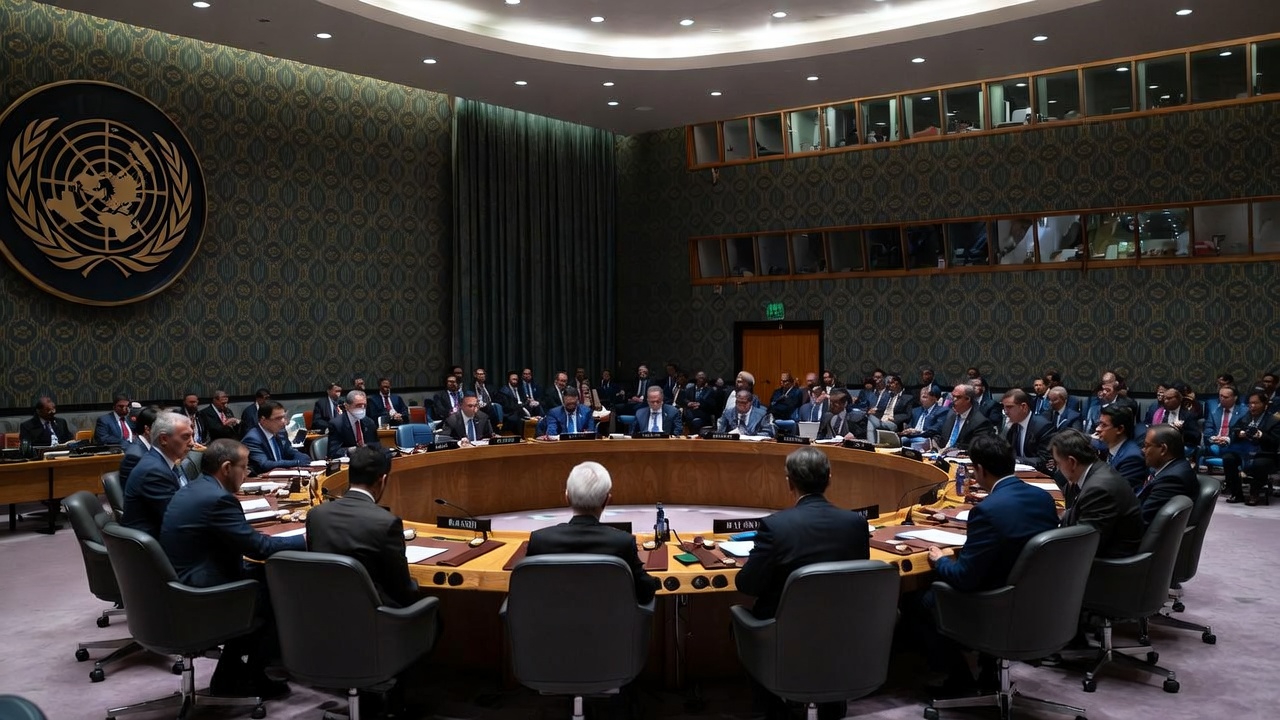
Few places on Earth carry the weight of promises broken and justice delayed quite like Kashmir. Nestled between the snow-draped peaks of the Himalayas, this region — often called “paradise on earth” — has been the subject of more than a dozen United Nations Security Council resolutions since 1948. Those resolutions promised the people of Kashmir something simple: a free and fair vote to decide their own future.
Nearly eight decades later, that vote has never taken place.
In the spring of 2025, the world watched Kashmir dominate headlines once again. A devastating terrorist attack in Pahalgam killed 26 civilians. India launched Operation Sindoor — missile strikes on Pakistani territory. Pakistan struck back. For four terrifying days in May, two nuclear-armed nations stood at the edge of full-scale war. A ceasefire came on May 10, 2025. But as analysts at the Stimson Center and the Congressional Research Service have noted, the underlying causes of the conflict remain entirely unresolved.
This guide examines every major UN resolution on Kashmir, explains what those resolutions actually say, and asks the hardest question of all: do they still matter in 2026?
What Is the Kashmir Conflict? A Brief History of the India-Pakistan Dispute
To understand the UN resolutions, you must first understand the dispute itself.
When the British withdrew from the Indian subcontinent in August 1947, they left behind two new nations — Hindu-majority India and Muslim-majority Pakistan. Hundreds of princely states had to choose which country to join. The choice was supposed to reflect geography and the will of the people.
Jammu and Kashmir presented the hardest case. It was a Muslim-majority state ruled by a Hindu king, Maharaja Hari Singh. The Maharaja initially chose independence. But when armed tribesmen from Pakistan’s northwestern frontier invaded the territory in October 1947, the Maharaja turned to India for military help. In exchange, he signed the controversial Instrument of Accession, bringing Kashmir under Indian control.
Pakistan has disputed the legitimacy of that accession ever since. Many scholars have also raised doubts. The Kashmiri people themselves were never consulted.
India airlifted troops into Srinagar on October 27, 1947. The first India-Pakistan war over Kashmir had begun. By the time a ceasefire took hold in January 1949, the territory was divided along what is now called the Line of Control (LoC). India controlled roughly 55 percent of the land, including the densely populated Kashmir Valley and the Jammu region. Pakistan held around 30 percent, now called Azad Jammu and Kashmir and Gilgit-Baltistan. China later came to control roughly 15 percent in the northeast, near Ladakh.
That division has persisted for over seven decades. It has fueled four wars, an armed insurgency that erupted in 1989, and recurring crises — most recently in 2025.
How Did the Kashmir Dispute Reach the United Nations Security Council?
India itself brought the Kashmir issue to the United Nations. On January 1, 1948, India filed a complaint with the Security Council under Article 35 of the UN Charter. India accused Pakistan of supporting the tribal invasion of Kashmir and asked the Council to stop Pakistan’s interference.
India’s position was clear at the time: Kashmir had legally acceded to India through the Instrument of Accession. However, India also declared that it was willing to hold a plebiscite — a popular vote — to confirm the wishes of the Kashmiri people.
Pakistan responded with counter-accusations. It called India’s accession fraudulent. It alleged that Indian forces were committing atrocities against Muslims in the region. Pakistan urged the Security Council to arrange a ceasefire, order the withdrawal of all outside forces, and organize a vote to let Kashmiris decide their future.
The Security Council’s initial response was Resolution 39, passed on January 20, 1948. This resolution established a three-member commission to investigate the facts on the ground. But the real substance came a few months later.
What Does UN Security Council Resolution 47 on Kashmir Actually Say?
Resolution 47 is the cornerstone of the entire international legal framework surrounding Kashmir. Adopted on April 21, 1948, it remains the most cited and most debated resolution on the dispute.
The resolution laid out a three-step process for resolving the conflict:
Step 1 — Pakistani withdrawal. Pakistan was asked to withdraw all its nationals who had entered Kashmir to fight, including both tribesmen and any Pakistani regulars.
Step 2 — Indian troop reduction. India was asked to progressively reduce its military presence to the minimum level needed to maintain law and order.
Step 3 — Plebiscite. India was asked to appoint a plebiscite administrator, nominated by the United Nations, who would organize a free and impartial vote so that the people of Kashmir could choose whether to join India or Pakistan.
The resolution also expanded the membership of the UN Commission for India and Pakistan (UNCIP) from three to five members and instructed the Commission to travel to the subcontinent immediately.
Several things are worth noting. The Security Council did not condemn Pakistan as the aggressor, as India had requested. It also did not rule on the legal validity of the Instrument of Accession. As scholar Josef Korbel later observed, the Council’s approach was “timid” — it avoided taking sides, which made enforcement much harder in the years to come.
The full text of the resolution is available through the Security Council Report archive.
Key UN Resolutions on Kashmir: A Complete Timeline From 1948 to 1957
The Security Council and UNCIP produced a series of resolutions and supplementary documents between 1948 and 1957. Each one reinforced the same core principle: the future of Kashmir must be decided by its people through a democratic vote. Here is a summary of the most important ones.
| Resolution | Date | Key Provision |
|---|---|---|
| Resolution 39 | January 20, 1948 | Established the UN Commission for India and Pakistan (UNCIP) |
| Resolution 47 | April 21, 1948 | Called for ceasefire, troop withdrawal, and plebiscite |
| UNCIP Resolution | August 13, 1948 | Proposed a ceasefire and truce agreement; stated accession question to be decided by plebiscite |
| UNCIP Resolution | January 5, 1949 | Detailed conditions for the plebiscite, including roles of the Plebiscite Administrator |
| Resolution 80 | March 14, 1950 | Called for demilitarization as a precondition for the plebiscite |
| Resolution 91 | March 30, 1951 | Designated a Plebiscite Administrator and reiterated the need for demilitarization |
| Resolution 98 | December 23, 1952 | Urged both parties to accept arbitration on demilitarization disagreements |
| Resolution 122 | January 24, 1957 | Declared that any attempt to determine Kashmir’s status through a constituent assembly was invalid without a plebiscite |
| Resolution 126 | December 2, 1957 | Requested the UN Representative report on progress toward demilitarization and the plebiscite |
Every one of these resolutions returned to the same principle: the question of Kashmir’s accession to India or Pakistan must be decided through a free and fair plebiscite. The Security Council explicitly rejected the idea that domestic elections or a constituent assembly could serve as a substitute for that vote.
Resolution 122 is especially significant. After India convened a constituent assembly in Indian-administered Kashmir, which then endorsed the region’s accession to India, the Security Council passed Resolution 122 to state clearly that such actions could not determine the final status of Kashmir.
Why Was the Kashmir Plebiscite Never Held? Understanding the Deadlock
The plebiscite promised in the UN resolutions never took place. Understanding why is essential to understanding the conflict today.
The short answer is that India and Pakistan could not agree on the terms of demilitarization. The resolutions required both sides to reduce their forces before a vote could be organized. Pakistan insisted on simultaneous withdrawal by both countries. India demanded that Pakistan withdraw first, since India viewed Pakistan as the aggressor. Neither side budged.
The Cold War made things worse. During the 1950s and 1960s, global powers prioritized their strategic alliances over justice for Kashmir. The United States courted Pakistan as a Cold War ally through the SEATO and CENTO pacts. The Soviet Union supported India. Both superpowers had reasons to avoid pressing for a resolution that might upset their partners.
By the 1950s, India began to shift its public position. Indian leaders started calling the UN resolutions non-binding — arguing that because they were passed under Chapter VI of the UN Charter (which deals with the “Pacific Settlement of Disputes”) rather than Chapter VII (which authorizes enforcement action), they carried no legal obligation. India also increasingly described Kashmir as an “integral part” of India, a position it maintains to this day.
Pakistan has consistently rejected this argument. Pakistan points to Article 25 of the UN Charter, which states that all member nations must “accept and carry out the decisions of the Security Council.” Pakistan also cites the fact that both India and Pakistan accepted the UNCIP resolutions of 1948 and 1949, making them binding agreements between the two countries — not mere recommendations.
Legal scholars remain divided. The debate over whether the Kashmir resolutions are binding or advisory remains one of the longest-running arguments in international law.
Are UN Resolutions on Kashmir Legally Binding? The International Law Debate
This question sits at the heart of the entire dispute. India says no. Pakistan says yes. International legal opinion is split, though many scholars lean toward a more nuanced view.
India’s position rests on two main arguments. First, the resolutions were adopted under Chapter VI, which is generally understood to produce recommendations rather than enforceable decisions. Second, India argues that the 1972 Simla Agreement — signed after the third India-Pakistan war — effectively replaced the UN framework with a bilateral one. Under the Simla Agreement, both countries agreed to settle their differences through peaceful bilateral negotiations, without third-party involvement.
Pakistan’s counter-argument is also well-grounded. Pakistan points out that the Simla Agreement did not extinguish the UN resolutions. Paragraph 6 of the Simla Agreement itself lists “a final settlement of Jammu and Kashmir” as an outstanding question yet to be resolved. Pakistan also notes that the agreement refers to a “Line of Control” rather than an international border, which preserves the disputed status of the territory. The Pakistan Mission to the UN has argued that the Simla Agreement explicitly protects “the recognized position of either side” — and Pakistan’s recognized position is the one endorsed by the United Nations.
There is a third layer to this debate. Several legal scholars argue that the right to self-determination has evolved since 1948 into a jus cogens norm — a peremptory principle of international law that cannot be overridden by any treaty or agreement. If that is the case, then the Kashmiri people’s right to determine their own political future exists independently of any specific UN resolution and cannot be bargained away by India and Pakistan.
The Fordham International Law Journal explored this question in depth in a 2019 analysis that remains influential. It noted that while self-determination is firmly embedded in the international legal framework, significant ambiguity surrounds who exactly constitutes “the people” entitled to exercise that right in a territory as diverse as Kashmir.
How Did the Revocation of Article 370 Change the Kashmir Question?
On August 5, 2019, the Indian government led by Prime Minister Narendra Modi took one of the most consequential steps in the history of the dispute. India revoked Article 370 of its constitution, which had granted Jammu and Kashmir a special autonomous status since 1950.
Under Article 370, Jammu and Kashmir had its own constitution, a separate flag, and autonomy over all matters except defense, foreign affairs, and communications. A related provision, Article 35A, restricted land ownership and permanent residency to local Kashmiris — a protection that many saw as essential to preserving the region’s Muslim-majority demographic character.
The revocation accomplished several things at once. It stripped Kashmir of its autonomy. It divided the former state into two union territories — Jammu and Kashmir (with a legislature) and Ladakh (without one) — both governed directly by New Delhi. It also removed restrictions on non-Kashmiris buying property or settling in the region.
The Indian government defended the move as necessary for economic development, integration, and the fight against terrorism. The ruling Bharatiya Janata Party (BJP) had long called Article 370 a barrier to progress. PM Modi and other leaders argued that scrapping it would bring Kashmir into the national mainstream and end decades of separatism and corruption.
The reaction was immediate and sharp. India imposed a communications blackout across the Kashmir Valley, cutting internet and phone services for months. Thousands of additional troops were deployed. Prominent Kashmiri politicians — including two former chief ministers — were detained.
On the international stage, Pakistan condemned the move as a violation of UN resolutions and the Simla Agreement. Pakistan suspended the Simla Agreement and downgraded its diplomatic relations with India.
In December 2023, India’s Supreme Court unanimously upheld the revocation, ruling that Article 370 was a “temporary provision” and that the president had the authority to abrogate it. The court also ordered assembly elections in Jammu and Kashmir by September 2024. Those elections took place in October 2024, with the Jammu and Kashmir National Conference (JKNC) winning 42 of 90 seats. Voter turnout was 58.46 percent — the highest in 35 years, according to the Australian Institute of International Affairs.
But critics say elections alone do not amount to self-determination. The UN resolutions specifically stated that elections organized by India could not substitute for a plebiscite. And concerns about ongoing human rights abuses persist.
What Happened in Kashmir in 2025? The Pahalgam Attack and the India-Pakistan Military Crisis
The year 2025 brought the Kashmir conflict roaring back into global headlines. The crisis unfolded in three stages.
The Pahalgam Attack — April 22, 2025
On April 22, 2025, armed militants attacked tourists near Pahalgam, a famous scenic spot in the Anantnag district of Indian-administered Kashmir. Twenty-six civilians were killed — the deadliest attack on civilians in India since the 2008 Mumbai attacks. The attackers specifically targeted Hindu tourists. A local Muslim pony ride operator and a Christian tourist were also among the dead.
The Resistance Front (TRF), a group that Indian authorities describe as a front for the Pakistan-based Lashkar-e-Taiba, initially claimed responsibility for the attack. TRF later denied involvement, claiming its social media accounts had been hacked. Pakistan rejected all accusations and described the attack as a potential “false flag operation.”
India’s Response — Operation Sindoor
India launched a sweeping crackdown in the Kashmir Valley, detaining at least 1,500 people. It suspended the Indus Waters Treaty — the 1960 agreement governing the sharing of river waters between the two countries. India also expelled Pakistani diplomats, closed borders, and revoked visas for Pakistani nationals.
Then, on May 7, 2025, India launched Operation Sindoor — missile strikes targeting what India described as “terrorist infrastructure” belonging to Jaish-e-Mohammed and Lashkar-e-Taiba in Pakistan and Pakistan-administered Kashmir. India stated that no Pakistani military or civilian facilities were targeted.
Pakistan disputed this account entirely. Pakistani officials said the strikes hit civilian areas, including mosques, and resulted in civilian casualties. Pakistan launched retaliatory strikes against Indian military targets. The UK House of Commons Library noted that the fighting involved missile, drone, and artillery exchanges affecting cities on both sides of the border — the worst military confrontation between the two countries since the 1971 war.
The Ceasefire — May 10, 2025
After four days of hostilities, India and Pakistan announced a ceasefire on May 10, 2025. US President Donald Trump was the first to announce the truce publicly and claimed credit for mediating it. Pakistan acknowledged American involvement, but India insisted the agreement was reached bilaterally, without third-party mediation.
As the Center for Strategic and International Studies (CSIS) observed, the ceasefire did not address any of the underlying causes of the conflict. The question of terrorism, the question of sovereignty, and the question of Kashmiri self-determination all remain exactly where they were before.
Human Rights Violations in Kashmir: What International Organizations Are Reporting in 2025 and 2026
The human rights situation in Kashmir — on both sides of the Line of Control — has drawn sustained international concern. The picture that emerges from reports by the UN, Human Rights Watch, Freedom House, and Amnesty International is deeply troubling.
Indian-Administered Kashmir
Human Rights Watch reported in 2024 that India had not restored freedom of speech or association to Jammu and Kashmir five years after revoking its special status. The organization documented ongoing arbitrary detention, extrajudicial killings, and restrictions on press freedom.
In November 2025, UN human rights experts expressed alarm over India’s response to the Pahalgam attack. They reported that Indian authorities had arrested and detained around 2,800 individuals — including journalists and human rights defenders. The experts also noted punitive house demolitions, forced evictions, and communication blackouts, calling these actions “collective punishment.”
Several high-profile cases illustrate the broader pattern:
- Khurram Parvez, a prominent Kashmiri human rights defender, has been imprisoned since November 2021 under India’s Unlawful Activities Prevention Act (UAPA). UN experts have repeatedly called for his release.
- Irfan Mehraj, an independent journalist, has been detained since 2023 on charges that rights organizations have described as politically motivated.
- Mian Abdul Qayoom, a former president of the High Court Bar Association and a vocal critic of government abuses, was arrested in 2024.
Freedom House’s 2025 report on Indian Kashmir documented restrictions on civil liberties, media censorship, harassment of journalists, and the use of anti-terrorism laws to suppress dissent.
Pakistan-Administered Kashmir
The human rights picture in Pakistan-administered Kashmir is different in character but also concerning. A Genocide Watch report from 2025 categorized the region at Stage 3 (Discrimination) and Stage 8 (Persecution) on its scale. The report documented the marginalization of religious minorities, the suppression of dissent through anti-terrorism laws, and heavy control by Pakistan’s federal government and intelligence services over local governance.
In October 2025, Amnesty International condemned Pakistan for cracking down on peaceful protests in Pakistan-administered Kashmir. Protesters demanding civil liberties, political rights, and better public services were met with force. Amnesty reported that Pakistani authorities imposed a total communications blackout in the region.
India’s Position on Kashmir and the UN Resolutions: Bilateral Negotiations Only
India’s official position on the UN resolutions has evolved significantly since 1948. Today, India maintains several core arguments:
Kashmir is an integral part of India. India considers the Instrument of Accession to be a legally valid document that settled the question of sovereignty. India does not recognize Kashmir as a disputed territory.
The UN resolutions are outdated and non-binding. India argues that the resolutions were passed under Chapter VI and carry no enforcement authority. India also maintains that circumstances have changed so fundamentally since 1948 — including Pakistan’s cession of territory to China in 1963 and the creation of Bangladesh in 1971 — that the original framework is no longer applicable.
The Simla Agreement superseded the UN framework. India holds that the 1972 Simla Agreement committed both countries to resolve the dispute bilaterally, without international mediation or involvement.
Democratic elections demonstrate popular consent. India points to the repeated holding of elections in Jammu and Kashmir — most recently in 2024, with a 58.46 percent turnout — as evidence that the Kashmiri people participate in Indian democracy voluntarily.
Development and integration benefit the people. Since the revocation of Article 370, India has highlighted infrastructure improvements, including the completion of the Udhampur–Srinagar–Baramulla railway line with the world’s highest railway bridge over the Chenab River. India also points to a record 23.5 million domestic tourists visiting Kashmir in 2024.
Pakistan’s Position on Kashmir and the UN Resolutions: Self-Determination Must Be Honored
Pakistan’s position has been remarkably consistent since 1948:
Kashmir is a disputed territory. Pakistan rejects India’s claim of sovereignty and insists that the question of accession was never settled. Pakistan points to the existence of the UN Military Observer Group in India and Pakistan (UNMOGIP), still stationed along the Line of Control, as proof that the international community does not consider the matter closed.
The UN resolutions remain valid and binding. Pakistan argues that both India and Pakistan accepted the UNCIP resolutions, making them binding international agreements. Pakistan has also argued that the Simla Agreement did not cancel the UN resolutions — the agreement itself lists the “final settlement of Jammu and Kashmir” as an outstanding issue.
Self-determination is the only path to peace. Pakistan consistently calls for the implementation of a plebiscite under UN supervision. On January 5, 2026, Pakistan’s Prime Minister Shehbaz Sharif reaffirmed this position, as reported by The Nation. He stated that the world must recognize that a just resolution of the dispute is the only path to lasting peace in South Asia.
India is committing human rights abuses. Pakistan highlights the reports of international human rights organizations to argue that India’s presence in Kashmir is one of military occupation, not democratic governance.
What Do Kashmiris Themselves Want? Voices From Both Sides of the Line of Control
One of the most overlooked dimensions of the Kashmir debate is the perspective of the Kashmiri people themselves. The UN resolutions were, after all, centered on the will of Kashmir’s inhabitants. Yet for decades, their voices have been drowned out by the competing claims of two nation-states.
Public opinion in Kashmir is diverse and complex. It does not break down into neat categories of “pro-India” or “pro-Pakistan.”
In the Kashmir Valley — the most heavily populated and most restive part of Indian-administered Kashmir — surveys have consistently shown that a significant portion of the population favors some form of independence or, at minimum, much greater autonomy than what currently exists. Many Kashmiris express deep resentment toward the Indian military presence and the security apparatus that governs their daily lives.
In the Jammu region, which has a more mixed Hindu-Muslim population, sentiment tilts more toward integration with India. The revocation of Article 370 was widely celebrated in Jammu, where many felt the old arrangement had given disproportionate power to the Kashmir Valley’s political establishment.
In Ladakh, the Buddhist-majority population has its own concerns. Ladakhis have long felt marginalized by both India and the old Kashmir-centered political order. Since becoming a separate union territory in 2019, Ladakh has lobbied for greater autonomy and protections for its land and culture.
In Pakistan-administered Kashmir, the population faces its own governance challenges. While Pakistan formally champions self-determination, critics — including Kashmiri activists in the region — point out that Pakistan exercises heavy control over the territory. The federal government in Islamabad retains authority over key policy areas, and political dissent is frequently suppressed.
The common thread across all of these perspectives is a deep desire for agency — for the Kashmiri people to have a genuine say in their own future, free from the dominance of outside powers.
How Does the 2025 India-Pakistan Crisis Affect the Relevance of UN Resolutions on Kashmir?
The events of 2025 have forced a reassessment of the entire Kashmir question. Several dynamics stand out.
The crisis demonstrated the dangerous fragility of the status quo. The speed with which a terrorist attack escalated into a full-scale military confrontation between two nuclear-armed states alarmed the international community. Analysts at the Stimson Center have observed that the 2025 crisis escalated more rapidly than any previous India-Pakistan confrontation over Kashmir.
International mediation briefly returned to the table. Despite India’s longstanding insistence on bilateral talks, the 2025 ceasefire involved at least some degree of American engagement. President Trump claimed a mediating role. Pakistan acknowledged it. India denied it. But the fact that external parties played a role — however contested — suggests that the bilateral framework India prefers may not be sufficient when tensions reach a critical point.
The human cost was staggering. Civilians on both sides of the border suffered. Indian cities experienced drone strikes and long-range attacks for the first time. Pakistani civilians in border regions endured devastating bombardment. Kashmiris on both sides of the Line of Control reported anxiety, displacement, and economic disruption.
The suspension of the Indus Waters Treaty raised new stakes. For the first time, India suspended the 1960 treaty that governs the sharing of rivers flowing through Kashmir into Pakistan. The treaty had survived every previous crisis, including the 1999 war. Its suspension added a water security dimension to the conflict that threatens millions of lives.
The UN resolutions remain the only internationally recognized framework. While the resolutions have never been implemented, they continue to represent the formal position of the international community. No UN body has ever rescinded them. And as CIVICUS noted in its 2025 analysis, the ceasefire alone is insufficient — lasting peace requires addressing the root cause, which is the unresolved political status of Kashmir.
What Role Does the United Nations Play in Kashmir Today?
The UN’s direct involvement in Kashmir today is far more limited than it was in the late 1940s and 1950s.
UNMOGIP — the United Nations Military Observer Group in India and Pakistan — still operates along the Line of Control. It was established in 1949 to supervise the ceasefire and has remained in place ever since. India has argued since 1972 that UNMOGIP’s mandate ended with the Simla Agreement. Pakistan disagrees. The UN continues to maintain the mission, though its practical influence is minimal.
The UN High Commissioner for Human Rights (OHCHR) has issued two reports on Kashmir — in 2018 and 2019 — documenting human rights abuses on both sides of the Line of Control. Both reports called for independent international investigations and urged India and Pakistan to grant the OHCHR access to the territory. As the International Commission of Jurists (ICJ) has noted, both governments have denied such access.
UN Special Rapporteurs continue to raise concerns. In November 2025, a group of UN experts issued a strongly worded statement condemning human rights violations in Indian-administered Kashmir following the Pahalgam attack. They urged both India and Pakistan to resolve the conflict peacefully.
The UN Secretary-General has periodically called for restraint during crises but has not actively pushed for the implementation of the original Security Council resolutions. The geopolitical realities of the Security Council — where both China and Russia have veto power and strategic interests in the region — make any new resolution on Kashmir extremely unlikely.
Kashmir and International Law: Does Self-Determination Still Apply in 2026?
The question of whether the Kashmiri people retain a legal right to self-determination is one of the most debated issues in contemporary international law.
The case for self-determination rests on several pillars. The UN resolutions explicitly established the right of the Kashmiri people to determine their political future through a plebiscite. The right to self-determination is enshrined in the UN Charter (Articles 1 and 55), the International Covenant on Civil and Political Rights (ICCPR, Article 1), and the International Covenant on Economic, Social and Cultural Rights (ICESCR, Article 1). Many legal scholars argue that self-determination has attained the status of jus cogens — a peremptory norm of international law that cannot be set aside by any treaty or agreement.
The case against — or at least the complications — are also significant. India argues that the Kashmiri people have exercised self-determination through their participation in democratic elections. India also points to the Supreme Court’s 2023 ruling upholding the revocation of Article 370 as evidence that the issue has been settled within India’s domestic legal framework. Additionally, some scholars question whether the “peoples” entitled to self-determination in Kashmir should be defined as a single unit or as multiple communities — Kashmiris, Jammuites, Ladakhis, and others — each potentially with different preferences.
The legal scholar Faizan Mustafa has argued that the revocation of Article 370 could paradoxically strengthen the case for a plebiscite. As the UK House of Commons Library reported, Mustafa characterized the original Instrument of Accession as a treaty-like agreement between two sovereign entities. By revoking the constitutional provisions that gave effect to that agreement, India may have returned Kashmir — in a legal sense — to its pre-accession status, potentially reopening the question of sovereignty.
What Would a Peaceful Resolution of the Kashmir Conflict Look Like?
After nearly eight decades of deadlock, what realistic options remain? Analysts and scholars have proposed several models.
Full implementation of UN resolutions. This would mean organizing a plebiscite in which the people of Kashmir choose between India and Pakistan. While this is the outcome that Pakistan and many Kashmiris favor, it is the least likely scenario. India would never agree to it under current conditions, and the logistical challenges — given the demographic changes since 1948, the division of the territory, and the security situation — would be immense.
Bilateral dialogue under the Simla framework. India prefers this approach. The idea is that India and Pakistan negotiate a settlement directly, without international mediation. The backchannel talks that took place between 2004 and 2007 — during which both sides reportedly came close to an agreement involving soft borders, demilitarization, and joint governance mechanisms — offer a model. Those talks collapsed after the 2008 Mumbai attacks and have never been revived in a serious way.
A third option: independence or shared sovereignty. Some Kashmiri groups have long advocated for independence from both India and Pakistan. Variants of this idea include a joint India-Pakistan condominium over Kashmir, an autonomous region with guaranteed rights, or a phased process toward self-governance. These ideas have gained traction in academic circles but face enormous political obstacles on all sides.
Confidence-building measures and incremental steps. Short of a grand bargain, smaller steps could help. Reopening cross-border trade and travel. Restoring the Indus Waters Treaty. Expanding people-to-people contacts. Demilitarizing the Line of Control. Granting Kashmiris on both sides greater political freedoms. These measures would not resolve the dispute, but they could reduce suffering and create the conditions for a more ambitious peace process.
Frequently Asked Questions About UN Resolutions on Kashmir
How many UN resolutions are there on Kashmir? The UN Security Council and UNCIP passed more than a dozen resolutions on Kashmir between 1948 and 1957. The most important are Resolutions 39, 47, 80, 91, 98, 122, and 126, along with the UNCIP resolutions of August 13, 1948, and January 5, 1949.
Are the UN resolutions on Kashmir still valid? Neither the Security Council nor any other UN body has ever rescinded or withdrawn the Kashmir resolutions. They remain on the record. However, their practical implementation has been blocked by the disagreement between India and Pakistan, and they have not been actively enforced by the international community.
Did the Simla Agreement replace the UN resolutions? India argues that it did, at least in practice. Pakistan disagrees, noting that the Simla Agreement itself lists a “final settlement of Jammu and Kashmir” as an outstanding issue. The majority of international legal opinion holds that the Simla Agreement does not formally extinguish the UN resolutions.
What does India say about the UN resolutions? India’s official position is that the resolutions are outdated, non-binding, and have been superseded by the bilateral framework established in 1972. India considers Kashmir an integral part of its territory and does not accept international mediation on the issue.
What does Pakistan say about the UN resolutions? Pakistan insists that the resolutions remain valid and binding. Pakistan calls for a plebiscite under UN supervision and argues that the international community has a legal and moral obligation to ensure that the Kashmiri people can exercise their right to self-determination.
Is UNMOGIP still in Kashmir? Yes. The United Nations Military Observer Group in India and Pakistan has maintained a presence along the Line of Control since 1949. Its mandate is to supervise the ceasefire. India disputes its continued relevance, but the UN has maintained the mission.
What happened in the 2025 India-Pakistan crisis? A terrorist attack in Pahalgam, Indian-administered Kashmir, killed 26 civilians on April 22, 2025. India launched military strikes on Pakistan on May 7, and Pakistan struck back. After four days of fighting — the worst since 1971 — a ceasefire was reached on May 10, 2025.
The Future of Kashmir: Why UN Resolutions Still Matter in 2026
It is tempting to dismiss the UN resolutions on Kashmir as relics of another era. They were written when the Cold War was just beginning. The world has changed beyond recognition since 1948. India has grown into a global economic and military power. Pakistan has its own nuclear arsenal. The Kashmiri people have endured generation after generation of conflict, displacement, and unfulfilled promises.
And yet, the resolutions still matter. They matter because they represent the only internationally recognized framework for resolving the dispute. They matter because they enshrine the principle of self-determination — the idea that the people of Kashmir, not the governments of India or Pakistan, should decide their future. They matter because, in the absence of a settlement, the cycle of violence, repression, and crisis continues — as the events of 2025 showed with devastating clarity.
The 2025 crisis was a warning. Two nuclear-armed nations went to war for four days. Civilians died on both sides of the border. The Indus Waters Treaty — a lifeline for millions — was suspended. The international community scrambled to broker a ceasefire. And when the guns fell silent, nothing had changed. The underlying dispute remained exactly where it has been for 78 years.
The people of Kashmir continue to wait. They wait for the promise of 1948 to be honored. They wait for the world to pay attention. They wait for justice.
Whether that justice comes through the UN framework, through bilateral talks, or through some path not yet imagined, one thing is certain: it will not come by pretending the problem does not exist.
This article is intended for educational and informational purposes. It presents perspectives from multiple sides of the dispute, drawing on verified sources including UN documents, government statements, academic publications, and reports from international human rights organizations. The views and positions of all parties are presented as faithfully as possible.
Sources and Further Reading
- Security Council Report — UN Documents for Jammu and Kashmir
- Pakistan Mission to the UN — Kashmir at the UN
- Wikipedia — UN Security Council Resolution 47
- CSIS — What Led to the Recent Crisis Between India and Pakistan
- Freedom House — Indian Kashmir: Freedom in the World 2025
- OHCHR — UN Experts Alarmed by Counter-Terrorism Operations in Jammu and Kashmir (2025)
- UK House of Commons Library — Kashmir: Renewed India-Pakistan Tensions (2025)
- Congressional Research Service — India-Pakistan Conflict in Spring 2025
- Stimson Center — Four Days in May: The India-Pakistan Crisis of 2025
- Fordham International Law Journal — Kashmir Dispute Redux: What of the Right of Self-Determination?
- Australian Institute of International Affairs — Six Years After Revocation of Article 370 (2025)