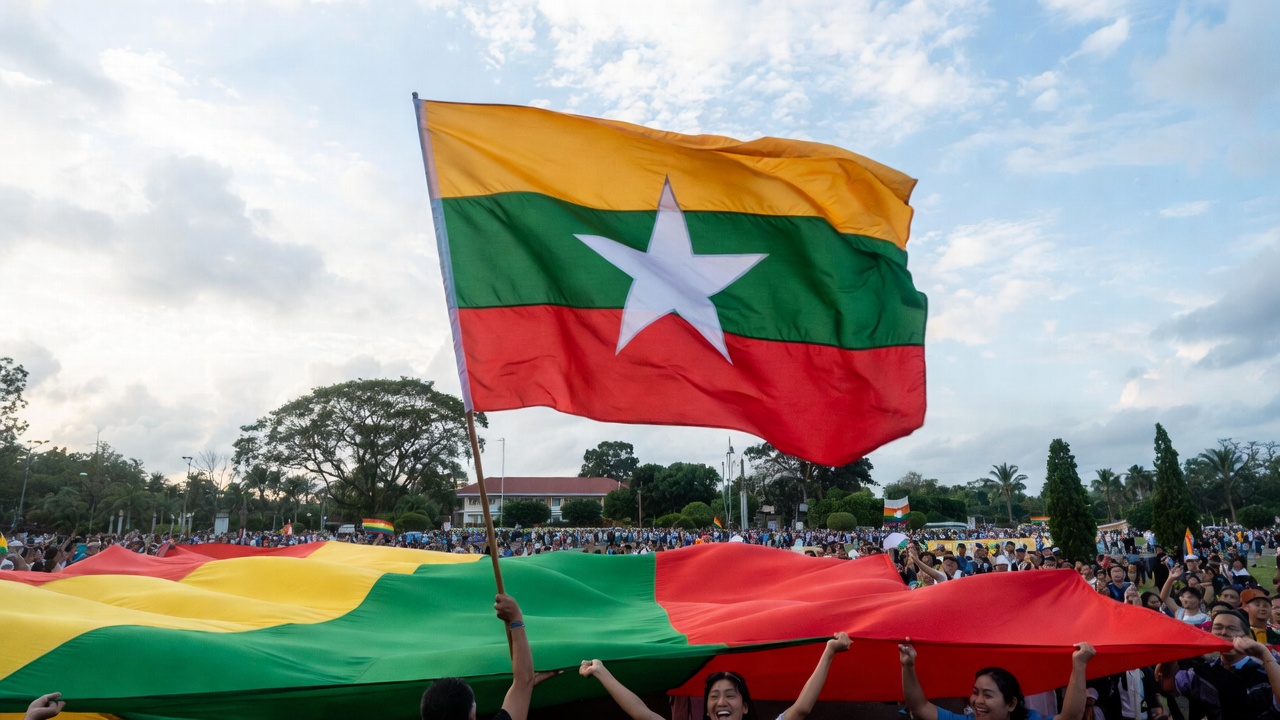
Every February 12, the golden spires and dusty plains of Myanmar come alive with the sound of drums, patriotic songs, and the rustle of the Union Flag passing from hand to hand. Union Day is not just another date on the calendar. It is the heartbeat of a nation built on a promise — a promise made in a small hill town nearly eight decades ago.
What Is Union Day in Myanmar and Why Is It Celebrated on February 12?
Union Day (ပြည်ထောင်စုနေ့, Pyidaungsu Nay) is one of the most important public holidays in Myanmar. Celebrated every year on February 12, it marks the anniversary of the Panglong Agreement, signed on that same date in 1947. The agreement brought together the major ethnic groups of what was then British Burma under a shared vision of independence and self-governance.
In 2026, Union Day falls on a Thursday, February 12. This year marks the 79th anniversary of the Panglong Agreement — a milestone that carries deep meaning for Myanmar’s 135 officially recognized ethnic groups. The day is a national public holiday. Government offices, banks, schools, and most businesses close. People across the country pause to remember the leaders who chose unity over division.
Union Day is not the same as Myanmar’s Independence Day, which falls on January 4. Independence Day celebrates the moment in 1948 when the British flag came down for the last time. Union Day, however, celebrates something arguably more difficult: the decision by diverse peoples — with different languages, customs, and histories — to walk the same road together.
As General Aung San, the architect of that agreement, once said: “We should not emphasize our differences. We should only think about how to live together.” That sentence, spoken in a dusty conference hall in the Shan hills, remains the guiding spirit of Union Day to this day.
The History Behind Union Day Myanmar: From Colonial Rule to the Panglong Agreement
British Colonial Burma and the Divide-and-Rule System
To understand Union Day, you must first understand what Myanmar looked like before it existed as a single country.
In 1886, the British completed their annexation of Burma after three Anglo-Burmese wars. But the British did not govern the territory as one unit. They drew a sharp line between “Ministerial Burma” — the central lowlands populated mainly by the Bamar (Burman) majority — and the “Frontier Areas”, the highlands and border regions home to the Shan, Kachin, Chin, Kayin (Karen), Kayah, Mon, and Rakhine peoples.
The Frontier Areas were governed under a separate administrative system. Local chiefs, known as Saophas (Sawbwas) in the Shan states, retained significant authority under British supervision. This system kept ethnic groups separated from one another and from the Bamar heartland. It was classic divide-and-rule — and it worked for decades.
The result was that, at the end of World War II, “Burma” was not a single nation in any practical sense. The central plains and the surrounding highlands had different laws, different administrative structures, and, in many cases, deep mutual suspicion.
General Aung San and the Road to Panglong
Bogyoke (General) Aung San is often called the father of modern Myanmar. Born in 1915 in Natmauk, he became a student activist and later the leader of the Anti-Fascist People’s Freedom League (AFPFL), the main political movement pushing for Burmese independence.
In January 1947, Aung San traveled to London and negotiated the Aung San–Attlee Agreement with British Prime Minister Clement Attlee. That agreement stated that the Frontier Areas would become part of an independent Burma — but only with the “free consent” of their peoples. A Commission of Enquiry would determine how a new constitution could include both Burma proper and the Frontier Areas.
This was the context in which Aung San headed to the small town of Panglong, in the southern Shan State, for one of the most consequential meetings in Southeast Asian history.
The Panglong Conference: February 3–12, 1947
The Second Panglong Conference was held from February 3 to February 12, 1947. (A “first” Panglong Conference had taken place in March 1946, organized by Sao Shwe Thaik, the Saopha of Yawnghwe, as a gathering of Shan, Kachin, and other leaders.)
The second conference was far more ambitious. Attendees included more than 30 top Burmese political leaders, representatives of the Shan states (including the powerful Saophas), Kachin and Chin delegates, and observers from foreign governments. Karen representatives attended as observers but did not sign the final agreement, a fact that would later carry heavy consequences.
The negotiations were not easy. According to the Global New Light of Myanmar, the first few days were marked by real tension. Shan leaders feared losing their autonomy after independence. Kachin delegates insisted on firm guarantees for the rights of non-Bamar ethnic groups. The Kachin also demanded the creation of a separate Kachin State — a territory that did not exist on any map at the time.
Aung San mediated, pledged commitments, and engaged in thorough, face-to-face negotiations. His personal credibility and his willingness to meet ethnic leaders as equals — rather than as subjects of a Bamar-led government — proved decisive.
The Panglong Agreement: 12 Key Points That Changed a Nation
On the afternoon of February 12, 1947, the delegates signed the historic Panglong Agreement. The agreement contained 12 main points addressing political, economic, and social equality among the ethnic groups.
Key signatories included:
| Representative | Ethnic Group |
|---|---|
| General Aung San | Bamar |
| Sao Shwe Thaik | Shan (Saopha of Yawnghwe) |
| Sao Khun Cho | Shan |
| Sao San Tun | Shan |
| Sama Duwa Sinwa Nawng | Kachin |
| Duwa Zaw Wan | Kachin |
| U Wam Kaung | Chin |
| U Hal Khun | Chin |
The agreement accepted the principle of “full autonomy in internal administration for Frontier Areas.” It also included provisions for a representative of the hill peoples to be appointed as a Counsellor to the Governor for Frontier Affairs, with real executive authority.
Importantly, the deal also offered ethnic leaders the theoretical possibility of seceding from the Union if they were dissatisfied with the new nation — a clause that would be included in the 1947 Constitution but later removed under military rule.
The Panglong Agreement was not signed by all ethnic groups. The Karen, Mon, Rakhine, and Karenni (Kayah) were not parties to the agreement. The reasons varied. Some groups were already represented in the interim government. Others, like the Mon and Rakhine, were considered part of “Ministerial Burma” and therefore not part of the Frontier Areas framework. The Karenni attended as observers only. These absences would haunt Myanmar’s politics for decades to come.
The Assassination of Aung San and the Birth of Independence
General Aung San never saw the fruits of his work at Panglong. On July 19, 1947 — just five months after signing the agreement — he and several members of his cabinet were assassinated by gunmen acting on behalf of a political rival, U Saw. Aung San was only 32 years old.
Despite this devastating loss, the process he set in motion continued. On January 4, 1948, at 4:20 a.m. — a time chosen by astrologers as the most auspicious moment — the Union Jack was lowered for the last time in Yangon, and the flag of the Union of Burma was raised. Sao Shwe Thaik, the Shan leader who had co-organized the Panglong Conference, became the first president of the new nation.
February 12 has been celebrated as Union Day every year since, a reminder that Myanmar’s independence was not just a Bamar achievement. It was — at least in its founding vision — a shared project among many peoples.
How Myanmar Celebrates Union Day in 2026: Traditions, Events, and Ceremonies
Union Day celebrations in Myanmar are a blend of patriotic ceremony, cultural performance, and community gathering. The festivities are not confined to a single day. Preparations begin weeks or even months in advance.
The Union Flag Relay: A Moving Symbol of National Unity
The most iconic tradition of Union Day is the relay of the Union Flag. This is not a simple flag-raising. It is a carefully choreographed, multi-day journey that carries deep symbolic weight.
According to PublicHolidays.asia, the relay follows a set pattern. As far as two months before Union Day, the Union Flag begins a tour through the capital cities of Myanmar’s various states and regions. At each stop, there are parades, cultural performances, and community events.
Then, approximately five days before February 12, the flag enters a more intensive phase. It is carried by hand through dozens of townships — tradition puts the number at around 35 to 45 towns — before arriving at People’s Square on Pyay Road in Yangon for the main ceremony. Each handover is treated with great solemnity. Officials, military personnel, ethnic representatives, and community leaders take turns carrying the flag, which rests in a ceremonial silver bowl.
In recent years, the flag relay has also traveled to Naypyidaw, Myanmar’s administrative capital since 2005, located roughly 200 miles north of Yangon. The arrival of the flag in Naypyidaw is met with formal ceremonies, including salutes from military guards, ethnic delegations, and government officials.
Patriotic Poems, Essays, and Speeches by School Children
In the weeks before Union Day, schools across Myanmar hold special activities. Children write patriotic poems and essays about the meaning of national unity. Teachers give lessons on the Panglong Agreement and the history of Myanmar’s independence movement.
This educational component is considered one of the most important parts of the Union Day season. For many young people in Myanmar, Union Day is their first introduction to the story of how their country came into being — and to the difficult questions about whether the promises of 1947 have been kept.
Cultural Performances and Ethnic Dance in Naypyidaw and Yangon
Union Day is one of the few occasions when Myanmar’s extraordinary ethnic diversity is put on full, public display. Concerts, dance performances, and cultural exhibitions take place in both Naypyidaw and Yangon.
These events feature traditional dances from across the country: the graceful movements of Bamar classical dance, the spirited rhythms of Kachin Manau dance, the elegant Shan sword dance, and the Kayin “Frog Drum” dance (toh née), among many others. Musicians play traditional instruments like the saung gauk (Burmese harp) and the pat waing (drum circle).
In 2025, the celebrations at People’s Square in Yangon ran from February 12 to February 14 and included sector-wise departmental exhibitions, an MSME (micro, small, and medium enterprise) fair, and a music concert, according to Myanmore.
For 2026, similar multi-day celebrations are expected. These events offer visitors and residents alike a rare chance to experience the full spectrum of Myanmar’s cultural heritage in one place.
Government Ceremonies and Official Speeches
The official government observance of Union Day includes flag-hoisting ceremonies, moments of silence, and the playing of the national anthem, “Kaba Ma Kyei” (“Until the End of the World”). Senior government officials give speeches emphasizing themes of national unity, reconciliation, and the importance of the Panglong spirit.
At the 2025 Union Day celebration, Acting President and Senior General Min Aung Hlaing stated: “While complying with the Constitution and laws of the State, all ethnic peoples must work together in unity to build a strong federal democratic Union.” He stressed that protecting the integrity of the Union is everyone’s responsibility and that trust among ethnic groups must be established.
The 2026 ceremony is expected to follow a similar format, with the 79th anniversary serving as an opportunity for renewed calls for peace and solidarity among Myanmar’s diverse communities.
The Meaning of the Panglong Spirit in Modern Myanmar
What Is the “Panglong Spirit” and Why Does It Matter Today?
The term “Panglong Spirit” (Panglong Seiktha) is used frequently in Myanmar to describe the ideal of different ethnic groups choosing to work together as equals — respecting each other’s cultures, languages, and rights, while building a shared future.
The Global New Light of Myanmar described Union Day 2026 as “an annual reaffirmation of the principles of our Union, reminding us that Myanmar is not the nation of a single ethnic group but a Union of many ethnicities, cultures, and languages.”
In practice, the Panglong Spirit means recognizing that unity is not the same as uniformity. It is possible for a Shan grandmother, a young Kachin singer, and a Rakhine farmer to all be fully Myanmar — without losing what makes each of them unique.
As historian Dr. Than Tun once put it: “The Panglong Agreement marks the beginning of a good future, not the end of the road.”
Ethnic Diversity in Myanmar: The 135 Groups That Make Up the Union
Myanmar is home to one of the most diverse populations in Southeast Asia. The government officially recognizes 135 distinct ethnic groups, organized under eight major national races:
| Major National Race | Notable Sub-Groups | Approximate % of Population |
|---|---|---|
| Bamar (Burman) | — | ~68% |
| Shan | Tai Yai, Pa-O, Palaung, Danu | ~9% |
| Kayin (Karen) | Sgaw, Pwo, Pa’O | ~7% |
| Rakhine | Kamein, Kwe Myi | ~3.5% |
| Mon | — | ~2% |
| Chin | Zomi, Mizo, Asho, Falam (53 sub-groups total) | ~2% |
| Kachin | Jinghpaw, Rawang, Lisu, Lashi | ~1.5% |
| Kayah (Karenni) | Padaung, Bre, Geba | <1% |
About 89% of Myanmar’s population practices Theravada Buddhism. Smaller communities follow Christianity (especially among the Chin and Kachin), Islam, Hinduism, and traditional Animist beliefs.
This diversity is both Myanmar’s greatest asset and its most enduring challenge. Many of the country’s internal conflicts stem from unresolved questions about autonomy, representation, and resource-sharing among these different groups — questions that the Panglong Agreement attempted, but ultimately failed, to answer fully.
Best Places to Visit in Myanmar During Union Day 2026
Union Day falls in the heart of Myanmar’s dry season (November to February), which is widely considered the best time to visit the country. The weather is pleasant — warm but not scorching — and the landscape is at its most photogenic.
Yangon: The Heart of Union Day Celebrations
Yangon (formerly Rangoon) is Myanmar’s largest city and its commercial capital. It is the traditional center of Union Day celebrations and the site of the People’s Square ceremony on Pyay Road.
Must-see attractions in Yangon:
- Shwedagon Pagoda — The crown jewel of Myanmar. This gilded stupa rises 99 meters (325 feet) above Singuttara Hill and is believed to be more than 2,500 years old. It is said to enshrine eight strands of the Buddha’s hair, along with relics of three previous Buddhas. The stupa is covered in genuine gold leaf — an estimated 27 metric tons of it — and its pinnacle is tipped with 5,448 diamonds and a 76-carat diamond at the very top. The Shwedagon Pagoda is open daily from 4:00 a.m. to 10:00 p.m. The entrance fee is 10,000 kyats (approximately US $8). Visit at sunrise or sunset for the most breathtaking light.
- Sule Pagoda — A 2,000-year-old pagoda sitting in the middle of downtown Yangon’s roundabout. It functions as both a sacred site and a practical landmark for navigating the city center.
- Bogyoke Aung San Market (Scott Market) — The best place in Yangon to shop for traditional crafts, gems, textiles, and lacquerware. Closed on Mondays and public holidays.
- Yangon Circular Train — A slow, rattling loop around the city and its outskirts. The full circuit takes about three hours. It costs less than a dollar and offers an unfiltered view of daily life in Yangon.
Union Day-specific experiences in Yangon: During the Union Day holiday period, People’s Square hosts exhibitions, cultural performances, and fairs. The area around Pyay Road may be subject to temporary road closures. Plan your travel accordingly.
Bagan: The Ancient City of Temples
Bagan is one of the world’s great archaeological sites. Spread across a dusty plain beside the Irrawaddy River, the Bagan Archaeological Zone contains more than 3,500 Buddhist temples, pagodas, and monasteries, most of which were built between the 9th and 13th centuries.
While Bagan does not host major Union Day events, the dry season weather in February makes it an ideal time to explore. Hot air balloon rides at sunrise over the temple-studded plains are legendary — and available during the dry season months.
Key temples to visit include Ananda Temple (considered the finest example of Mon architecture), Dhammayangyi Temple (the largest in Bagan), and Shwesandaw Pagoda (a popular sunset-viewing spot).
Mandalay: Myanmar’s Cultural Capital
Mandalay is the cultural heart of upper Myanmar. It was the last royal capital of the Burmese monarchy and remains a center of traditional arts, crafts, and Buddhist scholarship.
Important note for 2026: Mandalay was significantly affected by a major earthquake in March 2025, which caused infrastructure damage. While the city remains a popular destination, travelers should check the latest conditions before visiting and be prepared for ongoing reconstruction.
Key attractions include Mandalay Hill, Kuthodaw Pagoda (home to the “world’s largest book” — 729 marble slabs inscribed with the entire Pali Canon), and the U Bein Bridge at Amarapura, the longest teak footbridge in the world.
Inle Lake: The Floating World of Shan State
Inle Lake is a freshwater lake in the Shan highlands, famous for its floating gardens, stilt-house villages, and leg-rowing fishermen. It is one of Myanmar’s most serene and beautiful destinations.
February is an excellent time to visit Inle Lake. The weather is cool and clear, and the morning mist over the water creates magical photographic conditions. The Intha people of Inle Lake have a unique culture that is distinct from the surrounding Shan population.
The Panglong Monument: A Pilgrimage for History Lovers
For visitors with a deep interest in Myanmar’s history, the Panglong Monument in southern Shan State is a meaningful destination. The monument stands in the very garden where the Panglong Agreement was signed in 1947. Its facade features representations of Bogyoke Aung San and the ethnic leaders who put their names to the agreement.
A ceremony is held on-site every February 12. Getting to Panglong requires some effort — it is in a remote part of the Shan hills — but for those who make the journey, the experience is profoundly moving. Standing where Aung San and the ethnic leaders stood, in the cool mountain air, you can almost hear the echoes of the debate that shaped a nation.
Myanmar Travel Advisory 2026: Is It Safe to Visit Myanmar Right Now?
This is the question every prospective visitor must face honestly. The answer is nuanced.
Current Travel Warnings for Myanmar in 2026
As of early 2026, several major governments have issued high-level travel advisories for Myanmar:
| Country | Advisory Level |
|---|---|
| United States | Level 4: Do Not Travel |
| United Kingdom | Advise against all travel (many regions); Advise against all but essential travel (others) |
| Australia | Do Not Travel |
| Canada | Avoid all travel |
| Ireland | Do Not Travel |
The U.S. State Department cites armed conflict, civil unrest, arbitrary enforcement of local laws, poor health infrastructure, landmines, and the risk of wrongful detention as reasons for its Level 4 advisory. The UK FCDO and Australia’s Smartraveller echo similar concerns.
The situation stems from the February 2021 military coup, after which the political and security environment deteriorated significantly. Armed conflict continues in many parts of the country, and conditions can change rapidly.
The “Tourist Kite”: Safer Areas for Visitors
Despite the official advisories, a number of experienced travel operators and independent travelers report that specific tourist destinations — often referred to as the “Tourist Kite” — remain relatively safer for visitors who take precautions.
The Tourist Kite includes:
- Yangon — Classified as a “green zone” by the UK FCDO. Considered the safest major city for tourists.
- Bagan — Generally safe and largely unaffected by active conflict. Falls within the UK’s “orange zone.”
- Inle Lake — A serene destination within the Tourist Kite, considered relatively safe.
- Mandalay — A popular destination, though affected by the 2025 earthquakes. Also in the UK’s “orange zone.”
Beach destinations such as Ngapali, Ngwe Saung, and parts of the Mergui Archipelago are also considered accessible for tourism.
Areas to avoid include Kachin State, Chin State, Rakhine State, border regions with Thailand, China, and India, and other areas listed as restricted by Myanmar’s Ministry of Hotels and Tourism.
Practical Safety Tips for Traveling to Myanmar in 2026
If you decide to travel to Myanmar in 2026 — and many people do, responsibly and safely — here are essential precautions:
Before you go:
- Purchase comprehensive travel insurance that specifically covers Myanmar. SafetyWing is one provider known to offer coverage in Myanmar.
- Apply for a Myanmar e-Visa before departure. The e-Visa is typically processed within a few business days. Print the approval letter and present it upon arrival. The official government website is the only reliable source — beware of fraudulent third-party sites.
- Register with your country’s embassy or traveler enrollment program (e.g., the U.S. STEP program).
While in Myanmar:
- Fly between major cities rather than traveling overland. Military checkpoints are common on highways, and overland routes carry higher security risks.
- Avoid demonstrations and large gatherings. The military authorities have responded to protests with force.
- Do not discuss politics publicly or on social media while in Myanmar. Authorities have detained individuals for critical comments, including on private messaging platforms.
- Carry your passport at all times. Officials may ask to see identification.
- Be cautious after dark in Yangon. Stray dogs are a serious concern outside the city center, and rabies is a real risk.
- Use local guides. A knowledgeable local guide can help you navigate checkpoints, understand local conditions, and avoid restricted areas.
Myanmar Union Day Food and Cultural Traditions You Should Know
Traditional Myanmar Food to Try During Union Day
No celebration in Myanmar is complete without food. Union Day is a time for families to gather around the table, and street food vendors do brisk business.
Here are the dishes you must try:
Lahpet Thohk (Tea Leaf Salad) — Myanmar’s most famous dish. Fermented tea leaves (lahpet) are mixed with shredded cabbage, tomatoes, roasted peanuts, sesame seeds, fried garlic, and dried shrimp, then dressed with lime juice and fish sauce. It is tangy, crunchy, and utterly addictive. Lahpet thohk is served at virtually every celebration, and Union Day is no exception.
Mohinga — Often called Myanmar’s national dish. This is a rich, warming fish soup served over thin rice noodles, topped with crispy fritters, hard-boiled egg, and fresh coriander. It is eaten for breakfast across the country, but during Union Day, mohinga vendors are especially busy.
Shan Noodles (Shan Kauk Swe) — A lighter noodle dish from the Shan highlands, made with flat rice noodles, a mild tomato-based sauce, and chicken or pork. It reflects the cuisine of the Shan people, one of the key signatories of the Panglong Agreement.
Htamin Jin — A Shan-style rice ball made with turmeric rice, mixed with tomato paste and fish, shaped by hand, and served with fried garlic and chili. Often eaten as a snack during festivals.
Mont Lin Ma Yar — Literally “husband and wife snack.” These are tiny, round pancakes cooked in a special cast-iron pan, filled with quail egg, spring onions, and crispy bits. A beloved street food during holidays.
Cultural Etiquette for Visitors During Union Day
Myanmar is a deeply traditional society, and visitors should be mindful of local customs, especially during a patriotic holiday like Union Day.
At pagodas and temples:
- Always remove your shoes and socks before entering. This applies to the entire temple compound, not just the main building.
- Cover your shoulders and knees. Both men and women should dress modestly.
- Never point your feet toward a Buddha image. Sit with your legs tucked to the side or beneath you.
- Do not touch the heads of adults or children — the head is considered the most sacred part of the body.
In general social situations:
- The traditional Myanmar greeting is to bow slightly with both hands placed on the stomach. Older people may simply nod in acknowledgment.
- Avoid pointing with your finger, which can be seen as a rebuke. Use an open hand or your chin to indicate direction.
- Public displays of affection are considered inappropriate.
- Many Burmese people wear Thanaka, a yellowish-white cosmetic paste made from ground bark, on their faces. It serves as sunscreen, skincare, and a beauty tradition going back more than 2,000 years. It is a cultural practice, not a costume — do not mock it or treat it as a novelty.
- Both men and women commonly wear the longyi, a wraparound garment similar to a sarong. It is everyday clothing, not special occasion wear.
How to Get to Myanmar and Get Around in 2026
Flights to Myanmar and Visa Requirements
Yangon International Airport (RGN) is the main international gateway. Mandalay International Airport (MDL) also handles some international flights. Both airports receive flights from regional hubs including Bangkok, Singapore, Kuala Lumpur, and Kunming.
Visa requirements: Most foreign nationals need a visa to enter Myanmar. The e-Visa system is the most convenient option for tourists. You apply online, receive an approval letter by email (usually within a few business days), print it, and present it at immigration on arrival. Citizens of some ASEAN countries (Thailand, Vietnam, Laos, Cambodia) enjoy visa-free entry for up to 30 days.
Important: Myanmar’s military administration previously required visitors to purchase a mandatory $60 travel insurance policy. Check the latest entry requirements before booking, as these rules change frequently.
Getting Around Myanmar: Domestic Flights, Buses, and Trains
Domestic flights are the safest and fastest way to travel between major destinations. Airlines such as Myanmar National Airlines, Air KBZ, and Golden Myanmar Airlines operate regular services between Yangon, Bagan (Nyaung-U Airport), Mandalay, and Heho (for Inle Lake). Flights are affordable and typically cost between $50 and $120 one-way.
Buses are the most widely used long-distance transport for both locals and budget travelers. VIP overnight buses between major cities are surprisingly comfortable, with reclining seats, blankets, and onboard snacks. The fare from Yangon to Mandalay by VIP bus is approximately 15,000–24,000 MMK (around US $5–8). Expect military checkpoints along the way.
Trains are slower and less comfortable than buses, but offer a unique experience. The Yangon Circular Train is a must-do for atmosphere. The overnight train from Yangon to Mandalay is a classic journey, though it takes around 15 hours.
Private cars with drivers can be arranged through hotels and travel agencies. Self-driving is not practical for foreign visitors and is not recommended.
Frequently Asked Questions About Union Day Myanmar 2026
When is Union Day in Myanmar 2026?
Union Day 2026 falls on Thursday, February 12, 2026. It is a national public holiday.
Is Union Day the same as Myanmar Independence Day?
No. Independence Day is celebrated on January 4 and marks Myanmar’s independence from Britain in 1948. Union Day is celebrated on February 12 and marks the signing of the Panglong Agreement in 1947, which unified Myanmar’s ethnic groups in the push for independence.
What is the Panglong Agreement?
The Panglong Agreement was signed on February 12, 1947, in the town of Panglong in the Shan hills. It was an agreement between General Aung San’s interim government and leaders of the Shan, Kachin, and Chin peoples to cooperate in seeking independence from Britain and to form a unified, independent nation with autonomy for the Frontier Areas.
How many ethnic groups does Myanmar have?
Myanmar officially recognizes 135 ethnic groups under eight major national races: Bamar, Shan, Kayin, Rakhine, Mon, Chin, Kachin, and Kayah.
What is the best time of year to visit Myanmar?
The dry season from November to February is the best time to visit. The weather is pleasant, with cool mornings and warm afternoons. February, the month of Union Day, is an especially good time to visit because you can experience the celebrations firsthand while enjoying ideal weather conditions.
Is Myanmar safe for tourists in 2026?
Major tourist destinations — Yangon, Bagan, Inle Lake, and parts of Mandalay — are considered relatively safe for visitors who take precautions. However, multiple governments have issued Level 4 (Do Not Travel) advisories for Myanmar due to armed conflict and political instability. Travelers should consult their government’s travel advisory, purchase comprehensive insurance, and stay within well-traveled tourist areas. See the travel advisory section above for detailed guidance.
What should I wear when visiting temples in Myanmar?
Both men and women should cover their shoulders and knees. Shoes and socks must be removed before entering any temple or pagoda compound. Carry a bag for your footwear, as you may exit from a different entrance than the one you used to enter.
What currency is used in Myanmar?
The official currency is the Myanmar Kyat (MMK). As of early 2026, the exchange rate fluctuates significantly. ATMs are available in major cities but may not always work reliably. Carry U.S. dollars in clean, undamaged bills as backup. Many hotels and tour operators accept dollars. Always double-check your change carefully when exchanging money — scams involving damaged bills or sleight-of-hand tricks are reported.
A Timeline of Key Events in Myanmar’s Path to Union Day
| Year | Event |
|---|---|
| 1824–1886 | Three Anglo-Burmese Wars result in full British annexation of Burma |
| 1886 | Britain establishes separate governance for “Ministerial Burma” and the “Frontier Areas” |
| 1937 | Burma separated from British India, given a degree of self-governance |
| 1942–1945 | Japanese occupation of Burma during World War II |
| March 1946 | First Panglong Conference organized by Sao Shwe Thaik |
| January 27, 1947 | Aung San–Attlee Agreement signed in London |
| February 3–12, 1947 | Second Panglong Conference held; Panglong Agreement signed on February 12 |
| July 19, 1947 | General Aung San and several cabinet members assassinated |
| January 4, 1948 | Union of Burma officially gains independence from Britain |
| 1962 | Military coup by General Ne Win ends parliamentary democracy |
| 1989 | Military government changes the country’s name from Burma to Myanmar |
| 2005 | Capital moved from Yangon to Naypyidaw |
| 2021 | Military coup deposes elected government; civil unrest follows |
| 2026 | 79th anniversary of the Panglong Agreement; Union Day celebrated on February 12 |
The Ongoing Significance of Union Day for Myanmar’s Future
Union Day is not simply a backward-looking commemoration. It is, in the words of the Global New Light of Myanmar, “not just a historical milestone; it is also a map for the future.”
The challenges facing Myanmar today are profound. Armed conflict continues in multiple states. Ethnic tensions persist. The promises of the Panglong Agreement — political equality, economic fairness, cultural respect, and the right to self-determination — remain, in many ways, unfulfilled.
Yet the Panglong Spirit endures. It endures in the teachers who teach Burmese in Shan villages, in the cultural mentors who bring traditional Kayin dances to children in the Ayeyawady basin, and in the scholars who translate science and technology books into the Mon language. These are the quiet builders of unity.
On the day the Panglong Agreement was signed, General Aung San said: “We have decided to walk together.” Seventy-nine years later, that sentence remains both a promise and a question: Can Myanmar’s diverse peoples find a way to walk together, respecting each other’s differences while building something greater than any one group could build alone?
That is the question Union Day asks every February 12. And the answer, as always, lies not in ceremonies or speeches, but in the choices ordinary people make every day.
Planning Your Trip: A Quick-Reference Union Day Myanmar 2026 Checklist
| Item | Details |
|---|---|
| Date | Thursday, February 12, 2026 |
| Anniversary | 79th anniversary of the Panglong Agreement |
| Holiday Type | National public holiday (government offices, schools, banks closed) |
| Main Celebrations | Yangon (People’s Square), Naypyidaw, Panglong Monument |
| Best Base City | Yangon |
| Visa | e-Visa required for most nationalities; apply online in advance |
| Currency | Myanmar Kyat (MMK); carry clean USD as backup |
| Weather | Dry season; pleasant temperatures (~28°C / 82°F in Yangon) |
| Dress Code | Cover shoulders and knees at temples; remove footwear |
| Travel Insurance | Essential; ensure it covers Myanmar specifically |
| Language | Burmese is the official language; English is limited outside tourist areas |
| Key Phrase | “Min-ga-la-ba” (မင်္ဂလာပါ) — “Hello” in Burmese |
Union Day is more than a holiday. It is a living conversation between past and future, between hope and reality, between the diverse peoples of a nation still finding its way. If you are fortunate enough to be in Myanmar on February 12, 2026, you will witness something rare: a country pausing to remember why it chose to exist in the first place.
Mingalaba. Welcome to the Union.