Every winter, while most of Europe shivers under grey skies, a small capital city on a sun-kissed Mediterranean island erupts in devotion, brass-band music, and fireworks. Valletta, Malta’s UNESCO-listed capital, transforms on February 10 each year for the Feast of St Paul’s Shipwreck — known locally as Il-Festa ta’ San Pawl Nawfragu. It is one of the most historically significant religious celebrations in all of Southern Europe. It is also one of the most rewarding winter festivals a traveller can attend.
I first stumbled upon this feast years ago during a research trip to Malta. I had come to study Mediterranean folk traditions. What I found was something far more powerful than I had expected — an entire nation honouring the event that, according to tradition, gave it its Christian identity nearly two thousand years ago. The devotion was real. The energy was infectious. And the welcome, from the very first pastizz I was handed at a street stall, was genuine.
This guide is written for the curious traveller — someone who wants not just to observe this feast, but to understand it, respect it, and experience it fully during a February 2026 visit. Along the way, you will also find practical tips on weather, food, transport, and nearby events, including the Malta Carnival, which falls just days after the feast in 2026.
What Is the Feast of St Paul’s Shipwreck in Malta?
The Feast of St Paul’s Shipwreck commemorates a pivotal moment in Maltese history and identity. According to the Acts of the Apostles (Chapters 27–28) in the New Testament, the Apostle Paul was being transported to Rome as a prisoner around A.D. 60 when his ship encountered a violent storm. The vessel, carrying 276 people, was driven aground on the coast of Malta. All aboard survived.
During the three months that Paul spent on the island, several remarkable events reportedly took place. The most famous of these is the viper miracle: while gathering firewood, Paul was bitten by a venomous snake but suffered no ill effects. The islanders, who initially feared he would die, were astonished. Paul also healed the father of Publius, the Roman governor of the island, from fever and dysentery. According to tradition, Publius later converted to Christianity and became Malta’s first bishop.
These events are not simply religious footnotes for the Maltese. St Paul is the patron saint of Malta. His arrival is considered the founding moment of Christianity on the islands, making Malta one of the earliest Roman colonies to embrace the faith. The shipwreck narrative is woven into the national consciousness. You will find references to it in street names, church art, bay names, and everyday conversation.
The feast is observed every year on February 10 as a national public holiday. Schools close. Many businesses shut for the day. Families gather. And the heart of the celebration beats in Valletta, at the Collegiate Parish Church of St Paul’s Shipwreck — one of the oldest and most treasured churches in the capital.
When Is the Feast of St Paul’s Shipwreck 2026 and Why It Matters for Tourists
In 2026, the Feast of St Paul’s Shipwreck falls on Tuesday, February 10. This date is fixed — it does not move with the liturgical calendar the way Easter does. Every year, February 10 is a national holiday in Malta.
For tourists, the timing is significant for several reasons.
First, February is off-season in Malta. This means lower hotel prices, fewer crowds at major attractions, and a more authentic experience of daily Maltese life. According to Lonely Planet, the winter months offer good deals on accommodation, and activities like hiking and diving are enjoyable year-round. You will not be competing with summer cruise-ship crowds for a spot at the Upper Barrakka Gardens.
Second, the feast falls just three days before the Malta Carnival 2026, which runs from February 13 to 17. This means a tourist visiting during the week of February 9–17 can experience two of Malta’s most important annual celebrations in a single trip. Very few European destinations offer this kind of cultural density in the middle of winter.
Third, the feast is the first major outdoor festa of the Maltese calendar year. Most of Malta’s famous village festas take place in summer. The Feast of St Paul’s Shipwreck is unique in that it brings summer-level energy and spectacle to the depths of winter. Brass bands march through the streets. Fireworks explode over the Grand Harbour. The faithful carry a centuries-old statue through limestone alleyways. There is nothing else quite like it in Europe at this time of year.
The History Behind the Collegiate Church of St Paul’s Shipwreck in Valletta
The centre of the feast celebrations is the Collegiate Parish Church of St Paul’s Shipwreck, located on St Paul’s Street (Triq San Pawl) in Valletta. Understanding this church is essential to understanding the feast.
The church traces its origins to the 1570s, shortly after the founding of Valletta by Grand Master Jean de Valette following the Great Siege of 1565. The original design was by Girolamo Cassar, the architect responsible for many of Valletta’s most important buildings, including St John’s Co-Cathedral. The church was completed in 1582.
Over the centuries, the building was expanded and embellished. A new church was constructed in 1639, designed by Bartolomeo Garagona. The facade was rebuilt in 1885 according to plans by Nicola Zammit. The church is listed on the National Inventory of the Cultural Property of the Maltese Islands.
Artistic Treasures Inside the Church
The interior of the church is a treasury of Maltese art and devotion. Key highlights include:
- The altarpiece by Matteo Perez d’Aleccio (1547–1616), a follower of Michelangelo, depicting the shipwreck of St Paul
- Paintings by Giuseppe Calì and Attilio Palombi adorning the nave and chapels
- The choir and dome designed by Lorenzo Gafà
- The titular wooden statue of St Paul, carved by Melchiorre Cafà in 1659 at his studio in Rome
The statue of St Paul deserves special mention. Cafà, often described as the finest Maltese sculptor of all time, created a life-size wooden figure showing the apostle barefoot and bearded, wearing a gilded robe, holding an open Bible in one hand and gesturing with the other. This statue is the centrepiece of the feast-day procession. It is kept in a glass case inside the church for the rest of the year and carefully removed each February to be carried through the streets.
Sacred Relics of St Paul
The church holds two relics that draw pilgrims from around the world:
- A relic of St Paul’s right wrist bone, housed in a magnificent gold, silver, and precious-stone reliquary shaped like a forearm. This relic is carried in procession on the feast day.
- A piece of the marble column on which St Paul is said to have been beheaded in Rome in A.D. 64–67. This was donated to the church by Pope Pius VII in 1818 in recognition of the service rendered by the church’s clergy during Malta’s plague outbreak of 1813.
The combination of artistic beauty and historical relics makes this church a deeply significant stop for any visitor — religious or otherwise.
The Biblical Story of St Paul’s Shipwreck: What Actually Happened According to Scripture
To fully appreciate the feast, it helps to know the story in detail. The account appears in Acts 27:27 through 28:11 and is one of the most vivid travel narratives in the entire Bible.
Paul, a Roman citizen and convert to Christianity, had been arrested in Jerusalem and appealed to be tried before Caesar in Rome — his right as a citizen. He was placed aboard a ship sailing from Adramyttium in modern-day Turkey, along with other prisoners and a crew. The total number aboard, according to Acts 27:37, was 276 people.
The voyage began well but soon met trouble. Off the coast of Crete, a violent northeastern wind — called a Euroclydon in some translations — struck the ship. For fourteen days, the vessel was tossed by the storm with no sight of sun or stars. The crew threw cargo and tackle overboard. All hope of survival faded.
But Paul stood among the passengers and told them that an angel of God had appeared to him the previous night, assuring him that no lives would be lost, though the ship itself would be destroyed. He urged the crew to eat and keep their strength. According to Acts, they did — and shortly afterward, the ship ran aground on a sandbar. The stern broke apart under the pounding waves, but everyone made it safely to shore.
The island they reached was Melita — the ancient name for Malta. The locals, described in Acts as showing “unusual kindness,” built a fire for the survivors because of the cold and rain. It was while Paul was gathering sticks for this fire that a viper, driven out by the heat, fastened itself onto his hand. The islanders expected him to swell up and die. When he shook the snake off and remained unharmed, they began to say that he must be a god.
Paul then healed the father of Publius, the chief man of the island, who was suffering from fever and dysentery. Word spread, and many other sick people came to Paul for healing. The survivors remained on Malta for three months — the winter season — before departing for Rome on another ship that had been sheltering in the harbour.
This narrative shaped everything that followed in Maltese history. The Maltese view Paul’s arrival not as an accident but as an act of divine providence. His three-month stay planted the seeds of Christianity on the island. The church, the feast, the procession — all of it flows from those fourteen storm-tossed days at sea.
Why St Paul’s Shipwreck Is Central to Maltese National Identity and Culture
It is difficult to overstate how deeply the shipwreck of St Paul is embedded in the Maltese sense of self. Malta is one of the most devoutly Catholic countries in Europe. According to census data, over 80% of the population identifies as Roman Catholic. Church attendance remains high by European standards. And at the heart of this faith lies the figure of St Paul.
The Maltese do not simply remember Paul as a historical figure. They claim him as their spiritual father. His shipwreck is viewed, in Maltese tradition, as the single most important event in the nation’s history — more significant than the Great Siege of 1565, more foundational than independence in 1964.
This is reflected everywhere on the islands. St Paul’s Bay, on the northern coast, is the traditionally accepted location of the shipwreck. Churches, chapels, and shrines dedicated to Paul dot the landscape. The Catacombs of St Paul in Rabat are believed to mark the site where he preached during his stay. The capital’s grandest parish church is dedicated not to the Virgin Mary or to one of the island’s patron saints of convenience, but to the Shipwreck itself — to the event, not just the person.
The feast day is therefore not just a religious holiday. It is, in a real sense, Malta’s founding day — the anniversary of the moment the nation received its most cherished inheritance. When the faithful shout “Viva San Pawl!” during the procession, they are affirming something deeper than devotion. They are affirming identity.
For the visitor, understanding this context transforms the experience. You are not watching a quaint folk festival. You are witnessing a nation engaged in active remembrance of its origin story. That awareness will deepen your appreciation of every hymn, every cheer, every tear on the cheek of an elderly parishioner as the statue passes by.
How Locals Celebrate St Paul’s Shipwreck Day in Valletta: A Complete Guide
The celebration of San Pawl Nawfragu is a multi-layered event. It combines solemn religious ceremony with joyous public festivity. Here is what to expect throughout the day.
The Eve of the Feast — February 9
The celebrations begin the evening before. On the night of February 9, the city buzzes with anticipation. Grand Vespers are held at the Collegiate Church, accompanied by powerful choral music. The church is decorated with elaborate floral arrangements, glowing candles, and rich fabrics. Outside, the streets are illuminated with festive lights and decorations. Families from across Malta begin arriving in Valletta, and the atmosphere is warm and communal despite the winter air.
Pontifical Mass — The Morning of February 10
The spiritual heart of the feast is the Solemn Pontifical Mass, celebrated at the Collegiate Church on the morning of February 10. This Mass is led by the Archbishop of Malta and attended by clergy, government officials, and large crowds of devotees. The church fills well before the service begins, so arrive early if you wish to attend. Visitors of all faiths are welcome, but respectful dress and quiet behaviour are expected during the service.
The Midday Gun Salute from the Upper Barrakka Gardens
At midday on February 10, the Fondazzjoni Wirt Artna (Malta Heritage Trust) re-enacts a centuries-old military tradition by firing a full gun salute from the Saluting Battery beneath the Upper Barrakka Gardens. This is not the regular daily noon cannon — it is a special, expanded salute in honour of the feast. The booming echo across the Grand Harbour is thrilling. The Upper Barrakka Gardens, perched at the highest point of Valletta’s fortifications, offer spectacular views of the Three Cities and the harbour. Admission to the gardens is free, though the guided tour of the Saluting Battery has a small fee (around €3 for adults).
The Grand Procession — Afternoon and Evening
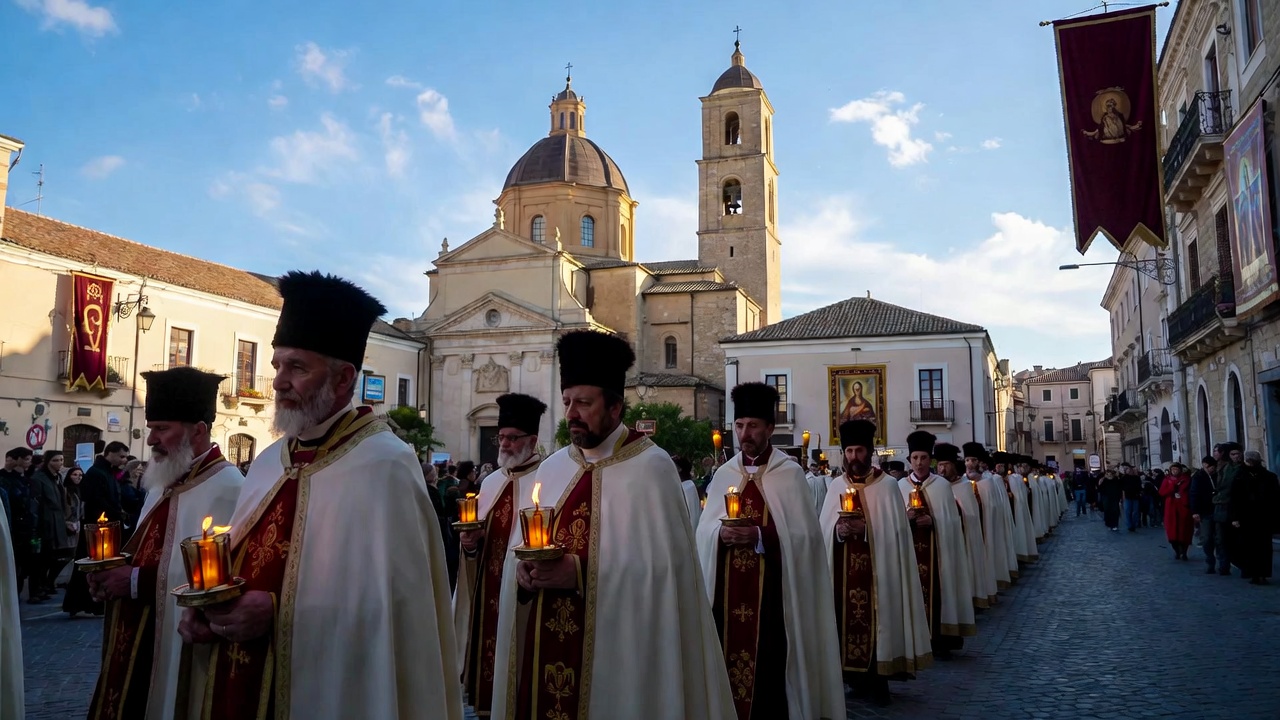
The emotional climax of the feast is the grand procession of the statue of St Paul through the streets of Valletta. In the late afternoon, the iconic 1659 statue by Melchiorre Cafà is lifted onto the shoulders of the city’s strongest men and carried out of the church. The procession winds through Valletta’s narrow streets, accompanied by:
- Brass band music filling the limestone corridors with sound
- Clergy and members of the Collegiate Chapter in ceremonial robes
- Thousands of worshippers and spectators lining the route, many applauding and cheering
- Hymns and choral singing creating a deeply moving atmosphere
- Fireworks lighting up the sky over the Grand Harbour as darkness falls
The procession is the moment when the feast truly comes alive. The combination of flickering candlelight, booming band music, and the sight of a four-century-old statue gliding above the crowd is an experience that stays with you. Even as a non-Maltese observer, you will feel the weight of the tradition.
Best Viewing Spots for the St Paul’s Shipwreck Procession in Valletta
Choosing the right location to watch the procession makes a real difference. Here are the best options:
| Location | Why It’s Good | Tips |
|---|---|---|
| Outside the Collegiate Church (St Paul’s Street) | You see the statue emerge from the church — the most dramatic moment | Arrive at least 90 minutes early |
| Republic Street | Wide boulevard with good sightlines; the statue passes slowly here | Stand near the edges; centre fills fast |
| Merchant Street | Less crowded than Republic Street; equally atmospheric | Good for photography |
| St George’s Square | Grand open space; festive atmosphere with food vendors nearby | A good spot for families |
| Upper Barrakka Gardens | Elevated view of fireworks over Grand Harbour after sunset | Ideal for the evening fireworks |
A practical note: Valletta is compact, and the procession route is not long. You can realistically see the procession from multiple points if you are willing to move with the crowd. Wear comfortable shoes — the streets are limestone and can be uneven.
What to Eat in Valletta During the Feast of St Paul’s Shipwreck
One of the great pleasures of visiting Malta during any celebration is the food. Maltese cuisine is a Mediterranean blend of Italian, Arabic, and British influences. February, with its cooler temperatures, is perfect for the heartier side of the island’s cooking.
Traditional Maltese Dishes to Try in February
Pastizzi — These diamond-shaped flaky pastries are the ultimate Maltese street food. They are traditionally filled with ricotta cheese (pastizzi tal-irkotta) or mushy peas (pastizzi tal-piżelli). They cost less than €1 each and are available at bakeries and pastizzerias across Valletta. Grab one from a street vendor during the feast — they are the perfect hand-held snack for a crowd.
Stuffat tal-Fenek (Rabbit Stew) — Widely regarded as Malta’s national dish, this rich stew slow-cooks rabbit with red wine, garlic, onions, tomatoes, and herbs. It is deeply comforting on a cool February evening. Try it at a traditional restaurant in Valletta after the procession.
Ftira — This traditional Maltese sourdough bread is ring-shaped with a thick crust and airy interior. It is typically filled with tuna, capers, olives, tomatoes, and Maltese goat cheese (ġbejniet). Ftira was added to UNESCO’s Intangible Cultural Heritage of Humanity list in 2020, recognising its cultural importance. You can find excellent ftira at bakeries and cafés throughout the capital.
Aljotta — A garlicky fish soup made with tomatoes, rice, and fresh herbs. It is especially popular in winter and during Lent. A warming bowl of aljotta is perfect after a morning spent walking the February streets.
Prinjolata — Since the feast falls just before Carnival season, you will begin to see this traditional Carnival cake in pastry shops around Valletta. It is a towering confection of sponge, biscuits, citrus peel, and nuts, topped with cream and chocolate drizzle. It is only available in February — do not miss it.
Kinnie — Malta’s beloved soft drink, made from bitter oranges and aromatic herbs. Order one with your pastizzi for the full Maltese street-food experience.
Where to Eat in Valletta During the February Feast
- Is-Suq Tal-Belt — Valletta’s renovated food market, located on Merchant Street, with vendors serving everything from traditional ftira to international dishes. It often has extended hours during the feast.
- Nenu the Artisan Baker — Known for its traditional bread-making and ftira.
- Café Jubilee — A cosy spot with excellent traditional Maltese cooking at reasonable prices.
- Rubino — A Valletta institution since 1906, famous for seasonal Maltese dishes including rabbit.
- The King’s Own Band Club — A local favourite on Republic Street, offering good meals in an authentic band-club setting.
Important: Because February 10 is a national holiday, some restaurants and shops may have reduced hours or be closed entirely. Larger establishments and those catering to tourists will generally remain open, but it is wise to check in advance or make reservations.
Valletta Weather in February: What to Pack for a Winter Festival in Malta
Many travellers are surprised to learn that Malta’s February weather is mild by European standards. While you will not be swimming, you also will not be freezing.
February Weather at a Glance
| Metric | Average |
|---|---|
| Daytime high temperature | 15–16°C (59–61°F) |
| Night-time low temperature | 9–10°C (48–50°F) |
| Sunshine hours per day | 6 hours |
| Rainfall days per month | 8–10 days |
| Average monthly rainfall | 55–61 mm |
| Sea temperature | 15°C (59°F) |
| Daylight hours | Approximately 11 hours |
Malta in February is significantly warmer than most Northern and Central European cities. While Paris averages 8°C and London averages 7°C in February, Valletta sits comfortably in the mid-teens. The days are often sunny and bright, though rain showers can arrive suddenly.
Packing Recommendations for Valletta in February
- Layers are essential. A light jacket or warm sweater for mornings and evenings, with a T-shirt underneath for sunny afternoons.
- A waterproof jacket — Rain is possible on any given day, and the open streets of the procession route offer no shelter.
- Comfortable walking shoes — Valletta is built on limestone. The streets can be slippery when wet and uneven in places. Heels are impractical.
- Sunglasses and sunscreen — The Mediterranean sun can be strong even in winter, especially when reflected off Valletta’s pale stone walls.
- A scarf or pashmina — Useful both for warmth outdoors and as a shoulder covering when entering churches.
Things to Do in Valletta Beyond the Feast of St Paul’s Shipwreck
While the feast is the centrepiece of a February visit, Valletta and its surroundings offer plenty to fill the remaining days. Here are the highlights.
St John’s Co-Cathedral
This is arguably Malta’s most important cultural monument. Built by the Knights of St John in the 1570s, its plain exterior conceals one of the most ornately decorated church interiors in Europe. Inside, you will find Caravaggio’s masterpiece, “The Beheading of Saint John the Baptist” — the largest painting the artist ever produced and the only one he signed. With fewer tourists in February, you can admire it without the summer queues.
The Upper Barrakka Gardens and Saluting Battery
Even outside the feast day, the Upper Barrakka Gardens are a must-visit. The gardens, originally designed as a retreat for Italian knights in 1661, offer panoramic views of the Grand Harbour, the Three Cities, and Fort St Angelo. The Saluting Battery fires a cannon at noon and 4 p.m. every day — a tradition dating back nearly 500 years. Arrive by 11:45 a.m. for the brief guided commentary before the noon firing. The gardens are open daily from 7 a.m. to 10 p.m. Admission is free.
The Three Cities: Vittoriosa, Senglea, and Cospicua
A short ferry ride from Valletta’s Grand Harbour brings you to the Three Cities — the original home of the Knights of Malta before Valletta was built. Vittoriosa (Birgu) is particularly atmospheric in winter, with its maze of quiet medieval streets and impressive harbourfront. The ferry runs regularly from the terminal near the Barrakka Lift, and the crossing takes about 10 minutes.
MUŻA — The National Community Art Museum
Malta’s national art museum is housed in the Auberge d’Italie on Merchant Street. It features Maltese and European art spanning centuries. Winter is the ideal time to visit, as the galleries are uncrowded.
Lascaris War Rooms
Beneath the Upper Barrakka Gardens lies a network of underground tunnels that served as the headquarters for defending Malta during World War II. The war rooms are open to visitors and offer a fascinating insight into Malta’s role in the war. A visit typically takes about an hour.
Mdina and Rabat — A Day Trip from Valletta
A 25-minute bus ride from Valletta takes you to Mdina, Malta’s ancient fortified capital. Known as the “Silent City,” Mdina is a walled medieval town of narrow streets and noble palaces. Adjacent Rabat is home to the Catacombs of St Paul, believed to be near the site where Paul stayed during his time in Malta. While there, stop at the legendary Crystal Palace Bar for what many locals consider the best pastizzi on the island.
Malta Carnival 2026: Extending Your Trip Beyond the Feast
One of the strongest reasons to visit Valletta in February 2026 is the Malta Carnival, which runs from Friday, February 13 to Tuesday, February 17 — just three days after the Feast of St Paul’s Shipwreck. This means you can experience both celebrations in a single trip.
Malta’s Carnival dates back over 500 years to the era of the Knights of St John. It is one of the oldest carnival traditions in Europe. The celebrations include:
- Colourful float parades through Republic Street and Merchant Street in Valletta
- Competitive dance performances by costumed dance companies in St George’s Square
- Grotesque mask parades — a uniquely Maltese tradition featuring giant satirical papier-mâché heads
- Il-Kukkanja — a traditional ceremony in which an effigy of King Carnival is paraded and burned
- The Grand Finale on Shrove Tuesday in Floriana, just outside Valletta’s walls, featuring the largest floats
Street parties fill Valletta on Friday, Saturday, and Sunday nights during Carnival. The atmosphere is lively, colourful, and family-friendly during the day, shifting to a more energetic party vibe after dark.
If you are planning to attend both the feast and Carnival, book your accommodation as early as possible. Hotels in Valletta fill up quickly during this period.
How to Get to Valletta for the Feast of St Paul’s Shipwreck in February 2026
Flying to Malta
Malta International Airport (MLA) is the only airport on the island. It receives direct flights from most major European cities, including London, Paris, Rome, Frankfurt, Barcelona, and Amsterdam. Flight times from the UK are approximately 3 hours. From Central Europe, flights are typically 2 to 2.5 hours.
In February, being off-season, flight prices are significantly lower than during summer. Budget carriers like Ryanair and Wizz Air frequently serve Malta, alongside national carriers such as Air Malta (now operated under the KM Malta Airlines brand), Lufthansa, and British Airways.
Getting from the Airport to Valletta
The airport is only 6 km from Valletta. You have several options:
| Transport | Cost (approx.) | Travel Time |
|---|---|---|
| X4 Express Bus | €2–€3 | 25–30 minutes |
| Pre-paid Airport Taxi | €17–€20 | 15–20 minutes |
| Bolt / Uber | €10–€15 | 15–20 minutes |
| Hotel Transfer | Varies | 15–20 minutes |
Getting Around Valletta and Malta
Valletta itself is best explored on foot. The city is compact — Europe’s smallest capital — and most attractions are within a 15-minute walk of each other. Be prepared for hills and steps.
For exploring beyond Valletta, Malta’s public bus network connects all major towns and attractions. A single bus ticket costs around €2.50 and is valid for two hours. A 7-day Explore Card offers unlimited travel for approximately €25.
Ferries connect Valletta to Sliema (about 15 minutes) and the Three Cities (about 10 minutes). These scenic crossings cost roughly €2.80 return.
Ride-sharing apps like Bolt and Uber operate across Malta and are often cheaper than traditional white taxis for longer journeys.
Where to Stay in Valletta for the February Feast and Carnival Season
Staying within Valletta’s walls puts you at the heart of both the feast and the Carnival. The city offers accommodation ranging from budget guesthouses to five-star luxury hotels, many housed in beautifully restored historic buildings.
Budget-Friendly Options
- Casa Asti — A clean and charming guesthouse in a 400-year-old building, close to the Upper Barrakka Gardens. Popular with solo travellers and couples.
- Inhawi Hostel (St Julian’s) — If Valletta is fully booked, nearby St Julian’s offers hostel accommodation with good bus connections.
Mid-Range Hotels
- 66 Saint Paul’s Boutique Hotel — A stylish boutique hotel within the city walls, named after its location on St Paul’s Street — ideal for the feast.
- The Capital Boutique Hotel — Located in the heart of Valletta with easy access to the procession route.
Luxury Stays
- The Phoenicia Malta — An elegant art-deco hotel just outside Valletta’s City Gate, with an infinity pool, Deep Nature Spa, and sweeping views of the city walls.
- Iniala Harbour House — A waterfront property overlooking the Grand Harbour, home to ION Harbour by Simon Rogan, which holds two Michelin stars — the first restaurant in Maltese history to receive this distinction.
- Rosselli AX Privilege — A five-star boutique hotel on Merchant Street, known for its rooftop terrace and personalised service.
Booking tip: February is off-season, so prices are considerably lower than in summer. However, the combination of the feast and Carnival can cause a brief spike in demand during the week of February 9–17. Book at least two to three months ahead for the best selection.
Practical Tips for Attending the Feast of St Paul’s Shipwreck as a Tourist
Having attended this feast multiple times, here are my recommendations for making the most of it.
Respect the religious nature of the celebration. The feast is first and foremost a religious event. The Maltese take their faith seriously, and the procession is an act of devotion. Photographs are welcome, but avoid blocking the procession route or behaving in a way that disrupts the reverence of the moment. Dress modestly if you plan to enter the church.
Learn a few words of Maltese. The Maltese language (Malti) is a Semitic language with heavy Italian and English influences. It is the only Semitic language written in the Latin alphabet. A few phrases will endear you to locals:
- Bonġu — Good morning
- Grazzi — Thank you
- Fejn hi l-knisja? — Where is the church?
- Viva San Pawl! — Long live St Paul! (You will hear this shouted during the procession)
Be prepared for closures. February 10 is a national holiday. Banks, government offices, and many private businesses will be closed. Public transport runs on a holiday schedule — check timetables in advance.
Carry cash. While most restaurants and shops in Valletta accept credit cards, street vendors and smaller bakeries often prefer cash. Malta uses the Euro (€).
Watch the fireworks from the waterfront or Upper Barrakka Gardens. The evening fireworks over the Grand Harbour are spectacular. The Upper Barrakka Gardens offer the best elevated vantage point, while the Valletta Waterfront below provides a dramatic perspective looking up at the light display.
Consider a guided walking tour. Several companies offer walking tours of Valletta that include historical context about the feast and the church. In winter, options are more limited than in summer, so check availability in advance.
Why the Feast of St Paul’s Shipwreck Is Worth the Journey
There are festivals, and then there are festivals that define a people. The Feast of St Paul’s Shipwreck belongs to the second category. It is not a tourist attraction dressed up in traditional costume. It is a living expression of Maltese identity — a nation saying, collectively, that it remembers where its story began.
For the traveller, this is precisely what makes it valuable. You are not watching a performance. You are standing inside a tradition that has been continuous for centuries, in a city built by crusading knights, on an island where the echoes of the ancient Mediterranean still sound clearly.
Add to this the mild February weather, the affordable off-season prices, the extraordinary Maltese food, and the proximity of the Malta Carnival just days later, and you have one of the most compelling reasons to visit Southern Europe in winter.
Malta is small. Valletta is smaller still — barely 600 metres from end to end. But within that compact space, on a cool February evening, as the statue of St Paul sways above the crowd and fireworks crack open the sky above the Grand Harbour, you will feel the full weight of nearly two thousand years of history, faith, and community.
That is not something you forget.
Frequently Asked Questions About the Feast of St Paul’s Shipwreck 2026
Is the Feast of St Paul’s Shipwreck a public holiday in Malta? Yes. February 10 is a national public holiday. Schools and most businesses are closed.
Can non-Catholic tourists attend the Pontifical Mass? Yes. Visitors of all faiths are welcome to attend the Mass at the Collegiate Church. Modest dress and respectful behaviour are expected.
Is there an entrance fee for the Collegiate Church of St Paul’s Shipwreck? The church is generally open to visitors free of charge, though donations are appreciated. Opening hours may vary on the feast day due to services.
What time does the procession start? The grand procession typically begins in the late afternoon and continues into the evening. Exact times may vary slightly each year. Arrive by mid-afternoon to secure a good viewing spot.
Is the feast suitable for families with children? Absolutely. The feast is a family event. Maltese families attend with children of all ages. The atmosphere is warm and welcoming, though it can get crowded.
What other events are happening in Malta in February 2026? The Malta Carnival runs from February 13 to 17, 2026. Combining both events in a single trip is highly recommended.
Do I need to speak Maltese to enjoy the feast? No. English is one of Malta’s two official languages, and virtually everyone in Valletta speaks it fluently. Signs, menus, and public announcements are generally bilingual.
How crowded does Valletta get during the feast? The streets around the church and the procession route will be very crowded, especially in the late afternoon and evening. Other parts of Valletta remain accessible. Arriving early is the best strategy.
A Suggested Three-Day Itinerary for the Feast of St Paul’s Shipwreck in Valletta
If you have three days around the feast, here is how I would spend them.
Day 1 — February 9 (Monday): Arrival and Eve of the Feast
Arrive in Malta and settle into your Valletta accommodation. Spend the afternoon exploring the city on foot — walk Republic Street, visit St John’s Co-Cathedral, and grab a pastizz at a local bakery. In the evening, head to the Collegiate Church of St Paul’s Shipwreck for the Grand Vespers service. The church will be beautifully decorated, and the choral music creates a powerful atmosphere. Afterward, stroll the illuminated streets and have dinner at one of Valletta’s traditional restaurants. Try a bowl of rabbit stew — it is perfect for a cool February night.
Day 2 — February 10 (Tuesday): The Feast Day
This is the main event. Begin your morning at the Pontifical Mass if you wish to attend — arrive early for a seat. At midday, head to the Upper Barrakka Gardens for the special gun salute. Have lunch at Is-Suq Tal-Belt or a nearby café. In the afternoon, position yourself along the procession route well before the statue emerges from the church. Follow the procession through the streets, soaking in the brass bands, the hymns, and the cheers of “Viva San Pawl!” from the crowd. As evening falls, find a spot to watch the fireworks over the Grand Harbour — the Upper Barrakka Gardens or the Valletta Waterfront both offer stunning views.
Day 3 — February 11 (Wednesday): Recovery and Exploration
Take the ferry to Vittoriosa and spend the morning exploring the Three Cities. Have lunch at a waterside restaurant in Birgu. In the afternoon, catch a bus to Mdina and Rabat — visit the Catacombs of St Paul and sample the legendary pastizzi at Crystal Palace Bar. Return to Valletta for a quiet evening dinner, perhaps trying aljotta or a Maltese platter (platt Malti) with local cheese, sausage, sundried tomatoes, and bigilla.
If you are staying longer through the weekend, you will be perfectly positioned for the start of Malta Carnival on Friday, February 13.
Final Thoughts: Why Every Festival Lover Should Visit Valletta in February
I have attended festivals on six continents. I have danced at Rio’s Carnival, walked in procession through Seville during Semana Santa, and stood in the crowd at Pushkar’s Camel Fair. The Feast of St Paul’s Shipwreck in Valletta holds its own among all of these — not because of its scale, but because of its sincerity.
There is no corporate sponsor. There is no VIP section. There is no admission fee. There is just a community — an entire nation, really — coming together to honour a story that has defined them for almost two thousand years. The statue carried through the streets is the same one carved by Melchiorre Cafà in 1659. The church where the Mass is celebrated was built in the same century that Valletta itself was founded. The hymns echo off the same limestone walls that the Knights of St John constructed after the Great Siege.
For the traveller willing to visit Europe in the quieter, cooler month of February, Malta offers something that no summer beach holiday can match — depth of experience. The Feast of St Paul’s Shipwreck is not simply an event to attend. It is a window into a living culture, a working faith, and a history that stretches from the pages of the Bible to the streets you will walk.
The affordability of February travel makes it even more appealing. Lower flight costs, reduced hotel rates, and the absence of summer crowds mean you can enjoy Valletta at its most authentic. And with the Malta Carnival following just days later, the value of a February trip to Malta is hard to beat anywhere in the Mediterranean.
Pack a warm jacket. Bring your curiosity. And when the statue of St Paul emerges from the church into the fading February light, carried on the shoulders of Valletta’s faithful, let yourself be moved.
You will not regret the journey.