A journey through nearly 150 years of patriotic celebration, civic pride, and the enduring legacy of the Father of Our Country
There is something profoundly American about the way we honor our first president. Long before the shopping sales and three-day weekends, Washington’s Birthday carried a weight of genuine reverence—a day when schoolchildren recited speeches, veterans paraded through town squares, and families gathered to remember the man who, as Henry Lee so eloquently put it, was “first in war, first in peace, and first in the hearts of his countrymen.”
This is the story of how that celebration evolved from solemn civic ritual to modern holiday, and why, even now, the spirit of George Washington continues to shape how Americans understand their national identity.
The History of Washington’s Birthday Becoming a Federal Holiday in 1879
The path to federal recognition was neither swift nor simple. Americans had celebrated Washington’s birthday informally since before his death in 1799—indeed, the first known public celebration occurred in 1778, while the Revolutionary War still raged and the outcome remained uncertain. But it took precisely one hundred years after that first wartime tribute for Congress to act.
In 1879, President Rutherford B. Hayes signed legislation making February 22nd a federal holiday—though initially only for federal employees in the District of Columbia. This made Washington’s Birthday the first federal holiday to honor an individual American citizen, a distinction it holds to this day. The holiday was expanded to include all federal employees nationwide in 1885, cementing Washington’s unique place in the American calendar.
| Year | Milestone | Significance |
|---|---|---|
| 1778 | First public celebration | Held at Valley Forge during the Revolutionary War |
| 1796 | Final birthday celebration during Washington’s presidency | Marked by grand balls and public festivities |
| 1832 | Centennial of Washington’s birth | Nationwide celebrations; Congress commissioned Horatio Greenough’s statue |
| 1879 | Federal holiday established | First holiday honoring an individual American |
| 1885 | Holiday expanded nationwide | All federal employees included |
| 1971 | Uniform Monday Holiday Act | Moved to third Monday of February |
Traditional Ways Americans Celebrated George Washington’s Birthday in the 1800s
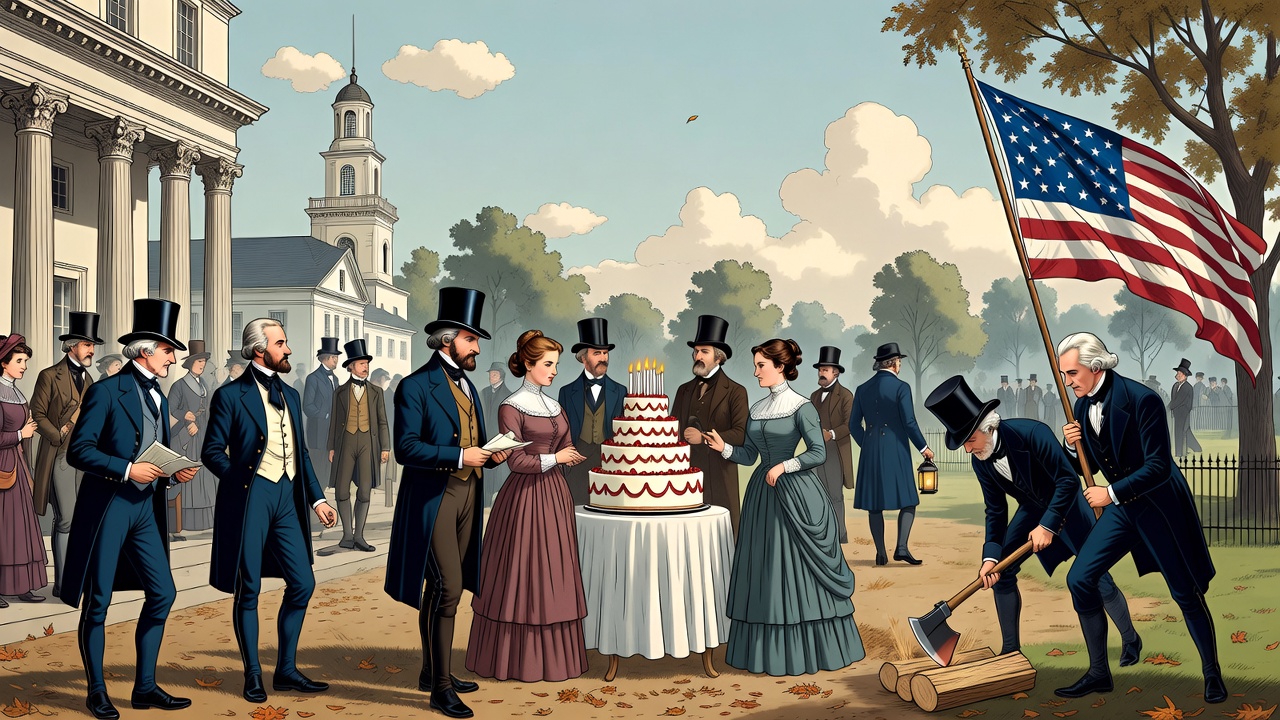
The nineteenth-century celebrations possessed a gravity largely absent from our contemporary observances. These were not occasions for leisure but for civic education and patriotic renewal.
In cities and towns across the nation, the day began with the firing of cannon at sunrise—thirteen rounds for the original colonies, followed by one round for each state in the Union. Church bells rang throughout the morning hours. Public buildings flew flags at full staff, and portraits of Washington, draped in bunting, appeared in shop windows and private homes alike.
Common 19th-Century Traditions:
- Public readings of Washington’s Farewell Address in Congress, state legislatures, and town halls
- Military parades featuring veterans, militia units, and civic organizations
- Grand balls and formal dinners where toasts to Washington’s memory were mandatory
- School programs in which students performed patriotic recitations and tableaux vivants depicting scenes from Washington’s life
- Pilgrimages to Mount Vernon, which became increasingly popular after the Mount Vernon Ladies’ Association purchased the estate in 1858
The Farewell Address readings deserve particular mention. This practice, begun in 1862 during the darkest days of the Civil War, served as a unifying ritual in a nation torn apart. Washington’s warnings against “the baneful effects of the spirit of party” and his counsel for national unity took on urgent meaning as Americans killed Americans on battlefields from Antietam to Gettysburg.
How Washington’s Birthday Parades and Civic Events Evolved Through the Decades
The nature of public celebration shifted dramatically as America itself transformed from agrarian republic to industrial powerhouse to global superpower.
The Gilded Age (1870s-1900)
Parades grew increasingly elaborate, reflecting America’s new wealth and confidence. In New York City, the celebrations rivaled those of Independence Day, with torchlight processions stretching for miles and fireworks illuminating the winter sky. Veterans of the Civil War—both Union and Confederate—often marched together, the holiday serving as a moment of reconciliation.
The Progressive Era (1900-1920)
The celebrations took on new purpose as millions of immigrants arrived on American shores. Washington’s Birthday became an occasion for “Americanization” programs, teaching newcomers about their adopted country’s founding ideals. Schools held special assemblies where immigrant children learned patriotic songs and pledged allegiance to the flag.
The World Wars Era (1914-1945)
During both World Wars, Washington’s Birthday celebrations emphasized sacrifice and duty. War bond drives were launched on February 22nd, and parades featured not just veterans but also active-duty servicemen preparing to ship overseas. The holiday reminded Americans that Washington himself had been a military commander who endured hardship for his country’s freedom.
Post-War America (1945-1971)
The celebrations became more commercialized but retained their civic character. Department stores held sales, but schools still devoted significant time to Washington’s legacy. The cherry tree myth, though historically dubious, became a vehicle for teaching children about honesty and moral character.
Why Congress Changed Washington’s Birthday to Presidents’ Day Weekend
Here we must address a common misconception: Congress never actually changed the holiday’s name to “Presidents’ Day.” The federal holiday remains officially “Washington’s Birthday” to this day. What Congress did change was the date.
The Uniform Monday Holiday Act of 1968, which took effect in 1971, moved Washington’s Birthday from February 22nd to the third Monday of February. The stated purpose was to create more three-day weekends for workers, thereby boosting retail sales and providing families with more leisure time. But the unintended consequence was profound: by moving the holiday away from Washington’s actual birthday, Congress severed the connection between the man and the celebration.
The “Presidents’ Day” nomenclature emerged organically, driven largely by advertisers and some state governments who saw an opportunity to honor Abraham Lincoln as well (whose birthday falls on February 12th). Today, different states call the holiday by different names:
| State Designation | States Using This Name |
|---|---|
| Washington’s Birthday | Federal government, many states |
| Presidents’ Day | California, Texas, and others |
| Washington’s and Lincoln’s Birthday | Several states |
| Presidents Day (no apostrophe) | Various state variations |
The Best Washington’s Birthday Events and Celebrations Happening Across America
Despite the commercialization of the holiday, authentic celebrations of Washington’s legacy persist—and in some places, they’ve experienced a renaissance.
Alexandria, Virginia: George Washington Birthday Parade
The nation’s largest Washington’s Birthday parade takes place annually in Alexandria, the city Washington called home. Established in the 1920s, this parade features Revolutionary War reenactors, marching bands, antique cars, and thousands of spectators lining the streets of Old Town. The parade culminates at the historic Friendship Firehouse, where Washington himself served as an honorary member.
Mount Vernon, Virginia
Washington’s beloved estate hosts a full weekend of celebrations, including:
- Wreath-laying ceremonies at Washington’s tomb
- Free admission for visitors on the holiday
- Revolutionary War military demonstrations
- Special tours focusing on Washington’s birthday celebrations during his lifetime
Laredo, Texas: Washington’s Birthday Celebration
Perhaps the most unexpected celebration occurs in Laredo, where Washington’s Birthday has been observed since 1898. The monthlong festival includes:
- The Martha Washington Society’s Colonial Ball
- The Princess Pocahontas Council Pageant
- An international bridge ceremony with Mexican dignitaries
- Jalapeño-eating contests and rodeo events
This unique blend of American patriotism and Tex-Mex culture demonstrates how communities adapt national traditions to local contexts.
Teaching Children About George Washington: Educational Activities and Lessons
The pedagogical approach to Washington’s Birthday has transformed dramatically since the rigid recitations of the nineteenth century, yet the core purpose remains: transmitting civic values to the next generation.
Modern educators face a challenge their predecessors did not: how to honor Washington’s genuine achievements while acknowledging the moral complexity of a slaveholder who championed liberty. The best educational approaches embrace this tension rather than avoid it.
Age-Appropriate Educational Activities:
| Age Group | Activity | Learning Objective |
|---|---|---|
| K-2 | Cherry tree story and honesty discussions | Character education and storytelling |
| 3-5 | Mapping Washington’s journey (crossing the Delaware, Valley Forge, Yorktown) | Geography and historical narrative |
| 6-8 | Analyzing the Farewell Address | Primary source interpretation and civic values |
| 9-12 | Debating Washington’s legacy (liberty vs. slavery) | Critical thinking and historical complexity |
Many families have developed their own traditions: baking cherry pie (a nod to the apocryphal tree), reading picture book biographies, or visiting local historical sites connected to the Revolutionary era. These small rituals, passed from parent to child, keep Washington’s memory alive in ways that official ceremonies cannot.
How Retailers Transformed Washington’s Birthday Into a Major Shopping Holiday
We cannot tell the honest story of this holiday without confronting its commercial transformation. What began as solemn civic observance has become, for many Americans, synonymous with mattress sales and automobile clearance events.
The commercialization began innocuously enough. Department stores in the late nineteenth century decorated their windows with patriotic themes and offered special promotions. By the mid-twentieth century, Washington’s Birthday sales had become a retail tradition nearly as established as the holiday itself.
The Uniform Monday Holiday Act accelerated this trend dramatically. The guaranteed three-day weekend created a natural shopping opportunity, and retailers responded accordingly. Today, “Presidents’ Day Weekend” generates billions in retail sales, making it one of the most significant shopping periods outside the traditional winter holiday season.
Evolution of Commercial Practices:
- 1880s-1920s: Patriotic window displays, modest sales
- 1930s-1950s: “Washington’s Birthday Sales” become annual tradition
- 1960s-1970s: Three-day weekend creates shopping boom
- 1980s-present: Major advertising campaigns, aggressive discounting
Some cultural critics lament this development, arguing that consumerism has drowned out civic meaning. Others suggest that the holiday’s commercial success actually keeps Washington in public consciousness, even if imperfectly. The truth likely lies somewhere between these positions.
Rediscovering the Meaning of Washington’s Birthday in Modern America
As we approach the 150th anniversary of Washington’s Birthday as a federal holiday, Americans face a question: what should this day mean to us now?
The answer cannot simply be nostalgia for nineteenth-century pageantry. Nor can it be uncritical hero worship that ignores Washington’s moral failures. But perhaps it can be something more nuanced—a day for reflecting on the American experiment itself, with all its contradictions and aspirations.
Washington’s greatness lay not primarily in his military victories or political skills, but in his willingness to relinquish power. When he voluntarily stepped down after two terms, King George III reportedly called him “the greatest man in the world.” In an age of autocrats and strongmen, Washington demonstrated that republican government could survive the transition of power—a lesson that remains urgently relevant.
Ways to Meaningfully Observe Washington’s Birthday:
- Read Washington’s Farewell Address—it takes about 45 minutes and remains startlingly relevant
- Visit a Revolutionary War site, battlefield, or historical museum
- Discuss with family members what Washington’s ideals mean in contemporary context
- Volunteer for civic organizations that embody the spirit of public service
- Cook a meal using colonial-era recipes (Martha Washington’s cookbook is available online)
Conclusion: Why Washington’s Birthday Still Matters to American National Identity
Nearly a century and a half after Congress first designated this holiday, George Washington remains the essential American. Not because he was perfect—he manifestly was not—but because he embodied the possibility that flawed human beings could create something unprecedented: a nation founded not on blood or soil but on ideas.
When we celebrate Washington’s Birthday, we celebrate that possibility. We honor the extraordinary gamble of the American founding and recommit ourselves to the unfinished work of making its promises real for all citizens.
The parades may be smaller now, the cannon salutes largely silent. Shopping malls have replaced town squares as gathering places, and many Americans enjoy the holiday without once thinking of the man it honors. Yet something of Washington’s spirit persists—in the peaceful transitions of power we take for granted, in the civic institutions that function despite our divisions, in the enduring dream of a more perfect union.
Perhaps that is celebration enough.