Every February 28, blue-and-white flags rise across Finland — not for a military victory or a political milestone, but for a book of poetry. That quiet act of flag-raising tells you everything about how deeply the Finns treasure their stories.
Kalevala Day (Kalevalan päivä), also known as Finnish Culture Day (suomalaisen kulttuurin päivä), is one of Finland’s most meaningful cultural holidays. Observed each year on February 28, it honors the Kalevala — the national epic of Finland — and celebrates the broader heritage of Finnish language, art, and identity. In 2026, the occasion carries fresh significance: the European Commission awarded the Kalevala its prestigious European Heritage Label in April 2024, recognizing it as one of the few pieces of intangible cultural heritage to earn that distinction across the entire European Union.
But what exactly is the Kalevala? Why does it matter so much to Finland? And how do Finns — and people around the world — celebrate it today? This guide covers everything you need to know.
When Is Kalevala Day 2026 and Why Is February 28 the Date?
Kalevala Day falls on Saturday, February 28, 2026. The date never changes. It is fixed to February 28 every year.
The reason is simple but powerful. On February 28, 1835, a physician and folklorist named Elias Lönnrot signed the preface to the first edition of the Kalevala. That signature marked the moment when centuries of oral poetry — songs passed down by generations of Finnish and Karelian rune singers — entered the written record as a unified literary work for the first time.
That first edition, now called the Old Kalevala (Vanha Kalevala), contained 12,078 verses. Lönnrot continued collecting and revising. In 1849, he published the expanded New Kalevala, which nearly doubled the poem to 22,795 verses across 50 cantos. It is this 1849 version that most readers know today, and it has since been translated into more than 60 languages.
Kalevala Day is one of Finland’s official flag flying days. By law, the Finnish flag must fly from all public buildings. Many private citizens also choose to raise the flag at home — a calm, dignified gesture that is very Finnish in character.
| Key Facts About Kalevala Day | |
|---|---|
| Date | February 28 (annually) |
| Also known as | Finnish Culture Day (suomalaisen kulttuurin päivä) |
| Type | Official flag day; cultural observance |
| Origin date | February 28, 1835 (Lönnrot signs preface) |
| First public celebration | 1865, by university students in Helsinki |
| First major public event | 1885 (50th anniversary), organized by the Finnish Literature Society |
| Public holiday? | No — offices and shops remain open |
Who Was Elias Lönnrot and How Did He Compile the Kalevala?
To understand Kalevala Day, you need to understand the man behind the epic. Elias Lönnrot (1802–1884) was a Finnish physician, philologist, and tireless collector of folk poetry. He was born in Sammatti, in the province of Uusimaa, into a modest family. Despite financial hardships, he pursued an education and eventually earned a medical degree.
But Lönnrot’s true passion lay elsewhere. In the early 19th century, Finland was a Grand Duchy under the Russian Empire. Before that, it had spent centuries under Swedish rule. The Finnish language had limited official status. Finnish-speaking people had no written national myth of their own — nothing comparable to the Norse Edda or Homer’s Iliad.
Lönnrot set out to change that. Beginning in 1828, he traveled extensively through Finland and Karelia, a region now split between Finland and Russia. He visited remote villages, sat with elderly rune singers, and recorded the ancient poems they chanted in the traditional Kalevala meter — a trochaic octosyllabic verse form unique to Baltic-Finnic oral poetry.
His goal was urgent. European rhymed poetry was growing popular, and the old oral traditions were fading. Lönnrot was racing against time to preserve songs that existed only in living memory.
He did not simply transcribe what he heard. Lönnrot arranged, combined, and edited the poems into a single narrative arc. He drew from multiple singers, merged variant versions, and added bridging passages to create a cohesive story. In this sense, the Kalevala is both a work of folklore and a work of literary artistry — an authored compilation rather than a single ancient text.
A statue of Elias Lönnrot stands in Helsinki. It was sculpted by Emil Wikström and erected in 1902 during a period of Russian attempts to suppress Finnish national identity. Because the Russian authorities sought to prevent displays of patriotism, the statue was unveiled in the dark of night — no ceremony, no speeches. Yet in the following days, silent crowds gathered, and wreaths appeared at its base. That quiet defiance became a tradition. To this day, laying wreaths at Lönnrot’s statue is a central part of Kalevala Day observances.
What Is the Kalevala About? A Guide to Finland’s National Epic Poem
The Kalevala is set in a mythical landscape that mirrors the real geography of Finland and Karelia — a world of dark forests, vast lakes, frozen wastes, and the mysterious North. It tells the stories of heroes, wizards, blacksmiths, and sorcerers through a blend of creation myth, adventure, romance, tragedy, and magic.
The Main Characters of the Kalevala
The epic revolves around several unforgettable figures:
- Väinämöinen — The central hero. He is an ancient, wise bard and shaman born of the goddess Ilmatar. His weapon is not a sword but his magical singing voice. He plays the kantele, a traditional Finnish stringed instrument he crafted from the jawbone of a giant pike. Väinämöinen’s name likely derives from the Finnish word väinä, meaning a slow-flowing stretch of deep water.
- Ilmarinen — A legendary blacksmith who forged the dome of the sky itself. He creates the Sampo, a magical artifact of immense power. He is practical, skilled, and loyal — a contrast to the mystical Väinämöinen.
- Lemminkäinen — A bold, reckless warrior-adventurer driven by love and pride. His mother’s devotion to him — she retrieves him from the river of death and reassembles his body — is one of the epic’s most moving episodes.
- Louhi — The powerful Mistress of Pohjola (the dark Northland). She is a cunning sorceress who commands bears, wolves, disease, and darkness. Louhi is both antagonist and a complex matriarchal figure.
- Kullervo — A tragic young man raised in slavery, consumed by anger and sorrow. His story of unknowing transgression and self-destruction is one of the darkest passages in any national epic.
The Sampo: The Mysterious Heart of the Story
At the center of the narrative lies the Sampo — a magical mill or artifact forged by Ilmarinen at Louhi’s demand. The Sampo produces grain, salt, and gold from nothing. Its exact nature is deliberately unclear. Some scholars interpret it as a world pillar holding up the sky. Others see it as an allegory for prosperity and good fortune.
The quest to create, steal, and recover the Sampo drives much of the epic’s plot. When the heroes of Kalevala steal the Sampo from Louhi, it falls into the sea and shatters. Only fragments wash ashore — yet those fragments bring fertility to the land. The loss of the Sampo and its partial recovery carry a bittersweet message: complete abundance is impossible, but the remnants of effort still bear fruit.
How the Kalevala Ends
The final canto introduces Marjatta, a maiden who becomes pregnant from a berry and gives birth to a miraculous son. The child is declared King of Karelia. Väinämöinen, stung by this turn of events, sails away in a copper boat to a land between earth and sky. Before departing, he leaves behind his kantele and his songs as a gift to the people — a promise that his wisdom will endure even in his absence.
This ending is widely read as an allegory for the arrival of Christianity in Finland and the fading of the old pagan beliefs. It carries a tone of melancholy acceptance, much like King Arthur’s departure for Avalon in British legend.
How the Kalevala Shaped Finnish National Identity and Independence
The Kalevala is not just a poem. It is a nation-building document. Its impact on Finnish history is difficult to overstate.
When Lönnrot published the first edition in 1835, Finland had no independent state, no widely shared literary tradition in the Finnish language, and limited cultural self-confidence. The educated class mostly spoke Swedish. The Russian imperial administration held political power. Finnish-speakers lacked a unifying national story.
The Kalevala changed that. It gave Finns a myth of their own — a rich, ancient, distinctively Finnish worldview rooted not in Swedish or Russian culture, but in the forests and lakes of their own homeland. It energized the Fennoman movement, which championed the Finnish language and culture against the dominance of Swedish.
Over the following decades, the Kalevala became a rallying point for Finnish national consciousness. It fueled the language strife (kielitaistelu) that ultimately led to Finnish gaining equal official status alongside Swedish. It inspired artists, composers, and writers who forged a distinct cultural identity. And that identity became the foundation for political action.
On December 6, 1917, Finland declared independence from Russia. The road to that moment ran, in a very real sense, through the pages of the Kalevala.
How Jean Sibelius and Akseli Gallen-Kallela Brought the Kalevala to Life
The Kalevala did not remain confined to the printed page. It sparked a golden age of Finnish art in the late 19th and early 20th centuries, with two towering figures leading the way.
Jean Sibelius: The Sound of the Kalevala
Jean Sibelius (1865–1957), Finland’s most celebrated composer, first encountered the Kalevala as a grammar school student during the surge of Finnish nationalism. The epic shaped his career.
His first major work was the Kullervo Symphony (Op. 7), a monumental five-movement choral symphony composed in 1891–1892. It set passages from the Kalevala‘s Kullervo cantos for soprano, baritone, male choir, and full orchestra. The premiere on April 28, 1892, at the Imperial Alexander University in Helsinki, was a sensation. Sibelius, at just 26, became a national hero overnight.
He returned to the Kalevala throughout his life. His Lemminkäinen Suite includes the famous tone poem The Swan of Tuonela, depicting the black swan that glides on the river of the underworld. Other Kalevala-inspired works include Pohjola’s Daughter, Luonnotar, and Tapiola — the last conjuring the dense, primeval Finnish forest with extraordinary orchestral power.
Akseli Gallen-Kallela: Painting the Myths
Akseli Gallen-Kallela (1865–1931) did for Finnish visual art what Sibelius did for music. His bold, striking paintings of Kalevala scenes — such as The Defence of the Sampo, Lemminkäinen’s Mother, and the Aino Triptych — became iconic images of Finnish identity.
Gallen-Kallela traveled to Karelia in the 1890s, during the peak of the Karelianist movement, when Finnish artists and intellectuals looked to eastern Finland as a living link to the ancient culture described in the epic. His work fused symbolism, Art Nouveau, and raw emotional power. Today, the Gallen-Kallela Museum in Espoo preserves his legacy and is a partner in the Kalevala’s European Heritage Label project.
How J.R.R. Tolkien Was Inspired by the Kalevala and Finnish Mythology
The Kalevala‘s reach extends far beyond Finland. Its most famous international admirer was J.R.R. Tolkien (1892–1973), the author of The Lord of the Rings and The Silmarillion.
Tolkien first discovered the Kalevala around 1911 as a schoolboy in Birmingham, reading W.F. Kirby’s English translation. He was immediately captivated. He later described the experience of encountering Finnish as like finding a wine cellar filled with bottles of a flavor he had never tasted before. He taught himself Finnish specifically to read the original.
The Kalevala left deep marks on Tolkien’s work:
- Kullervo became Túrin Turambar. In 1914, as an Oxford undergraduate, Tolkien began retelling the Kalevala‘s Kullervo story in his own prose — an unfinished work published posthumously as The Story of Kullervo. The tragic hero Kullervo directly inspired the character of Túrin Turambar in The Silmarillion and The Children of Húrin. Tolkien himself called Kullervo’s tale the seed from which his own mythology grew.
- The Sampo echoes in the Silmarils and the One Ring. Both the Kalevala‘s magical artifact and Tolkien’s precious objects are coveted treasures that drive conflict, corrupt their possessors, and ultimately cannot be fully controlled.
- Väinämöinen resonates in Gandalf and Tom Bombadil. The wise, ancient singer-shaman who shapes the world through song and eventually departs, leaving his legacy behind, finds echoes in several of Tolkien’s characters.
- Finnish shaped Quenya. Tolkien’s invented Elvish language, Quenya, was directly influenced by Finnish phonology — its long vowels, flowing consonants, and agglutinative structure.
Tolkien scholar Verlyn Flieger has argued that without the Kalevala, we might not have The Silmarillion — at least not in the form we know it. The Kalevala was, quite literally, the spark that ignited one of the 20th century’s greatest literary achievements.
How Do Finns Celebrate Kalevala Day? Traditions and Events in 2026
Kalevala Day is not a public holiday in Finland. Offices, shops, and public transport operate on normal schedules. But it is far from an invisible occasion.
Flag Flying Across Finland
The most visible tradition is the raising of the Finnish flag. As an official flag day, the blue-and-white cross flies from government buildings, schools, churches, and private homes across the country. According to the Finnish Ministry of the Interior, flags should be raised at 8:00 a.m. and lowered at sunset.
School and University Events
Schools organize storytelling sessions, dramatic readings, and student performances based on the Kalevala. Many Finnish children first encounter the epic through Kalevala Day activities. University students, particularly members of student nations, continue the tradition of torchlit processions and wreath-laying at Lönnrot’s statue in Helsinki — a practice dating to 1865, when the Savo-Karelian Student Nation held the first Kalevala celebration.
Museum Exhibitions and Cultural Programs
Libraries and museums across Finland host exhibitions, lectures, and workshops. These range from displays of historical manuscripts and folk art to modern multimedia installations exploring the Kalevala‘s themes.
The Juminkeko Information Center in Kuhmo, eastern Finland, is a year-round destination dedicated to the Kalevala and Karelian culture. For travelers interested in the epic’s living roots, it is an essential stop.
Music, Art, and Performance
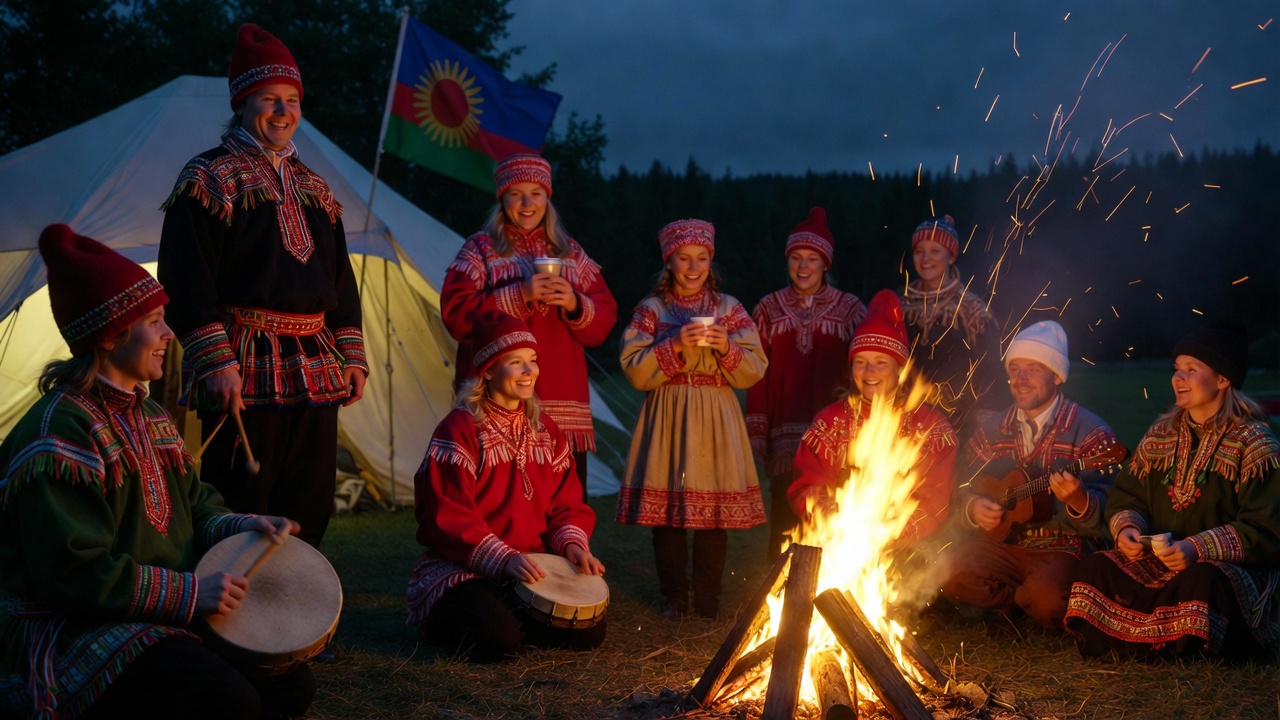
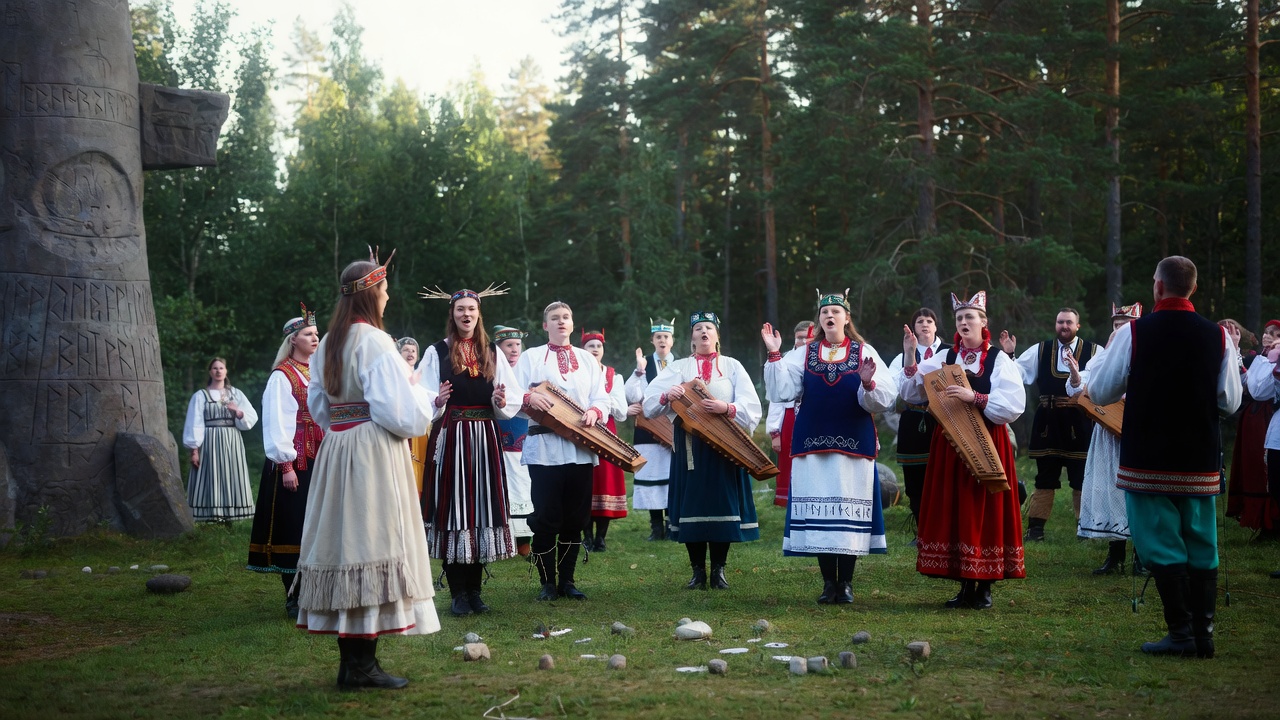
Concerts featuring Sibelius’s Kalevala-inspired works are common around this date. Folk musicians perform on the kantele, the traditional instrument associated with Väinämöinen. Contemporary artists, from painters to tattoo designers to metal bands, also draw on the Kalevala — a testament to the epic’s remarkable ability to inspire new generations.
Kalevala Day Celebrations Outside Finland
Finnish diaspora communities around the world observe the occasion. In 2026, the Duluth Ladies of Kaleva in Minnesota are hosting a Kalevala Day event on February 28, featuring live music, Finnish food, baked goods, and a guest speaker. In Seattle, the Finnish Choral Society hosts its 47th Annual Kalevala Day Festival at the National Nordic Museum — a tradition maintained since 1976.
The Kalevala’s European Heritage Label: What It Means in 2026
On April 11, 2024, the European Commission awarded the Kalevala its European Heritage Label — a designation granted since 2013 to sites, monuments, and documents central to European history, culture, and integration. The Kalevala is one of only a handful of intangible cultural heritage items to receive this honor.
The label recognizes the Kalevala as what the Commission calls a “living epic” — one that continues to generate new artistic, scientific, and cultural interpretations rather than merely sitting in archives.
Connected to the label is the Epic Kaleidoscope pedagogical project, led by the Finnish Literature Society together with the Kalevala Society Foundation, the Gallen-Kallela Museum, the Juminkeko Foundation, and the Parppeinvaara Rune Singer’s Village. The project runs through 2028 and aims to:
- Produce digital learning materials about the Kalevala in multiple languages
- Organize workshops and events for young Europeans to engage with epic traditions
- Highlight the endangered Karelian language and the cultural minorities behind the oral poetry that became the Kalevala
This last point is especially significant. The Karelian language, spoken by an estimated 20,000–25,000 people, is endangered and does not hold official language status in Finland. The Heritage Label project aims to raise awareness of the diverse linguistic and cultural roots behind Finland’s national epic.
Where to Experience the Kalevala: Travel Tips for Visitors to Finland
If Kalevala Day sparks your curiosity, Finland offers several destinations where you can experience the epic firsthand.
| Destination | Location | What You’ll Find |
|---|---|---|
| Lönnrot Statue | Helsinki city center | Wreath-laying ceremonies on Kalevala Day; a symbol of Finnish cultural resilience |
| Juminkeko Information Center | Kuhmo, eastern Finland | Year-round exhibitions on the Kalevala and Karelian culture |
| Parppeinvaara Rune Singer’s Village | Ilomantsi, North Karelia | A living-history site where rune-singing traditions are preserved |
| Gallen-Kallela Museum | Espoo (near Helsinki) | The studio-home of Akseli Gallen-Kallela, with Kalevala-themed paintings |
| Finnish Literature Society (SKS) | Helsinki | Archives of the original folk poems, manuscripts, and first editions |
| Kalevala District | Tampere | A neighborhood named after the epic; includes the Sampo district |
Practical tip: February 28 falls during the Finnish winter. Expect cold temperatures, short daylight hours, and possibly snow. Dress warmly. Public transport runs on a normal schedule since Kalevala Day is not a public holiday. Most museums and cultural venues are open, but it is wise to check specific event schedules in advance.
Why the Kalevala Still Matters: A Living Epic in the Modern World
What makes the Kalevala extraordinary is not just its age or its literary quality — it is the fact that it refuses to become a relic. Nearly two centuries after its first publication, the epic remains a living presence in Finnish culture.
In music, Finnish metal bands like Amorphis, Korpiklaani, and Turisas draw heavily on Kalevala mythology. Amorphis’s album Tales from the Thousand Lakes (1994) is entirely based on Kalevala stories. The kantele continues to be played and taught. Sibelius’s Kalevala-inspired compositions remain cornerstones of the orchestral repertoire worldwide.
In literature and popular culture, Kalevala characters appear in comics, video games, and contemporary fiction. The Donald Duck comic artist Don Rosa even drew an Uncle Scrooge story called The Quest for Kalevala, in which Scrooge and company seek to reassemble the Sampo.
In daily life, the Kalevala‘s influence is woven into Finland’s geography and commerce. Districts in Finnish cities carry names from the epic — Tapiola in Espoo, Kaleva and Sampo in Tampere, Pohjola in Turku. The Kalevala Koru jewelry brand, founded in 1937, creates designs inspired by the epic and ancient Finnish ornaments.
In education, Finnish children grow up with the Kalevala. It is part of the national curriculum. Kalevala Day ensures that each year, a new generation encounters the stories of Väinämöinen, Ilmarinen, and Louhi.
And in broader cultural terms, the Kalevala stands as proof that a people’s stories can shape their destiny. A collection of songs, gathered from the lips of elderly singers in remote Karelian villages, helped build a national language, a national art, and ultimately a nation.
Frequently Asked Questions About Kalevala Day in Finland
Is Kalevala Day a public holiday in Finland? No. It is an official flag day and cultural observance, but it is not a public holiday. Schools, offices, and businesses operate normally.
What is the Kalevala in simple terms? The Kalevala is Finland’s national epic poem. It is a collection of ancient oral poetry — myths, legends, and songs — compiled into a single narrative by Elias Lönnrot and first published in 1835. It tells the stories of heroes, gods, and magical beings in a mythical Finnish landscape.
How long is the Kalevala? The most widely known version (the 1849 New Kalevala) contains 22,795 verses divided into 50 cantos.
Can I read the Kalevala in English? Yes. Widely respected English translations include those by Keith Bosley (Oxford World’s Classics) and Eino Friberg. Several other translations exist as well.
What does “Kalevala” mean? The name can be translated as “the land of Kaleva.” Kaleva is a mythical ancestral figure in Finnish folklore.
Did J.R.R. Tolkien really learn Finnish because of the Kalevala? Yes. Tolkien taught himself Finnish after encountering the Kalevala in English translation. He used Finnish phonology as a primary influence for his invented Elvish language, Quenya.
Final Thoughts: What Kalevala Day Teaches the World About Cultural Heritage
Kalevala Day is not loud. There are no fireworks, no parades, no late-night parties. It is a day of flags, readings, quiet reflection, and shared pride — very much in keeping with the Finnish national character.
But beneath that stillness lies something powerful. Kalevala Day reminds us that stories matter. A physician wandering through frozen forests, writing down the songs of elderly villagers, helped give a people their voice. That voice echoed through music, painting, literature, and politics until it carried a nation to independence.
In 2026, with the Kalevala now bearing the European Heritage Label and the Epic Kaleidoscope project bringing the epic to new audiences across Europe, the story continues to unfold. The Sampo may have shattered long ago — but its fragments, as the Kalevala itself teaches, still bring life to the land.
Hyvää Kalevalan päivää — Happy Kalevala Day.