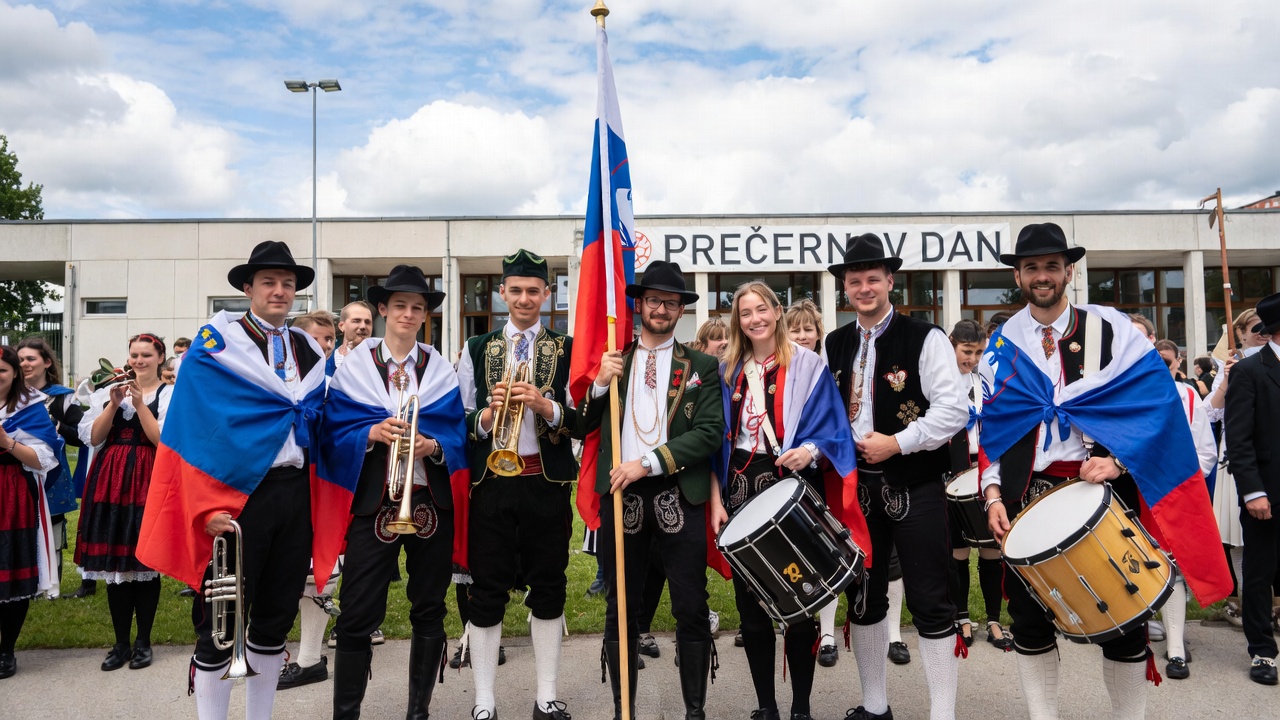
Every year on February 8, Slovenia pauses. Schools close. Offices go quiet. Museums swing open their doors — free of charge. The entire nation turns its attention to a man who died nearly two centuries ago, yet whose words still echo through the country’s identity. This is Prešeren Day (Prešernov dan), Slovenia’s national cultural holiday. And understanding it means understanding Slovenia itself.
Why Does Slovenia Celebrate Prešeren Day on February 8?
February 8 is the anniversary of the death of Dr. France Prešeren (1800–1849), the greatest poet in Slovenian literary history. But this holiday is about far more than mourning a lost writer. It is a celebration of Slovenian culture, language, and national identity.
The full official name of the day is Prešeren Day, the Slovenian Cultural Holiday (Prešernov dan, slovenski kulturni praznik). It is a public holiday and a work-free day. Most businesses, shops, and government offices close. In 2026, it falls on a Sunday, February 8, so some businesses may follow Sunday opening hours instead.
The holiday serves a dual purpose. First, it honors Prešeren’s lasting contribution to Slovenian literature and nationhood. Second, it functions as a broader celebration of all Slovenian cultural achievements — from visual arts and theater to music and film.
Slovenia is one of the few countries in the world that dedicates a national holiday entirely to culture and to a poet, rather than to a military victory or political figure. This says something profound about the Slovenian character. In Ljubljana’s central square, the main monument is not of a general or a king. It is a bronze statue of France Prešeren, holding a book of poems, gazing forever toward the window of his unrequited love.
Who Was France Prešeren: The Life of Slovenia’s National Poet
France Prešeren was born on December 3, 1800, in the village of Vrba na Gorenjskem, a small settlement nestled beneath the Julian Alps in what was then part of the Habsburg monarchy. He was the third of eight children and the first son in a farming family. His mother, Mina, was well-read and ambitious for her children. She wanted France to become a priest — a respected profession in their community.
Young France showed exceptional academic talent from an early age. His uncle Jožef, a Catholic priest, taught him to read and write and supported his education financially. At the age of eight, France was sent to elementary schools in Grosuplje and Ribnica. By 1812, he had moved to Ljubljana to attend the State Gymnasium, where he learned Latin, Ancient Greek, and German.
Education in Vienna and Literary Awakening
In 1821, Prešeren enrolled at the University of Vienna to study philosophy, and later switched to law. Vienna was the intellectual heart of the Habsburg Empire. There, Prešeren immersed himself in the Western literary canon. He read Homer, Dante, Petrarch, Goethe, and contemporary Romantic poets. This exposure transformed him.
He also formed a deep friendship with Matija Čop, a philologist, literary historian, and librarian. Čop became Prešeren’s closest intellectual companion and literary mentor. Together, they fought the so-called “Alphabet War” — a debate over the standardization of the Slovenian written language. Their work helped establish Slovenian as a serious literary language, not merely a rural dialect.
The Unrequited Love for Julija Primic
On Easter Saturday, April 6, 1833, Prešeren supposedly first saw Julija Primic at the Trnovo Church in Ljubljana. She was the daughter of a wealthy merchant. Prešeren fell deeply in love, but Julija did not return his feelings. She later married one of his former schoolmates.
This unrequited love became the central emotional force of Prešeren’s poetry. He dedicated some of his most famous works to her, including:
- Sonetni venec (A Wreath of Sonnets, 1834) — a technically brilliant cycle of 15 interconnected sonnets. The first letters of each line in the final sonnet spell out “PRIMICOVI JULIJI” (To Julija Primic).
- Gazele (Ghazals) — lyric love poems in the Arabic-inspired form.
- Sonetje nesreče (Sonnets of Unhappiness, 1834) — a deeply personal cycle reflecting his despair.
Following Čop’s advice, Prešeren elevated Julija into a poetic figure. She became his Beatrice, his Laura — a muse who represented not just personal longing, but the longing of an entire nation for recognition and freedom.
Tragedy, Loss, and Literary Greatness
Prešeren’s personal life was marked by repeated loss. In 1835, his beloved friend Matija Čop drowned in the Sava River at the age of 38. The same year, Julija married another man. Prešeren channeled his grief into Krst pri Savici (The Baptism on the Savica, 1836), an epic poem dedicated to Čop. This work is widely considered one of the masterpieces of Slovenian literature.
In 1840, another close friend, Andrej Smole, died suddenly in Prešeren’s arms during his own birthday celebration. Prešeren was left increasingly isolated and depressed.
Despite his literary brilliance, Prešeren struggled professionally. He wanted to practice law independently, but the Austrian authorities considered him politically unreliable and repeatedly denied his applications. He was not granted his own law office until 1846, when he was finally appointed as a provincial lawyer in Kranj.
France Prešeren died on February 8, 1849, in Kranj, at the age of 48. He died largely unrecognized and alone. He was buried at the old Kranj cemetery, now known as Prešeren’s Grove (Prešernov gaj).
The Major Literary Works of France Prešeren You Should Know
Prešeren’s output was not enormous in volume — he lived only 49 years and spent much of his energy on legal work — but the quality and range of his poetry was extraordinary. Here are the works that cemented his reputation as a poet of European stature.
Sonetni venec (A Wreath of Sonnets, 1834)
This is one of Prešeren’s most celebrated technical achievements. A wreath of sonnets is a complex poetic form consisting of 15 sonnets linked together in a specific pattern. The last line of each sonnet becomes the first line of the next. The fifteenth and final sonnet — called the Magistrale or “Master Theme” — is composed entirely of the first lines of the preceding fourteen sonnets.
In Prešeren’s version, the initial letters of each line in the Magistrale form an acrostic spelling “PRIMICOVI JULIJI” — “To Julija Primic.” This caused a scandal among the conservative readers of his day. Julija herself was reportedly displeased that the poet had so publicly declared his love.
Beyond its technical brilliance, A Wreath of Sonnets weaves together themes of personal love and national destiny. Prešeren imagines a new “Orpheus” whose poetry will awaken the Slovenian nation and unify it in cultural pride.
Krst pri Savici (The Baptism on the Savica, 1836)
This epic-lyric poem is dedicated to Prešeren’s friend Matija Čop, who drowned in the Sava River in 1835. It tells the story of Črtomir, a pagan Slavic warrior, and Bogomila, the woman he loves. After a battle between Christians and pagans at the Savica waterfall, Črtomir agrees to be baptized at Bogomila’s request.
The poem operates on multiple levels. On the surface, it is a story about the clash between old and new faiths. Deeper down, it explores themes of surrender, loss, and the tension between individual freedom and collective destiny. The Savica Waterfall, a real and dramatic natural site near Lake Bohinj, adds a vivid sense of place. Today, visitors to the waterfall often connect their visit to Prešeren’s poem.
Povodni mož (The Water Man, 1830)
This is Prešeren’s first and most famous ballad. It tells the story of Urška, a beautiful and vain young woman who rejects all the men who ask her to dance at a Sunday ball in Ljubljana’s Old Square (Stari trg). As evening falls, a mysterious stranger appears and asks her to dance. She agrees. They spin faster and faster until both disappear into the whirlpool of the Ljubljanica River.
The ballad draws on Slovenian folk tradition and the European Romantic fascination with supernatural beings. It remains one of the most widely known Slovenian literary works. A monument to the Water Man and Urška can be found along the banks of the Ljubljanica in Ljubljana.
Poezije (Poems, 1847)
Prešeren’s only published collection of poems, Poezije dr. Franceta Prešerna, appeared in late 1846 (with the printed date of 1847). He had been preparing this collection for years, gathering his finest work. The collection did not include Zdravljica due to censorship issues.
Despite its modest reception during Prešeren’s lifetime, Poezije is now considered a cornerstone of Slovenian literature. Every work in the collection has been analyzed, translated, and studied by generations of scholars.
How Zdravljica Became the Slovenian National Anthem
Among all of Prešeren’s works, none carries more national weight than Zdravljica — translated as “A Toast.”
Prešeren wrote Zdravljica around St. Martin’s Day in November 1844. The poem is a carmen figuratum — a shaped poem — in which each stanza is arranged to resemble the outline of a wine glass. This is fitting for a toast, and also fitting for Slovenia, a country proud of its winemaking tradition.
Zdravljica is a drinking song on its surface. But beneath the convivial tone lies a powerful political message. The poem calls for national liberation, freedom of thought, and the peaceful coexistence of all nations. This was a bold statement in the oppressive atmosphere of the Habsburg Empire.
Censorship and the March Revolution
When Prešeren prepared to publish his poetry collection Poezije (Poems) in 1846, the Austrian censor — a fellow Slovene named Franc Miklošič — flagged several stanzas of Zdravljica as promoting pan-Slavic sentiment. Prešeren refused to publish a mutilated version and excluded the poem entirely from the collection.
The full text of Zdravljica was only published on April 26, 1848, after the March Revolution temporarily abolished Austrian censorship. When it appeared in the newspaper Kmetijske in rokodelske novice, Slovenians immediately embraced it as a poem of liberation and unity.
From Poem to Anthem
The seventh stanza of Zdravljica carries a universal message of peace and brotherhood among nations. Its words transcend narrow nationalism. As the Slovenian government has noted, Zdravljica is one of the few non-militant national anthems in the world.
On September 27, 1989, the Assembly of the Socialist Republic of Slovenia adopted the seventh stanza of Zdravljica, set to a choral composition by Stanko Premrl from 1905, as the regional anthem. This was one of the earliest official signals of Slovenia’s desire for independence from Yugoslavia.
When Slovenia declared independence on June 25, 1991, Zdravljica became the anthem of the new sovereign state. In 2020, Zdravljica was awarded the European Heritage Label, recognizing its significance beyond Slovenian borders.
| Key Facts About Zdravljica | |
|---|---|
| Year Written | 1844 |
| First Full Publication | April 26, 1848 |
| Composer of Anthem Melody | Stanko Premrl (1905) |
| Adopted as Anthem | September 27, 1989 |
| Languages Translated Into | Over 25 |
| European Heritage Label | Awarded 2020 |
| Form | Carmen figuratum (stanzas shaped like wine glasses) |
The History of Prešeren Day: From Wartime Resistance to National Holiday
The story of how February 8 became Slovenia’s cultural holiday begins not in peacetime, but during the darkest chapter of the 20th century.
Origins During World War II
During World War II, Slovenia was occupied and divided among Nazi Germany, Fascist Italy, and Hungary. Slovenian artists were repressed. The Slovenian language was banned in many areas. Cultural expression became an act of resistance.
In 1941, February 7 — the eve of Prešeren’s death anniversary — was first celebrated as a day of all-Slavic unity. Then, in January 1945, a cultural worker named Bogomil Gerlanc proposed to the Slovene Liberation Front in the liberated town of Črnomelj that February 8 should become the official Slovenian cultural holiday.
On January 28, 1945, the Presidency of the Slovene National Liberation Council issued a decree making it official. The announcement was published in the newspaper Slovenski poročevalec on February 1, 1945.
Through Yugoslavia and Into Independence
Prešeren Day remained a public holiday during the era of the Socialist Republic of Slovenia within Yugoslavia. It was celebrated by Slovenian communities everywhere — including by Carinthian Slovenes in Austria and the Slovene minority in Italy.
However, it was not declared a work-free day until 1991, the year Slovenia gained independence. This decision was somewhat controversial. Some Slovenians worried that making it a day off would lead to the “banalisation” of a holiday originally meant for cultural enrichment, not leisure.
As a result, December 3 — the anniversary of Prešeren’s birth — gradually gained its own cultural significance. Slovenians now call it the “Merry Day of Culture” (Veseli dan kulture). On this day, too, many museums and galleries open their doors for free. Both dates are now widely celebrated, though only February 8 holds official status as a national holiday.
How Slovenians Celebrate Prešeren Day: Traditions and Cultural Events
Prešeren Day is not a holiday of fireworks or parades. It is quieter, more reflective — a celebration rooted in artistic appreciation and cultural pride.
Free Entry to Museums and Galleries Across Slovenia
One of the most beloved traditions of Prešeren Day is that all state and municipal museums and galleries offer free admission. This is the original spirit of the holiday: to encourage people to engage with culture and the arts.
In Ljubljana alone, visitors can explore:
- The National Gallery of Slovenia — home to the country’s most important fine art collection
- The Slovenian Ethnographic Museum — showcasing everyday and festive heritage
- The City Museum of Ljubljana — covering the capital’s history from prehistory to the present
- The Museum of Modern Art — featuring contemporary Slovenian visual arts
- Ljubljana Castle — which hosts free guided tours and exhibitions on Prešeren Day
- The Cukrarna Gallery — a converted 19th-century sugar refinery turned contemporary art space
Outside the capital, cultural institutions across the country participate. The Slovenian tourism board highlights opportunities in Maribor, Idrija, Pivka, and many smaller towns.
The Prešeren Fair in Kranj
The city of Kranj, where Prešeren spent his final years and died, hosts one of the most lively celebrations: the Prešeren Fair (Prešernov sejem).
During this event, the old town center of Kranj comes alive. Townspeople dress in 19th-century attire. Craft vendors sell traditional cottage industry products. Visitors can take horse-drawn carriage rides through the historic streets. Cultural institutions like the Gorenjska Museum, the Prešeren Theatre, and the Prešeren House memorial museum all participate with special programs.
The fair also features a tradition called the Gathering of the Muses on the Carniolan Parnassus (Zbor muz na kranjskem Parnasu), in which the town hosts the year’s Prešeren Award and Prešeren Fund Award winners.
The Cultural Heritage Path in Vrba
In Vrba na Gorenjskem, Prešeren’s birthplace, the holiday is marked by walks along the Cultural Heritage Path (Kulturna pot). This scenic 10-kilometer trail connects the birth houses of several major Slovenian literary figures, including Prešeren and Matija Čop.
Visitors can see the Prešeren Birth House, now a museum, and enjoy views of the Julian Alps and Mount Triglav, Slovenia’s highest peak at 2,864 meters. Although the path can be walked year-round, doing so on Prešeren Day alongside hundreds of locals and visitors is a uniquely moving experience.
LUV Fest in Ljubljana: Where Culture Meets Love
In recent years, Ljubljana has expanded the cultural holiday into a broader festival season. LUV Fest runs from February 8 to March 12, bridging Prešeren Day with St. Gregory’s Day (March 12), which Slovenian tradition considers a holiday of love — the day “the birds get married.”
According to Visit Ljubljana, LUV Fest in 2026 will feature an open-air art gallery, art installations, intimate concerts, exhibitions, guided walks, and culinary experiences throughout the old city. The 2026 edition includes an installation called “Brstenje” (Sprouting) by artist Nika Erjavec, symbolizing the awakening of nature, the city, and its people.
The Prešeren Award: Slovenia’s Highest Honor for Artistic Achievement
The evening before Prešeren Day — February 7 — is dedicated to Slovenia’s most prestigious cultural ceremony: the presentation of the Prešeren Prizes and Prešeren Fund Prizes.
These awards are the highest recognition in the Republic of Slovenia for achievements in artistic creation. They have been presented annually since 1947, making them among the longest-running cultural awards in the country.
How the Prešeren Awards Work
There are two categories:
| Award | Description | Maximum Recipients Per Year |
|---|---|---|
| Prešeren Prize (Grand Prešeren Award) | Recognizes lifetime achievement in the arts | Up to 2 |
| Prešeren Fund Prize (Small Prešeren Award) | Recognizes outstanding artistic work presented to the public in the past three years | Up to 6 |
The awards are administered by the Prešeren Fund Management Board, whose 15 members are artists and cultural professionals nominated by the Slovenian government and elected by the National Assembly. Nominations are open to any individual or organization, and candidates must be submitted with appropriate documentation between February 10 and September 15 each year.
The ceremony takes place at the Cankarjev dom, Ljubljana’s largest cultural and congress center, on the evening of February 7.
2026 Prešeren Award Winners
In 2026, the Prešeren Prize for lifetime achievement was awarded to two recipients:
- Mateja Bučar, a dancer and choreographer honored for her unique choreographic body of work in Slovenia.
- Saša J. Mächtig, an architect and industrial designer best known for creating the iconic K67 kiosk — a modular, polyfiber structure designed in 1966 that became a landmark of global industrial design. The K67 has been part of the Museum of Modern Art (MoMA) collection in New York since the 1970s.
The 2026 Prešeren Fund Prizes went to six women — the highest number of female recipients ever — including documentary filmmaker Petra Seliškar, poet Ana Pepelnik, performance artist Jasmina Cibic, composer Petra Strahovnik, actress Tina Vrbnjak, and director Gregor Božič. This marks the fourth consecutive year in which both a woman and a man received the lifetime achievement award.
Prešeren Square and the Monument: The Symbolic Heart of Ljubljana
Ljubljana is one of the few European capitals whose central square is named after a poet, not a politician or a military leader. Prešeren Square (Prešernov trg) has been the social and cultural heart of the city since it took its current form after the devastating Ljubljana earthquake of 1895.
The Architecture of the Square
The square sits at the entrance to medieval Ljubljana, forming a hub where several important streets converge. To the south, the famous Triple Bridge (Tromostovje), designed by celebrated Slovenian architect Jože Plečnik, connects the square to the old town. To the north, Miklošič Street leads past elegant Art Nouveau buildings toward the railway station. The salmon-pink Franciscan Church of the Annunciation, built in the 17th century, dominates the western side.
After the 1895 earthquake, architect Max Fabiani redesigned the square as a modern urban hub. In the 1980s, architect Edvard Ravnikar gave it its current circular form with granite block pavement and radiating lines of Macedonian marble. Since 2007, the square has been fully pedestrianized.
In June 1991, Prešeren Square and its monument were declared a cultural monument of national significance. A model of the square has been displayed at Mini-Europe in Brussels since 2008.
The Prešeren Monument: A Love Story in Bronze
The Prešeren Monument was unveiled on September 10, 1905, before a crowd of more than 20,000 people. It was designed by sculptor Ivan Zajec and placed on a pedestal designed by Max Fabiani.
The monument stands 9.6 meters tall in total. The bronze figure of Prešeren himself is 3.5 meters high. He is dressed in formal 19th-century attire, wearing a vest and an unbuttoned coat, and holds a book representing his Poezije. Above and behind him, a half-naked muse sits on a rock, holding a laurel branch over his head — the classical symbol of poetic triumph.
The monument’s orientation is deliberate and deeply symbolic. Prešeren’s gaze is fixed on the building across the square where Julija Primic once lived. A small bust of Julija is mounted on the facade of that building. The poet and his muse are forever locked in a one-sided exchange: he looks toward her, and she looks down from her window, but they never meet.
When the monument was unveiled, the nude muse caused an enormous controversy. Bishop Anton Bonaventura Jeglič demanded that the figure be removed or clothed more modestly. The satirical journal Osa (“The Wasp”) published poems mocking the bishop. Conservative Catholics were upset that a partially nude statue stood opposite the Franciscan Church. In a famously Slovenian compromise, birch trees were planted behind the statue to partially block the muse from the church’s view. The trees are still there today.
Two bronze reliefs on the pedestal depict scenes from Prešeren’s poems: one from The Baptism on the Savica, the other from The Fisherman.
Prešeren’s Lasting Impact on Slovenian Culture and National Identity
To understand why a small Central European nation of roughly 2.1 million people celebrates a 19th-century poet as its greatest national symbol, you need to understand what Prešeren’s work meant in context.
Elevating the Slovenian Language to a Literary Language
In the early 19th century, Slovenian was considered a language of peasants and rural communities. German was the language of administration, education, and high culture throughout the Habsburg lands. Many educated Slovenians wrote and published in German.
Prešeren chose to write primarily in Slovenian. By producing poetry that met the highest European literary standards — sonnets, elegies, epics, ballads — he proved that the Slovenian language was capable of artistic greatness. He is widely credited as the first modern Slovenian poet, the writer who raised Slovenian to the level of an artistic language.
As Britannica notes, Prešeren was “Slovenia’s national poet and its sole successful contributor to European Romanticism.” He stood alongside Goethe, Byron, and Pushkin — but he wrote in a language spoken by fewer than two million people.
A Symbol of National Consciousness
Prešeren’s poetry wove together themes of personal longing and national aspiration. His unrequited love for Julija Primic became a metaphor for the Slovenian people’s unrequited desire for self-determination. His poem A Wreath of Sonnets explicitly connected the flourishing of poetry to the awakening of national consciousness.
After his death, Prešeren became far more famous than he ever was during his lifetime. A critical essay by Josip Stritar in 1866 placed Prešeren in the broader European literary context and triggered a reevaluation of his work. By the early 20th century, Prešeren was firmly established as the symbol of Slovenian cultural identity.
Prešeren Is Everywhere in Modern Slovenia
Today, the name “Prešeren” is woven into the fabric of Slovenian daily life:
- Prešeren Square (Prešernov trg) — the central square in Ljubljana, declared a cultural monument of national significance in 1991
- The Prešeren Monument — a 9.6-meter bronze statue unveiled in 1905, featuring the poet gazing at Julija’s former home across the square
- The Slovenian two-euro coin — features Prešeren’s portrait and a verse from Zdravljica
- The Prešeren Award — the nation’s top artistic honor
- Streets, schools, theaters, and a rose — named after him across the country
Even the word “prešeren” itself has a meaning in Slovenian. It translates to “happy” or “joyful” — a bittersweet irony, given the poet’s own unhappy life.
Where to Celebrate Prešeren Day in Slovenia: A Visitor’s Guide for 2026
If you are visiting Slovenia around February 8, 2026, you have an exceptional opportunity to experience the country at its most culturally vibrant. Here is a practical guide.
Ljubljana: The Heart of the Celebrations
Ljubljana is the natural base for experiencing Prešeren Day. Key activities include:
- Visit Prešeren Square — Stand at the foot of the Prešeren Monument and look across to the bust of Julija Primic on the building opposite. This is the emotional center of the holiday.
- Free museum entry — Explore the National Gallery, the Ethnographic Museum, the City Museum, and many other institutions at no cost.
- Ljubljana Castle — Free guided tours and access to exhibitions are offered on the holiday.
- LUV Fest — Enjoy weeks of cultural programming, art installations, concerts, and culinary experiences throughout the old city.
- Poetry readings at the Prešeren Monument — Members of the Slovenian Association of Theatre Actors traditionally read Prešeren’s poems at his statue.
Kranj: Walk in Prešeren’s Footsteps
Kranj, known as the capital of the Slovenian Alps, is where Prešeren lived his final years. Key sights include:
- The Prešeren House (Prešernova hiša) — a memorial museum in the building where the poet spent his last years and died
- Prešeren’s Grove (Prešernov gaj) — the old cemetery where he is buried
- The Prešeren Theatre (Prešernovo gledališče) — with a large statue of the poet in front
- The Pavšlar House — a 16th-century building housing a gallery dedicated to Prešeren Award winners
- The Prešeren Fair — with 19th-century costumes, artisan stalls, and carriage rides through the old town
Vrba na Gorenjskem: The Poet’s Birthplace
The village of Vrba, located north of Ljubljana at the foot of Mount Stol (2,236 m), offers:
- The Prešeren Birth House — now a small museum with exhibits about his childhood
- The Cultural Heritage Path — a 10 km walk connecting the birthplaces of major Slovenian literary figures
- Views of the Julian Alps and Mount Triglav — a landscape that inspired Prešeren and is central to Slovenian national identity
Practical Travel Tips for February 8
| Tip | Details |
|---|---|
| Public holiday | Most shops and supermarkets are closed. Plan accordingly. |
| Museum hours | Free entry at most state museums and galleries. Check individual websites for hours. |
| Weather | February in Slovenia is cold, especially in alpine areas. Temperatures in Ljubljana average around 0–5°C. Pack warm layers. |
| Transport | Public transport runs on a Sunday/holiday schedule. Ljubljana is compact and walkable. |
| Accommodation | Book in advance. Ljubljana is a popular winter destination, especially during cultural events. |
| Kurentovanje | In 2026, the famous Kurentovanje Carnival in Ptuj runs from February 7–17, overlapping with Prešeren Day. Consider combining both events. |
Prešeren Day Beyond Slovenia: How the Global Slovenian Community Celebrates
Prešeren Day is not celebrated only within Slovenia’s borders. Slovenian communities around the world — from the Carinthian Slovenes in Austria to diaspora communities in Argentina, the United States, Canada, and Australia — mark the occasion with their own cultural events.
This global dimension reflects the holiday’s deep connection to Slovenian identity. For communities living abroad, Prešeren Day is a way to maintain cultural ties, celebrate the Slovenian language, and pass traditions to younger generations.
The Slovenian government actively supports these efforts through cultural diplomacy. Slovenian embassies and cultural centers worldwide often organize readings, concerts, and exhibitions around February 8.
Prešeren Day vs. Other European Cultural Holidays: What Makes It Unique
Many European nations honor their literary giants with commemorations. Robert Burns Night in Scotland (January 25) celebrates the poet with haggis and whisky. Dante Day in Italy (March 25) remembers the author of the Divine Comedy. Pushkin Day in Russia (June 6) honors the father of modern Russian literature.
But Prešeren Day stands apart in several ways:
- It is a full public holiday. Not merely a commemorative date, but an official work-free day. Most European literary holidays do not have this status.
- It doubles as a national cultural holiday. The celebration extends beyond one poet to encompass all Slovenian artistic achievement.
- The poet’s work is the national anthem. No other European country has its national anthem drawn from the work of a single Romantic poet.
- Free access to culture is a central tradition. The practice of opening museums and galleries for free on this day reinforces the idea that culture belongs to everyone.
This combination of elements makes Prešeren Day genuinely unusual in the European cultural calendar.
The Deeper Meaning of Prešeren Day: Why Culture Matters to Slovenia
Slovenia is a young nation. It declared independence only in 1991. But Slovenian cultural identity is ancient, stretching back to the Freising Manuscripts of the 9th and 10th centuries — among the oldest surviving texts in any Slavic language.
For a small nation that spent centuries under foreign rule — first the Habsburgs, then as part of Yugoslavia — culture was never a luxury. It was a survival mechanism. The Slovenian language, Slovenian poetry, and Slovenian art were the tools through which national identity was preserved when political sovereignty was absent.
Prešeren understood this. His poetry was not simply art for art’s sake. It was an assertion that the Slovenian language and the Slovenian people deserved recognition on the European stage. When he published his masterwork in Slovenian rather than German, he made a political statement as much as an artistic one.
This is why Slovenia celebrates a poet, not a general. This is why the central square of the capital features a statue of a man holding a book of verses, not a sword. And this is why, every February 8, the nation pauses — not to remember a battle won, but to honor the belief that culture is the truest expression of a people’s soul.
Frequently Asked Questions About Prešeren Day in Slovenia
Is Prešeren Day a public holiday in Slovenia? Yes. Prešeren Day on February 8 is an official public holiday and a work-free day. Most businesses, schools, and government offices are closed.
What is the Slovenian name for Prešeren Day? The full Slovenian name is Prešernov dan, slovenski kulturni praznik, which translates to “Prešeren Day, the Slovenian Cultural Holiday.”
Who was France Prešeren? France Prešeren (1800–1849) was Slovenia’s greatest poet and a major figure of European Romanticism. He is credited with elevating the Slovenian language to a literary language. The seventh stanza of his poem Zdravljica is the Slovenian national anthem.
Are museums free on Prešeren Day? Yes. All state and municipal museums and galleries in Slovenia offer free admission on February 8.
What is the Prešeren Award? The Prešeren Award is the highest recognition in Slovenia for artistic achievement. Up to two Prešeren Prizes (for lifetime achievement) and six Prešeren Fund Prizes (for recent work) are awarded annually on the eve of Prešeren Day.
Where is the best place to celebrate Prešeren Day? The main celebrations take place in Ljubljana (the capital), Kranj (where Prešeren died), and Vrba na Gorenjskem (his birthplace). All three locations offer unique cultural programs and historical sites.
Is there a second cultural holiday related to Prešeren? Yes. December 3, Prešeren’s birthday, is informally celebrated as the “Merry Day of Culture” (Veseli dan kulture), with many museums and galleries again offering free entry. However, it is not an official public holiday.
Final Thoughts: Visiting Slovenia on Its Most Cultural Day of the Year
Prešeren Day is more than a date on the calendar. It is a window into the Slovenian soul — a nation that chose to define itself through poetry, art, and the stubborn preservation of its language against centuries of pressure.
Whether you are a first-time visitor exploring the charming streets of Ljubljana, a literature enthusiast tracing the footsteps of a Romantic poet through alpine villages, or a cultural traveler looking for something beyond the ordinary, February 8 in Slovenia offers an experience that is rare, authentic, and deeply moving.
Come for the free museums. Stay for the poetry readings in the winter air. Listen for the echoes of Zdravljica in a small country that proves, year after year, that the mightiest weapon of all is a beautifully written verse.
Žive naj vsi narodi. Long live all nations.