Every year on February 6, a wave of color, song, and pride sweeps across the snow-covered landscapes of northern Europe. From the fjords of Norway to the frozen lakes of Finnish Lapland, the Sámi people raise their vibrant flag, don their traditional clothing, and sing their national anthem in languages that have echoed across the Arctic for thousands of years. This is Sámi National Day — or Sámi álbmotbeaivi in Northern Sámi — a celebration that transcends the borders of four nations and honors Europe’s only recognized Indigenous people.
But what exactly is Sámi National Day? Why is it celebrated on February 6? And how can you experience it yourself in 2026?
Whether you are a traveler planning a winter trip to Scandinavia, a student researching Indigenous cultures, or simply curious about a holiday you may have never heard of, this guide covers everything. From the historic 1917 congress in Trondheim to the reindeer races of Tromsø, from the meaning behind the Sámi flag to the ongoing fight for Indigenous rights, this is your complete resource.
Who Are the Sámi People of Northern Europe?
Before we explore the holiday itself, it helps to understand who the Sámi people are.
The Sámi (also spelled Saami) are an Indigenous Finno-Ugric people who have inhabited the Arctic and sub-Arctic regions of northern Europe for thousands of years. Their homeland, called Sápmi, stretches across four modern nations: Norway, Sweden, Finland, and Russia’s Kola Peninsula. Sápmi is not a country with borders you will find on a standard political map. It is a cultural region, bound together by shared language, tradition, and identity.
The total Sámi population is estimated at roughly 80,000 to 100,000 people. The largest share — approximately 50,000 — live in Norway. Sweden is home to about 20,000, Finland to around 8,000, and Russia’s Kola Peninsula to approximately 2,000. These numbers are approximate because census methods vary across the four countries and not all people of Sámi descent choose to register.
The Sámi languages belong to the Uralic language family, making them distant relatives of Finnish, Estonian, and Hungarian. There are nine distinct Sámi languages still spoken today, though several are critically endangered. The most widely spoken is Northern Sámi, used in Norway, Sweden, and Finland. Other languages include Lule Sámi, Southern Sámi, Inari Sámi, Skolt Sámi, and Kildin Sámi, among others.
For centuries, the Sámi have been known for their deep connection to the land. Their livelihoods have traditionally included reindeer herding, coastal fishing, hunting, and fur trapping. While only about 10% of the Sámi population today is directly involved in reindeer herding, this practice remains one of the most important pillars of Sámi cultural identity. In parts of Norway and Sweden, reindeer herding is legally reserved for Sámi people alone, a recognition of their ancestral claim to the practice.
The Sámi are often described as Europe’s only recognized Indigenous people. In Norway, the Sámi hold this status under international law, and the country ratified the ILO Convention 169 on Indigenous and Tribal Peoples in 1990. Finland and Sweden have recognized the Sámi as an Indigenous group as well, though the legal frameworks differ between countries.
| Country | Estimated Sámi Population | Sámi Parliament Established | Official Recognition |
|---|---|---|---|
| Norway | ~50,000 | 1989 | ILO 169 ratified (1990) |
| Sweden | ~20,000 | 1993 | Constitutional mention |
| Finland | ~8,000 | 1973 (reformed 1996) | Constitutional mention |
| Russia | ~2,000 | None | Limited regional recognition |
Understanding the Sámi people’s identity and their relationship to the land is essential for grasping why Sámi National Day carries such profound meaning.
The History Behind Sámi National Day: Why Is February 6 Important?
The date February 6 was not chosen at random. It marks the anniversary of a watershed event in Sámi history — the first Sámi congress, held on February 6, 1917, in Trondheim (Tråante), Norway.
The First Sámi Congress in 1917
In the early 20th century, the Sámi faced immense pressure from the governments of Norway, Sweden, Finland, and Russia. National borders had been drawn straight through traditional reindeer migration routes and family homelands. Government-driven assimilation policies — collectively known as “Norwegianization” in Norway and similar programs elsewhere — aimed to erase Sámi language, culture, and identity. Children were sent to boarding schools where they were forbidden from speaking their own language. Traditional practices like the joik (a form of vocal expression) and elements of the gákti (traditional clothing) were suppressed or banned outright.
Against this backdrop, a remarkable woman named Elsa Laula Renberg helped organize the first cross-border gathering of Sámi people. Born in 1877 in Saepmie (Southern Sámi territory), Renberg was a political activist and a powerful voice for Sámi rights. She understood that the Sámi from different countries shared common struggles and that unity was essential.
On February 6, 1917, approximately 150 delegates from Norway and Sweden gathered in Trondheim. It was the first time Sámi from both sides of the national border came together officially to discuss shared problems: land rights, reindeer herding regulations, education, and cultural preservation. The congress was groundbreaking. It planted the seed for organized Sámi political movements that would grow throughout the 20th century.
The Decision to Create a National Day
Despite the significance of the 1917 congress, a formal Sámi National Day did not exist for decades. It was not until 1992, at the 15th Sámi Conference in Helsinki, Finland, that a resolution was passed declaring February 6 as the official day of celebration. The resolution stated three key things:
- February 6 would be the Sámi National Day, honoring the 1917 congress.
- The day belongs to all Sámi people, regardless of which country they live in.
- On this day, the Sámi flag should be flown and the Sámi anthem should be sung in the local Sámi language.
The First Celebration in 1993
The first official Sámi National Day took place on February 6, 1993. This date coincided with the United Nations International Year of Indigenous People, which was proclaimed open in Jokkmokk, Sweden. The timing was symbolic: as the world turned its attention to Indigenous rights, the Sámi marked their own day of cultural pride.
Since then, the celebration has grown steadily. What began as a modest observance in a few Sámi communities has become a widely recognized event across the Nordic countries. Schools teach lessons about Sámi culture, governments issue official statements, and cities from Oslo to Helsinki host public events.
By an interesting coincidence, February 6 also happens to be the date when Sámi representatives from the Kola Peninsula in Russia historically gathered for an assembly called the Kola Sobbar. This assembly, sometimes called the “first Sámi Parliament,” met during the late 1800s to discuss issues with Russian officials. However, the Kola Sobbar was largely forgotten until the early 2000s and did not influence the choice of February 6 as the National Day.
What Does the Sámi Flag Look Like and What Does It Mean?
One of the most striking features of Sámi National Day is the sight of the Sámi flag flying against the Arctic sky. This flag is the most important visual symbol of Sámi identity, and its story is one of art, activism, and cultural pride.
Design and Colors of the Sámi Flag
The official Sámi flag was adopted on August 15, 1986, at the 13th Nordic Sámi Conference in Åre, Sweden. It was the result of a competition organized by the Sámi newspaper Sámi Áigi, which received more than 70 design entries from 27 artists.
The winning design was created by Astrid Båhl, a Coast Sámi artist from Ivgobahta (Skibotn) in Troms county, Norway. Båhl drew inspiration from two sources: the poem “Päiven Pārne” (“Sons of the Sun”) by the 19th-century Southern Sámi priest Anders Fjellner, and the sun and moon symbols found on traditional Sámi shaman drums.
The flag features four colors arranged in vertical bands: red, green, yellow, and blue, with a circle placed at the center.
| Element | Symbolism |
|---|---|
| Red | The sun, warmth, and love |
| Blue | The moon, water, and sky |
| Green | Nature and the earth |
| Yellow | The sun’s energy and generative warmth |
| Circle (red half) | The sun (Beaivi) |
| Circle (blue half) | The moon (Mánnu) |
The four colors reflect the traditional palette found on the gákti, the Sámi national garment. Båhl titled her flag design “Sámi are children of the sun,” drawing directly from Fjellner’s poem, which describes the Sámi as the sons and daughters of the Sun.
Official Status of the Flag
For the first 17 years of its existence, the Sámi flag was a cultural symbol without formal governmental status. That changed in 2003, when Norway granted the flag official recognition. Since then, it has been compulsory for municipalities in Norway to fly the Sámi flag on February 6. The Norwegian, Swedish, and Finnish authorities all recommend flying the flag on Sámi National Day.
One of the most moving moments of the celebration takes place in Norway’s capital. Each year on February 6, the bells in the highest tower of Oslo City Hall play the Sámi national anthem as the flags are raised. It is a simple gesture, but it carries enormous weight for a people whose culture was once officially suppressed.
The Sámi National Anthem: “Sámi Soga Lávlla” and Its Significance
No Sámi National Day celebration is complete without the singing of “Sámi soga lávlla” — the Song of the Sámi People. This anthem holds a place of honor alongside the flag as one of the two great national symbols of the Sámi.
The lyrics were originally written as a poem in 1906 by Isak Saba, a Northern Sámi politician, teacher, and the first Sámi representative elected to the Norwegian Parliament (Stortinget). Saba’s poem was a call for unity and pride among the Sámi at a time when their culture was under severe pressure from assimilation policies.
The poem was later set to music and officially adopted as the Sámi national anthem at the same 1986 conference in Åre that approved the flag. Today, it is sung in various Sámi languages across Sápmi on February 6.
The anthem speaks of the Sámi homeland, the northern landscape, and the enduring spirit of the people. It evokes the vast tundra, the reindeer, and the deep bond between the Sámi and their environment. Singing it in the local Sámi language — whether Northern Sámi, Lule Sámi, or Southern Sámi — is an act of linguistic preservation and cultural defiance.
In a region where many Sámi languages are endangered, the simple act of singing the anthem each February 6 becomes a statement: we are still here, and our languages are still alive.
How Do the Sámi People Celebrate Sámi National Day?
Sámi National Day is a day of cultural pride, community, and visibility. The celebrations are as varied as the Sámi communities themselves, ranging from intimate family gatherings in remote villages to large-scale public events in Nordic capitals.
Traditional Clothing: The Gákti
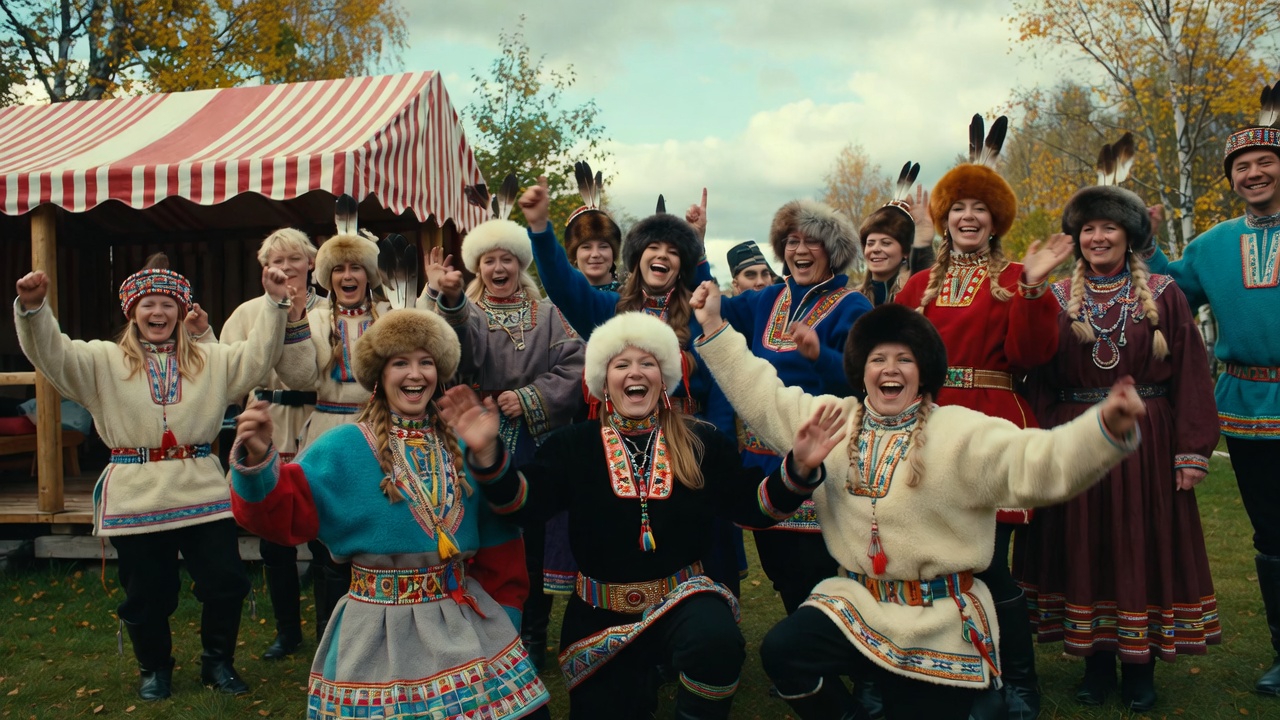
One of the most visible aspects of Sámi National Day is the wearing of the gákti (called kofte in Norwegian). The gákti is the traditional clothing of the Sámi people, and it is far more than a costume. It is a wearable identity document.
The colors, patterns, and embellishments of a gákti reveal detailed information about the wearer: their home region, family, marital status, and sometimes even their specific community. An experienced observer can identify where a person comes from simply by looking at their gákti — even from a distance across a snowfield.
Traditional gákti are made from wool, cotton, silk, or reindeer leather, depending on the region and season. They are commonly seen in variations of red, blue, green, and white. The accompanying accessories — belts, brooches, and boots with their distinctive curled toes — are equally meaningful.
On Sámi National Day, Sámi people of all ages wear their gákti with pride. For many, it is one of the most important days of the year to publicly display their heritage.
Raising the Flag and Singing the Anthem
The central ritual of Sámi National Day is the raising of the Sámi flag and the communal singing of the national anthem. This takes place at government buildings, schools, cultural centers, and homes across Sápmi and beyond.
In Norway, municipal administrative buildings are required to fly the Norwegian flag on February 6, with the option of also flying the Sámi flag. In practice, the Sámi flag is flown widely. The ceremony at Oslo City Hall, where the anthem is played from the tower bells, has become one of the most recognized moments of the day.
Traditional Sámi Food
Food plays an important role in any celebration, and Sámi National Day is no exception. Traditional dishes often include:
- Bidos — a hearty reindeer meat stew, considered one of the most beloved Sámi dishes
- Smoked and dried reindeer meat (reinsdyrkjøtt) — a staple preserved for the harsh winter
- Smoked fish — especially salmon and Arctic char from northern rivers
- Gáhkku — a type of flatbread baked over an open fire
- Cloudberries and lingonberries — wild Arctic berries that have provided essential vitamins to the Sámi for centuries
Sharing a meal together, often around an open fire or inside a lávvu (a traditional tent similar to a tipi), is one of the warmest expressions of Sámi community life.
Music, Joik, and Cultural Performances
Music is central to Sámi culture, and Sámi National Day is filled with performances of the joik — one of Europe’s oldest living musical traditions.
The joik is not a song in the Western sense. It is a form of vocal expression that captures the essence of a person, an animal, or a place. In Northern Sámi, people do not “joik about” something — they “joik” something. The tradition holds that a joik makes the listener feel the subject, as if experiencing that person or place through sound alone.
Joiks are typically sung a cappella and are deeply personal. A reindeer herder might joik while watching over the herd. A mother might joik her child. Friends greet each other with their personal joik. Traditionally, joik was used in everyday life, but it was also one of the cultural practices most aggressively suppressed during the assimilation era. Christian missionaries and state authorities banned it for centuries, viewing it as a pagan practice.
Today, joik has experienced a powerful revival. Artists like Mari Boine, Sofia Jannok, and the experimental group VASSVIK have brought joik to international audiences, blending traditional vocal techniques with contemporary genres. On Sámi National Day, joik performances — both traditional and modern — are a highlight of celebrations.
School Activities Across the Nordic Countries
In the week leading up to February 6, schools and kindergartens across Norway, Sweden, and Finland dedicate time to teaching children about Sámi culture. Students learn about reindeer herding, Sámi languages, the flag, and traditional crafts. Many schools hold their own flag-raising ceremonies and sing the Sámi anthem.
This educational focus has grown significantly since the early 2000s. It reflects a broader societal shift in the Nordic countries toward acknowledging the Sámi as an integral part of the national story, rather than a forgotten footnote.
Where to Experience Sámi National Day Celebrations in 2026
In 2026, Sámi National Day falls on a Friday, February 6. This means celebrations in many towns and communities will likely extend into the weekend, making it an ideal time for travelers to experience Sámi culture firsthand.
Tromsø, Norway: Sámi Week Festival
One of the best-known celebrations takes place in Tromsø, Norway’s largest Arctic city. The Sámi Week (Samisk Uke) is an annual festival organized by the Midnight Sun Marathon Foundation, held since 2004. The 2026 edition runs from February 1 to February 8.
The week includes lectures, debates, exhibitions, concerts, traditional Sámi handicraft displays, and cultural performances. The highlight for many is the Norwegian Championships in Reindeer Racing, held on the final day. Thousands of spectators gather in the city center to watch the country’s fastest reindeer compete — a uniquely Sámi sporting event that draws cheers and laughter.
On February 6 itself, the day begins with a communal breakfast in the city, followed by performances and activities for all ages.
Oslo, Norway: The Capital’s Tribute
In Oslo, the celebration centers on Oslo City Hall. The ceremony includes the raising of the Sámi flag, the playing of the national anthem from the tower bells, and speeches by Sámi leaders and politicians. Museums like the Norwegian Museum of Cultural History (Norsk Folkemuseum) often host special exhibitions and events.
Jokkmokk, Sweden: The Winter Market
Jokkmokk, in Swedish Lapland, holds a special place in Sámi history. It was here that the first Sámi National Day was celebrated in 1993 when the UN opened the International Year of Indigenous People. The town hosts the famous Jokkmokk Winter Market (Jokkmokks marknad), a tradition dating back over 400 years to 1605.
The market takes place annually on the first Thursday, Friday, and Saturday of February, which in 2026 overlaps perfectly with Sámi National Day. Visitors can browse traditional Sámi handicrafts (duodji), taste reindeer meat and other local delicacies, attend joik concerts, and experience the warmth of Sámi hospitality in temperatures that can drop well below -20°C.
Skansen, Stockholm: A Cultural Showcase
Even far south of Sápmi, celebrations take place. Skansen, the famous open-air museum in Stockholm, partners with the Stockholm Sámi Association to host a range of activities from February 6 to 8, 2026. The program includes Sámi food, handicraft demonstrations, historical talks, and live joik performances.
Inari, Finland: The Heart of Finnish Sámi Culture
Inari is the cultural capital of the Sámi in Finland. The Siida Sámi Museum and Nature Centre is a world-class institution that tells the story of the Sámi people and their relationship with the Arctic environment. On Sámi National Day, the museum and the surrounding community host events that draw visitors from across Finland.
Kautokeino, Norway: A Living Sámi Community
For a more immersive experience, Kautokeino (Guovdageaidnu in Northern Sámi) is one of the most important Sámi communities in Norway. Located in the heart of Finnmark, it is a center for reindeer herding, Sámi education, and cultural institutions. Celebrations here are deeply authentic, rooted in the everyday life of the community.
| Location | Country | Key Event | Dates (2026) |
|---|---|---|---|
| Tromsø | Norway | Sámi Week Festival | Feb 1–8 |
| Oslo | Norway | City Hall ceremony | Feb 6 |
| Jokkmokk | Sweden | Winter Market | Feb 5–7 |
| Stockholm (Skansen) | Sweden | Cultural showcase | Feb 6–8 |
| Inari | Finland | Siida Museum events | Feb 6 |
| Kautokeino | Norway | Community celebrations | Feb 6 |
The Sámi Parliament: Political Representation and Self-Governance
Sámi National Day is not only a cultural celebration. It is also a reminder of the political struggle that the Sámi have waged for over a century. Central to this struggle is the institution of the Sámi Parliament.
Norway’s Sámi Parliament (Sámediggi)
The Norwegian Sámi Parliament was established in 1989 and is located in Karasjok (Kárášjohka), in northern Norway. The building itself, completed in 2001, is an architectural masterpiece that has won design awards. It was opened by King Olav V, who signed a ceremonial reindeer hide at the inauguration — a gesture that symbolized the Norwegian state’s recognition of the Sámi as one of two peoples of Norway.
The Parliament has 39 seats and is elected by Sámi voters across Norway. Its primary role is to promote and protect Sámi language, culture, and social life. While it has advisory and administrative powers rather than full legislative authority, the Sámi Parliament plays a crucial role in shaping policies that affect the Sámi community.
Sweden and Finland
Sweden established its Sámi Parliament (Sametinget) in 1993, and Finland’s Sámi Parliament (Saamelaiskäräjät) was first formed in 1973 and reformed in 1996. Both serve similar functions: representing the Sámi voice in national politics and safeguarding cultural rights.
Russia, however, has no Sámi Parliament. The approximately 2,000 Sámi on the Kola Peninsula have limited political representation, and their situation has worsened in recent years due to geopolitical tensions and restrictions on civil society organizations.
Sámi Rights and Ongoing Challenges in 2026
Sámi National Day is a celebration, but it is also a day of reflection. The Sámi people continue to face significant challenges, and the holiday serves as an annual reminder that the fight for Indigenous rights is far from over.
The Norwegianization Policy and Its Legacy
From the mid-1800s through much of the 20th century, the governments of Norway, Sweden, and Finland pursued assimilation policies designed to erase Sámi identity. In Norway, this process was called “fornorsking” (Norwegianization). Sámi children were taken from their families and placed in boarding schools where they were forbidden from speaking their language. Traditional practices were suppressed. Land was seized for agriculture, mining, and infrastructure.
The damage from these policies is still felt today. Many Sámi families lost their language within a single generation. Cultural knowledge was interrupted. The trauma of forced assimilation has been passed down through families, a phenomenon that researchers describe as intergenerational trauma.
In recent decades, the Nordic governments have taken steps to acknowledge and address this history. Norway’s Truth and Reconciliation Commission, established to investigate the effects of Norwegianization policies on the Sámi and Kven peoples, has been a significant step forward.
The Fosen Wind Farm Case: A Landmark Struggle
One of the most important recent chapters in the Sámi rights story involves the Fosen wind farm in central Norway. The case became an international symbol of the tension between renewable energy development and Indigenous rights.
In October 2021, the Norwegian Supreme Court unanimously ruled that the operating permits for two wind farms — Storheia and Roan — on the Fosen peninsula were invalid. The court found that the 151 turbines, which constitute part of Europe’s largest onshore wind power project, violated the Sámi people’s rights under Article 27 of the International Covenant on Civil and Political Rights (ICCPR). The turbines disrupted traditional winter grazing areas used by Sámi reindeer herders for centuries.
Despite the ruling, the turbines continued to operate for over two years. This prompted widespread protests, including demonstrations at the Norwegian Parliament and blockades of government ministries. Sámi youth activists, backed by supporters including Greta Thunberg, demanded action.
In March 2024, Norway finally reached an agreement with the Sámi reindeer herders of the southern Fosen area. Under the deal, the turbines remain operational, but the agreement includes compensation payments from the state-owned energy company Statkraft, new winter grazing areas, and a grant of 5 million Norwegian kroner to support Sámi cultural programs. The Sámi Parliament’s president, Silje Karine Muotka, expressed hope that the rights violation had been addressed but also warned against future encroachments.
The Fosen case raised critical questions that remain relevant in 2026: How do nations balance their climate goals with their obligations to Indigenous peoples? Can green energy projects be developed without repeating the colonial patterns of the past?
Climate Change and Its Impact on Reindeer Herding
Beyond political and legal challenges, the Sámi face a growing threat from climate change. The Arctic is warming at a rate roughly two to four times faster than the global average. For reindeer herders, this has profound consequences.
Warmer temperatures cause unpredictable freeze-thaw cycles. When rain falls on snow and then freezes, it creates an ice crust over the lichen that reindeer depend on for food. The reindeer cannot break through the ice to eat. This has led to mass starvation events in some years.
Warming also affects migration routes. Thawing permafrost makes traditional paths unstable. Earlier snowmelt disrupts the seasonal rhythms that have guided reindeer herding for millennia. Industrial development — roads, railways, mines, and wind farms — further fragments the landscape.
For the Sámi, reindeer herding is not just an economic activity. It is the foundation of a culture, a language, and a way of understanding the world. The loss of herding would mean the loss of something irreplaceable.
Language Endangerment
Of the nine Sámi languages, several are critically endangered. Ume Sámi has fewer than 50 speakers. Pite Sámi has roughly 25 to 50. Ter Sámi and Akkala Sámi are nearly extinct. Even the most widely spoken language, Northern Sámi, with approximately 25,000 speakers, faces challenges as younger generations grow up in majority-language environments.
Efforts to revitalize Sámi languages have intensified in recent years. Language nests — immersion programs for young children — have been established in several communities. The Sámi Parliaments fund language courses and cultural programs. Digital tools, including Sámi-language apps and social media content, are helping to reach younger audiences.
On Sámi National Day, the use of Sámi languages in public spaces — on flags, in anthems, in speeches, and in everyday greetings — takes on special significance. It is an annual affirmation that these languages are living, breathing parts of a vibrant culture.
Traditional Sámi Culture You Should Know About
Sámi National Day is a gateway to a rich and ancient culture. Here are some of the most important cultural traditions you should know.
Reindeer Herding: The Heart of Sámi Identity
Reindeer herding is believed to have originated among the Sámi around 2,000 years ago, evolving from the hunting of wild reindeer to the management of semi-domesticated herds. The practice shaped every aspect of Sámi life: food, clothing, tools, shelter, and even spiritual beliefs.
Traditionally, the Sámi organized their herding through a system called the siida — a community unit in which several families managed their herds collectively within a shared territory. The siida system balanced individual rights with communal cooperation, and its principles still influence Sámi reindeer herding today.
Every part of the reindeer was used. The meat provided food. The hides made clothing and shelter. The sinews were used for sewing. The antlers became tools and decorative objects. The blood was made into sausages. This holistic relationship with the reindeer reflects a broader Sámi worldview: one of respect for nature and minimal waste.
Today, modern technology has changed some aspects of herding. GPS trackers monitor reindeer movements. Snowmobiles have replaced much of the travel once done on foot or by reindeer sled. But the traditional knowledge — understanding the land, reading the weather, knowing the behavior of the herd — remains essential. As one Sámi saying goes: tools change, but the knowledge endures.
Duodji: The Art of Sámi Handicrafts
Duodji is the Sámi tradition of handicrafts. It encompasses a wide range of objects: woven birch baskets, hand-carved wooden drinking cups (kuksa), leather goods, jewelry made from silver and reindeer antler, felted wool garments, and much more.
Duodji is guided by a core principle: an object should serve a purpose first and be decorative second. This pragmatic beauty is a hallmark of Sámi design. A knife handle carved from reindeer antler is both functional and exquisite. A woven belt is both warm and stunning.
Today, duodji is taught in Sámi schools and cultural centers, and Sámi artisans sell their work at markets across the Nordic region. The Jokkmokk Winter Market is one of the best places in the world to see and purchase authentic duodji.
Sámi Spirituality: Shamanism and the Sacred Landscape
The traditional Sámi religion was animistic, centered on the belief that all elements of nature — rocks, rivers, animals, mountains — possessed a spirit. The Sámi spiritual leader, known as the noaidi (shaman), served as a mediator between the human world and the spirit world. Using a drum decorated with symbolic paintings and a chanting technique, the noaidi would enter a trance to seek guidance, healing, or communication with the spirits.
Christian missionaries, particularly during the 17th and 18th centuries, systematically destroyed Sámi drums and suppressed shamanic practices. Many drums were burned. The joik was banned. Sacred sites were desecrated.
Despite this, elements of Sámi spirituality have survived and are experiencing a quiet revival. Sacred natural sites called sieidi — often unusual rock formations or prominent landscape features — are still visited and respected. Many contemporary Sámi practice Christianity but maintain a deep, culturally rooted reverence for the natural world that echoes the animistic tradition.
How to Say Happy Sámi National Day in Different Sámi Languages
One of the most respectful ways to acknowledge Sámi National Day is to learn a greeting in one of the Sámi languages. Here are several ways to say “Happy Sámi National Day”:
| Language | Greeting |
|---|---|
| Northern Sámi | Lihkku sámi álbmotbeivviin! |
| Southern Sámi | Læhkoeh saemiej åålmegebiejjine! |
| Lule Sámi | Vuorbbe sáme álmmukbiejvvijn! |
| Inari Sámi | Pyeri säämi aalmugpeeivi! |
| Norwegian | Gratulerer med samefolkets dag! |
| Swedish | Grattis på samernas nationaldag! |
| Finnish | Hyvää saamelaisten kansallispäivää! |
Using even one of these greetings on February 6 is a small but meaningful gesture of recognition and respect.
How to Respectfully Participate in Sámi National Day as a Visitor
If you are traveling in the Nordic countries during early February, you may have the opportunity to attend Sámi National Day events. Visitors are generally welcome at public celebrations, but there are a few guidelines to keep in mind.
Listen and learn first. Sámi National Day is, above all, a day for the Sámi people. Approach the celebrations with curiosity and humility. Attend museum exhibitions, listen to joik performances, and read about Sámi history before you arrive.
Try traditional food. Tasting dishes like reindeer stew (bidos), smoked fish, or gáhkku flatbread is an excellent and respectful way to engage with the culture. Many communities and restaurants offer special menus on the holiday.
Support Sámi artisans. If you admire Sámi handicrafts, consider purchasing authentic duodji from Sámi-owned shops and market stalls. This directly supports the community and helps preserve traditional skills.
Do not wear the gákti unless invited. The gákti is not a costume for outsiders to try on. It carries deep personal and cultural meaning. Wearing it without proper connection to Sámi identity is considered disrespectful. If a Sámi host invites you to try one on or learn about it, that is a different and special situation.
Ask before photographing. Not everyone wants to be photographed during what is a deeply personal and cultural event. Always ask permission before taking pictures of individuals, especially those in traditional dress.
Learn about the issues. Understanding the political and social challenges the Sámi face — from land rights to language loss to climate change — deepens your appreciation of the day. Sámi National Day is not just a festival; it is a statement of survival and resilience.
Sámi National Day in the Context of Global Indigenous Rights
Sámi National Day does not exist in isolation. It is part of a global movement of Indigenous peoples asserting their rights, reclaiming their histories, and celebrating their cultures. From the National Indigenous Peoples Day in Canada (June 21) to NAIDOC Week in Australia to the International Day of the World’s Indigenous Peoples (August 9), Indigenous communities around the world mark similar occasions.
What makes Sámi National Day distinctive is its cross-border nature. The Sámi are one people divided by the borders of four nations. Their National Day is a powerful statement that cultural identity does not stop at a political boundary. It is a declaration that the Sámi are not Norwegian, Swedish, Finnish, or Russian first — they are Sámi first, bound by a shared heritage that predates every modern nation-state on their land.
The Fosen wind farm case, the ongoing language revitalization efforts, and the work of the Sámi Parliaments all reflect broader global themes: the rights of Indigenous peoples to their ancestral lands, the importance of cultural preservation in the face of globalization, and the need to include Indigenous voices in decisions about climate and energy policy.
Frequently Asked Questions About Sámi National Day
Is Sámi National Day a public holiday? No, it is not an official public holiday in any of the four countries where Sámi live. However, it is widely recognized and celebrated, particularly in Norway and Sweden. Government buildings fly flags, schools hold events, and many workplaces and institutions acknowledge the day.
Can non-Sámi people celebrate Sámi National Day? Yes, non-Sámi people are encouraged to learn about and acknowledge the day. Attending public events, reading about Sámi history, and using social media to share awareness are all positive ways to participate.
What year was the first Sámi National Day? The first official Sámi National Day was celebrated on February 6, 1993.
Who designed the Sámi flag? The flag was designed by Astrid Båhl, a Coast Sámi artist from Skibotn, Norway. It was adopted in 1986.
How many Sámi languages are there? There are nine distinct Sámi languages, of which three are actively used in Norway. Several are critically endangered.
What is the Sámi national anthem called? It is called “Sámi soga lávlla” (Song of the Sámi People), with lyrics written by Isak Saba in 1906.
Final Thoughts: Why Sámi National Day Matters in 2026 and Beyond
Sámi National Day is more than a date on a calendar. It is a living declaration of identity, resilience, and hope.
For over a century, the Sámi people have fought for the right to be themselves — to speak their languages, practice their traditions, herd their reindeer, and live on their ancestral lands. They have faced boarding schools designed to erase their culture, governments that ignored their rights, and industries that carved up their homeland. And yet, every February 6, they raise their flag, sing their anthem, and celebrate who they are.
In 2026, the celebration carries particular weight. The Fosen case reminded the world that even in progressive Scandinavian democracies, Indigenous rights can be violated. Climate change continues to threaten the Arctic ecosystems that the Sámi depend on. Several Sámi languages are running out of time.
But there is also hope. A new generation of Sámi youth is reclaiming their languages, revitalizing joik, and engaging in political activism. Cultural events are drawing larger audiences than ever. The global conversation about Indigenous rights is louder and more urgent than at any point in history.
Sámi National Day reminds us that the story of the Sámi is not a relic of the past. It is unfolding right now, in the frozen landscapes of the north, in the halls of parliaments, and in the hearts of a people who refuse to be forgotten.
Lihkku sámi álbmotbeivviin! — Happy Sámi National Day.