Every year, millions of Koreans embark on one of the world’s largest human migrations. They travel across the country to reunite with family. The occasion? Seollal (설날), the Korean Lunar New Year. This ancient celebration represents far more than just a date change on the calendar. It embodies centuries of Korean tradition, filial piety, and cultural identity.
As someone who has dedicated decades to studying global festivals and customs, I can confidently say that Seollal ranks among the most meaningful and culturally rich celebrations I have ever witnessed. Unlike the often commercialized New Year celebrations in Western countries, Seollal maintains its deep roots in Confucian values, ancestral reverence, and family unity.
In this comprehensive guide, we will explore everything you need to know about the Korean Lunar New Year. From ancient rituals to modern celebrations, from traditional foods to timeless games, this post will serve as your complete resource for understanding and experiencing Seollal.
Understanding Seollal: What Does Korean Lunar New Year Mean?
Seollal (설날) literally translates to “New Year’s Day” in Korean. However, this simple translation barely scratches the surface of its significance. The word “Seol” carries connotations of unfamiliarity and newness, while “nal” means day. Together, they represent the first day of a fresh beginning.
This holiday follows the lunisolar calendar, which means its date varies each year on the Gregorian calendar. Seollal typically falls between late January and mid-February. The celebration officially spans three days: the day before, the day of, and the day after Seollal. These three days are national holidays in South Korea.
The Difference Between Seollal and Solar New Year in Korea
Koreans actually celebrate two New Year’s days:
| Celebration | Calendar | Date | Significance |
|---|---|---|---|
| Sinjeong (신정) | Solar/Gregorian | January 1st | Modern celebration, one-day holiday |
| Seollal (설날) | Lunar | Varies (Jan-Feb) | Traditional celebration, three-day holiday |
While Sinjeong is acknowledged with a single day off, Seollal commands significantly more cultural importance. Most Koreans reserve their major celebrations, family gatherings, and traditional observances for Seollal. According to the Korea Tourism Organization, over 30 million domestic trips occur during the Seollal holiday period, making it one of the busiest travel times in South Korea.
The Ancient History of Seollal: Origins of Korean Lunar New Year Traditions
The origins of Seollal stretch back thousands of years. Historical records indicate that Koreans have celebrated the lunar new year since at least the Silla Dynasty (57 BCE – 935 CE). The Samguk Sagi (삼국사기), Korea’s oldest surviving history book compiled in 1145, documents Seollal celebrations during this ancient period.
How Seollal Evolved Through Korean Dynasties
The celebration evolved significantly through different eras:
Three Kingdoms Period (57 BCE – 668 CE)
- Early agricultural societies marked the new year with prayers for abundant harvests
- Shamanistic rituals dominated the celebrations
- Communities gathered to perform ceremonies honoring nature spirits
Goryeo Dynasty (918 – 1392)
- Buddhism influenced Seollal traditions
- Temple visits became common practice
- The lunar calendar became officially standardized
Joseon Dynasty (1392 – 1897)
- Confucian principles transformed Seollal into a family-centered holiday
- Ancestral rites (Charye) became mandatory for proper observance
- Elaborate court ceremonies were established
- Many customs practiced today were formalized during this period
Japanese Colonial Period (1910 – 1945)
- The Japanese colonial government attempted to suppress Seollal
- Koreans were forced to celebrate only the solar new year
- Despite persecution, Koreans secretly maintained their lunar traditions
Modern Era (1945 – Present)
- Seollal was reinstated as an official holiday after liberation
- The three-day holiday was established in 1985
- Contemporary celebrations blend ancient traditions with modern conveniences
When is Seollal Celebrated? Korean Lunar New Year 2024 and 2025 Dates
One of the most common questions travelers and cultural enthusiasts ask is: “When is Korean Lunar New Year?” Because Seollal follows the lunar calendar, the date shifts each year on the Western calendar.
Korean Lunar New Year Dates for Upcoming Years
| Year | Seollal Date | Zodiac Animal |
|---|---|---|
| 2024 | February 10 | Year of the Dragon (용띠) |
| 2025 | January 29 | Year of the Snake (뱀띠) |
| 2026 | February 17 | Year of the Horse (말띠) |
| 2027 | February 6 | Year of the Goat (양띠) |
| 2028 | January 26 | Year of the Monkey (원숭이띠) |
The official holiday period includes the day before and after Seollal. This means most businesses, banks, and government offices close for the entire three-day period. If Seollal falls near a weekend, Koreans may enjoy up to five consecutive days off.
The Significance of the Korean Zodiac During Seollal
Like the Chinese zodiac, the Korean zodiac (띠, “tti”) consists of twelve animals that cycle through the years. Each animal supposedly influences the characteristics of people born in that year. During Seollal, zodiac signs feature prominently in:
- New Year greetings and cards
- Television programs and advertisements
- Gift packaging and decorations
- Fortune-telling for the coming year
Traditional Seollal Rituals and Customs: How Koreans Celebrate Lunar New Year
Charye (차례): The Sacred Ancestral Memorial Ceremony
Perhaps the most important ritual of Seollal is Charye (차례). This ancestral memorial service honors deceased family members from the past four generations. The ceremony reflects core Confucian values of filial piety and respect for elders.
How Charye is Performed:
- Setting Up the Altar (차례상)
- A table faces north toward the ancestors’ positions
- Foods are arranged according to strict traditional rules
- Typically includes rice, soup, meat, fish, vegetables, fruits, and rice cakes
- Photographs or spirit tablets of ancestors are displayed
- The Ceremony
- Family members dress in formal hanbok or neat attire
- The eldest male typically leads the ceremony
- Incense is lit to invite ancestral spirits
- Rice wine (makgeolli or soju) is offered
- Family members perform deep bows (jeol)
- The ceremony concludes with burning spirit money
- Sharing the Food
- After the ceremony, the family shares the prepared foods
- This communal meal symbolizes the ancestors dining with the living
The National Folk Museum of Korea provides detailed documentation of traditional Charye procedures, noting regional variations across different provinces.
Sebae (세배): The Traditional Deep Bow for New Year
Sebae is the formal bow that younger family members perform to their elders. This custom demonstrates respect and well-wishes for the new year. It is one of the most anticipated moments of Seollal, especially for children.
The Proper Way to Perform Sebae:
For men:
- Stand with feet together
- Raise hands to chest level, left hand over right
- Kneel down slowly
- Place hands on the floor
- Bow deeply, touching forehead near hands
- Rise and repeat twice (three bows total for elders)
For women:
- Stand with feet together
- Hands positioned at shoulder height, right hand over left
- Kneel down gracefully
- Bow deeply while maintaining upright posture
- Rise and repeat
After performing Sebae, the younger person says the traditional New Year greeting: “새해 복 많이 받으세요” (Saehae bok mani badeuseyo), meaning “May you receive many blessings in the new year.”
Sebaetdon (세뱃돈): Korean Lucky Money for New Year
In exchange for Sebae, elders give children Sebaetdon (세뱃돈), which translates to “New Year money.” This custom parallels the red envelopes given during Chinese New Year, though Korean traditions have their own distinct characteristics.
Key Facts About Sebaetdon:
- Color: Unlike Chinese red envelopes, Korean Sebaetdon pouches come in various colors, often white, pink, or traditional patterns
- Amount: Varies widely based on relationship and financial means
- Recipients: Primarily children, but also young adults and newlyweds
- Etiquette: Money is given immediately after Sebae is performed
According to surveys by Korean financial institutions, the average Sebaetdon amount has steadily increased over the years. In 2023, the average ranged from ₩10,000 to ₩50,000 ($8 to $40 USD) per recipient, with grandparents typically giving the most generous amounts.
Traditional Seollal Food: What Do Koreans Eat for Lunar New Year?
Food plays a central role in Seollal celebrations. The dishes prepared carry symbolic meanings of prosperity, longevity, and good fortune. Korean Lunar New Year food is distinct from everyday cuisine in both preparation and presentation.
Tteokguk (떡국): The Essential Korean New Year Soup
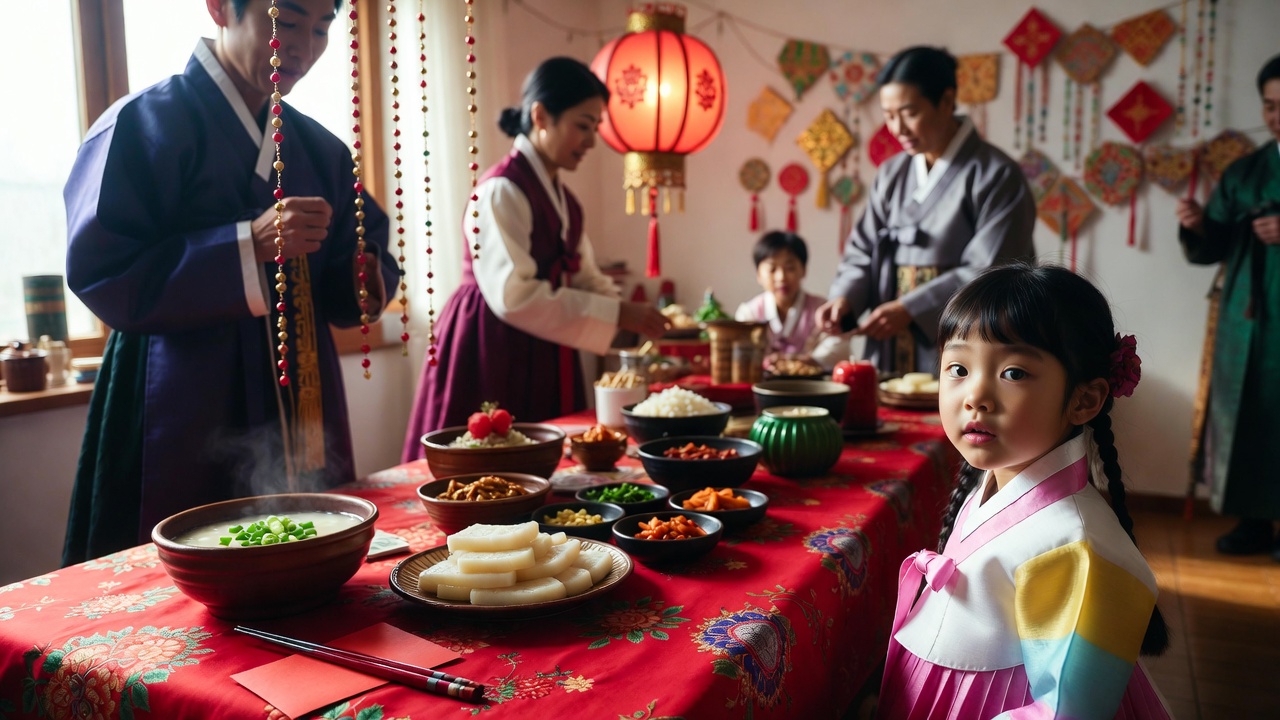
Tteokguk is the quintessential Seollal dish. This clear soup features sliced rice cakes (tteok) in a savory broth. Eating Tteokguk on Seollal morning is considered essential for properly beginning the new year.
Symbolism of Tteokguk:
- White rice cakes: Represent purity and a fresh start
- Round/oval shape: Symbolizes coins and prosperity (traditional coins were round)
- Eating one bowl: Signifies aging one year (Koreans traditionally gain a year on Seollal, not their birthday)
Traditional Tteokguk Recipe:
| Ingredient | Amount | Purpose |
|---|---|---|
| Sliced rice cakes (garaetteok) | 2 cups | Main ingredient |
| Beef broth | 6 cups | Base of soup |
| Beef brisket | 200g | Flavor and topping |
| Eggs | 2 | Garnish (yellow and white strips) |
| Green onions | 2 stalks | Garnish |
| Garlic | 3 cloves | Seasoning |
| Soy sauce | 2 tbsp | Seasoning |
| Sesame oil | 1 tsp | Finishing touch |
Jeon (전): Korean Savory Pancakes for Lunar New Year
Jeon refers to various Korean pancakes or fritters served during Seollal. These pan-fried delicacies are essential components of both the Charye altar and the holiday feast.
Popular Types of Jeon Served During Seollal:
- Bindaetteok (빈대떡) – Mung bean pancakes
- Pajeon (파전) – Green onion pancakes
- Dongeurangttaeng (동그랑땡) – Meat and tofu patties
- Saengseon-jeon (생선전) – Fish fillets in egg batter
- Hobak-jeon (호박전) – Zucchini pancakes
- Gogi-jeon (고기전) – Meat pancakes
Japchae (잡채): Glass Noodles with Vegetables
Japchae is a beloved dish of sweet potato glass noodles stir-fried with vegetables and meat. While served year-round, it holds special importance during Seollal for its colorful appearance and symbolic ingredients.
Galbi-jjim (갈비찜): Braised Short Ribs
Galbi-jjim features tender beef short ribs braised in a sweet and savory sauce with vegetables. This luxurious dish appears on Seollal tables as a symbol of abundance and prosperity.
Traditional Korean New Year Desserts and Sweets
Sweet treats round out the Seollal feast:
- Yakgwa (약과) – Honey cookies with sesame oil
- Hangwa (한과) – Traditional confections
- Sujeonggwa (수정과) – Cinnamon persimmon punch
- Sikhye (식혜) – Sweet rice beverage
Hanbok During Seollal: Traditional Korean Clothing for Lunar New Year
Hanbok (한복), the traditional Korean garment, experiences its most prominent annual showcase during Seollal. While rarely worn in daily life today, hanbok remains essential for proper Seollal observance.
Understanding Hanbok Design and Components
Women’s Hanbok:
- Jeogori (저고리) – Short jacket with curved lines
- Chima (치마) – Full, high-waisted skirt
- Goreum (고름) – Ribbon ties on the jeogori
- Beoseon (버선) – Traditional white socks
- Ggotsin (꽃신) – Embroidered shoes
Men’s Hanbok:
- Jeogori (저고리) – Jacket with straight lines
- Baji (바지) – Wide-legged trousers
- Joggi (조끼) – Vest worn over jeogori
- Durumagi (두루마기) – Overcoat for formal occasions
- Gat (갓) – Traditional hat (rarely worn today)
Modern Hanbok Trends for Seollal 2024-2025
Contemporary hanbok designs have evolved to suit modern sensibilities while maintaining traditional aesthetics:
- Saenghwal Hanbok (생활한복) – “Daily life hanbok” with more practical designs
- Fusion Hanbok – Incorporates Western elements like shorter skirts or fitted silhouettes
- Children’s Hanbok – Often features brighter colors and cartoon-character embellishments
- Couple Hanbok – Matching sets for couples or families
The hanbok rental and purchase industry has grown significantly, with the Korea Craft & Design Foundation reporting increased interest among younger generations and international visitors.
Traditional Korean New Year Games: Seollal Folk Games and Activities
Seollal brings families together not just for ceremonies and meals, but also for traditional folk games. These activities have entertained Koreans for centuries and remain popular during the holiday.
Yutnori (윷놀이): The Classic Korean Board Game
Yutnori is arguably the most iconic Seollal game. This strategic board game involves throwing wooden sticks and moving pieces around a board. The rules are simple enough for children yet engaging enough for competitive adults.
How to Play Yutnori:
Equipment:
- Four wooden sticks (yut) with one flat and one rounded side
- A cloth game board (mal-pan) with 29 spaces
- Four tokens (mal) per team
Basic Rules:
- Teams take turns throwing the four sticks
- The combination of flat/round sides determines moves:
- Do (도) – 1 flat = move 1 space
- Gae (개) – 2 flat = move 2 spaces
- Geol (걸) – 3 flat = move 3 spaces
- Yut (윷) – 4 flat = move 4 spaces + extra turn
- Mo (모) – 0 flat = move 5 spaces + extra turn
- First team to move all four pieces around the board wins
- Landing on an opponent’s piece sends it back to start
Strategic Elements:
- Pieces can be stacked to move together
- Shortcut routes across the board exist
- “Catching” opponents provides significant advantages
Neolttwigi (널뛰기): Korean Seesaw Game
Neolttwigi is a traditional game where two people stand on opposite ends of a seesaw and take turns jumping. When one person lands, the other is propelled into the air.
Historical Context: This game was particularly popular among women during the Joseon Dynasty. Because women were often confined to their homes, neolttwigi allowed them to glimpse over compound walls and see the outside world during jumps.
Jegichagi (제기차기): Korean Hacky Sack
Jegichagi involves kicking a small weighted object (jegi) with the inside of the foot to keep it aloft. The player who keeps the jegi in the air longest wins.
How to Make a Traditional Jegi:
- Wrap a coin in paper or cloth
- Cut paper/cloth into strips below the coin
- Fluff the strips for better air resistance
- Modern versions use plastic coins and colorful paper
Paengi-chigi (팽이치기): Top Spinning
Paengi-chigi features wooden spinning tops that players keep spinning using a whip. This game requires skill and practice to master.
Yeonnarigi (연날리기): Korean Kite Flying
Kite flying during Seollal carries special significance. Koreans traditionally write their wishes and troubles on kites, then release them to the wind, symbolically sending away bad luck.
Traditional Korean Kites:
- Rectangular shape with a central hole
- Called “Bangpae-yeon” (방패연)
- Decorated with colorful designs and patterns
- The hole helps with stability and maneuverability
Seollal Gift-Giving Traditions: What Gifts Do Koreans Give for Lunar New Year?
Gift-giving during Seollal reflects Korean values of respect, gratitude, and maintaining relationships. The types of gifts exchanged reveal much about Korean social customs.
Popular Seollal Gift Sets in Korea
The Korean gift set industry generates billions of won in revenue during the Seollal season. Common gift categories include:
| Gift Category | Examples | Typical Recipients |
|---|---|---|
| Food Sets | Hanwoo beef, fresh fruit, traditional snacks | Parents, in-laws, respected elders |
| Health Products | Ginseng, vitamins, health supplements | Elderly relatives, sick individuals |
| Practical Items | Cooking oil, canned goods, toiletries | Colleagues, acquaintances, neighbors |
| Premium Items | Luxury goods, electronics, gift cards | Close family members, business partners |
| Cash/Gift Cards | Department store vouchers, cash | Younger relatives, service workers |
Spam Gift Sets: A Uniquely Korean Phenomenon
One of the most fascinating aspects of Korean gift culture is the popularity of Spam gift sets. Western visitors often express surprise at seeing elaborately packaged canned meat sold as premium gifts.
Why is Spam Popular in Korea?
- Introduced during the Korean War by American soldiers
- Became associated with prosperity during post-war hardship
- High-quality protein was scarce and valued
- Now a nostalgic and practical gift option
- Sold in elegant packaging during Seollal
Gift-Giving Etiquette for Seollal
Do’s:
- ✅ Use both hands when giving and receiving gifts
- ✅ Choose quality over quantity
- ✅ Consider the recipient’s age and position
- ✅ Include a card or verbal well-wishes
- ✅ Wrap gifts attractively (presentation matters)
Don’ts:
- ❌ Give gifts in sets of four (associated with death)
- ❌ Use red ink for cards (associated with death)
- ❌ Give sharp objects (symbolizes severing relationships)
- ❌ Open gifts immediately in front of the giver
- ❌ Give extremely personal items to non-close relations
Modern Seollal Celebrations: How Contemporary Koreans Observe Lunar New Year
While traditional elements remain central, Seollal celebrations have evolved to accommodate modern lifestyles. Understanding these changes provides insight into contemporary Korean society.
The Great Seollal Migration: Korea’s Busiest Travel Period
The days surrounding Seollal witness an extraordinary population movement. According to the Korea Transport Database, highway traffic during Seollal can be five times the normal volume.
Key Statistics:
- Over 30 million trips occur during the holiday period
- The Seoul-to-Busan route normally takes 4 hours but can exceed 10 hours during peak times
- Train tickets (KTX) sell out within minutes of release
- Airlines add hundreds of extra domestic flights
Tips for Traveling During Seollal:
- Book transportation at least one month in advance
- Consider traveling during off-peak hours
- Use rest areas strategically to avoid crowds
- Pack snacks and entertainment for long delays
- Consider alternative routes
How Younger Koreans Celebrate Seollal Today
Generational differences in Seollal observance reflect broader social changes:
Baby Boomers and Older (born before 1965):
- Strictly observe traditional customs
- Lead Charye ceremonies
- Expect formal Sebae from younger generations
- Prepare traditional foods from scratch
Generation X (born 1965-1980):
- Balance tradition with practicality
- May order some prepared foods
- Still travel for family gatherings
- Teach customs to their children
Millennials (born 1981-1996):
- Often experience stress around holiday obligations
- May prefer smaller, immediate family gatherings
- Use convenience foods and catering services
- Share Seollal content on social media
Generation Z (born 1997-2012):
- Less familiar with traditional customs
- More likely to view Seollal as vacation time
- Connect with relatives via video calls
- Create Seollal-themed digital content
The “Seollal Stress” Phenomenon in Korean Society
Despite its joyful aspects, Seollal brings significant stress for many Koreans. This phenomenon has gained increasing attention in Korean media and society.
Common Sources of Seollal Stress:
- Travel Exhaustion – Long hours in traffic congestion
- Financial Burden – Gifts, Sebaetdon, and food expenses
- Family Pressure – Questions about marriage, careers, and children
- Gender Inequality – Women often bear disproportionate cooking/cleaning duties
- Social Expectations – Pressure to appear successful and happy
Korean therapists and counselors report increased patient visits before and after Seollal. The Korean Mental Health Association has published guidelines for managing holiday stress.
Changes in Seollal Traditions Due to COVID-19 and Beyond
The COVID-19 pandemic accelerated changes in Seollal observance:
- Virtual Sebae via video calls became acceptable
- Smaller gatherings replaced large family reunions
- Delivery services for Seollal foods experienced massive growth
- “Hybrid” celebrations combined in-person and virtual elements
Many of these adaptations have persisted, offering alternatives for families separated by distance or circumstance.
Experiencing Seollal in Korea: A Guide for Tourists and Visitors
For travelers seeking authentic cultural experiences, celebrating Seollal in Korea offers unparalleled opportunities. However, the holiday requires special planning due to widespread closures and travel challenges.
Best Places to Experience Korean Lunar New Year Traditions
1. Korean Folk Village (한국민속촌) – Yongin
This living museum brings Seollal traditions to life with:
- Traditional performances and ceremonies
- Folk game demonstrations and participation
- Hanbok rental for visitors
- Traditional food tastings
- Artisan craft experiences
2. Namsangol Hanok Village (남산골한옥마을) – Seoul
Located in central Seoul, this village offers:
- Free admission during Seollal
- Traditional house (hanok) tours
- Cultural programs and workshops
- Performances of traditional music and dance
- Calligraphy and craft activities
3. National Folk Museum of Korea (국립민속박물관) – Seoul
The museum provides:
- Special Seollal exhibitions
- Educational programs about holiday customs
- Hands-on cultural experiences
- Traditional game areas for families
4. Gyeongbokgung Palace (경복궁) – Seoul
The grand palace features:
- Free admission for hanbok wearers
- Special royal ceremony reenactments
- Guard-changing ceremonies
- Beautiful photo opportunities
What’s Open and Closed During Seollal in Korea
Understanding closures is essential for Seollal trip planning:
| Category | Status During Seollal |
|---|---|
| Tourist Attractions | Major sites open, some with special hours |
| Museums | Many closed on Seollal day, open before/after |
| Restaurants | Many closed, especially family-owned places |
| Department Stores | Closed Seollal day, open other days |
| Convenience Stores | Usually open (24/7 chains) |
| Public Transportation | Reduced but operational |
| Banks | Closed during holiday period |
| Traditional Markets | Mostly closed |
| Tourist Information Centers | Limited hours |
Tips for Tourists Visiting Korea During Seollal
Before Your Trip:
- Book accommodation well in advance (prices increase significantly)
- Research which attractions will be open
- Make restaurant reservations if possible
- Exchange currency before the holiday
- Download Korean transportation apps
During Your Visit:
- Experience cultural programs at folk villages
- Try traditional Seollal foods at hotel restaurants
- Respect Koreans celebrating with their families
- Take advantage of quieter tourist sites
- Enjoy the festive decorations around the city
Cultural Sensitivity:
- Learn basic Korean greetings
- Understand that many Koreans prioritize family time
- Don’t expect normal service levels
- Appreciate the cultural significance of what you’re witnessing
Seollal Greetings and Phrases: How to Wish Someone Happy Korean New Year
Learning Seollal greetings enhances cultural appreciation and communication. Here are essential phrases for the holiday:
Essential Korean New Year Greetings
| Korean | Romanization | Meaning |
|---|---|---|
| 새해 복 많이 받으세요 | Saehae bok mani badeuseyo | Please receive many new year blessings (formal) |
| 새해 복 많이 받아 | Saehae bok mani bada | Receive many new year blessings (informal) |
| 복 많이 받으세요 | Bok mani badeuseyo | Receive many blessings |
| 건강하세요 | Geonganghaseyo | Please be healthy |
| 만사형통 | Mansahaengtong | May everything go well |
| 부자 되세요 | Buja doeseyo | Become wealthy |
New Year Wishes by Zodiac Year
During the Year of the Snake (2025), appropriate greetings include:
- “뱀띠의 해에 행운이 가득하세요” (May you be full of luck in the Year of the Snake)
- “뱀처럼 지혜롭게” (Be wise like a snake)
How to Respond to Seollal Greetings
When someone wishes you a happy Seollal, respond with:
- “감사합니다, 당신도요” (Thank you, you too)
- “네, 당신도 복 많이 받으세요” (Yes, may you also receive many blessings)
Comparing Seollal with Other Asian Lunar New Year Celebrations
Lunar New Year is celebrated across Asia, but each country has distinct traditions. Understanding these differences enriches cross-cultural appreciation.
Seollal vs. Chinese New Year (春节)
| Aspect | Korean Seollal | Chinese New Year |
|---|---|---|
| Duration | 3-day holiday | 7-15 day celebration |
| Lucky Color | Various (white important for food) | Red dominates |
| Signature Dish | Tteokguk (rice cake soup) | Jiaozi (dumplings), Fish |
| Money Envelopes | Various colors (Sebaetdon) | Red envelopes (hongbao) |
| Fireworks | Minimal | Extensive |
| Decorations | Subtle | Elaborate red decorations |
| Focus | Ancestor veneration, family unity | Prosperity, good fortune |
Seollal vs. Vietnamese Tết
| Aspect | Korean Seollal | Vietnamese Tết |
|---|---|---|
| Duration | 3 days | 7+ days |
| Key Symbol | Rice cakes (tteok) | Bánh chưng (square rice cake) |
| Tree/Plant | None specific | Peach blossoms, kumquat trees |
| Cleaning Ritual | House cleaning before | Similar cleaning traditions |
| Family Focus | Central importance | Equally central |
Seollal vs. Japanese Shōgatsu (正月)
Interestingly, Japan switched to the solar calendar for New Year in 1873, while Korea maintained lunar traditions:
| Aspect | Korean Seollal | Japanese Shōgatsu |
|---|---|---|
| Calendar | Lunar | Solar (January 1st) |
| Signature Dish | Tteokguk | Ozoni (also rice cake soup) |
| Ancestral Rites | Charye ceremony | Visit to ancestors’ graves |
| Children’s Money | Sebaetdon | Otoshidama |
| Games | Yutnori, neolttwigi | Hanetsuki, karuta |
The Cultural Significance of Seollal in Korean Identity
Beyond its practical elements, Seollal holds profound significance for Korean cultural identity. Understanding this deeper meaning reveals why Koreans maintain these traditions despite modernization pressures.
Confucian Values Embedded in Seollal
Confucianism has shaped Korean society for centuries, and Seollal embodies its core principles:
- 효 (Hyo) – Filial Piety
- Respecting and caring for parents and elders
- Demonstrated through Sebae and gift-giving
- Maintaining family ties across generations
- 예 (Ye) – Ritual Propriety
- Following proper procedures for ceremonies
- Observing correct etiquette in social interactions
- Preserving traditional customs
- 충 (Chung) – Loyalty
- Commitment to family obligations
- Honoring ancestors and their sacrifices
- Maintaining family honor
Seollal and Korean Collective Memory
Seollal serves as a vehicle for transmitting cultural memory:
- Oral traditions pass from elders to youth during gatherings
- Ritual practices connect modern Koreans to ancestral experiences
- Traditional foods maintain culinary heritage
- Folk games preserve intangible cultural assets
- Hanbok wearing keeps traditional aesthetics alive
UNESCO Recognition of Korean Seollal Traditions
Several elements of Seollal traditions have received international recognition:
- Kimchi-making (Kimjang) – UNESCO Intangible Cultural Heritage since 2013
- Traditional Korean music (Pansori, Arirang) – UNESCO recognition
- Hanbok – Ongoing preservation efforts supported by Korean government
Preparing for Seollal: A Timeline and Checklist
For Koreans, Seollal preparation begins weeks in advance. This timeline helps understand the comprehensive nature of holiday readiness.
Seollal Preparation Timeline
4 Weeks Before:
- [ ] Book travel tickets (KTX, buses, flights)
- [ ] Reserve accommodation if staying outside home
- [ ] Begin shopping for gift sets
- [ ] Plan menu for Seollal feast
2 Weeks Before:
- [ ] Purchase all gift sets
- [ ] Order specialty food items online
- [ ] Arrange hanbok rental or purchase
- [ ] Prepare Sebaetdon envelopes and cash
1 Week Before:
- [ ] Deep clean the house (대청소)
- [ ] Shop for fresh ingredients
- [ ] Confirm travel arrangements
- [ ] Prepare children’s new clothes
Day Before Seollal:
- [ ] Complete final cooking preparations
- [ ] Set up ancestral altar
- [ ] Final house cleaning
- [ ] Travel to family home if needed
Seollal Day:
- [ ] Wake early for preparations
- [ ] Perform Charye ceremony
- [ ] Enjoy Tteokguk breakfast
- [ ] Perform Sebae with family
- [ ] Give and receive Sebaetdon
- [ ] Play traditional games
- [ ] Enjoy family feast
Seollal in Popular Culture: Korean Media and the Lunar New Year
Korean media heavily features Seollal themes, reflecting and shaping how the holiday is perceived and celebrated.
Seollal in Korean Television
Major Korean broadcasters produce special Seollal programming:
- Seollal Special Variety Shows – Extended episodes of popular programs
- Traditional Performance Specials – Showcasing Korean music and dance
- Movie Marathons – Classic Korean films aired throughout the holiday
- New Drama Premieres – Networks launch anticipated series
- Family-Oriented Content – Programming suitable for multigenerational viewing
K-Drama Seollal Episodes
Many Korean dramas feature Seollal episodes that showcase traditions:
- Family conflict resolution during holiday gatherings
- Romantic developments during ancestral ceremonies
- Cultural clashes between traditional and modern values
- Comedic situations arising from holiday stress
These depictions have introduced Seollal customs to international audiences through the global spread of Korean entertainment.
K-Pop and Seollal
K-pop groups actively participate in Seollal celebrations:
- Release special greeting videos for fans
- Perform on music show Seollal specials
- Share behind-the-scenes holiday content
- Wear hanbok for photo shoots and performances
- Send personalized Seollal messages
Seollal Food Recipes: Make Traditional Korean New Year Dishes at Home
For those wanting to celebrate Seollal at home, here are authentic recipes for essential dishes.
Authentic Tteokguk Recipe (Korean Rice Cake Soup)
Ingredients:
- 400g sliced rice cakes (garaetteok)
- 300g beef brisket
- 8 cups water
- 2 eggs
- 2 stalks green onion
- 3 cloves garlic, minced
- 2 tbsp soy sauce
- 1 tsp sesame oil
- Salt and pepper to taste
- Dried seaweed (gim) for garnish
Instructions:
- Prepare the broth:
- Boil beef brisket in water for 40 minutes
- Remove beef, slice thinly, set aside
- Strain broth for clarity
- Prepare egg garnish:
- Separate yolk and white
- Fry each separately in thin layers
- Cut into diamond shapes
- Soak rice cakes:
- Soak in cold water for 30 minutes
- Drain before use
- Finish the soup:
- Bring broth to boil
- Add rice cakes, cook until soft (about 5 minutes)
- Season with soy sauce, garlic, salt
- Add green onions
- Serve:
- Ladle into bowls
- Top with sliced beef, egg garnishes, and seaweed
- Drizzle with sesame oil
Quick Vegetable Jeon Recipe
Ingredients:
- 1 medium zucchini, sliced
- 1 medium potato, sliced
- 1/2 cup flour
- 2 eggs, beaten
- Vegetable oil for frying
- Salt
Instructions:
- Season vegetable slices with salt
- Dredge in flour, shaking off excess
- Dip in beaten egg
- Pan-fry until golden on both sides
- Serve with soy dipping sauce
Environmental and Economic Impact of Seollal
As Korea’s largest holiday, Seollal significantly impacts the environment and economy.
Economic Significance of Seollal
Consumer Spending:
- Gift set market exceeds $2 billion USD annually
- Transportation sector sees massive revenue increase
- Food industry experiences peak demand
- Retail sales surge before the holiday
Economic Challenges:
- Small businesses struggle with holiday closures
- Tourism sector sees domestic surge but international dip
- Transportation infrastructure faces strain
- Labor shortages in service industries
Environmental Considerations
Sustainability Concerns:
- Excessive gift packaging creates waste
- Food waste from over-preparation
- Carbon emissions from mass travel
- Single-use product consumption
Positive Developments:
- Growing trend toward eco-friendly packaging
- Food sharing initiatives reduce waste
- Public transportation campaigns
- Reusable gift wrapping options
The Future of Seollal: Preserving Traditions in a Changing World
As Korean society continues to evolve, Seollal faces both challenges and opportunities for preservation and adaptation.
Challenges to Traditional Seollal Observance
- Urbanization – Fewer Koreans maintain ancestral homes
- Smaller Families – Lower birth rates mean smaller gatherings
- Globalization – Western holiday influences compete for attention
- Work Culture – Demands limit holiday observance time
- Gender Equality Movements – Traditional gender roles face criticism
- Geographic Dispersion – Family members live further apart
Efforts to Preserve Seollal Traditions
Government Initiatives:
- Cultural heritage programs in schools
- Support for traditional artisans
- Promotion of Seollal tourism experiences
- Documentation of regional variations
Community Efforts:
- Neighborhood Seollal celebrations
- Cultural center programs
- Church and temple community events
- Online tutorials and resources
Technology Integration:
- Virtual reality traditional experiences
- Mobile apps for learning customs
- Social media promotion of traditions
- Video calling for distant family members
Conclusion: The Enduring Spirit of Seollal in Korean Culture
Seollal stands as a testament to Korea’s cultural resilience and the enduring importance of family, tradition, and communal identity. Despite the pressures of modernization, this ancient celebration continues to bring millions of Koreans together each year in a powerful display of cultural continuity.
For travelers, understanding Seollal offers a window into the Korean soul. The meticulous food preparation reflects a culture that values care and effort. The Sebae bows demonstrate deep respect for elders and ancestors. The traditional games reveal a playful spirit that balances solemn rituals. The gift-giving showcases the importance of relationships and social harmony.
As the world becomes increasingly connected, Seollal’s significance extends beyond Korea’s borders. The Korean diaspora maintains these traditions across continents. International fans of Korean culture discover these customs through K-dramas and K-pop. And cultural tourists seek authentic Seollal experiences in Korea itself.
Whether you are Korean, have Korean heritage, or simply appreciate world cultures, Seollal offers valuable lessons about the importance of:
- Honoring those who came before us
- Maintaining connections with family
- Preserving cultural traditions
- Finding meaning in ritual and ceremony
- Balancing tradition with adaptation
As another lunar new year approaches, may we all find inspiration in Seollal’s message of renewal, gratitude, and hope. Whether you celebrate with a bowl of Tteokguk, perform Sebae to your elders, or simply learn something new about Korean culture, you participate in keeping these precious traditions alive.
새해 복 많이 받으세요! (Saehae bok mani badeuseyo!)
May you receive abundant blessings in the new year.
Frequently Asked Questions About Seollal
What is Seollal and why is it important?
Seollal (설날) is the Korean Lunar New Year, one of Korea’s most important traditional holidays. It celebrates the first day of the lunar calendar and emphasizes family reunions, ancestral rites, and traditional customs that have been observed for thousands of years.
When is Seollal 2025?
Seollal 2025 falls on January 29, 2025, marking the Year of the Snake. The official holiday period includes January 28-30, 2025.
What food do Koreans eat on Seollal?
The most important dish is Tteokguk (rice cake soup), which Koreans must eat to gain a year of age. Other traditional foods include various Jeon (savory pancakes), Japchae (glass noodles), Galbi-jjim (braised ribs), and traditional sweets like Yakgwa.
What is Sebae in Korean culture?
Sebae (세배) is the traditional deep bow performed by younger family members to their elders during Seollal. It demonstrates respect and wishes for good fortune in the new year. In return, elders give Sebaetdon (money) and words of blessing.
How do you say “Happy New Year” in Korean?
The most common phrase is “새해 복 많이 받으세요” (Saehae bok mani badeuseyo), which means “Please receive many blessings in the new year.”
Is Seollal the same as Chinese New Year?
While both celebrate the lunar new year on the same date, Seollal and Chinese New Year have distinct traditions, foods, and cultural significance. Korean customs emphasize ancestral rites (Charye), rice cake soup (Tteokguk), and the deep bow (Sebae), while Chinese traditions feature different foods, decorations, and customs.
Should tourists visit Korea during Seollal?
Visiting Korea during Seollal offers unique cultural experiences but requires careful planning. Many businesses close, travel is challenging, but cultural programs at folk villages and palaces provide authentic experiences. Book accommodation and transportation well in advance.
For more information about Korean traditions and travel, visit the Korea Tourism Organization or the National Folk Museum of Korea.