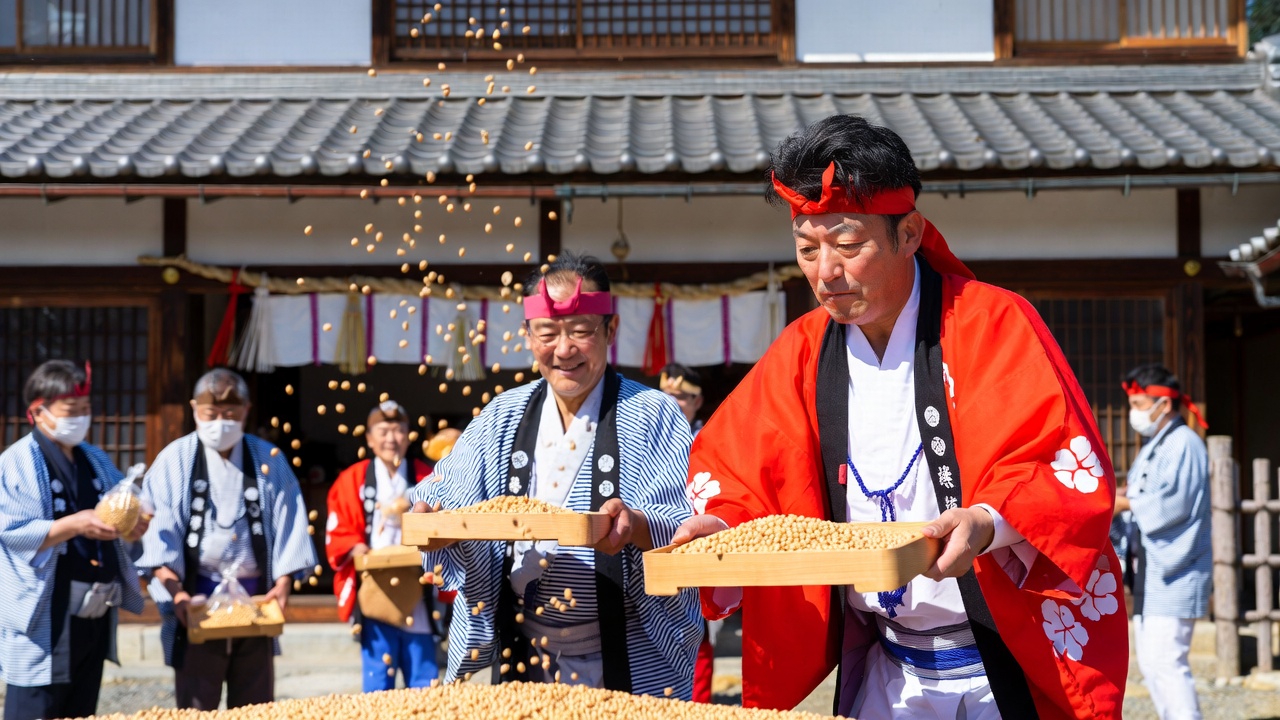
Every year, as the cold grip of Japanese winter begins to loosen, something unusual happens across the country. Fathers put on fearsome red and blue masks. Children load their tiny fists with roasted soybeans. And then, with gleeful shouts of “Oni wa soto! Fuku wa uchi!” (“Demons out! Good fortune in!”), the beans fly.
This is Setsubun (節分) — one of Japan’s most beloved seasonal traditions. It is not a public holiday. There are no days off work. Yet on this single day, millions of Japanese families, temples, and shrines come together to chase away misfortune and welcome the spring with rituals that stretch back over a thousand years.
If you have ever wondered why the Japanese throw beans at demons, eat enormous sushi rolls in total silence, or hang sardine heads on their front doors, you are in the right place. This guide covers everything you need to know about Setsubun in 2026 — from its ancient Chinese origins to the best temple festivals you can visit this year.
When Is Setsubun 2026? Date, Day, and Lucky Direction This Year
In 2026, Setsubun falls on Tuesday, February 3. This is the most common date for the festival, though it does occasionally shift to February 2 or February 4 depending on astronomical calculations. (In 2021 and 2025, for example, Setsubun was observed on February 2.)
The reason for this flexibility is simple. Setsubun is defined as the day before Risshun (立春), the first day of spring according to the traditional Japanese calendar. Because Risshun is determined by the position of the sun along the ecliptic — specifically, when the sun reaches 315 degrees of celestial longitude — the exact date can vary slightly from year to year.
The Lucky Direction (Ehō) for 2026
One of the most important pieces of information for anyone celebrating Setsubun is the ehō (恵方), or “lucky direction,” for the year. This is the direction in which the deity Toshitokujin (歳徳神), the god of good fortune for the year, is believed to reside.
In 2026, the lucky direction is south-southeast (南南東やや南).
There are only four possible lucky directions in the cycle: east-northeast, west-southwest, south-southeast, and north-northwest. The direction rotates each year based on the Ten Heavenly Stems (十干), an ancient Chinese counting system that has been part of the Japanese calendar for centuries.
| Year | Lucky Direction (Ehō) |
|---|---|
| 2024 | East-northeast |
| 2025 | West-southwest |
| 2026 | South-southeast |
| 2027 | North-northwest |
| 2028 | South-southeast |
You will need to know this direction when you eat your ehomaki sushi roll — but more on that later.
What Does Setsubun Mean? The Meaning Behind the “Division of Seasons”
The word Setsubun (節分) literally translates to “seasonal division” or “the division of seasons.” It is composed of two kanji characters: setsu (節), meaning “season” or “joint,” and bun (分), meaning “divide” or “part.”
Technically, there are four setsubun each year — one before the start of each season (spring, summer, autumn, and winter). However, over the centuries, the spring setsubun became far more important than the others. By the Edo period (1603–1867), the word “Setsubun” had come to refer almost exclusively to the day before Risshun.
Why did the spring transition matter so much? In the old Japanese lunar-solar calendar, the first day of spring was essentially the start of the new year. Risshun carried the same weight that January 1 carries today. The day before it — Setsubun — was therefore the equivalent of New Year’s Eve: a time to clean house, settle debts, and prepare for a fresh beginning.
This is the key to understanding Setsubun. It is not simply about the end of winter. It is about spiritual renewal. The Japanese believed that the boundaries between seasons were unstable, liminal moments when the barrier between the human world and the spirit world grew thin. Evil spirits, misfortune, and disease were thought to slip through the cracks during these transitions. Setsubun rituals were designed to seal those cracks and ensure that the new season — and the new year — would begin in safety and good health.
The History and Origins of Setsubun: From Ancient China to Modern Japan
How an Ancient Chinese Exorcism Became a Japanese Tradition
The roots of Setsubun reach back to an ancient Chinese court ritual called Tsuina (追儺), also known as Oniyarai (鬼遣らい), meaning “driving away demons.” According to Shoku Nihongi, one of the six classical Japanese history texts, tsuina was first performed in Japan in 706 CE during the Nara period. It was a court ceremony held on the last day of the year to ward off evil spirits and pestilence.
The original tsuina ceremony looked nothing like modern Setsubun. At the imperial palace, clay figures of oxen and children were placed at each gate. Priests wielded peach-wood branches and walking sticks to drive away invisible evil. A key figure in the ceremony was the Hōsōshi (方相氏), a powerful shaman who wore a fearsome four-eyed golden mask and led the ritual exorcism.
Here is where history gets interesting. Over time, people confused the Hōsōshi’s frightening appearance with the very demons he was supposed to drive away. The protector became the monster. This misidentification gradually merged the figure of the exorcist with the figure of the oni (demon), laying the foundation for the bean-throwing rituals we know today.
The Muromachi Period: When Bean-Throwing Began
The custom of mamemaki (豆撒き) — throwing roasted soybeans to drive away evil — became firmly established during the Muromachi period (1336–1573). According to the Ainōshō, a dictionary compiled during this era, the practice originated from a legend set in the 10th century during the reign of Emperor Uda. The story tells of a monk on Mount Kurama (鞍馬山) in Kyoto who escaped a demonic attack by throwing roasted soybeans into the eyes of an oni.
This legend gave mamemaki both its narrative justification and its symbolic logic. The Japanese word for bean, mame (豆), can also be written with the characters for “demon’s eye” (魔目, also read mame). Throwing beans at a demon is therefore literally targeting its eyes. Furthermore, the word mame sounds like mametsu (魔滅), meaning “to destroy evil.” In a culture where wordplay and linguistic symbolism carry deep meaning, these connections helped cement the bean-throwing custom in the national consciousness.
During the Muromachi period, mamemaki was primarily practiced among the aristocracy and samurai class. Households would throw roasted soybeans from their homes into the open air, chanting to expel evil and invite good fortune.
The Edo Period: Setsubun Becomes a National Festival
It was during the Edo period (1603–1867) that Setsubun evolved from an elite ritual into a widespread popular festival. Bean-throwing spread to Shinto shrines, Buddhist temples, and the homes of ordinary citizens across Japan. The practice became a community event, with large-scale mamemaki ceremonies drawing crowds to local temples.
The Edo period also gave rise to two other key Setsubun traditions:
- Hiiragi Iwashi (柊鰯): The custom of placing grilled sardine heads on holly branches at the entrance of homes began during this era. People believed that oni were repelled by the sharp smell of the sardines and the prickly thorns of the holly leaves.
- Ehomaki (恵方巻き): The custom of eating thick sushi rolls on Setsubun is thought to have originated in the geisha districts of Osaka during the late Edo to early Meiji period. (We will explore this custom in detail below.)
By the end of the Edo period, Setsubun had taken the shape we recognize today: a day of bean-throwing, demon-chasing, and symbolic cleansing observed in homes, temples, and shrines from Hokkaido to Kyushu.
Mamemaki: The Japanese Bean-Throwing Tradition Explained Step by Step
Mamemaki (豆撒き) is the heart of Setsubun. The word means “bean scattering,” and it is exactly what it sounds like — people throw roasted soybeans, called fukumame (福豆, “fortune beans”), to drive evil spirits from their homes and lives.
Why Roasted Soybeans? The Rules of Mamemaki
The beans must be roasted, not raw. This is not just a matter of taste. According to traditional belief, if a raw bean were accidentally left on the floor and sprouted, it would bring bad luck. Roasting the beans eliminates this risk. In symbolic terms, roasting also “kills” the evil contained in the beans, making them safe to scatter and eat.
From mid-January onward, bags of Setsubun fukumame begin appearing on supermarket and convenience store shelves across Japan. These packages often include a paper oni mask that a family member can wear during the ritual.
How to Do Mamemaki at Home: A Step-by-Step Guide
Here is the traditional way to perform mamemaki, as practiced in most Japanese households:
- Prepare the beans. Buy or roast soybeans. Place them on a small altar or elevated surface (such as a kamidana, or household shrine shelf) until evening.
- Choose the oni. One family member — traditionally the father — puts on the oni mask.
- Wait for nightfall. Oni are believed to come at night, so mamemaki is best performed after dark when the whole family is home.
- Open the doors and windows. Starting from the innermost room of the house, the family moves outward toward the front entrance.
- Throw the beans outward while shouting: “Oni wa soto!” (鬼は外!) — “Demons out!”
- Close the doors and windows. Then throw beans inside the rooms while shouting: “Fuku wa uchi!” (福は内!) — “Good fortune in!”
- Eat the beans. After the ritual, each family member eats the same number of roasted soybeans as their age — or their age plus one — to pray for good health throughout the year.
Pro tip: If you find it difficult to eat that many beans (older family members often do), you can instead drink fuku-cha (福茶) — a simple tea made by steeping roasted soybeans with pickled plum (umeboshi) and kelp (kombu) in hot green tea.
Regional Differences in Mamemaki
Not all parts of Japan use soybeans for mamemaki. In Hokkaido, Tohoku, Niigata, and parts of Kyushu, families throw unshelled peanuts instead. The practical reason is straightforward: peanuts in their shells are easier to pick up off the floor after the ritual, and they stay clean even when they land on the ground.
Some regions also have their own unique chants. The most common version is “Oni wa soto, fuku wa uchi,” but at certain temples — particularly those associated with powerful guardian deities — the chant drops the first part entirely. At Naritasan Shinshōji Temple in Chiba, for example, participants only shout “Fuku wa uchi!” This is because the temple’s principal deity, Fudō Myōō (the Immovable Wisdom King), is considered so powerful and merciful that even oni repent in his presence. There are no demons to drive away.
Ehomaki: How to Eat Lucky Direction Sushi Rolls on Setsubun
If mamemaki is the oldest Setsubun tradition, ehomaki (恵方巻き) is the most commercially successful one — and the most fun for food lovers.
What Is Ehomaki? Meaning and Origin of Lucky Sushi Rolls
Ehomaki is a thick, uncut sushi roll eaten on the day of Setsubun. The name breaks down into two parts: ehō (恵方), meaning “lucky direction,” and maki (巻き), meaning “roll.” The idea is simple but specific: you face the year’s auspicious direction, hold the entire uncut roll in both hands, and eat it in complete silence while making a wish.
The origins of ehomaki are somewhat murky, with several competing theories. The most widely accepted explanation traces the custom to Osaka’s Senba district during the late Edo to early Meiji period. Merchants and geisha are said to have eaten thick sushi rolls as a playful ritual to pray for business prosperity. The rolls were called marukaburi zushi (丸かぶり寿司, “bite-into-whole sushi”) or simply futomaki zushi (太巻き寿司, “thick rolled sushi”).
For decades, ehomaki remained a regional Kansai tradition, little known outside of Osaka, Kyoto, and the surrounding areas. That changed dramatically in 1989, when the convenience store chain Seven-Eleven (now 7-Eleven) began marketing the rolls under the catchy name “ehomaki” and selling them nationwide. Other convenience stores and supermarkets quickly followed suit. By the late 1990s, ehomaki had become a national phenomenon.
Today, the ehomaki market is enormous. The economic effect of ehomaki sales in 2022 was estimated at roughly ¥64.9 billion (approximately $430 million USD), making it one of the most commercially significant food traditions in Japan’s seasonal calendar.
How to Eat Ehomaki the Right Way: Three Rules for Good Luck
There are three simple but non-negotiable rules for eating ehomaki:
- Face the lucky direction. In 2026, that means south-southeast. Use a compass app on your phone if you are not sure which way to face.
- Eat the entire roll without cutting it. Cutting the roll is believed to “cut off” your good fortune. You must eat it whole — yes, even if it is comically large.
- Eat in complete silence. Do not speak until you have finished the entire roll. Speaking is thought to let your luck escape. Focus on your wish for the year as you chew.
What Is Inside Ehomaki? The Seven Lucky Ingredients
Traditional ehomaki contains seven ingredients, a number chosen to represent the Shichifukujin (七福神), or Seven Gods of Good Fortune — a group of deities from Japanese, Chinese, and Indian traditions who are believed to bring luck, wealth, and happiness.
There is no single fixed recipe, but common traditional fillings include:
| Ingredient (Japanese) | English | Symbolism |
|---|---|---|
| かんぴょう (kanpyō) | Dried gourd strips | Longevity (long strips = long life) |
| しいたけ (shiitake) | Simmered shiitake mushroom | Protection and health |
| 伊達巻 / 卵焼き (datemaki / tamagoyaki) | Sweet egg omelet | Brightness and prosperity |
| うなぎ / あなご (unagi / anago) | Eel or conger eel | Success (“climbing upward”) |
| おぼろ (oboro) | Sweet fish flakes | Good fortune |
| きゅうり (kyūri) | Cucumber | Freshness and the Nine Lucky Stars |
| 桜でんぶ (sakura denbu) | Pink fish flakes | Celebration and joy |
In recent years, the range of ehomaki fillings has expanded dramatically. Modern convenience stores and supermarkets offer premium versions featuring Hokkaido salmon, scallops, tuna, wagyu beef, salmon roe, and even truffle salt. In 2026, major retailers like 7-Eleven, Lawson, FamilyMart, and AEON all launched reservation-based ehomaki lines with luxury seafood options — some costing over ¥3,000 per roll.
The Ehomaki Food Waste Problem: A Growing Concern
The commercial success of ehomaki has a darker side. Because the rolls are sold on a single day and are highly perishable, overproduction has become a serious problem.
Food-loss expert and journalist Rumi Ide estimated that in 2023, approximately ¥1.28 billion worth of ehomaki — some 2.56 million rolls — went unsold and were thrown away. The Japan Food Ecology Center reported that an average of six tons of food waste per day was generated around Setsubun from 2019 to 2021. Each ehomaki requires roughly 120 liters of water to produce and carries a carbon footprint of about 528 grams, making this waste both economically and environmentally significant.
In response, the Ministry of Agriculture, Forestry and Fisheries has encouraged retailers to adopt reservation-based sales systems and better demand forecasting. Some supermarket chains, like Shell Garden, now monitor hourly sales and redistribute stock between stores in real time. Co-op Kyushu has introduced half-size ehomaki that are easier for children and elderly customers to finish, reducing household waste as well.
What can you do? If you want to celebrate Setsubun responsibly, consider buying your ehomaki from a local sushi shop rather than a convenience store — specialized shops tend to have far less waste because they better understand local demand. Or, better yet, make your own ehomaki at home.
Hiiragi Iwashi: Why the Japanese Hang Sardine Heads on Holly Branches
Of all Setsubun customs, Hiiragi Iwashi (柊鰯) is perhaps the most visually striking — and the most puzzling to visitors encountering it for the first time.
The tradition involves placing a grilled sardine head on a sprig of holly (hiiragi) and hanging it at the entrance of the home. The combination is designed to repel oni through a kind of sensory assault: the sharp, prickly holly leaves threaten to stab the demon’s eyes, while the pungent smell of the grilled sardine overwhelms its nose.
This custom is also sometimes called Yaikagashi (焼い嗅がし), which roughly translates to “grilled and smelly.” The earliest record of a similar practice appears in the Tosa Nikki (Tosa Diary), a literary work compiled in 934 CE during the Heian period. In the diary, the author mentions decorating the gate with sardine heads — though the combination with holly likely developed later.
Today, Hiiragi Iwashi is less commonly practiced than mamemaki or ehomaki, especially in urban areas. However, it remains a living tradition in many rural communities and is widely referenced in Setsubun-themed decorations, illustrations, and children’s crafts.
In some regions, people skip the doorway decoration and simply eat sardines as a Setsubun meal instead, keeping the protective symbolism while adapting to modern apartment living.
Oni and Otafuku: The Demons and the Goddess of Setsubun
No discussion of Setsubun is complete without understanding the two figures at its symbolic center: the oni (鬼) and Otafuku (お多福).
What Are Oni? Understanding Japanese Demons
In Western culture, the closest equivalent to oni would be ogres or demons. They are large, fearsome creatures typically depicted with horns, wild hair, fangs, and brightly colored skin — usually red or blue. They carry heavy iron clubs (kanabō) and wear tiger-skin loincloths.
But in the context of Setsubun, oni are not just mythological monsters. They are symbols of invisible misfortune — illness, natural disasters, accidents, and bad luck. The ancient Japanese term for these hidden calamities was oni, which derives from the word on (隠), meaning “hidden” or “concealed.” In other words, oni originally referred not to visible monsters but to the unseen forces of harm that people feared during seasonal transitions.
The visual appearance of oni has an interesting origin. In the traditional Chinese directional system used in Japan, the northeast direction was called Ushitora (丑寅), combining the characters for “ox” (ushi) and “tiger” (tora). This direction was considered the “demon gate” (kimon, 鬼門) — the direction from which evil entered. This is why oni are depicted with ox-like horns and tiger-skin clothing: their appearance literally embodies the “ox-tiger” direction of evil.
Who Is Otafuku? The Smiling Face of Good Fortune
Where oni represent misfortune, Otafuku (also called Okame or O-fuku) represents happiness and good luck. She is depicted as a round-faced, smiling woman with plump cheeks, a small nose, and a gentle expression. Her name contains the character fuku (福), meaning “fortune” or “blessing.”
The connection between Otafuku and Setsubun comes from a traditional Kyōgen (comic theater) performance in which Otafuku’s kindness and warmth persuade a fearsome oni to change its ways. This story directly links her to the Setsubun chant: when people shout “Fuku wa uchi!” (“Good fortune in!”), the “fuku” is personified by Otafuku herself.
In some parts of Japan — particularly Fukuoka — shrines erect giant Otafuku masks with open mouths at their gates during Setsubun. Visitors walk through the mouth of the mask to receive blessings of household safety and business prosperity.
The Watanabe Exemption: Why One Japanese Family Does Not Throw Beans
One of the most charming footnotes in Setsubun history involves the Watanabe family. According to tradition, people with the surname Watanabe (渡辺) do not need to perform mamemaki — because oni are already afraid of them.
The reason traces back to the legendary warrior Watanabe no Tsuna (渡辺綱), a retainer of the famous Heian-era general Minamoto no Yorimitsu. Watanabe no Tsuna is credited with defeating some of the most powerful oni in Japanese mythology, including the notorious Shuten-dōji and Ibaraki-dōji. His reputation as a demon-slayer was so fearsome that oni are said to avoid anyone bearing his family name.
Watanabe no Tsuna was the first person to take the surname Watanabe, and today it is the fifth most common surname in Japan, with approximately 1.08 million people bearing the name. Some Watanabe families have maintained the tradition of skipping mamemaki for generations — a rare and delightful example of a folk belief that exempts people from a national custom.
Best Setsubun Festivals at Temples and Shrines in Japan 2026
While Setsubun is widely celebrated at home, the most spectacular observances take place at temples and shrines across the country. These public events feature massive bean-throwing ceremonies, celebrity guests, traditional dances, and festive food stalls. Here are some of the most famous Setsubun festivals to attend in 2026.
Naritasan Shinshōji Temple — Chiba Prefecture
Date: February 3, 2026 Ceremonies: 11:00 AM, 1:30 PM, 4:00 PM
Naritasan Shinshōji is arguably the most famous Setsubun destination in Japan. Located just 30 minutes from Narita International Airport, this grand Shingon Buddhist temple — founded in 940 CE — draws approximately 40,000 visitors for its annual Setsubun festival. The event features celebrities, kabuki actors, and sumo wrestlers who throw an estimated 860 kg of beans (plus 400 kg of peanuts) from the stage in front of the Great Main Hall.
Because the temple is dedicated to Fudō Myōō (the Immovable Wisdom King), whose mercy is so powerful that even demons repent, the chant here omits “Oni wa soto.” Participants only call out “Fuku wa uchi!”
Sensōji Temple — Asakusa, Tokyo
Date: February 3, 2026
Sensōji in Asakusa was the first temple in Japan to hold a large-scale public Setsubun ceremony. Around 10,000 people gather each year to watch celebrities and local entertainers throw beans from the temple grounds. The event also features the famous Fukuju-no-Mai (福寿の舞), a “Dance of the Seven Lucky Gods” that is one of Sensōji’s most treasured rituals.
Like Naritasan, Sensōji’s chant omits the demon-banishing phrase. Because the temple is dedicated to Kannon (the Bodhisattva of Mercy), it is believed that no oni can exist in her presence. The chant is changed to: “Sensō, fuku wa uchi!” — invoking long life and good fortune.
Yasaka Shrine — Kyoto
Date: February 2–3, 2026
The Setsubun festival at Yasaka Shrine is one of Kyoto’s most lively seasonal events. The highlight is the performance of traditional dances by geisha and maiko (apprentice geisha) from the Gion district. After the dance, the geisha themselves throw packets of roasted soybeans to the crowd — a scene that is both elegant and joyful.
Yoshida Shrine — Kyoto
Date: February 2–3, 2026
Yoshida Shrine hosts one of the largest and oldest Setsubun festivals in the Kansai region. The festival features a dramatic Tsuina ritual — a recreation of the ancient court exorcism ceremony — complete with costumed performers driving away oni with bows, arrows, and ritual chanting. Fire ceremonies and rows of food stalls create a vibrant festival atmosphere.
Kasuga Taisha — Nara
Date: February 3, 2026
At Kasuga Taisha, Setsubun is celebrated with the breathtaking Setsubun Mantōrō (節分万燈籠) ceremony. More than 3,000 stone and bronze lanterns throughout the shrine grounds are lit at dusk, creating a scene of ethereal beauty. This lantern-lighting tradition has continued for approximately 800 years. Many of the lanterns were originally donated by samurai during Japan’s Warring States period.
Zōjōji Temple — Tokyo
Date: February 3, 2026
Set at the base of Tokyo Tower in Shiba Park, Zōjōji has a deep historical connection to the Tokugawa shogunate. Its Setsubun festival draws roughly 3,000 attendees and features celebrities born in the current year’s Chinese zodiac sign as special bean-throwers. The event typically runs around midday, making it a convenient stop during a Tokyo lunch break.
Ikegami Honmonji — Tokyo
Date: February 3, 2026
Located in Ōta-ku, Ikegami Honmonji hosts one of Tokyo’s most established Setsubun celebrations, drawing over 10,000 people annually. The temple is known for attracting a particularly colorful lineup of celebrity guests from the worlds of sports, television, and music.
How to Celebrate Setsubun at Home: A Complete Guide for Beginners
You do not need to be in Japan — or even be Japanese — to celebrate Setsubun. The rituals are simple, fun, and deeply meaningful. Here is everything you need for a proper Setsubun celebration at home.
What You Need to Prepare for Setsubun
| Item | Where to Get It | Purpose |
|---|---|---|
| Roasted soybeans (fukumame) | Asian grocery store or online | Bean-throwing and eating |
| Oni mask | Print one online or buy at a Japanese store | The “demon” for mamemaki |
| Ehomaki ingredients | Supermarket or sushi shop | Lucky sushi roll |
| Holly sprig + sardine head (optional) | Fish market + garden center | Doorway protection |
| Compass or compass app | Your smartphone | Finding the lucky direction |
Step-by-Step Home Celebration
Evening — Mamemaki Time:
- One family member puts on the oni mask. (Traditionally the father, but anyone can be the oni.)
- The rest of the family grabs handfuls of roasted soybeans.
- Open the front door or a window.
- Throw beans at the oni and toward the outside, shouting “Oni wa soto!”
- Close the door quickly.
- Throw beans inside the house, shouting “Fuku wa uchi!”
- Move through each room, repeating the process from the innermost room outward.
- Everyone eats the number of beans equal to their age (or age plus one).
Dinner — Ehomaki Time:
- Prepare or purchase ehomaki rolls — one per family member.
- Face south-southeast (the 2026 lucky direction).
- Hold the uncut roll in both hands.
- In complete silence, make a wish and eat the entire roll without stopping.
- Do not speak until you have finished.
Optional — Hiiragi Iwashi:
- Grill a sardine and remove the head.
- Skewer the head on a sprig of holly.
- Place it at your front entrance to repel evil spirits.
Setsubun Food Traditions Beyond Ehomaki: What to Eat on February 3
While ehomaki dominates the modern Setsubun food scene, several other regional dishes are traditionally enjoyed on this day.
Setsubun Soba (節分そば)
In some parts of Japan, Setsubun is called “the real New Year’s Eve.” Just as many Japanese eat buckwheat noodles (toshikoshi soba) on December 31, some families eat Setsubun soba on February 3 to mark the old-calendar year-end. The long, thin noodles symbolize longevity and the cutting away of the old year’s misfortunes.
Kenchin-jiru (けんちん汁)
This hearty vegetable soup, made with tofu, root vegetables, mushrooms, and sesame oil, is a popular Setsubun dish in the Kantō region (eastern Japan, including Tokyo). It is a warming, nourishing meal perfectly suited to the cold February weather.
Iwashi (Sardines)
In many households — particularly in the Kansai region and parts of western Japan — grilled sardines are eaten as a Setsubun meal. The strong-smelling fish serves a dual purpose: it is both a protective talisman and a nutritious winter dish. Some families eat the sardine body while using the head for the Hiiragi Iwashi decoration.
Fuku-cha (福茶)
As mentioned earlier, fuku-cha (“fortune tea”) is a simple but symbolic drink made by steeping roasted soybeans, pickled plum, and kelp in hot green tea. It is an alternative for those who find eating a large number of beans impractical. The three ingredients represent good luck, health, and happiness.
How Setsubun Has Evolved in Modern Japan: 2026 Trends and Changes
Setsubun in 2026 looks quite different from Setsubun a generation ago. While the core traditions remain strong, several trends reflect the changing demographics and lifestyle patterns of contemporary Japan.
Family-Friendly and Simplified Celebrations
With more dual-income households and smaller family sizes, many Japanese families have simplified their Setsubun observances. Eating ehomaki at home has become the primary activity, while mamemaki is often experienced at kindergartens, daycare centers, or local community events rather than at home. Parents of young children frequently report that their kids are more excited about the nursery school mamemaki event than the one at home.
Convenience Store Culture and Ehomaki Innovation
Japan’s convenience stores — 7-Eleven, Lawson, FamilyMart, and others — remain the primary drivers of ehomaki sales. Each year, they compete fiercely to offer the most creative and luxurious fillings. In 2026, reservation options include everything from classic seven-ingredient rolls to premium options with brand-name wagyu beef, Hokkaido scallops, and bluefin tuna. Some retailers, like AEON, have introduced a “super-thick” ehomaki called the Gokubutomaki that is designed to be shared by the whole family.
Sustainability and Waste Reduction Efforts
The ehomaki food waste problem has pushed both government and industry to adopt better practices. The Ministry of Agriculture, Forestry and Fisheries now publishes retailer case studies on waste reduction. More stores are shifting to reservation-only sales to match production with actual demand. Half-size and mini ehomaki options are increasingly common, reducing both cost and waste.
Setsubun Events Abroad
Setsubun is increasingly celebrated outside Japan as well. Japanese cultural centers, gardens, and community organizations in cities from Los Angeles to London hold Setsubun events featuring mamemaki, oni mask-making workshops, and ehomaki tastings. In 2026, the Japanese Friendship Garden in San Diego hosted a Setsubun celebration open to the public, complete with bean-tossing, performances, and traditional crafts.
Setsubun Frequently Asked Questions (FAQ)
Is Setsubun a public holiday in Japan? No. Setsubun is a traditional seasonal observance, not a national holiday. Schools, businesses, and government offices operate on their normal schedules. However, many workplaces serve ehomaki at lunch, and schools hold mamemaki events for students.
Can I celebrate Setsubun if I am not Japanese? Absolutely. Setsubun is a cultural celebration, not a religious one, and visitors of all backgrounds are welcome to participate. Temple and shrine events are open to the public, and you do not need to be a Buddhist or Shinto practitioner to join in.
What if I have a soy allergy? Some regions of Japan already use peanuts instead of soybeans for mamemaki. You can substitute any roasted legume or even small wrapped candies. The symbolic intention matters more than the specific ingredient.
Do I really have to eat the whole ehomaki in silence? Tradition says yes. In practice, especially with young children, many families relax this rule. The spirit of the custom — making a wish while enjoying a special meal together — is what matters most.
Which direction is south-southeast? Use the compass app on your smartphone. Stand facing approximately 157.5 degrees from north. Many Japanese compass apps have a special “ehō mode” during Setsubun that points directly to the year’s lucky direction.
What happens if I drop a bean during mamemaki? Pick it up! According to tradition, you should clean up all the beans after the ritual. Leaving beans scattered on the floor — especially raw ones — was considered bad luck because they might sprout. Since you are using roasted beans, sprouting is not an issue, but tidiness is still appreciated.
Is Setsubun the same as the Lunar New Year? Not exactly, though they share historical roots. Setsubun marks the day before the old-calendar start of spring, which was once treated as the beginning of the new year. The modern Lunar New Year (celebrated widely in China, Korea, and Vietnam) follows a slightly different calendar system. In 2026, the Chinese Lunar New Year falls on February 17, while Setsubun is on February 3.
Conclusion: Why Setsubun Still Matters in 2026
In a country famous for its rapid modernization, Setsubun is a quiet reminder that some of the most meaningful human rituals are also the simplest. You do not need expensive equipment, elaborate preparations, or even a trip to a shrine. You need beans, a mask, a sushi roll, and the people you love.
At its core, Setsubun is about transition — the passage from one season to the next, from one year to the next, from the person you were to the person you hope to become. The beans flying through the air, the laughter of children chasing the “demon” dad, the silent shared moment of eating ehomaki while facing south-southeast — all of these small acts carry the same ancient wish: let the bad things go, and let the good things come in.
Whether you are planning a trip to Japan this February, celebrating at a Japanese cultural center in your own city, or simply curious about one of the world’s most charming seasonal traditions, Setsubun offers something rare in our increasingly frantic world: a moment to pause, to mark the turning of the season, and to start fresh.
Oni wa soto. Fuku wa uchi.
Demons out. Good fortune in.
Planning to visit Japan during Setsubun? February is one of the best months to experience traditional Japanese culture. Arrive a few days early to enjoy plum blossom season, winter illuminations, and the festive atmosphere at local temples and shrines. Don’t forget to pick up a bag of fukumame at any convenience store — and face south-southeast when you eat your ehomaki.