Serbia’s Statehood Day, known locally as Dan državnosti or Sretenje, falls on February 15 every year. It is the country’s biggest civic holiday — a two-day celebration of freedom, identity, and constitutional democracy. In 2026, it falls on a Sunday, with Monday, February 16 and Tuesday, February 17 given as official days off.
But this is far more than a date on the calendar. For Serbians, Sretenje is a profound meeting point of revolution, law, faith, and folklore. It marks the day an oppressed people took up arms against an empire — and the day, thirty-one years later, when they wrote one of the most progressive constitutions Europe had ever seen.
Whether you’re planning a trip to Belgrade in mid-February, researching Balkan history, or simply curious about one of Southeast Europe’s most emotionally charged holidays, this guide covers everything you need to know.
When Is Serbia Statehood Day 2026 and How Long Is the Holiday?
Statehood Day is always celebrated on February 15 and 16. The first day marks the anniversary itself. The second day extends the official commemoration. When either date falls on a weekend, workers receive a substitute day off during the week.
Here is how the dates look for 2026 and upcoming years:
| Year | Day 1 (Feb 15) | Day 2 (Feb 16) | Extra Day Off |
|---|---|---|---|
| 2026 | Sunday | Monday | Tuesday, Feb 17 |
| 2027 | Monday | Tuesday | — |
| 2028 | Tuesday | Wednesday | — |
| 2029 | Thursday | Friday | — |
In 2026, many Serbians will enjoy a three-day weekend (February 15–17), making it one of the longer holiday breaks of the winter season. Schools, government offices, and most businesses close. Many families use the time for travel, gatherings, or visits to historical sites.
Why Does Serbia Celebrate Statehood Day on February 15?
February 15 carries the weight of two separate but deeply connected events in Serbian history. Together, they capture the arc of a nation rising from subjugation to self-governance in a single generation.
The first event is the outbreak of the First Serbian Uprising in 1804 — the armed revolt that ignited the Serbian Revolution against centuries of Ottoman rule.
The second event is the adoption of the Sretenje Constitution in 1835 — the first modern constitution in Serbia and one of the most liberal legal documents in all of Europe at the time.
The fact that both events occurred on the same date — the Orthodox feast of Sretenje (Candlemas) — gives the holiday a rare triple significance: political, constitutional, and spiritual, all at once.
Serbia is, as former Prime Minister Ana Brnabić once noted, among the very few countries in the world that celebrate their national day in memory of two first-rate historical events that took place on the same day.
The First Serbian Uprising of 1804: How a Revolution Began in a Small Village
The Ottoman Occupation and the Slaughter of the Knezes
To understand why February 15, 1804 matters so deeply, you have to go back centuries. By the mid-1400s, most of modern-day Serbia had fallen under Ottoman control. The occupation lasted for more than 300 years. Serbian peasants paid heavy taxes, faced forced labor, and had limited rights.
By the early 1800s, power in the Belgrade region had been seized by the Dahije — a group of renegade Janissary commanders who had overthrown the lawful Ottoman governor. These warlords were brutal. They suspended the limited freedoms the Sultan had previously granted to Serbian communities. They raised taxes. They imposed even harsher forms of forced labor.
Then came the event that pushed the Serbian people past the breaking point.
In late January and early February 1804, the Dahije feared that the Ottoman Sultan would use Serbian leaders against them. Their response was ruthless: they ordered the systematic execution of roughly 70 to 150 prominent Serbian village elders (knezes). This massacre, known as the Seča knezova or Slaughter of the Knezes, was designed to eliminate any potential resistance. Heads of murdered leaders were displayed on the gates of the Belgrade fortress as a warning.
It had exactly the opposite effect.
The Assembly at Orašac and the Election of Karađorđe
Enraged and with nothing left to lose, Serbian leaders gathered in secret. On February 14, 1804 (February 15 by the modern calendar), over 300 Serbs assembled at Marićevića jaruga (Marićević Gully) in the small village of Orašac, near the town of Aranđelovac in central Serbia.
The gathering included village elders, priests, and hajduci (guerrilla fighters). They decided unanimously to rise up against the Dahije. They needed a leader — someone with military experience and the respect of the people.
They chose Đorđe Petrović, a cattle trader and former soldier who had served in the Austrian Freikorps during the Austro-Turkish War. He was known by his nickname: Karađorđe — meaning “Black George.” He was tough, charismatic, and fearless.
That afternoon, the uprising began immediately. A Turkish inn near the church in Orašac was burned. The rebellion spread quickly to surrounding villages and towns — Rudnik, Valjevo, Požarevac — and by 1806, Serbian forces had taken Belgrade itself.
From Revolt to Revolution
What started as a local uprising against rogue Janissaries evolved into something far greater: a full-scale war for independence. The Serbian rebels established their own government, parliament, and system of laws. They founded schools. They reduced taxes. The University of Belgrade traces its roots to the Belgrade Higher School established in 1808 during this period.
The uprising eventually failed militarily — the Ottomans reconquered Serbia in 1813 after Russia, Serbia’s key ally, was forced to redirect its attention to the Napoleonic Wars. But the revolution was not in vain. A Second Serbian Uprising in 1815, led by Miloš Obrenović, secured Serbian autonomy. And the spirit of 1804 never died.
By 1878, at the Congress of Berlin, Serbia gained full international recognition as an independent state.
The Sretenje Constitution of 1835: Serbia’s First Modern Constitution
A Constitution Born on Candlemas Day
Exactly 31 years after the Orašac assembly, on February 15, 1835, the Serbian National Assembly gathered in the city of Kragujevac — then the capital of the Principality of Serbia. Approximately 2,500 participants and 10,000 spectators witnessed the adoption of the first modern Serbian constitution.
The document was drafted by Dimitrije Davidović, one of the most educated Serbians of his era — a journalist, diplomat, philosopher, and the founder of modern Serbian publishing. He based its framework on the French Constitutional Charter of 1814 and 1830 and the Belgian Constitution of 1831.
What the Sretenje Constitution Established
The constitution was remarkably progressive for its time. Its 14 chapters and 142 articles introduced principles that many European nations had not yet adopted:
- Separation of powers into legislative, executive, and judicial branches
- Equality of all citizens regardless of religion or ethnicity
- Abolition of feudalism and slavery
- Freedom of movement and settlement
- Right to choose one’s own profession
- Right to a lawful trial
- Independence of the judiciary
- Inviolability of the home and person
One of its most celebrated provisions declared that anyone who sets foot on Serbian soil becomes a free person, regardless of their faith or nationality.
As the National Assembly of Serbia has noted, the Sretenje Constitution demonstrated that Serbia was building an organized state based on the fundamental tenets of justice — and that it was following the course of European civilization.
Why It Was Suspended After Only 55 Days
Despite its idealism, the constitution alarmed three powerful neighbors: the Ottoman Empire, Russia, and Austria. Each of these empires saw the document as a dangerous example of limiting monarchical power. Under joint pressure, Prince Miloš Obrenović was forced to suspend the constitution just 55 days after its adoption.
It was replaced in 1838 by a far more restrictive “Turkish Constitution” imposed by the Ottoman Sultan. But the principles of the Sretenje Constitution — democracy, human rights, separation of powers — remained embedded in the Serbian political imagination. They resurfaced in every subsequent constitution the country would write.
Today, the original handwritten copy of the Sretenje Constitution is preserved at the Serbian State Archives in Belgrade.
The Religious Meaning of Sretenje: Candlemas in the Serbian Orthodox Tradition
The word Sretenje comes from the Old Serbian verb meaning “to meet.” In the Orthodox Christian calendar, the feast of Sretenje — known as Candlemas or the Presentation of Jesus at the Temple — falls 40 days after Christmas.
According to tradition, it was on this day that the Virgin Mary brought the infant Jesus to the Temple in Jerusalem. The elderly priest Simeon, who had been promised by God that he would not die before seeing the Messiah, took the child in his arms. It was a meeting — a sretenje — between the old and the new, between prophecy and fulfillment.
In Serbian folk tradition, Sretenje also marks the meeting of winter and summer. There is a popular saying: “Sretenje obretenje” — from the verb obrtati, meaning “to turn.” The days grow longer. The seasons begin to shift.
There is even a Serbian folk belief about the weather on Sretenje that mirrors America’s Groundhog Day. If it is sunny on Sretenje and the bear (or a mythical figure called Božana) sees her shadow, winter will last six more weeks. If it is cloudy, spring is on its way.
This overlap of civic, religious, and folk traditions is part of what makes Sretenje so unique. As Folkways Today explains, the two names — “Sretenje” and “Statehood Day” — are used interchangeably by most Serbians, and many view the civic and religious celebrations as a single, unified observance.
How Does Serbia Celebrate Statehood Day? Traditions, Ceremonies, and Events
Official State Ceremonies and Military Honors
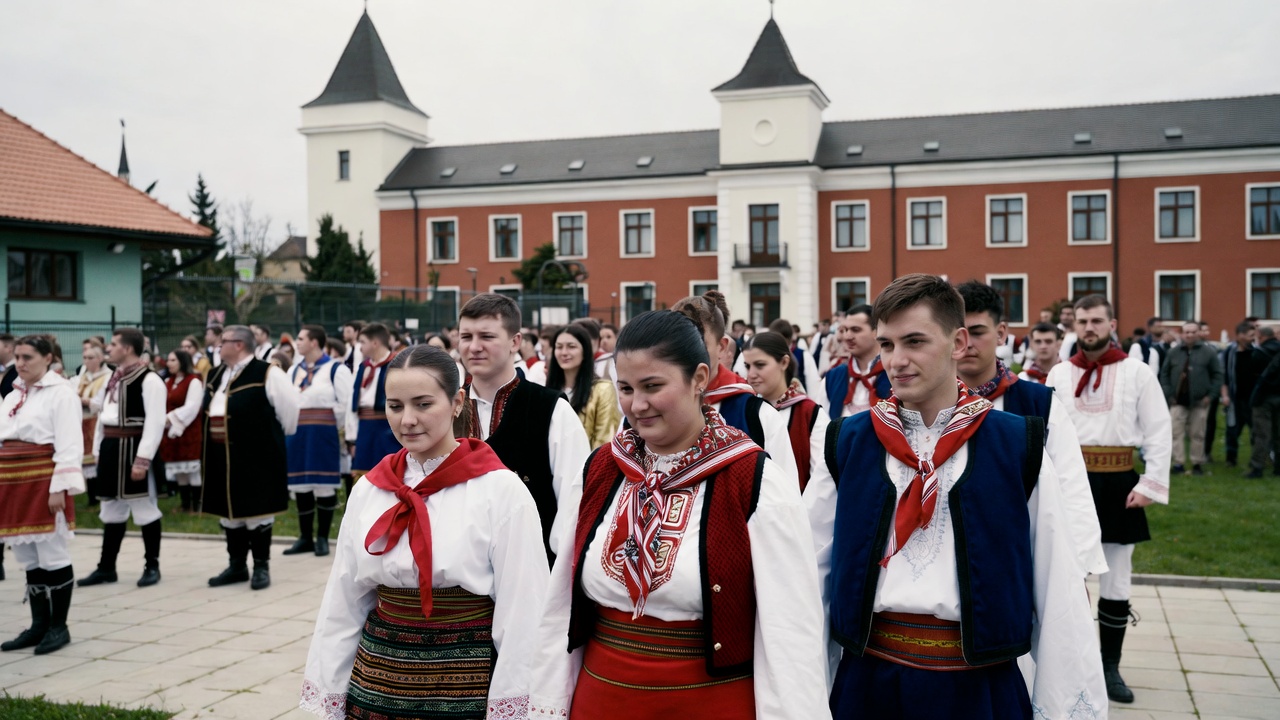
Statehood Day is the most solemn civic occasion on the Serbian calendar. The celebrations combine military ceremony, political tradition, and public pageantry.
Key elements include:
- Wreath-laying at the Monument to the Unknown Hero on Mt. Avala, just south of Belgrade. Senior officials — often the President or Minister of Defense — lay wreaths and write messages in the monument’s guest book.
- Ceremonies at the Orašac memorial complex, the birthplace of the uprising, where the annual state ceremony takes place in the presence of military and government officials.
- A solemn session of the Serbian Parliament in the Old Assembly building in Kragujevac, the city where the Sretenje Constitution was adopted.
- Ceremonial gun salutes fired simultaneously in Belgrade, Novi Sad, Niš, and Kragujevac by Serbian Armed Forces guard units.
- A River Flotilla parade on the Sava and Danube rivers, along with an Air Force flypast over Belgrade.
- Presidential speeches and award ceremonies — in 2022, for example, President Aleksandar Vučić famously awarded the Gold Medal of Merit to actor Johnny Depp on Statehood Day.
Flag Raising, Fireworks, and Concerts
Beyond the official events, cities and towns across Serbia hold flag-raising ceremonies, fireworks displays, and public concerts. The national anthem, Bože pravde (“God of Justice”), rings out at gatherings and broadcasts throughout the day.
In Belgrade, the Kalemegdan Fortress, the Church of Saint Sava, and the National Museum become popular destinations for citizens marking the occasion.
Family Gatherings and Traditional Serbian Food
For many ordinary Serbians, Statehood Day is above all a time to gather with family and friends. Tables are set with traditional Serbian dishes. Common holiday fare includes:
- Sarma — cabbage rolls stuffed with minced meat and rice
- Ajvar — a roasted pepper and eggplant spread
- Pita — savory pastry, often filled with cheese or meat
- Rakija — Serbia’s beloved fruit brandy, raised in toasts to freedom and health
Serbian Orthodox church services are also held on this day, blending the religious observance of Candlemas with the civic celebration.
Where to Experience Statehood Day in Serbia: Best Places to Visit
If you are traveling to Serbia around mid-February, Statehood Day offers a remarkable window into the country’s soul. Here are the most meaningful places to experience the holiday:
| Location | Why Visit | Distance from Belgrade |
|---|---|---|
| Orašac | Birthplace of the uprising; memorial complex, museum, and annual state ceremony | ~70 km south |
| Kragujevac | Where the Sretenje Constitution was adopted; ceremony at the Old Assembly | ~140 km south |
| Belgrade | Military honors, flag-raising, concerts, fireworks at Kalemegdan | — |
| Mt. Avala | Monument to the Unknown Hero; wreath-laying ceremonies | ~16 km south of Belgrade |
| Topola & Oplenac | Mausoleum of the Karađorđević dynasty, linked to the uprising’s legacy | ~80 km south |
Travel tip for 2026: Because February 15 is a Sunday, the celebrations may feel spread across the entire long weekend. Book accommodation early if you plan to stay in Belgrade or Kragujevac — hotel demand rises around Sretenje.
Statehood Day Serbia: A Brief Timeline from Ottoman Rule to National Holiday
| Year | Event |
|---|---|
| 1459 | Serbia falls fully under Ottoman control |
| Jan–Feb 1804 | Dahije massacre Serbian elders (Slaughter of the Knezes) |
| Feb 15, 1804 | Assembly at Orašac; Karađorđe elected leader; First Serbian Uprising begins |
| 1805 | Serbian rebels form a government, parliament, and legal system |
| 1806 | Belgrade captured by Serbian forces |
| 1813 | Ottoman Empire reconquers Serbia |
| 1815 | Second Serbian Uprising begins under Miloš Obrenović |
| Feb 15, 1835 | Sretenje Constitution adopted in Kragujevac |
| April 1835 | Sretenje Constitution suspended under foreign pressure |
| 1878 | Serbia recognized as fully independent at the Congress of Berlin |
| 1918 | Serbia merges into the Kingdom of Serbs, Croats, and Slovenes; Sretenje celebrations end |
| 2001 | Statehood Day restored as a national holiday in modern Serbia |
Why Did Serbia Stop and Then Restore Statehood Day?
This is a part of the story many people miss. Statehood Day was not always a holiday. It was celebrated continuously from the 1800s until 1918, when Serbia was absorbed into the newly formed Kingdom of Serbs, Croats, and Slovenes — a state that would later become Yugoslavia.
Under both royal and communist Yugoslavia, Sretenje was no longer marked as a national holiday. It was only after Yugoslavia began to break apart that the holiday was revived.
In 2001, the new democratic Serbian government officially restored Statehood Day as the country’s national day. It has been celebrated every year since, growing in scale and importance. The decision reflected a desire to reconnect with Serbia’s pre-Yugoslav identity — with the revolution of 1804 and the constitutional ideals of 1835.
The Global Significance of Serbia’s Statehood Day for Balkan History
Serbia’s uprising in 1804 was not an isolated event. It was the first successful large-scale Christian revolt against Ottoman rule in the Balkans. Its impact rippled across the region.
The Serbian Revolution inspired later independence movements in Greece (1821), Bulgaria, and other Balkan nations. It demonstrated that Ottoman power, long assumed unshakeable, could be challenged and defeated by a determined populace.
The Sretenje Constitution, meanwhile, demonstrated that a small, newly autonomous state could aspire to the most progressive legal principles of the age. Despite being suspended after just 55 days, it proved that the ideals of the Enlightenment — separation of powers, equality, human rights — had taken root far beyond Western Europe.
Today, the United States Department of State recognizes February 15 as Serbia’s National Day and routinely issues congratulatory messages to the Serbian people on this occasion.
Frequently Asked Questions About Serbia’s Statehood Day
Is Statehood Day the same as Serbia’s Independence Day? No. Statehood Day (February 15) commemorates the 1804 uprising and the 1835 constitution. Serbia’s modern independence from the State Union of Serbia and Montenegro was declared on June 5, 2006.
Is Statehood Day a public holiday in Serbia? Yes. It is a two-day public holiday (February 15–16). Schools, government offices, and most businesses close. In 2026, workers will receive an additional day off on February 17 because the 15th falls on a Sunday.
What is the difference between Sretenje and Statehood Day? Sretenje is the Orthodox feast of Candlemas, celebrated on February 15 (Julian calendar). Statehood Day falls on the same date for historical, not religious, reasons. Most Serbians use the two names interchangeably.
Who was Karađorđe? Karađorđe (meaning “Black George”) was the nickname of Đorđe Petrović, the cattle trader and ex-soldier who was elected to lead the First Serbian Uprising in 1804. He is considered the founder of modern Serbia and the ancestor of the Karađorđević royal dynasty.
Can tourists visit Orašac during Statehood Day? Yes. The memorial complex at Orašac, including the museum and monument at Marićevića jaruga, is open to visitors. A major state ceremony is held there each year on February 15.
Final Thoughts: What Statehood Day Means to Serbia Today
Every nation has a day that cuts to the heart of who it is. For Serbia, that day is Sretenje.
It is a day that remembers a cattle trader named Karađorđe who stood in a gully surrounded by oak trees and said: Enough. A day that remembers a journalist named Dimitrije Davidović who put quill to paper and wrote that anyone who sets foot on Serbian soil is free.
It is also a day of family, of rakija and sarma, of church bells and cannon salutes, of children learning in school about what it cost to build a country from nothing.
In 2026, Serbia marks 222 years since the Orašac assembly and 191 years since the Sretenje Constitution. The numbers grow longer. The meaning does not fade.
If you ever find yourself in Serbia around mid-February, do not treat it as just another winter day. Step into a kafana. Raise a glass. Listen to the stories. Sretenje is Serbia at its most essential — proud, resilient, and deeply alive.
Srećan Dan državnosti! — Happy Statehood Day!