A Complete Guide to Understanding the Holiest Month in Islam
Every year, over 2 billion Muslims worldwide pause their daily routines to observe one of the most sacred periods in the Islamic calendar. The start of Ramadan marks the beginning of a spiritual journey that has transformed lives, strengthened communities, and shaped cultures for more than 1,400 years. But what exactly triggers this holy month? How do Muslims know when Ramadan begins? And why does this period hold such profound significance?
As a world folklore expert who has witnessed Ramadan celebrations across continents—from the vibrant streets of Istanbul to the serene mosques of Jakarta—I’ve come to appreciate the remarkable depth and universality of this sacred observance. In this comprehensive guide, we’ll explore everything you need to know about when Ramadan starts, its rich history and origins, the spiritual meaning behind fasting, and the global traditions that make this month truly extraordinary.
When Does Ramadan Start? Understanding the Islamic Lunar Calendar
The start date of Ramadan varies each year in the Gregorian calendar because Islam follows a lunar calendar called the Hijri calendar. Unlike the solar-based Gregorian calendar with its fixed 365 days, the Islamic calendar consists of only 354 or 355 days, causing Ramadan to shift approximately 10 to 12 days earlier each year.
Ramadan 2025 and 2026 Expected Dates
| Year | Expected Start Date | Expected End Date | Eid al-Fitr |
|---|---|---|---|
| 2025 | February 28 (evening) | March 29-30 | March 30-31 |
| 2026 | February 17 (evening) | March 18 | March 19 |
Important Note: These dates are estimates. The official start of Ramadan depends on the sighting of the crescent moon (hilal) by designated moon-sighting committees in Muslim countries.
How is the First Day of Ramadan Determined?
The Islamic tradition relies on the actual visual sighting of the new crescent moon to mark the beginning of each month. This practice traces back to the Prophet Muhammad (peace be upon him), who instructed followers to begin fasting upon seeing the crescent and to end their fast upon seeing the following month’s crescent.
Key factors that determine when Ramadan begins:
- Moon sighting committees in various countries observe the sky at sunset on the 29th day of Sha’ban (the month preceding Ramadan)
- If the crescent moon is visible, Ramadan begins the following day
- If clouds obstruct the view or the moon isn’t sighted, Sha’ban is completed to 30 days, and Ramadan begins afterward
- Some communities follow astronomical calculations rather than physical sightings
- The timing varies by geographical location, which is why Ramadan may start on different days in different countries
This beautiful tradition of looking to the night sky creates a sense of anticipation and connection to nature that modern calendars simply cannot replicate.
What is Ramadan? The Meaning Behind the Holy Month
Ramadan (Arabic: رمضان) is the ninth month of the Islamic lunar calendar and is considered the holiest month in Islam. The word “Ramadan” derives from the Arabic root “ar-ramad,” meaning scorching heat or dryness—a reference to the intense summer heat during which this month originally occurred when the Islamic calendar was named.
Why is Ramadan So Important in Islam?
Ramadan holds unparalleled significance for Muslims for several interconnected reasons:
1. The Revelation of the Quran
The most profound reason Ramadan is sacred is that it marks the month when the Quran was first revealed to the Prophet Muhammad (peace be upon him). According to Islamic belief, in 610 CE, while meditating in the Cave of Hira near Mecca, the Prophet received the first verses of divine revelation through the Angel Jibril (Gabriel).
The Quran itself states:
“The month of Ramadan [is that] in which was revealed the Quran, a guidance for the people and clear proofs of guidance and criterion.” — Surah Al-Baqarah 2:185
2. One of the Five Pillars of Islam
Fasting during Ramadan, known as Sawm, is one of the Five Pillars of Islam—the foundational acts of worship that every Muslim is expected to fulfill:
| Pillar | Name | Description |
|---|---|---|
| 1st | Shahada | Declaration of faith |
| 2nd | Salah | Five daily prayers |
| 3rd | Zakat | Obligatory charity |
| 4th | Sawm | Fasting during Ramadan |
| 5th | Hajj | Pilgrimage to Mecca |
3. Spiritual Purification and Self-Discipline
Ramadan is a time of spiritual renewal, self-reflection, and heightened devotion. By abstaining from physical needs, Muslims train their souls to resist temptation and draw closer to Allah (God).
The History and Origin of Ramadan Fasting
Understanding the history of Ramadan requires examining both its pre-Islamic roots and its establishment as an Islamic practice.
Pre-Islamic Fasting Traditions in Arabia
Before Islam, various forms of fasting existed in the Arabian Peninsula. The pre-Islamic pagans of Mecca observed fasting on the 10th day of Muharram to atone for sins and seek protection from drought. Scholars note that fasting was a common spiritual practice across ancient civilizations, including among Jews and Christians in the region.
The First Revelation in 610 CE
The origin of Ramadan’s sacred status dates to 610 CE when Muhammad, then a 40-year-old merchant, received his first divine revelation. According to authentic traditions recorded by Aisha (may Allah be pleased with her):
“The commencement of the Divine Inspiration to Allah’s Messenger was in the form of good dreams which came true like bright daylight, and then the love of seclusion was bestowed upon him. He used to go into seclusion in the cave of Hira, where he used to worship continuously for many days.”
On a blessed night during Ramadan—later known as Laylat al-Qadr (the Night of Power)—the Angel Jibril appeared to Muhammad and commanded: “Iqra!” (Read/Recite!). The first five verses of Surah Al-Alaq were revealed:
“Read in the name of your Lord who created. Created man from a clinging substance. Read, and your Lord is the Most Generous. Who taught by the pen. Taught man that which he knew not.” — Quran 96:1-5
When Did Fasting Become Obligatory for Muslims?
Interestingly, fasting during Ramadan was not immediately obligatory after the Quran began to be revealed. The command to fast came approximately 15 years later, in the second year of Hijrah (624 CE), after the Prophet Muhammad and his followers had migrated from Mecca to Medina.
The Quran states:
“O you who have believed, decreed upon you is fasting as it was decreed upon those before you that you may become righteous.” — Surah Al-Baqarah 2:183
This verse emphasizes that fasting is not unique to Islam but was prescribed to previous religious communities as a means of spiritual purification.
Historical Events During Ramadan
Ramadan has been the setting for pivotal moments in Islamic history:
| Year | Event | Significance |
|---|---|---|
| 610 CE | First Quranic revelation | Beginning of Muhammad’s prophethood |
| 624 CE | Battle of Badr | First major victory for Muslims (17th Ramadan) |
| 630 CE | Conquest of Mecca | Peaceful return of Muslims to their homeland |
| 632 CE | Prophet’s last Ramadan | His final observation of the holy month |
What Does Ramadan Mean for Muslims Today? The Spiritual Significance
For the world’s 2 billion Muslims, Ramadan transcends mere abstention from food and drink. It represents a holistic spiritual experience that touches every aspect of life.
The Deeper Purpose of Fasting During Ramadan
Sawm (fasting) serves multiple spiritual objectives:
1. Developing Taqwa (God-Consciousness)
The Quran explicitly states that the purpose of fasting is to develop taqwa—a heightened awareness of God and mindfulness of one’s actions. When Muslims fast, they become acutely aware that Allah sees everything, even when no one else is watching.
2. Building Self-Discipline and Willpower
By voluntarily giving up food, water, and physical desires from dawn to sunset, Muslims strengthen their ability to resist temptation. This self-control extends beyond physical needs to encompass:
- Speech: Avoiding gossip, lies, and harsh words
- Actions: Refraining from anger, jealousy, and harmful behavior
- Thoughts: Cultivating positive intentions and gratitude
3. Cultivating Empathy for the Less Fortunate
Experiencing hunger and thirst creates a powerful connection to those who suffer from poverty and food insecurity. This empathy motivates Muslims to increase charitable giving during Ramadan and take active steps to help those in need.
4. Strengthening Community Bonds
Ramadan is inherently communal. Families gather for suhoor (pre-dawn meal) and iftar (breaking the fast), mosques overflow with worshippers during Taraweeh prayers, and communities come together to share food, prayers, and support.
The Spiritual Benefits of Ramadan Fasting
According to Islamic teachings, the rewards of worship during Ramadan are multiplied manifold. The Prophet Muhammad (peace be upon him) said:
“When Ramadan begins, the gates of Paradise are opened, the gates of Hell are closed, and the devils are chained.” — Sahih al-Bukhari
And:
“Whoever fasts during Ramadan out of sincere faith and hoping to attain Allah’s rewards, then all his past sins will be forgiven.” — Sahih al-Bukhari
Laylat al-Qadr: The Night of Power During Ramadan
No discussion of Ramadan would be complete without understanding Laylat al-Qadr, considered the holiest night of the entire Islamic year.
What is Laylat al-Qadr?
Laylat al-Qadr (Arabic: ليلة القدر), translated as the Night of Power, Night of Decree, or Night of Destiny, commemorates the night when the Quran was first revealed. According to Britannica, this event occurred on one of the final 10 nights of Ramadan in 610 CE, though the exact night remains unknown.
Why is the Night of Power So Significant?
The Quran dedicates an entire chapter (Surah Al-Qadr) to this night:
“Indeed, We sent it down during the Night of Decree. And what can make you know what is the Night of Decree? The Night of Decree is better than a thousand months. The angels and the Spirit descend therein by permission of their Lord for every matter. Peace it is until the emergence of dawn.” — Quran 97:1-5
Key spiritual significance:
| Aspect | Meaning |
|---|---|
| Better than 1,000 months | Worship on this night equals more than 83 years of devotion |
| Angels descend | Jibril and other angels come down with blessings and mercy |
| Destinies are written | According to tradition, fates for the coming year are decreed |
| Sins are forgiven | Sincere worship leads to complete forgiveness |
When is Laylat al-Qadr?
The Prophet Muhammad (peace be upon him) did not specify the exact date, instead advising:
“Seek Laylat al-Qadr in the odd nights of the last ten days of Ramadan.” — Sahih al-Bukhari
This means Laylat al-Qadr likely falls on the 21st, 23rd, 25th, 27th, or 29th night of Ramadan. Many Muslims observe the 27th night as the most probable date, though scholars encourage intensified worship throughout the final ten nights.
Sunni and Shia perspectives:
- Sunni Muslims: Generally observe the 27th night as most likely
- Shia Muslims: Emphasize the 19th, 21st, and particularly the 23rd night
How Do Muslims Observe Laylat al-Qadr?
During these blessed nights, devout Muslims engage in:
- Extended night prayers (Tahajjud/Qiyam)
- Recitation of the Quran
- Making heartfelt supplications (dua)
- Seeking forgiveness from Allah
- Giving charity (Sadaqah)
- Practicing I’tikaf (spiritual retreat in the mosque)
Understanding Suhoor and Iftar: The Ramadan Meals
Two meals bookend each day of fasting, creating a rhythm that defines daily life during Ramadan.
What is Suhoor? The Pre-Dawn Meal
Suhoor (also spelled Sehri, Sahur, or Sahari) is the pre-dawn meal eaten before the Fajr (dawn) prayer, after which the fast begins. This meal is highly encouraged in Islam, with the Prophet saying:
“Eat suhoor, for in suhoor there is blessing.” — Sahih al-Bukhari
Ideal suhoor foods include:
| Category | Examples | Benefits |
|---|---|---|
| Complex carbohydrates | Oats, whole grain bread, brown rice | Slow-release energy throughout the day |
| Protein | Eggs, yogurt, cheese, legumes | Sustained fullness and muscle maintenance |
| Healthy fats | Nuts, avocado, olive oil | Long-lasting satiety |
| Hydrating foods | Watermelon, cucumber, soups | Combat daytime dehydration |
| Dates | Medjool or other varieties | Traditional, nutrient-rich, quick energy |
The tradition of the Musaharati:
In many traditional Muslim societies, a figure called the musaharati (Ramadan drummer) walks through neighborhoods before dawn, playing drums or singing to wake people for suhoor. While this practice has declined due to alarm clocks and modern technology, it persists in places like Egypt, Syria, Sudan, and Old Dhaka in Bangladesh.
What is Iftar? Breaking the Fast at Sunset
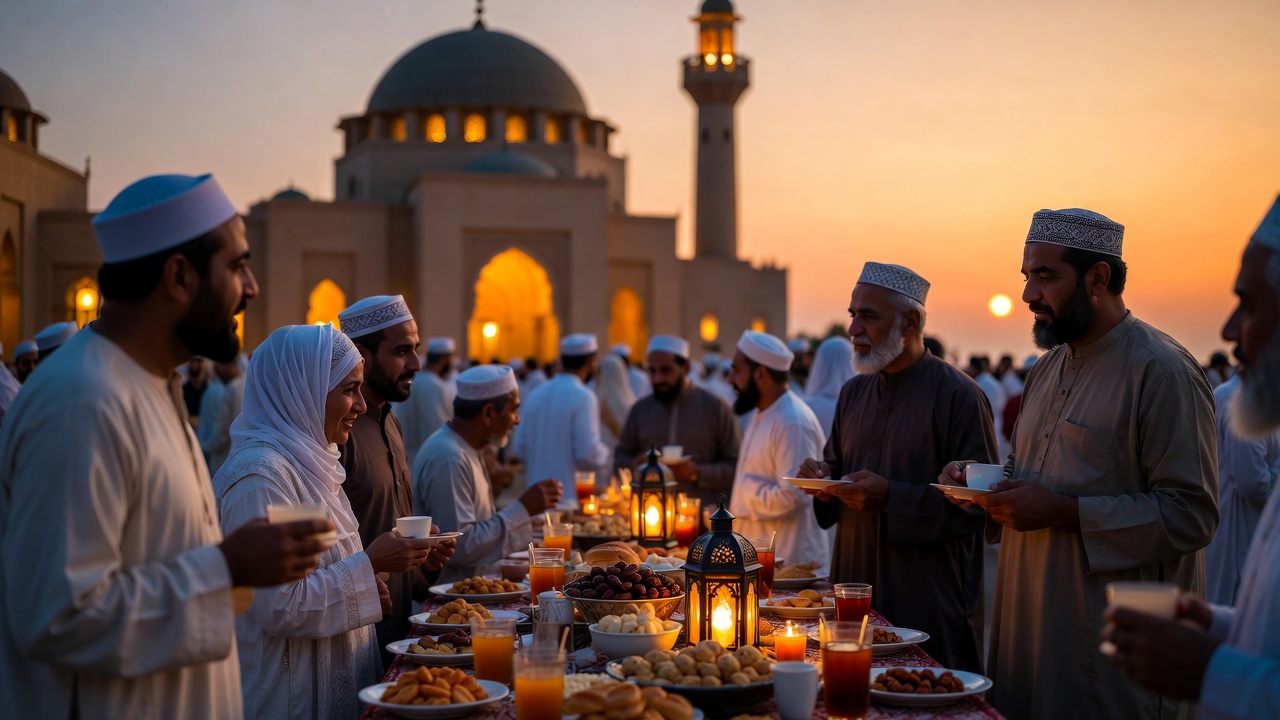
Iftar is the evening meal that breaks the daily fast at sunset (Maghrib prayer time). It is a moment of profound gratitude, community celebration, and spiritual fulfillment.
Traditional practices for breaking the fast:
- Begin with dates and water — Following the Sunnah (practice) of Prophet Muhammad
- Recite the dua: “Dhahaba al-zama’ wa abtalat al-‘urooq wa thabata al-ajr in sha Allah” (The thirst has gone, the veins are moistened, and the reward is confirmed, if Allah wills)
- Perform the Maghrib prayer
- Enjoy the full meal with family and community
Popular iftar foods around the world:
| Region | Traditional Iftar Dishes |
|---|---|
| Middle East | Hummus, falafel, fattoush, lamb dishes, dates |
| South Asia | Samosas, pakoras, fruit chaat, haleem, biryani |
| Turkey | Pide bread, soups, Turkish delight, baklava |
| North Africa | Harira soup, briouats, couscous, mint tea |
| Indonesia | Kolak (sweet coconut soup), es buah (fruit ice), rendang |
| Egypt | Ful medames, konafa, qatayef, stuffed grape leaves |
Who Must Fast During Ramadan? Rules and Exemptions
Understanding the rules of Ramadan fasting helps clarify who is obligated to fast and who may be exempted.
Fasting is Obligatory For:
- All adult Muslims who have reached puberty
- Those who are physically and mentally healthy
- Those who are not traveling long distances
Exemptions from Fasting
Islam is a religion of mercy and ease. The Quran explicitly states:
“Allah intends for you ease and does not intend for you hardship.” — Surah Al-Baqarah 2:185
Categories of exemption:
| Group | Exemption Type | Make-up Requirement |
|---|---|---|
| Sick/Ill | Temporary exemption | Fast equivalent days later |
| Travelers | Temporary exemption | Fast equivalent days later |
| Pregnant women | Temporary exemption | Fast later or pay fidyah |
| Breastfeeding mothers | Temporary exemption | Fast later or pay fidyah |
| Menstruating women | Required to break fast | Fast equivalent days later |
| Elderly | Permanent exemption | Pay fidyah (feed one poor person per day) |
| Chronically ill | Permanent exemption | Pay fidyah |
| Children | Not obligated | Encouraged to practice |
What is Fidyah?
Fidyah is a charitable compensation paid when someone genuinely cannot fast and cannot make up the missed days later. It typically involves feeding one poor person for each day of fasting missed.
What is Kaffarah?
Kaffarah is a more substantial expiation required for deliberately breaking a fast without valid reason. It involves fasting 60 consecutive days or feeding 60 poor people.
Ramadan Traditions and Celebrations Around the World
One of the most beautiful aspects of Ramadan is how local cultures have enriched the universal practice of fasting, creating diverse traditions across the globe.
Ramadan in the Middle East
Egypt:
- The iconic Ramadan lantern (fanous) originated during the Fatimid Caliphate
- Streets, homes, and mosques are decorated with colorful lights
- The mesaharati still walks through neighborhoods playing drums
- Popular foods include qatayef (stuffed pancakes) and konafa
Saudi Arabia:
- Grand iftar gatherings at the Holy Mosques in Mecca and Medina
- Massive charitable distribution of food to pilgrims and locals
- Traditional dishes like kabsa and dates are central
Turkey:
- Called Ramazan Bayramı or Şeker Bayramı (Festival of Sweets)
- Pide bread (special Ramadan flatbread) is baked fresh daily
- The mahya tradition involves illuminated messages strung between minarets
- Turkish delight and baklava are popular sweets
Ramadan in South Asia
Pakistan and India:
- Vibrant iftar bazaars with endless varieties of snacks
- Pakoras, samosas, fruit chaat, and dahi bhalla are iftar staples
- Women apply henna (mehndi) designs on their hands
- Sheer khurma (vermicelli pudding) is a beloved Eid dessert
Bangladesh:
- The tradition of singing qasidas in Old Dhaka to wake people for suhoor
- Special iftar markets with seasonal delicacies
- Community iftars at mosques and public spaces
Ramadan in Southeast Asia
Indonesia:
- Home to the world’s largest Muslim population (approximately 229 million)
- The practice of Padusan — bathing in holy springs to prepare for fasting
- Dugderan carnival in Semarang with the warak ngendog (mythical creature) parade
- Mudik — the mass exodus to hometowns for Eid celebrations
- Traditional sweets include kolak and lapis legit (thousand-layer cake)
Malaysia:
- Open house tradition where families host elaborate buffets for neighbors and friends
- Ramadan bazaars featuring a dazzling array of local delicacies
- Special terawih prayers at beautiful mosques
Ramadan in Africa
Morocco:
- The harira soup is the quintessential iftar dish
- Chebakia (sesame cookies) and sellou are popular sweets
- Extended family gatherings last well into the night
Nigeria:
- Home to Africa’s largest Muslim population (approximately 99 million)
- Community iftar programs feeding the poor
- Traditional dishes vary by ethnic group and region
Ramadan in Western Countries
United States:
- Growing Muslim communities host interfaith iftars
- Mosque open houses welcome non-Muslim neighbors
- Many cities now recognize Ramadan officially
- According to National Geographic, diverse American Muslims bring traditions from their home countries
United Kingdom:
- Trafalgar Square hosts annual Eid celebrations
- Major supermarkets stock Ramadan products
- The Muslim population has grown from 2.7 million (2011) to 3.9 million (2021)
Eid al-Fitr: The Festival Marking the End of Ramadan
The conclusion of Ramadan is celebrated with Eid al-Fitr (عيد الفطر), one of the two major Islamic holidays.
What Does Eid al-Fitr Mean?
Eid al-Fitr translates to “Festival of Breaking the Fast” in Arabic. It marks the first day of Shawwal, the tenth month of the Islamic calendar, and celebrates the successful completion of the month-long fast.
How is Eid al-Fitr Celebrated?
The celebration typically spans three days and includes:
1. Eid Prayer (Salat al-Eid)
- Performed in congregation in the morning
- Often held in large open spaces or mosques
- Includes a special sermon (khutbah)
2. Zakat al-Fitr
- A mandatory charitable payment
- Must be given before the Eid prayer
- Ensures everyone can participate in the celebration
- Typically the equivalent of one meal for each family member
3. Family and Community Gatherings
- Visiting relatives, friends, and neighbors
- Exchanging gifts, especially for children
- Wearing new or best clothes
4. Feasting
- Special festive meals after a month of fasting
- Sweets and desserts are particularly prominent
- Regional specialties vary widely
5. Visiting Graves
- Many Muslims visit cemeteries to pray for deceased loved ones
- A time for reflection and remembrance
Eid al-Fitr Greetings
The most common greeting is “Eid Mubarak” (Blessed Eid). Other expressions include:
| Language | Greeting |
|---|---|
| Arabic | Eid Mubarak / Kul ‘am wa antum bi-khayr |
| Turkish | Bayramınız mübarek olsun |
| Indonesian | Selamat Hari Raya |
| Urdu/Hindi | Eid Mubarak |
| Malay | Selamat Hari Raya Aidilfitri |
| Bengali | Eid Mubarak / Eid Shubhechha |
The Global Muslim Population: Ramadan’s Worldwide Impact
To appreciate the scale of Ramadan’s observance, understanding the global Muslim population is essential.
Muslim Population Statistics 2024-2025
According to Pew Research Center, the global Muslim population has grown significantly:
| Metric | Figure |
|---|---|
| Global Muslim population (2020) | 2.0 billion |
| Percentage of world population | 26% |
| Growth rate (2010-2020) | 21% |
| Projected population (2050) | 2.8 billion |
Countries with the Largest Muslim Populations
| Rank | Country | Muslim Population (Est.) |
|---|---|---|
| 1 | Indonesia | 229 million |
| 2 | Pakistan | 200 million |
| 3 | India | 195 million |
| 4 | Bangladesh | 154 million |
| 5 | Nigeria | 99 million |
| 6 | Egypt | 87.5 million |
| 7 | Iran | 82.5 million |
| 8 | Turkey | 79.9 million |
| 9 | Algeria | 42 million |
| 10 | Sudan | 40 million |
Regional distribution:
- Asia-Pacific: 59% of global Muslims (over 1 billion)
- Middle East-North Africa: 23% of global Muslims
- Sub-Saharan Africa: 18% of global Muslims
- Europe: 6% of population
- North America: Growing community of ~5.9 million
This means that during Ramadan, approximately 2 billion people participate in some form of observance—fasting, prayer, charity, and community gatherings—making it one of the largest synchronized spiritual events on Earth.
Health Benefits of Ramadan Fasting: What Science Says
While the primary purpose of Ramadan fasting is spiritual, modern research has revealed several potential health benefits associated with intermittent fasting.
Physical Health Benefits
| Benefit | How It Works |
|---|---|
| Improved insulin sensitivity | Fasting helps regulate blood sugar levels |
| Weight management | Caloric restriction can lead to fat loss |
| Cardiovascular health | May improve cholesterol levels and blood pressure |
| Cellular repair | Autophagy (cellular cleanup) is triggered during fasting |
| Reduced inflammation | Fasting may decrease inflammatory markers |
Mental and Emotional Benefits
- Increased mindfulness and presence
- Improved self-discipline and willpower
- Enhanced gratitude and appreciation
- Stress reduction through prayer and meditation
- Stronger social connections through community iftar gatherings
Important Health Considerations
Fasting is not without risks, especially for certain populations. Muslims with chronic conditions, diabetes, or heart disease should consult healthcare providers before fasting. Pregnant and breastfeeding women are encouraged to prioritize their health and that of their children.
How Non-Muslims Can Respectfully Engage with Ramadan
For those who don’t observe Ramadan, understanding how to be respectful and supportive of fasting colleagues, friends, and neighbors enriches cross-cultural relationships.
Do’s and Don’ts During Ramadan
Do:
- ✅ Wish Muslim friends “Ramadan Mubarak” (Blessed Ramadan) or “Ramadan Kareem” (Generous Ramadan)
- ✅ Accept invitations to iftar meals—a wonderful way to learn about the culture
- ✅ Be understanding if Muslim colleagues seem tired or less energetic
- ✅ Avoid scheduling important meetings during prayer times if possible
- ✅ Learn about the significance of the month
Don’t:
- ❌ Eat, drink, or smoke in front of fasting Muslims (while not forbidden, it’s considerate to be discrete)
- ❌ Make jokes about fasting or express excessive pity
- ❌ Assume all Muslims fast (some have exemptions)
- ❌ Schedule lunch meetings with fasting colleagues without offering alternatives
Attending an Iftar: What to Expect
If invited to an iftar:
- Arrive a few minutes before sunset (Maghrib prayer time)
- Guests may be offered dates and water to break the fast
- There will likely be a brief pause for prayer
- A generous meal follows—come hungry!
- Expressing gratitude for the invitation is appreciated
- Offering to bring a dish or dessert is a lovely gesture
Frequently Asked Questions About Ramadan
What is the meaning of Ramadan in Islam?
Ramadan is the ninth month of the Islamic calendar, commemorating the revelation of the Quran to Prophet Muhammad. It involves fasting from dawn to sunset, increased prayer, Quran recitation, and charitable giving. The primary purpose is to develop taqwa (God-consciousness) and spiritual purification.
When did Ramadan start in history?
The practice of fasting during Ramadan became obligatory in 624 CE (the second year of Hijrah), approximately 14 years after the first Quranic revelation in 610 CE.
Can you drink water during Ramadan?
No, during fasting hours (from dawn to sunset), Muslims abstain from all food and drink, including water. However, between sunset (iftar) and dawn (suhoor), eating and drinking are permitted and encouraged.
What happens if you accidentally eat during Ramadan?
If someone accidentally eats or drinks while fasting (forgetting they were fasting), their fast remains valid according to most Islamic scholars. They should simply stop eating once they remember and continue their fast.
How long do Muslims fast during Ramadan?
The duration varies based on geographic location and season. Fasting lasts from dawn (Fajr) to sunset (Maghrib), which can range from approximately 10 to 20+ hours depending on latitude and time of year.
Why does Ramadan move every year?
Ramadan follows the Islamic lunar calendar, which is approximately 11 days shorter than the solar Gregorian calendar. This causes Ramadan to shift earlier each year, allowing Muslims to experience fasting during different seasons over a 33-year cycle.
What is the Night of Power (Laylat al-Qadr)?
Laylat al-Qadr is the night when the Quran was first revealed. The Quran states it is “better than a thousand months.” It falls on one of the odd nights during the last ten days of Ramadan, with many observing the 27th night.
What is the difference between Eid al-Fitr and Eid al-Adha?
Eid al-Fitr (“Festival of Breaking the Fast”) marks the end of Ramadan and occurs on the first of Shawwal. Eid al-Adha (“Festival of Sacrifice”) commemorates Prophet Ibrahim’s willingness to sacrifice his son and occurs approximately 70 days later during the Hajj pilgrimage season.
Conclusion: The Timeless Significance of Ramadan
The start of Ramadan initiates far more than a period of physical abstention from food and drink. It marks the beginning of a spiritual transformation that has shaped the lives of billions across fourteen centuries. From the first revelation in the Cave of Hira to the modern iftar tables stretching from Jakarta to New York, Ramadan represents humanity’s enduring quest for spiritual meaning, self-improvement, and connection to the Divine.
Whether you’re a Muslim preparing for the sacred month, someone curious about Islamic traditions, or a global citizen seeking to understand the world’s diverse cultures, Ramadan offers profound lessons. It teaches discipline in an age of instant gratification, empathy in times of social division, generosity amid economic uncertainty, and community in an increasingly isolated world.
As approximately 2 billion Muslims around the globe prepare to sight the crescent moon and begin their annual journey of fasting and devotion, they carry forward a tradition that has survived empires, crossed continents, and adapted to countless cultures—yet remains fundamentally unchanged in its spiritual essence.
The gates of Paradise are said to open. The gates of Hell close. And for one blessed month, hearts turn toward the Divine with renewed hope and determination.
Ramadan Mubarak—may your Ramadan be blessed.
Have you experienced Ramadan celebrations in different cultures? Share your stories and experiences in the comments below. And if you found this guide helpful, please share it with others who want to understand this beautiful month better.
Taraweeh Prayers: The Special Night Prayers of Ramadan
One of the most distinctive practices during Ramadan is the Taraweeh prayer, a special congregational prayer performed after the Isha (night) prayer throughout the month.
What is Taraweeh Prayer?
Taraweeh (Arabic: تراويح) comes from the root word meaning “to rest and relax.” It refers to the additional voluntary prayers performed exclusively during Ramadan nights. While not obligatory (fard), Taraweeh is considered a highly recommended Sunnah practice established by Prophet Muhammad.
How is Taraweeh Performed?
| Aspect | Details |
|---|---|
| Timing | After Isha prayer, before Witr |
| Number of units (rak’ahs) | 8-20 (varies by tradition) |
| Duration | 30 minutes to 2+ hours |
| Quran recitation | Typically, the entire Quran is completed over the month |
| Location | Preferred in congregation at the mosque |
During Taraweeh, a hafiz (someone who has memorized the entire Quran) typically leads the prayers, reciting portions of the Quran each night. By the end of Ramadan, the entire 114 chapters of the Quran have been recited—a beautiful tradition that allows attendees to hear the complete divine revelation.
The Spiritual Atmosphere of Taraweeh
Mosques during Ramadan nights transform into havens of spirituality. The air fills with the melodious recitation of Quranic verses, the rhythmic movements of worshippers standing shoulder to shoulder, and the collective supplication that rises toward the heavens. For many Muslims, attending Taraweeh prayers creates some of their most profound spiritual memories—moments of peace, reflection, and connection that sustain them throughout the year.
I’tikaf: The Spiritual Retreat During the Last Ten Days
I’tikaf is the practice of secluding oneself in a mosque during the last ten days of Ramadan, dedicating this time exclusively to worship, Quran recitation, and seeking Laylat al-Qadr.
What Happens During I’tikaf?
During I’tikaf, Muslims:
- Remain inside the mosque continuously (except for essential needs)
- Disconnect from worldly affairs as much as possible
- Focus exclusively on worship including prayer, Quran reading, and dhikr (remembrance of Allah)
- Seek spiritual closeness to Allah during the most blessed nights of the year
- Sleep and eat within the mosque premises
The Prophet Muhammad (peace be upon him) practiced I’tikaf regularly during the last ten days of Ramadan, and it remains a cherished tradition among devoted Muslims today. While the full ten-day I’tikaf may not be feasible for everyone, many Muslims observe partial I’tikaf by spending as many nights as possible in the mosque during this blessed period.
Preparing for Ramadan: Practical Tips for a Meaningful Month
For those approaching Ramadan, thoughtful preparation can maximize the spiritual and physical benefits of the month.
Spiritual Preparation
Begin before Ramadan arrives:
- Increase Quran recitation in the weeks leading up to Ramadan
- Practice voluntary fasting on Mondays and Thursdays during Sha’ban
- Make sincere repentance (tawbah) and seek forgiveness
- Set spiritual goals for the month
- Forgive others and mend broken relationships
- Plan your worship schedule including prayer times and Quran reading goals
Physical and Practical Preparation
Preparing your body and home:
- Adjust sleep schedules gradually to accommodate suhoor and Taraweeh
- Stock up on healthy foods for suhoor and iftar
- Reduce caffeine intake before Ramadan to minimize withdrawal headaches
- Clean and organize your home so you can focus on worship
- Plan meals in advance to avoid excessive time cooking
- Inform employers and colleagues about your fasting schedule
Financial Preparation
- Calculate your Zakat obligation in advance
- Set a charitable giving budget for the month
- Identify deserving recipients for your charity
- Consider setting up automatic donations for charity organizations
The Economic and Social Impact of Ramadan
Beyond its spiritual dimensions, Ramadan significantly impacts economies, societies, and daily life patterns across Muslim-majority countries and Muslim communities worldwide.
Economic Patterns During Ramadan
Consumer spending:
- Food purchases increase significantly, particularly dates, dried fruits, and special ingredients
- Charitable giving reaches its annual peak during Ramadan
- Clothing sales spike as families prepare for Eid
- Restaurant and hospitality industries adapt with special iftar offerings
Workplace adjustments:
- Reduced working hours in many Muslim-majority countries
- Shifted schedules with later start times and earlier closing
- Increased flexibility for prayer and iftar breaks
- Temporary business closures during peak prayer times
Social Transformations
Family dynamics:
- Multi-generational gatherings become more frequent
- Strengthened family bonds through shared meals
- Teaching children about religious obligations and traditions
- Reconnecting with extended family members
Community life:
- Mosques become community centers for prayer, education, and iftar
- Neighborhood cooperation in preparing and sharing food
- Interfaith dialogue through open iftar events
- Increased charitable activities reaching vulnerable populations
Ramadan in the Digital Age: Modern Adaptations
While Ramadan’s spiritual essence remains unchanged, technology and modern life have introduced new dimensions to its observance.
Technology-Enhanced Worship
Digital tools for Ramadan:
| Tool Type | Purpose |
|---|---|
| Prayer time apps | Accurate prayer and fasting times based on location |
| Quran apps | Digital reading, audio recitation, translations |
| Ramadan trackers | Recording fasts, prayers, and Quran progress |
| Charity platforms | Online donation and Zakat calculation |
| Streaming services | Live broadcast of Taraweeh from major mosques |
| Social media | Sharing inspiration and connecting with community |
Virtual Community During Ramadan
The COVID-19 pandemic accelerated the adoption of virtual iftar gatherings, online religious lectures, and streaming Taraweeh prayers. While many prefer returning to in-person congregation, these digital options have expanded access for:
- Muslims in areas without nearby mosques
- Those with physical limitations
- People seeking scholars from different regions
- New Muslims learning about the faith
Teaching Children About Ramadan: Building Future Generations
Passing the traditions of Ramadan to younger generations ensures the continuation of this sacred practice.
Age-Appropriate Involvement
Toddlers and young children (2-6 years):
- Involve them in decorating the home for Ramadan
- Let them help set the iftar table
- Share simplified stories about Ramadan’s meaning
- Practice mini-fasts (skipping one snack)
Older children (7-12 years):
- Encourage partial fasting (half-day or selected days)
- Teach them to recite Quran portions
- Involve them in charitable activities
- Explain the deeper spiritual meaning
Teenagers (13+ years):
- Support their full fasting observance
- Encourage Taraweeh attendance
- Discuss philosophical aspects of fasting
- Foster independent spiritual growth
Making Ramadan Memorable for Children
Many Muslim families create special traditions that make Ramadan exciting for children:
- Ramadan calendars with daily activities or small gifts
- Special iftar treats children can help prepare
- Charity projects children can participate in
- Storytelling sessions about Islamic history
- Decorating projects creating lanterns and banners
- Countdown activities building anticipation
Common Misconceptions About Ramadan
Despite its widespread observance, several misconceptions about Ramadan persist.
Myth vs. Reality
| Misconception | Reality |
|---|---|
| “Muslims can’t swallow their saliva” | Swallowing saliva is perfectly fine during fasting |
| “All Muslims must fast” | Several valid exemptions exist (illness, travel, pregnancy, etc.) |
| “Fasting is just about food and water” | It encompasses abstaining from anger, gossip, and negative behavior |
| “Ramadan is a month of weight loss” | Many actually gain weight due to large iftar meals |
| “Muslims are miserable during Ramadan” | Most experience joy, spiritual fulfillment, and community connection |
| “Non-Muslims should hide when eating” | While discretion is appreciated, it’s not required |
| “Children are forced to fast” | Fasting is only obligatory after puberty |
Final Reflections: Carrying the Spirit of Ramadan Throughout the Year
The true measure of Ramadan’s success isn’t merely surviving 30 days without food—it’s the lasting transformation that carries into the remaining eleven months.
Sustaining Ramadan’s Benefits
Spiritual habits to maintain:
- Continue regular Quran recitation (even a few verses daily)
- Maintain voluntary fasting (Mondays, Thursdays, or monthly fasts)
- Keep up charitable giving throughout the year
- Preserve improved prayer consistency
- Practice mindful eating and gratitude
Character improvements to sustain:
- Patience and self-control developed during fasting
- Empathy for the less fortunate cultivated through hunger
- Stronger family bonds built during iftar gatherings
- Community connections forged at the mosque
As the crescent moon of Shawwal appears and Ramadan concludes, Muslims worldwide carry forward the lessons, habits, and spiritual growth gained during this blessed month. The gates of Paradise may symbolically close, but the doors of mercy, compassion, and devotion remain forever open to those who seek them.
In this way, Ramadan becomes not just an annual event but a continuous cycle of renewal—a spiritual reset that realigns hearts toward their Creator and strengthens the bonds that hold communities together.