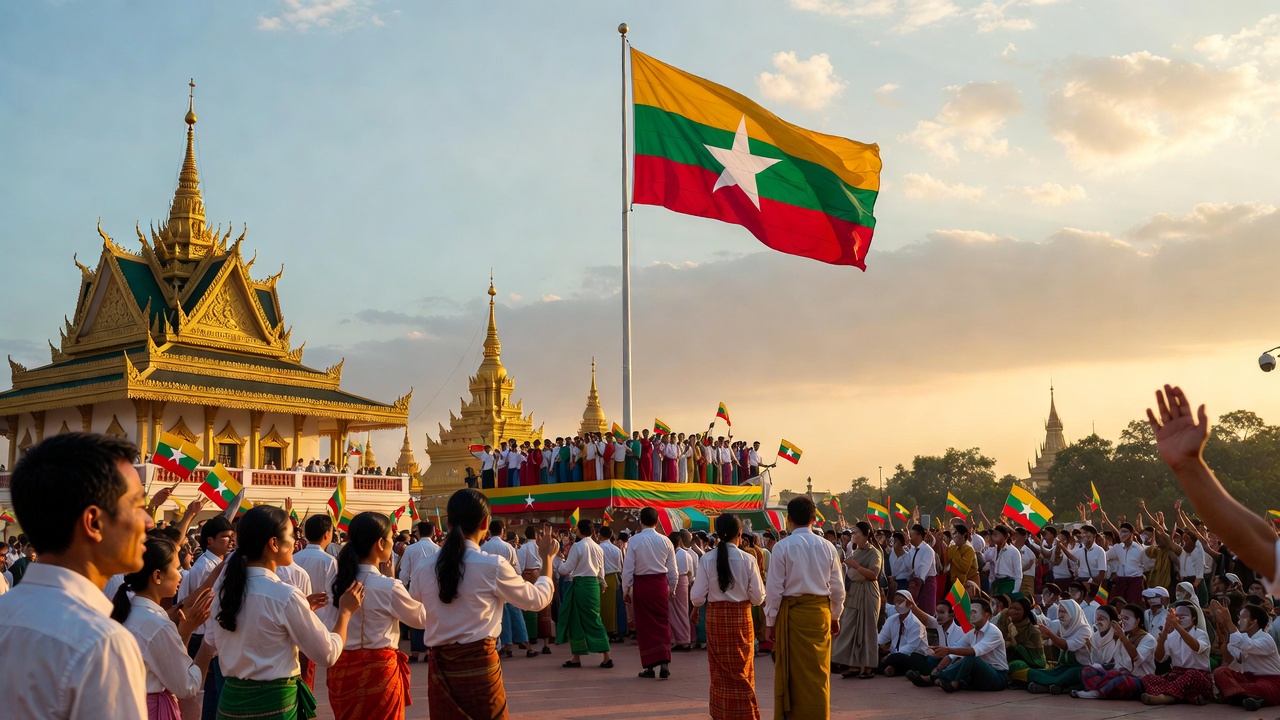
Every February 12, the streets of Myanmar come alive with flag processions, ethnic dances, and patriotic songs. This is Union Day — a holiday that tells the story of how one of Southeast Asia’s most diverse nations tried to become whole.
Myanmar is a land of staggering diversity. 135 officially recognized ethnic groups call this country home. They speak over 100 languages. They practice different religions, wear different clothes, and follow different customs. Yet every year on February 12, they share a single holiday: Union Day (ပြည်ထောင်စုနေ့).
In 2026, Myanmar marks the 79th anniversary of the Panglong Agreement — the historic pact that united the country’s fractured regions into one nation. Union Day falls on Thursday, February 12, 2026, and it remains one of the most emotionally charged public holidays on the Myanmar calendar.
But what does this day actually mean to the people who celebrate it? What traditions define it? And why does a 79-year-old agreement still matter so deeply in modern Myanmar?
This guide answers all of those questions — and more.
The History of Union Day in Myanmar: Why February 12 Matters
To understand Union Day, you have to go back to a time when “Myanmar” did not exist as a single country.
A Divided Land Under British Rule
In 1886, the British Empire completed its conquest of Burma after the Third Anglo-Burmese War. King Thibaw was overthrown, and the entire territory fell under colonial control. But the British did not govern Burma as one unified entity. They split the territory into two zones:
- Ministerial Burma — the central lowlands, home to the majority Bamar (Burman) population, governed directly from Rangoon (now Yangon).
- The Frontier Areas — the mountainous periphery, home to the Shan, Kachin, Chin, Karenni, and other ethnic groups, governed through indirect arrangements with local chiefs and hereditary rulers called Saophas.
This division was deliberate. The British used a divide-and-rule policy to prevent any unified resistance to colonial authority. Central Burma and the ethnic hill regions were administered under separate legal frameworks. Different ethnic groups were recruited into different military units. The result was a deepening of divisions that had existed for centuries.
As the Minority Rights Group International notes, Burma’s geographic position — bordered by India, Bangladesh, China, Laos, and Thailand — had already attracted settlers from many backgrounds throughout its long history. British rule hardened these fluid identities into rigid colonial categories.
The Three Anglo-Burmese Wars: How Burma Lost Its Independence
The British conquest of Burma was not a single event but a process that unfolded over six decades through three wars:
- The First Anglo-Burmese War (1824–1826) ended with the Treaty of Yandabo. Burma was forced to cede the coastal territories of Arakan and Tenasserim to the British.
- The Second Anglo-Burmese War (1852) resulted in the British seizure of Lower Burma, including the commercially vital Irrawaddy Delta.
- The Third Anglo-Burmese War (1885) lasted just two weeks. The British captured Mandalay, overthrew King Thibaw, and absorbed all of Upper Burma into the British Empire.
By 1886, Burma was administered as a province of British India — a status it held until 1937, when it was separated into a distinct colony. This long period of colonial rule — lasting over a century — fundamentally reshaped the country’s social fabric, economy, and ethnic relations.
The British exploited Burma’s resources aggressively. Teak forests were logged. Rice production was commercialized for export. Indian and Chinese immigrants were brought in as laborers and merchants, creating new demographic tensions. Buddhist monastic schools, which had provided universal education for centuries, lost their role as the British imposed a Western-style education system.
It was against this backdrop of dispossession and cultural erosion that the independence movement gained strength in the early 20th century.
The Rise of Aung San and the Independence Movement
The man who changed everything was Bogyoke Aung San (ဗိုလ်ချုပ် အောင်ဆန်း).
Born on February 13, 1915, in the small town of Natmauk in Magway District, Aung San came from a family with a history of anti-colonial resistance. His grandfather had been killed by British soldiers during the annexation. This personal history shaped his lifelong mission: to free Burma from foreign rule.
Aung San became a student leader at Rangoon University in the 1930s. He co-founded the Communist Party of Burma and joined the nationalist Dobama Asiayone (“We Burman Association”), whose members adopted the title “Thakin” (Lord) as a symbolic act of reclaiming sovereignty. In 1940, facing an arrest warrant, he fled to seek foreign support.
The Japanese intercepted him and offered military training. Aung San and his Thirty Comrades formed the Burma Independence Army (BIA) in Bangkok in 1941. They marched into Burma alongside the Japanese invasion force in 1942.
But Japanese promises of independence turned hollow. As British Field Marshal William Slim later recalled, the Burmese quickly learned that they had simply “exchanged an old master for an infinitely more tyrannical new one.” In March 1945, Aung San switched sides and led a revolt against the Japanese, forming the Anti-Fascist People’s Freedom League (AFPFL).
After the war, Aung San emerged as Burma’s de facto leader. He traveled to London in January 1947 and negotiated the Aung San-Attlee Agreement, which guaranteed Burma’s independence within one year. But one critical challenge remained: uniting the ethnic Frontier Areas with central Burma.
The Panglong Conference: Where Union Day Was Born
This brings us to the small town of Panglong in southern Shan State.
From February 6 to 12, 1947, Aung San and his delegation — including U Aung Zeya, Thakin Tun Oak, Mahn Ba Khine, and Deedok U Ba Cho — met with ethnic leaders from the Shan, Kachin, and Chin regions. The stakes were enormous. Without their agreement, Burma would gain independence as a fractured collection of territories, not as a unified nation.
The negotiations were tense. Shan leaders feared losing their traditional rights after independence. Kachin representatives demanded the creation of a separate Kachin State and insisted on guarantees for non-Bamar ethnic rights. Chin leaders sought assurances of political equality.
Aung San mediated patiently. He made a famous promise that has echoed through decades of Myanmar politics: “If Burma receives one kyat, you will also get one kyat.” This pledge of economic equality became a cornerstone of the negotiations.
On the afternoon of February 12, 1947, the historic Panglong Agreement was signed. The document contained 12 main points covering political, economic, and social equality. Among the key signatories were:
| Signatory | Representing |
|---|---|
| General Aung San | Bamar / Interim Government |
| Sao Shwe Thaik | Shan States |
| Sao Khun Cho | Shan States |
| Sao San Tun | Shan States |
| Sama Duwa Sinwa Nawng | Kachin |
| Duwa Zaw Wan | Kachin |
| U Wam Kaung | Chin |
| U Hal Khun | Chin |
The agreement accepted the principle of “full autonomy in internal administration for Frontier Areas.” It also gave ethnic leaders the option of seceding from the Union if they were dissatisfied with the new nation — a provision that would later become deeply controversial.
Aung San captured the spirit of the moment with words that are still quoted across Myanmar: “We should not emphasize our differences. We should only think about how to live together.”
Who Signed the Panglong Agreement and Who Did Not?
One important detail is often overlooked: not all ethnic groups signed the Panglong Agreement.
The Karen (Kayin) sent only four observers to the conference. The Mon and Rakhine (Arakanese) were not represented separately because they fell within Ministerial Burma. The Karenni (Kayah) attended only as observers. The Pa-O, Palaung, and Wa were considered part of the Shan States and were represented indirectly through Shan leaders.
As researchers at the International Crisis Group have pointed out, the absence of several major ethnic groups from the signing created fault lines that persist to this day. The agreement was a breakthrough, but it was not comprehensive.
Despite these gaps, the Panglong Agreement formed the basis for the creation of the Union of Burma. On January 4, 1948 — at the astrologically selected time of 4:20 a.m. — the Union Jack was lowered for the last time in Rangoon. The flag of the Union of Burma was raised. Sao Shwe Thaik, a Shan leader and Panglong signatory, became the country’s first president.
Aung San never saw it happen. He was assassinated on July 19, 1947, along with six cabinet members, just five months after Panglong. He was only 32 years old. July 19 is now commemorated as Martyrs’ Day in Myanmar.
How Is Union Day Celebrated Across Myanmar? Traditions and Festivities
Union Day is a national public holiday. Government offices, schools, and banks close for the day. But the celebrations extend far beyond a single date. Preparations begin months in advance and build to a crescendo of patriotic energy.
The Union Flag Relay: A Nationwide Journey of Unity
The most distinctive tradition of Union Day is the Union Flag Relay (အလံပြိုင်ပွဲ).
Approximately two months before February 12, the Union Flag is carried through the capital cities of each of Myanmar’s states and regions. At every stop, the flag’s arrival is marked by parades, cultural performances, and community celebrations. Local ethnic groups perform traditional dances, musicians play folk instruments, and speeches about national unity fill town squares.
About five days before Union Day, the relay enters its final phase. The Union Flag is carried through 45 different townships in succession. Each township holds a brief ceremony before passing the flag to the next. The relay concludes at People’s Square (Pyay Road) in Yangon, where a grand ceremony marks the flag’s arrival.
This relay is more than symbolic pageantry. It is a physical act of connection — linking distant towns and diverse ethnic communities through a shared journey. For many people living in remote areas, the flag relay is the most visible expression of Union Day.
Ceremonies in the Capital: Naypyidaw’s Union Day Concert
Since 2005, Myanmar’s capital has been Naypyidaw, located about 200 miles north of Yangon. The city hosts the country’s main official Union Day events.
The celebrations typically include:
- Flag-raising ceremonies at the Uppatasanti Pagoda grounds
- Speeches by senior government officials emphasizing national unity and the spirit of Panglong
- A Union Day concert featuring performances from ethnic cultural troupes
- Traditional dance performances representing the country’s major ethnic groups
- Departmental exhibitions and MSME (Micro, Small, and Medium Enterprise) fairs
- Military parades and formal commemorations
At the 2025 Union Day celebration, Senior General Min Aung Hlaing stated: “While complying with the Constitution and laws of the State, all ethnic peoples must work together in unity to build a strong federal democratic Union.” He also stressed that the Panglong Agreement is a “historic gift of unity” and that trust among ethnic groups must be established.
Yangon’s People’s Square: The Heart of Public Celebrations
For many ordinary citizens, People’s Square in Yangon is where Union Day feels most alive.
The square, located on Pyay Road, serves as the terminus for the Union Flag Relay. In recent years, the 78th Union Day Commemoration in 2025 featured sector-wise departmental exhibitions, an MSME fair, and a music concert at People’s Square from February 12 to 14. Pyay Road is temporarily closed for the occasion, transforming the area into a festival ground.
Visitors can expect to see:
- Ethnic food stalls serving dishes from across Myanmar’s regions
- Traditional handicraft exhibitions featuring textiles, lacquerware, and woodcarving
- Cultural performances by ethnic dance troupes in full traditional attire
- Student poetry readings and essay competitions on the theme of national unity
- Photo exhibitions documenting Myanmar’s independence movement
Schools and Communities: How Ordinary People Celebrate Union Day
Union Day is not just a government-organized affair. It reaches into everyday life across Myanmar.
In the weeks leading up to February 12, schoolchildren write patriotic poems and essays about the importance of national unity. Teachers lead lessons about the Panglong Agreement and the role of Bogyoke Aung San. In some schools, students perform skits dramatizing the events of 1947.
Families gather for special meals. While there is no single “Union Day dish,” the occasion often features regional specialties shared among friends and neighbors. Mohinga (မုန့်ဟင်းခါး), a rich fish noodle soup widely considered Myanmar’s national dish, is a common choice. Lahpet thoke (လက်ဖက်သုပ်), the famous fermented tea leaf salad, is another staple at gatherings.
Communities hang the national flag from homes, shops, and public buildings. In some neighborhoods, residents organize small processions or set up loudspeakers to play patriotic songs.
The Eight Major Ethnic Groups of Myanmar and Their Role in Union Day
Understanding Union Day requires understanding Myanmar’s extraordinary ethnic tapestry. The government officially recognizes eight major national ethnic races (taing-yin-tha), each comprising multiple sub-groups:
| Major Ethnic Race | Approximate Population % | State / Region | Primary Religion |
|---|---|---|---|
| Bamar (Burman) | ~68% | Central Myanmar (7 Regions) | Theravada Buddhism |
| Shan | ~9% | Shan State (East) | Theravada Buddhism |
| Karen (Kayin) | ~7% | Kayin State | Buddhism, Christianity, Animism |
| Rakhine | ~4-5% | Rakhine State (West) | Theravada Buddhism |
| Chin | ~2.5% | Chin State (West) | Christianity (80-90%), Animism |
| Mon | ~2% | Mon State (South) | Theravada Buddhism |
| Kachin | ~1.5% | Kachin State (North) | Christianity, Animism |
| Kayah (Karenni) | ~1.83% | Kayah State (East) | Christianity, Buddhism, Animism |
Each of these groups has its own distinct festivals, dress, language, and traditions. The Kachin Manau festival, the Shan Poi Sang Long, the Karen New Year, and the Mon Water Festival are just a few examples of the cultural richness that exists within Myanmar’s borders.
On Union Day, representatives from these groups come together to perform their traditional dances and music. This is one of the few occasions each year when Myanmar’s full cultural diversity is displayed on a single stage. Kayin “Frog Drum” dances, Kachin sword dances, Shan long-drum performances, and Chin traditional weaving demonstrations all feature in Union Day celebrations.
The Global New Light of Myanmar described the 2026 occasion as a reminder that “Myanmar is not the nation of a single ethnic group but a Union of many ethnicities, cultures, and languages.”
Traditional Dress on Display During Union Day
One of the most visually striking aspects of Union Day celebrations is the traditional clothing worn by performers and attendees from different ethnic groups.
The longyi (လုံချည်), a sarong-like garment, is worn across much of Myanmar, but each ethnic group has its own distinctive version. Bamar longyis feature woven patterns in rich colors. Shan women wear long-sleeved blouses paired with a brightly colored longyi and sometimes a distinctive turban. Kachin traditional dress includes black velvet garments adorned with silver ornaments and intricate beadwork. Chin women are known for their woven shawls, and in some communities, older women still bear the traditional facial tattoos that have become an iconic image of Chin culture.
Kayin (Karen) women wear elaborately woven tunics and skirts in white, red, and black patterns. Kayah (Karenni) traditional attire is distinguished by striking red and black fabrics with silver accessories. Rakhine clothing shows the influence of both Bamar and South Asian styles, reflecting the region’s position on Myanmar’s western coast.
On Union Day, seeing these varied styles side by side — on dancers, on dignitaries, on families strolling through festival grounds — is a vivid reminder of the diversity that the holiday celebrates. Many Myanmar people who normally wear Western-style clothing choose to wear their ethnic dress specifically for Union Day as an expression of cultural pride.
Visiting the Panglong Monument: A Pilgrimage to Myanmar’s Birthplace
For history enthusiasts and cultural travelers, one of the most meaningful things you can do around Union Day is visit the Panglong Monument in Shan State.
The monument stands on the exact spot where the Panglong Agreement was signed on February 12, 1947. The original monument was a modest 3.5-meter-high (12 feet) structure. General Aung San himself contributed 1,000 rupees on behalf of the AFPFL to help erect it. In 1951, U San Mya, the mayor of Panglong, replaced the original with a stronger 10-meter-high obelisk built by six workers at a cost of 4,100 kyats.
The monument’s facade features representations of Bogyoke Aung San and other independence leaders. On February 12 each year, a special ceremony is held at the site. Government officials, ethnic leaders, and descendants of the original signatories attend to lay wreaths and pay respects.
The town of Panglong itself is small and remote, tucked into the hills of southern Shan State. Getting there typically requires traveling through Taunggyi, the capital of Shan State. The journey is part of the experience — the winding mountain roads offer stunning views of the Shan Plateau, and the cool February climate makes the trip pleasant.
Union Day and Myanmar’s Ongoing Quest for National Unity and Peace
Union Day is a celebration, but it is also a day of reflection. The promises made at Panglong in 1947 have never been fully realized. This tension between aspiration and reality gives the holiday its emotional depth.
The Unfinished Promise of Panglong
After Aung San’s assassination in July 1947, the political landscape shifted dramatically. The 1947 Constitution created states for the Kachin, Karenni, Shan, and Karen peoples. But the equality and autonomy promised at Panglong proved elusive.
In 1962, General Ne Win launched a military coup. His regime abolished the 1947 Constitution and centralized power. The right to secession — one of the key provisions of the Panglong Agreement — was eliminated. This sparked armed resistance among multiple ethnic groups. The Kachin, Karen, Shan, Chin, and others launched insurgencies that have continued in various forms for over seven decades.
Myanmar holds the grim distinction of hosting one of the world’s longest-running civil wars. The conflict between the central government and ethnic armed organizations has displaced hundreds of thousands of people and remains unresolved.
The 21st Century Panglong Conference
In an effort to revive the spirit of the original agreement, the government launched the 21st Century Panglong Conference in 2016 under the leadership of Daw Aung San Suu Kyi, the daughter of Bogyoke Aung San. The conference aimed to bring together ethnic armed groups, political parties, and government representatives to negotiate a lasting peace.
The process has been long and difficult. Many ethnic armed groups have refused to sign the Nationwide Ceasefire Agreement (NCA) in its current form, citing concerns about the military’s continued dominance and the lack of genuine federal guarantees.
Despite these challenges, the name “Panglong” continues to carry enormous symbolic weight. It represents the possibility — however distant — of a united, federal Myanmar where all ethnic groups enjoy equal rights and self-determination.
The 2021 Coup and Its Aftermath
On February 1, 2021, the Myanmar military seized power in a coup, detaining Aung San Suu Kyi and other elected leaders. The coup triggered massive protests and a widespread civil resistance movement. Armed conflict escalated across much of the country, with ethnic armed organizations and newly formed People’s Defense Forces (PDFs) fighting the military.
As of 2026, Myanmar continues to experience significant political instability and armed conflict. Union Day celebrations in recent years have taken on an added poignancy, with many citizens viewing the holiday as a reminder of the unity and democratic ideals that the country aspires to but has not yet achieved.
The 2026 Wikipedia entry for Myanmar notes the ongoing civil war and the continuation of the 2025-26 Myanmar general election process, reflecting the country’s complex political situation.
Traditional Myanmar Food to Try During Union Day Celebrations
Food is central to every Myanmar celebration, and Union Day is no exception. Here are some traditional dishes you might encounter at Union Day gatherings and festivals:
Mohinga (မုန့်ဟင်းခါး) — Myanmar’s National Dish
Mohinga is a rich, savory fish noodle soup that many consider the unofficial national dish of Myanmar. It features a thick broth made from catfish, lemongrass, banana stem, and chickpea flour, served over thin rice noodles. It is commonly eaten for breakfast but appears at celebrations throughout the day. Street vendors serve it in small bowls topped with crispy fritters, boiled eggs, and fresh cilantro.
Lahpet Thoke (လက်ဖက်သုပ်) — Fermented Tea Leaf Salad
Lahpet thoke is uniquely Myanmar. Fermented tea leaves are mixed with shredded cabbage, tomatoes, roasted peanuts, sesame seeds, fried garlic, dried shrimp, and a squeeze of lime. It is served as a shared dish at social gatherings and has deep cultural significance. Offering lahpet to guests is considered a gesture of hospitality and respect. During Union Day, families often prepare lahpet thoke as part of their celebrations.
Shan Noodles (ရှမ်းခေါက်ဆွဲ) — A Shan State Specialty
Given that the Panglong Agreement was signed in Shan State, it feels fitting to mention Shan noodles. This dish features flat rice noodles in a clear broth flavored with tomato, garlic, and meat (often chicken or pork). The Shan version is lighter and more delicate than many Bamar dishes, reflecting the culinary traditions of the Shan Plateau.
Htamin Jin (ထမင်းချဉ်) — Rice Salad Balls
Htamin jin is a Shan-style dish of rice mixed with turmeric, fish, and oil, formed into small balls and served with a side of fresh vegetables. It is a popular snack at festivals and outdoor events, making it a common sight at Union Day celebrations.
Ethnic Regional Specialties Worth Seeking Out
One of the joys of Union Day food festivals is the chance to sample dishes from across Myanmar’s ethnic regions. Chin cuisine features fermented bamboo shoot soups and smoked meats — hearty mountain fare suited to the cool highlands. Kachin food is known for its bold use of fresh herbs, particularly cilantro and mint, often paired with river fish and sticky rice. Rakhine dishes draw on coastal ingredients like dried fish and shrimp paste, with a distinctly tangy flavor profile that sets them apart from inland cooking.
At Union Day food stalls, you may also encounter mont lone yay paw (မုန့်လုံးရေပေါ်), small glutinous rice balls filled with jaggery (palm sugar) and served in a sweet coconut milk broth. These sweet treats are traditionally associated with the Full Moon Day of Tabodwe, which falls close to Union Day in February. Eating them during the Union Day period carries a double layer of cultural significance — celebrating both the seasonal harvest and national unity.
The act of sharing food across ethnic lines is itself a powerful statement during Union Day. When a Bamar family tries Shan noodles at a festival stall, or when Kachin friends share lahpet thoke with Chin neighbors, the simple act of eating together embodies the Panglong spirit more directly than any official speech.
What You Should Know Before Visiting Myanmar on Union Day
If you are planning a trip to Myanmar around Union Day, here are some practical tips:
Union Day is a public holiday. Government offices, banks, and many businesses will be closed on February 12. Plan accordingly for banking and official services.
Expect road closures. Major roads in Yangon, particularly Pyay Road near People’s Square, may be temporarily closed for processions and ceremonies. Allow extra travel time.
Dress modestly. When attending cultural events, visiting pagodas, or entering communities, dress conservatively. Long sleeves and clothing that covers the knees are recommended. Remove shoes before entering any religious site.
Respect the diversity. Myanmar’s ethnic groups prefer the term “ethnic nationalities” rather than “ethnic minorities.” This distinction matters deeply to communities that make up roughly 30% of the population and occupy two-thirds of the country’s land area.
Check travel advisories. Given the ongoing political situation, travelers should consult their government’s travel advisories before visiting Myanmar. Some areas may have restricted access.
February weather is pleasant. February falls within Myanmar’s cool, dry season. Temperatures in Yangon average around 25–32°C (77–90°F). In the Shan Plateau and highland areas, nights can be cool, dropping to around 10°C (50°F).
The Panglong Agreement: Key Facts and Figures at a Glance
| Detail | Information |
|---|---|
| Date signed | February 12, 1947 |
| Location | Panglong, Southern Shan State |
| Key architect | Bogyoke (General) Aung San |
| Ethnic groups represented | Shan, Kachin, Chin (Bamar government as counterpart) |
| Number of main points | 12 |
| Core principle | Full autonomy in internal administration for Frontier Areas |
| Led to | Creation of the Union of Burma; independence on January 4, 1948 |
| Anniversary in 2026 | 79th |
| Public holiday date | February 12 (every year) |
| Monument height | 10 meters (rebuilt in 1951) |
Why Union Day Still Matters in 2026: Cultural Significance and National Identity
In a country torn by conflict and political upheaval, why does a 79-year-old agreement still matter?
The answer lies in what Union Day represents — not as a perfect historical event, but as an ideal.
The Panglong Agreement was imperfect. Not all ethnic groups were represented. Many of its promises were broken. The man who brokered it was murdered before he could see it through. And yet, the idea at the heart of Panglong — that Myanmar’s diverse peoples can choose to live together as equals — remains the most powerful unifying vision the country has ever produced.
As the Global New Light of Myanmar wrote in its 2026 editorial: “We must remember that unity is not simply speaking the same words, but understanding one another — a truth our ancestors demonstrated through the Panglong Agreement.”
Union Day is a mirror that Myanmar holds up to itself. It reflects both what the country has achieved and what it has failed to achieve. It honors the courage of leaders like Aung San, Sao Shwe Thaik, Sinwa Nawng, and others who dared to imagine a united nation. And it challenges every generation to ask: What does unity mean today?
For the teachers who teach Burmese in Shan villages, for the cultural mentors who bring traditional Kayin dances to children along the Ayeyawady River, for the scholars who translate science books into the Mon language — these are the everyday builders of the Union that Panglong envisioned.
How Union Day Compares to Other Myanmar National Holidays
Myanmar has a rich calendar of public holidays. Here is how Union Day fits within the broader context:
| Holiday | Date | Significance |
|---|---|---|
| Independence Day | January 4 | Marks Burma’s independence from Britain in 1948 |
| Union Day | February 12 | Celebrates the Panglong Agreement of 1947 |
| Peasants’ Day | March 2 | Honors Myanmar’s agricultural workers |
| Armed Forces Day | March 27 | Commemorates the 1945 anti-Japanese resistance |
| Thingyan (Water Festival) | April 13–16 | Myanmar New Year celebration |
| Martyrs’ Day | July 19 | Remembers the assassination of Aung San and cabinet |
| National Day | December 4 | Marks the 1920 student boycott against colonial education |
Union Day is unique among these holidays because it specifically celebrates ethnic unity rather than military achievement, agricultural labor, or independence itself. It is the one day in the calendar dedicated to the idea that Myanmar is a union of peoples, not a country dominated by a single group.
The Legacy of Bogyoke Aung San: Father of the Union
No discussion of Union Day is complete without reflecting on the man who made it possible.
Bogyoke Aung San was 32 years old when he was killed. In his short life, he founded the modern Burmese military, led a guerrilla resistance against two occupying powers, negotiated independence from the British Empire, and brokered an agreement that united the country’s ethnic regions.
His legacy is complicated — as all political legacies are. He is celebrated as the “Father of the Nation” and the “Father of Independence.” Streets, markets, and public buildings across Myanmar bear his name. Bogyoke Market in Yangon, the country’s most famous bazaar, is named after him. His portrait appears on the 1,000-kyat banknote, reintroduced in 2020 after being removed during the military era.
But he is also a contested figure. His role in founding the military (Tatmadaw) that later oppressed the country is a source of uncomfortable reflection. Some ethnic communities remember that the BIA committed atrocities against Karen villages during World War II. History is rarely simple.
What is clear is that Aung San’s vision at Panglong — a federal union built on equality, self-determination, and mutual respect — remains the most widely shared political aspiration in Myanmar. His daughter, Aung San Suu Kyi, carried that vision forward as leader of the National League for Democracy and as State Counsellor before her detention following the 2021 coup.
On Union Day 2026, Aung San’s words from 1947 will be repeated across the country: “We should not emphasize our differences. We should only think about how to live together.”
Frequently Asked Questions About Union Day in Myanmar
What is Union Day in Myanmar? Union Day is a national public holiday in Myanmar observed every February 12. It celebrates the signing of the Panglong Agreement in 1947, which united the country’s ethnic regions and paved the way for independence from British colonial rule.
When is Union Day 2026? Union Day 2026 falls on Thursday, February 12, 2026. It is the 79th anniversary of the Panglong Agreement.
Is Union Day a public holiday? Yes. Union Day is an official public holiday in Myanmar. Government offices, schools, banks, and most businesses are closed. Workers are entitled to a paid day off.
Who signed the Panglong Agreement? The agreement was signed by General Aung San (representing the Bamar-led interim government) and leaders from the Shan, Kachin, and Chin ethnic groups. Not all of Myanmar’s ethnic groups were represented at the signing.
What is the Panglong Agreement? The Panglong Agreement was a pact signed on February 12, 1947, in the town of Panglong in Shan State. It established the principle of full autonomy for ethnic Frontier Areas and unified Burma as a single entity seeking independence from Britain.
How is Union Day celebrated? Celebrations include the Union Flag Relay through 45 townships, cultural performances, ethnic dance shows, concerts, government ceremonies, school essay competitions, community feasts, and visits to the Panglong Monument.
What is the Union Flag Relay? The Union Flag Relay is a tradition where the national flag is carried through the capital cities of Myanmar’s states and regions in the weeks before Union Day. It concludes at People’s Square in Yangon with a ceremony on February 12.
Can tourists visit Myanmar for Union Day? Tourists can attend many Union Day events. However, travelers should check current travel advisories due to the ongoing political situation and potential security concerns in some areas.
Final Thoughts: Union Day as a Living Tradition in Myanmar
Union Day is not a frozen moment in history. It is a living tradition — one that evolves with each passing year.
In the classrooms where children recite poems about Panglong, in the village squares where the Union Flag arrives after its long journey, in the concert halls of Naypyidaw where Kachin and Shan and Chin dancers share the same stage — Union Day breathes new life into an old promise.
That promise has been broken many times. But it has never been abandoned.
For travelers, scholars, and anyone interested in Southeast Asian culture, Union Day offers a rare window into the soul of Myanmar. It reveals a country that is deeply aware of its diversity, fiercely proud of its heritage, and still searching for the unity that Bogyoke Aung San and the leaders at Panglong dared to imagine on that cool February day in 1947.
Myanmar’s 79th Union Day on February 12, 2026, is not just a celebration of the past. It is an act of faith in the future.
Have you experienced Union Day in Myanmar? Share your stories and travel tips in the comments below. For more guides on Southeast Asian festivals and cultural traditions, explore our other posts on global celebrations.