
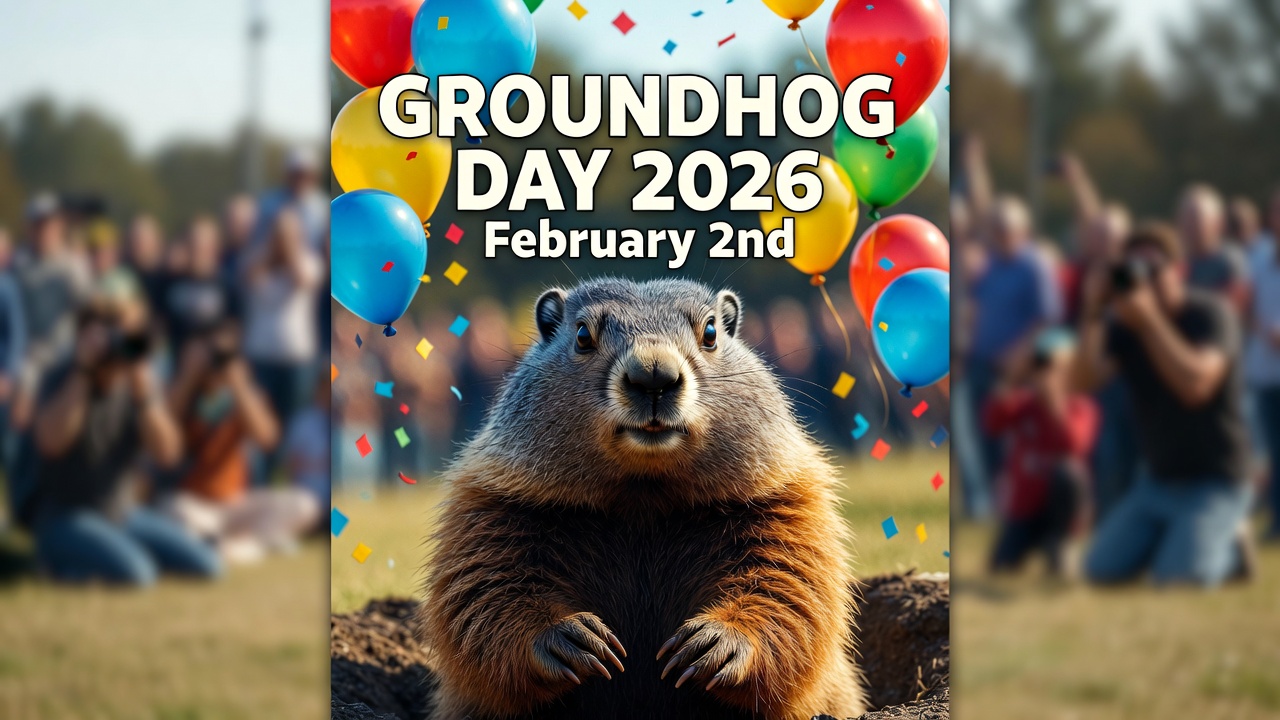
Every February, millions of Americans turn their attention to a small Pennsylvania town where a rotund rodent holds the fate of winter in his furry paws. It’s one of the most peculiar holidays on the American calendar—a celebration that blends ancient Celtic mysticism, medieval Christian tradition, German immigrant folklore, and a healthy dose of good-natured absurdity. Whether you’re a devoted follower of Punxsutawney Phil or simply curious about this enduring midwinter tradition, this comprehensive guide will tell you everything you need to know about Groundhog Day 2026.
What Is the Exact Date of Groundhog Day 2026?
Groundhog Day 2026 falls on Monday, February 2nd. Unlike many American holidays that shift around the calendar to create convenient long weekends, Groundhog Day is fixed—it occurs on February 2nd every single year without exception. This isn’t arbitrary; the date carries profound astronomical and cultural significance stretching back thousands of years.
The timing places Groundhog Day at the precise midpoint between the winter solstice (December 21, 2025) and the spring equinox (March 20, 2026). For our ancient ancestors who lived and died by the agricultural calendar, this cross-quarter day represented a pivotal moment: half of winter had passed, and the promise of spring hung tantalizingly on the horizon. The vernal equinox in 2026 arrives on March 20th at 10:46 a.m. EDT, meaning that regardless of what any groundhog predicts, astronomical spring is exactly 46 days away from Groundhog Day.
| 2026 Groundhog Day Quick Facts | |
|---|---|
| Date | Monday, February 2, 2026 |
| Day of Week | Monday |
| Federal Holiday? | No |
| Celebration Number | 140th Annual (Punxsutawney) |
| Spring Equinox 2026 | March 20, 2026 |
| Days Until Spring | 46 days from Feb. 2 |
What Time Does the Groundhog Day Ceremony Start in 2026?
For those planning to attend in person or watch the livestream, timing is everything. The gates at Gobbler’s Knob open to the public at approximately 3:00 a.m. Eastern Time on February 2nd. Yes, you read that correctly—three o’clock in the morning.
What follows is a several-hour celebration featuring live entertainment, stage performances, and fireworks that illuminate the frigid Pennsylvania darkness. The main event—Phil’s emergence and official prognostication—occurs around 7:25 a.m. Eastern Time, just after sunrise. The Punxsutawney Groundhog Club has announced that festivities for 2026 will begin at 6:00 a.m., with Phil making his appearance shortly after sunrise.
Punxsutawney Phil recently made a surprise appearance at The Press Cider and Taproom in State College, Pennsylvania, drawing enthusiastic crowds eager for an early glimpse of the famous forecaster ahead of his big day.
The Ancient Origins of Groundhog Day: From Imbolc to Pennsylvania
To truly understand Groundhog Day, we must travel back in time—far beyond 1887 Punxsutawney, past medieval Germany, all the way to the ancient Celtic world.
The Celtic Festival of Imbolc and Weather Prediction Traditions
The ancient Celts divided their calendar by the solstices, equinoxes, and the four cross-quarter days that fell between them. February 1st-2nd marked Imbolc (pronounced “IM-bolk”), derived from the Old Irish i mbolg, meaning “in the belly”—a reference to pregnant ewes about to birth the first lambs of spring. This pastoral festival, sacred to the goddess Brigid, signaled that the darkest days were behind and the season of renewal approached.
Weather prognostication was central to Imbolc. Ancient peoples closely observed animal behavior, understanding that creatures emerging from hibernation might signal warming trends. In Irish folk tradition, seeing a hedgehog on this day was considered a good weather sign—if the hedgehog stayed out, mild weather was coming; if it retreated, cold would persist.
From Candlemas to Badger Day: The Christian and German Connections
As Christianity spread through Europe, the Church transformed Imbolc into Candlemas, the Feast of the Purification of the Virgin Mary, celebrated on February 2nd—forty days after Christmas. Clergy would bless candles and distribute them to the faithful, the candles symbolizing Christ as the “light of the world” and, practically speaking, representing how much longer winter would last.
The weather lore persisted through this transformation. Medieval Europeans believed that clear, sunny weather on Candlemas foretold a longer winter, while cloudy skies promised spring’s early arrival. This belief crystallized into rhymes that survive to this day:
If Candlemas be fair and bright,
Winter has another flight.
If Candlemas bring clouds and rain,
Winter will not come again.
In German-speaking regions, this weather-watching tradition became associated with hibernating animals—specifically, the badger. The day became known as Dachstag (Badger Day). If the badger emerged on Candlemas and saw his shadow (indicating sunny weather), he would retreat for four more weeks of winter. German farmers took this very seriously; their livelihoods depended on accurately gauging the coming growing season.
How German Immigrants Brought Groundhog Day to America
When German-speaking settlers—the Pennsylvania Dutch—arrived in southeastern and central Pennsylvania during the 18th and 19th centuries, they carried their Candlemas traditions with them. There was just one problem: badgers were scarce in their new homeland. The resourceful immigrants needed a substitute.
Enter the groundhog (Marmota monax), also called the woodchuck or whistle-pig, a plump, burrowing rodent abundant throughout the eastern and midwestern United States. The groundhog proved an ideal stand-in: like the badger, it hibernated through winter and emerged in early February. By the 1840s, the tradition had taken root.
The earliest known written reference to Groundhog Day in America comes from February 4, 1841, in the diary of James Morris, a storekeeper from Morgantown, Berks County, Pennsylvania:
“Last Tuesday, the 2nd, was Candlemas day, the day on which, according to the Germans, the Groundhog peeps out of his winter quarters and if he sees his shadow he pops back for another six weeks nap, but if the day be cloudy he remains out, as the weather is to be moderate.”
This remarkable entry demonstrates that the core elements of modern Groundhog Day—the February 2nd date, the shadow prophecy, the six-week forecast—were already established in Pennsylvania German communities nearly 185 years ago.
The History of Punxsutawney Phil: America’s Most Famous Groundhog
While groundhog celebrations occurred throughout Pennsylvania Dutch country, one town would rise to dominate the tradition: Punxsutawney.
How Punxsutawney Became the Groundhog Capital of the World
The name “Punxsutawney” derives from the Delaware (Lenape) word ponksad-uteney, meaning “town of the sand flies”—a far cry from its current fame. The town sits in Jefferson County in western Pennsylvania, roughly 80 miles northeast of Pittsburgh.
In 1886, Clymer H. Freas, city editor of The Punxsutawney Spirit newspaper, was inspired by a local tradition of hunting and barbecuing groundhogs. He dubbed the participants the “Punxsutawney Groundhog Club” and, wielding his editorial influence, proclaimed a local groundhog the one and only official weather prognosticator.
The first official trek to Gobbler’s Knob—the wooded knoll that would become hallowed ground—occurred on February 2, 1887. This marked the birth of the organized celebration we know today, making Groundhog Day 2026 the 140th annual Punxsutawney celebration.
Punxsutawney Phil’s Official Title and Legend
Over the decades, Punxsutawney Phil accumulated a gloriously absurd official title: “Punxsutawney Phil, Seer of Seers, Sage of Sages, Prognosticator of Prognosticators, and Weather-Prophet Extraordinary.”
According to Groundhog Club mythology, there has been only one Phil throughout the entire 140-year history. His immortality is attributed to a magical elixir called “Groundhog Punch,” administered at the annual Groundhog Picnic. One sip supposedly grants Phil seven more years of life. In reality, groundhogs in the wild live two to six years, while those in captivity can live considerably longer—the original Wiarton Willie of Canada lived to age 22.
Phil now resides in a climate-controlled habitat at the Punxsutawney Memorial Library, where visitors can view him year-round through a special window into his burrow. According to his handlers, Phil weighs approximately 20 pounds and enjoys a diet of dog food and ice cream—a far cry from the wild grasses, dandelions, and clover his wild cousins prefer.
Understanding the Groundhog Day Prediction: Shadow Meaning Explained
The prediction ritual is charmingly straightforward:
| Condition | Shadow? | Prediction |
|---|---|---|
| Clear, sunny day | Phil sees his shadow | Six more weeks of winter |
| Cloudy, overcast day | No shadow visible | Early spring ahead |
The logic follows the ancient Candlemas wisdom: clear February skies often accompany high-pressure systems bringing cold, dry Arctic air—hence, extended winter. Cloudy conditions may indicate approaching warm fronts and moderating temperatures.
When Phil emerges at Gobbler’s Knob, he’s handled by members of the Inner Circle—a group of local dignitaries distinguished by their formal top hats and tuxedos. Phil supposedly “speaks” to the President of the Inner Circle in “Groundhogese,” a language only this individual can understand. The prediction is then announced to the waiting crowd.
Phil’s Prediction Track Record and Accuracy Statistics
Let’s address the elephant—or rather, the groundhog—in the room: how accurate is Phil?
The Punxsutawney Groundhog Club maintains that Phil is correct 100% of the time. However, independent analyses tell a different story:
- NOAA (National Oceanic and Atmospheric Administration): Approximately 35-40% accuracy
- Stormfax Weather Almanac: 39% accuracy
- Various meteorological studies: Around 50%—essentially a coin flip
Since 1887, Phil has predicted “six more weeks of winter” 107 times and “early spring” only 21 times (with 10 years having no recorded prediction). This heavy bias toward extended winter makes statistical accuracy difficult to assess fairly.
In 2025, Phil saw his shadow and predicted six more weeks of winter. Previous years with early spring predictions include 2024, 2020, 2019, and 2016.
Groundhog Day 2026 Events and Celebrations in Punxsutawney
The Punxsutawney Groundhog Club has announced an extensive schedule of festivities for 2026:
Complete Groundhog Day 2026 Event Schedule
| Date | Event | Time | Location |
|---|---|---|---|
| Sat, Jan 31 | Lunch with Phil | 11 AM – 1 PM | Fraternal Order of Eagles |
| Sat, Jan 31 | Knob’s Got Talent Competition | 1 PM | Community Center (Free) |
| Sat, Jan 31 | Groundhog Ball | 8 – 11 PM | TBA |
| Sat-Mon, Jan 31 – Feb 2 | Groundhog Days in the Park | Various | Chamber of Commerce |
| Sun, Feb 1 | Rockin’ Groundhog Eve Dance | 8 – 11 PM | TBA (21+) |
| Mon, Feb 2 | Gates Open at Gobbler’s Knob | 3 AM | Gobbler’s Knob |
| Mon, Feb 2 | Phil’s Prognostication | ~7:25 AM | Gobbler’s Knob |
Ticket and Pass Information for 2026
Tickets for Groundhog Day 2026 went on sale December 10, 2025, through the official website (www.groundhog.org). Available passes include:
- Hogspitality Village Tickets: Exclusive access to a private area with food and beverages provided by IUP Culinary School and Nemacolin Resort
- VIP/Inner Circle Passes: Access to the limited-capacity natural amphitheater closest to the stage
- Parking Passes: Early morning access to Gobbler’s Knob starting at 3 AM
- Handicap Parking: Available with valid handicap placard
The main Groundhog Day event at Gobbler’s Knob is free and open to the public, though special events require advance ticket purchase.
Other Famous Groundhog Predictions Across North America
While Punxsutawney Phil enjoys the brightest spotlight, he’s hardly the only prognosticating rodent. Weather-predicting groundhogs (and other animals) hold court in at least 28 U.S. states and Canadian provinces.
Most Accurate Groundhog Predictors by Track Record
| Groundhog | Location | Accuracy | Notable Facts |
|---|---|---|---|
| Staten Island Chuck | New York, NY | ~80% | Most accurate according to NOAA |
| General Beauregard Lee | Georgia | ~80% | Holds honorary degrees |
| Sun Prairie Jimmy | Wisconsin | ~60% | Bit the mayor’s ear in 2015 |
| Buckeye Chuck | Ohio | ~50% | Official Ohio State Groundhog since 1979 |
| Punxsutawney Phil | Pennsylvania | ~39% | The most famous |
Staten Island Chuck: Phil’s Most Accurate Rival
Staten Island Chuck, residing at the Staten Island Zoo, boasts the highest accuracy rate among major groundhog prognosticators—approximately 80% over the past 32 years. In 2025, Chuck did not see his shadow and predicted an early spring, directly contradicting Phil’s extended winter forecast.
Chuck’s history hasn’t been without controversy. In 2009, he bit then-Mayor Michael Bloomberg’s finger. More tragically, in 2014, then-Mayor Bill de Blasio dropped the squirming groundhog during the ceremony; Chuck died a week later, though zoo officials stated the fall was unrelated to his death.
Canadian Groundhog Celebrations and Predictions
Canada embraces the tradition with equal enthusiasm:
- Wiarton Willie (Ontario): An albino groundhog who has become a beloved Canadian icon, complete with a statue in his honor
- Shubenacadie Sam (Nova Scotia): The first groundhog to make a prediction each year due to Atlantic Canada’s time zone
- Fred la Marmotte (Quebec): Quebec’s French-Canadian forecaster
What to Expect on Groundhog Day 2026: Weather Forecast and Predictions
According to The Old Farmer’s Almanac long-range forecast, February 2, 2026, will bring snow showers to Punxsutawney, Pennsylvania. If accurate, this cloudy, snowy weather would mean Phil won’t see his shadow—predicting an early spring.
The Farmers’ Almanac takes a more pessimistic view, suggesting that regardless of Phil’s prediction, “winter isn’t going anywhere any time soon” and that the “wet winter whirlwind will take a moment to unwind.”
Of course, meteorologists remind us that the six-week timeframe is somewhat meaningless: spring officially arrives with the vernal equinox on March 20, 2026—which is, conveniently, almost exactly six weeks after Groundhog Day.
Tips for Attending Groundhog Day in Person at Gobbler’s Knob
Planning to make the pilgrimage? Here’s hard-won wisdom from those who’ve braved the experience:
Practical Survival Guide for Gobbler’s Knob
- Dress for extreme cold: February 2nd in northwestern Pennsylvania is brutal. Temperatures regularly drop well below freezing, and you’ll be standing outside for hours starting at 3 AM. Layer aggressively—thermal underwear, insulated boots, hand warmers, face coverings.
- Arrive early: With crowds exceeding 30,000 people, getting a good vantage point requires commitment. Gates open at 3 AM for a reason.
- Arrange transportation in advance: Parking is limited near Gobbler’s Knob. Many attendees use shuttle buses from designated lots. Purchase parking passes early if you want vehicle access.
- Be patient leaving: After Phil’s appearance, 30,000+ people all try to leave simultaneously. Plan for significant wait times for buses and traffic.
- Book accommodations months ahead: Hotels fill up quickly throughout the region. Consider staying in nearby DuBois or Indiana, PA.
- Embrace the absurdity: As Marcy Galando, executive director of the Punxsutawney Groundhog Club, puts it: “We know this is silly; we know this is fun. We want people to come here with a sense of humor.”
If You Can’t Attend: How to Watch Groundhog Day 2026 Online
The ceremony is livestreamed on the official Groundhog Club website and various news outlets. It’s the perfect option for those who love Phil but prefer to watch from under warm blankets rather than shivering on a frozen hillside at dawn.
The Cultural Impact of Groundhog Day in American Folklore
How the 1993 Film “Groundhog Day” Changed Everything
No discussion of Groundhog Day’s cultural significance is complete without mentioning the 1993 Columbia Pictures film starring Bill Murray as Phil Connors, a cynical TV weatherman trapped in a time loop, reliving February 2nd in Punxsutawney endlessly until he becomes a better person.
Though filmed primarily in Woodstock, Illinois (chosen for its accessibility to Chicago), the movie recreated Punxsutawney’s traditions in meticulous detail. It became the 13th highest-grossing film of 1993 and evolved into a beloved cult classic. Its cultural impact was so profound that “Groundhog Day” entered the lexicon as shorthand for any repetitive, seemingly inescapable situation.
The film’s release transformed the real Punxsutawney celebration. Attendance exploded—by 1997, crowds had swelled to 35,000, five times the town’s population. Unfortunately, this surge brought complications: reports emerged of rowdy crowds drinking through the night, people climbing trees, and visitors stripping to their underwear. Alcohol is now prohibited at Gobbler’s Knob.
The Deeper Meaning of Groundhog Day as an American Folk Holiday
Groundhog Day endures because it speaks to something universal: the human longing for winter’s end. In an age of satellite meteorology and supercomputer weather models, we still gather—in person and virtually—to watch a groundhog emerge from a stump. The scientific absurdity is precisely the point.
This celebration connects us to our agricultural ancestors who anxiously watched for signs of spring, to German immigrants who adapted their traditions to a new land, and to the Celtic peoples who lit fires at Imbolc to coax the sun’s return. Groundhog Day is a folk tradition in the truest sense—evolving, adapting, and persisting because it serves a deep human need: hope that the darkness will pass and warmth will return.
Conclusion: Why Groundhog Day Still Matters in 2026
As you mark your calendar for Monday, February 2, 2026, remember that you’re participating in a tradition with roots stretching back millennia. Whether Phil sees his shadow or not, whether spring comes early or winter lingers, the real magic of Groundhog Day lies in its power to bring people together during the dreariest stretch of the year.
So set your alarm for that 7:25 AM prognostication, pour yourself a warm beverage, and join millions of Americans in asking the eternal question: will Punxsutawney Phil, Seer of Seers and Sage of Sages, grant us an early spring?
Either way, the vernal equinox arrives on March 20th. The groundhog may not be a reliable meteorologist—but he’s a wonderful reminder that, shadow or no shadow, spring is always on its way.