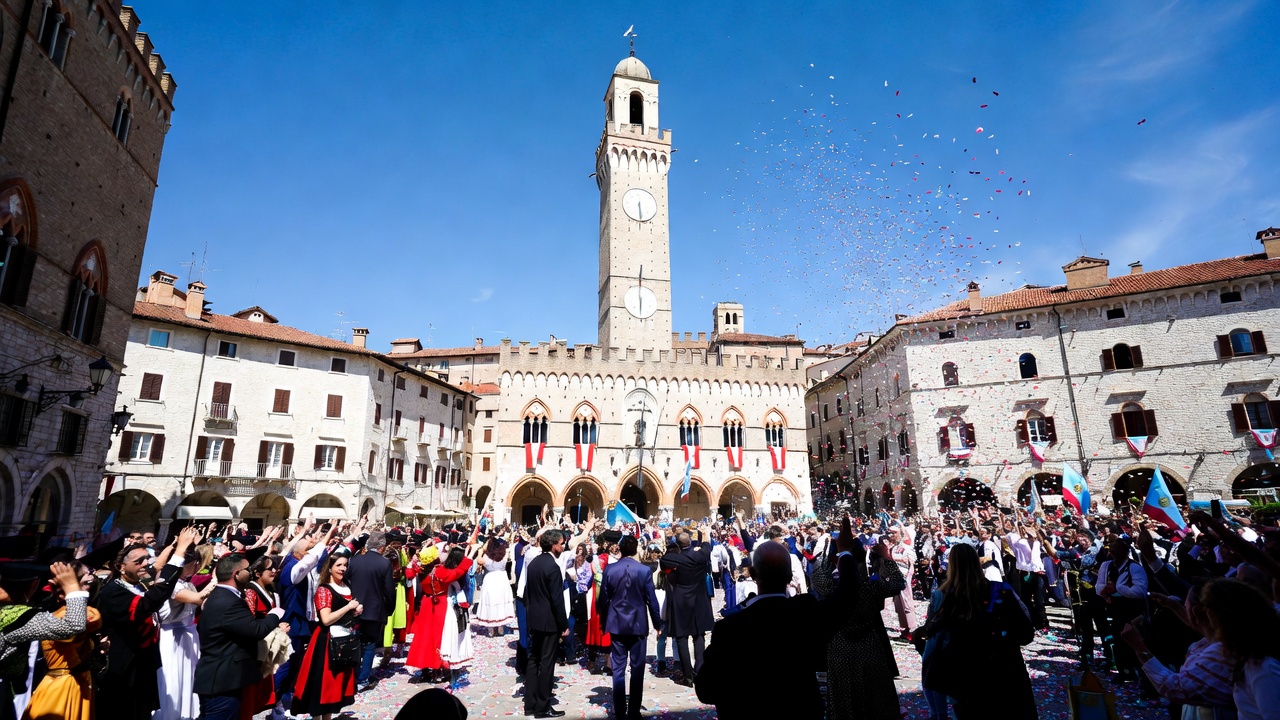
There is a mountaintop republic in the heart of Italy where freedom is not a slogan — it is a lived inheritance. Every year on February 5, the people of San Marino take to the cobblestone streets of their ancient capital to celebrate Liberation Day (Festa della Liberazione). They carry paintings of saints on their shoulders. They march from the sanctuary of Borgo Maggiore up to the Basilica del Santo in the historic center. And they do this in every kind of weather — rain, snow, sunshine — because tradition demands it.
This is not a quaint re-enactment or a tourist show. Liberation Day in San Marino is a living memorial to the moment an entire nation, numbering only a few thousand souls, stood up against one of the most powerful institutions on Earth — the Papal States — and won its freedom back through courage, stubbornness, and a handful of secret letters.
If you have never heard of this holiday, you are not alone. San Marino remains one of the least visited countries in Europe. But its story of independence is one of the most remarkable in all of world history. And Liberation Day is the beating heart of that story.
Let me take you there.
What Is Liberation Day in San Marino and Why Is It Celebrated on February 5?
Liberation Day in San Marino is a national public holiday observed every year on February 5. Its official title is a mouthful: the Anniversary of the Liberation of the Republic from the Alberonian Occupation (1740) and the Feast of Saint Agatha, Co-Patron Saint of San Marino.
That long name tells you everything you need to know about this holiday. It marks two events woven into one celebration:
- The restoration of San Marino’s independence on February 5, 1740, after a brief but traumatic occupation by Cardinal Giulio Alberoni.
- The Feast of Saint Agatha, a Christian martyr from Sicily whose feast day falls on February 5 and who was proclaimed co-patron saint of the republic after independence was restored on her day.
The holiday is deeply civic and religious at the same time. In the morning, there are official speeches and institutional ceremonies at the Palazzo Pubblico, the seat of government. Throughout the day, the historic center comes alive with flags, music, and processions. The most important tradition is the procession that carries a painting of Saint Agatha from the sanctuary in Borgo Maggiore up through the winding streets to the parish church in the capital city.
According to local legend, one year a heavy snowfall prevented the procession from taking place. The next morning, the footprints of the saint were found in the snow — as if she had walked the route herself. Since that day, the people of San Marino have carried out the procession in all types of weather, without exception.
For the Sammarinese (as the people of San Marino call themselves), this day is not simply about looking backward. It is about renewing a commitment — the commitment to self-governance, civic autonomy, and the freedom that their ancestors fought so hard to protect.
The History of San Marino: How the World’s Oldest Republic Survived for 1,700 Years
To understand why Liberation Day matters, you first need to understand how extraordinary San Marino truly is.
San Marino is the oldest surviving sovereign state in the world. It is also the oldest existing constitutional republic. According to tradition, it was founded on September 3, 301 AD, when a Christian stonemason named Marinus fled religious persecution under the Roman Emperor Diocletian and established a small monastic community on the peak of Monte Titano in the Apennine Mountains.
Marinus came from the island of Rab, off the coast of modern-day Croatia. He had been working as a stonecutter in the nearby city of Rimini. When persecution intensified, he retreated to the remote mountain summit and gathered around him a community of fellow believers. According to the founding legend, on his deathbed Marinus told his followers: “Relinquo vos liberos ab utroque homine” — “I leave you free from both men,” meaning free from both the emperor and the pope.
Those words became the foundation of the Sammarinese identity. Freedom — from external power, from tyranny, from domination — is the core principle on which the republic was built.
A Timeline of San Marino’s Key Historical Milestones
| Year | Event |
|---|---|
| 301 AD | Saint Marinus founds the community on Monte Titano |
| 885 | The name “San Marino” first appears in a historical document |
| 1243 | The first two Captains Regent are appointed as joint heads of state |
| 1263 | The earliest surviving statutes of San Marino are written |
| 1291 | The Holy See officially recognizes San Marino’s independence |
| 1463 | Pope Pius II grants additional territory, expanding the republic to its current borders |
| 1503 | Cesare Borgia briefly invades; San Marino regains independence after his death in 1507 |
| 1631 | Pope Urban VIII formally confirms San Marino’s independence |
| 1739 | Cardinal Giulio Alberoni occupies San Marino by military force |
| 1740 | Pope Clement XII restores independence on February 5 — Liberation Day |
| 1797 | Napoleon recognizes San Marino’s sovereignty via the Treaty of Tolentino |
| 1815 | The Congress of Vienna reaffirms San Marino’s independence |
| 1862 | San Marino signs a treaty of friendship with the newly unified Kingdom of Italy |
| 2008 | The Historic Centre and Monte Titano are inscribed as a UNESCO World Heritage Site |
What makes this timeline so astonishing is not just its length — it is the consistency. For more than 1,700 years, this community of a few thousand people perched on a limestone mountain has managed to maintain its sovereignty while empires, kingdoms, and ideologies rose and fell all around it.
The republic survived the Saracens. It survived the feudal wars of medieval Italy. It survived the Borgias, the Papal States, Napoleon, and two World Wars. It even survived an Allied bombing raid in 1944, when British planes mistakenly struck the country.
Today, San Marino covers just 61 square kilometers (about 24 square miles). Its population is approximately 34,000 people. It is the fifth-smallest country in the world by land area. And yet, within those tiny borders lies one of the most resilient political experiments in human history.
Who Was Cardinal Giulio Alberoni and Why Did He Invade San Marino?
The story behind Liberation Day begins with a 75-year-old Italian cardinal named Giulio Alberoni.
Alberoni was born in 1664 in the town of Fiorenzuola d’Arda in the Duchy of Parma. He rose through the ranks of the Catholic Church and European diplomacy, eventually becoming a powerful figure in the Spanish and Papal courts. By 1739, he held the position of papal legate of Ravenna — essentially the pope’s governor in the Romagna region of northeastern Italy, where San Marino is located.
Alberoni was ambitious. He wanted to expand the influence of the Papal States. And the tiny, independent Republic of San Marino — surrounded entirely by papal territory — was an irritation to him.
The pretext for invasion
At the time, San Marino’s government was controlled by a small oligarchy of powerful families. Not everyone in the republic was happy with this arrangement. Some wealthy but politically excluded citizens wanted to restore the Arengo — the ancient assembly of family heads that had once served as the sovereign governing body.
Alberoni saw an opportunity. He supported certain rebels within San Marino who opposed the ruling families. He used their internal disputes as a pretext to intervene. Claiming he was restoring order, Alberoni obtained (or possibly forged) a brief from the Pope and moved to seize control.
The occupation of October 1739
On October 17, 1739, Cardinal Alberoni used military force to occupy San Marino. His troops entered the republic. He dismissed the Captains Regent — the two heads of state who had been elected in the traditional manner since 1243. He replaced them with his own appointees. He imposed a new constitution and tried to force the citizens to submit to the authority of the Papal States.
It was a bold and aggressive move. In a single stroke, Alberoni attempted to extinguish more than a thousand years of Sammarinese independence.
But the people of San Marino had other ideas.
How the Sammarinese Used Civil Disobedience to Reclaim Their Independence
What happened next is the most remarkable part of the story — and the reason February 5 is celebrated as Liberation Day.
The Sammarinese did not take up arms against Cardinal Alberoni. They did not riot in the streets. They did not attempt a military counter-attack. Instead, they employed something far more effective in the context of 18th-century European politics: civil disobedience and diplomatic cunning.
Quiet resistance
The citizens of San Marino refused to cooperate with Alberoni’s new government. They rejected his constitution. They refused to submit to his appointed officials. They made his occupation as difficult and unproductive as possible through passive resistance.
At the same time, the Sammarinese began a covert diplomatic campaign. They sent clandestine letters to Pope Clement XII in Rome, appealing for justice. These secret messages described Alberoni’s actions and argued that his occupation was illegal — that it violated the republic’s ancient rights, which had been recognized by the papacy itself as recently as 1631.
The Pope’s response
The appeal worked. Pope Clement XII was displeased with Alberoni’s actions. Whether Alberoni had acted on his own initiative or had exceeded his authority is still debated by historians. But the outcome was clear.
On February 5, 1740 — just three and a half months after the occupation began — the Pope formally recognized San Marino’s rights and restored its independence. Alberoni was subsequently replaced as papal legate.
The date of the restoration was significant. February 5 was already the feast day of Saint Agatha of Sicily, a beloved early Christian martyr. The Sammarinese saw the timing as a sign of divine favor. In gratitude, they proclaimed Saint Agatha the co-patron saint of the republic, joining Saint Marinus, the founder.
And ever since, February 5 has been celebrated as the day San Marino won back its freedom — not through war, but through the quiet courage of its people.
Who Was Saint Agatha and Why Is She the Patron Saint of San Marino?
The story of Saint Agatha adds a profound spiritual dimension to Liberation Day. To understand why the Sammarinese revere her, you need to know her story.
Agatha was born around 231 AD in the city of Catania, Sicily, into a noble and wealthy family. From a young age, she dedicated her life to God and took a vow of virginity. When the Roman Emperor Decius launched a wave of persecution against Christians around 249–251 AD, a local Roman official named Quintianus saw an opportunity. He had long desired Agatha — both for her beauty and for her family’s wealth.
Quintianus ordered Agatha to renounce her Christian faith. She refused. He imprisoned her in a brothel for a month, hoping to break her will. She remained steadfast. He had her tortured in horrific ways. She endured. According to tradition, Agatha died in prison on February 5, 251 AD, having never abandoned her faith.
Over the centuries, Saint Agatha became one of the most widely venerated martyrs in the Christian world. She is the patron saint of Catania, Malta, Molise, and — since 1740 — the Republic of San Marino.
Her connection to San Marino is deeply symbolic. Just as Agatha resisted the tyranny of Roman power through inner strength and moral conviction, the Sammarinese resisted the tyranny of Alberoni’s occupation through courage and persistence. The fact that the Pope restored San Marino’s independence on her feast day cemented the link between the saint and the nation forever.
Today, the procession on February 5 — carrying the painting of Saint Agatha from Borgo Maggiore to the capital — is both a civic celebration and a religious act of devotion. It honors the saint who, the Sammarinese believe, watched over them in their hour of need.
How San Marino Celebrates Liberation Day: Traditions, Processions, and Local Customs
If you visit San Marino on February 5, you will witness a celebration that blends medieval tradition, religious devotion, and national pride in a way that few other holidays in Europe can match.
The procession from Borgo Maggiore to the capital
The centerpiece of the day is the procession that winds from the town of Borgo Maggiore, located at the base of Monte Titano, up to the historic center of the City of San Marino. Participants carry a revered painting of Saint Agatha on their shoulders, accompanied by clergy, local officials, and citizens dressed in traditional attire.
The route is steep and winding, climbing the slopes of the mountain through narrow streets and ancient gates. The procession takes place regardless of weather conditions — a point of pride for the Sammarinese.
Civic ceremonies and institutional speeches
At the Palazzo Pubblico (the Government Palace) on Piazza della Libertà, official ceremonies are held. The Captains Regent — San Marino’s two heads of state, who serve six-month terms in a tradition dating back to 1243 — preside over speeches and symbolic rituals that reaffirm the republic’s commitment to independence.
Religious celebrations
A solemn Mass is celebrated at the Basilica del Santo, the main church of San Marino. The Mass honors Saint Agatha and gives thanks for the republic’s continued freedom. The basilica, a neo-classical structure built in the 19th century, is one of the most important buildings in the UNESCO World Heritage Site.
Flags, music, and festive atmosphere
Throughout the day, the streets of the historic center are decorated with Sammarinese flags — horizontal bands of white and blue, with the national coat of arms featuring the three towers of Monte Titano. Musicians perform traditional pieces. The atmosphere is festive but also reflective, combining celebration with remembrance.
What about the food?
No Italian-rooted celebration is complete without food, and Liberation Day is no exception. While specific Liberation Day dishes are not rigidly prescribed, the occasion is a natural time for Sammarinese families to enjoy their most beloved traditional recipes.
Here are some of the dishes you might encounter:
| Dish | Description |
|---|---|
| Fagioli con le cotiche | A hearty bean and bacon rind soup, traditionally a winter and holiday dish |
| Pasta e ceci | A warming chickpea and noodle soup flavored with garlic and rosemary |
| Nidi di rondine | Baked pasta rolls stuffed with smoked ham, beef, cheese, and tomato sauce — the name means “swallows’ nests” |
| Coniglio con finocchio | Roast rabbit with fennel, a classic of the Romagna region |
| Passatelli in brodo | Pasta made from breadcrumbs, eggs, and Parmesan, served in chicken broth |
| Torta Tre Monti | A layered wafer cake covered in chocolate, inspired by the three towers of Monte Titano |
| Torta Titano | A dessert of biscuit, hazelnuts, chocolate, cream, and coffee, named after the mountain |
The wines of San Marino are also worth seeking out. Local varieties include Brugneto and Tessano (cask-aged reds) and Biancale and Roncale (still whites). The republic also produces distinctive liqueurs like Mistrà, an aniseed-flavored spirit.
San Marino’s UNESCO World Heritage Site: The Historic Centre and Monte Titano
One of the reasons Liberation Day resonates so powerfully is the physical setting in which it takes place. The Historic Centre of San Marino and Monte Titano were inscribed as a UNESCO World Heritage Site in 2008.
The site covers 55 hectares and includes the entire historic core of the capital city, perched atop Monte Titano at an elevation of 739 meters (2,425 feet) above sea level. The views from the summit are staggering — on clear days, you can see all the way to the Adriatic Sea, just 13 kilometers to the east.
The Three Towers of San Marino
The most iconic features of the skyline are the Three Towers (Tre Torri), which crown the three peaks of Monte Titano:
- Guaita (First Tower): The oldest of the three, dating back to the 11th century. Originally used as a prison, it was rebuilt several times and reached its current form in the 15th century. It is open to visitors and offers some of the most breathtaking panoramic views in all of southern Europe.
- Cesta (Second Tower): Perched on the highest peak of Monte Titano, the Cesta tower houses a museum with over 1,500 historical weapons dating back to the medieval period. The walk from Guaita to Cesta along the ridge of the mountain is one of the most popular short hikes in the country.
- Montale (Third Tower): The smallest and most remote of the three. It is not open to the public, but it completes the dramatic silhouette that appears on the national coat of arms and flag.
These towers were not built as decoration. They were military fortifications, designed to defend the tiny republic against invaders. Their survival is a physical testament to the same spirit of resistance that Liberation Day celebrates.
Other notable structures
The UNESCO site also includes:
- Palazzo Pubblico — the Government Palace, rebuilt in the late 19th century in neo-Gothic style, where the Captains Regent hold office
- Basilica di San Marino — the main church, housing relics of Saint Marinus
- Piazza della Libertà (Freedom Square) — the central square, featuring the famous Statue of Liberty (Statua della Libertà), a marble sculpture by Stefano Galletti
- Teatro Titano — an 18th-century theater that hosts cultural events
- 14th and 16th century convents — beautifully preserved religious buildings
UNESCO recognized San Marino as an outstanding example of a representative democracy based on civic autonomy and self-governance, with an uninterrupted continuity as the capital of an independent republic since the 13th century. In the words of the UNESCO inscription, San Marino is “one of the world’s oldest republics and the only surviving Italian city-state.”
Walking through these streets on Liberation Day, surrounded by flags and music and the echoes of a 1,700-year-old tradition, is an experience that stays with you.
San Marino and Napoleon: How a Tiny Republic Won the Respect of an Emperor
The story of San Marino’s independence does not end with the Alberoni occupation. In fact, one of the most charming chapters comes just a few decades later, during the Napoleonic Wars.
When Napoleon’s armies swept through Italy in the 1790s, many small states were swallowed up or reorganized. San Marino, however, was not. Thanks to the diplomatic skill of a Sammarinese leader named Antonio Onofri, San Marino won Napoleon’s personal admiration and respect.
Napoleon was reportedly moved by the republic’s founding ideals of liberty and self-governance — ideals that echoed the rhetoric of the French Revolution itself. In a letter to the scientist Gaspard Monge, Napoleon praised San Marino’s cultural and political significance. He not only guaranteed the republic’s independence but even offered to extend its territory.
The Sammarinese, ever cautious and self-sufficient, politely declined the offer of more land. They were happy with their mountain.
Napoleon also exempted San Marino’s citizens from taxation and sent them a gift of grain. The republic’s independence was formally recognized in the Treaty of Tolentino in 1797.
Later, the Congress of Vienna in 1815 — which redrew the map of Europe after Napoleon’s defeat — also recognized San Marino’s independence. It was a remarkable achievement for a state that could fit inside many European cities.
Abraham Lincoln and San Marino: An Unlikely Friendship Between Two Republics
Perhaps the most surprising chapter in San Marino’s diplomatic history is its connection to Abraham Lincoln.
In 1861, just as the American Civil War was beginning, the government of San Marino wrote to President Lincoln. They proposed a friendship between the two democratic republics and offered Lincoln honorary citizenship. The letter was written in both Italian and English.
Lincoln accepted. In his reply, composed with the help of Secretary of State William H. Seward, Lincoln wrote that the tiny republic proved that “government founded on republican principles is capable of being so administered as to be secure and enduring.”
This was not empty flattery. Lincoln was making a serious philosophical point. At a time when the very idea of democratic self-governance was under threat — in America and elsewhere — the survival of San Marino for more than 1,500 years was powerful evidence that republics could work.
The exchange between Lincoln and San Marino is a beautiful reminder that the values celebrated on Liberation Day — self-governance, civil autonomy, the courage to stand up for freedom — are not limited to one small country on a mountain in Italy. They belong to the entire world.
How San Marino Protected Over 100,000 Refugees During World War II
San Marino’s commitment to freedom extends beyond its own borders. During World War II, the tiny neutral republic performed an extraordinary act of humanitarianism that deserves to be more widely known.
When Nazi persecution intensified across occupied Europe, San Marino opened its doors. Despite having a population of only about 15,000 people at the time, the republic sheltered more than 100,000 refugees — including Jews and other Italians fleeing fascist and Nazi violence. That is roughly ten times the republic’s own population.
San Marino officially maintained its neutrality throughout the war. However, on June 26, 1944, it was mistakenly bombed by Allied aircraft. Four waves of bombers struck the tiny country in the belief that German forces had occupied it. The Sammarinese government immediately declared that no military installations or belligerent forces were present on its territory.
The bombing caused casualties and damage, but it did not break the Sammarinese spirit. The republic continued to provide refuge to those fleeing the war until the conflict ended.
This chapter of history adds another layer of meaning to Liberation Day. The holiday does not just celebrate San Marino’s own freedom — it honors the principle that all people deserve to live in safety and dignity.
How to Visit San Marino for Liberation Day: A Practical Travel Guide for 2026
If reading about Liberation Day has inspired you to witness it in person, you are in luck. San Marino is surprisingly easy to reach, even though it has no airport and no train station.
Getting there
The gateway to San Marino is the Italian city of Rimini, located on the Adriatic coast. Rimini has its own small airport (Federico Fellini International Airport, with mostly seasonal flights) and is well connected by train to major Italian cities.
From Rimini to San Marino by bus: The Bonelli Bus operates regular service from Rimini train station to San Marino. The journey takes approximately 50 minutes and costs around €6–7 each way. The bus departs from a stop near the Napoleon Hotel, directly across the street from Rimini station. Buy your tickets at the tabaccheria (tobacco shop) across from the station, or book online.
Approximate train travel times to Rimini:
| Origin City | Approximate Travel Time | Approximate Cost (2nd Class) |
|---|---|---|
| Bologna | 1 hour | €10–15 |
| Florence | 2 hours (via Bologna) | €20–30 |
| Rome | 4 hours | €25–50 |
| Venice | 3 hours | €20–40 |
| Milan | 3.5 hours | €30–50 |
By car: San Marino is approximately 20 km from Rimini by road. There are no border checks between Italy and San Marino — you simply drive from one country to the other. Parking is available at several lots near the historic center.
Where to stay
Most visitors treat San Marino as a day trip from Rimini, but for Liberation Day, I strongly recommend staying overnight. After the day-trippers leave in the evening, the medieval streets become peaceful and hauntingly beautiful. You will have the towers, the views, and the sunset virtually to yourself.
The Grand Hotel San Marino offers excellent views from its hillside location. Budget travelers can find more affordable options in Borgo Maggiore or back in Rimini.
What to bring
February in San Marino can be cold and windy. Monte Titano sits at nearly 750 meters above sea level, and winter temperatures regularly drop below freezing. Bring warm layers, a windproof jacket, and sturdy shoes — especially if you plan to walk between the towers along the mountain ridge.
Passport stamp
Here is a delightful detail for collectors: you can get a San Marino passport stamp at the state tourist office in the historic center. It costs a small fee and is one of the most charming souvenirs you can bring home.
Respectful visiting
Liberation Day is a genuine national celebration, not a tourist attraction. The Sammarinese take their history and traditions seriously. Be respectful during the procession and religious ceremonies. If you are invited to share a meal or a glass of local wine, accept with gratitude — Sammarinese hospitality is warm and sincere.
Why San Marino’s Constitution Is the Oldest in the World Still in Use
One detail that often surprises visitors is that San Marino’s Statutes of 1600 — its modern constitution — is the oldest written constitutional document still in active use anywhere in the world.
The statutes were written in Latin and codified the legal framework, governmental structure, and citizen rights that had evolved over centuries of self-governance. They formalized the role of the Captains Regent, the Great and General Council (the 60-member parliament), and the civic institutions that continue to function today.
The government of San Marino works as a parliamentary representative democratic republic. The two Captains Regent serve as joint heads of state for six-month terms — one of the shortest terms for a head of state anywhere in the world. They are elected by the Great and General Council, whose 60 members are chosen by the citizens every five years through proportional representation.
This system dates back, in one form or another, to 1243, when the first two Captains Regent were appointed. That makes San Marino’s system of dual heads of state nearly 800 years old.
The continuity is extraordinary. While most countries in Europe have experienced revolutions, regime changes, constitutional rewrites, and political upheavals, San Marino has maintained its basic governing structure since the Middle Ages. Liberation Day is a celebration of this continuity — a reminder that democratic self-governance, when built on strong civic values, can endure.
What Liberation Day Teaches the World About Freedom and Civic Courage
Liberation Day is not just a Sammarinese holiday. It carries a universal message.
Consider the circumstances of the 1739 occupation. A tiny republic of a few thousand people, with no army to speak of, was invaded by a representative of one of the most powerful institutions in the Western world. The citizens had every reason to submit. Resistance seemed futile.
But they did not submit. They used the tools available to them — civil disobedience, diplomatic protest, and moral persuasion — to make their case. They appealed to a higher authority. They insisted on their ancient rights. And they won.
This story resonates far beyond San Marino’s borders. It speaks to anyone who has ever felt that the odds were stacked against them. It says: your voice matters. Your rights matter. Your refusal to give in matters.
In an era of rising authoritarianism, political polarization, and threats to democratic norms around the world, the example of San Marino is both humbling and inspiring. A nation of 34,000 people has maintained its freedom for more than 1,700 years — not through military might, but through civic engagement, institutional resilience, and an unshakable belief in the principle of self-governance.
That is what Liberation Day celebrates. And that is why it matters.
Frequently Asked Questions About San Marino Liberation Day
When is Liberation Day in San Marino? Liberation Day is celebrated every year on February 5. It is a national public holiday.
What does Liberation Day commemorate? It marks the restoration of San Marino’s independence on February 5, 1740, after the republic was occupied by Cardinal Giulio Alberoni in October 1739. It also celebrates the Feast of Saint Agatha, the co-patron saint.
Is San Marino the oldest republic in the world? Yes. San Marino claims a founding date of September 3, 301 AD, making it the oldest surviving sovereign state and the oldest constitutional republic in the world.
How big is San Marino? San Marino covers approximately 61 square kilometers (24 square miles) and has a population of about 34,000 people. It is the fifth-smallest country in the world.
Do I need a visa to visit San Marino? San Marino has an open border with Italy. If you are legally present in Italy (or the Schengen Area), you can enter San Marino without additional documentation. However, bring your passport if you want the famous passport stamp.
Is San Marino part of the European Union? No. San Marino is not a member of the EU, though it uses the euro as its official currency and has a customs union with Italy.
Can I visit the Three Towers of Monte Titano? Yes. Guaita (First Tower) and Cesta (Second Tower) are open to visitors. Montale (Third Tower) is not open to the public but can be viewed from outside.
What language is spoken in San Marino? The official language is Italian. Many Sammarinese also speak the Romagnol dialect, a regional language shared with the surrounding area of Italy.
Final Thoughts: A Mountain of Freedom Worth Climbing
I have visited hundreds of festivals and celebrations on six continents. I have danced in the streets of Rio during Carnival and watched the sunrise on Diwali in Varanasi. But there is something about Liberation Day in San Marino that stays with me in a different way.
Maybe it is the scale — a country you can walk across in a single afternoon, celebrating a freedom older than most nations on Earth. Maybe it is the setting — the mist rolling off Monte Titano in the February cold, the towers standing sharp against the winter sky. Maybe it is the people — proud, quiet, deeply rooted in their traditions but welcoming to the stranger who shows genuine interest.
Or maybe it is the story itself. A handful of citizens. A stack of secret letters. A pope who listened. And a freedom that was restored on the feast day of a martyred Sicilian saint.
If you are looking for a winter travel experience that goes beyond the ordinary, if you want to witness a living tradition that connects the ancient world to the present day, if you want to stand on a mountain and understand what it means for a small community to fight for its independence and win — come to San Marino on February 5.
Bring warm clothes. Bring curiosity. And bring your respect for a republic that has been free for 1,725 years and counting.
Benvenuti nella Repubblica di San Marino. Welcome to the Republic of San Marino.