Every February 14, the world celebrates love. Roses are bought. Chocolates are exchanged. Cards are signed with hearts. But there is another celebration happening on this very same day — one that honors a different kind of love altogether. World Bonobo Day 2026 falls on Saturday, February 14, and it shines a light on one of the most peaceful, loving, and misunderstood creatures on Earth: the bonobo.
If you have never heard of bonobos, you are not alone. They are often called “the forgotten ape” because they live in the shadow of their more famous relatives — chimpanzees, gorillas, and orangutans. But bonobos are extraordinary animals. They share 98.7% of their DNA with humans, making them, alongside chimpanzees, our closest living relatives. They live in female-led societies. They resolve conflict through affection rather than aggression. And they are in serious danger of disappearing from the planet forever.
This World Bonobo Day, we are diving deep into the world of bonobos. Below, you will find 10 fun and fascinating facts about these gentle apes — facts that will change the way you think about wildlife, about conservation, and maybe even about what it means to be human.
What Is World Bonobo Day and Why Is It Celebrated on Valentine’s Day?
Before we get into our 10 facts, let’s talk about the day itself. World Bonobo Day was founded in 2017 by the Bonobo Conservation Initiative (BCI), a nonprofit organization dedicated to saving bonobos and their rainforest habitat in the Democratic Republic of the Congo (DRC).
It is no accident that this day falls on Valentine’s Day. Bonobos are often called the “make love, not war” apes because they use affection, social bonding, and physical intimacy to settle disputes, greet one another, and maintain harmony within their groups. They are, in many ways, nature’s ambassadors of love. What better day to celebrate them than February 14?
The day is supported by several prominent conservation groups, including Friends of Bonobos, the International Primate Protection League, and the African Wildlife Foundation (AWF). Each year, zoos, sanctuaries, schools, and wildlife lovers around the world hold events to spread awareness about these amazing primates and the threats they face.
In 2026, the celebration carries a special weight. The bonobo population continues to decline. New genetic research has revealed that bonobos may be even more vulnerable than scientists previously believed. And in 2025, the world lost Kanzi, the most famous bonobo in history — a loss that reminded millions of people just how remarkable these animals truly are.
Let us honor their legacy by learning more about them. Here are 10 fun facts about bonobos for World Bonobo Day 2026.
Fun Fact 1: Bonobos Share 98.7% of Their DNA with Humans
Of all the animals on Earth, bonobos and chimpanzees are our closest living relatives. Both species share approximately 98.7% of their genetic makeup with Homo sapiens. That number is staggering when you think about it. It means that the genetic distance between you and a bonobo is smaller than the distance between a bonobo and a gorilla.
According to the World Wildlife Fund (WWF), bonobos share this remarkable genetic similarity with us and yet remain one of the least studied great apes on the planet. Much of their habitat is remote and difficult to access, and decades of political instability in the DRC have made field research extremely challenging.
But here is where it gets truly interesting. While chimpanzees and bonobos are equally close to us genetically, they are very different in behavior. Chimpanzees tend to be more aggressive and hierarchical. Bonobos are more cooperative and egalitarian. Some scientists suggest that studying bonobos may teach us just as much about human nature as studying chimps — perhaps more.
Dr. Richard Carroll, Vice President of WWF’s Africa Program, put it simply: bonobos are fascinating creatures with the only great ape society led by females, built on cooperation and peace. Understanding them means understanding a piece of ourselves.
| Trait | Bonobos | Chimpanzees |
|---|---|---|
| DNA shared with humans | ~98.7% | ~98.7% |
| Social structure | Matriarchal (female-led) | Patriarchal (male-led) |
| Conflict resolution | Social bonding, affection | Aggression, dominance displays |
| Geographic range | DRC only (south of Congo River) | Central and West Africa |
| IUCN Status | Endangered | Endangered |
Fun Fact 2: Bonobos Are Found Only in One Country in the World
Here is a fact that surprises most people. Bonobos exist in the wild in only one country: the Democratic Republic of the Congo. They live in the dense tropical rainforests south of the Congo River and north of the Kasai River. This river system acts as a natural barrier — chimpanzees live on the north side, and bonobos live on the south.
Their total geographic range spans roughly 500,000 square kilometers of forest, according to the African Wildlife Foundation. However, they are not found everywhere within that area. Their distribution is patchy and fragmented. Only about 28% of their geographic range is considered suitable habitat. Researchers have identified just four major bonobo strongholds: Maringa-Lopori-Wamba, Tshuapa-Lomami-Lualaba, Salonga, and Lac Tumba-Lac Mai Ndombe.
The fact that bonobos are endemic to a single country makes them extremely vulnerable. The DRC has experienced decades of armed conflict, extreme poverty, and political instability. These conditions have made conservation work difficult and have put bonobos at constant risk from habitat destruction and poaching.
Salonga National Park, Africa’s largest protected forest park, is considered the world’s bonobo stronghold. A landmark study published in late 2024 by researchers at the Max Planck Institute of Animal Behavior — the largest temporal comparison of a bonobo population ever conducted — estimated that between 8,000 and 18,000 adult bonobos inhabit Salonga. The study found that while the population has remained relatively stable since 2000, there are signs of potential decline. It also highlighted the critical role that park rangers play in keeping bonobo numbers steady.
Fun Fact 3: Bonobo Societies Are Led by Females — A Rare Matriarchy in the Animal Kingdom
One of the most remarkable things about bonobos is their matriarchal social structure. In bonobo groups, females hold the highest social ranks. Males rank lower than all females in the group. This is the opposite of chimpanzee society, where a dominant alpha male sits at the top of the hierarchy.
In a bonobo community, a male’s social status is largely determined by the status of his mother. If his mother is a high-ranking female, he enjoys a higher position. If she dies or loses her status, his rank drops. This maternal bond is one of the strongest relationships in bonobo society. Sons often stay close to their mothers throughout their entire lives.
Female bonobos are not born into their groups, though. When they reach adolescence, they leave their birth group and migrate to a new one — a pattern scientists call female dispersal. Once they arrive in a new group, they form tight alliances with other females. These alliances give them collective power over males, even though individual males are physically larger and stronger.
This system leads to a remarkably peaceful society. Group conflicts are typically resolved through non-aggressive behaviors. Instead of fighting, bonobos use grooming, play, and physical affection to ease tensions. The result is a community that values cooperation over competition.
As Dr. Sojung Han of the University of Vienna described in a 2024 genetics study published in Current Biology: bonobos live in tight social groups which, despite some conflicts, are markedly peaceful and egalitarian. Females form close alliances and can hold higher dominance than males — a pattern that makes bonobos truly unique among great apes.
Fun Fact 4: Bonobos Resolve Conflict Through Affection Instead of Aggression
This is perhaps the fact that bonobos are most famous for. While chimpanzees settle disputes through aggressive displays, fighting, and even lethal violence, bonobos take a radically different approach. They use social bonding behaviors — including grooming, embracing, and physical intimacy — to defuse tension, restore peace, and strengthen relationships.
Scientists call this the “bonobo handshake.” When two groups of bonobos encounter each other in the wild, instead of fighting, they will often play together and engage in friendly social contact. This behavior is the opposite of what chimpanzees do when they meet a rival group.
This peaceful reputation has earned bonobos the nickname “hippie chimps.” The phrase captures something real about their temperament, but it is also a simplification. Bonobos are not conflict-free. They do argue. They do compete for food and social status. And a 2024 study reported in the journal Current Biology found that bonobos can behave more aggressively than previously thought.
However, the overall pattern is clear. Bonobos are significantly less violent than chimpanzees. They do not wage war on neighboring groups. They do not regularly kill members of their own species. And their societies function on a foundation of cooperation rather than domination.
What makes this especially interesting is what it might tell us about human evolution. For decades, scientists used chimpanzee behavior as a model for understanding our own ancestors. But bonobos show us that cooperation and peacemaking are also ancient strategies — strategies that may have played a much larger role in human evolution than we once believed.
Fun Fact 5: Bonobos Can Understand Human Ignorance — A Groundbreaking Discovery in Ape Intelligence
In February 2025, a study published in the Proceedings of the National Academy of Sciences (PNAS) revealed something astonishing. Researchers at Johns Hopkins University found that bonobos can recognize when a human partner lacks knowledge and will proactively communicate to help them.
The experiment was elegant. Three male bonobos — Kanzi (age 43), Nyota (25), and Teco (13) — sat across from a human researcher named Luke Townrow. A treat was hidden under one of three cups. Sometimes Townrow saw where the treat was placed. Sometimes he did not.
When Townrow had seen the hiding spot, the bonobos sat quietly and waited for their reward. But when Townrow had not seen where the treat was hidden, the bonobos sprang into action. They pointed to the correct cup quickly and demonstratively. Kanzi, the oldest, was especially expressive — tapping and gesturing urgently to guide his confused human partner.
“This is a milestone,” lead author Luke Townrow told Mongabay. The ability to detect what someone else does not know — and act on that information — is a core component of what psychologists call “theory of mind.” It was long believed to be unique to humans.
Co-author Chris Krupenye, an assistant professor at Johns Hopkins, explained the significance: the ability to sense gaps in others’ knowledge is at the heart of human cooperation, communication, and strategic thinking. This study demonstrates that humans and great apes share rich mental foundations — and suggests these abilities evolved millions of years ago in our common ancestor.
This finding has profound implications. It suggests that the roots of teaching, language, and cooperative communication stretch back at least 6 to 8 million years, to the last common ancestor of humans, bonobos, and chimpanzees.
Fun Fact 6: The World Lost Its Most Famous Bonobo in 2025 — Remembering Kanzi
On March 18, 2025, the world said goodbye to Kanzi, the most famous bonobo who ever lived. He died at the age of 44 at the Ape Initiative campus in Des Moines, Iowa, where he had lived for more than two decades. His death was most likely caused by heart disease, for which he had been receiving treatment.
Kanzi was born on October 28, 1980, at what is now the Emory National Primate Research Center in Georgia. What made him extraordinary was not his physical strength or his athletic ability. It was his mind.
Kanzi learned to communicate using lexigrams — a system of geometric symbols printed on a keyboard. Each symbol represented a word or concept. Remarkably, nobody taught Kanzi directly. He picked up the symbols by watching his adoptive mother, Matata, during her own (less successful) language training sessions. He absorbed language the way a human toddler does — simply by being exposed to it.
Over his lifetime, Kanzi’s vocabulary grew to include more than 300 lexigram symbols. He could understand approximately 3,000 spoken English words. In a famous study, his ability to respond to spoken instructions was compared to that of a two-year-old human child named Alia. Kanzi responded correctly to 74% of the instructions. Alia scored 65%.
But language was only part of Kanzi’s story. He also learned to make and use stone tools, working with archaeologists Nicholas Toth and Kathy Schick of Indiana University. He even invented his own technique — throwing rocks against hard surfaces to produce sharp flakes, as reported by Scientific American. He was a painter. He was a musician who jammed with Peter Gabriel and Paul McCartney. And in his later years, he became a gamer — playing Pac-Man and even beating the final boss in Minecraft.
Kanzi was the last language-trained ape alive. His death marks the end of an era in primate research. But his legacy lives on in every study that builds on his groundbreaking work — and in the six bonobos he helped raise, who still live at Ape Initiative today.
Fun Fact 7: Bonobos Are Endangered and Their Population Is Declining Fast
Behind the charming facts and heartwarming stories, there is a harsh reality. Bonobos are endangered. The International Union for Conservation of Nature (IUCN) classifies them as Endangered on its Red List. Some conservationists believe their status may soon need to be upgraded to Critically Endangered.
Exact population numbers are difficult to determine. Bonobos live in some of the most remote and inaccessible forests on Earth. Political instability in the DRC has limited scientific surveys. Current estimates vary widely:
- The African Wildlife Foundation estimates a minimum of 15,000 to 20,000 individuals remain, based on surveys of four major strongholds.
- WWF puts the number at 29,500 to 50,000, though with low confidence.
- The Bonobo Conservation Initiative cites estimates of 10,000 to 20,000 and emphasizes that the population is fragmented and decreasing.
- Friends of Bonobos notes that 20,000 to 50,000 may remain, but scientists have low confidence in this range.
What all sources agree on is this: the population has been declining for at least 30 years, and the decline is expected to continue for another 45 to 55 years. The bonobo’s slow reproductive rate makes recovery extremely difficult. Females give birth to just one infant every 4 to 6 years. They do not become sexually mature until age 12. Population growth simply cannot keep pace with the rate of loss.
Major Threats Facing Wild Bonobos in 2026
| Threat | Description |
|---|---|
| Bushmeat hunting | The greatest single threat. Bonobos are hunted for meat, and smoked bushmeat is a durable trade commodity. |
| Habitat loss | Slash-and-burn agriculture, commercial logging, and mining destroy and fragment forests. |
| Armed conflict | Decades of war in the DRC have enabled poaching and habitat destruction. |
| Palm oil | 99.2% of the bonobo’s range is suitable for palm oil production, posing a major future threat. |
| Coltan mining | Mining for coltan, used in electronics batteries, degrades bonobo habitat. |
| Disease | Close genetic similarity to humans means bonobos are vulnerable to diseases like Ebola. |
| Illegal pet trade | Baby bonobos are captured and sold as pets after their mothers are killed. |
Fun Fact 8: New Genetic Research Reveals Three Distinct Bonobo Populations
In October 2024, a landmark genetics study co-led by scientists from University College London (UCL), the University of Vienna, and the Max Planck Institute for Evolutionary Anthropology revealed a critical new finding: bonobos are not a single, uniform population. They actually consist of at least three genetically distinct groups that have been living separately for tens of thousands of years.
The three groups originate in the central, western, and far-western regions of the bonobo’s range. The researchers analyzed genomic data from 30 bonobos born in the wild but now living in captivity. They found that the genetic differences between these groups are as significant as the differences between the most closely related chimpanzee subspecies.
This discovery has major implications for conservation. As Professor Aida Andrés of UCL’s Genetics Institute explained: bonobos may be even more vulnerable than previously thought, because their population actually consists of at least three smaller populations. Some of these may historically have been among the smallest across similar primates.
The key takeaway is this: losing even one of these three groups would be devastating for the total genetic diversity of the species. Every species needs sufficient genetic diversity to adapt to a changing environment. For bonobos, preserving all three groups is essential.
This research means that conservation strategies can no longer treat bonobos as a single population. Habitat preservation, translocation, and reintroduction efforts must consider the genetic differences between groups — especially if individuals are adapted to specific environments.
Fun Fact 9: Lola ya Bonobo Is the Only Bonobo Sanctuary in the World
In Lingala, one of the primary languages spoken in the DRC, “Lola ya Bonobo” means “paradise for bonobos.” And for the orphaned, injured, and rescued bonobos who call it home, that name could not be more fitting.
Lola ya Bonobo was founded in 1994 by Claudine André in Kinshasa, the capital of the DRC. It is the only bonobo sanctuary in the world. Today, it is home to approximately 60 bonobos living in 30 hectares of primary forest on the outskirts of the city.
Most bonobos arrive at the sanctuary as young infants. Their stories are heartbreaking. The bushmeat trade kills hundreds of bonobos each year. When a mother bonobo is killed, her baby is often captured and sold as a pet or for the illegal wildlife trade. When authorities confiscate these orphans, they are brought to Lola ya Bonobo.
What happens next is extraordinary. Each orphaned baby is assigned a human surrogate mother — a Congolese woman who provides around-the-clock love, care, and physical contact. This is not optional. Bonobo babies are unique among great apes in that they will die without constant nurturing. Unlike gorilla or chimpanzee infants, baby bonobos need continuous emotional and physical connection to survive. Without it, they can literally die of a broken heart.
Over time, the baby bonobos are gradually integrated into social groups within the sanctuary’s forested enclosures. They learn to forage, play, compete, and form relationships — just as they would in the wild. The bonobos at Lola ya Bonobo display all the naturally occurring behaviors observed in wild populations. Some even show behaviors, like certain types of tool use, that have not been documented in the wild.
The sanctuary also runs the Ekolo ya Bonobo Community Reserve, where rehabilitated bonobos are returned to their natural habitat — a process called rewilding. Friends of Bonobos, the organization that operates the sanctuary, has completed two successful bonobo rewildings so far.
2025: A Year of Challenges and Hope at Lola ya Bonobo
The year 2025 was a difficult one for the sanctuary. In April, historic floods swept through Kinshasa, causing significant damage to Lola ya Bonobo’s infrastructure. The Lukaya River flooded critical areas. Paths, enclosures, and buildings were all affected. Thanks to emergency donations from supporters around the world, the sanctuary was able to stabilize and begin rebuilding.
But there was good news too. On September 6, 2025, a new baby bonobo was born at the sanctuary to a mother named N’djili. This birth was especially meaningful. N’djili had lost two previous infants — one to a suspected snake bite in 2024, and another shortly after birth in 2022. Her new baby represents hope, resilience, and the effectiveness of the sanctuary’s conservation model.
Fun Fact 10: You Can Help Protect Bonobos — Here’s How to Celebrate World Bonobo Day 2026
World Bonobo Day is not just about learning facts. It is about taking action. The good news is that there are many ways you can help — whether you are in Kinshasa, Kansas City, or Kuala Lumpur.
Donate to Bonobo Conservation Organizations
Several reputable organizations are doing critical work to protect bonobos and their habitat:
- Friends of Bonobos — Operates Lola ya Bonobo sanctuary and the Ekolo ya Bonobo Community Reserve. They rescue orphaned bonobos, run education programs, and work with local communities.
- Bonobo Conservation Initiative (BCI) — Focuses on protecting wild bonobo habitat and empowering local communities to become conservation leaders.
- African Wildlife Foundation (AWF) — Trains rangers, uses satellite technology to monitor habitat, and supports community-based conservation in the DRC.
- World Wildlife Fund (WWF) — Works with the Congolese Wildlife Authority (ICCN) to protect bonobos in Salonga National Park and beyond.
Even small donations make a difference. The cost of feeding a bonobo at Lola ya Bonobo for a day is modest — but it adds up to survival.
Spread the Word on Social Media
Bonobos are the least known of all great apes. Most people cannot tell them apart from chimpanzees. Sharing a post, a video, or even this article on February 14 can help change that. Use the hashtags #WorldBonoboDay, #BonoboLove, and #SaveTheBonobos to join the global conversation.
Recycle Your Electronics
This one is surprisingly practical. Coltan, a mineral used in the batteries of smartphones, laptops, and tablets, is mined in the DRC — often in or near bonobo habitat. By recycling your old electronics, you keep coltan in circulation and reduce demand for new mining. It is a simple step that directly benefits bonobos.
Visit Lola ya Bonobo
If you ever have the chance to visit the DRC, Lola ya Bonobo is open to visitors. It is located just outside Kinshasa and offers guided day tours as well as overnight stays in eco-lodges. Seeing bonobos up close — watching them play, groom, and interact with each other — is an experience that visitors describe as life-changing. Tour fees directly support the sanctuary’s work.
Symbolically Adopt a Bonobo
Several organizations offer symbolic adoption programs. For a set donation, you can “adopt” a bonobo and receive updates on their well-being. It is a wonderful gift for a partner, child, or friend on Valentine’s Day — far more meaningful than a box of chocolates.
Why Bonobos Matter: Lessons from Our Closest Relatives for 2026 and Beyond
In a world that often feels divided, aggressive, and uncooperative, bonobos offer a different model. They show us that peace is not weakness. That female leadership can create stable, thriving communities. That conflict resolution through empathy and connection is not just possible — it is natural.
Of course, we should be careful not to romanticize bonobos. They are animals, not symbols. They have their own conflicts, their own struggles, their own complex inner lives. But there is something deeply moving about a species that has evolved to prefer cooperation over combat. About mothers who love so fiercely that their babies cannot survive without them. About a creature that shares almost all of our DNA and yet lives in a way that we, as humans, are still struggling to achieve.
Protecting bonobos is not just about saving a species. It is about preserving an ecosystem — the Congo Basin rainforest, the second largest tropical forest on Earth and a critical carbon sink in the fight against climate change. It is about supporting the people of the DRC, who share their home with these remarkable animals and whose livelihoods depend on healthy forests. And it is about honoring the bond that connects us to every other living being on this planet.
Bonobo Conservation Success Stories That Give Us Hope in 2026
Despite the serious threats facing bonobos, there are reasons for optimism. Conservation work is making a real difference. Here are some encouraging developments:
Salonga National Park remains a stronghold. The 2024 study by the Max Planck Institute confirmed that the park’s bonobo population has remained stable over two decades. The study credited the presence of dedicated park rangers as a key factor. This demonstrates that well-managed protected areas work.
New protected areas are being established. In August 2025, the Monte Carmelo Municipal Protected Area was created to help preserve water, forests, and wildlife in the bonobo’s range. WWF has also helped establish the Lac Tumba-Lediima Nature Reserve, which protects a previously unknown bonobo population with the highest density and largest group sizes recorded anywhere.
Rewilding efforts are succeeding. Friends of Bonobos has completed two bonobo rewildings at Ekolo ya Bonobo Community Reserve. Rehabilitated bonobos are living freely in the forest, reproducing naturally, and forming healthy social groups. This proves that sanctuary-based rehabilitation can lead to successful return to the wild.
Community-based conservation is growing. Organizations like AWF and BCI have learned that conservation must benefit local communities to succeed. Training local rangers, supporting sustainable agriculture, providing economic alternatives to bushmeat hunting — these community-centered approaches are creating lasting change.
Science is advancing. The 2024 UCL genetics study and the 2025 Johns Hopkins theory-of-mind study are just two examples of groundbreaking bonobo research. Every new discovery deepens our understanding and strengthens the case for conservation.
A Quick Reference Guide: Everything You Need to Know About Bonobos
For quick reference, here is a summary of key bonobo facts:
| Category | Details |
|---|---|
| Scientific name | Pan paniscus |
| Common names | Bonobo, pygmy chimpanzee, gracile chimpanzee |
| First classified as separate species | 1933, by German anatomist Ernst Schwarz |
| DNA shared with humans | ~98.7% |
| Habitat | Tropical rainforest, DRC (south of Congo River) |
| Geographic range | ~500,000 km² (patchy distribution) |
| Estimated wild population | 15,000–50,000 (wide range, low confidence) |
| IUCN conservation status | Endangered |
| Social structure | Matriarchal (female-led) |
| Diet | Primarily frugivorous (fruit-based), supplemented with leaves, seeds, insects, and occasionally small vertebrates |
| Lifespan | ~40 years in the wild; up to 50+ in captivity |
| Reproduction rate | One infant every 4–6 years |
| Sexual maturity | Around 12 years old |
| Community size | 30–80 individuals (fission-fusion groups) |
| Locomotion | Knuckle-walking; can walk bipedally (upright) |
| Key physical traits | Slender build, longer legs, pink lips, black face, hair parted in the middle |
| Known for | Peaceful conflict resolution, female-led groups, high social intelligence |
How to Celebrate World Bonobo Day 2026: A Practical Guide for Families, Schools, and Communities
World Bonobo Day is perfect for people of all ages. Here are some ways to get involved:
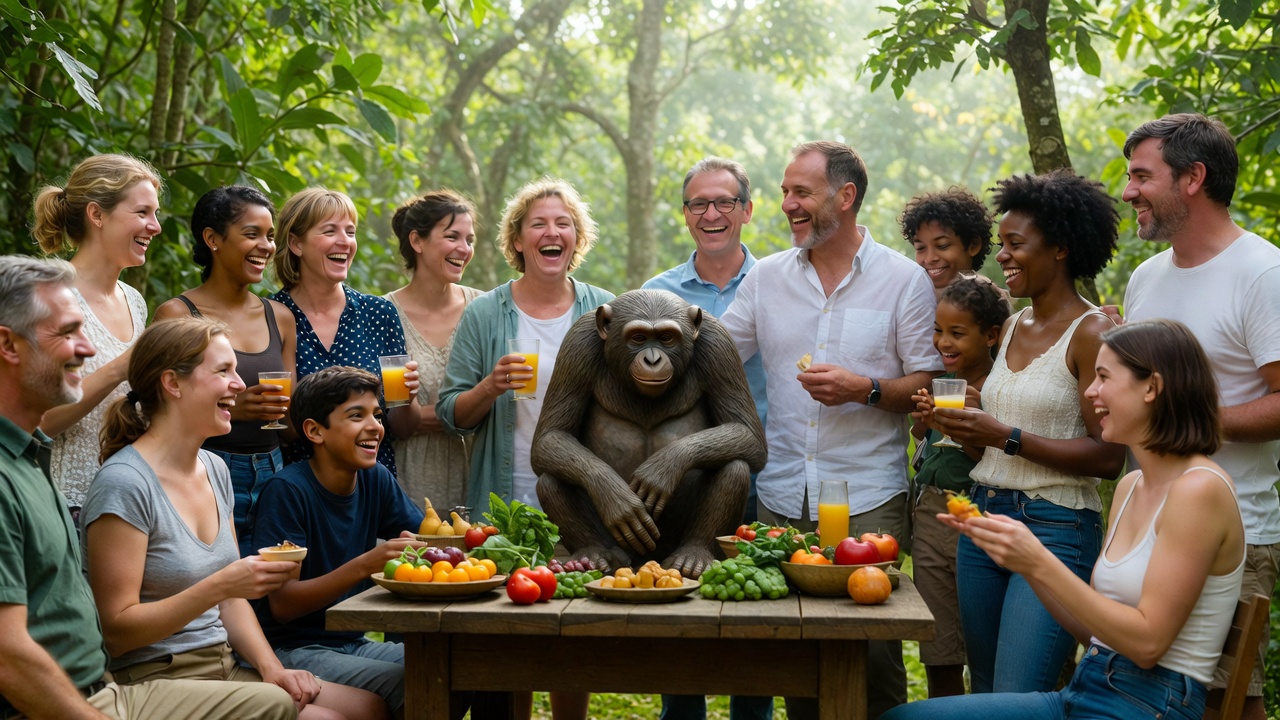
For families: Host a bonobo-themed party. Serve fruit — bonobos love it — and share fun facts about these incredible apes. Watch a wildlife documentary together. Many excellent films about bonobos are available on streaming platforms.
For schools: Use World Bonobo Day as a teaching opportunity. The Friends of Bonobos website offers educational resources and activities for children. Teachers can build lessons around topics like biodiversity, conservation, the Congo Basin ecosystem, and what bonobos teach us about empathy and cooperation.
For communities: Organize a fundraiser for a bonobo conservation organization. Hold a screening of a bonobo documentary. Set up an electronics recycling drive to reduce coltan demand. Invite a local zoo educator to give a presentation.
For individuals: Learn something new about bonobos today. Share what you learn. Make a donation, no matter how small. Choose sustainably sourced products. And remember: awareness is the first step toward action.
Frequently Asked Questions About Bonobos and World Bonobo Day 2026
Q: What is the difference between a bonobo and a chimpanzee?
Bonobos are slightly smaller and slimmer than chimpanzees, with longer legs and shorter arms. They have black faces with bright pink lips and hair that often falls with a natural middle part. Behaviorally, the differences are stark. Bonobos live in female-led societies and resolve conflict through social bonding. Chimpanzees live in male-dominated groups and are more prone to aggressive behavior.
Q: Are bonobos dangerous to humans?
Bonobos are generally not considered dangerous to humans. They are known for their peaceful temperament. However, like all great apes, they are powerful animals and should be treated with respect. Wild bonobos typically avoid human contact.
Q: How many bonobos are left in the wild in 2026?
Estimates range from 15,000 to 50,000, but exact numbers are uncertain. The population is fragmented and has been declining for at least three decades. All experts agree that urgent conservation action is needed.
Q: Can I see bonobos at a zoo?
Yes. A number of accredited zoos around the world house bonobos, including the Fort Worth Zoo, San Diego Zoo, Columbus Zoo, and several European zoos. Visiting bonobos at a zoo and supporting their conservation programs is a meaningful way to celebrate World Bonobo Day.
Q: Why was Kanzi the bonobo so famous?
Kanzi was the first nonhuman great ape known to understand spoken English. He communicated using more than 300 lexigram symbols, made stone tools, played video games, and participated in hundreds of scientific studies over his 44-year life. He died on March 18, 2025, and is widely regarded as one of the most important research subjects in the history of cognitive science.
Final Thoughts: This Valentine’s Day, Show Some Love for the World’s Most Peaceful Ape
This February 14, 2026, as you celebrate love in all its forms, take a moment to think about bonobos. Think about N’djili at Lola ya Bonobo, cradling her new baby after years of loss. Think about the park rangers in Salonga, risking their lives every day to protect these animals. Think about Kanzi, who taught the world that the gap between humans and other apes is far smaller than we imagined.
Bonobos are not just interesting animals. They are our relatives. They are living proof that cooperation, empathy, and peace are deeply woven into the fabric of life on Earth. And they need our help to survive.
Happy World Bonobo Day 2026. Let’s make it one that truly makes a difference.