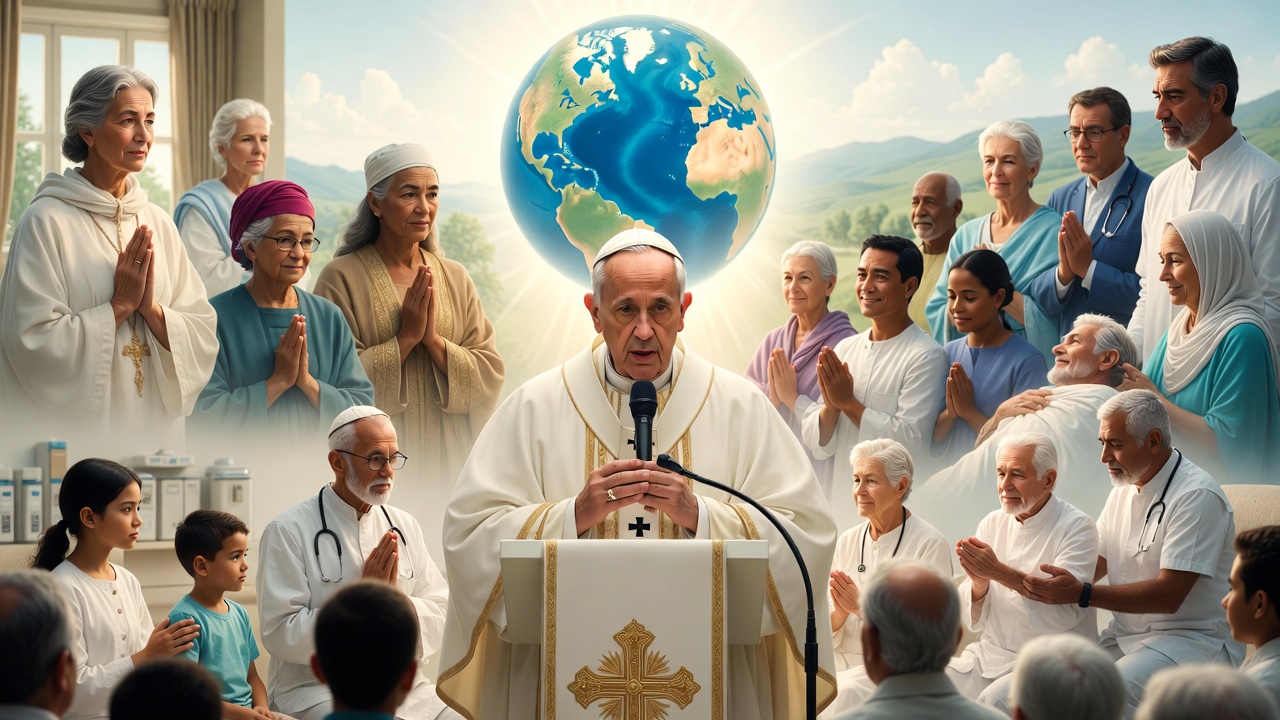
Every year on February 11, the Catholic Church and communities around the globe pause to remember those who suffer from illness. The 34th World Day of the Sick in 2026 carries special weight. It is the first under the leadership of Pope Leo XIV, the first American-born pontiff in the Church’s two-thousand-year history. His message — “The Compassion of the Samaritan: Loving by Bearing Another’s Pain” — calls on believers and non-believers alike to stop, draw near, and care for the suffering.
This year’s solemn celebration takes place not in Rome or Lourdes, but in Chiclayo, Peru, a city where Pope Leo XIV once served as bishop. The choice is deeply personal. It is also deeply symbolic. It ties this global day of prayer to the heart of Latin America, where faith, community, and solidarity with the sick run through everyday life like a river.
In this guide, we explore everything you need to know about the World Day of the Sick 2026. We cover Pope Leo XIV’s full message, the history of this observance, the connection to Our Lady of Lourdes, how different countries mark the day, and what the latest global health data tells us about the challenges ahead.
What Is the World Day of the Sick and Why Is It Celebrated on February 11?
The World Day of the Sick is an annual observance established by the Catholic Church. It falls on February 11 every year. The date is not random. It coincides with the Feast of Our Lady of Lourdes, which honors the first apparition of the Virgin Mary to a 14-year-old French girl named Bernadette Soubirous at the Grotto of Massabielle in 1858.
Pope Saint John Paul II created this observance on May 13, 1992. He wrote a letter to Cardinal Fiorenzo Angelini, who was then President of the Pontifical Council for the Pastoral Care of Health Care Workers. In that letter, he declared February 11 as a day devoted to prayer, reflection, and spiritual closeness to those who are sick.
The goals of the day are clear:
- Pray for those suffering from illness, disability, and pain.
- Recognize the dedication of healthcare workers, caregivers, and volunteers.
- Reflect on the moral duty of societies to ensure access to care.
- Encourage the Catholic faithful to see Christ in the faces of the sick.
Since 1993, every pope has issued a message for this day. Each message carries a unique theme. The solemn celebration rotates to a different location around the world each year. Past host sites have included Lourdes (France), Fatima (Portugal), Yaoundé (Cameroon), and Seoul (South Korea).
In 2026, the world turns its gaze to Chiclayo, Peru — and to the first papal message written by Pope Leo XIV.
Who Is Pope Leo XIV? The First American Pope and His Connection to Peru
Understanding the 2026 World Day of the Sick message requires knowing the man behind it. Pope Leo XIV, born Robert Francis Prevost on September 14, 1955, in Chicago, Illinois, is a figure of many firsts.
He is the first United States-born pope in the history of the Roman Catholic Church. He is the first pope from the Order of Saint Augustine. He is the second pope from the Americas, after Pope Francis, who hailed from Argentina. He holds dual citizenship in both the United States and Peru.
His path to the papacy was shaped by decades of missionary service. After earning a degree in mathematics from Villanova University in 1977, Prevost joined the Augustinian order. He was ordained a priest in 1982 in Rome, where he also completed a doctorate in canon law. His heart, however, was drawn to Latin America.
Starting in the mid-1980s, Prevost spent years doing missionary work in Peru. He served in Chulucanas and then in Trujillo, where he taught canon law, patristics, and moral theology. He served as a parish pastor, seminary professor, and judicial vicar. He led the global Augustinian order from Rome between 2001 and 2013.
In 2014, Pope Francis appointed him Apostolic Administrator of the Diocese of Chiclayo. He was named Bishop of Chiclayo in 2015. During his time there, he became a Peruvian citizen. He witnessed firsthand the struggles of the poor and the sick in northern Peru. He saw how families, neighbors, and healthcare workers — not just professionals, but ordinary people — offered compassion in the spirit of the Good Samaritan.
In 2023, Pope Francis called him to Rome to serve as Prefect of the Dicastery for Bishops. He was created a cardinal later that year. On May 8, 2025, after the death of Pope Francis on April 21, Robert Prevost was elected the 267th pope on the fourth ballot of the conclave. He chose the name Leo XIV, inspired by Pope Leo XIII, who championed workers’ rights and sought to modernize the Church.
His connection to Chiclayo makes the 2026 World Day of the Sick deeply personal. As he wrote in his message, his time as a missionary and bishop in Peru allowed him to witness many who showed “mercy and compassion in the spirit of the Samaritan and the innkeeper.”
Pope Leo XIV’s Message for World Day of the Sick 2026: Key Themes and Takeaways
Pope Leo XIV’s message for the 34th World Day of the Sick was signed on January 13, 2026, and publicly presented at the Holy See Press Office on January 20, 2026. The full title is:
“The Compassion of the Samaritan: Loving by Bearing Another’s Pain”
The message is grounded in the Parable of the Good Samaritan from the Gospel of Luke (10:25–37). It also draws from Pope Francis’s encyclical Fratelli Tutti and from Pope Leo XIV’s own apostolic exhortation, Dilexi Te, released in October 2025.
The Pope organizes his reflection around three central ideas:
1. The Joy of Offering Closeness and Presence
Pope Leo XIV highlights that the Samaritan did not “pass by” the wounded man. He stopped. He looked upon the man with what the Pope calls “the very gaze of Jesus — open and attentive.” This is the foundation: love is not passive. It requires the decision to act.
Being a neighbor, the Pope writes, is not defined by physical or social closeness. It is defined by the choice to love. Christians become neighbors to those who suffer by following the example of Christ, whom Leo describes as “the true divine Samaritan who drew near to a wounded humanity.”
2. The Shared Mission of Caring for the Sick
In his message, Pope Leo draws from personal experience. He writes:
“In my experience as a missionary and Bishop in Peru, I have personally witnessed many who show mercy and compassion in the spirit of the Samaritan and the innkeeper.”
He describes seeing this compassion in family members, neighbors, healthcare workers, pastoral care volunteers, and many others who stop along the way to “draw near, heal, support, and accompany those in need.” He points to the care of the sick not merely as an “important part” of the Church’s work but as an authentic “ecclesial action” — a central expression of what the Church is called to be.
He references Saint Cyprian, the third-century bishop, to argue that the way a society cares for its sick is a measure of that society’s moral health.
3. Driven by Love for God, to Encounter Ourselves and Our Neighbor
The final section ties the message to the double commandment: love God with all your heart, and love your neighbor as yourself (Luke 10:27). Pope Leo emphasizes that serving one’s neighbor is loving God through deeds. Compassion is not just an emotion. It is a concrete response. It “springs from within and leads to a committed response to another’s suffering.”
The Pope concludes by entrusting the journey to the Virgin Mary, Health of the Sick, asking for her intercession for all who are ill, their families, and their caregivers.
Why Was Chiclayo, Peru Chosen to Host the 2026 World Day of the Sick Celebration?
The solemn celebration of the 34th World Day of the Sick takes place from February 9 to 11, 2026, at the Shrine of Nuestra Señora de la Paz (Our Lady of Peace) in the Diocese of Chiclayo, Peru.
Cardinal Michael Czerny, S.J., Prefect of the Dicastery for Promoting Integral Human Development, was appointed by Pope Leo XIV as his special envoy to the celebration. At a Vatican press conference on January 20, 2026, Cardinal Czerny explained the reasoning behind the choice.
He offered a practical reason first: the organizing committee needed a location where February weather would be favorable. Chiclayo, located on Peru’s northern coast, fits that requirement. But the Cardinal called the choice a “happy coincidence” — because the city holds enormous spiritual meaning for Pope Leo XIV.
The Pope served as bishop in Chiclayo from 2015 to 2023. He walked its streets. He ministered to its sick. He held Peruvian citizenship. A statue of Pope Leo XIV has been erected in the city, and the local community regards him with deep affection.
Cardinal Czerny shared that he was moved to hear how the Pope himself “has been touched by the way the people of his diocese respond to suffering — not only the professionals, but everyone.” The celebration in Chiclayo is meant to reflect both the spiritual dimension of care for the ill and the active participation of an entire community.
Peru, a predominantly Catholic country, has a rich tradition of religious festivals that blend indigenous customs with Catholic devotion. The choice of Chiclayo connects the universal Church to Latin America’s deep culture of solidarity — a culture Pope Leo experienced personally during his decades of missionary work.
The History of Our Lady of Lourdes: Why Healing and Faith Are Inseparable on This Day
The World Day of the Sick cannot be understood apart from the story of Lourdes, France. The connection between February 11, the sick, and the Virgin Mary runs through the very DNA of this observance.
On February 11, 1858, a 14-year-old girl named Bernadette Soubirous went to collect firewood near the Grotto of Massabielle, along the banks of the Gave de Pau river. She came from a desperately poor family. She herself was a sickly child, prone to asthma and other ailments. While removing her stockings to wade across the water, she heard what she described as a sound “like a gust of wind.” She looked up and saw a figure — a young woman dressed in white, wearing a white veil, a blue sash, and a yellow rose on each foot.
This was the first of 18 apparitions that would take place between February and July of 1858. During one of the apparitions, the lady told Bernadette to dig in the ground. A spring of water appeared. During another, the lady identified herself with words that shook the theological world: “I am the Immaculate Conception.” Bernadette, uneducated and unfamiliar with the dogma that Pope Pius IX had defined only four years earlier, could not have known the significance of that phrase.
Church authorities investigated. In 1862, the Bishop of Tarbes declared the visions authentic. A basilica was built at the site. Pilgrims began arriving — first from nearby French towns, then from across Europe, and eventually from every continent.
Today, Lourdes welcomes approximately 5 million visitors each year, making it one of the most visited pilgrimage sites in the Christian world. The Sanctuary covers 50 hectares and includes the Grotto of Massabielle, three basilicas, chapels, fountains of Lourdes water, bathing pools, and residences for sick and disabled pilgrims.
Since 1858, the Catholic Church has officially recognized 72 miraculous healings at Lourdes, as of April 2025. The International Medical Committee of Lourdes, a group of roughly 20 physicians, has certified an additional 2,000 inexplicable cures. Cures are examined through a rigorous scientific process that can take years.
But physical healings are only part of the story. Research published in the International Journal of Environmental Research and Public Health found that 67.6% of “sick pilgrims” reported their self-rated quality of life as “much better” or “better” immediately after returning from Lourdes. The factors with the most impact were “spiritual and religious aspects of pilgrimage,” “a sense of togetherness,” and “spiritual healing.”
It is this intersection of faith, community, and care for the sick that led John Paul II to choose February 11 as the World Day of the Sick. The Lourdes shrine is, above all, a place where the sick come first.
How Different Countries and Cultures Honor the World Day of the Sick: Global Traditions
The World Day of the Sick is observed primarily within Catholic communities, but its themes of compassion, care, and solidarity resonate across cultures and faiths. Here is how different parts of the world mark this day.
France: Torchlight Processions at the Lourdes Sanctuary
The heart of this day’s global observance beats in Lourdes. Even when the solemn celebration takes place elsewhere, Lourdes remains a spiritual anchor. On February 11 each year, the Sanctuary holds a full program of events. An International Mass is presided over by the Bishop of Tarbes-Lourdes. Pilgrims gather at the Grotto for the Angelus prayer and an evocation of the first apparition. In the afternoon, they can participate in the water gesture — touching or drinking from the spring. The evening before, a Marian torchlight procession fills the sanctuary grounds as pilgrims carry candles and sing the Ave Maria of Lourdes.
Starting in 2026, the Sanctuary of Lourdes has opened a new three-year spiritual journey based on the Gospel of Luke. The 2026 theme is the Annunciation: “Hail, full of grace, the Lord is with you” (Luke 1:28). This year of “welcome, listening, and the ‘yes’ that changed everything” adds another layer of meaning to the February 11 observance.
Italy: Pilgrimages to Marian Shrines and the Anointing of the Sick
Italy, as the seat of the Vatican, holds the World Day of the Sick with particular devotion. Parishes across the country celebrate special Masses for the sick, during which the Sacrament of the Anointing of the Sick is offered. This sacrament, once known as “Last Rites” or “Extreme Unction,” is now understood as a sacrament of healing and comfort available to anyone facing serious illness — not only the dying.
Catholic hospitals and care facilities organized by groups like Caritas hold prayer services and community gatherings. The Bambino Gesù Hospital in Rome — one of Europe’s largest pediatric hospitals — marks the day with special activities for young patients and their families. Casa Gelsomino, a facility near the hospital that welcomes families of hospitalized children, is regularly highlighted in the day’s Vatican programming.
Peru: Community Solidarity and the 2026 Solemn Celebration in Chiclayo
Peru’s Catholic culture runs deep. As a predominantly Catholic nation where roughly 75% of the population identifies as Roman Catholic, religious observances are woven into everyday life. The February 9–11 celebration in Chiclayo in 2026 is a milestone moment for the country.
Peruvians are accustomed to large-scale religious festivals that mix Catholic liturgy with indigenous traditions. The Fiesta de la Virgen de la Candelaria in Puno, held in early February, is one of the largest religious festivals in South America. While the World Day of the Sick is a quieter, more reflective observance, it taps into the same deep current of Peruvian faith.
In Chiclayo, the celebration at the Shrine of Nuestra Señora de la Paz includes Mass, prayer services, pastoral activities for the sick and their families, and a public witness of faith. Thousands of locals crowded the city square for Masses of Thanksgiving when Pope Leo XIV was elected. Similar enthusiasm is expected for the 2026 World Day of the Sick, now that the universal Church has turned its eyes to this northern coastal city.
The Philippines: Novenas, Prayers, and Parish-Level Devotion
The Philippines is home to one of the world’s largest Catholic populations. More than 80% of Filipinos identify as Catholic. Devotion to the Virgin Mary is deeply embedded in Filipino spiritual life. Churches dedicated to Our Lady of Lourdes hold special novenas (nine days of prayer), prayer vigils, and community Masses on and around February 11.
Filipino Catholic culture places a strong emphasis on communal prayer for the sick. It is common for extended families and entire neighborhoods to organize prayer chains for ailing members of the community. Parish priests conduct home visits to administer the Anointing of the Sick to those who cannot travel to church. The feast day connects with the Filipino value of “damayan” — the practice of accompanying others in their time of need.
The United States: Hospital Ministry and Catholic Health Systems
In the United States, the World Day of the Sick is observed across the country’s extensive network of Catholic hospitals and health systems. The Catholic Church operates one of the largest private healthcare networks in the nation. Organizations such as the Catholic Health Association use February 11 as an occasion to reflect on their mission of care.
Parishes hold Masses with the Anointing of the Sick. Catholic schools organize awareness campaigns about visiting the homebound and elderly. In cities with large Catholic populations — Chicago, Boston, New York, Los Angeles, San Antonio — the day takes on added significance, especially in 2026, given that the pope is a native son of Chicago.
Since Pope Leo XIV’s election, Catholic parishes in the greater Chicago area have shown heightened engagement with papal initiatives. The 2026 World Day of the Sick, with its message rooted in the Pope’s personal missionary experience, is expected to draw strong participation across American parishes.
Latin America: A Continent-Wide Culture of Solidarity with the Sick
Across Mexico, Colombia, Brazil, Argentina, and other Latin American nations, the World Day of the Sick resonates with a broader cultural ethos of solidarity. The concept of “acompañamiento” — walking alongside those who suffer — is central to Latin American Catholicism.
In many communities, parish groups organize visits to hospitals and nursing homes, bring meals and supplies to sick neighbors, and hold public prayers in town squares. The influence of Liberation Theology, which emphasizes the Church’s obligation to the poor and marginalized, has shaped how Latin American Catholics approach healthcare, justice, and compassion.
Pope Leo XIV’s apostolic exhortation Dilexi Te, released in October 2025, explicitly draws on this Latin American tradition. In the exhortation, he recalls the Church’s “preferential option for the poor” — a concept that arose from the Latin American episcopal conferences of Medellín (1968), Puebla (1979), and Aparecida (2007). The 2026 World Day of the Sick celebration in Chiclayo embodies this tradition in a concrete, visible way.
A Complete Timeline: The History of the World Day of the Sick from 1993 to 2026
The following table provides a quick reference to the history of this observance, including key themes and host locations.
| Year | Edition | Theme Highlights | Notable Host / Event |
|---|---|---|---|
| 1993 | 1st | Inaugural observance | Lourdes, France |
| 2000 | 8th | Jubilee Year celebration | Rome, Italy |
| 2005 | 13th | Christ’s compassion for the sick | Yaoundé, Cameroon |
| 2013 | 21st | “Go and do likewise” (Lk 10:37) | Altötting, Germany |
| 2015 | 23rd | Wisdom of the heart | Global observances |
| 2018 | 26th | Mater Ecclesiae (Mother Church) | Global observances |
| 2020 | 28th | “Come to me, all you who labor” | Global (during COVID-19) |
| 2024 | 32nd | “It is not good that man should be alone” | Global observances |
| 2025 | 33rd | Final message of Pope Francis | Global (Jubilee Year) |
| 2026 | 34th | “The Compassion of the Samaritan” | Chiclayo, Peru |
Global Health in 2026: Why the World Day of the Sick Matters More Than Ever
Pope Leo XIV’s message does not exist in a vacuum. The call to compassion arrives at a moment when global health systems face enormous challenges.
The WHO–World Bank UHC Global Monitoring Report 2025, released in December 2025, paints a mixed picture. Health service coverage, measured by the Service Coverage Index, rose from 54 to 71 points (out of 100) between 2000 and 2023. The share of people facing financial hardship from out-of-pocket health payments declined from 34% to 26% between 2000 and 2022.
But the numbers behind the progress are sobering:
- 4.6 billion people worldwide still lack access to essential health services.
- 2.1 billion people experience financial hardship to access health care.
- 1.6 billion people are pushed into poverty or pushed deeper into it because of health expenses.
- The global progress rate has slowed since 2015. Only one-third of countries improved in both increasing health coverage and reducing financial hardship.
- The global Service Coverage Index is projected to reach only 74 out of 100 by 2030 — falling short of universal health coverage goals.
These numbers give urgency to the World Day of the Sick’s call for compassion. When Pope Leo XIV speaks of the Samaritan who stopped for the wounded man on the road, the parallel is hard to miss. Billions of people around the world are, in a sense, “lying by the roadside” — waiting for healthcare systems, governments, and fellow human beings to stop and help.
Low-income countries have made the fastest gains in health coverage but still face the largest gaps. Progress has been driven largely by infectious disease programs. Coverage for noncommunicable diseases — cancer, diabetes, cardiovascular disease, mental illness — has lagged behind. Gains in reproductive, maternal, newborn, and child health have stalled in recent years.
The Pope’s message and the WHO’s data tell the same story from different angles: the measure of a society’s health is how it treats its most vulnerable members.
The Parable of the Good Samaritan: Why Pope Leo XIV Chose This Theme for 2026
The Parable of the Good Samaritan (Luke 10:25–37) is one of the most widely known stories in Western civilization. It has shaped moral philosophy, legal theory, and public health ethics for two thousand years. Pope Leo XIV’s decision to place it at the center of his 2026 message is both traditional and timely.
In the parable, a man traveling from Jerusalem to Jericho is attacked by robbers and left for dead. A priest and a Levite — both religious figures — see the man and pass by on the other side of the road. Then a Samaritan — a member of a group despised by the Jewish community of the time — stops. He bandages the man’s wounds. He takes him to an inn. He pays for his care. He promises to return and cover any additional costs.
Jesus tells this story in response to a simple question: “Who is my neighbor?” The answer, delivered through the parable, is revolutionary. Your neighbor is not defined by ethnicity, religion, social status, or geography. Your neighbor is anyone who needs you. And you become a neighbor through the decision to act.
Pope Leo XIV chose to read this parable through the lens of Pope Francis’s encyclical Fratelli Tutti (2020). In that document, Francis devoted an entire chapter to the Good Samaritan, arguing that the parable challenges us to ask not “Who is my neighbor?” but rather “Am I a neighbor to others?”
For Pope Leo, the Samaritan’s compassion is not just a feeling. It is, as he writes, “a profound emotion that compels us to act” — one that “springs from within and leads to a committed response to another’s suffering.” This distinction matters. In a world overwhelmed by information about suffering — through news feeds, social media, and global health reports — it is easy to feel compassion without acting on it. The Pope’s message pushes back against that passive compassion.
The choice of this parable also connects to Pope Leo XIV’s first major teaching document, the apostolic exhortation Dilexi Te (“I Have Loved You”), released on October 9, 2025. In that document, the Pope emphasized the “close connection between Christ’s love and his summons to care for the poor.” He described care for the sick not as charity alone but as a fundamental expression of Christian identity — one exemplified by saints like Camillus de Lellis (patron of the sick), John of God (patron of hospitals), and Teresa of Calcutta.
How to Observe World Day of the Sick 2026: Practical Ways to Participate
Whether you are a devout Catholic, a member of another faith, or a person of no religious affiliation, the World Day of the Sick offers practical ways to engage.
For individuals:
- Visit someone who is ill. Call a sick neighbor, family member, or friend. Bring a meal. Sit with them. The Pope’s message reminds us that presence itself is a form of love.
- Volunteer at a hospital or care facility. Many Catholic hospitals and parish-based ministries welcome volunteers, especially around February 11.
- Pray for the sick. Catholic tradition includes the Rosary, the Litany of the Sick, and the Prayer to Our Lady of Lourdes. Prayers can be offered at home, in church, or through online communities.
- Donate to healthcare charities. Organizations like Caritas Internationalis, Catholic Relief Services, and Médecins Sans Frontières work directly with sick and vulnerable populations worldwide.
For parishes and faith communities:
- Celebrate a special Mass with the Anointing of the Sick. The Dicastery for Promoting Integral Human Development has produced liturgical guides, homily suggestions, and prayer resources specifically for the 2026 celebration.
- Organize a parish visitation program. Assign volunteers to visit homebound parishioners, especially the elderly and chronically ill.
- Host an awareness event. Use the Pope’s message as a starting point for a community discussion about healthcare access, loneliness among the sick, and the ethics of care.
For healthcare professionals:
- Reflect on your vocation. Pope Leo XIV describes care for the sick as an “ecclesial action.” For Catholic healthcare workers, February 11 is a day to reconnect with the spiritual dimension of their work.
- Advocate for equitable access. Cardinal Czerny, speaking at the Vatican press conference, noted that pastoral visits to the sick often reveal “the injustice of inaccessibility to health care.” He encouraged turning that experience into advocacy.
The Role of the Anointing of the Sick: A Sacrament of Healing and Hope
One of the most visible liturgical elements of the World Day of the Sick is the administration of the Sacrament of the Anointing of the Sick. This is one of the seven sacraments of the Catholic Church. It is offered to those who are seriously ill, preparing for surgery, elderly and experiencing the fragility of age, or facing chronic conditions.
The sacrament involves the laying on of hands by a priest, prayer over the sick person, and anointing with the Oil of the Sick (blessed olive oil) on the forehead and hands. The words of the prayer ask God to save the person and raise them up. The sacrament is understood to offer spiritual healing, strength, peace, and courage. In some cases, the Church teaches, it can also contribute to physical healing — if that is God’s will.
For centuries, this sacrament was known as “Extreme Unction” or “Last Rites” and was typically administered only to the dying. The Second Vatican Council (1962–1965) reformed this understanding. The sacrament was renamed and reframed as a sacrament for any serious illness, not only imminent death. This shift was significant. It transformed the Anointing of the Sick from a farewell sacrament into a sacrament of hope, healing, and accompaniment.
On the World Day of the Sick, parishes worldwide offer this sacrament during special Masses. Lines form as the elderly, the chronically ill, those with cancer, heart disease, depression, and other conditions come forward. For many, it is a moment of profound spiritual comfort — a tangible sign that they are not alone.
Pope Leo XIV’s Apostolic Exhortation Dilexi Te and Its Connection to the World Day of the Sick
To fully appreciate the 2026 World Day of the Sick message, it helps to understand the broader theological vision Pope Leo XIV has articulated since taking office.
His apostolic exhortation Dilexi Te (“I Have Loved You”), signed on October 4, 2025 — the Feast of Saint Francis of Assisi — and published on October 9, is his first major teaching document. It builds on Pope Francis’s final encyclical, Dilexit Nos (“He Loved Us”), which explored the Sacred Heart of Jesus. Where Francis focused on the love of Christ, Leo extended that love toward its most concrete expression: love for the poor and the sick.
Dilexi Te spans 121 numbered paragraphs across five chapters. It names more than 33 saints as examples of holiness in care for the poor, the sick, the imprisoned, and the migrant. It draws from 150 years of Catholic social teaching, from Leo XIII’s Rerum Novarum (1891) to Benedict XVI’s Caritas in Veritate (2009).
Key passages relevant to the World Day of the Sick include:
- Pope Leo describes care for the sick as one of “the highest forms of evangelical life” when carried out through genuine presence and shared suffering.
- He highlights the work of the Camillians — a Catholic religious order dedicated to the care of the sick — and of women’s religious congregations who have served in hospitals and nursing homes for centuries.
- He insists that poverty is a “structural reality” and that healthcare access is a justice issue, not merely a matter of charity.
- He quotes Saint Cyprian to argue that how a society treats its sick reveals the health of that society’s soul.
In his World Day of the Sick message, Pope Leo explicitly references Dilexi Te, describing care for the sick as an “ecclesial action” — not optional kindness, but a core expression of what the Church is meant to be.
Lourdes in 2026: A New Three-Year Spiritual Journey Begins at the Sanctuary
Even as the solemn celebration takes place in Chiclayo, Lourdes remains the spiritual home of the World Day of the Sick. In 2026, the Sanctuary of Our Lady of Lourdes is embarking on a new chapter.
Starting this year, the Sanctuary has launched a three-year spiritual journey based on the Gospel of Luke. Each year will focus on a different theme drawn from the life of the Virgin Mary.
The 2026 theme is the Annunciation: “Hail, full of grace, the Lord is with you” (Luke 1:28). It is a year of welcome, listening, and saying “yes.” This pairs naturally with the World Day of the Sick’s message of compassion and encounter.
The Sanctuary continues to attract millions of visitors annually. The pilgrimage season runs from Easter to the end of October, but the February 11 feast day draws pilgrims year-round. Key activities at the Sanctuary on February 11, 2026, include:
- International Mass at the Rosary Basilica
- Angelus prayer at the Grotto
- The water gesture — touching or drinking from Bernadette’s spring
- Rosary at the Grotto
- Eucharistic praise and blessing of the sick
- Torchlight Marian procession the evening before
For those unable to travel to Lourdes, the Our Lady of Lourdes Hospitality North American Volunteers and similar organizations arrange virtual and local pilgrimage experiences at parishes around the world. In the Diocese of Phoenix, Arizona, for example, local pilgrimages to parishes are being held throughout February 2026 to bring the Lourdes experience to those who cannot travel abroad.
Pastoral Resources for the 34th World Day of the Sick: What the Vatican Has Prepared
The Dicastery for Promoting Integral Human Development has produced a range of pastoral resources to support the global celebration of the 2026 World Day of the Sick. These resources are designed for use in parishes, hospitals, schools, and faith communities worldwide.
Available materials include:
- A liturgical guide with readings, prayers, and hymn suggestions for the February 11 Mass.
- Homily suggestions based on the Pope’s message and the parable of the Good Samaritan.
- Prayer intentions for the sick, their families, healthcare workers, and caregivers.
- Activities for young people, children, and adults — designed to teach the values of compassion, solidarity, and care.
- The full text of Pope Leo XIV’s message in multiple languages.
These resources are available through the Dicastery’s website and through national bishops’ conferences. The USCCB (United States Conference of Catholic Bishops) and the CBCEW (Catholic Bishops’ Conference of England and Wales) have both promoted the materials to parishes across their respective countries.
The Connection Between Faith and Healing: What Science Tells Us About Spiritual Care
The relationship between faith and health is a subject of growing scientific interest. While no one claims that prayer alone cures disease, a body of research suggests that spiritual care, community support, and a sense of meaning can meaningfully affect patient outcomes and quality of life.
Key findings include:
- A study published in PLOS ONE examining Lourdes pilgrimage found that 67.6% of sick pilgrims reported improved quality of life immediately after their pilgrimage, with improvement sustained in 54.7% two months later. The most beneficial factors were spiritual engagement and a “sense of togetherness.”
- The World Health Organization recognizes that spiritual care is an important component of palliative care, which aims to improve quality of life for patients facing life-threatening illness.
- Multiple studies have shown that social isolation worsens health outcomes for the chronically ill. Cardinal Czerny, in his January 2026 remarks, noted: “Since the major suffering for so many today, young and not so young, is loneliness and hopelessness, by worrying about it less and reaching out to someone who needs you, you will discover that there’s more life than you imagined.”
The World Day of the Sick sits at this intersection of faith and evidence. Its call to visit the sick, to be present, and to accompany those who suffer is not only a theological imperative. It is also, increasingly, a public health strategy.
Frequently Asked Questions About World Day of the Sick 2026
When is World Day of the Sick 2026? February 11, 2026. The solemn celebration in Chiclayo, Peru, runs from February 9 to 11.
What is the theme for 2026? “The Compassion of the Samaritan: Loving by Bearing Another’s Pain.”
Who wrote the 2026 message? Pope Leo XIV (born Robert Francis Prevost), the 267th pope and the first American-born pontiff.
Where is the solemn celebration held? At the Shrine of Nuestra Señora de la Paz in the Diocese of Chiclayo, Peru.
Who is the Pope’s envoy to Chiclayo? Cardinal Michael Czerny, S.J., Prefect of the Dicastery for Promoting Integral Human Development.
Is this day only for Catholics? While the World Day of the Sick is a Catholic observance, its themes of compassion and care for the ill are universal. People of all faiths and backgrounds are welcome to participate.
How can I read the Pope’s full message? The message is available on the Vatican News website and through the Dicastery for Promoting Integral Human Development.
Looking Ahead: What the World Day of the Sick Means in Pope Leo XIV’s Pontificate
The 2026 World Day of the Sick is more than an annual observance. It is a window into the priorities of Pope Leo XIV’s young pontificate.
In less than a year since his election on May 8, 2025, Leo XIV has established a clear trajectory. His first apostolic exhortation, Dilexi Te, placed love for the poor and the sick at the center of the Church’s mission. His choice of Chiclayo as the 2026 celebration site connects the universal Church to the grassroots communities where he witnessed compassion firsthand. His message on the Good Samaritan is not abstract theology. It is a call to action rooted in personal experience.
Cardinal Czerny captured this well at the Vatican press conference: “By responding to someone who needs you, in a sense, your own suffering is also addressed.” The World Day of the Sick is an invitation — not only to care for others, but to discover, through that care, a deeper sense of purpose and connection.
As the faithful in Chiclayo gather at the Shrine of Our Lady of Peace, as pilgrims light candles in the Grotto of Massabielle, as parish priests administer the Anointing of the Sick in churches from Manila to Chicago, as volunteers visit the homebound and the lonely — the 34th World Day of the Sick carries a simple, powerful message.
Stop. Look. Draw near. And love by bearing another’s pain.