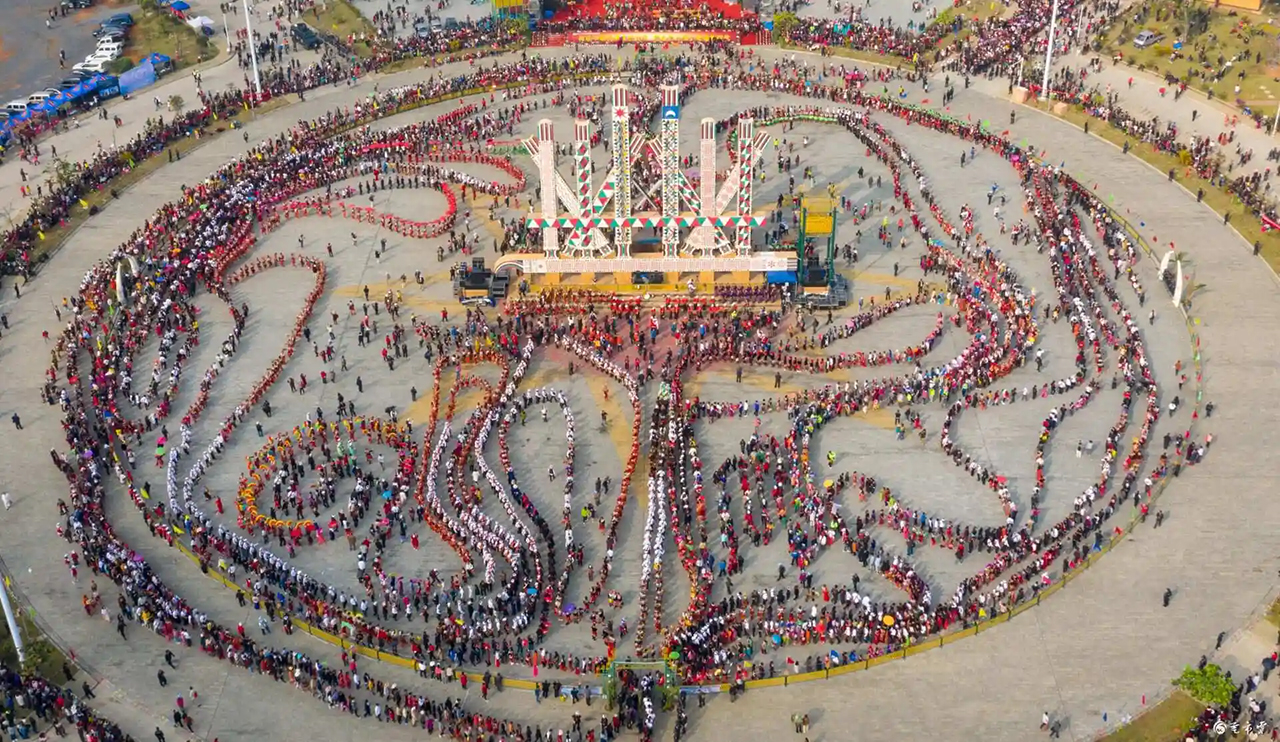
Deep in the mist-wrapped mountains of southwestern China, where Yunnan Province meets the border of Myanmar, there is a dance so powerful that it brings tens of thousands of people together in a single, pulsing rhythm. The ground trembles with footsteps. Gongs shake the air. Silver ornaments flash like lightning. This is Munao Zongge — the grandest festival of the Jingpo people, and one of the most extraordinary mass dances on the planet.
If you have never heard of Munao Zongge, you are not alone. This festival rarely appears in mainstream travel guides. But among the ethnic communities of Dehong Dai and Jingpo Autonomous Prefecture, it is the single most important event of the year. It is a prayer for good harvests. It is a celebration of survival. It is a living museum of migration, mythology, and identity — performed not on a stage, but in the dust and sunlight of a communal square where everyone, from toddlers to elders, dances as one.
This guide will take you deep into the heart of Munao Zongge. We will explore its origins, decode its symbolism, walk through every ritual, and give you the practical details you need to experience it firsthand. Whether you are a cultural traveler, a festival enthusiast, or simply curious about the traditions that hold communities together, this is the most complete English-language resource you will find.
What Is Munao Zongge and Why Is It Celebrated Every Year?
Munao Zongge (目瑙纵歌) is the grandest traditional festival of the Jingpo ethnic group. The name comes from the Jingpo and Zaiwa languages. It translates roughly to “dancing together” or “singing and dancing in mass.” Some scholars also translate it as “dance of paradise.”
The festival is not simply a performance. It is a communal ritual that has been practiced for centuries. Its roots stretch back to the primitive society age of the Jingpo people, when religious ceremonies centered on spirit worship and prayers for protection. Over time, it evolved into the defining cultural event of an entire ethnic group.
Munao Zongge was historically held for many occasions. These included celebrations before and after battles, harvest thanksgivings, the completion of new homes, weddings, and the welcoming of honored guests. Today, the annual festival typically takes place around the 15th day of the first month on the Chinese lunar calendar, which falls near the Lantern Festival. The celebration lasts three to seven days, depending on the location.
In 2006, Munao Zongge was officially added to China’s National Intangible Cultural Heritage List. This recognition confirmed what the Jingpo people have always known: this festival is not just entertainment. It is the beating heart of their culture.
Key facts at a glance:
| Detail | Information |
|---|---|
| Festival name | Munao Zongge (目瑙纵歌) |
| Meaning | “Dancing together” / “Dance of paradise” |
| Ethnic group | Jingpo (known as Kachin in Myanmar, Singpho in India) |
| Main location | Longchuan County, Dehong Prefecture, Yunnan Province, China |
| Typical dates | 15th–19th day of the first lunar month (usually February) |
| Duration | 3–7 days |
| Heritage status | China’s National Intangible Cultural Heritage (2006) |
| Attendance | Tens of thousands; over 200,000 tourists in peak years |
Who Are the Jingpo People? A Brief History of the Dance’s Creators
To understand Munao Zongge, you must first understand the people who created it. The Jingpo (景颇族) are a Tibeto-Burman ethnic group with a remarkable history of migration and resilience. They are not confined to a single country. They live across three nations: China, Myanmar, and India.
In China, they are called Jingpo. In Myanmar, they are the largest subgroup of the Kachin peoples. In the far northeast of India, they are known as the Singpho. Despite these different names, they share a common language family, a common ancestral homeland, and a common love of dance.
Origins on the Tibetan Plateau
The ancestors of the Jingpo people trace their roots to the Qinghai-Tibet Plateau. Their oral histories speak of a frigid homeland called Nojoi Shingra Bum, meaning “natural mesa” in the Jingpo language. Snow covered the ground all year. Growing food was nearly impossible. Driven by the need for survival, the Jingpo began a slow, centuries-long migration southward.
They followed the great rivers — the Lancang (Mekong), the Jinsha (Yangtze), and the Irrawaddy — moving gradually into what is now western Yunnan. Historical records from the Tang Dynasty (618–907 CE) mention the Jingpo under the name “Xunchuan.” By the 15th and 16th centuries, large numbers had settled in the Dehong area, where they remain today.
The Jingpo in Dehong Today
According to China’s 2020 national census, the Jingpo population in China stands at approximately 147,828. The vast majority live in the Dehong Dai and Jingpo Autonomous Prefecture, a subtropical region in western Yunnan that shares a 503.8-kilometer border with Myanmar. The prefecture was established in 1953 and remains one of the most ethnically diverse corners of China, home to the Dai, Jingpo, Achang, De’ang, and Lisu peoples.
Longchuan County within Dehong is considered the “hometown of Munao Zongge.” It has the largest concentration of Jingpo people in China — roughly one-third of the ethnic group’s total Chinese population — and the most complete and standardized tradition of the festival.
The Jingpo are mountain dwellers by heritage. Most villages sit on forested slopes between 1,470 and 1,980 meters above sea level. Their traditional houses are two-story structures built from wood and bamboo, with storage and livestock on the ground floor and living quarters above. They are farmers, growing rice in terraced paddies and an array of crops including maize, buckwheat, and vegetables in household gardens.
But what truly sets the Jingpo apart, in the eyes of the wider world, is their love of dance. And no dance captures that spirit more fully than Munao Zongge.
The Legend Behind the Munao Zongge Festival Origin Story
Every great festival has an origin story. Munao Zongge has several, but the most widely told is a tale of courage, divine intervention, and communal celebration.
The Legend of the Sun Palace
In ancient times, the Jingpo believed that only the children of the Sun could perform the Munao dance. According to the legend, the King of the Sun once hosted a grand carnival in his palace in the sky. He invited all of the Earth’s creatures to attend. The birds were the first to arrive. They watched the celestial dances, memorized the steps, and carried them back to Earth. The peacock and the toucan, in particular, became the dance’s earthly teachers.
Humans observed the birds dancing in the forest. They learned the movements, adapted them, and began holding their own Munao celebrations. This is why carvings of a toucan and a peacock appear on the crossbeams of the sacred Munao pillars at every festival. They honor the birds that first brought the dance from heaven to Earth.
The Legend of the Hero Leipan
A second, equally powerful legend tells of a time when a devil terrorized the Jingpo people, feeding on children and destroying villages. A brave man named Leipan rose to lead his people to safety. With the aid of the Sun God, Leipan defeated the devil. The Jingpo people held a great singing and dancing gathering — a Munao — to celebrate his victory. This tradition has continued ever since.
These stories are not mere fairy tales. They encode core Jingpo values: bravery, community solidarity, reverence for nature, and the belief that joy and dance have the power to heal. Every time the Jingpo people gather to perform Munao Zongge, they reenact these legends. They dance as their ancestors danced. They celebrate survival itself.
How the Munao Zongge Dance Festival Works: A Step-by-Step Guide
Munao Zongge is not a casual gathering. It follows a carefully structured sequence of rituals, each with deep symbolic meaning. Here is what happens from start to finish.
Step 1: Preparing the Munao Square
Before the festival begins, the community prepares a large open square. At its center stand four tall wooden pillars, the sacred Munao Poles (also called Munao Shidong). These pillars are the most important visual symbols of the festival. They are elaborately decorated with painted patterns that carry specific meanings.
The patterns on the Munao Poles include:
- Ferns — Fern sprouts resemble clenched fists. Their leaves look like arrows pointing in formation. They symbolize unity and progress.
- Swords — They represent bravery and strength of character.
- The Himalayas — A horizontal board at the top of the poles bears an image of the Himalayan mountains, the legendary ancestral homeland of the Jingpo.
- Crops and livestock — These represent the pursuit of a prosperous life.
- Gongs and musical instruments — They symbolize good fortune and celebration.
- The sun, mountains, and winding roads — These tell the story of the Jingpo migration from the Tibetan Plateau to their present homeland.
A living bamboo pole is also erected in front of the wooden pillars. It symbolizes the evergreen tree of life — a reminder that the Jingpo spirit endures across generations.
Bamboo fences with two doors surround the square. Their purpose is both practical and spiritual: they keep out unwanted animals and ward off evil spirits.
Step 2: The Crowning of the Lead Dancers
The festival begins with cannon salutes and the exchange of wine and gifts. Then comes one of the most important rituals: the crowning of the Naoshuang (lead ritual dancers) and the Naoba (crowd dance directors).
There are four Naoshuang, and they hold enormous cultural authority. They are typically village elders or spiritual leaders. During the dance, they wear crest-shaped hats, robes of red and green silk, and silver-colored cloaks. Each carries a long broad sword. The Naoshuang stand in two columns. The front pair is called the “military pair,” and the rear pair is the “civil pair.”
The Naoshuang lead the dance according to the patterns on the Munao pillars. The Naoba, meanwhile, direct the crowd with lively, free-flowing movements. Their role is to guide — not to perform. The real dancers are everyone else.
Step 3: The Mass Dance Begins
Once the lead dancers take their positions, the mass dance begins. This is the heart of Munao Zongge.
Thousands of people step into the square. Men carry long knives or swords. Women wave fans and handkerchiefs. Everyone follows the beat of enormous traditional drums and gongs. The rhythm is insistent, powerful, and deeply physical. You feel it in your chest before you hear it with your ears.
The dancers move in long, snaking lines, following the Naoshuang around the Munao pillars. The patterns of the dance mirror the patterns on the poles — spirals, zigzags, and winding paths that symbolize the Jingpo people’s long journey of migration.
Each dance session lasts approximately two hours. In a typical festival, there are four sessions spread over multiple days. There is no limit on who can join. Visitors, tourists, and people from other ethnic groups are welcome to step into the line at any time.
Step 4: Music, Feasting, and Community
Between dance sessions, the festival overflows with other activities. There are sword dances performed by men, showcasing martial skill and physical courage. There is the Yinpao dance, a graceful performance that highlights the beauty and elegance of Jingpo women. There are songs that express reverence for the mountains and rivers that sustain the community.
Food is central. The Jingpo are known for their bold, spicy cuisine. Festival dishes often include sour soup fish, grilled meats, sticky rice, and an array of wild herbs and vegetables gathered from the surrounding forests. Sharing food is an act of community bonding, as important as the dance itself.
The 12 Types of Munao Zongge Dance You Should Know About
Most visitors see only the grand annual festival. But Munao Zongge is not a single dance. There are 12 distinct types, each performed for a specific occasion. Understanding these types gives you a much deeper appreciation for the tradition.
| Type | Jingpo Name | Purpose |
|---|---|---|
| Harvest Celebration | Su Munao (苏目瑙) | To give thanks for a good harvest |
| Victory Celebration | Ba Dang Munao (巴当木脑) | To celebrate a military or communal victory |
| New Home Celebration | Dingshuan Munao (定栓目瑙) | To bless the completion of a new house |
| War Vow Dance | Deru Munao (德如目瑙) | To make vows before going to war |
| Foundation Laying | Tingre Munao (亭热目瑙) | To celebrate the selection and laying of a new site |
| Recreation | Naosai Munao (瑙赛目瑙) | For general fun and entertainment |
| Marriage Celebration | Kenran Munao (肯然目瑙) | To celebrate a wedding |
| Friendship Dance | Tingran Munao (亭然目瑙) | To make or honor friendships |
| Welcome Guests | Kelong Munao (克龙目瑙) | To welcome honored visitors |
| Divorce Farewell | Gongran Munao (宫然目瑙) | To mark the respectful separation of a couple |
| Funeral and Sacrifice | Zhu Munao (朱目瑙) | For funerals and spiritual sacrifice rituals |
| Annual Grand Festival | Munao Zongge (目瑙纵歌) | The full-scale communal celebration |
This range reveals something important. Munao is not just celebration. It marks every major life passage — birth, marriage, death, friendship, conflict, and resolution. It is a complete ritual language, expressed through the body rather than through words.
What to Expect at the Jingpo Traditional Costume Parade During Munao Zongge
One of the most visually stunning aspects of Munao Zongge is the traditional costume display. Jingpo festival attire is among the most elaborate and symbolically rich of any ethnic group in China.
Women’s Festival Costume
Jingpo women dress in black blouses with a vertical front placket, paired with barrel skirts in red and black that extend to their shin wraps. But the true spectacle is the silver. During the festival, women attach dozens of silver plates to the front, back, and shoulders of their blouses. They wear silver earrings longer than a finger, one or two pairs of silver bracelets with carved motifs, and up to seven silver neck rings. A silver chain or a string of silver bells completes the ensemble.
In Jingpo culture, the silver adornments represent dragon scales. According to folklore, Jingpo women are the descendants of a female dragon. The more silver a woman wears, the more able and prosperous she is considered. When she moves, the silver catches the light and produces a soft, musical jingling. During the mass dance, this creates a shimmering wave of sound and light across the entire square.
Some women also wear painted vine circles around their waists — the more circles, the more beautiful the wearer is considered. This is a unique aesthetic concept found only among the Jingpo.
Men’s Festival Costume
Jingpo men wear black jackets with buttons down the front and short, loose black trousers. Their heads are wrapped in turbans — white for young men, black for elders. Across their shoulders, they carry the tongpa (a traditional backpack) and a long sword or knife. During the dance, the swords are not weapons. They are extensions of the body, wielded with controlled grace to demonstrate strength and courage.
The contrast between the silver-shimmering women and the dark, sword-bearing men creates a visual drama that is impossible to forget.
Why Munao Zongge Is Recognized as China’s National Intangible Cultural Heritage
When the Chinese government added Munao Zongge to its National Intangible Cultural Heritage List in 2006, it was recognizing a tradition that integrates an extraordinary number of cultural elements into a single event.
Munao Zongge is not just a dance. It brings together:
- Music and dance — The drumming, gong-playing, and choreographed mass movement
- Painting and sculpture — The decorated Munao poles with their symbolic patterns
- Costume and textile art — The silver-adorned attire of the Jingpo people
- Architectural craft — The construction of the festival square with its bamboo fences and sacred pillars
- Religious ritual — The prayers for good harvests and the worship of the sun god
- Community customs — The feasting, gift-giving, and hospitality traditions
Few festivals anywhere in the world combine so many art forms in a single event. This is what makes Munao Zongge not just a local celebration, but a living cultural encyclopedia of the Jingpo people.
The heritage designation also carries practical weight. It provides government funding for preservation efforts, supports the training of young Naoshuang and Naoba dancers, and encourages tourism that brings economic benefits to Dehong’s ethnic communities.
Munao Zongge Festival 2026: When and Where to Experience the Celebration
Planning to attend Munao Zongge in 2026? Here is what you need to know.
Festival Dates
Munao Zongge follows the Chinese lunar calendar. The main celebration falls around the 15th day of the first lunar month. In 2026, this corresponds to early-to-mid February on the Gregorian calendar. The festival typically lasts three to four days, with some villages extending celebrations for up to a week.
Individual villages across Dehong may hold their own Munao events on slightly different dates. The largest and most famous is held in Longchuan County, specifically in and around Jinghan Township.
How to Get to Longchuan County, Dehong Prefecture
Dehong is in the far west of Yunnan Province. Here are the main travel options:
By air: Fly into Dehong Mangshi Airport (LUM), which has direct flights from Kunming, Chengdu, Chongqing, and other major Chinese cities. The airport is about 6.5 kilometers from the center of Mangshi, the prefectural capital. From Mangshi, Longchuan is about a one-hour drive.
By rail and bus: The Dali-Ruili Railway now connects Dali with cities in western Yunnan, improving access to the region. From Kunming, you can take high-speed rail to Baoshan or Dali, then transfer to a bus. Long-distance buses from Kunming to Mangshi take approximately 8–9 hours.
By road: For those driving or hiring a car, the roads through Yunnan’s western mountains are scenic but winding. Allow extra travel time, especially during the festival period when traffic increases.
Accommodation
Mangshi, as the prefectural capital, has the widest range of hotels and guesthouses. Options range from business hotels to smaller locally owned inns. During the festival, accommodations fill up quickly, so book well in advance. In Longchuan itself, options are more limited but growing, as local tourism infrastructure expands.
Climate and What to Pack
Dehong enjoys a subtropical monsoon climate. February is part of the dry season, with daytime temperatures typically between 15°C and 25°C and cooler nights. Pack layers, comfortable walking shoes (the dance square is dusty), and sun protection. A camera with a fast lens is essential — the silver ornaments and rapid movement create incredible photo opportunities.
How Munao Zongge Connects the Jingpo People Across Three Countries
One of the most remarkable features of Munao Zongge is its power to cross national borders. The Jingpo are not a people confined to one country. They span China, Myanmar, and India, and the festival serves as a thread that connects them all.
The Kachin Connection in Myanmar
Across the border from Dehong lies Myanmar’s Kachin State. The Jingpo people there, known as Kachin, are the same ethnic group. They speak the same language, share the same ancestry, and hold their own version of the Munao festival, known locally as Manau.
Dehong shares a 500-kilometer border with Myanmar. During the Munao Zongge festival in Longchuan, Kachin people from across the border regularly attend. As one Kachin singer from Myanmar told the press during a recent festival: he was glad to have participated and hoped to return again. This cross-border participation is one of the festival’s most moving aspects — families and communities separated by a political boundary, reunited through dance.
The Singpho in India
In India’s Arunachal Pradesh and Assam, a small population of Jingpo known as the Singpho maintain their own cultural traditions. While their Manau celebrations are smaller in scale, they share the same foundational mythology and dances.
A Festival Without Walls
In recent decades, the festival has also attracted participants from beyond the Jingpo community entirely. Ethnic groups from Taiwan have sent delegations. Tourists from across China and from countries around the world now attend. As Shang Deguang, a provincial-level inheritor of Munao Zongge tradition, has noted, the festival that was once celebrated only by Jingpo people now brings together people from all over the world.
This openness is deliberate. Munao Zongge is not a closed ceremony. Its very name — “dancing together” — is an invitation. Anyone can join the line at any moment. There are no tickets, no reserved seats. You simply step into the rhythm.
The Deep Symbolism of the Munao Poles: Decoding the Sacred Pillars
The four Munao Poles at the center of the dance square are the festival’s most sacred objects. They are not merely decorative. They are a visual scripture — a record of Jingpo history, values, and cosmology, painted in bold colors on wooden columns.
The Patterns and Their Meanings
Each element on the poles carries a specific message:
The Sun — The Jingpo trace their ancestry to the children of the Sun. The sun pattern affirms this divine origin and asks for the Sun God’s continued blessing.
Mountains and winding roads — These depict the epic migration of the Jingpo people from the Tibetan Plateau to their present homeland. The zigzag lines represent the treacherous mountain paths their ancestors traveled over centuries.
Fern sprouts — With their curled, fist-like shapes and arrow-like leaves, ferns symbolize collective strength and forward momentum.
Swords and spears — Placed beside the poles, they represent the martial courage of the Jingpo people and their history as fierce defenders of their territory.
Toucan and peacock carvings — Mounted on crossbeams at both ends of the poles, these birds honor the legendary carriers of the Munao dance from the Sun Palace to Earth.
The living bamboo pole — Placed in front of the main poles, it represents the tree of life and the enduring vitality of the Jingpo people.
The dance itself follows the patterns on the poles. The Naoshuang lead the crowd in spiraling, zigzagging formations that trace the same routes painted on the wood. The dance is the map. The map is the dance. This is one of the most elegant fusions of visual art and physical movement in any world tradition.
How Jingpo Food Culture Enhances the Munao Zongge Festival Experience
No festival is complete without food, and Munao Zongge is no exception. Jingpo cuisine is bold, rustic, and deeply tied to the land.
What the Jingpo Eat During the Festival
The Jingpo are known for their love of spicy and sour flavors. Festival foods typically include:
- Sour soup fish (酸汤鱼) — A tangy, herb-rich fish stew that is a signature Jingpo dish. The sourness comes from wild tomatoes and tamarind-like plants gathered from the surrounding forests.
- Grilled meats — Pork, chicken, and sometimes wild game, grilled over open flames with local spices.
- Sticky rice (糯米饭) — Served in bamboo tubes or wrapped in banana leaves, this is a staple of all celebrations in the region.
- Wild herb salads — The forests around Dehong provide an abundance of edible plants, ferns, and flowers that are gathered fresh and mixed into salads with chili and lime.
- Jingpo rice wine — A homebrew made from glutinous rice, this is the drink of choice during the festival. It is shared freely among guests, friends, and strangers alike.
Food as Ritual
In Jingpo culture, sharing food is not just hospitality. It is a spiritual act. During Munao Zongge, gifts of wine and food are exchanged before the dancing begins. Elders offer blessings over the meals. Eating together — especially with visitors from other villages and other ethnic groups — reinforces the bonds of community that the dance celebrates.
If you attend the festival, accept every offer of food and drink. It is a gesture of welcome, and refusing can cause offense. Sit on the ground, eat with your hands if that is what others do, and let the warmth of Jingpo hospitality carry you into the spirit of the occasion.
The Role of Music in the Munao Zongge Traditional Dance Ceremony
If the dance is the body of Munao Zongge, the music is its heartbeat.
The Instruments
The primary instruments are:
- Wooden drums (木鼓) — Enormous drums, often taller than a person, that produce a deep, resonant boom. Two or more drummers play in unison, creating a rhythm that can be felt through the soles of your feet.
- Gongs — Brass gongs of various sizes are hung from the Munao poles and played to signal transitions, mark time, and create layers of metallic shimmer over the drum beat.
- Flutes — Jingpo bamboo flutes provide melody over the percussive foundation. Their sound is reedy, bright, and distinctly evocative of the mountain forests.
Rhythm and the Body
The music of Munao Zongge is not background. It is a command system. The beat of the drum tells dancers when to step, when to turn, and when to change formation. The gong signals shifts between sections of the dance. The flute carries the emotional tone — sometimes triumphant, sometimes mournful, always deeply moving.
For first-time visitors, the most striking aspect is the physical power of the rhythm. Standing in the square with thousands of dancers, the combined vibration of drums, gongs, and stomping feet creates a sensation that is almost trance-like. Many participants describe a feeling of losing themselves in the movement — of becoming part of something much larger than their individual body.
How Munao Zongge Preserves Jingpo Cultural Identity in the Modern Era
Like many indigenous traditions, Munao Zongge faces the pressures of modernization. Young Jingpo people are increasingly drawn to cities for education and employment. The traditional knowledge required to perform the Naoshuang role — the correct dance steps, the ritual prayers, the reading of the pole patterns — takes years to master and is held by a shrinking number of elders.
Preservation Efforts
Several initiatives are working to keep the tradition alive:
Government support — China’s intangible cultural heritage designation provides both recognition and funding. Local governments in Dehong invest in festival infrastructure, promote tourism, and support cultural education programs in schools.
Inheritor programs — The Chinese heritage system identifies specific individuals as “inheritors” of intangible cultural traditions. Figures like Shang Deguang, a provincial-level inheritor of Munao Zongge, play a critical role in training the next generation of Naoshuang and Naoba dancers.
Tourism as preservation — The growing interest of domestic and international tourists creates economic incentives for maintaining the festival. When over 200,000 visitors travel to Longchuan during the festival — as they have in recent peak years — it demonstrates the market value of cultural authenticity and encourages younger Jingpo to engage with their heritage.
Cross-border cultural exchange — The participation of Kachin people from Myanmar and representatives from indigenous communities in other regions creates a sense of shared purpose that reinforces the festival’s importance.
The Challenge Ahead
Preservation is not without tension. The festival has evolved from a purely religious ceremony into a broader cultural and tourism event. Some elders worry that this shift dilutes the spiritual core of Munao Zongge. Others argue that adaptation is necessary for survival — that a festival which cannot attract the young cannot endure.
This is a universal tension in cultural heritage. The same debate plays out among Indigenous communities in Australia, among festival organizers in Japan, and among folk musicians in Appalachia. What makes the Jingpo response distinctive is its emphasis on inclusion. By keeping the dance open to everyone — Jingpo and non-Jingpo, Chinese and foreign — they ensure that the festival remains a living practice rather than a museum exhibit.
Best Tips for Visiting the Munao Zongge Festival in Yunnan as a Foreign Traveler
Attending Munao Zongge as an outsider is a privilege. Here are some practical tips to help you make the most of the experience while showing respect for the community that hosts it.
Before You Go
- Learn a few words of Jingpo or Mandarin. Even a simple “thank you” (多谢 / duōxiè in Mandarin) goes a long way. In Dehong, most people speak Southwestern Mandarin as well as their ethnic language.
- Book accommodation early. Hotels in Mangshi and Longchuan fill up fast during the festival period.
- Bring cash. Smaller villages may not accept mobile payment apps that require Chinese bank accounts.
- Check travel advisories. Dehong is a border region, and some areas near Myanmar may have restrictions. Stay informed about current conditions.
During the Festival
- Join the dance. You are warmly welcome. There are no tickets and no formal invitation required. Simply step into the line and follow the person in front of you.
- Ask before photographing individuals. While the festival itself is a public event, close-up photographs of people — especially elders and children — should be taken with permission.
- Accept food and drink. This is an important sign of respect. The rice wine is potent, so pace yourself.
- Dress simply. You do not need to wear Jingpo costume (and doing so without invitation could be seen as presumptuous). Clean, modest clothing is appropriate.
- Respect the Munao Poles. Do not touch, lean on, or climb the sacred pillars. They are religious objects, not photo props.
- Stay hydrated. The dancing is physically intense, and the February sun can be strong despite the cool mornings.
After the Festival
- Explore Dehong. The region offers much more than the festival. Visit the Menghuan Golden Pagoda, explore the jade markets in Ruili, or take a day trip to the Sino-Myanmar border area at Jiegao.
- Support local artisans. Jingpo silverwork, woven textiles, and the famous Husa knives of the neighboring Achang people are all available for purchase and make meaningful souvenirs.
- Share your experience responsibly. If you post photos or videos online, provide context. Name the ethnic group, the location, and the significance of what you saw. Avoid reducing the festival to exotic spectacle.
Comparing Munao Zongge to Other Famous Ethnic Minority Festivals in China
China is home to 56 officially recognized ethnic groups, many of which maintain vibrant festival traditions. How does Munao Zongge compare?
| Festival | Ethnic Group | Location | Key Feature |
|---|---|---|---|
| Munao Zongge | Jingpo | Dehong, Yunnan | Mass dance around sacred poles |
| Water-Splashing Festival | Dai | Xishuangbanna / Dehong, Yunnan | Water-throwing for New Year blessings |
| Torch Festival | Yi / Bai | Chuxiong / Dali, Yunnan | Bonfires and fire processions |
| Sisters’ Meal Festival | Miao | Guizhou | Silver-adorned courtship rituals |
| Nadam Fair | Mongol | Inner Mongolia | Horse racing and wrestling |
| Shoton Festival | Tibetan | Lhasa, Tibet | Opera performances and thangka display |
What sets Munao Zongge apart is its participatory scale. While many festivals feature performances that audiences watch, Munao Zongge is built for participation. Everyone dances. There is no audience and no stage. The entire community — and all willing visitors — become performers. This is a fundamentally different model of celebration, and it is one reason the festival leaves such a deep impression on those who experience it.
The Future of Munao Zongge: Challenges and Hopes for the Next Generation
Looking ahead, the future of Munao Zongge rests on two pillars: the commitment of the Jingpo community and the support of those who value cultural diversity.
The signs are encouraging. The festival continues to grow in size and visibility. Cross-border participation strengthens ties between Jingpo communities in China and Kachin communities in Myanmar. The Chinese government’s heritage programs provide institutional support. And a new generation of Jingpo cultural advocates is using social media, film, and digital platforms to share their traditions with the world.
But challenges remain. Urbanization pulls young people away from their villages. The specialized knowledge of elder Naoshuang dancers is difficult to transmit in a world of smartphones and streaming video. And the delicate balance between tourism and authenticity requires constant negotiation.
What gives cause for hope is the nature of the tradition itself. Munao Zongge is not a relic. It is a practice. Every year, when the drums begin to beat and the Naoshuang step into the square, the tradition is renewed. Every year, when tens of thousands of feet strike the earth in unison, the Jingpo people declare: We are here. We remember. We dance.
Frequently Asked Questions About Munao Zongge Festival
Q: What does Munao Zongge mean in English? A: It translates to “dancing together,” “singing and dancing in mass,” or “dance of paradise” in the Jingpo and Zaiwa languages.
Q: When is the Munao Zongge Festival held? A: It takes place around the 15th day of the first month on the Chinese lunar calendar, usually falling in February. The festival lasts three to seven days.
Q: Where is the best place to experience Munao Zongge? A: Longchuan County in Dehong Prefecture, Yunnan Province, is the festival’s hometown and offers the most complete celebration.
Q: Can foreigners attend and participate? A: Yes. The festival is open to all. Visitors are encouraged to join the dance, and there is no entry fee.
Q: How do I get to Dehong Prefecture? A: Fly to Dehong Mangshi Airport from major Chinese cities like Kunming or Chengdu. From Mangshi, Longchuan is about one hour by car.
Q: Is Munao Zongge a UNESCO World Heritage tradition? A: It is listed as a China National Intangible Cultural Heritage (since 2006). It is not currently on the UNESCO list, but it holds equivalent national recognition.
Q: What should I wear to the festival? A: Clean, simple, modest clothing. You do not need traditional Jingpo attire. Comfortable shoes are essential for dancing.
Q: How many people attend the festival? A: In peak years, over 200,000 tourists have visited Longchuan during the festival period, with around 60,000 people directly participating in the main dance events.
Final Thoughts: Why Munao Zongge Matters in a Divided World
In a world that often emphasizes what divides us — nations, languages, religions, borders — Munao Zongge offers a powerful counter-narrative. It is a festival built on the idea that when people dance together, they become one. It does not matter whether you are Jingpo, Han, Kachin, Dai, or a traveler from the other side of the planet. When you step into the line and follow the rhythm, you belong.
The Jingpo people have carried this tradition across centuries of migration, hardship, and change. They have carried it from the frozen heights of Tibet to the subtropical valleys of Yunnan. They have carried it across the borders of three nations. And they continue to carry it forward, one drumbeat at a time.
If you are looking for a festival that will change the way you think about dance, community, and cultural survival, put Munao Zongge on your list. Go to Longchuan. Step into the square. Listen for the drums. And when the Naoshuang raises his sword and the crowd begins to move, do not stand on the sidelines.
Have you experienced Munao Zongge or another Jingpo cultural event? Share your stories in the comments below. For more in-depth guides to the world’s most extraordinary ethnic festivals, subscribe to our newsletter and follow us on social media.