When winter’s chill settles deep into our bones and spring feels impossibly distant, one chubby, whiskered creature steps into the spotlight to offer hope—or deliver the news of six more weeks of frost. Groundhog Day, celebrated each February 2nd, stands as one of America’s most charming and enduring folk traditions, blending ancient European customs with distinctly American character. Far beyond the headlines from Punxsutawney, this holiday presents a wonderful opportunity to gather your family for hands-on learning, imaginative play, and the creation of lasting memories. Whether you’re a parent seeking meaningful winter activities, a teacher planning engaging classroom projects, or simply someone who appreciates the magic of seasonal celebrations, this guide offers a treasure trove of crafts, games, recipes, and traditions that transform Groundhog Day into an unforgettable experience for all ages.
The Fascinating History and Folklore Origins of Groundhog Day in America
Before diving into activities, understanding the cultural roots of Groundhog Day enriches every craft and game with deeper meaning. This holiday represents a remarkable example of cultural syncretism—the blending of Old World traditions with New World adaptations.
Groundhog Day traces its origins to the ancient Celtic festival of Imbolc, which marked the midpoint between the winter solstice and spring equinox. European settlers, particularly German immigrants who arrived in Pennsylvania in the 18th and 19th centuries, brought with them the tradition of Candlemas Day, when clergy would bless candles needed for winter. German folklore held that if a hedgehog cast a shadow on Candlemas Day, winter would persist for six more weeks.
Upon arriving in Pennsylvania, German settlers found no hedgehogs but discovered an abundant population of groundhogs (also called woodchucks or Marmota monax). The industrious groundhog, with its hibernation patterns perfectly timed to early February emergence, became the natural American successor to the European hedgehog.
| Cultural Origin | Animal Forecaster | Key Date | Tradition |
|---|---|---|---|
| Celtic (Imbolc) | Serpent/Badger | February 1-2 | Seasonal divination |
| German (Candlemas) | Hedgehog | February 2 | Shadow prophecy |
| American | Groundhog | February 2 | Weather prediction |
The first official Groundhog Day celebration occurred in Punxsutawney, Pennsylvania, in 1887, organized by a group of groundhog hunters who called themselves the “Punxsutawney Groundhog Club.” Today, Punxsutawney Phil remains the most famous prognosticating groundhog, though dozens of regional groundhogs across North America now participate in this charming tradition.
Easy Groundhog Day Crafts for Preschoolers and Toddlers
Young children experience the world through sensory exploration and hands-on creation. These simple crafts are designed for little hands while introducing concepts of hibernation, shadows, and seasonal change.
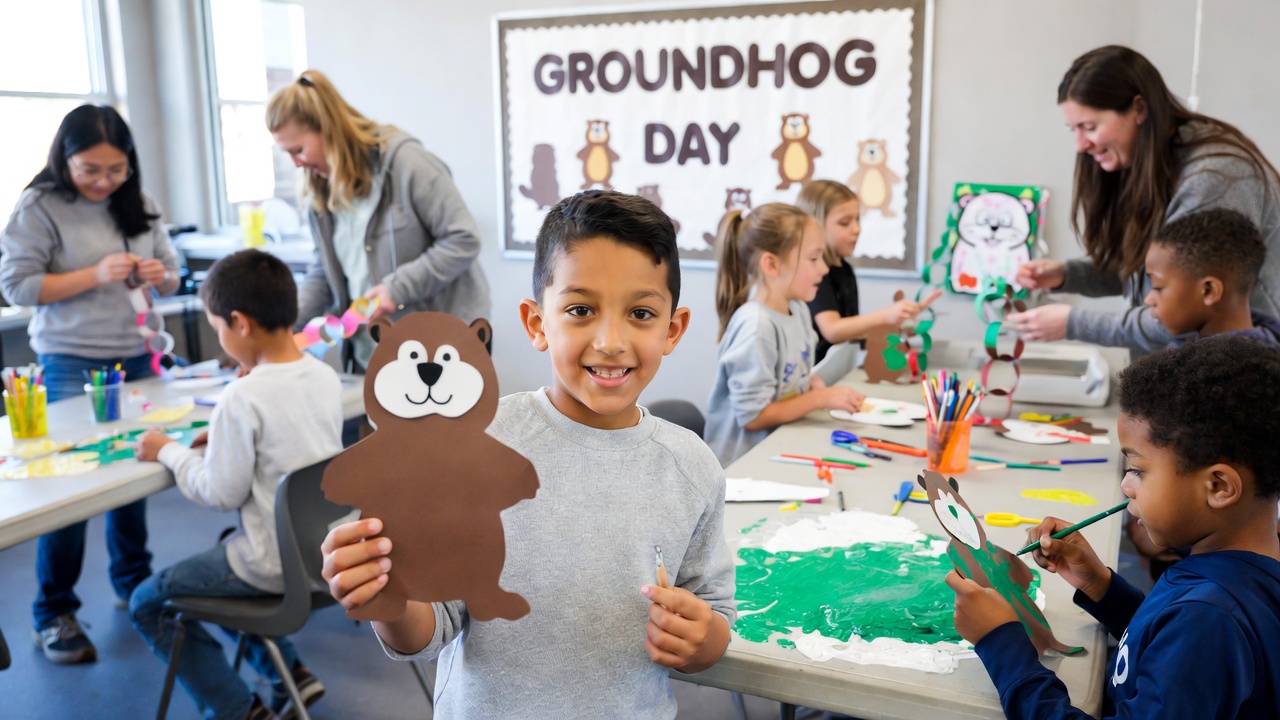
Paper Plate Groundhog Puppet Craft for Young Children
This classic craft transforms an ordinary paper plate into an interactive storytelling tool.
Materials Needed:
- Small paper plate
- Brown construction paper or paint
- Googly eyes
- Black pom-pom (for nose)
- Craft stick
- Scissors, glue
Instructions:
- Paint the paper plate brown or cover with brown construction paper
- Cut out two small semi-circles for ears from brown paper
- Attach googly eyes and a black pom-pom nose
- Add two large front teeth cut from white paper
- Glue a craft stick to the back as a handle
- Create a “burrow” from a paper bag for the groundhog to pop in and out of
This activity teaches children about groundhog behavior while developing fine motor skills and encouraging imaginative play.
Groundhog Shadow Art Activity for Toddlers
Shadow play connects directly to the holiday’s central tradition while introducing basic science concepts.
Simple Shadow Exploration:
- Use a flashlight in a darkened room
- Help children position their groundhog puppets to cast shadows
- Discuss when shadows appear (sunny days) and disappear (cloudy days)
- Create shadow puppet shows retelling the Groundhog Day story
Fun Groundhog Day Crafts and Projects for Elementary School Kids
School-age children are ready for more complex projects that incorporate learning objectives alongside creative expression.
DIY Groundhog Day Weather Station Craft Project
Transform your classroom or home into a meteorological observation center that honors the groundhog’s role as weather forecaster.
Materials:
- Cardboard box (shoe box works well)
- Thermometer (child-safe)
- Paper cups and pencil (for simple anemometer)
- Clear plastic bottle (for rain gauge)
- Journal or notebook
Weather Observation Chart:
| Date | Temperature | Cloud Cover | Precipitation | Wind | Shadow Visible? |
|---|---|---|---|---|---|
| Feb 1 | |||||
| Feb 2 | |||||
| Feb 3 | |||||
| (continue for 6 weeks) |
Children track weather daily for six weeks following Groundhog Day, then compare their observations to the groundhog’s prediction. This project teaches scientific methodology, data collection, and critical thinking about folklore versus meteorology.
Groundhog Day Pop-Up Card Tutorial for Kids
Pop-up mechanics introduce basic engineering concepts while creating a delightful keepsake.
Steps:
- Fold a piece of cardstock in half (this is your card base)
- Cut a small rectangle in the fold, leaving both ends attached
- Push the rectangle inward to create a pop-up mechanism
- Attach a drawn or printed groundhog to the pop-up tab
- Decorate the background with a burrow scene
- When the card opens, the groundhog “pops up” from its hole
Educational Groundhog Day Activities for Classroom Learning
As a folklorist, I encourage educators to use Groundhog Day as a gateway to multiple disciplines—from biology and meteorology to cultural studies and creative writing.
Groundhog Day Science Experiments and STEM Activities
Hibernation Investigation: Groundhogs are true hibernators, unlike bears who enter a lighter torpor state. During hibernation, a groundhog’s heart rate drops from 80-100 beats per minute to just 4-10, and body temperature falls from 99°F to as low as 37°F.
Classroom Experiment: Modeling Hibernation
| Activity | Learning Objective | Materials |
|---|---|---|
| Ice cube insulation test | Understanding how fat layers protect hibernating animals | Ice cubes, various materials (cotton, bubble wrap, etc.) |
| Heart rate measurement | Comparing active vs. resting metabolic states | Stopwatch, stethoscope |
| Temperature graphing | Visualizing seasonal temperature changes | Thermometer, graph paper |
Shadow Science Investigation:
- Measure shadows at different times of day
- Track how shadow length changes over weeks
- Discuss Earth’s rotation and axial tilt
- Compare shadows on sunny vs. cloudy days
Groundhog Day Reading Comprehension and Writing Prompts
Writing Prompts for Various Grade Levels:
Grades K-2: “If I were a groundhog waking up on February 2nd, I would see…”
Grades 3-5: “Write a news report from Punxsutawney, Pennsylvania, describing this year’s Groundhog Day ceremony. Include quotes from witnesses and the official prediction.”
Grades 6-8: “Research and compare weather prediction accuracy: Punxsutawney Phil vs. modern meteorology. Present your findings with data and analysis.”
Recommended Groundhog Day Books for Children:
- Groundhog Day! by Gail Gibbons (nonfiction, ages 4-8)
- Substitute Groundhog by Pat Miller (fiction, ages 4-8)
- Groundhog Gets a Say by Pamela Curtis Swallow (ages 5-9)
- Go to Sleep, Groundhog! by Judy Cox (ages 4-7)
Creative Groundhog Day Party Ideas and Games for Families
Hosting a Groundhog Day gathering offers a unique midwinter celebration opportunity during the February doldrums.
How to Plan a Groundhog Day Party for Kids and Adults
Party Timeline:
| Time | Activity |
|---|---|
| 10:00 AM | Guests arrive; “Burrow Building” craft station opens |
| 10:30 AM | Watch live stream of Punxsutawney Phil’s emergence (typically around 7:25 AM ET, but replays available) |
| 11:00 AM | Groundhog Day trivia game |
| 11:30 AM | Shadow tag and outdoor games |
| 12:00 PM | Groundhog-themed lunch |
| 12:30 PM | Prediction ceremony: guests make their own spring predictions |
| 1:00 PM | Craft time and free play |
Decoration Ideas:
- Brown and green color scheme (earth and spring)
- Groundhog silhouettes with shadows
- “Spring vs. Winter” divided décor
- Burrow entrance photo backdrop
Best Groundhog Day Games and Activities for Family Fun Night
Shadow Tag: One player is “the groundhog” and must freeze whenever another player steps on their shadow. The last unfrozen player becomes the next groundhog.
Groundhog, Groundhog, What Do You See? A variation of “Duck, Duck, Goose” where children circle while chanting “Groundhog, groundhog, what do you see?” The tapped child calls out either “shadow!” (and a chase ensues) or “spring!” (and everyone must find a “burrow” to hide in).
Prediction Voting Station: Create a ballot box where family members cast votes predicting whether the groundhog will see their shadow. Compare predictions to actual results and discuss why people historically relied on such folklore for agricultural planning.
Delicious Groundhog Day Snacks and Recipes for Kids
Food crafts engage multiple senses and can reinforce holiday themes deliciously.
Easy Groundhog Day Treats and Desserts to Make with Children
Groundhog Cupcakes:
- Bake chocolate cupcakes
- Frost with chocolate frosting
- Use chocolate cookies for ears
- Add candy eyes and a chocolate chip nose
- Use white frosting for teeth
- Optional: place each cupcake in a cup of crushed Oreos (dirt)
Groundhog Day Snack Ideas:
| Snack | How It Connects to Groundhog Day |
|---|---|
| Dirt cups (chocolate pudding with cookie crumbs) | Represents the groundhog’s burrow |
| Vegetable tray with ranch “snow” | Groundhogs are herbivores |
| Sun-shaped sugar cookies | Celebrates hope for spring sunshine |
| Snowflake pretzels | Represents six more weeks of winter |
| Carrot stick “logs” | Groundhogs’ natural food source |
Groundhog-Shaped Sandwiches: Use a circle cookie cutter for the face, smaller circles for ears, and arrange lunch meat, cheese, and vegetables to create edible groundhog faces.
Outdoor Groundhog Day Activities and Nature Exploration Ideas
February offers unique opportunities for winter nature study that connect directly to Groundhog Day themes.
Groundhog Day Nature Walk and Wildlife Observation Activities
What to Look For:
Even in winter, evidence of groundhog activity can sometimes be observed. Look for:
- Burrow entrances (typically 10-12 inches in diameter)
- Mounds of excavated dirt near burrow openings
- Trails between burrows
- Gnawed vegetation near burrow sites
Citizen Science Connection: Organizations like iNaturalist welcome observations of groundhog activity and emergence dates. Families can contribute to real scientific data collection while participating in Groundhog Day traditions.
Winter Ecology Discussion Points:
- Why do some animals hibernate while others migrate or remain active?
- How do groundhogs prepare their burrows for winter?
- What are the groundhog’s predators, and how does early emergence affect survival?
- How is climate change affecting hibernation patterns?
Shadow Exploration Activities for Groundhog Day Outdoors
Sundial Creation:
- Place a stick vertically in the ground
- Mark the shadow’s position each hour
- Discuss how people used sundials before clocks
- Connect to how weather conditions affect shadow visibility
Human Sundial: Children stand as the “gnomon” (center post) while others trace their shadow at different times, creating a life-sized sundial on pavement with chalk.
Meaningful Groundhog Day Traditions to Start with Your Family
Creating family traditions around lesser-known holidays builds unique memories and cultural connection.
How to Create Special Groundhog Day Family Traditions at Home
Annual Prediction Ceremony: Each family member makes predictions about what they hope to accomplish before spring officially arrives. Write these on paper groundhogs and store in a “burrow” (decorated box). Open on the first day of spring to review.
Groundhog Day Time Capsule: Inspired by the repetitive day loop from the famous 1993 film, create an annual time capsule containing:
- A photo of each family member
- Current favorite things (songs, books, foods)
- Hopes for the coming spring
- Weather prediction
Six-Week Challenge: Whatever the groundhog predicts, use the six weeks until mid-March for a family goal:
- Learn a new skill together
- Complete a puzzle or LEGO set over six weeks
- Read a chapter book together
- Start seeds indoors for spring planting
| Week | Challenge Activity Example |
|---|---|
| Week 1 | Choose your spring garden plants |
| Week 2 | Start seeds indoors |
| Week 3 | Create plant markers |
| Week 4 | Monitor seedling growth |
| Week 5 | Begin hardening off plants |
| Week 6 | Prepare outdoor garden beds |
Groundhog Day Crafts Using Recycled and Natural Materials
Sustainability-focused crafts honor the groundhog’s connection to the natural world.
Eco-Friendly Groundhog Day Art Projects for Environmentally Conscious Families
Toilet Paper Roll Groundhog: Transform cardboard tubes into adorable groundhog figures:
- Cover tube with brown paper or paint
- Cut ear shapes from cardboard scraps
- Add facial features with markers or paper scraps
- Create a grass “burrow entrance” from green paper shreds
Nature Collage Groundhog: Collect natural materials (with permission and sustainability in mind):
- Dried leaves for fur texture
- Small twigs for whiskers
- Acorn caps for ears
- Seeds for eyes
Shadow Box Diorama: Repurpose a shoebox into a shadow box featuring a groundhog habitat. Include:
- Underground burrow tunnels (cardboard tubes)
- A groundhog figure (clay or paper)
- Seasonal elements (cotton snow, paper flowers)
- A moveable sun to demonstrate shadow creation
Understanding Groundhog Day: Teaching Kids About American Folk Traditions
As a folklorist, I believe every holiday offers an opportunity to teach children about cultural transmission, adaptation, and the human need for seasonal markers.
How to Explain the Meaning of Groundhog Day to Children
Key Concepts to Discuss:
What is folklore? Folklore includes the traditional beliefs, customs, and stories passed down within communities. Groundhog Day is a perfect example of living folklore—a tradition that continues to evolve while maintaining its core elements.
Why did people create weather prediction traditions? Before modern meteorology, agricultural communities desperately needed to predict seasonal changes. Planting too early could mean crop failure; waiting too long could shorten growing seasons. Animal behavior observations, while not scientifically reliable, gave communities a sense of agency over unpredictable forces.
What can we learn from Groundhog Day today?
- The importance of observing nature
- How traditions adapt when people move to new places
- The value of community celebrations during difficult seasons
- The difference between folklore and science (and why both have value)
Discussion Questions for Families:
- Why do you think people still celebrate Groundhog Day even though we have weather forecasts?
- What traditions does our family have that came from other places or times?
- If you could create a new holiday tradition, what would it be?
- What animal in our area would make a good weather predictor?
Conclusion: Celebrating Groundhog Day with Purpose and Joy
Groundhog Day occupies a special place in the American folk calendar. It arrives during winter’s deepest grip, offering a moment of levity and hope. Whether or not Punxsutawney Phil sees his shadow, the holiday reminds us that spring will eventually arrive—and that the anticipation itself is worth celebrating.
Through crafts, we connect children to creativity and fine motor development. Through games, we build family bonds and joyful memories. Through education, we honor the rich cultural heritage that gave us this delightfully quirky holiday. And through outdoor exploration, we maintain the original purpose of Groundhog Day: paying attention to the natural world and our place within it.
This February 2nd, I encourage you to embrace the groundhog spirit. Build a burrow, cast some shadows, make predictions, and most importantly—gather those you love for a celebration of one of America’s most endearing folk traditions.
Happy Groundhog Day!
Quick Reference: Groundhog Day Activities at a Glance
| Age Group | Best Activities | Learning Focus |
|---|---|---|
| Toddlers (1-3) | Paper plate puppets, shadow play, simple snacks | Sensory exploration, basic concepts |
| Preschool (3-5) | Pop-up groundhogs, nature walks, prediction voting | Fine motor skills, observation |
| Early Elementary (5-8) | Weather stations, science experiments, party planning | STEM concepts, social skills |
| Upper Elementary (8-12) | Research projects, citizen science, time capsules | Critical thinking, data analysis |
| Whole Family | Traditions, cooking together, prediction ceremonies | Bonding, cultural connection |