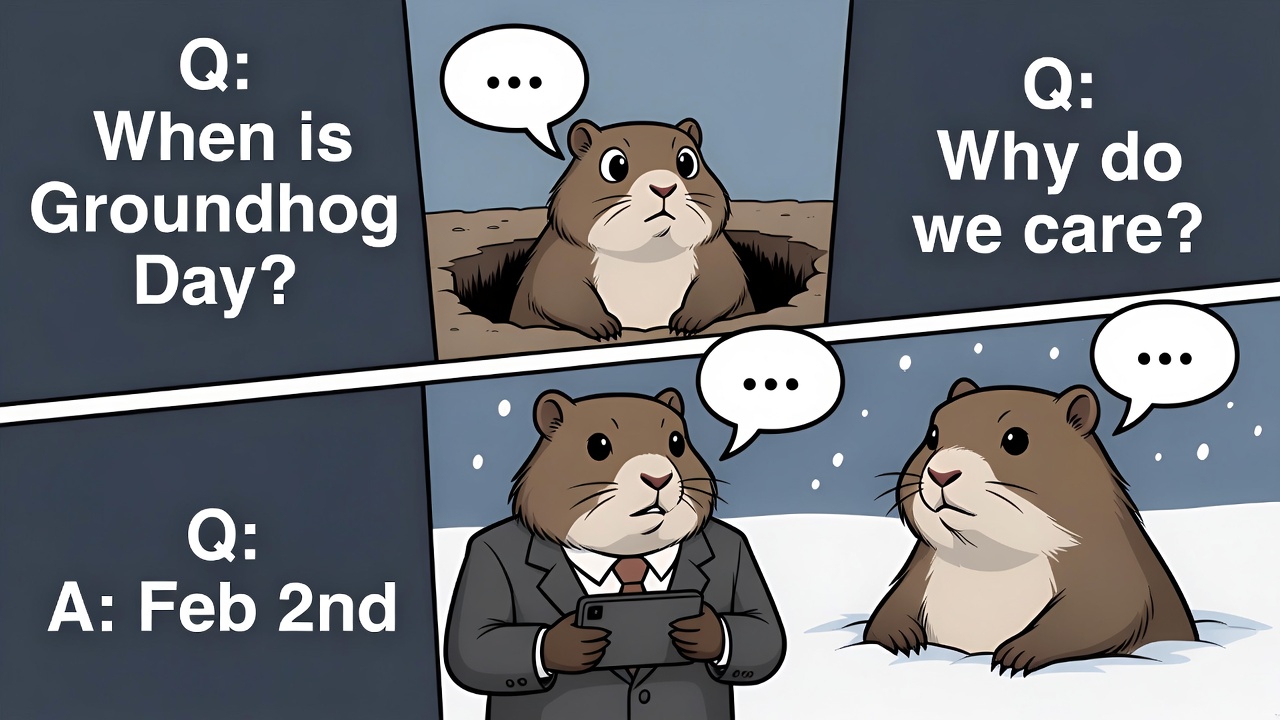
What Is Groundhog Day? A Complete Introduction to This Unique American Holiday
Every February 2nd, tens of thousands of people gather in the frigid pre-dawn darkness of Punxsutawney, Pennsylvania, their eyes fixed on a furry prognosticator emerging from his burrow. This quirky ritual, known as Groundhog Day, perfectly blends American folklore, seasonal anticipation, and festive celebration into one unforgettable experience.
The core prediction rules of Groundhog Day are simple yet captivating:
- If the groundhog sees his shadow (sunny day) → Winter will last 6 more weeks
- If the groundhog doesn’t see his shadow (cloudy day) → Spring will arrive early
This tradition represents far more than folk weather forecasting—it’s a vital piece of American cultural heritage that attracts over 30,000 on-site spectators and millions of television viewers worldwide each year.
Who Is Punxsutawney Phil? Meet the World’s Most Famous Groundhog
The Legend of Punxsutawney Phil
Punxsutawney Phil is the undisputed star of Groundhog Day, crowned as the “Seer of Seers” and “Prognosticator of Prognosticators.” According to official legend, this remarkable groundhog has been alive since his first prediction in 1887—thanks to a mysterious “Elixir of Life” that he supposedly drinks each summer to maintain his eternal youth.
Of course, this is part of the tradition’s charming humor. In reality, the Punxsutawney Groundhog Club’s Inner Circle—a group of distinguished gentlemen dressed in top hats and tuxedos—cares for successive generations of Phil and “translates” his weather predictions from “Groundhogese” during the annual ceremony.
Where Does the Groundhog Day Ceremony Take Place?
Punxsutawney Phil’s official residence is at Gobbler’s Knob, a small hill located just outside of Punxsutawney, Pennsylvania. Every February 2nd, the ceremony unfolds here in a carefully orchestrated sequence:
- 3:00 AM: Festivities begin with live music and entertainment
- Dawn (approximately 7:25 AM): Phil is coaxed from his specially designed tree stump burrow
- The Prediction: The Inner Circle President announces Phil’s official forecast
- Global Broadcast: Major media outlets livestream this historic moment worldwide
The Ancient Origins of Groundhog Day: From European Folklore to American Tradition
Ancient European Roots: Candlemas and Animal Omens
The history of Groundhog Day traces back to ancient European pagan traditions associated with the midpoint between the winter solstice and spring equinox:
The Celtic Festival of Imbolc (February 1-2)
- Celebrated the first signs of approaching spring
- Honored the goddess Brigid
- Symbolized light conquering darkness and warmth defeating cold
The Christian Feast of Candlemas (February 2nd)
- The Church Christianized the pagan festival
- Clergy blessed candles for the faithful
- Folk proverb emerged: “If Candlemas be fair and bright, winter will have another flight”
German Badger and Hedgehog Prediction Traditions
- German farmers observed badger or hedgehog behavior on February 2nd
- If the animal saw its shadow, six more weeks of winter were expected
- This custom traveled to America with German immigrants
The Pennsylvania Dutch: Americanizing the Groundhog Tradition
The Pennsylvania Dutch—actually German immigrants (the word “Dutch” derives from “Deutsch,” meaning German)—brought this tradition to America in the 18th century. Since North America had no native badgers or hedgehogs, they substituted the abundant local groundhog (Marmota monax), also known as the woodchuck.
Key Historical Milestones:
- 1840: Earliest known written record of Groundhog Day in Pennsylvania
- 1886: The Punxsutawney Spirit newspaper first reports on Groundhog Day activities
- 1887: The Punxsutawney Groundhog Club officially forms; first official prediction made
- 1993: Bill Murray’s film “Groundhog Day” brings the tradition to global audiences
Groundhog Symbolism in Native American Culture and Indigenous Lore
Before European settlers arrived, Native American tribes had rich cultural connections with groundhogs:
Delaware Nation (Lenape) Groundhog Legends
The name Punxsutawney itself derives from the Lenape language, meaning “town of the sandflies” or relating to local geography. In Delaware mythology, Wojak (the great groundhog) was an important ancestral figure symbolizing:
- Life force emerging from the earth
- Natural renewal and rebirth
- Humanity’s intimate connection with the land
Cherokee Groundhog Stories
In Cherokee folklore, the groundhog is celebrated for wisdom and cunning, often outsmarting predators like wolves in traditional tales. These stories embody:
- Survival wisdom of smaller creatures
- Cultural values of wit over brute strength
- Respect for nature’s underdogs
The Groundhog’s Ecological Role
From an ecological perspective, groundhogs serve as important “ecosystem engineers”:
- Their burrows provide shelter for numerous other species
- Soil excavation promotes nutrient cycling
- They serve as a crucial food source for various predators
Punxsutawney Phil’s Prediction Accuracy: Data, Statistics, and the Truth
Historical Prediction Record Statistics
Since 1887, Punxsutawney Phil’s prediction record breaks down as follows:
| Prediction Type | Occurrences | Percentage |
|---|---|---|
| Saw shadow (6 more weeks of winter) | 108 times | ~84% |
| No shadow (early spring) | 21 times | ~16% |
| Missing records | 9 years | – |
Interesting Finding: Phil clearly “prefers” predicting longer winters!
Scientific Verification: How Accurate Is Phil Really?
Multiple independent studies have evaluated Punxsutawney Phil’s prediction accuracy:
| Research Source | Time Period | Accuracy Rate |
|---|---|---|
| Stormfax Almanac | 1887-2024 | 39% |
| NOAA National Centers for Environmental Information | 2005-2024 | 35% |
| Weather Underground | 1969-2024 | 36% |
| Wikipedia Compilation | 1887-2024 | 35-41% |
Conclusion: Punxsutawney Phil’s prediction accuracy hovers around 35-40%—actually worse than a random coin flip at 50%!
Why Are Phil’s Predictions So Inaccurate?
From a scientific perspective, groundhogs cannot accurately predict weather for several reasons:
- Biological Factors: Groundhog hibernation awakening is driven by hormones and body temperature, not meteorological conditions
- Geographic Limitations: Phil’s Pennsylvania-based predictions are judged against national weather patterns, lacking regional specificity
- Meteorological Complexity: Modern weather forecasting relies on satellites, radar, and supercomputers—a single animal’s behavior at one location cannot reflect atmospheric system changes
- Vague Definitions: “Early spring” and “6 more weeks of winter” lack standardized scientific measurement criteria
Comparing America’s Top Groundhog Prognosticators: Phil vs. the Competition
Punxsutawney Phil isn’t North America’s only animal meteorologist! Various regions have their own “official” forecasters:
Top 5 Most Accurate Groundhog Prognosticators (According to NOAA Data)
| Rank | Name | Location | Accuracy Rate |
|---|---|---|---|
| 1 | Staten Island Chuck | Staten Island, New York | 85% |
| 2 | General Beauregard Lee | Georgia | 80% |
| 3 | Lander Lil (statue) | Wyoming | 75% |
| 4 | Essex Ed | New Jersey | 70% |
| 5 | Jimmy the Groundhog | Wisconsin | 65% |
Surprising Discovery: Punxsutawney Phil ranks only 17th out of 19 prognosticators in NOAA’s evaluation!
Other Animal Weather Forecasters
Beyond groundhogs, various American regions feature other animals in weather prediction traditions:
- Woolly Bear Caterpillars: Band width observations predict winter severity
- Persimmon Seeds: Seed shape analysis forecasts winter weather patterns
- Parrots: Some regions use parrots as alternative forecasters
Groundhog Day’s Modern Cultural Impact and Influence
The Lasting Legacy of “Groundhog Day” (1993 Film)
The movie “Groundhog Day” starring Bill Murray isn’t just a classic comedy—it propelled this local tradition onto the global stage:
Plot Summary: Weatherman Phil Connors becomes trapped in a time loop, forced to relive the same day (February 2nd) in Punxsutawney repeatedly until he learns to appreciate life and treat others with kindness.
Cultural Legacy:
- “Groundhog Day” became everyday slang for repetitive, monotonous experiences
- The film was added to the National Film Registry by the Library of Congress
- Annual pilgrimages by film fans to Punxsutawney increased dramatically
- Inspired a Broadway musical adaptation (2016)
Groundhog Day in the Social Media Era
In the digital age, Groundhog Day has found new life:
- #GroundhogDay trends every February 2nd
- Punxsutawney Phil maintains official social media accounts
- Predictions broadcast globally via livestream
- Groundhog memes and viral content spread across platforms
The Deeper Cultural Significance of Groundhog Day
Why Do We Need Traditions Like This?
Despite scientific evidence that groundhogs cannot accurately predict weather, the Groundhog Day tradition endures for compelling reasons:
1. Community Cohesion
- Provides a reason to gather during the cold mid-winter months
- Strengthens local identity and sense of belonging
- Creates shared memories passed down through generations
2. Connection with Nature
- Reminds urbanized societies to notice natural rhythms
- Reflects humanity’s eternal concern with seasonal changes
- Maintains emotional bonds with the animal world
3. Hope and Optimism
- Symbolizes hope that the long winter will eventually end
- Provides a psychological “countdown” milestone
- Encourages facing uncertainty with humor
4. Cultural Preservation
- Preserves historical memories of German immigrant heritage
- Blends Indigenous and European traditions
- Showcases America’s multicultural fusion
Climate Change and the Future of Groundhog Day Traditions
Warming Winters, Confused Groundhogs
As global climate change accelerates, Groundhog Day traditions face new challenges:
Climate Change Impacts:
- Disrupted hibernation cycles
- Increasingly unpredictable February 2nd weather patterns
- The concept of “6 more weeks of winter” becoming meaningless
- Noticeably shorter winters in some regions
Adaptation and Evolution of Tradition
Folklore scholars note that traditional holidays always evolve with the times:
- Virtual Celebrations: Pandemic-era livestreams established new engagement models
- Environmental Themes: Integration of climate awareness education
- Science Integration: Combining tradition with meteorological science outreach
- International Expansion: Internet connectivity attracts global audiences
How to Watch and Participate in Groundhog Day Festivities
Attending the Punxsutawney Event in Person
Date: February 2nd annually Location: Gobbler’s Knob, Punxsutawney, Pennsylvania
Event Schedule:
- 3:00 AM – Celebration activities begin
- Around 7:25 AM – Phil officially emerges and makes his prediction
- All day – Various activities throughout the town
Practical Tips:
- Book accommodations early (months in advance recommended)
- Dress warmly in layers (February predawn temperatures are brutally cold)
- Prepare for extended periods of standing and waiting
- Bring hot beverages and snacks
Watching the Livestream Online
Can’t attend in person? Participate virtually through:
- Official livestream at groundhog.org
- Real-time coverage on major news websites
- Social media live updates
- Local television station broadcasts
Groundhog Day Frequently Asked Questions (FAQ)
Q1: Did Punxsutawney Phil see his shadow in 2024?
Check the official website for the most current prediction results.
Q2: Is Groundhog Day a public holiday?
Groundhog Day is not a U.S. federal holiday, though it’s a major celebration in Punxsutawney and surrounding areas.
Q3: Is it really the same groundhog living for over 130 years?
Of course not! This is part of the tradition’s humor. In reality, groundhogs have a natural lifespan of approximately 6-8 years in the wild.
Q4: Why was February 2nd chosen?
February 2nd marks the midpoint between the winter solstice and spring equinox, holding special significance in ancient European cultures.
Q5: Where else besides Punxsutawney celebrates Groundhog Day?
Groundhog Day celebrations occur throughout the United States, including Staten Island (New York), Georgia, Wisconsin, and many other locations.
Q6: What happens to Phil the rest of the year?
Phil lives in a climate-controlled habitat at the Punxsutawney Memorial Library, where visitors can see him year-round.
Conclusion: Embracing Tradition and Celebrating Uncertainty
Whether Punxsutawney Phil’s predictions prove accurate or not, the Groundhog Day tradition reminds us that some things in life hold value beyond mere utility. In an age dominated by algorithms and data, a furry little animal can still make millions of people smile on a cold February morning—and that itself is something beautiful.
Next February 2nd, consider tuning in to watch Phil’s prediction. Not because it’s accurate, but because this tradition connects past and present, nature and culture, science and imagination.
Shadow or no shadow, spring will eventually arrive.