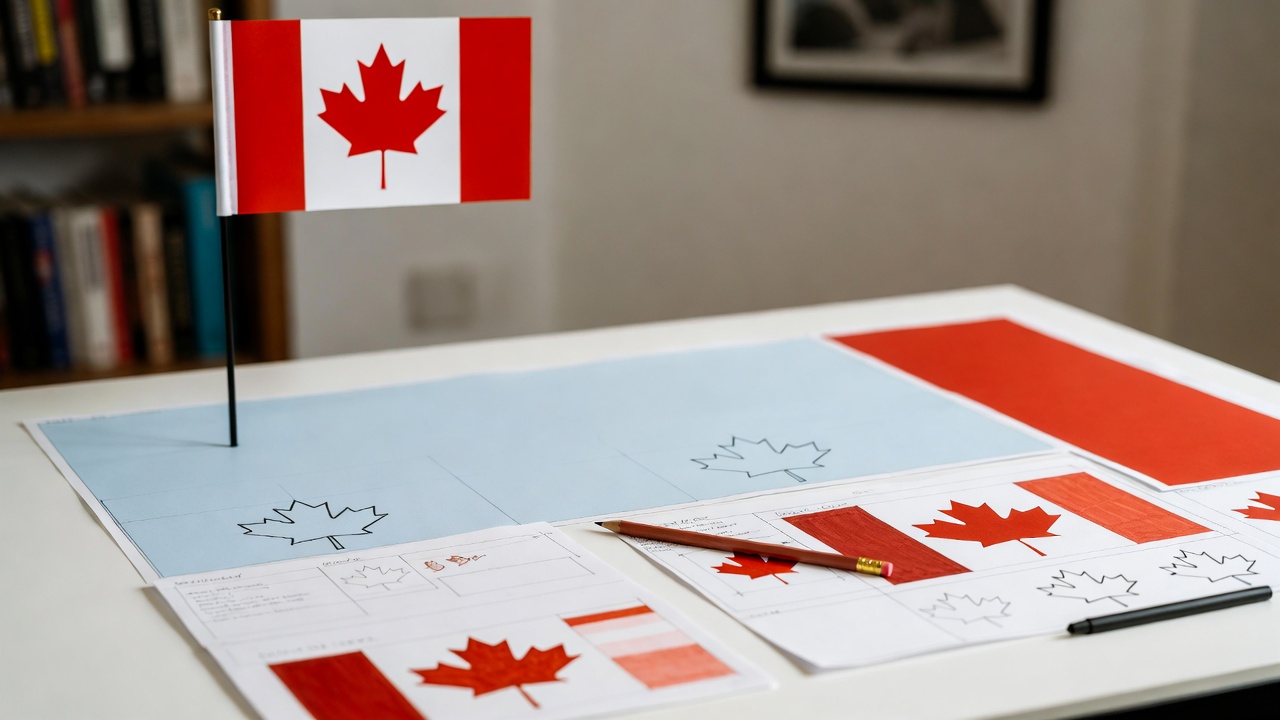
Every year on February 15, Canadians celebrate National Flag of Canada Day — a moment to honour the bold red-and-white Maple Leaf that flies over Parliament Hill, neighbourhood porches, and backpacker rucksacks around the globe. But the flag’s journey from rough pen sketch to global icon was anything but smooth. It was born from political turmoil, wartime pride, a six-month parliamentary filibuster, anonymous death threats, and one historian’s elegant idea scribbled in red ink.
In 2025, the flag turned 61 years old since its first official raising. That milestone year was charged with fresh meaning when all five of Canada’s living former prime ministers — Joe Clark, Kim Campbell, Jean Chrétien, Paul Martin, and Stephen Harper — issued a joint open letter urging citizens to “show the flag as never before” in the face of trade disputes with the United States. The letter declared that “Canada, the true north, strong and free, the best country in the world, is worth celebrating and fighting for.”
Now in 2026, as Canadians prepare for another Flag Day on Sunday, February 15, understanding how this flag came to be is more relevant than ever. This is the full design story.
Why Did Canada Need a New National Flag in the 1960s?
It may surprise many travellers to learn that Canada did not have its own official flag for nearly a century after Confederation in 1867. For most of that time, the country flew two borrowed standards: the British Union Jack and the Canadian Red Ensign — a red banner bearing the Union Jack in the upper-left corner and Canada’s coat of arms on the right side.
The Red Ensign served Canadians unofficially from 1868 onward. Soldiers carried it into battle during both World Wars. Veterans loved it. But it carried a fundamental problem: it looked like a British colonial flag.
That problem exploded into international embarrassment during the 1956 Suez Crisis. Canada’s Secretary of State for External Affairs, Lester B. Pearson, brokered a groundbreaking ceasefire and proposed the world’s first United Nations peacekeeping force. He later won the Nobel Peace Prize for that achievement. Yet Egypt initially rejected Canadian peacekeepers — specifically because the Red Ensign on their uniforms resembled the flag of the British forces they were fighting against.
As The Canadian Encyclopedia notes, the country that invented international peacekeeping was unwelcome solely because of the flag it flew. Pearson never forgot that lesson. When he became Prime Minister in 1963, he made a new, distinctly Canadian flag one of his top priorities.
The Great Canadian Flag Debate of 1964: A Nation Divided Over Identity
What followed was one of the most heated political battles in Canadian parliamentary history. It became known as the Great Flag Debate, and it consumed the country for most of 1964.
Pearson’s Opening Move
On May 17, 1964, Pearson strapped on his war medals and marched into the Royal Canadian Legion’s national convention in Winnipeg — perhaps the most hostile audience he could have chosen. The Legion was fiercely protective of the Red Ensign. The cover of its magazine, The Legionary, had recently featured the Red Ensign with the caption: “This Is Canada’s Flag: Keep It Flying.”
Pearson told the veterans the time had come for change. Many booed. But the Prime Minister pressed forward.
The Pearson Pennant
Pearson’s own preferred design featured three red maple leaves on a white background with blue vertical bars on each side. The blue was meant to reflect Canada’s motto: A Mari usque ad Mare — “From Sea to Sea.” Heraldic artist Alan Beddoe polished the concept.
Opposition Leader John Diefenbaker immediately mocked it as “Pearson’s Pennant.” A Gallup poll from August 1964 found that only 48 percent of Canadians supported the design, while 41 percent opposed it. The country was nearly split down the middle.
A Filibuster and a Deadline
Diefenbaker demanded a national referendum. He argued the new flag must honour Canada’s “founding races” and include the Union Jack. Pearson refused a referendum. The debate ground to a halt. Finally, in September 1964, the issue was sent to a 15-person all-party parliamentary committee with just six weeks to find a solution.
The committee’s composition was:
| Party | Members |
|---|---|
| Liberal | 7 |
| Progressive Conservative | 5 |
| New Democratic Party (NDP) | 1 |
| Social Credit | 1 |
| Ralliement créditiste | 1 |
Liberal MP John Matheson, who served as the Prime Minister’s chief advisor on the flag project, later recalled: “With a gun at our heads, we were asked to produce a flag for Canada and in six weeks!”
Who Designed the Canadian Flag? The Story of George Stanley’s Maple Leaf Sketch
While nearly 4,000 designs poured in from ordinary Canadians — including one that featured the Beatles — the winning concept came from an unexpected source: a military historian standing in front of a building in Kingston, Ontario.
A Letter Written Before the Debate Even Began
Dr. George Francis Gillman Stanley was the Dean of Arts at the Royal Military College of Canada (RMC) in Kingston. Born in Calgary in 1907, he was a Rhodes Scholar, a decorated Second World War veteran, and one of the country’s foremost historians. His biography of Louis Riel remains a landmark of Canadian scholarship.
On March 23, 1964 — nearly two months before Pearson even publicly launched the flag campaign — Stanley wrote a four-page memorandum to his friend John Matheson. In it, he laid out the principles that a new flag should follow:
- It must be instantly recognizable.
- It should use Canada’s official colours: red and white.
- It must “avoid the use of national or racial symbols that are of a divisive nature.”
- It should be simple enough for a child to draw.
At the bottom of the letter, Stanley sketched a rough design in red ink: a single red maple leaf on a white background, flanked by two red vertical bars.
His inspiration? The flag of the Royal Military College itself. That flag features two red vertical stripes bookending a white centre — with an armoured fist holding three maple leaves beneath a royal crown. Stanley simply replaced the centre image with a single maple leaf.
As The Canadian Encyclopedia explains, “No design was as straightforward and elegant as Stanley’s. His proposal also avoided any reference to founding races, the colonial past, or any other source of potential controversy.”
The Political Chess Match That Made It Win
Here is where the story takes a remarkable political turn.
When the committee held its final vote on October 22, 1964, the choice came down to two designs: the Pearson Pennant and Stanley’s single-leaf flag. The Conservative members, trying to block Pearson’s preferred design, voted for Stanley’s flag — assuming the Liberal members would loyally back their Prime Minister’s choice.
They were outmanoeuvred. Every Liberal member also voted for Stanley’s design. So did the representatives from the NDP, Social Credit, and Ralliement créditiste. The result was a stunning unanimous 15-to-0 vote for the Maple Leaf.
The committee had spoken. But the House of Commons had not.
How the 11-Point Maple Leaf Was Created: From 13 Points to Iconic Design
The committee’s selection of Stanley’s concept was only the beginning of the design process. The rough sketch needed to become a production-ready national symbol. This is where a team of skilled graphic artists and scientists stepped in.
The Design Team Behind the Final Canadian Flag
According to the Government of Canada’s official history, several key figures refined the flag:
| Name | Role | Contribution |
|---|---|---|
| George Stanley | Historian, RMC Dean of Arts | Proposed the original single-leaf concept |
| John Matheson | Liberal MP | Championed the design in committee and Parliament |
| Alan Beddoe | Heraldic artist | Created the first professional rendering of Stanley’s sketch |
| Jacques St-Cyr | Graphic artist | Redesigned the maple leaf from 13 points to 11 points |
| George Bist | Graphic designer | Defined the final proportions of the flag’s elements |
| Dr. Günter Wyszecki | Physicist, National Research Council | Determined the exact shade of red |
| Patrick Reid | Director, Canadian Government Exhibition Commission | Oversaw the final design production |
| Joan O’Malley | Seamstress | Sewed the first physical prototypes |
Why the Maple Leaf Changed from 13 Points to 11
Stanley’s original sketch, as rendered by Alan Beddoe, featured a maple leaf with 13 points. But there was a practical problem: the 13-point leaf lost its detail when seen from a distance or in windy conditions. The fine points blurred together, making the leaf difficult to recognize.
Jacques St-Cyr, a graphic artist from Trois-Rivières, Quebec, who worked for the Canadian Government Exhibition Commission, was brought in to solve this problem. As Maclean’s reported, Patrick Reid chose St-Cyr for the assignment because he was simply “the best designer we had.”
Working late into the night on November 6, 1964, St-Cyr, Matheson, and Reid refined the leaf. They tested versions with 13 points, then trimmed it down. Within an hour, St-Cyr had produced a finished sketch with 11 points that all three men approved. Prototypes were silk-screened that same night. On November 9, Prime Minister Pearson gave his blessing.
The 11 points do not carry any specific symbolic meaning. Despite popular myths that they represent 10 provinces and one nation, this is simply not the case. The number was chosen for visual clarity and practical recognition at a distance — pure design logic.
The Exact Shade of Red: A Scientific Precision
Even the colour had to be carefully defined. Dr. Günter Wyszecki, a physicist and director of the Optics Section at the National Research Council of Canada, was tasked with determining the precise shade of red. The official specifications, still in use today, call for:
- Pantone: PMS 032 (Flag Red 100%) or PMS 485 (for screens)
- CMYK: 0/100/100/0
- RGB: 255–0–0 (hex #FF0000)
In 1984, the National Flag of Canada Manufacturing Standards Act was passed to ensure that all government-issued flags conformed to these specifications.
The Historic First Flag-Raising Ceremony on Parliament Hill: February 15, 1965
After the committee’s vote, the battle returned to the House of Commons floor. Diefenbaker and his allies mounted a bitter filibuster that lasted weeks. After approximately 250 speeches, the Pearson government invoked closure. On December 15, 1964, at 2:15 a.m., MPs voted 163 to 78 in favour of the Maple Leaf. The Senate followed two days later, voting 38 to 23.
On January 28, 1965, Queen Elizabeth II signed the royal proclamation making it official.
The inauguration took place at noon on February 15, 1965, on Parliament Hill in Ottawa. Thousands gathered in the winter cold. The Red Ensign was lowered. The new Maple Leaf was raised. The crowd sang “O Canada” and “God Save the Queen.”
Governor General Georges Vanier said the flag would “symbolize to each of us — and to the world — the unity of purpose and high resolve to which destiny beckons us.”
Senator David Croll offered perhaps the most poetic summary: “The single maple leaf presents an image of dignified simplicity. It shows the world a new and yet a well-known image of a nation.”
George Stanley attended the ceremony despite having received an anonymous death threat. He showed up wearing a colourful Hudson’s Bay Company coat — a bold statement of Canadiana that stood out against the sea of dark formal attire. When someone at the ceremony threatened to shoot him, Stanley reportedly replied: “I was shot at for several years by the Germans. I don’t know if you’ll have any more luck than they had.”
What Do the Colours and Symbols on the Canadian Flag Represent?
The Canadian flag’s design is deceptively simple, but every element carries deep meaning rooted in centuries of history.
The Maple Leaf: Canada’s Oldest National Emblem
The maple leaf has represented Canada long before it appeared on the flag. Key milestones include:
- 1860: The 100th Regiment of Foot adopted the maple leaf as a regimental symbol.
- 1867: Alexander Muir composed “The Maple Leaf Forever,” which became an unofficial anthem in English-speaking Canada.
- 1868: The maple leaf appeared on the coats of arms of Ontario and Quebec.
- 1876–1901: The maple leaf graced all Canadian coins.
- 1921: King George V added the maple leaf to the Canadian coat of arms.
- World War I & II: Maple leaf badges adorned Canadian military uniforms, and the maple leaf was carved into the tombstones of fallen soldiers overseas.
Today, Canada remains the only country in the world with a maple leaf on its national flag.
Red and White: The Official Colours of Canada
Red and white became Canada’s official national colours on November 21, 1921, when King George V proclaimed the Royal Arms of Canada. The red comes from Saint George’s Cross (England), and the white from the historic royal banner of France. These colours represented Canada’s two founding European nations.
The Canadian Pale: A Unique Flag Design
The white centre section of the flag is known in flag terminology as a “Canadian pale” — a term coined specifically for this flag. In traditional flag design, a vertical band takes up one-third of the width. On the Canadian flag, the white centre takes up a full half, with each red bar occupying one-quarter. This was a deliberate choice by George Bist, who calculated these proportions to ensure the maple leaf would be clearly visible at a distance.
The flag’s overall ratio is 2:1 — it is exactly twice as wide as it is tall.
Why Vexillologists Call the Canadian Flag One of the Best-Designed Flags in the World
Flag experts — known as vexillologists — frequently cite the Canadian Maple Leaf as one of the finest national flags ever created. According to the Government of Canada, the flag is admired for its “compelling design and measured use of colour.”
The flag succeeds because it follows the core principles of good flag design:
- Simplicity: A child can draw it from memory — exactly what George Stanley argued for.
- Meaningful symbolism: The maple leaf, red, and white each carry historical weight.
- Distinctive: No other national flag looks remotely like it.
- Limited colours: Only two colours — red and white.
- No lettering or seals: The design relies on shape and colour alone.
Over six decades, the Maple Leaf has become one of the most recognizable national symbols on the planet — stitched onto backpacks, printed on passports, and draped over the shoulders of Olympic athletes.
How National Flag of Canada Day Is Celebrated Across the Country
National Flag of Canada Day was officially proclaimed on February 15, 1996, by Governor General Roméo LeBlanc at the initiative of Prime Minister Jean Chrétien. The date was chosen to mark the anniversary of the flag’s first raising in 1965.
While it is not a statutory holiday — meaning businesses and schools remain open — Canadians mark the day in many ways:
- Flag-raising ceremonies are held at government buildings, military bases, schools, and community centres across the country.
- Schools hold special lessons about the history and symbolism of the flag.
- Many people wear flag pins on their lapels.
- The Parliamentary Flag Program, running since 1973, allows Members of Parliament and Senators to distribute flags and pins to their constituents.
- In 1996, one million miniature flags were distributed as part of the “One in a Million National Flag Challenge,” so Canadians could display them the following year.
In recent years, social media has amplified the celebrations. Canadians share flag photos, post memories, and express national pride with hashtags like #FlagDay and #CanadianFlag.
The Canadian Flag’s Role in National Unity: From 2025 to 2026
The Maple Leaf has always been more than decoration. It has served as a rallying point during moments of national crisis — and the period from 2025 into 2026 has proven that once again.
When the flag celebrated its 60th anniversary on February 15, 2025, the occasion coincided with heightened tensions between Canada and the United States over trade tariffs and pointed remarks about Canadian sovereignty. In response, all five living former prime ministers issued their unprecedented joint letter, calling the surge in flag-flying “an occasion to engage Canadians.”
Conservative Leader Pierre Poilievre also posted a video urging Canadians to raise the flag, declaring: “We will always be a strong, self-reliant, sovereign country.”
That wave of patriotism has continued into 2026. The Maple Leaf has become a quiet but unmistakable statement: Canada is here, Canada is proud, and Canada intends to stay.
Key Facts About the Canadian National Flag at a Glance
| Detail | Fact |
|---|---|
| Official name | The National Flag of Canada |
| Common name | The Maple Leaf (l’Unifolié in French) |
| Date adopted | February 15, 1965 |
| Designer (concept) | George F. G. Stanley |
| Designer (final leaf) | Jacques St-Cyr |
| Maple leaf points | 11 |
| Proportions | 2:1 (width to height) |
| Colours | Red (PMS 032) and White |
| National colours since | 1921 (proclaimed by King George V) |
| Flag Day established | February 15, 1996 |
| Flag Day 2026 | Sunday, February 15, 2026 |
| Designs submitted in 1964 | Nearly 4,000 |
| House of Commons vote | 163–78 (December 15, 1964) |
| Senate vote | 38–23 (December 17, 1964) |
| Only country with a maple leaf flag | Yes — Canada |
Visiting Canada on Flag Day: What Travellers Should Know
If you happen to be visiting Canada around February 15, here are a few things to keep in mind:
Flag Day is not a public holiday. Shops, restaurants, transit, and attractions operate on their normal schedules. You will not encounter closures.
Ottawa is the best place to experience it. Parliament Hill often hosts a flag-raising ceremony, and the city has a special energy around the anniversary. Bundle up — February in Ottawa means temperatures well below freezing.
Look for flags everywhere. Canadians hang the Maple Leaf from porches, balconies, car antennas, and office windows. In some years, community groups hand out free miniature flags on the street.
Respect the flag etiquette. When the Canadian flag is raised, lowered, or carried past in a parade, Canadians face it in silence. Hats are removed. Visitors are welcome to observe the same courtesy.
February also brings Family Day. Several provinces celebrate Family Day on the third Monday of February — in 2026, that falls on February 16, the day right after Flag Day. This is a statutory holiday in provinces like Ontario, Alberta, and British Columbia, meaning some businesses may close.
A Flag That Tells a Story of Who Canadians Are
The Maple Leaf was not handed down from colonial rulers or designed by a royal court. It was argued over by ordinary citizens, debated in Parliament until 2:15 in the morning, sketched by a history professor with a red pen, refined by a graphic artist from small-town Quebec, and sewn by a civil servant’s daughter working late into the night.
George Stanley died in Sackville, New Brunswick, on September 13, 2002, at the age of 95. Jacques St-Cyr died in 1996, his contribution largely unrecognized during his lifetime. John Matheson passed away in 2013. But what these men created — with contributions from scientists, seamstresses, politicians, and thousands of everyday Canadians who submitted their own hopeful designs — has endured for over six decades.
In 1995, Prime Minister Jean Chrétien officially recognized George Stanley as the designer of Canada’s flag. A life-size bronze sculpture of Stanley now stands in the town of Sackville, New Brunswick. A school bearing his name was opened in Calgary in 2017.
As former Governor General David Johnston once wrote in tribute to Stanley: the flag he created has been “flown from the top of the Peace Tower and from thousands of public and private buildings across the country, from embassies around the world, and at Olympic medal ceremonies.”
This February 15, when you see that bright red leaf snapping in the cold winter wind, know that it carries a story. A story of a nation finding its own voice, drawn first in red ink on a single piece of paper, and now recognized across the world.
Happy National Flag of Canada Day 2026. 🍁