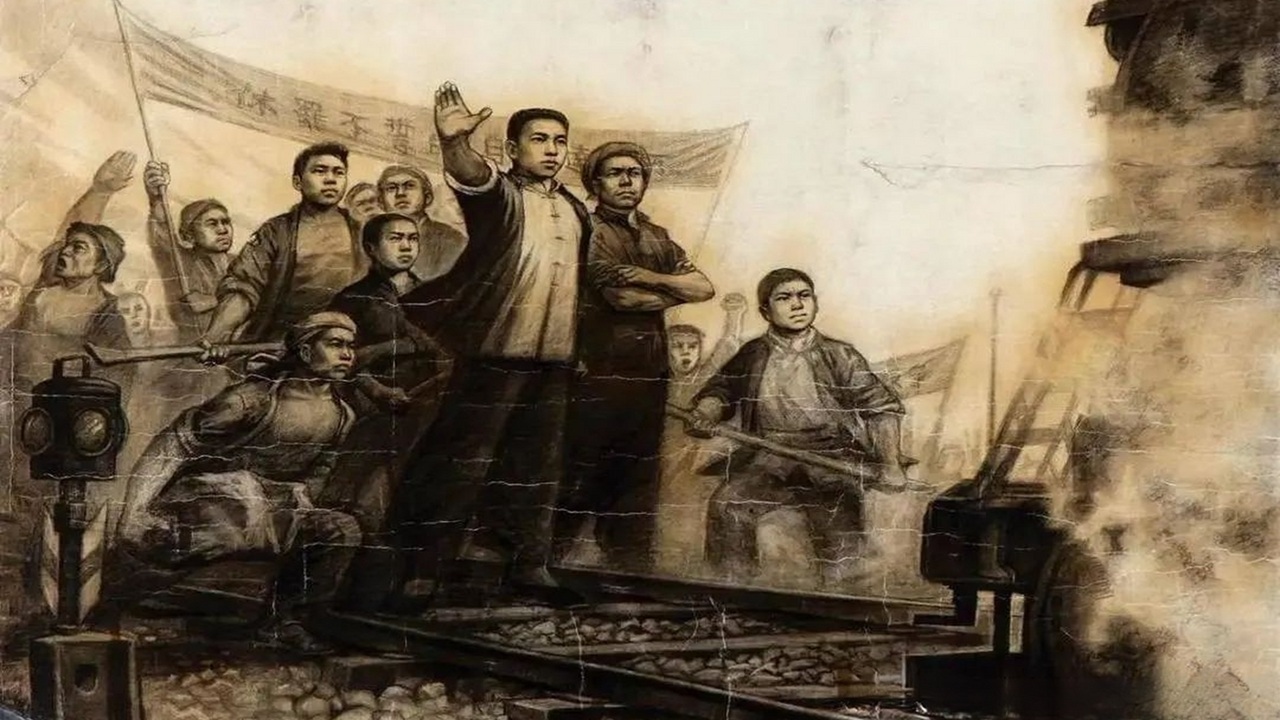
On a bitter February night in 1923, a young railway worker named Lin Xiangqian stood bound to a wooden stake on the platform of the Jiang’an Railway Station in Hankou. Soldiers demanded he order his fellow workers back to their posts. He refused. He was thirty-one years old when the blade fell.
That single act of defiance became the defining image of the Jinghan Railway Strike of 1923 — one of the most consequential labor events in modern Chinese history. Known in Chinese as the 二七大罢工 (Èr-Qī Dàbàgōng, or the “February 7th Great Strike”), this three-day uprising of 20,000 railway workers along the 1,200-kilometer Beijing–Hankou Railway line left dozens dead, hundreds wounded, and thousands expelled from their jobs.
More than a century later, the strike’s legacy endures. Monuments, museums, and public squares across China still bear its name. The Erqi Memorial Tower stands at the heart of Zhengzhou as the city’s most recognizable landmark. Every year, on or around February 7, citizens, students, and officials gather to remember the workers who sacrificed their lives for the right to organize.
This article tells the full story — the causes, the key players, the bloody climax, and the lasting impact — for anyone seeking to understand why the February 7th Massacre of 1923 still matters in 2026.
What Was the Beijing-Hankou Railway and Why Did It Matter in the 1920s?
To understand the strike, you first need to understand the railway itself.
The Beijing–Hankou Railway (京汉铁路, Jīnghàn Tiělù), also known historically as the Peking–Hankow Railway, was one of the most important transportation arteries in early twentieth-century China. Running approximately 1,200 kilometers from Beijing in the north to Hankou (now part of Wuhan) in the south, it linked the political capital with the commercial heartland of central China.
A Railway Built by Foreign Powers
Construction began in 1897 after a Belgian consortium secured a concession worth £4.5 million sterling from the Qing Dynasty government. French investors backed the Belgian company. The work progressed from both ends, with about 100 kilometers of embankments completed in the south and 60 kilometers in the north by the end of 1899. The Boxer Rebellion of 1900 temporarily halted construction, but the line was finished by 1906.
The railway’s foreign ownership quickly became a source of national humiliation. When the Belgians also purchased a controlling stake in the American-held concession for the connecting Guangdong–Hankou Railway, fears grew that the entire Beijing-to-Guangzhou corridor would fall under Franco-Belgian control. Opposition was fierce, especially in Hunan Province.
Repatriation Under Chinese Control
In 1907, a reformer named Liang Shiyi proposed forming the Bank of Communications specifically to buy the railway back from its Belgian owners. The bank was established in 1908 and provided over half the financing needed. On January 1, 1909, the Beijing–Hankou Railway officially came under Chinese ownership. This successful repatriation boosted the prestige of Liang’s Communications Clique, which became a powerful political force in the early Republic.
By the early 1920s, the Jinghan Railway had become far more than a transportation line. It was an economic lifeline. It moved troops. It generated enormous tax revenue. And it employed tens of thousands of workers — workers who lived in desperate conditions.
| Key Facts About the Jinghan Railway | |
|---|---|
| Route | Beijing to Hankou (now part of Wuhan) |
| Length | Approximately 1,200 km (745 miles) |
| Construction Period | 1897–1906 |
| Original Financier | Belgian consortium with French backing |
| Chinese Repatriation | January 1, 1909 |
| Modern Successor | Beijing–Guangzhou Railway (completed 1957) |
How Did Working Conditions on the Jinghan Railway Lead to the 1923 Strike?
The men who built, maintained, and operated the Jinghan Railway in the early 1920s lived under conditions that would be unimaginable today.
Exploitation at Every Level
Railway workers in this period faced a triple burden. Imperialist interests still exerted influence over railway operations through debts and trade agreements. Warlord governments taxed the railways heavily to fund their armies. And local bosses skimmed wages and enforced brutal discipline on the shop floor.
Workers endured long hours, low pay, and virtually no job security. Personal freedoms were restricted. Many laborers were not even allowed to leave their work areas without permission. Their political status was essentially nonexistent — they had no right to organize, no right to petition, and no legal avenue for grievances.
At the dawn of the twentieth century, the completion of the Jinghan Railway had created a large, concentrated industrial workforce in a country where such populations were still rare. These workers lived in railway towns along the line — in places like Changxindian near Beijing, Zhengzhou in Henan, and Jiang’an in Hankou. They shared cramped housing, faced common hardships, and gradually developed a shared identity.
The Rise of Railway Worker Unions
Between April 1922 and January 1923, workers along the Jinghan Railway began forming local unions. By the end of 1922, 16 individual workers’ unions had been established at various points along the line. These unions were small and local, each representing the workers at a particular station or depot.
But the workers understood that isolated local unions had little bargaining power. They needed a federation — a single, unified body that could represent all 20,000 workers along the entire 1,200-kilometer route. This idea of a Federation of Workers’ Unions of the Beijing–Hankou Railway became the spark that ignited the crisis.
Who Were the Key Leaders of the Jinghan Railway Workers’ Strike?
Every great historical event has its protagonists. The Jinghan Railway Strike produced several figures whose names are still honored across China today.
Lin Xiangqian (1892–1923): The Unbowed Worker
Lin Xiangqian (林祥谦) was born in Fujian Province in 1892 into a working-class family. He joined the Jinghan Railway as a laborer and worked at the Jiang’an depot in Hankou. By temperament, he was quiet but resolute. He joined the Chinese Communist Party (CCP) and rose to become the chairman of the Jiang’an branch of the railway workers’ union.
When the general strike was called on February 4, 1923, Lin became one of its most important on-the-ground coordinators in the Hankou area. On February 7, when warlord troops stormed the Jiang’an union headquarters, Lin was arrested.
His captors tied him to a stake at the Jiang’an Railway Station platform. They slashed his shoulders with swords and demanded he order the workers back to their jobs. Lin refused. According to accounts passed down through decades of commemoration, his final words were a defiant accusation against the warlords as the true cause of China’s suffering. He was executed on the spot. He was 31 years old.
Shi Yang (1889–1923): The People’s Lawyer
Shi Yang (施洋), born in 1889 in Zhushan County, Hubei Province, came from a rural farming family. Despite his humble origins, he studied law and eventually opened his own practice. He became known for taking cases on behalf of workers, the poor, and the marginalized — a rarity in an era when most lawyers served only the wealthy.
Shi Yang joined the CCP in 1922 and became the legal counsel for the Beijing–Hankou Railway Workers’ Federation. He played a central role in planning the February 1 inaugural congress and in coordinating the strike in the Hankou region alongside Lin Xiangqian.
On the evening of February 7, Shi Yang was arrested at his home. According to the account preserved by the Made in China Journal, when police arrived, Shi Yang calmly told his wife not to worry: “I didn’t violate any law.” He was taken to the Hankou police station, then transferred to a military facility in Wuchang the next morning. He was put on trial by a military tribunal, where he represented himself and openly condemned the warlord government.
Warlord Wu Peifu did not wait for the tribunal to finish. He issued a secret order for Shi Yang’s execution, which was carried out on February 15, 1923. In 1963, a large tomb was built for him in Wuchang, where he was re-interred with full honors.
Other Notable Figures
Several other workers and organizers also gave their lives in the struggle:
- Wang Shengyou and Si Wende — union leaders in Zhengzhou who were killed during the crackdown. The Erqi Memorial Tower was later built on the site where they fell.
- Unnamed workers in Changxindian, Baoding, and Gaobeidian who resisted the military suppression and were killed or expelled.
What Triggered the February 7th Great Strike on the Beijing-Hankou Railway?
The immediate cause of the strike was the military suppression of a peaceful union meeting. But the deeper causes ran much further back.
The Zhengzhou Congress of February 1, 1923
Throughout late 1922, the 16 local railway unions had been making plans to unite. A preparation commission was formed to organize the inaugural congress of the Federation of Workers’ Unions of the Beijing–Hankou Railway. The date was set for February 1, 1923, and the location was Pule Park in Zhengzhou, roughly halfway along the railway line.
Zhengzhou was chosen for practical reasons — it was centrally located and a major junction on the line. Delegates from unions up and down the corridor began making their way to the city.
Warlord Wu Peifu’s Intervention
The Jinghan Railway ran through territory controlled by Wu Peifu (吴佩孚), one of the most powerful warlords of the era. Wu was the leader of the Zhili clique of the Beiyang Army. At his peak, he commanded an estimated 500,000 troops and controlled large swaths of central and northern China. Britannica records that he was born in 1874 in Penglai, Shandong Province, and dominated Beijing-based politics from 1917 to 1924.
Wu saw the growing labor movement as a direct threat. The Jinghan Railway was the principal source of his economic and military sustenance. If workers could shut it down, they could cripple his army’s supply lines and his government’s revenue.
When he learned about the planned congress, Wu ordered his military police to block the meeting. Soldiers were dispatched to Zhengzhou to surround Pule Park and prevent the delegates from assembling.
The Workers Break Through
But the delegates were not deterred. On February 1, representatives from the local unions broke through the military blockade and declared the official establishment of the Jinghan Railway General Union (京汉铁路总工会). The congress was brief and defiant.
In response, the newly formed General Union issued five demands to the warlord government and called for solidarity among the people. When these demands were ignored, the union issued an order: a general strike would begin on February 4, 1923.
What Happened During the Three Days of the Jinghan Railway Strike in February 1923?
The strike unfolded rapidly. Within hours of the February 4 deadline, it paralyzed one of China’s most important transportation corridors.
February 4: The Railway Falls Silent
On that day, all transportation was halted along the Jinghan Railway. An estimated 20,000 workers across dozens of stations and depots laid down their tools. Trains stopped running. Freight stopped moving. The 1,200-kilometer line went dark.
The impact was immediate. Commerce ground to a halt. Military supply lines were cut. The strike affected not just Wu Peifu’s government but also foreign business interests tied to the railway and its cargo.
February 4–6: Standoff and Tension
For three tense days, the standoff continued. Workers held the line. The union’s headquarters, now relocated to Jiang’an in Hankou, coordinated the strike across the entire route. Workers in Zhengzhou, Changxindian, Baoding, and other stations all held firm.
Wu Peifu’s government, backed by foreign powers who feared disruption to their commercial interests, decided on a policy of violent suppression.
February 7: The Bloody Crackdown — The February 7th Massacre
On the morning of February 7, Wu Peifu mobilized an overwhelming military force. According to China Daily, he deployed more than 20,000 soldiers and police along the railway line. The crackdown struck simultaneously at multiple points:
- In Jiang’an (Hankou): Troops surrounded the union headquarters. Workers resisting the assault were shot. Lin Xiangqian was arrested and executed.
- In Zhengzhou: Union leaders Wang Shengyou and Si Wende were killed. Workers’ gatherings were violently dispersed.
- In Changxindian (near Beijing): The workers’ movement was forcibly put down.
- In Baoding and Gaobeidian: Similar crackdowns occurred.
The total number of casualties has been reported differently by various sources. The Wikipedia article on the Great Strike of February 7 states that 52 workers were killed and about 100 were injured, with thousands of workers expelled from their jobs in the following weeks. The chineseposters.net project places the figure at approximately 40 killed on February 7 alone. Encyclopedia.com’s entry on Wu Peifu records that his troops killed some 80 striking workers.
The discrepancies reflect the chaos of the event and the difficulty of gathering precise data in warlord-era China. What is not disputed is that the massacre was deliberate, widespread, and shocking.
| Timeline of the February 7th Strike | |
|---|---|
| February 1, 1923 | Workers break through military blockade to hold inaugural congress of the Jinghan Railway General Union in Zhengzhou |
| February 2–3 | Union issues five demands; deadline set for general strike |
| February 4 | General strike begins; 20,000 workers halt all railway traffic |
| February 7 | Wu Peifu deploys 20,000+ troops; massacres occur at Jiang’an, Zhengzhou, Changxindian, and other points |
| February 9 | Strike ends; union orders workers to resume work to preserve remaining forces |
| February 15 | Shi Yang is executed in Wuchang after a secret order from Wu Peifu |
Why Did the Jinghan Railway Strike Fail and What Were Its Immediate Consequences?
The strike lasted only three days before the union leadership ordered a return to work. This decision was made not out of weakness, but out of strategic calculation.
An Uneven Contest of Force
The fundamental problem was simple: the workers had no army. They faced a warlord with tens of thousands of well-armed troops, backed by foreign powers who feared disruption to their economic interests. The workers’ only weapon was their collective refusal to work — a powerful tool in peacetime, but no match for machine guns and bayonets.
The decision to resume work on February 9 was made jointly by the Jinghan Railway General Union and the trade unions in Hubei Province. The stated purpose was the preservation of revolutionary forces. In other words, the union leaders judged that continued resistance would only mean more death without political gain. It was better to retreat, regroup, and fight another day.
The Aftermath: Repression and Retaliation
The consequences for the workers were severe:
- Dozens killed in the crackdown (estimates range from 35 to 80+)
- Hundreds injured in the violence
- Thousands expelled from their railway jobs in the following weeks
- Union leaders hunted — many were arrested, imprisoned, or forced underground
- The Jinghan Railway General Union was dissolved by force
- Workers who wore union badges — inscribed with the characters for “Member’s Badge of the Jiang’an Jing-Han Railway Union” — were targeted for identification and punishment
The repression extended beyond the railway. Labor organizing across China became far more dangerous. Warlords in other regions took note of Wu Peifu’s methods and applied similar tactics to suppress workers’ movements in their own territories.
How Did the February 7th Massacre Change the Chinese Communist Party’s Strategy?
The failure of the Jinghan Railway Strike had profound implications for the Chinese Communist Party, which was barely two years old at the time.
The CCP’s Role in the Strike
The CCP had been deeply involved in organizing the railway workers. Since its founding in July 1921, the party had focused its energy on building a labor movement, following the orthodox Marxist-Leninist model that treated industrial workers as the vanguard of revolution. The party established the National Labour Union Secretariat and sent organizers to factories, mines, and railways across the country.
Between January 1922 and February 1923, over 100 major and minor strikes involving more than 300,000 workers took place nationwide, according to the Academy of Chinese Studies. The Jinghan Railway Strike was meant to be the crowning achievement of this “first wave” of the Chinese labor movement.
Both Lin Xiangqian and Shi Yang were CCP members. The party’s organizers had helped establish the 16 local unions and had pushed for their federation. The Jinghan strike was, in a very real sense, the CCP’s most ambitious project up to that point.
A Turning Point: From Workers to Peasants
The crushing defeat forced the CCP to reconsider its entire approach. Several lessons emerged:
- Workers alone could not defeat armed warlords. The industrial proletariat in 1920s China was too small, too scattered, and too vulnerable to military force to serve as the sole base of revolution.
- The party needed military allies. Pure labor organizing, no matter how effective, could not withstand the violence of the warlord system.
- Cooperation with the Guomindang became essential. After the February 7th defeat, the CCP moved toward closer cooperation with Sun Yat-sen’s Guomindang (Nationalist Party), which had both military resources and a broader political base. This led to the First United Front between the CCP and the GMD, formally established in 1924.
- The peasantry held untapped revolutionary potential. Thinkers within the CCP, most notably Mao Zedong, began to argue that China’s revolution would have to be led by its vast rural population, not just its relatively small urban working class. This intellectual shift — from an urban, worker-centered strategy to a rural, peasant-centered one — would eventually define the course of the Chinese revolution.
The chineseposters.net analysis summarizes this pivotal turn: after the defeat, the CCP reconsidered its strategy that relied heavily on a revolutionary working class, and began looking for cooperation with Sun Yat-sen’s Guomindang.
Where Can You Visit Memorials and Museums About the Jinghan Railway Strike Today?
The Jinghan Railway Strike is commemorated across several cities in China. For history travelers and heritage tourists, these sites offer a powerful window into early twentieth-century Chinese social history.
Erqi Memorial Tower, Zhengzhou — The Most Famous Landmark
The Erqi Memorial Tower (二七纪念塔, Èrqī Jìniàntǎ) is the most recognized monument to the strike. It stands in the center of Erqi Square in Zhengzhou, the capital of Henan Province.
The original memorial was a modest 21-meter wooden structure built in 1951. The current tower was completed on September 29, 1971. It is 63 meters (approximately 210 feet) tall with 14 floors, including 3 basement levels and 11 above ground. The tower’s distinctive design features two pentagonal bodies joined together, creating a profile that looks like a single tower from the east or west, and twin towers from the north or south. Its green-glazed tile roofs and archaized cornices blend traditional Chinese architectural elements with revolutionary memorial purpose.
A spiral staircase leads visitors to the top, where a bell tower plays the melody of “The East is Red” on the hour. Inside, an exhibition hall displays historical artifacts, photographs, documents, and interactive exhibits that tell the story of the strike through video and animated presentations.
Practical visitor information:
| Location | Erqi Square, Erqi District, central Zhengzhou |
| Admission | Free (bring your ID/passport) |
| Opening Hours | 8:30–18:30 (closed Mondays) |
| Metro Access | Line 1 & Line 3 to Erqi Square Station, Exit D |
| Bus Routes | Lines 2, 6, 21, 26, 34, 906, Y6 and others |
| Time Needed | 30–60 minutes |
In May 2020, Zhengzhou announced plans to enlarge the square surrounding the tower to 21,000 square meters and reduce the height of an adjacent building to better showcase the monument. This urban renewal project underscores how central the tower remains to Zhengzhou’s civic identity.
The area around Erqi Square is also the city’s busiest commercial district, packed with shopping malls, food streets, and restaurants. A visit to the memorial tower can easily be combined with an exploration of Zhengzhou’s famed culinary scene — including the city’s beloved huimian (stewed noodles) and hulatang (spicy soup).
Jiang’an — The Site of Lin Xiangqian’s Execution
Jiang’an (江岸), now a district within the modern city of Wuhan, is where the most dramatic events of the strike unfolded. It was here that Lin Xiangqian was executed on the railway platform and Shi Yang was arrested before being taken to Wuchang.
The February 7th Revolutionary Memorial Hall in Wuhan preserves the history of the strike with a focus on the events in the Hankou area. Each year, commemorative ceremonies are held here. In 2005, government officials, workers, students, and soldiers gathered in Wuhan to mark the 82nd anniversary of the strike, laying wreaths before the Monument to the Martyrs.
Shi Yang’s tomb, rebuilt in 1963, can be visited in Wuchang.
Changxindian, Beijing — Where the Northern Workers Organized
Changxindian (长辛店), a railway town on the southern outskirts of Beijing, was one of the earliest sites of labor organizing along the Jinghan line. The CCP established one of its first worker clubs there. The town played an important role in the February 7 events, as workers here joined the general strike and faced the military crackdown.
Today, visitors to Changxindian can see remnants of the old railway town and learn about the area’s role in the birth of China’s labor movement.
How Does the Jinghan Railway Strike Compare to Other Labor Movements Around the World in the 1920s?
The 1920s were a turbulent decade for labor movements globally. Placing the Jinghan Railway Strike in its international context helps illuminate both what was unique about it and what it shared with workers’ struggles elsewhere.
Parallel Movements Across the Globe
The early 1920s saw a wave of labor unrest worldwide, driven by the aftershocks of World War I, the Russian Revolution of 1917, and worsening economic conditions for working people.
- The Hong Kong Seamen’s Strike of 1922 — Just months before the Jinghan strike, Chinese seamen in Hong Kong struck for 56 days over wage disparities between Chinese and European sailors. The strike ended in a partial victory and demonstrated the growing power of organized Chinese labor.
- The Anyuan Railway Workers’ and Miners’ Strike of September 1922 — Perhaps the closest parallel. Over 17,000 workers at the Anyuan coal mines and railway in Jiangxi Province struck successfully, forcing management to accept most of their demands. This was one of the CCP’s earliest and most celebrated labor victories, organized in part by a young Mao Zedong, Li Lisan, and Liu Shaoqi.
- The Ruhr Strikes in Germany (1923) — German workers in the industrial Ruhr valley struck against the French and Belgian military occupation and the hyperinflation that devastated their wages. These strikes, called the Cuno strikes, brought down the German government of Chancellor Wilhelm Cuno in August 1923.
- The 1926 United Kingdom General Strike — Three years after the Jinghan strike, 1.7 million British workers walked off the job in solidarity with locked-out coal miners. The strike lasted nine days before the TUC called it off. Like the Jinghan strike, it ended in defeat for the workers, and like the Jinghan strike, it was followed by punitive anti-union legislation.
What Made the Jinghan Strike Different
The Jinghan Railway Strike stands apart from its Western counterparts in several ways:
- The violence was far more extreme. While the British General Strike saw relatively little bloodshed, the Jinghan strike ended in a military massacre. Warlord Wu Peifu deployed soldiers against unarmed workers with no pretense of legal process.
- It took place in a failed state. Unlike strikes in Germany or Britain, which occurred in countries with (however imperfect) legal systems and democratic structures, the Jinghan strike happened in a China fragmented by warlordism, where no central authority could protect workers’ rights.
- It was entangled with imperialism. Foreign powers had a direct economic stake in keeping the railway running. Workers were fighting not just their employers but an entire system of imperial and warlord exploitation.
- It catalyzed a strategic revolution. The defeat did not crush the movement — it redirected it. The CCP’s shift from urban workers to rural peasants as the base of revolution was one of the most consequential strategic decisions in twentieth-century history.
What Is the Lasting Historical Significance of the February 7th Railway Workers’ Strike?
More than a century after the events of February 1923, the Jinghan Railway Strike continues to resonate — in Chinese national memory, in labor history, and in the broader study of social movements.
A Foundational Myth of the Chinese Revolution
In the official narrative of the People’s Republic of China, the February 7th Strike occupies a hallowed place. It is taught in schools. It is commemorated annually. It is cited as proof that the CCP has stood with workers since its earliest days.
The strike is remembered as the moment when the Chinese proletariat “stepped onto the revolutionary stage,” in the words of official commemorations. The slogan of the strike — “Fight for freedom and human rights” — has been incorporated into the broader narrative of the Chinese revolution as a workers’ declaration of war against imperialism and feudalism.
Lessons for Global Labor History
For scholars of labor and social movements, the Jinghan Railway Strike offers several enduring lessons:
- Organization matters, but so does power. The workers were well-organized. Their unions were functioning. Their demands were reasonable. But without military force or political allies to back them up, organization alone was not enough against a determined and violent adversary.
- Defeats can be more influential than victories. The strike failed in its immediate objectives. But its failure led directly to the CCP-GMD alliance, the Northern Expedition, and ultimately the transformation of China’s revolutionary strategy. In the long arc of history, the February 7th defeat was more consequential than many victories.
- Memory is a political tool. The way the strike has been commemorated — through monuments, museums, textbooks, and annual observances — shows how historical events are shaped and reshaped to serve the needs of the present.
The Railway Today: From Jinghan to Jingguang
The old Jinghan Railway no longer exists as a separate entity. In 1957, with the completion of the Wuhan Yangtze River Bridge, it was merged with the Guangdong–Hankou Railway to form the Beijing–Guangzhou Railway (京广铁路, Jīngguǎng Tiělù). This combined line, at 2,324 kilometers, became the most important conventional railway in China, linking Beijing with Guangzhou through five provincial capitals.
Today, the route is served by the Beijing–Guangzhou High-Speed Railway, one of the busiest high-speed rail corridors in the world, with trains traveling at speeds up to 350 km/h. The journey from Beijing to Guangzhou, which once took days by conventional rail, can now be completed in about eight hours.
The contrast is striking. The workers who struck in 1923 lived in a China of warlords, foreign concessions, and grinding poverty. The passengers who ride the high-speed trains in 2026 travel through a China that is the world’s second-largest economy, with the largest high-speed rail network on Earth. Yet the memorial towers and monuments along the route serve as reminders that this transformation was built, in part, on the sacrifices of those who came before.
How Is the February 7th Strike Remembered and Commemorated in China in 2026?
The commemoration of the February 7th Strike has evolved over the decades, but it remains a significant part of China’s revolutionary heritage landscape.
Annual Ceremonies and Public Observances
Every year around February 7, ceremonies take place at memorial sites in Zhengzhou, Wuhan, and Beijing. Government officials, trade union representatives, students, and soldiers typically lay wreaths, observe moments of silence, and give speeches honoring the martyrs.
These events are covered by state media and serve as occasions for public education about the early labor movement. They are part of a broader calendar of “red tourism” (红色旅游, hóngsè lǚyóu) events that draw millions of Chinese domestic travelers each year to sites associated with the Communist revolution.
Red Tourism and Heritage Travel Along the Old Jinghan Route
For international heritage travelers, the old Jinghan Railway route offers a fascinating itinerary that combines labor history, revolutionary heritage, and contemporary Chinese culture. A suggested route might include:
- Changxindian, Beijing — See the origins of the railway labor movement in the old workshop district south of the capital.
- Zhengzhou, Henan — Visit the Erqi Memorial Tower and explore the vibrant commercial district surrounding Erqi Square. Don’t miss the Henan Museum, one of the finest provincial museums in China, and the ancient Shang Dynasty ruins nearby.
- Wuhan, Hubei — Tour the February 7th Revolutionary Memorial Hall in Jiang’an and visit Shi Yang’s tomb in Wuchang. Wuhan itself is a city of immense historical depth, from the 1911 Wuchang Uprising to the modern megacity of today.
Each of these cities is connected by China’s high-speed rail network, making it possible to complete the entire journey in a few days — a far cry from the laborious travel conditions of the 1920s.
The Erqi Tower as a Living Urban Landmark
The Erqi Memorial Tower is not just a museum piece. It is a living part of Zhengzhou’s urban fabric. Locals meet friends at Erqi Square. Shoppers browse the surrounding malls. Food vendors sell steamed buns and sesame soup in the shadow of the tower.
The ongoing urban renovation of Erqi Square, announced in 2020, aims to restore the tower to visual prominence after decades of being overshadowed by modern high-rises. The plan to enlarge the square and reduce the height of the adjacent Friendship Mansion reflects a conscious effort to keep the memorial relevant to a new generation.
What Can We Learn from the Jinghan Railway Strike of 1923 for Understanding China Today?
The story of the Jinghan Railway Strike is more than an episode from a distant past. It offers a lens for understanding several themes that remain central to Chinese society and politics in 2026.
The Relationship Between Labor and the State
The CCP’s origin story is deeply intertwined with the labor movement. The February 7th Strike is one of the founding chapters of that story. Understanding it helps explain why the Chinese government continues to view independent labor organizing with deep caution — not because it opposes workers’ interests per se, but because the party has always insisted on being the sole legitimate representative of the working class.
The Power of Infrastructure
In 1923, the railway was so vital that shutting it down threatened the entire warlord system. In 2026, China’s high-speed rail network, its ports, and its digital infrastructure play a similar role in the national economy. The lesson of the Jinghan strike — that infrastructure is both an engine of growth and a point of vulnerability — remains relevant.
The Role of Historical Memory
China invests heavily in historical commemoration. The February 7th memorials are part of a vast network of revolutionary heritage sites that includes everything from the birthplace of the CCP in Shanghai to Mao’s home in Shaoshan. These sites are not just tourist attractions; they are tools of national identity. They tell a story about where China came from and, by implication, where it is going.
For international visitors, engaging with these sites respectfully and thoughtfully — understanding their context without either uncritical acceptance or dismissive cynicism — is one of the most rewarding aspects of heritage travel in China.
Frequently Asked Questions About the Jinghan Railway Strike of 1923
What was the Jinghan Railway Strike of 1923? It was a general strike by approximately 20,000 workers on the Beijing–Hankou Railway (also called the Jinghan Railway) in February 1923. The strike was called to protest the military suppression of a union inauguration ceremony. It lasted from February 4 to February 9 and ended in a bloody crackdown by warlord Wu Peifu’s forces on February 7.
Why is it also called the February 7th Massacre? Because the deadliest violence occurred on February 7, 1923, when Wu Peifu deployed over 20,000 soldiers and police to suppress the strike. Workers were killed in Jiang’an (Hankou), Zhengzhou, Changxindian, and other locations along the railway.
How many people died in the February 7th Strike? Estimates vary. Sources report between 35 and 80 or more workers killed, with about 100 injured and thousands subsequently fired from their jobs.
Who were the most important martyrs of the strike? Lin Xiangqian (1892–1923), chairman of the Jiang’an branch union, and Shi Yang (1889–1923), the workers’ legal counsel, are the two most prominently remembered figures.
Where is the Erqi Memorial Tower? It is in Erqi Square in central Zhengzhou, Henan Province, China. It is free to enter and accessible via Metro Lines 1 and 3.
What does “Erqi” mean? “Erqi” (二七) literally means “February 7th” in Chinese — “er” (二) for “two” (the second month) and “qi” (七) for “seven” (the seventh day). It refers to the date of the massacre.
How did the strike affect the Chinese Communist Party? The failure of the strike prompted the CCP to shift its focus from urban workers to rural peasants and to seek alliance with the Guomindang (Nationalist Party). This strategic shift shaped the course of the Chinese revolution for decades to come.
Can I visit the memorial sites today? Yes. The Erqi Memorial Tower in Zhengzhou, the February 7th Memorial Hall in Wuhan, and historical sites in Changxindian near Beijing are all accessible to visitors, including international travelers. All are reachable by China’s high-speed rail network.
Final Reflections: Why the Jinghan Railway Strike of 1923 Still Resonates in 2026
Every February, when the cold winds sweep through central China, the memory of the Jinghan Railway Strike stirs again. It stirs in the wreaths laid at the foot of the Erqi Tower. It stirs in the classrooms where young students learn about Lin Xiangqian and Shi Yang. It stirs in the academic debates about labor, power, and revolution.
The strike of 1923 was, by its immediate measure, a failure. The workers were defeated. Their union was crushed. Their leaders were killed. But the blood spilled on the railway platforms of Jiang’an and Zhengzhou did not disappear. It seeped into the ground of Chinese political consciousness, nourishing movements and strategies that would reshape the country and, in time, the world.
For the heritage traveler, the labor historian, or simply the curious reader, the story of the Jinghan Railway Strike is a reminder that great changes often begin with acts of extraordinary courage by ordinary people. The workers who laid down their tools on February 4, 1923, were not generals, politicians, or philosophers. They were men who maintained tracks, stoked boilers, and loaded freight cars. When they chose to stop, they shook a system — and when they paid the price, they seeded a revolution.
Standing at the base of the Erqi Tower in Zhengzhou today, with the hum of modern city life all around you, it is worth pausing to remember that this busy commercial square sits on hallowed ground. The ghosts of 1923 are quiet now. But they have not gone away.
Interested in more stories of global labor history and heritage travel? Explore our archives for in-depth articles on workers’ movements and cultural commemorations from around the world.
References and Further Reading:
- “Beijing-Hankou Railway Workers Strike.” China.org.cn Wiki. http://wiki.china.org.cn/
- “Beijing–Hankou Railway.” Wikipedia. https://en.wikipedia.org/wiki/Beijing–Hankou_railway
- “Great Strike of February 7.” Wikipedia. https://en.wikipedia.org/wiki/Great_Strike_of_February_7
- “The Last Days of Shi Yang.” Made in China Journal, July 7, 2018. https://madeinchinajournal.com/2018/07/07/the-last-days-of-shi-yang/
- “Erqi Memorial Tower.” Wikipedia. https://en.wikipedia.org/wiki/Erqi_Memorial_Tower
- “Shi Yang.” Wikipedia. https://en.wikipedia.org/wiki/Shi_Yang
- “Wu Peifu.” Encyclopædia Britannica. https://www.britannica.com/biography/Wu-Peifu
- “Feb 4, 1923: Beijing-Hankou Railway Workers Go on a Strike.” China Daily. https://www.chinadaily.com.cn/
- “The Beijing-Hankou Railway Strike (1923).” Chineseposters.net. https://chineseposters.net/themes/beijing-hankou-railway-strike
- “Early Labour and Peasant Movements Led by the Chinese Communist Party.” Academy of Chinese Studies. https://chiculture.org.hk/en/photo-story/2758
- Hall, Jared. China’s First Red Martyrs: The February Seventh Massacre of 1923 and the Politics of Historical Memory. Thesis, George Washington University, Washington DC, 2010.
- Luo Zhanglong. “The 7 February Massacre.” In Ivan Franceschini and Christian Sorace, eds., Proletarian China: A Century of Chinese Labour. London: Verso Books, 2022. 74–86.