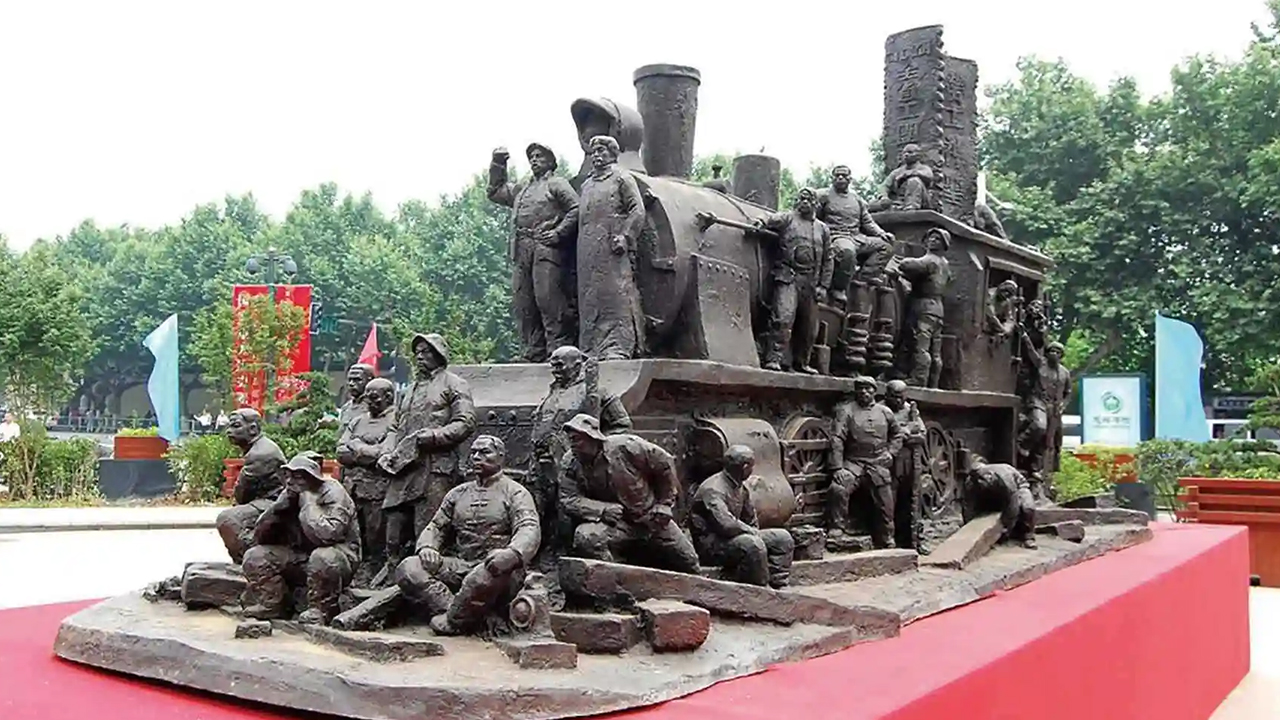
On a bitter winter morning in February 1923, the shriek of a locomotive whistle cut through the cold air along the banks of the Yangtze River. But this was no ordinary whistle. It was the sound of 20,000 railway workers laying down their tools, shutting their engines, and bringing one of the longest rail corridors in China to a dead stop. Within hours, the entire 1,200-kilometer Beijing-Hankou Railway — a lifeline that connected northern and southern China — fell silent.
What followed was not just a strike. It was a massacre. And the reverberations of that event, known as the February 7th Incident (二七惨案), shaped the trajectory of China’s labor movement, its revolutionary politics, and even the landscape of modern Chinese cities. Yet outside of China, almost nobody knows this story.
This is the untold story of the Jinghan Railway Strike of 1923 — told not from the pages of a textbook, but from the platform of a railway station where workers once traded their lives for dignity.
How the Beijing-Hankou Railway Shaped Early 20th Century China
To understand the strike, you first need to understand the railway. The Jinghan Railway (京汉铁路) — literally the “Beijing-Hankou Railway” — was not just a set of tracks. It was the backbone of modern China during the warlord era.
Construction began in 1897 when a Belgian consortium, backed by French financing, agreed to lend £4.5 million sterling for the project. The work progressed from both ends — south from Beijing, north from Hankou — through the flat plains of Hebei and the rolling hills of Henan. The Boxer Rebellion of 1900 briefly halted progress, but by 1906, the entire line was completed.
The railway quickly became a political football. Belgian interests, backed by the financier Édouard Empain, threatened to link the entire route from Beijing to Guangzhou under foreign control. This alarmed Chinese nationalists. In 1907, the reformist official Liang Shiyi proposed creating the Bank of Communications to buy back the railway. The bank was established in 1908, and by January 1, 1909, the Beijing-Hankou Railway was placed under Chinese control — a rare victory for Chinese sovereignty in an era of unequal treaties.
But ownership did not mean justice. The workers who operated and maintained the railway continued to toil under terrible conditions. Long hours. Low wages. No protections. No rights. The tracks ran through some of China’s most important cities — Beijing, Baoding, Zhengzhou, and Hankou (now part of Wuhan). And the men who kept the trains running were among the most organized and politically aware workers in the country.
| Key Facts: The Jinghan Railway | |
|---|---|
| Route | Beijing to Hankou (now Wuhan) |
| Length | Approximately 1,200 km |
| Construction period | 1897–1906 |
| Financed by | Belgian consortium (French backing) |
| Returned to Chinese control | January 1, 1909 |
| Modern successor | Beijing–Guangzhou Railway (京广铁路) |
By the early 1920s, the railway employed tens of thousands of workers across dozens of stations, workshops, and depots. These workers were about to make history.
Why Did China’s First Major Labor Movement Start on a Railway?
The answer lies in the unique nature of railway work in early Republican China. Railways were the most modern industry in a country still largely governed by feudal relationships. Workers were concentrated in large numbers at fixed locations — locomotive workshops, marshaling yards, station depots. They shared common grievances and could communicate along the length of the line.
More importantly, railways were strategic assets. Warlords depended on them to move troops and supplies. Shutting down a railway was not just an economic disruption — it was a political threat.
The early 1920s were a period of intense political awakening in China. The May Fourth Movement of 1919 had ignited nationalist sentiment among students and intellectuals. The Chinese Communist Party (CCP) was founded in Shanghai in July 1921, with labor organizing as one of its core missions. And across the country, workers were beginning to fight back.
The first wave of China’s labor movement, spanning roughly from January 1922 to February 1923, produced more than 100 strikes involving over 300,000 workers. Three events stand out as the peaks of this wave:
| Strike | Date | Workers involved | Outcome |
|---|---|---|---|
| Hong Kong Seamen’s Strike | January–March 1922 | Over 30,000 seamen; 120,000 in solidarity | Victory — 15–30% wage increase |
| Anyuan Railway and Coal Miners’ Strike | September 1922 | Over 13,000 miners and rail workers | Partial victory — wage and condition improvements |
| Jinghan Railway Strike | February 4–9, 1923 | Approximately 20,000 railway workers | Defeated — violent suppression |
The Hong Kong Seamen’s Strike of 1922 was a watershed moment. Chinese seamen demanded equal treatment with their European counterparts. After 52 days, they won significant wage increases and the reinstatement of their banned union. This victory electrified workers across China and demonstrated that collective action could achieve results.
The Anyuan strike in Jiangxi province is famous partly because of the young organizers who led it — including Mao Zedong and Li Lisan, who helped mobilize over 13,000 miners and railway workers. The iconic propaganda painting Chairman Mao Goes to Anyuan later commemorated this event, with an estimated 900 million copies printed during the Cultural Revolution.
Against this backdrop of rising labor consciousness, the Jinghan Railway workers prepared to take their stand.
The February 7th Strike: A Day-by-Day Timeline of the Jinghan Railway Workers’ Uprising
The story of the Jinghan Railway Strike unfolds over a single, fateful week. Here is what happened, day by day.
The Setup: 16 Unions, One Goal
By the end of 1922, workers along the Beijing-Hankou Railway had established 16 separate union branches at stations and workshops along the line. These unions represented workers at locations including Changxindian (near Beijing), Zhengzhou, Jiang’an (in Hankou), Baoding, and Gaobeidian.
The workers recognized that individual unions were vulnerable. They needed a united front. So the Preparation Commission of the Federation of Workers’ Unions of the Beijing-Hankou Railway was formed. They planned to hold the inaugural ceremony of the new federation on February 1, 1923, in Zhengzhou — a major railway junction roughly halfway along the line.
Nearly 300 delegates traveled to Zhengzhou for the event. The mood was hopeful. Workers believed that a unified federation would give them the bargaining power to demand better wages, shorter hours, and basic human dignity.
February 1: The Warlord Steps In
But one man stood in their way: Wu Peifu (吴佩孚).
Wu Peifu was one of the most powerful warlords of the era. Often called the “Jade Marshal,” he controlled vast territories across central China and depended heavily on the Jinghan Railway for military logistics and revenue. Britannica records that he had earlier developed a reputation as a relatively progressive warlord. He had supported student protests against Japanese encroachment and expressed sympathy for civilian governance. But when his vital interests were threatened, he could be ruthless.
On the morning of February 1, 1923, Wu dispatched large numbers of military police to Zhengzhou. Soldiers armed with live ammunition imposed martial law across the city. They surrounded the venue where the inaugural ceremony was to take place, blocked delegates from entering, and physically sabotaged the meeting hall.
The delegates were outraged — but not deterred.
February 1 (Evening): The Secret Meeting
That evening, union leaders held a secret meeting. They decided on two courses of action. First, they issued five demands to the authorities, including the dismissal of the Zhengzhou police chief and compensation for workers’ lost property. Second, they set a deadline: if the demands were not met within two days, they would call a general strike along the entire railway.
A critical decision was also made at this meeting: the headquarters of the federation would be moved from Zhengzhou to Jiang’an (江岸), a railway district in the city of Hankou. Two men were chosen to lead the strike in the Hankou area: Lin Xiangqian and Shi Yang.
February 3–4: The Move to Jiang’an and the Start of the Strike
On February 3, the federation’s leadership relocated to Jiang’an, transforming it into the nerve center of the entire strike operation.
At 9:20 a.m. on February 4, 1923, the strike whistle at the Jiang’an Locomotive Factory pierced the sky. The general strike had begun. Within three hours, every passenger train, freight car, and military transport on the Beijing-Hankou Railway had stopped. The entire 1,200-kilometer line — one of the most important rail corridors in China — was completely paralyzed.
Approximately 20,000 workers participated in the strike. Shops closed. Depots went dark. The economic and military lifeline between Beijing and central China was severed.
February 4–6: Standoff
For three tense days, the strike held. Workers maintained discipline and solidarity. Union leaders communicated along the line, coordinating actions at stations from Changxindian in the north to Jiang’an in the south. The five demands remained unmet.
Wu Peifu, now facing a direct challenge to his authority and his revenue, began mobilizing troops.
February 7: The Massacre
On the afternoon of February 7, 1923, Wu Peifu unleashed his forces. Backed by what China Daily reported as more than 20,000 soldiers and police, the crackdown fell simultaneously on multiple points along the railway.
In Jiang’an, troops besieged the Workers’ Union headquarters. In Zhengzhou, soldiers attacked striking workers. In Changxindian and Baoding, local garrisons moved to crush the movement. The violence was sudden and devastating.
The exact death toll remains debated by historians. Various sources cite different figures — some report 35 killed, others 40, still others 52. The Made in China Journal reports that 35 workers were killed in the immediate violence. Other Chinese sources state that 52 workers died, with over 300 injured and thousands expelled from their jobs. What is not in dispute is that the suppression was brutal, bloody, and intended as a message to all who would challenge warlord authority.
The strike was broken. On February 9, the Beijing-Hankou Railway Federation and trade unions in Hubei province jointly ordered the resumption of work — not out of surrender, but to preserve the lives of those who remained.
Lin Xiangqian: The Railway Worker Who Refused to Bow
Of all the stories to emerge from the February 7th Incident, none is more heartbreaking — or more defiant — than that of Lin Xiangqian (林祥谦).
Born in 1892 in Minhou County, Fujian Province, Lin came from a humble peasant family. He moved to Wuhan as a young man and found work at the Jiang’an railway workshops. He was known for his integrity, his natural leadership, and his devotion to his fellow workers. In 1922, when the Jiang’an Workers’ Club was established, he was elected financial officer. His colleagues respected him for his honesty — “with a clear distinction between public and private,” as one contemporary account noted.
Shortly afterward, Lin was promoted to chairman of the Jiang’an Branch of the Beijing-Hankou Railway Federation of Trade Unions. In the summer of 1922, he joined the Chinese Communist Party. He was 30 years old.
When the strike began on February 4, Lin was at the front lines. He organized workers, maintained discipline, and kept morale high. When Wu Peifu’s troops surrounded the Jiang’an union headquarters on February 7, Lin was captured.
What happened next has become one of the most remembered acts of defiance in Chinese labor history. According to accounts preserved in Chinese archives and memorial sites, the military commander Zhang Housheng dragged Lin to the railway platform. He put a knife to Lin’s throat and demanded that he issue the order for workers to return to work.
Lin’s wife, Chen Guizhen, had stumbled to the scene in the pre-dawn darkness. She cried out to her husband for some final words.
Lin, who had already accepted his fate, shouted back: “Leave me alone and go back to take care of the baby!”
Then, turning to his captors, he spoke the words that would echo through a century of Chinese history:
“This matter concerns the lives of 30,000 workers along the entire railway. My branch union must receive orders from the Federation before we return to work. You can cut off my head, you can spill my blood, but you will never make me order the workers back!”
Lin Xiangqian was executed on the spot. He was 31 years old.
Today, his hometown of Shanggan in Minhou County has been renamed Xiangqian Town (祥谦镇) in his honor. His martyrs’ cemetery, at the foot of Pillow Peak Mountain, 22 kilometers west of Fuzhou, remains a site of pilgrimage for those who remember.
Shi Yang: The Lawyer Who Defended Workers Until His Last Breath
If Lin Xiangqian was the strike’s heart, Shi Yang (施洋) was its legal mind.
Born on June 13, 1889, in the small village of Yangjiahe in Zhushan County, Hubei, Shi Yang came from a family of poor farmers. Against enormous odds, he educated himself, studied law, and eventually opened his own law firm. He dedicated his career to defending the poor and marginalized — workers, trade unionists, and anyone who could not afford representation.
In 1922, Shi Yang joined the Chinese Communist Party. But unlike many party members of the era, he preferred to work openly. He served as the legal consultant for the Beijing-Hankou Railway Workers’ Association and played a central role in organizing the February 1 congress in Zhengzhou.
When troops moved in on February 7, Shi Yang was at his home in Hankou. That afternoon, according to Wikipedia’s entry on Shi Yang, a dozen armed policemen burst through his door. Their leader demanded: “The boss of our department wants to meet you for a chat. Hurry up!”
Shi Yang, ever the lawyer, responded calmly: “Who is your boss?”
“The head of Hankou police, don’t you understand? Stop talking and follow me!”
“Since the director of such an important department has ordered you to come in person to fetch me, I will obviously come. Just please don’t be so aggressive. There is no need.”
His wife protested, insisting on accompanying him. Shi Yang reassured her: “I didn’t violate any law. Wherever they take me, there is nothing to worry about.”
He was taken to the Hankou police station, then transferred the next morning to a military facility in Wuchang. There, he was put on trial before a military tribunal. Representing himself, Shi Yang delivered a blistering criticism of the warlord regime and the repression of workers’ rights.
Wu Peifu did not wait for the trial to conclude. He issued a secret order for Shi Yang’s execution, which was carried out in the early morning of February 15, 1923. Shi Yang was 33 years old.
In 1963, a large tomb was built for Shi Yang in Wuchang, and his remains were re-interred there. Today, the Chinese government honors him as a revolutionary martyr — a lawyer who gave his life defending the people he served.
The Aftermath: How the February 7th Massacre Changed China’s Revolutionary Strategy
The crushing of the Jinghan Railway Strike was a devastating blow. But its effects were far-reaching and, in many ways, transformative.
Immediate consequences
The immediate aftermath was grim. Workers’ organizations along the railway were dismantled. Union leaders were hunted down. The nascent labor movement, which had been building momentum since 1922, was thrown into crisis.
Key figures and outcomes of the February 7th Strike:
| Name | Role | Fate |
|---|---|---|
| Lin Xiangqian | Chairman, Jiang’an Branch Union | Executed February 7, 1923 |
| Shi Yang | Legal consultant, Railway Workers’ Association | Executed February 15, 1923 |
| Wang Shengyou | Worker leader, Zhengzhou | Killed during the suppression |
| Si Wende | Worker leader, Zhengzhou | Killed during the suppression |
| Luo Zhanglong | CCP organizer, Changxindian area | Survived; continued party work |
A strategic turning point
For the young Chinese Communist Party, the February 7th Massacre was a wake-up call. The party had been focusing its energy on urban labor organizing, believing that the industrial working class would be the engine of revolution. But the brutal efficiency of Wu Peifu’s crackdown demonstrated a hard truth: workers alone could not defeat armed warlords.
This realization had profound consequences. Within months, the CCP began reassessing its strategy. At the Third National Congress in June 1923 in Guangzhou, the party debated its future direction. The defeat of the railway strike was a major factor in the decision to pursue the First United Front — an alliance with Sun Yat-sen’s Kuomintang (KMT) — in the hope that combined political and military strength could succeed where labor action alone had failed.
The shift also laid the groundwork for a later, even more consequential strategic transformation. When Mao Zedong eventually turned the party’s focus from urban workers to rural peasants as the base of revolution, the memory of February 7 was part of the calculus. The Jinghan Railway Strike had demonstrated both the courage of the Chinese working class and the limits of urban industrial action in a country still dominated by military strongmen.
The Erqi Memorial Tower in Zhengzhou: Visiting China’s Monument to Railway Workers
If you visit the city of Zhengzhou today, you cannot miss the Erqi Memorial Tower (二七纪念塔). It stands at the center of Erqi Square, the commercial heart of Henan’s capital, and it is the city’s most recognized landmark.
“Erqi” means “Two-Seven” — a reference to February 7, the date of the massacre. The tower was built to ensure that the sacrifice of the railway workers would never be forgotten.
The history of the tower
The first memorial structure was a modest 21-meter-high wooden tower erected in 1951. It stood on the site where worker leaders Wang Shengyou and Si Wende were killed during the suppression. In 1971, this was replaced by the current tower — a striking 63-meter reinforced concrete structure with 14 floors, designed in a traditional Chinese architectural style with green glazed tiles and archaized cornices.
The tower’s design is unusual. Its body consists of two connected pentagonal sections. Viewed from the east or west, it appears to be a single tower. Viewed from the north or south, it looks like twin towers. A winding staircase inside leads to the top floor, where visitors can enjoy a panoramic view of the city. At the very top, a bell tower houses six large bells that play the melody of “The East Is Red” every hour.
In May 2006, the Erqi Memorial Tower and its adjacent memorial hall were designated as a Major Historical and Cultural Site Protected at the National Level by China’s State Administration of Cultural Heritage.
Visiting the tower in 2026
For travelers visiting Zhengzhou today, the Erqi Memorial Tower offers a free and accessible window into this chapter of history.
| Visitor Information | |
|---|---|
| Location | Erqi Square, Erqi District, Zhengzhou, Henan Province |
| Admission | Free (ID required) |
| Closed | Every Monday |
| Metro access | Line 1 and Line 3, Erqi Square Station, Exit D |
| Bus routes | 6, 21, 34, 906, B50, Y6 to Erqi Square |
| Recommended time | 30–60 minutes for the tower; longer for the surrounding area |
Inside the tower, an interactive museum tells the story of the 1923 strike through exhibits, animated videos, and historical documents. The surrounding Erqi Business District is the most vibrant commercial area in Zhengzhou, packed with shopping malls, restaurants, and street food vendors. As one travel guide notes, the tower is a symbol of the city’s spirit and resilience — “by day it reflects the city’s history, but at night the tower glows with lights.”
In May 2020, city authorities announced plans to enlarge the square surrounding the tower to 21,000 square meters and to reduce the height of an adjacent building — the 20-story Friendship Mansion — to just 6 stories, so that the memorial tower can once again dominate the skyline.
The Former Site of the Jinghan Railway General Union in Wuhan
While Zhengzhou has the tower, Wuhan has the site where the strike was commanded. The former headquarters of the Jinghan Railway Federation of Trade Unions is located at 2185 Jiefang Avenue, Hankou — the very building where Lin Xiangqian and Shi Yang coordinated the February 4 walkout.
Today, this site has been rebuilt and preserved as a revolutionary memorial. Visitors can tour the building for free and learn about the events that unfolded there in those fateful days of February 1923. The site is modest compared to the gleaming towers and high-speed rail stations of modern Wuhan. But it carries a weight that no skyscraper can match.
For travelers combining a Wuhan visit with other historical sites, this memorial pairs well with the nearby Xinhai Revolution Museum, which documents the 1911 revolution that ended China’s imperial era. Together, these sites tell the story of a nation in transformation — from dynasty to republic, from feudalism to the stirrings of modern labor rights.
How the Jinghan Railway Became the Beijing-Guangzhou Railway
The tracks that witnessed the bloodshed of February 7, 1923, did not remain frozen in time. They evolved into one of the most important railway corridors in the world.
In 1957, the completion of the Wuhan Yangtze River Bridge — the first bridge to cross the mighty Yangtze — connected the Jinghan Railway in the north with the Guangdong-Hankou Railway in the south. The merged line became the Beijing-Guangzhou Railway (京广铁路), stretching 2,324 kilometers from Beijing to Guangzhou through five provincial capitals.
Today, this route is shadowed by the Beijing-Guangzhou High-Speed Railway, one of the longest high-speed rail lines in the world. Trains traveling at speeds up to 350 km/h cover the distance that once took days in just eight hours. The original conventional railway, its capacity freed from heavy passenger loads, now handles a dramatically increased volume of freight.
| The Railway’s Evolution | |
|---|---|
| 1897–1906 | Jinghan Railway built by Belgian consortium |
| 1909 | Returned to Chinese control |
| 1923 | February 7th Strike and Massacre |
| 1957 | Linked with Guangdong-Hankou line via Wuhan Yangtze River Bridge |
| 1992–2001 | Electrified in stages |
| 2012 | Beijing-Guangzhou High-Speed Railway completed |
The transformation from a colonial-era rail line to a pillar of 21st-century infrastructure mirrors the broader arc of Chinese history. But the ghosts of 1923 still linger along those tracks. Every high-speed train that glides through Zhengzhou passes within sight of the Erqi Memorial Tower. Every express that stops in Wuhan does so near the streets where Lin Xiangqian refused to kneel.
China’s First Wave of Labor Strikes: Lessons from the 1920s Workers’ Movement
The Jinghan Railway Strike was the climax — and the ending — of what historians call the first wave of China’s labor movement. Understanding that wave helps explain why the February 7th Incident carries such weight in Chinese historical memory.
Between January 1922 and February 1923, China experienced a surge of labor activism without precedent. The historian Jean Chesneaux has identified at least 152 strikes occurring between 1895 and 1918. But the early 1920s saw a dramatic acceleration, driven by several factors:
Rising political consciousness. The May Fourth Movement of 1919 had awakened nationalist sentiment among students and intellectuals. Magazines like New Youth (新青年) spread ideas about workers’ rights and international labor solidarity. In 1920, Li Dazhao — co-founder of the Chinese Communist Party — organized a Labor Day rally at Peking University with 500 students and workers, advocating for an eight-hour workday.
Stark economic inequality. Though China was still largely rural, over 2 million factory workers labored under terrible conditions in the early 1920s. Wages were low, hours were brutal, and safety protections were nonexistent. The pay gap between Chinese and European workers — especially in foreign-owned enterprises and on foreign ships — added an anti-imperialist dimension to labor grievances.
Organizational infrastructure. The CCP, founded in 1921, made labor organizing a priority from day one. Young party members — including Mao Zedong, Li Lisan, Liu Shaoqi, and Deng Zhongxia — fanned out across China’s industrial centers, establishing night schools, workers’ clubs, and union branches.
The wave crested with three major strikes: the Hong Kong Seamen’s Strike (victory), the Anyuan Strike (partial victory), and the Jinghan Railway Strike (defeat and massacre). Together, these events demonstrated both the power and the vulnerability of China’s young working class.
Why the February 7th Incident Still Matters in Modern China
More than a century has passed since the events of February 1923. China has undergone revolutions, wars, famines, and the most rapid industrialization in human history. Yet the February 7th Incident remains a touchstone of national memory. Here is why.
A founding narrative of the working class
In the official narrative of the People’s Republic of China, the February 7th Strike represents the moment when the Chinese proletariat — led by the Communist Party — first stepped onto the revolutionary stage. The workers’ slogan was “fight for freedom and human rights.” Their courage, and their sacrifice, helped the broader public recognize that imperialism and feudal warlordism were the enemies of the Chinese people.
The strike demonstrated that workers could organize across vast distances, maintain discipline under pressure, and paralyze critical infrastructure. Even in defeat, they awakened the nation.
A reminder of sacrifice
The stories of Lin Xiangqian and Shi Yang are not abstract history. They are personal, visceral, and deeply human. A father telling his wife to take care of the baby before being executed. A lawyer calmly following armed men out of his home, reassuring his wife that the law would protect him — knowing it would not. These are stories that resonate across cultures and centuries.
In China, these stories are taught in schools, commemorated at memorial sites, and celebrated in film and literature. They serve as reminders that the rights and protections workers enjoy today were not given freely — they were earned with blood.
Red tourism and heritage preservation
The memorial sites associated with the February 7th Strike are part of China’s extensive network of “red tourism” (红色旅游) destinations. These sites — which include revolutionary battlefields, historical party congress locations, and martyrs’ cemeteries — attract millions of domestic visitors each year.
The Erqi Memorial Tower in Zhengzhou, the former union headquarters in Wuhan, and the Lin Xiangqian Martyrs’ Cemetery near Fuzhou are all key stops on red tourism circuits. They serve a dual purpose: honoring the past and reinforcing national identity in the present.
Visiting the Key Historical Sites of the Jinghan Railway Strike in 2026
For travelers interested in Chinese labor history, revolutionary heritage, or simply off-the-beaten-path cultural tourism, the sites associated with the Jinghan Railway Strike offer a compelling itinerary. Here is a practical guide.
1. Erqi Memorial Tower and Erqi Square, Zhengzhou
Why visit: The most iconic memorial to the strike. The tower itself is architecturally unique, and the surrounding business district is perfect for shopping and street food.
Getting there: Fly into Zhengzhou Xinzheng International Airport. The city center is well connected by metro and bus. Take Metro Line 1 or Line 3 to Erqi Square Station, Exit D.
Tips: Visit in the evening for the best photos — the tower is beautifully illuminated at night. The Erqi Memorial Hall, adjacent to the tower, offers deeper historical context. Bring your ID for free entry. Closed Mondays.
Nearby: The Henan Museum, one of China’s finest provincial museums, is a short metro ride away. Mount Song and the Shaolin Temple are a popular day trip from Zhengzhou.
2. Former Site of the Jinghan Railway General Union, Wuhan
Why visit: The actual command center of the 1923 strike. A small but powerful memorial.
Getting there: Located at 2185 Jiefang Avenue, Hankou district, Wuhan. Accessible by bus and metro.
Tips: Combine with a visit to the Xinhai Revolution Museum (Wuchang district) and the Hubei Provincial Museum for a full day of historical exploration. End the day with Wuhan’s famous hot dry noodles (热干面) at a local stall.
3. Lin Xiangqian Martyrs’ Cemetery, Fuzhou
Why visit: The final resting place of the most famous martyr of the strike. Located at the foot of Pillow Peak Mountain, 22 km west of Fuzhou.
Getting there: Fly into Fuzhou Changle International Airport. The cemetery is in Xiangqian Town, Minhou County — reachable by local bus or taxi.
Tips: The setting is peaceful and somber. Groups of visitors and school students often come to pay their respects. The town itself, renamed in Lin Xiangqian’s honor, offers a glimpse of rural Fujian life.
4. Changxindian, Beijing
Why visit: The northern anchor of the strike. The Changxindian locomotive workshops were among the first sites to walk out on February 4, 1923. This area, on the outskirts of southwestern Beijing, was also a key base for early CCP labor organizing.
Getting there: Accessible by bus from central Beijing. The area is part of the Fengtai District.
Tips: Changxindian is less tourist-oriented than the other sites, but it rewards curious travelers with an authentic look at Beijing’s industrial heritage. The nearby China Railway Museum (main branch in Chaoyang District; branch at Zhengyangmen near Tian’anmen) offers additional context.
The Jinghan Railway Strike in the Context of Global Labor History
The February 7th Incident did not happen in isolation. It was part of a global tide of labor activism in the early 20th century.
In the United States, the 1920s saw fierce battles between organized labor and industrialists, including the Pullman Strike aftermath and continued coal mine struggles. In Britain, the General Strike of 1926 brought the country to a standstill. In India, textile workers in Bombay were organizing under the influence of both nationalist and communist movements.
What made the Chinese experience distinctive was the intersection of labor rights, anti-imperialism, and anti-warlordism. Chinese workers were fighting not just for better wages. They were fighting against a system in which foreign powers controlled key industries, warlords ruled by force, and working people had no legal protections whatsoever.
The Hong Kong Seamen’s Strike of 1922, for example, was explicitly framed as a struggle for equality between Chinese and European workers — a demand that linked labor rights to national dignity. The Jinghan Railway Strike extended this logic: workers were demanding the right to organize freely, a right that the warlord regime denied because it threatened the military’s control over strategic infrastructure.
In this sense, the Chinese labor movement of the 1920s was both a local struggle and a chapter in the worldwide story of working people demanding to be treated as human beings.
How to Plan a China Heritage Trip Around the February 7th Commemoration
Each year, February 7 is observed at memorial sites across China. While it is not a public holiday, commemorative events are held at the Erqi Memorial Tower in Zhengzhou, the former union headquarters in Wuhan, and martyrs’ cemeteries in Fuzhou and elsewhere.
For heritage travelers, building a trip around this date offers a unique opportunity to experience Chinese history as a living tradition rather than a museum exhibit. Here is a suggested itinerary:
| Day | Location | Activity |
|---|---|---|
| Day 1 | Beijing | Visit the China Railway Museum. Explore Changxindian area. |
| Day 2 | Train to Zhengzhou | High-speed rail (approx. 2.5 hours). Visit Erqi Memorial Tower and Erqi Square. Evening: Henan street food (try stewed noodles / 烩面). |
| Day 3 | Zhengzhou | Henan Museum. Optional day trip to Shaolin Temple. |
| Day 4 | Train to Wuhan | High-speed rail (approx. 2 hours). Visit former Jinghan Railway General Union site. Evening: Hot dry noodles and Yangtze River waterfront. |
| Day 5 | Wuhan | Hubei Provincial Museum. Xinhai Revolution Museum. Yellow Crane Tower. |
| Day 6 | Flight to Fuzhou | Visit Lin Xiangqian Martyrs’ Cemetery in Xiangqian Town. |
| Day 7 | Fuzhou | Explore Fuzhou old town. Three Lanes and Seven Alleys (三坊七巷). |
This itinerary follows the path of the railway itself — from Beijing south through Zhengzhou and Wuhan — before concluding in Lin Xiangqian’s hometown. It combines revolutionary heritage with some of China’s finest museums, food, and architectural treasures.
Frequently Asked Questions About the Jinghan Railway Strike and China’s Labor History
What does “Jinghan” mean? “Jinghan” (京汉) is a shorthand combining “Jing” (京, for Beijing) and “Han” (汉, for Hankou). The Jinghan Railway was the line connecting these two cities.
What is the “February 7th Incident”? The February 7th Incident (二七惨案), also called the February 7th Massacre or the Erqi Strike, refers to the violent suppression of the Beijing-Hankou Railway workers’ strike on February 7, 1923, by warlord Wu Peifu’s military forces.
How many people died in the February 7th Massacre? Estimates vary. Chinese sources commonly cite 52 workers killed and over 300 injured, though some Western sources put the death toll at 35 to 80. Thousands of workers were also dismissed from their jobs.
Who was Wu Peifu? Wu Peifu (1874–1939) was a Chinese warlord of the Zhili clique who controlled large parts of central and northern China during the early 1920s. He ordered the suppression of the railway strike because the Jinghan Railway was critical to his military logistics and revenue.
Is the Erqi Memorial Tower worth visiting? Yes. It is the most recognizable landmark in Zhengzhou and offers free admission. The interior museum provides an engaging account of the strike through interactive exhibits and video.
Can I still ride the old Jinghan Railway route? The original route has been incorporated into the Beijing-Guangzhou Railway. You can travel this route by conventional train. The parallel Beijing-Guangzhou High-Speed Railway covers the same corridor at much higher speeds.
Final Thoughts: The Sound of a Whistle That Changed History
The whistle that sounded at 9:20 a.m. on February 4, 1923, at the Jiang’an Locomotive Factory was not just an alarm. It was a declaration. It said: we are here, we matter, and we will not be silent.
The Jinghan Railway Strike was defeated in blood. Its leaders were killed. Its unions were smashed. But the movement it represented — the idea that working people deserve dignity, safety, and a voice — did not die on that railway platform. It lived on in the people who carried it forward, through decades of revolution, war, and transformation.
Today, as China’s high-speed trains glide at 350 kilometers per hour along the route that those 20,000 workers once shut down with nothing but their solidarity, the ghosts of February 7 ride alongside them. The Erqi Tower still stands in Zhengzhou. The bells still ring every hour. And the names of Lin Xiangqian and Shi Yang are still spoken with respect.
Some stories are untold not because they are unimportant, but because their weight is too great for casual telling. The Jinghan Railway Strike is one of those stories. It deserves to be heard — not just in China, but wherever people gather to remember the price of the rights they hold today.