There is a place in China where the mountains meet Myanmar, where tropical forests give way to terraced rice paddies, and where the thunder of ten thousand drumbeats shakes the red earth beneath your feet. That place is Dehong Dai and Jingpo Autonomous Prefecture, tucked into the far western edge of Yunnan Province. And if you are fortunate enough to visit around the fifteenth day of the first lunar month — usually falling in February — you will witness something that defies simple description: Munao Zongge, the grandest mass dance on Earth.
I first heard the drums from a hilltop overlooking Longchuan County. The sound rose through the mist like a heartbeat — steady, insistent, ancient. Below me, a sea of black, red, and silver swirled in formation around four towering wooden poles. Tens of thousands of Jingpo people, young and old, moved in synchronized steps. The silver ornaments on the women’s costumes flashed like starlight. The long swords in the men’s hands cut arcs through the morning air. This was not a performance staged for tourists. This was a living prayer. This was Munao Zongge.
In this guide, I will take you deep into the world of this extraordinary festival. We will explore its origins, its sacred poles and symbolic patterns, the breathtaking costumes, the thunderous drums, the feasts served on banana leaves, and the collective spirit that binds together one of China’s most fascinating ethnic minorities. Whether you are a cultural traveler planning your 2026 trip, a folklore researcher, or simply someone who loves a good story, this is for you.
What Is Munao Zongge Festival and Why Is It Celebrated by the Jingpo People?
Munao Zongge (目瑙纵歌) is the single most important cultural event for the Jingpo people. The name comes from the Jingpo and Zaiwa languages. “Munao” means “dance,” and “Zongge” means “everyone together.” So Munao Zongge literally translates to “everyone dances together” — a mass dance, a collective song, a communal prayer made with the body rather than with words.
The Jingpo are a Tibeto-Burman ethnic group numbering roughly 150,000 people in China, according to the 2010 national census reported by CGTN. They live primarily in the mountainous regions of Dehong Prefecture, though their cultural cousins — known as the Kachin in Myanmar — number over a million across the border. The Jingpo trace their ancestral migration from the Qinghai-Tibet Plateau, moving southward over centuries through some of the most rugged terrain in Asia. That long journey is encoded directly into the dance itself, as we will see.
Historically, Munao Zongge was held before battles, after victories, during good harvests, at weddings, and when welcoming honored guests. Today, it serves as a celebration of Jingpo identity, a prayer for prosperity, and a bridge connecting past and present. In 2006, the Chinese State Council officially added Munao Zongge to the national list of intangible cultural heritage, recognizing its importance not just to the Jingpo but to the cultural fabric of all of China.
The festival typically lasts three to seven days, with the main celebrations concentrated around the 15th day of the first lunar month — the same date as the Chinese Lantern Festival. While much of China is lighting lanterns and eating tangyuan, the Jingpo are dancing under open skies, their feet pounding the earth in patterns that have been passed down for generations.
The Ancient Origin Story of Munao Zongge: Legend of the Sun God and the Dancing Birds
Every great festival has an origin story. For Munao Zongge, the story begins in the heavens.
According to Jingpo oral tradition, the King of the Sun once hosted a grand carnival in his palace. He invited all of the Earth’s creatures to attend. The birds — being the only creatures capable of flight — made the journey to the Sun Palace and danced with great joy. On their way home, they stopped in a forest filled with beautiful fruit. To celebrate their good fortune, the birds held the First Birds’ Munao Carnival, dancing and singing beneath the trees.
Two human beings happened upon this forest. They watched the birds dance and were deeply moved. They joined in, and for the first time, humans experienced the happiness of Munao Zongge. As China Daily reported in its coverage of the festival, the legend holds that after humans learned this dance, they became healthier and luckier. From that day forward, whenever the Jingpo people needed to ward off evil, celebrate a triumph, or pray for a good harvest, they performed the Munao Zongge.
This is why, to this day, the lead dancer of Munao Zongge — called the Naoshuang — wears bird feathers on his head. He is the human embodiment of those first dancing birds. And the wooden poles at the center of the dance ground? They are carved with images of toucans and peacocks, the birds who first brought the dance from the Sun Palace to Earth.
There is a second legend, too. In this version, a demon terrorized the Jingpo people, devouring children and destroying villages. A brave hero named Leipan led his people to safety and, with the help of the Sun God, defeated the demon. The Jingpo held the first Munao Zongge in celebration of Leipan’s victory. Both stories carry the same core message: Munao Zongge is a celebration of survival, courage, and the collective spirit.
How to Experience Munao Zongge Festival in Longchuan County, Dehong Prefecture
Where the Festival Takes Place
The heart of Munao Zongge beats in Longchuan County (陇川县), located within Dehong Dai and Jingpo Autonomous Prefecture. Longchuan has the largest concentration of Jingpo people in China and preserves the most complete and standardized form of the Munao Zongge tradition. The festival is staged on a large open square called the Munao Square, spacious enough to hold tens of thousands of dancers.
Other Jingpo settlements across Dehong — including Yingjiang, Ruili, and Mangshi (the prefectural capital) — also hold Munao Zongge celebrations. But Longchuan is where the tradition runs deepest.
When to Go
The primary Munao Zongge Festival falls around the 15th day of the first lunar month. For 2026, this falls in mid-to-late February. However, additional celebrations are sometimes held during China’s Golden Week holidays (early October), making the festival accessible at multiple times of the year.
Getting There
Dehong is located in far western Yunnan, approximately 700 kilometers from Kunming by road. The most practical route is to fly into Mangshi Airport (also called Dehong Mangshi Airport), which has daily connections from Kunming. From Mangshi, Longchuan County is about a 90-minute drive south. Alternatively, you can take the scenic overland route through the mountainous interior of Yunnan — a journey that passes through Dali, Baoshan, and some of the most spectacular landscapes in China.
The Sacred Munao Poles: Symbols and Patterns That Guide the Dance
At the center of every Munao Zongge celebration stand four tall wooden pillars known as the Munao Poles (目瑙柱). These poles are not merely decorative. They are sacred objects that serve two essential functions: they honor the Sun God, and they guide the path of the dance.
The poles are painted and carved with a rich vocabulary of symbolic patterns. Each symbol tells part of the Jingpo story:
| Symbol on Munao Pole | Meaning |
|---|---|
| Fern sprouts (shaped like fists, with leaves resembling arrows) | Unity and forward progress |
| Swords and spears | Bravery and strength of character |
| The Himalayan mountain range | The ancestral homeland of the Jingpo people |
| Crops and livestock | Hope for a prosperous future |
| Gongs and musical instruments | Good fortune and joy |
| Toucans and peacocks (on crosspieces) | The birds who first danced the Munao in the Sun Palace |
A living bamboo pole is erected in front of the four wooden poles. It symbolizes the evergreen tree of life — a reminder that Jingpo culture is a growing, breathing thing. At its top sits a horizontal board bearing an image of the Himalayas, the legendary place where the Jingpo people first came into being.
The dance route itself is traced in an “S” pattern around these poles. This is not an arbitrary shape. According to Jingpo tradition, the S-curve represents the migration route of their ancestors — the long, winding path from the Tibetan Plateau down through the mountains to their present homeland in Dehong. Every step of the dance is a retelling of that journey.
The 12 Types of Munao Zongge Dance and Their Cultural Significance
Most visitors to the festival see one grand spectacle. But within that spectacle, there are actually 12 distinct types of Munao Zongge, each associated with a specific occasion. Here are the main categories, as documented by the Yunnan Intangible Cultural Heritage archives:
- Su Munao — Performed to celebrate a bountiful harvest
- Ba Dang Munao — A victory dance, performed after triumph in battle
- Dingshuan Munao — Danced when a new house is completed
- Deru Munao — Performed before going to war, as a vow of courage
- Tingre Munao — For celebrating the selection and laying of a building foundation
- Naosai Munao — A recreational dance, purely for enjoyment
- Kenran Munao — The wedding dance
- Tingran Munao — A dance of friendship, performed to strengthen bonds
- Kelong Munao — A welcoming dance for guests
- Gongran Munao — Performed during divorce proceedings
- Zhu Munao — A funeral and sacrificial dance
- Various combined forms for mixed celebrations
This list tells us something profound about Jingpo culture. Dance is not separate from life. It is woven into every major moment — birth, death, love, loss, war, peace, building, and breaking. There is a Munao for everything.
Traditional Jingpo Costume: Silver Ornaments, Dragon Scales, and the Art of Dressing for Munao
If the drums provide the heartbeat of Munao Zongge, the costumes provide its visual soul. And no discussion of this festival is complete without understanding the extraordinary artistry of Jingpo traditional dress.
Women’s Festival Costume
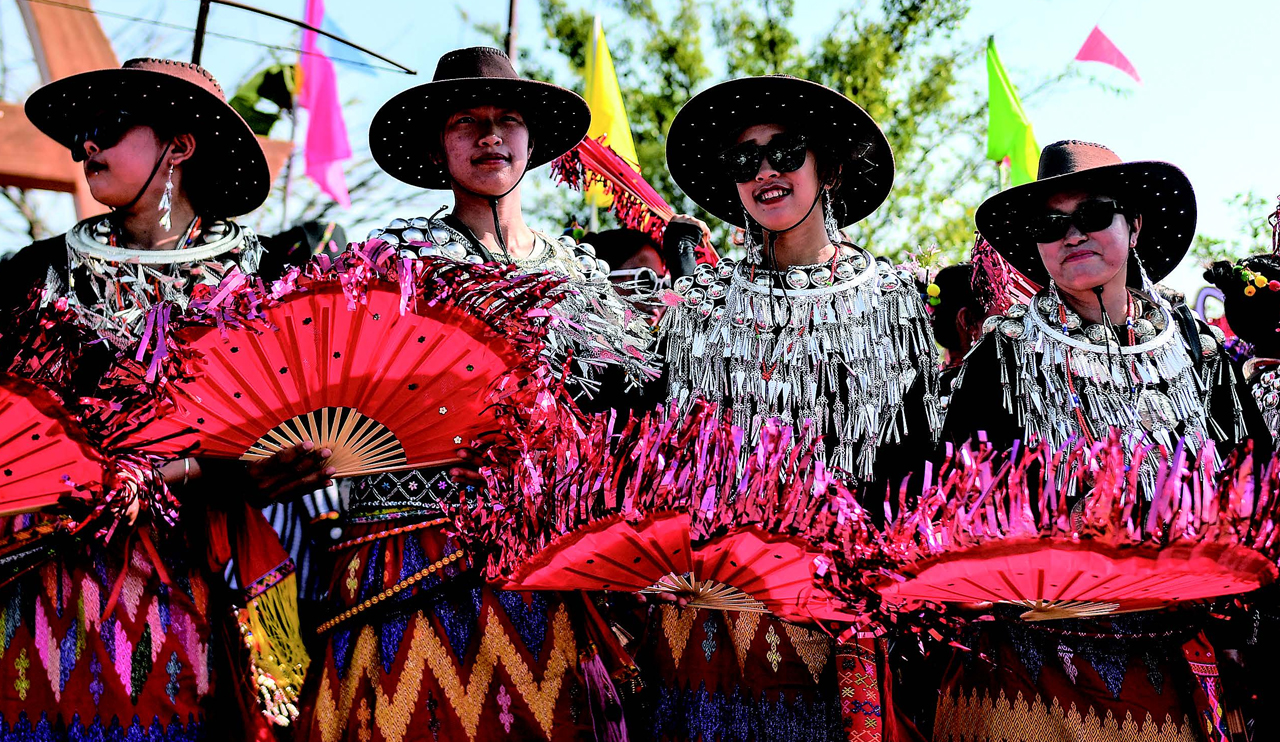
Jingpo women wear black blouses with a vertical front placket, paired with barrel skirts in vivid red and black. The skirts are typically made of woven wool, featuring bold geometric patterns. Over their heads, many women wear red jacquard scarves made of wool, and they wrap their lower legs in dark cloth.
But it is the silver ornamentation that takes your breath away. During Munao Zongge and other grand occasions, Jingpo women adorn their blouses with rows of silver plates, silver bubbles, and silver tassels attached to the front, back, and shoulders. According to the Yunnan Provincial Museum’s documentation on Google Arts & Culture, a fully dressed Jingpo woman may wear:
- Seven silver neck rings
- Silver earrings longer than her fingers
- One or two pairs of engraved silver bracelets
- A silver chain or a string of silver bells
- Dozens of silver bubbles (called “yinpao”) sewn onto the bodice
The more silver a woman wears, the more she is considered capable and prosperous. There is a beautiful cultural logic at work here: the silver is not merely decorative. It is a statement of skill, labor, and family wealth.
The Dragon Scale Connection
Here is a detail that moved me deeply when I first learned it. According to Jingpo folklore, Jingpo women are the descendants of a female dragon. The silver bubbles sewn onto their clothing are meant to represent dragon scales. When women dance during Munao Zongge, they swing and shake their bodies so that these silver “scales” catch the light and produce a shimmering, musical sound. As CGTN reported in their feature on Jingpo women’s silver dance, the effect is both dazzling to the eye and melodious to the ear — a performance that engages multiple senses at once.
Lacquered Rattan Waist Rings
Some Jingpo women also wear rattan rings around their waists, painted with red or black lacquer. The tradition holds that the more rattan rings a woman wears, the more beautiful she is considered. This is a unique aesthetic concept that sets Jingpo beauty standards apart from nearly any other culture I have encountered in my travels.
Men’s Festival Costume
Jingpo men dress in black and white clothing, wearing turbans on their heads — white turbans for young men, black turbans for elders. They carry the tongpa, a traditional embroidered satchel, across their bodies. Most strikingly, during Munao Zongge, men carry long swords (called “ntuq” in Jingpo), spears, or bows and arrows. These are not props. They are symbols of the Jingpo tradition of hunting and the warrior spirit.
The Naoshuang: The Lead Dancer’s Sacred Attire
The most elaborately dressed participants are the Naoshuangs — the lead dancers who guide the entire crowd through the dance. Naoshuangs wear crest-like headdresses adorned with bird feathers, recalling the origin legend of the dancing birds. Their robes are made of red and green silk, and they drape themselves in silver-colored cloaks. Each Naoshuang holds a long ceremonial sword. The four Naoshuangs stand in two columns. The front pair is called the “military pair,” while the rear pair is known as the “civil pair.”
The Role of Drums and Music in Munao Zongge Festival Dance Traditions
You feel the drums before you hear them. The vibrations travel through the ground and up through the soles of your feet. Then comes the sound — deep, resonant, and unyielding.
The music of Munao Zongge is built on a foundation of large drums and gongs. The drumbeat is not fast. It is steady and powerful, like a slow march. This is deliberate. The rhythm must be simple enough for tens of thousands of people to follow simultaneously. The tempo allows even first-time participants to pick up the steps within minutes.
The gongs add a metallic brightness to the deep drum tones, creating a sound that carries across the entire Munao Square. During a typical festival, four sessions of Munao Zongge dance are performed, each lasting about two hours. The drumming does not stop during these sessions. It is continuous, hypnotic, and profoundly physical.
Beyond the drums, there are the sounds of the dancers themselves. The silver ornaments on the women’s costumes jingle and chime with every step. The swords in the men’s hands whistle through the air. The collective footfall of thousands of dancers creates a deep, earthy percussion of its own. Together, these sounds create a layered sonic landscape that is unlike anything else in the world of ethnic music.
The Naoshuangs perform specialized ritual dances at the front of the formation, while the Naobas — a second category of dance leaders — work through the crowd, directing the movements with free, lively gestures. The Naobas ensure that everyone, from grandmothers to small children, stays in time with the beat.
This is the genius of Munao Zongge as a musical form: it is simultaneously structured and open. The dance route and the rhythm are fixed. But anyone can join at any time. There is no audition, no rehearsal, no ticket. You simply step into the line and let the drums carry you.
Green Leaf Banquet: Traditional Jingpo Food Culture During Munao Zongge Celebrations
The dancing is only one half of the Munao Zongge experience. The other half is eating — and the Jingpo have a way of eating that is as distinctive as their way of dancing.
The signature feast of Munao Zongge is the Green Leaf Banquet (绿叶宴), a communal meal that embodies the Jingpo philosophy of simplicity, nature, and togetherness.
What Makes the Green Leaf Banquet Unique?
Imagine long bamboo tables covered not with tablecloths but with fresh banana leaves. There are no plates. There are no bowls. There are no chopsticks, spoons, or forks. Every dish is wrapped in green leaves — palm leaves, plantain leaves, and various forest leaves gathered from the surrounding mountains. Even the rice is wrapped in leaves. Wine is served in cups made from hollowed bamboo.
Diners eat with their hands, wearing disposable gloves for hygiene. As recorded in historical texts from the Yuan and Ming dynasties, this style of eating — “food without utensils, served on banana leaves” — has been a hallmark of Jingpo culture for centuries.
What Is Served?
A typical Green Leaf Banquet includes seven to nine dishes. The cooking methods are roasting, boiling, frying, and pickling — all using ingredients gathered from the wild or grown locally. Here are some of the most celebrated dishes:
| Dish | Description |
|---|---|
| Pestled dish (舂菜) | Roasted meat, bamboo shoots, and herbs pounded together in a bamboo mortar. The most iconic Jingpo dish. |
| Ghost chicken (鬼鸡) | Not supernatural at all — chicken prepared with lemon juice, chili, and cardamom. A tangy, refreshing appetizer. |
| Bamboo tube roast fish | Fresh river fish sealed inside a bamboo tube and roasted over open flame. |
| Grilled beef | Beef roasted and then hammered with a wooden stick until tender and fragrant. |
| Glutinous rice wrapped in leaves | Sticky rice steamed inside banana or plantain leaf wrappers. |
| Wild herb salads | Foraged greens from the forest, seasoned with local spices. |
The defining characteristic of Jingpo cuisine is that it is spicy but not greasy. The flavors are bright, sharp, and herbaceous. If Dai cuisine (the other major food tradition in Dehong) is known for its sour and refreshing notes, Jingpo cuisine is defined by its bold heat and fresh ingredients.
The Social Meaning of the Banquet
During the Munao Zongge festival, the Green Leaf Banquet serves as a communal gathering that reinforces social bonds. In recent years, large-scale banquets have drawn over 4,000 participants, including guests from Taiwan, Myanmar, and around the world. Eating together from banana leaves, with no barriers of tableware, embodies the same egalitarian spirit as the dance itself: everyone is equal at the table, just as everyone is equal in the dance line.
Jingpo Ethnic Culture and Heritage Preservation: Intangible Cultural Heritage Status
The inclusion of Munao Zongge on China’s national intangible cultural heritage list in 2006 was a turning point for the preservation of Jingpo culture. This recognition brought government funding, media attention, and a sense of institutional permanence to a tradition that had survived centuries of migration, warfare, and social upheaval.
But heritage preservation is not just about official lists. It lives in people.
Shang Deguang, a provincial-level inheritor of Munao Zongge, has devoted his life to passing on the tradition. In an interview with China Daily, he noted the festival’s growing reach. The tradition that was once celebrated only within Jingpo communities now attracts people from across the globe.
There are formal mechanisms of cultural transmission at work. Longchuan County is recognized as the most representative area for Munao Zongge inheritance, with a system of designated inheritors who teach younger generations the dances, songs, and rituals. Local schools incorporate elements of Jingpo culture into their curricula. Cultural centers host exhibitions and workshops throughout the year.
At the same time, the Jingpo community is grappling with the same challenges that face indigenous cultures everywhere: urbanization, migration of young people to cities, and the homogenizing pull of digital culture. The annual festival serves as a gravitational force, pulling people back to their roots, reminding them who they are and where they come from.
Cross-Border Cultural Connections: Jingpo, Kachin, and the Myanmar Border
One of the most fascinating dimensions of Munao Zongge is its cross-border character. Dehong Prefecture shares a boundary of approximately 500 kilometers with Myanmar. On the other side of that border live the Kachin people — who are, in cultural and linguistic terms, the same people as the Jingpo.
The Kachin speak the Jingpo language (called Jinghpaw in Myanmar). They share the same ancestral traditions, the same clan structures, and the same love of Munao. In Myanmar, the equivalent celebration is called the Manau Festival, and it plays an equally central role in Kachin cultural identity.
During the Munao Zongge Festival in Dehong, Kachin visitors from Myanmar regularly cross the border to participate. As reported by CGTN, Kachin musicians and dancers have described the festival as a homecoming. The border may be a political reality, but culturally, it dissolves during Munao Zongge. The dance ground becomes a shared space where national boundaries cease to matter, and ethnic kinship takes precedence.
In recent years, the festival has also welcomed participants from Taiwan’s indigenous communities, including members of the Amis people. These cross-cultural exchanges add new layers of meaning to a festival already rich with historical significance.
What to Expect at Munao Zongge Festival 2026: A Complete Travel Guide for Visitors
If this article has convinced you to visit Munao Zongge in 2026, here is what you need to know.
Festival Dates
The 2026 Munao Zongge Festival will take place around mid-to-late February, coinciding with the 15th day of the first lunar month. Check the exact dates closer to your trip, as the lunar calendar shifts each year. A secondary celebration may also occur during the October Golden Week.
What to Bring
- Comfortable walking shoes — you will be on your feet for hours, often on packed earth.
- Sun protection — Dehong sits at a low altitude with a subtropical climate. Even in February, the sun can be strong.
- A respectful attitude — this is a sacred and cultural event, not a theme park. Dress modestly, ask before photographing individuals, and follow local guidelines.
- An empty stomach — the Green Leaf Banquet awaits.
Festival Etiquette for Visitors
Respecting Jingpo customs is essential. Here are some important rules, based on traditional Jingpo hospitality norms:
- Never stand in front of the Naoshuang (lead dancer). Instead, follow behind the dance line.
- Accept offerings of rice wine and food with both hands. This is a sign of respect.
- Do not whistle inside a Jingpo home. It is considered disrespectful.
- Do not reverse banana leaves when they are used as plates. In Jingpo tradition, reversed leaves are associated with hostility.
- Do not eat dog meat in Jingpo areas. According to Jingpo legend, a dog once stole food seeds from heaven and saved the people from starvation. Dogs are therefore honored, not eaten.
Nearby Attractions in Dehong
While you are in Dehong, take time to explore the wider region:
- Ruili — A border town known for its jade and jewelry trade, tropical gardens, and the famous “One Village, Two Countries” site where China and Myanmar share a single community.
- Menghuan Golden Pagoda — A stunning Burmese-style Buddhist pagoda on a mountain overlooking Kongque Lake.
- Tower Wrapped in Tree (树包塔) — A surreal natural phenomenon where a centuries-old banyan tree has grown around and engulfed a Buddhist pagoda.
- Mangshi — The prefectural capital, with excellent restaurants serving both Dai and Jingpo cuisine.
How Munao Zongge Dance Reflects the Collective Spirit of the Jingpo Community
There is a moment during Munao Zongge that stays with me more than any other. It comes about an hour into the dance, when the individual participants begin to lose themselves in the collective rhythm. The faces change. The self-consciousness that visitors carry into the dance line melts away. Eyes close. Smiles emerge. The drumbeat becomes the only thing that exists.
This is the collective spirit of Munao Zongge — and it is, I believe, the real reason this festival has endured for centuries.
In an age of individualism, Munao Zongge is a radical act of togetherness. There is no audience and no stage. Everyone is a participant. The S-shaped dance route ensures that you are always facing someone, always moving with someone, always connected to the living chain of dancers that stretches back through the Munao Square and back through time.
The Jingpo word for this kind of collective identity is hard to translate. It is closer to “family” than to “community,” but it extends far beyond blood relations. It includes the living and the dead, the people on this side of the border and the people on the other side. It includes the birds who first danced in the Sun Palace and the hero Leipan who defeated the demon. When the Jingpo dance Munao Zongge, they are dancing with all of these beings at once.
This is why the festival cannot be fully understood from photographs or video. You have to feel the ground shake. You have to hear the silver jingle. You have to let the drums enter your body. Only then do you begin to understand what Munao Zongge really is: not a festival, but a way of being in the world together.
The Future of Munao Zongge: Cultural Tourism, Youth Engagement, and Digital Storytelling
As of 2026, Munao Zongge stands at a crossroads — not of survival, but of evolution.
The festival’s inclusion on the national intangible cultural heritage list has brought significant resources for preservation. Annual celebrations in Longchuan now attract upwards of 200,000 visitors, with as many as 60,000 people directly participating in the dance. These numbers continue to grow year over year as Dehong’s tourism infrastructure improves and as awareness of Jingpo culture spreads through social media and documentary filmmaking.
Young Jingpo people are playing an increasingly active role in cultural preservation. While some elders worry about the younger generation losing touch with tradition, the reality on the ground is more nuanced. Many young Jingpo are using platforms like Douyin (the Chinese version of TikTok), WeChat, and Bilibili to share videos of Munao Zongge, Jingpo cooking, and traditional craftsmanship. They are not abandoning their heritage. They are translating it into a new language — the language of the digital age.
At the same time, cultural tourism brings both opportunities and risks. The influx of visitors supports local economies, creating demand for Jingpo handicrafts, cuisine, and homestay accommodations. But it also raises questions about commodification and authenticity. How do you welcome the world to your most sacred dance without turning it into a spectacle? How do you share your culture without losing control of its narrative?
The Jingpo community is navigating these questions with characteristic resilience. The answer, so far, seems to be rooted in the same principle that governs the dance itself: everyone is welcome to join, but the Naoshuang still leads the way. The tradition adapts without surrendering its core. The drums keep beating. The silver keeps shining. The S-shaped path keeps winding through the Munao Square, retracing the journey of ancestors who walked a thousand miles to find a home.
Practical Tips for Attending the Jingpo Munao Zongge Festival in Yunnan, China
Here is a quick reference for planning your 2026 trip:
| Detail | Information |
|---|---|
| Festival name | Munao Zongge (目瑙纵歌) |
| Ethnic group | Jingpo (景颇族) |
| Location | Longchuan County, Dehong Prefecture, Yunnan Province, China |
| Usual timing | 15th day of the first lunar month (February, varies by year) |
| Duration | 3–7 days |
| Nearest airport | Mangshi Airport (Dehong Mangshi Airport) |
| Distance from Kunming | ~700 km by road; ~1 hour by air |
| Heritage status | China National Intangible Cultural Heritage (since 2006) |
| Estimated visitors (annual) | 200,000+ |
| Can visitors join the dance? | Yes — everyone is welcome to enter the dance line |
| Key food experience | Green Leaf Banquet (绿叶宴) |
| Climate in February | Subtropical; warm days, cool nights; 15–25°C |
Frequently Asked Questions About Munao Zongge Festival
Is Munao Zongge a UNESCO World Heritage event? Not yet at the UNESCO level. However, it has been on China’s national intangible cultural heritage list since 2006, which is the highest level of domestic cultural protection. There are ongoing discussions about future UNESCO consideration.
Can foreigners participate in the dance? Absolutely. One of the most beautiful aspects of Munao Zongge is its open invitation. Anyone — regardless of ethnicity, nationality, or dance ability — can step into the line and join. Just follow the person in front of you and keep time with the drums.
What language is spoken? The Jingpo language (Jinghpaw) is the primary language of the festival, though Mandarin Chinese is widely understood. The Zaiwa dialect is also common in Longchuan. Younger Jingpo people often speak both Jingpo and Mandarin fluently.
Is the festival safe for solo travelers? Yes. Dehong is generally safe, and the festival atmosphere is welcoming and communal. Standard travel precautions apply. Accommodations in Longchuan are limited, so book early — or stay in Mangshi and make the day trip.
What is the best way to show respect? Learn a few words of Jingpo. Follow the dance etiquette. Accept food and drink with both hands. Avoid loud or disruptive behavior during ceremonial moments. When in doubt, watch what the locals do and follow their lead.
Final Thoughts: Why Munao Zongge Deserves a Place on Every Traveler’s Bucket List
In over twenty years of chasing festivals across six continents, I have seen fire dances in Fiji, bull runs in Pamplona, lantern releases in Chiang Mai, and carnival in Rio. Munao Zongge stands apart from all of them — not because it is louder or flashier, but because it is deeper.
This is a festival where the dance is not performed for you. It is performed with you. Where the costumes are not costumes at all, but the living skin of a culture that has survived migration, colonialism, revolution, and modernity. Where the drums do not entertain. They summon.
If you can make it to Longchuan in February 2026, go. Step into the line. Let the Naoshuang lead you. Let the drums enter your feet. Let the silver flash around you. And for a few hours, let yourself be part of something that is older, wiser, and more joyful than anything you have known.
The Jingpo have a saying, roughly translated: “When we dance together, we are one.”
I have stood in the Munao Square. I can tell you — they mean it.
This blog post was researched and written with deep respect for the Jingpo people and their cultural traditions. All factual information has been cross-referenced with primary sources including CGTN, China Daily, the Yunnan Provincial Museum, and the Yunnan Intangible Cultural Heritage archives. The author encourages all visitors to approach Munao Zongge with humility, curiosity, and an open heart.