
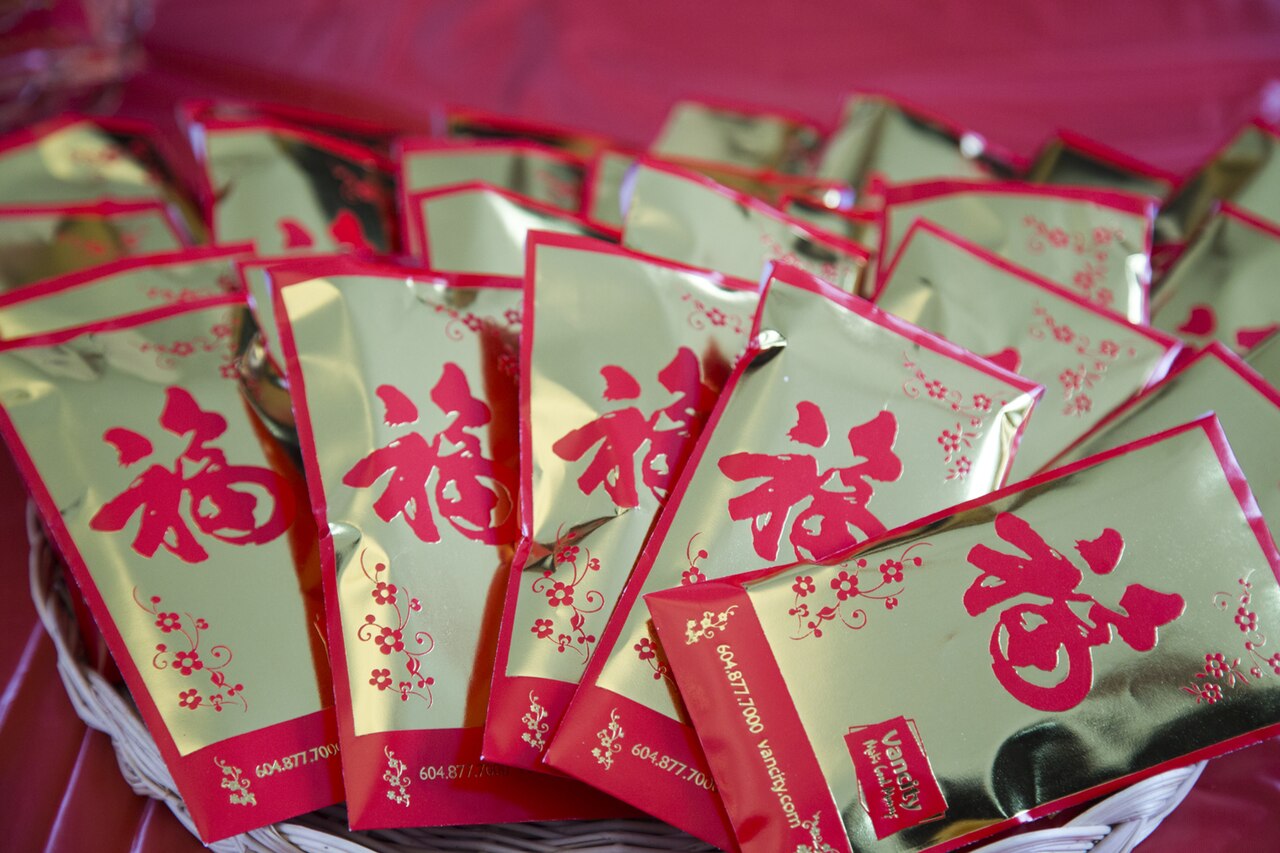
The red envelope is the most recognisable exchange of the Chinese New Year, and also the one outsiders most often get wrong. Hand over the wrong amount, use the wrong hand, or pick a number with a four in it, and a well-meant gift can land awkwardly. This guide explains what red envelopes mean, who gives them to whom, when to give them, how much to put inside, and the etiquette that makes the gesture land as intended.
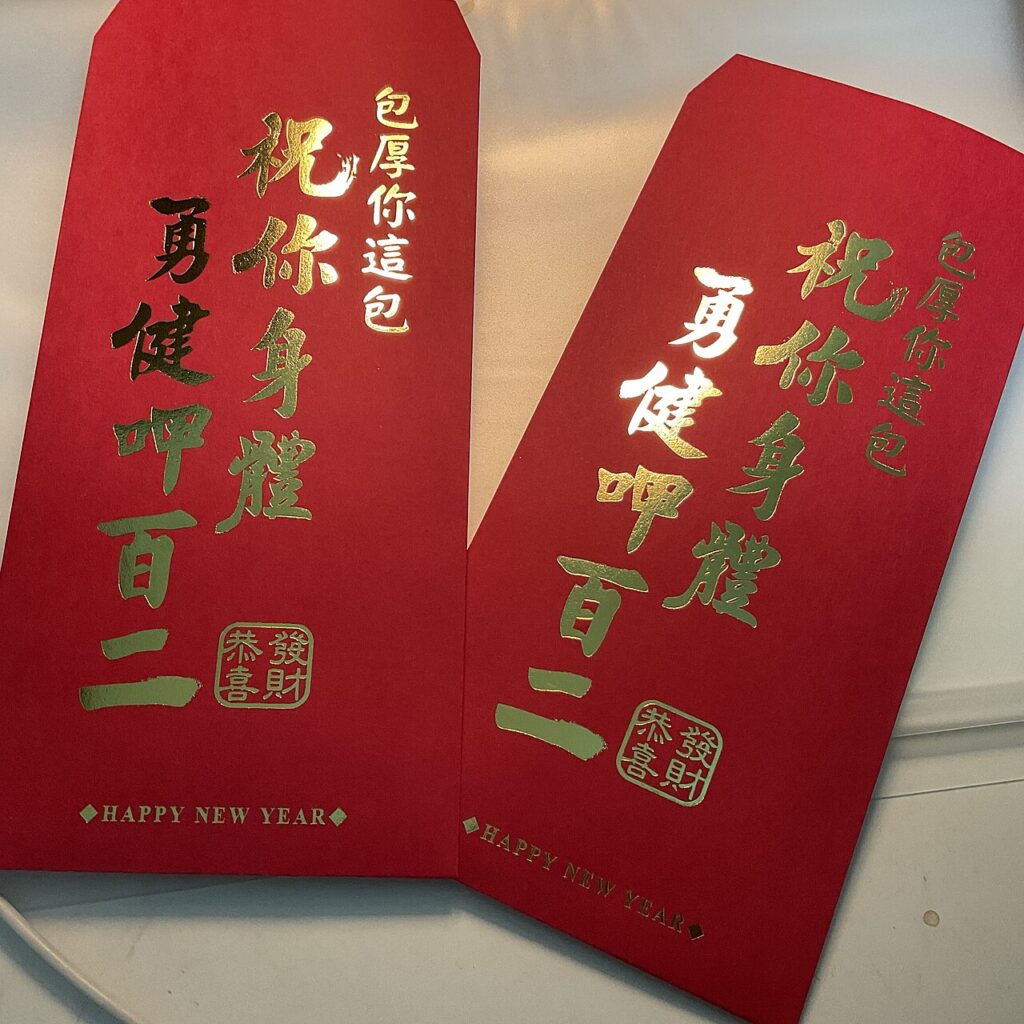
What Red Envelopes Mean
A red envelope (红包, hóngbāo) is simply money wrapped in red paper, but the wrapping carries the meaning. Red is the colour of luck and protection in Chinese culture, and the money inside is not really a transfer of wealth; it is a vessel for a blessing. The traditional name for New Year money given to children is yāsuìqián (压岁钱), which can be read as “money to suppress the year” or “money that wards off evil.” The gift is meant to keep the recipient safe and fortunate through the year ahead.
The Legend Behind Lucky Money
The custom is usually traced to a legend about a demon named Sui (祟), said to appear on New Year’s Eve to touch sleeping children on the head, leaving them feverish and frightened. According to the story, one couple gave their child eight coins to play with to keep him awake. The child eventually fell asleep with the coins, wrapped in red paper, beside his pillow. When Sui crept in, the coins flashed with light and drove the demon away. The eight coins were believed to be a disguise of the Eight Immortals. From then on, parents wrapped coins in red paper to protect their children, and because the word for the demon, suì (祟), sounds identical to the word for age, suì (岁), the lucky money came to be called yāsuìqián.
The form of the gift has changed over the centuries even as its meaning held. In imperial China the original yāsuìqián was not paper money but coins, often a hundred of them threaded onto a red string in a chain meant to symbolise long life, or braided into small ornaments. As printed banknotes and machine-made paper became common in the twentieth century, the string of coins gave way to the red paper envelope we know today, which kept the amount private and added a surface for auspicious words and images. The red wrapper, in other words, is the part that endured; what goes inside it has simply followed whatever form money has taken.
Who Gives, and Who Receives
The flow of red envelopes follows the structure of the family. The basic rule is that those who are married give, and those who are not yet married receive. In practice that means several directions of giving:
- Married adults give to children and to the unmarried younger members of the family. This is the classic exchange.
- Adult children give to their parents and grandparents as a gesture of filial respect and gratitude, often with a more generous amount.
- Employers give to employees, frequently on the first working day after the holiday, as a bonus and a wish for a prosperous year.
- Anyone may give to the children of friends they visit during the New Year period.
An important point of etiquette for couples: a married couple is usually treated as a single unit and gives one combined envelope rather than two separate ones. Crossing the married line is the moment a person’s role flips from receiver to giver, which is why unmarried adults, however old, may still receive envelopes from married relatives.
When to Give Them
The main giving period runs from New Year’s Eve through the early days of the festival. Many families hand children their envelopes on New Year’s Eve after the reunion dinner, or on the morning of the first day after the children offer New Year greetings to their elders. In Hong Kong and among many Cantonese families, the custom extends through the first fifteen days, until the Lantern Festival, so there is no rush to give them all at once.
Red envelopes are not limited to the New Year. The same gift, in the same red wrapping, appears at weddings, at the birth or first month of a baby, at milestone birthdays for the elderly, and at graduations. The colour and the gesture carry across all of life’s happy occasions.
How Much to Put Inside
There is no fixed amount, and trying to find a single “correct” figure misses the point. The sum depends on your relationship to the recipient, your means, and local custom, which varies widely: symbolic amounts are normal in Hong Kong, where the envelope, called lai see, is often a token, while mainland amounts can be much larger. What matters more than the exact figure is following the conventions around the number itself:
- Prefer even numbers. Good things in Chinese culture come in pairs, so even amounts are auspicious. Odd numbers are associated with funerals and are avoided.
- Avoid anything with the digit four. Four (四, sì) sounds like the word for death (死, sǐ), so amounts like 40 or 400 are considered deeply unlucky.
- Favour eight. Eight (八, bā) echoes the word for wealth and prosperity (发, fā), making amounts such as 8, 88, or 888 especially welcome. Six, linked to smoothness, is also a lucky choice.
- Use new, crisp banknotes. Giving fresh bills shows care and respect, and many people queue at banks before the holiday to exchange worn notes for new ones.
For romantic partners, amounts built around the number nine sometimes appear, because nine (九, jiǔ) sounds like the word for “long-lasting,” a wish for an enduring relationship. The deeper logic of these lucky and unlucky numbers connects to the same wordplay that governs Chinese New Year taboos.
While there is no fixed figure, it helps to have a sense of the relative scale, since the amount is read as a signal of the relationship. The closer the bond and the more senior the recipient, the more generous the envelope. As rough guidance, drawn from common practice rather than rule:
- Your own children: the most generous envelopes in the household, often the year’s largest.
- Parents and grandparents: a substantial amount from working adult children, given as filial gratitude.
- Nieces, nephews, and the children of close friends: a moderate, warm amount.
- The children of acquaintances or colleagues: a smaller, token sum is perfectly appropriate.
- Building staff, cleaners, and security guards: a small symbolic envelope, common in Hong Kong and southern China as a thank-you.
Regional norms matter as much as relationship. In Hong Kong, lai see is deliberately modest and symbolic, and handing over a token amount is entirely correct, whereas mainland amounts, especially between close family, tend to be larger and have risen over the years to the point that some people now feel social pressure around them. The safest approach as a guest is to ask a local friend what is normal in that family and follow their lead rather than guessing high.
The Modern Pressure of the Red Envelope
As incomes have risen, so have expectations around amounts, and in parts of mainland China the custom has become a genuine source of stress. Young working adults can find themselves expected to give envelopes to a long list of relatives’ children, sometimes amounting to a meaningful share of a month’s salary, and rural areas in particular have seen sums climb to levels that strain budgets. The reaction has been a quiet pushback: families agreeing to cap amounts, regions where a modest token is proudly the norm, and younger people defending the idea that the gesture, not the figure, is the point. It is a useful reminder that the healthiest version of the tradition is the one that keeps the blessing larger than the bill.
How to Give and Receive Gracefully
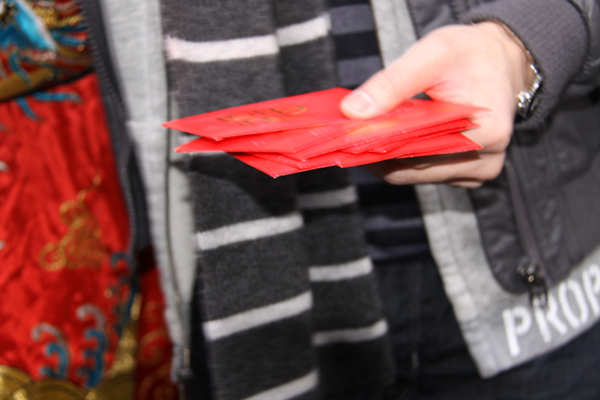
The handover has its own quiet etiquette. Offer and accept the envelope with both hands, which signals respect. The receiver should never open the envelope in front of the giver, as inspecting the amount on the spot is considered rude and greedy; envelopes are opened later, in private. Children are taught to accept with a New Year greeting, a wish such as gōngxǐ fācái rather than a simple thank you. A wider set of these blessings is collected in our guide to Chinese New Year greetings.
One exception is worth knowing: white and blue envelopes, and odd amounts, belong to funerals and condolence gifts, not celebrations. For the New Year, stay with red and even numbers.
Digital Red Envelopes
The physical envelope now shares the season with a digital twin. In 2014 the messaging app WeChat introduced a digital red packet feature, and it spread with astonishing speed, turning the giving of lucky money into a nationwide online event. The most popular format is the group red packet: a sender puts in a total sum and specifies a number of packets, and the app splits the money into random amounts that members of a chat group race to grab. The randomness turned a solemn tradition into a game, and rival platform Alipay competed fiercely for the same New Year audience in what the press dubbed a “red envelope war.” For families separated by distance, digital envelopes also made it easy to send lucky money home instantly.
The scale of the digital shift is hard to overstate. After WeChat tied its red packet feature to the wildly popular New Year’s Eve television gala, hundreds of millions of envelopes began flying between phones in the opening seconds of the new year, and the feature is widely credited with rapidly spreading mobile payments across China. The format has since folded into everyday life, with red packets sent for birthdays and thank-yous year round, and China’s emerging digital currency, the e-CNY, has experimented with its own official New Year envelopes. For all that, the physical envelope has not disappeared. Many families still treat the paper hongbao, handed over in person with both hands, as the version that carries the real weight of the blessing, with the digital one reserved for relatives too far away to visit.
Red Envelopes Across Asia
The custom is not Chinese alone. Across the cultures that share the Lunar New Year, and beyond, the same idea of lucky money in a special envelope recurs under different names:
- Vietnam: children receive lì xì during Tết, in red envelopes much like the Chinese ones.
- Singapore and Malaysia: the Hokkien term ang pow is used, and the custom is shared across the region’s Chinese communities.
- Korea: at Seollal, children receive sebaetdon, New Year money, after performing the formal sebae bow, though it is often given in white or patterned envelopes rather than red.
- Japan: at the Gregorian New Year, children receive otoshidama, money in small decorated envelopes called pochibukuro.
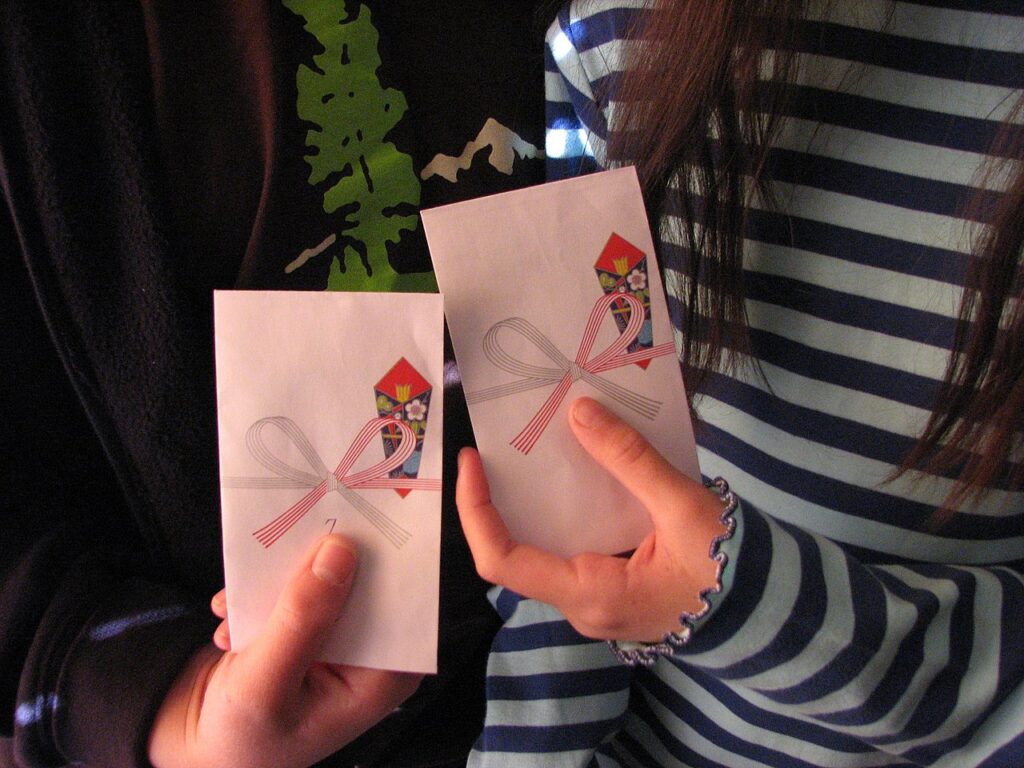
These variations are part of what distinguishes the wider Lunar New Year from the Chinese version specifically, a distinction explored in our guide to Lunar New Year versus Chinese New Year.
Red Envelopes at Weddings
At a Chinese wedding, the red envelope replaces the wrapped gift almost entirely. Guests give cash in a red envelope, and the unwritten expectation is that the amount should at least cover the cost of your seat at the banquet, with more from close family and friends. The same number rules apply, with extra force: even amounts only, never anything with a four, and figures built around eight and nine are especially favoured, nine for its sound of lasting union. Couples often keep a careful record of who gave what, both to thank guests and because the gift is understood to be reciprocal when the giver later marries or celebrates. Wedding envelopes are frequently more ornate than New Year ones, printed with double-happiness characters and gold foil.
Red Envelopes for Births, Birthdays, and Graduations
The red envelope follows the family through its milestones. When a baby reaches its first full month, the red egg and ginger party traditionally brings envelopes for the newborn. Elderly relatives receive generous envelopes at milestone birthdays, the sixtieth, seventieth, and eightieth being especially significant, as a wish for long life. Students are given envelopes to mark graduations and academic success. In each case the logic is the same as at New Year: the envelope is less about the money than about wrapping a blessing in the luckiest colour and handing it across a generation.
Choosing and Buying Red Envelopes
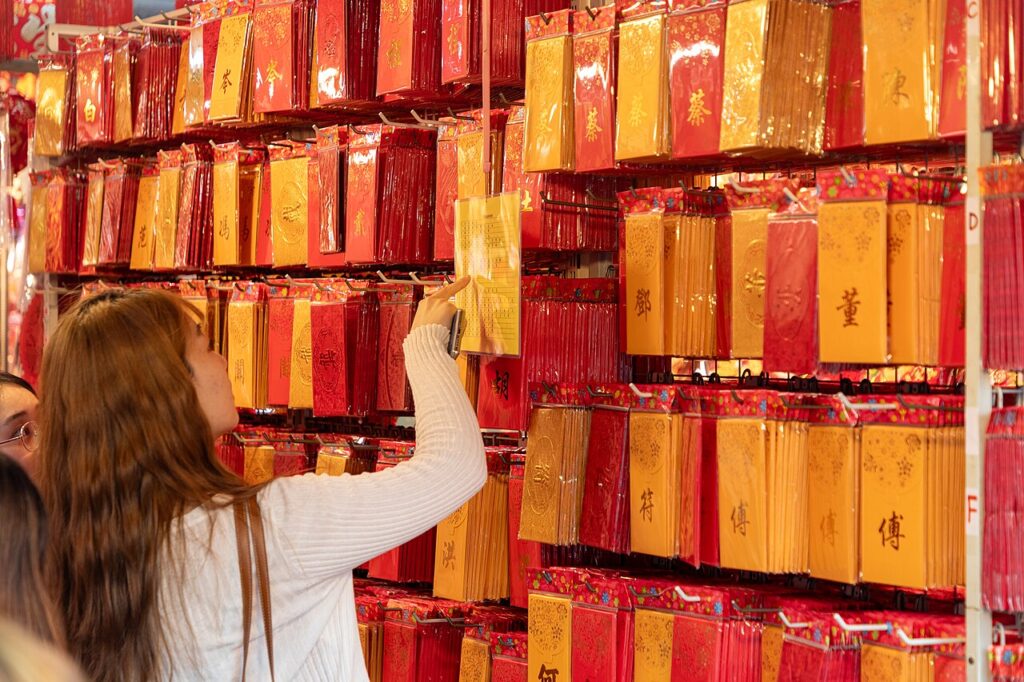
Red envelopes are sold everywhere in the run-up to the New Year, from supermarkets and stationery shops to banks, which often give branded ones to customers. When choosing, look for designs that suit the moment: many carry the year’s zodiac animal, the character for fortune or wealth, or gold-foil good-luck phrases. A few practical points are worth keeping in mind. Reserve white, blue, and black envelopes for funerals and condolence money, never for celebrations. Avoid reusing an envelope you have received, as a fresh one shows care. And buy a few more than you think you need, since the New Year has a way of producing unexpected children to bless.
Red Envelopes in the Workplace
The custom reaches into working life as well as family life. In many Chinese companies the first day back after the holiday is marked by managers handing red envelopes to staff, and some employers give a “kai gong” envelope to open the working year on a prosperous note. Among colleagues the etiquette is lighter: peers do not generally exchange envelopes, though a married employee might give a small one to a much younger, unmarried junior. For anyone managing a team in a Chinese or multicultural workplace, a modest and equal red envelope for staff is a thoughtful gesture, provided it follows the same rules as any other: red, an even amount, no fours, and handed over with both hands and a word of New Year goodwill.
Common Mistakes to Avoid
- Giving an amount that contains a four, or an odd number.
- Using old, creased, or dirty banknotes instead of fresh ones.
- Handing the envelope over with one hand, or opening one in front of the giver.
- Using a white envelope, which belongs to funerals.
- Forgetting the people who quietly deserve one: parents, grandparents, and sometimes the building’s cleaners or security staff, who are often remembered at New Year.
What Children Do With the Money
For children, the red envelopes are one of the great pleasures of the New Year, and how the money is handled varies from family to family. In some households younger children hand their envelopes to their parents for safekeeping, a practice that has launched countless half-joking complaints about money promised to be “kept for you” that never quite returns. Older children are increasingly allowed to keep and manage their own, which makes the New Year a natural occasion for a first lesson in saving and budgeting. Beyond the cash, the ritual teaches its own quiet lessons: that gifts are received with both hands and a courteous greeting, that elders are thanked with respect, and that good fortune is something passed deliberately from one generation to the next rather than simply taken. For many adults, the memory of collecting those bright envelopes as a child remains among the warmest of the whole year, which is precisely why they take such care to keep the custom alive for the next generation: crisp notes, lucky numbers, both hands, and all.
The Spirit of the Gesture
Strip away the rules and the red envelope is a small, bright act of care: a wish for safety, health, and good fortune passed from one generation to the next, sealed in the luckiest colour there is. Get the number right and give it with both hands, and the gesture says exactly what it is meant to. The red envelope is one thread in the larger fabric of the festival, which our complete guide to Chinese New Year ties together in full.
Frequently Asked Questions
Who gives red envelopes to whom?
Married adults give to children and unmarried younger relatives, adult children give to their parents and grandparents, and employers give to employees. Crossing into marriage is what turns a person from a receiver into a giver.
How much money should go in a red envelope?
There is no fixed amount; it depends on your relationship and local custom. Follow the conventions instead: prefer even numbers, favour amounts with the lucky digit eight, avoid any amount containing four, and use new, crisp banknotes.
Can unmarried adults receive red envelopes?
Yes. The dividing line is marriage, not age, so an unmarried adult may still receive red envelopes from married relatives, while a young married couple is expected to start giving them.
Is it okay to give red envelopes if I am not Chinese?
Yes, and it is often appreciated as a sign of respect for the tradition. Just follow the basic etiquette: red envelope, even amount, no fours, new notes, and give it with both hands.
Should I open a red envelope in front of the giver?
No. Opening it on the spot to check the amount is considered rude. Accept it with both hands and a New Year greeting, and open it later in private.
What is a digital red envelope?
Apps such as WeChat and Alipay let users send lucky money electronically. A popular format is the group red packet, where a total sum is split into random amounts that members of a chat group race to claim, turning the tradition into an online game.