Somewhere deep in the subtropical borderlands of western Yunnan, where China meets Myanmar across a winding 500-kilometer frontier, tens of thousands of people gather each spring to dance. Not in a nightclub. Not at a concert. They dance in an open square, following the painted patterns on four towering wooden poles that rise twenty meters into the sky. The drums never stop. The silver ornaments on the women flash in the sun. The men carry long knives and bows, moving their feet in ancient steps that trace the migration route of their ancestors from the Tibetan Plateau. This is the Munao Zongge Festival — the grandest celebration of the Jingpo ethnic minority — and it may be the most spectacular mass dance event on the planet.
If you have not yet heard of it, you are not alone. While millions of travelers flock to Yunnan each year for the cobblestone lanes of Lijiang, the terraced rice paddies of Yuanyang, or the Dai water-splashing festivities in Xishuangbanna, the Munao Zongge Festival remains gloriously under the radar. That is exactly why now — in 2026 — is the perfect time to go. China’s expanded visa-free policies have opened the country to travelers from over 100 nations, and Dehong Prefecture, the festival’s heartland, is more accessible than ever before.
This guide covers everything you need to know: the cultural roots of the dance, the food you must try, the sights you should not miss, and the practical tips that will get you there. Pull up a seat — preferably one lined with a banana leaf — and let us begin.
What Is the Munao Zongge Festival and Why Does It Matter?
The name itself tells the story. In the Jingpo language, “Munao Zongge” translates roughly to “let’s get together and dance.” It is the single most important cultural event for the Jingpo people, an ethnic minority of approximately 150,000 who live mainly in the mountains of the Dehong Dai and Jingpo Autonomous Prefecture in western Yunnan. The festival typically falls on the 15th day of the first lunar month, which in 2026 corresponds to early March. Celebrations last between two and three days.
The festival has deep spiritual roots. Traditionally, the Jingpo practice polytheism and ancestor worship. They believe that the sun, the moon, the rivers, and the mountains all possess spirits. The Munao dance was once a sacred ritual performed to pray for good harvests, ward off disease, and honor the journeys of Jingpo ancestors who migrated southward from the Tibetan Plateau centuries ago. Today, those religious overtones have softened into a broader celebration of Jingpo identity, heritage, and community solidarity.
In 2006, the Chinese government officially added the Munao Zongge Festival to the National Intangible Cultural Heritage List, recognizing its extraordinary value as a living cultural tradition. That designation brought new attention and resources to the event, helping to preserve dance forms, costumes, and music that might otherwise have faded.
What makes the festival so remarkable is its scale. This is not a performance watched from a chair. It is a participatory event. Thousands of dancers — sometimes more than ten thousand — fill a massive open square and move in unison. Old women, young children, visiting tourists, Jingpo families from across the border in Myanmar (where the Jingpo are known as Kachin) — everybody joins. The rhythm does not stop for two or three days.
When Is the Munao Zongge Festival in 2026 and How Long Does It Last?
The Munao Zongge Festival follows the Chinese lunar calendar. It begins on the 15th day of the first lunar month, which in 2026 falls on approximately March 3–4. The main celebrations last two to three days, though related events — food fairs, cultural performances, market gatherings — may extend the festivities by a day or two on either end.
Here is a quick timeline of what to expect:
| Day | Activities |
|---|---|
| Day before the festival | Green Leaf Feast (massive communal banquet), arrival of guests from Myanmar and other provinces, sacrificial ceremony preparations |
| Day 1 | Official opening ceremony, crowning of the naoshuang and naoba (lead dancers), first mass dance around the Munao Poles |
| Day 2 | All-day dancing, cultural performances, Jingpo singing competitions, market fair |
| Day 3 (if applicable) | Closing ceremonies, final round of mass dancing, farewell rituals |
Travel tip: Arrive at least one day before the festival begins. The Green Leaf Feast on the eve of the main event is an experience in itself, and it gives you time to settle into the local rhythm before the square fills with dancers.
Where Does the Munao Zongge Festival Take Place in Dehong Prefecture?
The primary celebration takes place in Longchuan County, which has the largest concentration of Jingpo people in China. However, smaller Munao Zongge events are also held in other parts of Dehong, including the prefectural capital Mangshi (also called Luxi) and Yingjiang County.
Dehong Dai and Jingpo Autonomous Prefecture sits at the westernmost edge of Yunnan Province. It shares a 503.8-kilometer border with Myanmar. Four of its five counties sit directly on the international boundary. The landscape is dramatic: think subtropical river valleys flanked by mountains rising above 3,000 meters, dense tropical rainforest, and rolling hills blanketed in coffee, tea, and rubber plantations.
Here is a snapshot of key locations:
| Location | Why It Matters |
|---|---|
| Longchuan County | Main Munao Zongge celebration site, largest Jingpo population in China |
| Mangshi (Luxi) | Prefectural capital, gateway city with airport and bus connections |
| Ruili | Famous border trading town, jade market, multicultural atmosphere |
| Yingjiang County | Secondary Munao celebration site, excellent Jingpo cuisine |
The festival grounds in Longchuan feature a massive open square at the center of which stand the Munao Poles (Munao Shidong) — four elaborately painted wooden pillars, each about twenty meters tall. The patterns on these poles are not decorative. They depict scenes from Jingpo history, representations of the Himalayan mountains, and the migration routes that brought the Jingpo people to their present homeland. Every step in the Munao dance is choreographed to follow these painted paths.
How to Get to Dehong for the Jingpo Munao Zongge Dance Festival
Getting to Dehong is easier than most travelers expect, though it does require some planning. Here are your main options:
By Air
Dehong Mangshi Airport receives direct flights from several major Chinese cities, including Kunming, Beijing, Shanghai, Shenzhen, Chengdu, Chongqing, and Xi’an. The most common route for international travelers is to fly into Kunming Changshui International Airport and then catch a connecting flight to Mangshi. The Kunming-to-Mangshi flight takes roughly one hour.
From Mangshi Airport, the city center is about 12 kilometers away. A taxi ride takes around 20 minutes and costs approximately ¥30–50. Airport shuttle buses are also available.
By Road
If you prefer an overland journey, the drive from Kunming to Mangshi covers about 530 kilometers along the G56 Hangrui Expressway. Road conditions are generally good, and the drive takes approximately 7–8 hours with stops. This route passes through stunning mountain scenery and makes for an excellent road trip, especially if you combine it with stops in Dali or Baoshan along the way.
Long-distance buses run daily from Kunming to Mangshi and Ruili. Expect a journey of 10–12 hours by bus, with fares around ¥200–300.
By Rail (Coming Soon)
As of early 2026, there is no train station in Mangshi. However, the railway line from Baoshan to Ruili (passing through Mangshi) is under construction and expected to open in the coming years. Once complete, this line will dramatically improve access to Dehong.
Getting Around Dehong
Within the prefecture, local buses connect Mangshi to Longchuan, Ruili, and Yingjiang. Fares for short-distance buses range from ¥20 to ¥50. Taxis in Mangshi start at ¥8 (always insist on the meter). For maximum flexibility, renting a car is a solid option — the roads between towns are well-maintained and the distances are manageable.
Experience the World’s Largest Mass Dance at the Munao Zongge Celebration
The heart of the Munao Zongge Festival is the dance. There is nothing quite like it anywhere else on earth.
At the center of the festival square stand the four Munao Poles, each painted with intricate patterns in red, black, and white. These poles are not merely decorative — they are sacred. The designs encode the history and cosmology of the Jingpo people. Two poles represent male attributes (victory and bravery), and two represent female attributes (good fortune and unity).
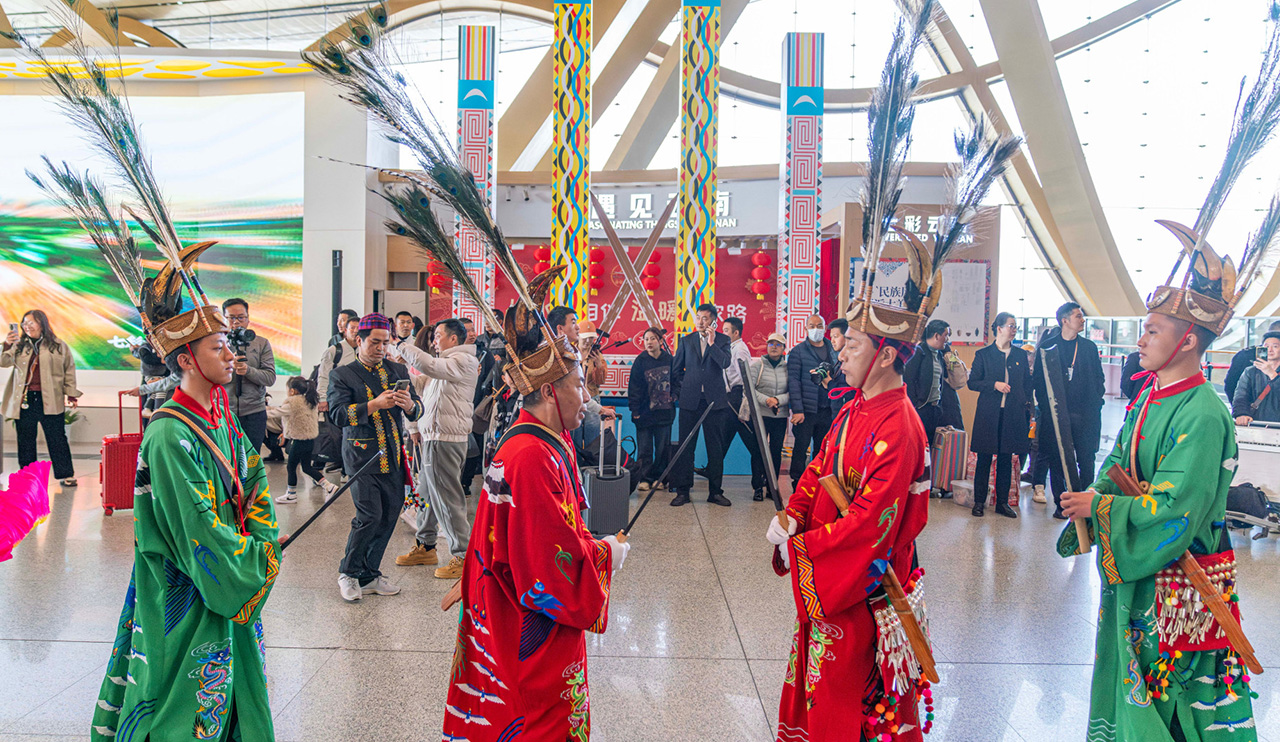
The dance begins with the entrance of the naoshuang — four lead dancers who are traditionally spiritual leaders in the community. They wear tall, crest-shaped headdresses, flowing robes of red and green silk, and silver cloaks. Each naoshuang holds a long knife. They take their positions in two columns and begin to move.
Behind them, the crowd falls into formation. Men carry long knives, spears, or bows and arrows, referencing the Jingpo hunting tradition. Women wear elaborately woven skirts in bright geometric patterns, their bodices and headdresses sparkling with silver ornaments — chains, coins, bells, and pendants that flash and jingle with every step. The overall effect is breathtaking: a sea of color and motion stretching across the square.
The drumbeat is relentless. Massive wooden drums and elephant-leg drums drive the rhythm, accompanied by gongs, cymbals, and bamboo flutes. The dancers move in a spiraling, serpentine pattern around the Munao Poles, their steps tracing the migration route depicted in the painted designs. The choreography is both simple enough for anyone to join and deeply meaningful to those who understand its symbolism.
And anyone truly can join. This is not a show. Visitors are welcomed into the dancing lines with open arms. You do not need to know the steps in advance — the person beside you will show you. Within minutes, you find yourself caught in the current of the crowd, moving to the same drum, feeling the same pulse. It is one of those rare travel experiences that dissolves the boundary between spectator and participant.
Taste Authentic Jingpo Green Leaf Feast During the Festival in Yunnan
No trip to the Munao Zongge Festival is complete without sitting down to a Green Leaf Feast (Lüyeyan, 绿叶宴). This is the signature communal meal of the Jingpo people, and it is unlike any dining experience you have had before.
The concept is elegant in its simplicity: no plates, no bowls, no chopsticks. Instead, large banana leaves are spread across long bamboo tables. The food — grilled, boiled, fried, and pickled — is wrapped in various kinds of leaves and arranged directly on the green surface. Soup is served in bowls folded from leaves. You eat with your hands.
Historical records from the Yuan and Ming dynasties describe the Jingpo custom of eating from banana leaves without utensils. This ancient practice has survived into the modern era and has become an iconic symbol of Dehong food culture.
Here are some of the dishes you can expect:
| Dish | Description |
|---|---|
| Jingpo Ghost Chicken (Guiji, 鬼鸡) | Shredded chicken tossed with lemon juice, chili, cardamom, and fresh herbs. Tangy and refreshing. |
| Pestled Dish (Shungcai, 舂菜) | Roasted meat, bamboo shoots, and bitter nightshade pounded together in a bamboo mortar. Complex, slightly bitter, deeply aromatic. |
| Bamboo Tube Roast Fish | Fresh river fish sealed inside a bamboo tube with herbs and roasted over an open flame. The bamboo imparts a delicate sweetness. |
| Glutinous Rice Wraps | Sticky rice packed into banana leaf parcels, sometimes with savory or sweet fillings. |
| Bamboo Tube Rice Wine | Home-brewed rice wine served in hollowed-out bamboo cups. Mildly sweet and deceptively strong. |
| Toasted Pork (Huoshaozhu, 火烧猪) | Whole suckling pig slow-roasted over a wood fire until the skin is crispy and the meat is tender. A Dehong specialty. |
The flavor profile of Jingpo cuisine leans spicy and herbaceous, drawing heavily from the wild plants and vegetables found in the surrounding mountains. Dai cuisine, which coexists alongside Jingpo food in Dehong, tends toward sour and refreshing flavors. Together, they create one of the most exciting regional food scenes in all of China.
During the Munao Zongge Festival, massive Green Leaf Feasts are organized for thousands of guests. In recent years, these communal banquets have drawn upward of 3,000 to 4,000 people sitting together under the trees, eating from banana leaves, and toasting with bamboo cups of rice wine.
Why Yunnan’s Dehong Prefecture Is a Hidden Gem for Cultural Tourism
Dehong is not on most international travel itineraries. That is part of its charm.
While cities like Lijiang and Dali have been reshaped by mass tourism — with souvenir shops, chain hostels, and crowds that can feel overwhelming — Dehong remains authentically rooted in its local cultures. The Dai and Jingpo people are not performing for tourists. They are living their traditions. The pagodas are places of worship, not photo backdrops. The markets sell jade and local produce, not mass-produced trinkets.
Here is what makes Dehong stand apart:
Extraordinary ethnic diversity. Besides the Dai and Jingpo, Dehong is home to the Lisu, Achang, De’ang, and more than 30 other ethnic groups. Each has its own language, costume, architecture, and culinary tradition. Visiting Dehong is like traveling through a mosaic of cultures compressed into a single prefecture.
A living border culture. Dehong’s proximity to Myanmar creates a fascinating cross-cultural atmosphere. In the border town of Ruili, Chinese and Burmese merchants trade jade, amber, and gemstones side by side. The Jingpo people on the Chinese side share language and kinship ties with the Kachin people across the border. During the Munao Zongge Festival, Kachin guests from Myanmar routinely cross over to join the celebrations, making it a truly international event.
Subtropical beauty. Dehong sits between 800 and 2,100 meters above sea level, giving it a warm, comfortable climate year-round. Average temperatures hover around 18–20°C. The landscape is lush and green: tropical rainforests, river valleys, hot springs, waterfalls, and mountain ridges draped in mist. In winter — the dry season — the weather is particularly pleasant, with daytime temperatures reaching 25°C.
A gateway to the old Silk Road. Historically, Dehong was a major outpost on the ancient Southwest Silk Road connecting China to India and Southeast Asia. That trading heritage lives on in Dehong’s border ports, its jade markets, and its multicultural cuisine.
Best Things to Do in Dehong Besides Attending the Munao Zongge Festival
The festival itself is reason enough to travel to Dehong, but the surrounding region offers plenty of additional experiences worth your time. Here are some highlights:
Visit the Moli Tropical Rainforest and Waterfall
Located near Ruili, the Moli Tropical Rainforest Scenic Area is a dense jungle preserve threaded with walking trails. The centerpiece is Moli Waterfall (also called Zhaduo Waterfall), where clear spring water plunges 60 meters from a steep cliff into a misty pool below. The surrounding forest is rich in rare plant species and is a paradise for nature photographers.
Explore Ruili, the Jade Capital of China
Ruili is one of the most important jade trading centers in Asia. The city’s proximity to Myanmar — the world’s primary source of jadeite — has made it a magnet for gem dealers and collectors. Wander through the Jiegao Border Trade Zone or the bustling Ruili Border Trade Street to browse jade, amber, rubies, and other gemstones. Even if you are not buying, the atmosphere is electric.
Walk Through “One Village, Two Countries”
Near Ruili, the Sino-Myanmar border slices directly through a small Dai village. On one side: China. On the other: Myanmar. The families on both sides share the same language, customs, and even the same swing set, which straddles the border line. One Village, Two Countries (一寨两国) is a fascinating, slightly surreal experience that brings the abstract concept of a national border into very human terms.
Marvel at Menghuan Grand Golden Pagoda
In Mangshi, the Menghuan Grand Golden Pagoda rises from the crest of Leiyarang Mountain, overlooking Peacock Lake. This Theravada Buddhist temple is one of the most impressive religious structures in Dehong, with a hollow pagoda design and four ornate gates. The nearby Menghuan Silver Pagoda is especially photogenic and worth a visit as well.
Discover the Tree-Wrapped Pagoda
One of Dehong’s most unusual sights is the Tree-Wrapped Pagoda (Shubao Ta) in Mangshi. Over the centuries, the roots of a massive banyan tree have grown around and enveloped an ancient Buddhist pagoda, creating a striking natural sculpture where stone and wood merge into one form. It is a quiet, contemplative spot and one of the most photographed landmarks in the prefecture.
Sample Dehong Coffee
Few travelers realize that Dehong produces some of the finest coffee in China. The small-grain Arabica coffee grown in the prefecture is internationally recognized for its quality — smooth, aromatic, and distinctly different from the mass-market beans you find elsewhere. Several small farms and cafes in the Mangshi area offer tastings and tours.
What to Wear and Pack for the Munao Zongge Festival in Yunnan
Packing for the Munao Zongge Festival requires thinking about both the climate and the cultural context. Here are some practical recommendations:
Clothing:
- Dehong in early March is warm during the day (20–25°C) and cool in the evening (10–15°C). Dress in layers.
- Wear comfortable, sturdy shoes. You will be on your feet for hours if you join the dancing, and the festival grounds can be dusty.
- Pack a light rain jacket just in case. March falls near the transition between dry and wet seasons.
- Respectful dress is appreciated. While there is no strict dress code, avoid overly revealing clothing out of respect for local customs.
Essentials:
- Sunscreen and a hat. The subtropical sun is strong, even in early spring.
- A portable water bottle. Stay hydrated, especially if you are dancing.
- Cash in small denominations. While mobile payment (WeChat Pay, Alipay) is widely used in China, smaller vendors and rural markets may still prefer cash. Note that as of 2026, international travelers can now link foreign bank cards to Alipay and WeChat Pay more easily than before.
- A camera or smartphone with plenty of storage. The visual spectacle of the Munao dance is extraordinary, and you will want to capture it.
- Translation app. English is not widely spoken in Dehong. Having a translation app (such as the built-in translation features of WeChat) will be very helpful.
Understanding Jingpo Culture and Traditions Before You Visit Yunnan
Traveling with some understanding of Jingpo culture will deepen your festival experience immeasurably. Here are some key things to know:
Language. The Jingpo language belongs to the Tibeto-Burman language family and is closely related to the Kachin language spoken across the border in Myanmar. Most Jingpo people in Dehong also speak Mandarin Chinese. Written Jingpo uses a romanized script introduced in the 20th century.
Religion. Traditional Jingpo belief is animist and polytheistic. The Jingpo revere natural spirits and practice ancestor worship, believing that the spirits of their forebears watch over and protect the living. A smaller number of Jingpo people practice Christianity, which was introduced by Western missionaries in the early 20th century. Both belief systems coexist peacefully within the community.
Social life. The Jingpo are known as warm, gregarious hosts. Music, singing, and dancing are woven into the fabric of daily life — not just reserved for festivals. Harvests, weddings, the construction of a new house, and the arrival of honored guests are all occasions for communal singing and dancing. Group dances can sometimes involve more than a thousand people, with songs echoing through the mountain valleys.
Costume. Jingpo traditional dress is striking. Men typically wear white or black headbands, black jackets, and dark trousers. Women wear brightly patterned woolen skirts woven with geometric designs, short black jackets, and woolen leggings. The most distinctive feature of women’s dress is the elaborate silver ornamentation — necklaces, chains, pendants, earrings, and brooches that can weigh several kilograms. These silver pieces are not mere accessories; they represent family wealth, social status, and cultural identity.
Migration history. Historical records suggest that the ancestors of the Jingpo people originally lived in the southern mountain areas of the Xikang-Tibetan Plateau. Over centuries, they migrated gradually southward and westward, eventually settling in the Dehong region around the 15th and 16th centuries. The painted patterns on the Munao Poles depict this epic migration, and the dance steps themselves are said to trace the route.
China Visa-Free Travel Policy 2026: How International Tourists Can Visit Yunnan
One of the best developments for international travelers in 2026 is the expansion of China’s visa-free entry policies. Getting to Yunnan has never been easier.
As of late 2025, China extended its unilateral visa-free entry policy through December 31, 2026, covering citizens of numerous countries across Europe, Asia-Pacific, and the Americas. Under this policy, eligible travelers can enter China without a visa for stays of up to 30 days for purposes of tourism, business, family visits, or transit.
Here is a summary of the key policies relevant to festival-goers:
| Policy | Details |
|---|---|
| 30-Day Visa-Free Entry | Citizens of eligible countries (dozens of European, Asian, and South American nations) can enter China without a visa for up to 30 days. Valid through December 31, 2026. |
| 240-Hour (10-Day) Visa-Free Transit | Citizens of 55 countries transiting through China can stay up to 10 days in any of 24 designated areas, including Yunnan. |
| Bilateral Visa Exemptions | Various mutual agreements with specific countries allow visa-free stays of varying durations. |
Practical tips for visa-free travelers:
- Carry a valid passport with at least six months of remaining validity.
- Have a confirmed return or onward ticket.
- Book accommodation in advance and carry proof of reservation.
- Register with the local Public Security Bureau within 24 hours of arrival if staying outside a hotel (hotels handle this automatically).
- International payment is becoming easier in China. As of 2026, foreign credit and debit cards can be linked to Alipay and WeChat Pay at most merchants.
For the latest and most detailed information, check China’s National Immigration Administration website before your trip.
Best Time to Visit Yunnan for Festivals and Cultural Experiences
Yunnan is a year-round destination, but certain seasons are better for specific experiences. Here is how the Munao Zongge Festival fits into the broader Yunnan festival calendar:
| Month | Festival / Event | Location |
|---|---|---|
| January–February | Chinese New Year celebrations, Lantern Festival | Province-wide |
| February–March | Munao Zongge Festival | Dehong Prefecture |
| March | Sanyuesan (Third Month Fair) | Dali |
| April | Dai Water-Splashing Festival (Songkran) | Xishuangbanna, Dehong |
| June | Torch Festival of the Yi people | Chuxiong, Dali |
| July–August | Huashan Festival (Miao), various harvest festivals | Southeast Yunnan |
Early March — the window for the Munao Zongge Festival — is an excellent time to visit Dehong. The weather is dry and warm. The hillsides are green. Tourist crowds are thin. And the energy of the festival fills every corner of the prefecture.
If you have extra time, consider combining your Dehong trip with a visit to Dali (about 8 hours by road) or Tengchong (about 7 hours from Mangshi), where you can soak in volcanic hot springs and explore the famous Heshun Ancient Town.
How the Munao Zongge Festival Promotes Cross-Border Cultural Exchange
One of the most remarkable aspects of the Munao Zongge Festival is its role as a bridge between nations.
The Jingpo people do not stop at the Chinese border. Across the frontier in Myanmar’s Kachin State, the same ethnic group — known there as Kachin — speaks the same language and shares the same cultural traditions. Every year, Kachin guests travel from Myanmar to Dehong to participate in the Munao Zongge celebrations. The festival becomes a family reunion that transcends international boundaries.
In recent years, the festival has also welcomed guests from Taiwan and other parts of China. Indigenous Taiwanese groups, such as the Amis people, have been invited to share their own traditional dances and music, creating a rich intercultural dialogue.
This cross-border dimension gives the Munao Zongge Festival a significance that goes beyond local culture. It is a living demonstration of how shared heritage can connect people across political boundaries — a reminder that culture does not recognize borders.
Responsible Travel Tips for Visiting Indigenous Festivals in Yunnan
Attending an indigenous cultural festival carries a responsibility. Here are some guidelines for being a thoughtful and respectful visitor:
Ask before photographing. Most Jingpo people are happy to be photographed, especially during the festival when everyone is dressed in their finest. But always ask first, particularly when photographing elders, children, or religious ceremonies. A smile and a gesture toward your camera usually gets a warm nod of permission.
Participate, don’t just observe. The Munao dance is an open invitation. Joining in — even clumsily — shows respect and earns goodwill. Standing on the sidelines filming on your phone the entire time can feel extractive. Put the phone down for a while and dance.
Support local businesses. Buy your souvenirs from local artisans, eat at family-run restaurants, and stay at locally owned guesthouses. Your tourism dollars have the greatest positive impact when they flow directly into the community.
Learn a few words. Even a simple “hello” or “thank you” in Jingpo or Mandarin goes a long way. Locals genuinely appreciate the effort.
Respect religious and ceremonial spaces. The Munao Poles are sacred. Do not climb on them, lean against them, or treat them as props for photos. The sacrificial ceremonies that precede the dance are religious rites, not performances — observe quietly and respectfully.
Be mindful of environmental impact. Bring a reusable water bottle. Carry out your trash. Dehong’s natural beauty is one of its greatest assets, and it deserves protection.
Where to Stay During the Munao Zongge Festival in Dehong, Yunnan
Dehong is not a luxury resort destination, but it offers comfortable and affordable accommodation options. Here is what to expect:
Mangshi has the widest selection of hotels, ranging from budget guesthouses (¥100–200 per night) to mid-range business hotels (¥300–500 per night). A handful of higher-end options are available as well.
Longchuan, where the main festival takes place, has fewer accommodation options. Book well in advance during the festival period, as rooms fill up quickly.
Ruili is another good base, with a lively border-town atmosphere and plenty of hotels and restaurants. It is about a 1.5-hour drive from Longchuan.
Pro tip: If you are flexible, consider staying in Mangshi and making day trips to the festival grounds in Longchuan. The drive is manageable, and Mangshi offers better dining and nightlife options.
A Sample Five-Day Itinerary for the Munao Zongge Festival in Yunnan
Here is a suggested itinerary that combines the festival with broader exploration of the Dehong region:
Day 1 — Arrive in Mangshi Fly into Mangshi from Kunming. Settle into your hotel. In the afternoon, visit the Menghuan Grand Golden Pagoda and the Menghuan Silver Pagoda on Leiyarang Mountain. Enjoy a Dai-style dinner in the city.
Day 2 — Eve of the Festival Drive to Longchuan in the morning. Explore the town and visit the festival preparations. In the late afternoon, attend the Green Leaf Feast — a massive communal banquet of Jingpo cuisine served on banana leaves. This is a highlight of the entire trip.
Day 3 — Munao Zongge Festival Day 1 Attend the opening ceremony and the crowning of the naoshuang lead dancers. Watch (and join!) the mass dance around the Munao Poles. Explore the festival market for Jingpo handicrafts, silver jewelry, and local snacks.
Day 4 — Munao Zongge Festival Day 2 + Ruili Spend the morning at the festival for the second day of dancing. After lunch, drive to Ruili (about 1.5 hours). Browse the jade market at Jiegao Border Trade Zone. Visit One Village, Two Countries at the Sino-Myanmar border. Enjoy a border-town dinner featuring Dai, Jingpo, and Burmese flavors.
Day 5 — Nature Day + Departure Visit the Moli Tropical Rainforest and Moli Waterfall in the morning. Drive back to Mangshi for your afternoon flight. Alternatively, if time permits, stop at the Tree-Wrapped Pagoda in Mangshi before heading to the airport.
Why 2026 Is the Best Year to Visit Yunnan for the Munao Zongge Festival
Several factors converge to make 2026 an unusually good year for this trip:
Expanded visa-free access. China’s visa-free entry policy for dozens of countries has been extended through the end of 2026. This means citizens of eligible nations can visit for up to 30 days without the hassle and expense of a visa application.
Growing but still manageable tourism. Dehong is starting to attract more attention from domestic and international travelers, but it has not yet been overwhelmed by mass tourism. You can still experience the festival in a relatively intimate, authentic setting. That window will not stay open forever.
Improved infrastructure. New flights, better roads, and upgraded hotel options have made Dehong more accessible than it was even five years ago. The coming railway line will eventually bring even more visitors.
A post-pandemic cultural renaissance. After years of disrupted festivals and restricted travel, China’s ethnic minority communities are celebrating with renewed energy and pride. The Munao Zongge Festival in 2026 promises to be a vibrant, full-throated expression of Jingpo culture.
International participation. The festival’s growing reputation is attracting guests not just from Myanmar, but from across Asia and beyond. Attending now means being part of a moment when this ancient tradition is gaining new global visibility — while still retaining its soul.
Frequently Asked Questions About Visiting the Munao Zongge Festival
Is the Munao Zongge Festival free to attend? The main festival activities, including the mass dance, are typically free and open to the public. Some organized events or performances may have small entrance fees.
Do I need to speak Chinese to enjoy the festival? Speaking Mandarin is helpful but not essential. The Jingpo people are famously warm and hospitable. Gestures, smiles, and a translation app will get you surprisingly far. Many younger Jingpo people also speak some English.
Is Dehong safe for foreign travelers? Yes. Dehong is generally safe. Standard travel precautions apply — watch your belongings in crowded markets, use registered taxis, and avoid wandering near the Myanmar border without proper documentation.
Can I cross into Myanmar from Dehong? Day trips to the Myanmar side of the border are possible through the Ruili and Wanding border crossings, but you typically need to arrange this through a registered Chinese travel agency. Requirements and availability vary, so check the latest regulations before your trip.
What currency should I carry? The Chinese yuan (¥/CNY) is the local currency. ATMs are available in Mangshi and Ruili. As of 2026, international visitors can also use Alipay and WeChat Pay by linking a foreign bank card.
Is there a language barrier for food ordering? At local restaurants, menus may be in Chinese only. A translation app with a camera feature (which can translate text in real time) is extremely useful. Many restaurants also have picture menus. At the Green Leaf Feast, the food is pre-arranged — just sit down and eat.
Final Thoughts: Why the Munao Zongge Festival Deserves a Place on Your Bucket List
In a world of increasingly commodified travel experiences — theme park villages, staged ceremonies, Instagram-ready “authenticity” — the Munao Zongge Festival stands apart. It is raw, it is real, and it is deeply human.
There is something profoundly moving about watching ten thousand people move as one body, their feet tracing a path that their ancestors walked centuries ago. There is something unforgettable about eating from banana leaves under banyan trees, surrounded by strangers who treat you like family. There is something rare and precious about a cultural tradition that has survived war, migration, revolution, and modernity — and still pulses with life.
The Jingpo people have a saying that captures the spirit of Munao Zongge: “Where there is Munao, there is joy.” If you visit Dehong during the festival, you will understand exactly what they mean.
Pack your bags. Book your flight. The drums are waiting.
Have you attended the Munao Zongge Festival? Share your experience in the comments below. For more in-depth guides to Yunnan’s ethnic festivals and hidden cultural gems, explore our festival travel archive.