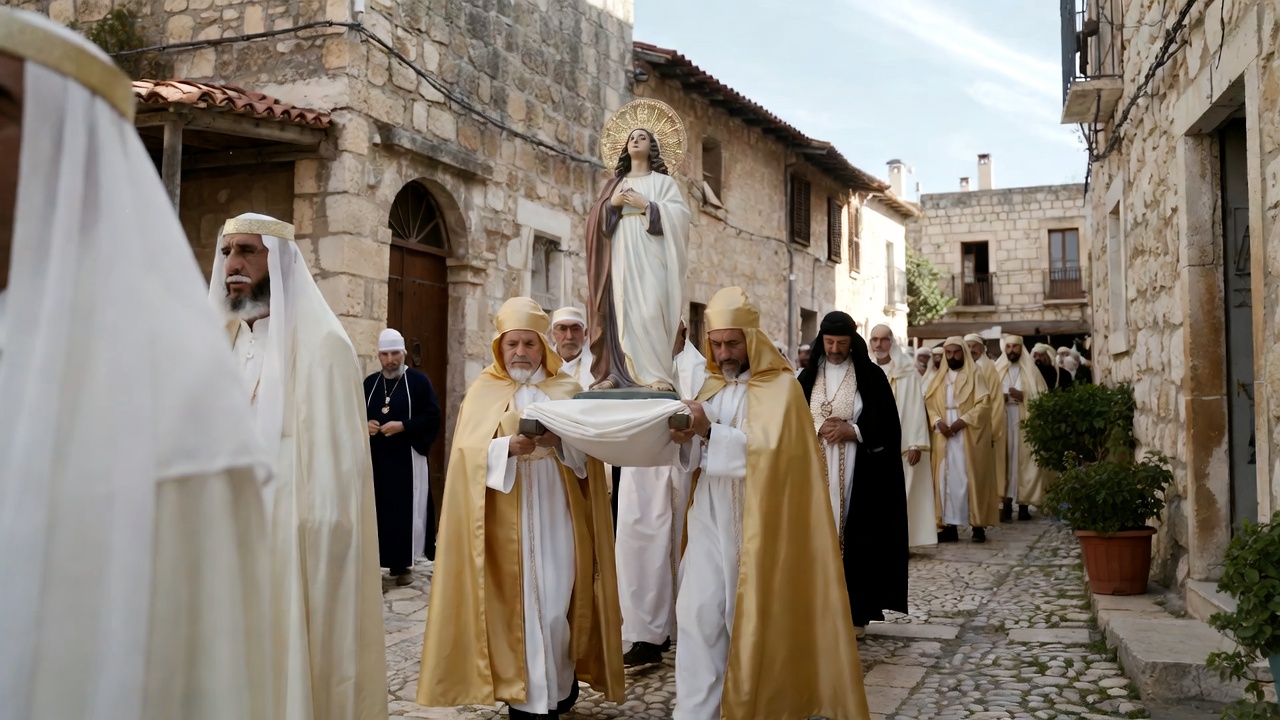
Discover the remarkable story of Saint Maroun, the 4th-century hermit monk whose spiritual teachings gave birth to the Maronite Church and continue to inspire millions of faithful around the world.
Introduction: The Father of the Maronite Spiritual Movement
In the rugged mountains of ancient Syria, during the twilight years of the Roman Empire, a humble priest withdrew from worldly life to seek God in solitude. His name was Maroun—or Maron, as he is sometimes known—and his legacy would stretch far beyond those rocky hillsides to shape the faith of millions across sixteen centuries.
Saint Maroun stands as a towering figure in Eastern Christianity. He is the patron saint of Lebanon and the spiritual father of the Maronite Catholic Church. Unlike many religious movements named after theological concepts or geographical regions, the Maronite Church remains the only Catholic rite named after an individual person. This distinction speaks volumes about the profound impact one devoted life can have on the course of human history.
Today, the Maronite community numbers between 3 and 4 million members worldwide. They are found not only in their ancestral homeland of Lebanon but also across the global diaspora in Argentina, Brazil, Australia, the United States, and beyond. Every year on February 9, Maronites and admirers of this great saint gather to celebrate his feast day—a day that is also a national public holiday in Lebanon.
But who exactly was this man whose influence has endured for more than 1,600 years? What made his spiritual teachings so compelling that they attracted followers from across the ancient world? And how did his humble life of prayer and asceticism give rise to an entire church community that has weathered centuries of persecution, migration, and transformation?
This comprehensive guide explores the life, teachings, and enduring legacy of Saint Maroun. From his early years in Cyrrhus to the magnificent statue that now graces Saint Peter’s Basilica in Vatican City, we will trace the remarkable journey of a saint whose story is inseparable from the history of Lebanon itself.
Who Was Saint Maroun? Early Life and Historical Background
Birth and Origins in Fourth-Century Syria
Saint Maroun was born around 350 AD in Cyrrhus, a small town located in the region between Aleppo and Antioch in what is now modern-day Syria and Turkey. This area was part of the Roman province of Syria and fell under the ecclesiastical jurisdiction of the Patriarchate of Antioch—one of the five major sees of early Christianity.
The world into which Maroun was born was one of profound religious transformation. Christianity had only recently been legalized under Emperor Constantine, and the faith was rapidly spreading throughout the Roman Empire. Antioch, located approximately two days’ journey from Cyrrhus, was the third-largest city in the Roman Empire and a major center of Christian learning and theological development.
Little is known about Maroun’s childhood or family background. Historical records from this period are sparse, and the primary source of information about his life comes from the writings of Theodoret of Cyrrhus, a bishop and historian who chronicled the lives of Syrian monks in the fifth century. What we do know is that Maroun was ordained as a priest before feeling called to a more contemplative life of solitude and prayer.
The Antiochene Tradition and Early Christian Monasticism
The Christianity of Maroun’s era was deeply influenced by the Antiochene theological tradition, which emphasized scriptural literalism and historical exegesis. This approach to faith shaped Maroun’s spiritual formation and would later influence the distinctive character of Maronite spirituality.
Maroun lived during a time when the monastic movement was flourishing in the Eastern Mediterranean. Inspired by the example of Saint Anthony the Great and Saint Pachomius in Egypt, Christians throughout the region were withdrawing from society to pursue lives of prayer, fasting, and spiritual discipline. Syria, in particular, became renowned for its ascetic monks, many of whom practiced extreme forms of self-denial in their quest for closeness with God.
It was within this context that Maroun made the decision that would define his life and shape the future of countless believers.
Saint Maroun’s Life as a Hermit Monk in the Taurus Mountains
Retreating to the Mountain: A Life of Open-Air Asceticism
At some point in his adult life, Maroun left his priestly ministry and retreated to a hilltop in the Taurus Mountains near Cyrrhus. According to Theodoret’s account in his work Historia Religiosa (A History of the Monks of Syria), written around 440 AD, the location Maroun chose had previously been a site of pagan worship.
In a powerful act of spiritual reclamation, Maroun consecrated the pagan precinct to God and transformed it into a place of Christian devotion. He converted a pagan temple into a Christian church—an act that would mark the beginning of widespread conversion to Christianity in the region.
Theodoret describes Maroun’s way of life in vivid detail:
“Embracing the open-air life, he repaired to a hill-top formerly honored by the impious. Consecrating to God the precinct of demons on it, he lived there, pitching a small tent which he seldom used.”
This description reveals several key aspects of Maroun’s spirituality. Unlike monks who lived in enclosed monasteries, Maroun practiced open-air asceticism. He exposed himself to the elements—sun, rain, hail, and snow—using the natural world as a means of deepening his communion with the Creator. The tent he possessed was rarely used; Maroun preferred to live directly under the sky, maintaining constant awareness of God’s presence in creation.
Ascetic Practices and Spiritual Disciplines
Maroun’s asceticism went beyond typical monastic practices. Theodoret notes that he “practiced not only the usual labors, but devised others as well, heaping up the wealth of philosophy.” This suggests that Maroun developed his own distinctive spiritual disciplines, pushing the boundaries of traditional ascetic practice.
According to historical accounts, Maroun’s practices included:
| Spiritual Practice | Description |
|---|---|
| Open-air vigils | Spending nights in prayer under the open sky |
| Fasting | Extended periods of food restriction for spiritual purification |
| Standing prayer | Spending entire nights standing in prayer |
| Exposure to elements | Living without shelter to strengthen dependence on God |
| Contemplation | Deep meditation on Scripture and divine mysteries |
Yet Maroun’s asceticism was not mere self-punishment. It was oriented toward a profound goal: discovering God’s presence in all things. His spirituality integrated the physical and spiritual worlds, using bodily discipline as a pathway to mystical union with the divine.
The Miraculous Healing Powers of Saint Maroun
A Universal Cure Through Prayer
One of the most striking aspects of Theodoret’s account is his description of Maroun’s reputation as a healer. According to the Historia Religiosa, God granted Maroun “the gift of healing” in abundance, “with the result that his fame circulated everywhere, attracted everyone from every side and taught by experience the truth of the report.”
The illnesses Maroun reportedly healed ranged from physical ailments to spiritual afflictions:
- Fevers and shivers
- Trembling conditions (including what modern medicine might recognize as symptoms similar to Parkinson’s disease)
- Demonic possession
- Various other maladies
But Maroun’s healing ministry extended beyond the body. Theodoret emphasizes that he “cured not only infirmities of the body, but applied suitable treatment to souls as well.” The bishop describes how Maroun addressed:
- Greed and material attachment
- Anger and destructive emotions
- Problems with self-control
- Injustice in relationships
- Intemperance and lack of moderation
- Spiritual sloth and religious apathy
This holistic approach to healing—addressing both physical and spiritual ailments—became a hallmark of the Maronite spiritual tradition. Maroun understood that true health required the integration of body, mind, and soul.
The Growing Fame of Saint Maroun Throughout the Empire
Word of Maroun’s holiness and miraculous powers spread rapidly throughout the Roman Empire. People traveled great distances to seek his counsel, receive healing, and learn from his example. His influence reached the highest levels of the Church.
Around 405 AD, Saint John Chrysostom—the renowned Archbishop of Constantinople known as the “Golden Mouth” for his extraordinary preaching—wrote a letter to Maroun expressing deep admiration and requesting his prayers. Chrysostom and Maroun are believed to have studied together at the great Christian learning center in Antioch, and their friendship reflects the esteem in which Maroun was held by his contemporaries.
In his letter, Chrysostom wrote words that reveal the depth of their spiritual bond:
“We are bound to you by love and interior disposition, and see you here before us as if you were actually present. For such are the eyes of love; their vision is neither interrupted by distance nor dimmed by time… please pray for us.”
This correspondence is significant because it comes from one of the most respected theologians in Christian history. Chrysostom’s appeal for Maroun’s prayers indicates that even among the spiritual giants of the early Church, Maroun was recognized as someone of exceptional holiness.
Saint Maroun’s Disciples and the Birth of the Maronite Movement
Training Monks and Cultivating “Plants of Philosophy”
Saint Maroun’s influence extended far beyond his personal ministry of healing and prayer. He attracted numerous disciples who sought to learn his way of life. Theodoret describes this process using beautiful agricultural imagery:
“Applying this mode of cultivation, he produced many plants of philosophy, and it was he who planted for God the garden that now flourishes in the region of Cyrrhus.”
Among Maroun’s disciples were approximately twenty individuals who became saints themselves, including three women. Theodoret describes these followers as “virtuous and heroic, totally dedicated to a life of contemplative prayer… obedient to Church authority and trying to imitate their predecessor in their exercises of austerity.”
The most prominent of Maroun’s disciples include:
| Disciple | Significance |
|---|---|
| Saint James of Cyrrhestica | Described by Theodoret as Maroun’s greatest spiritual “product,” applying the prophetic words “the righteous man will flower as the palm tree” |
| Abraham of Cyrrhus | Known as the “Apostle of Lebanon” for spreading Maronite Christianity to Mount Lebanon |
| Various women disciples | Three female disciples who achieved sainthood following Maroun’s teachings |
Abraham of Cyrrhus: The Apostle of Lebanon
Perhaps no disciple played a more significant role in the spread of Maronite Christianity than Abraham of Cyrrhus. Recognizing that many people in the region of Mount Lebanon remained unconverted to Christianity, Abraham set out on a missionary journey to bring Maroun’s teachings to new populations.
Abraham’s evangelization was remarkably successful. He introduced the inhabitants of Lebanon to “the way of Saint Maroun,” and the conversions he achieved laid the groundwork for Lebanon’s enduring identity as a center of Maronite Christianity. The Nahr Ibrahim (River of Abraham) in Lebanon is named in his honor, commemorating his missionary work in the region.
This expansion into Lebanon would prove crucial for the survival of the Maronite community. When persecution later threatened Maronites in Syria, the mountains of Lebanon provided a refuge where the faith could flourish even in the most challenging circumstances.
The Death of Saint Maroun and the Dispute Over His Remains
The Passing of a Holy Man (Circa 410 AD)
Saint Maroun died around 410 AD, though some sources place his death as late as 423 AD. According to tradition, he expressed a wish to be buried in the tomb of Saint Zabina in the village of Kita in the region of Cyrrhus.
However, his wishes were not fulfilled. Upon his death, multiple communities claimed the right to possess his remains, and disputes broke out among villages eager to inter the holy man in their territory. The rivalry over Maroun’s relics reflects the profound veneration in which he was held even at the moment of his death.
The Question of Saint Maroun’s Burial Place
The exact location of Saint Maroun’s burial remains a subject of historical debate. Several theories exist:
- Brad Village: Some scholars, including Jesuit priest Henri Lammens, believe Maroun was buried in Brad, a village north of Aleppo where archaeological evidence suggests the presence of a significant early church and sarcophagus.
- Arethusa (modern al-Rastan): Lebanese historians including Giuseppe Simone Assemani and Maronite bishop Yusef al-Dibs proposed that Maroun was buried along the Orontes River in this region.
- Kfarnabo: The site where Maroun lived and ministered has also been suggested as a possible burial location.
What is certain is that Maroun’s spiritual legacy proved far more enduring than any physical remains. His teachings lived on through his disciples, and within decades of his death, a major monastery would be established in his honor.
The Monastery of Saint Maroun (Beit Maroun) and Its Historical Significance
Founding of the Great Monastery on the Orontes River
In 452 AD, influenced by the writings of Theodoret and following an order from Byzantine Emperor Marcian (who reigned 450-457), the disciples of Saint Maroun built a monastery on the Orontes River between Hama and Aleppo. This monastery, known as Beit Maroun (House of Maroun) or Beth-Maroun, became the institutional center of the Maronite movement.
The monastery quickly grew into what ancient records describe as the “greatest monastery” in the region of Syria Secunda. Historical sources indicate that more than 300 hermitages surrounded the main monastery complex, creating a vast spiritual community devoted to preserving and transmitting Maroun’s teachings.
As Abbot Boulos Naaman has observed, this monastery was “not only a house of prayer and work, but also a fortress of faith and the foundation of a message.” From Beit Maroun emerged the distinctive spiritual, liturgical, and theological traditions that would define Maronite identity for centuries to come.
The Council of Chalcedon and Maronite Orthodoxy
The founding of Beit Maroun coincided with a crucial moment in Christian history: the Council of Chalcedon in 451 AD. This ecumenical council affirmed that Jesus Christ was “true God and true Man,” possessing both divine and human natures united in one person.
The Maronites firmly embraced the Chalcedonian definition, placing themselves in communion with Rome and Constantinople against those who rejected the council’s teachings. This commitment would have profound consequences.
In 517 AD, conflict between Chalcedonian Maronites and Monophysites (who rejected Chalcedon’s Christological formulation) turned violent. According to a letter sent to Pope Hormisdas, 350 Maronite monks were killed in an act of sectarian violence. This massacre is commemorated in the Maronite calendar on July 31 and represents the first of many persecutions the community would endure.
The Maronite Church: From Monastery to Patriarchate
The First Maronite Patriarch: Saint John Maron
Following the Arab-Muslim conquest of the region in the seventh century, the Patriarchal seat of Antioch became vacant. In this power vacuum, the Maronite community, led by the Monastery of Saint Maron, took a momentous step. Around 685 AD, they elected John Maron (also known as Youhanna Maroun) as their own Patriarch of Antioch.
John Maron became the first Maronite Patriarch, establishing an independent ecclesiastical hierarchy that would endure to the present day. He was affirmed by Pope Sergius I, highlighting that the Maronite Church maintained communion with Rome from its earliest institutional existence.
This election had significant consequences:
| Consequence | Description |
|---|---|
| Byzantine opposition | The Byzantine Emperor viewed the election as a usurpation, leading to persecution |
| Migration to Lebanon | Many Maronites fled Syria for the mountains of Mount Lebanon |
| Preserved communion with Rome | Unlike other Eastern churches, Maronites maintained continuous unity with the Pope |
| Distinctive identity | The patriarchate solidified Maronite distinctiveness within Eastern Christianity |
Migration to Mount Lebanon: A New Homeland
Persecution from both Byzantine authorities and later Islamic rulers drove waves of Maronite migration from Syria to Mount Lebanon. By the tenth century, Maronites had become the majority Christian population in the hills around Tripoli and Byblos.
The rugged mountains of Lebanon provided natural protection against invaders. In valleys like the Qadisha (“Holy Valley” in Aramaic), Maronite monks established monasteries carved into cliff faces, creating communities that could withstand centuries of turmoil. The Qadisha Valley, along with the nearby Forest of the Cedars of God, was designated a UNESCO World Heritage Site in 1998 in recognition of its exceptional cultural and spiritual significance.
The Qadisha Valley: Sacred Heartland of Maronite Christianity
A UNESCO World Heritage Site of Global Importance
The Qadisha Valley represents one of the most important early Christian monastic settlements in the world. Located in the North Governorate of Lebanon, this dramatic gorge has sheltered Christian communities since the earliest centuries of the faith.
According to UNESCO’s official description, “The Qadisha valley is one of the most important early Christian monastic settlements in the world. Its monasteries, many of which are of a great age, stand in dramatic positions in a rugged landscape.”
The valley contains an exceptional concentration of monasteries, hermitages, and caves that have been continuously used for religious purposes for more than 1,500 years. Major monastic complexes include:
- Qannubin Monastery: The seat of the Maronite Patriarchate from the 15th to the 19th century
- Monastery of Saint Anthony of Qozhaya: One of the oldest monasteries in Lebanon, traditionally dated to the 4th century
- Mar Lishaa (Saint Elisha) Monastery: Mentioned in records dating to the 14th century
- Monastery of Our Lady of Hauqqa: An ancient center of Marian devotion
The Cedars of Lebanon: Symbols of Endurance and Faith
Adjacent to the Qadisha Valley stands the Forest of the Cedars of God (Horsh Arz el-Rab), containing ancient cedar trees that have become powerful symbols of Lebanese identity. The forest is said to contain 375 individual trees, with some claimed to be over 3,000 years old.
The Lebanon Cedar (Cedrus libani) is referenced in ancient texts including the Epic of Gilgamesh and the Hebrew Bible. These trees were prized throughout antiquity for their strong and durable wood, used in constructing the Temple of Solomon in Jerusalem and Egyptian pharaonic ships.
For Maronites, the cedars hold special spiritual significance. The Maronite cross often incorporates cedar imagery, and the tree appears on the Lebanese national flag—a symbol of the deep connection between Maronite identity and the Lebanese landscape.
The Legacy of Saint Maroun in Modern Times
The Vatican Statue: A Monument to Maronite Faith
On February 23, 2011, Pope Benedict XVI unveiled a statue of Saint Maroun on the outer wall of Saint Peter’s Basilica in Vatican City. This 15-foot (approximately 4.6-meter) tall statue was commissioned by the Maronite Church and sculpted by Spanish artist Marco Augusto Dueñas.
The statue depicts Saint Maroun holding a miniature Maronite-style church, symbolizing his role as the spiritual father of the Maronite community. An inscription in Syriac—the liturgical language of the Maronite Church—accompanies the figure, reading: “The righteous will flourish like a palm tree, they will grow like a cedar of Lebanon” (Psalm 92:12).
The statue’s unveiling was attended by Lebanese President Michel Suleiman and Maronite Patriarch Nasrallah Boutros Sfeir. It was donated by the family of the late Antoine Shoueiri at a cost of approximately 500,000 euros and occupies the last available niche in the outer perimeter of Saint Peter’s Basilica—a testament to the Maronite Church’s enduring place within the Catholic communion.
The Relics of Saint Maroun
The physical remains of Saint Maroun have had a complex history. According to Maronite tradition, following the destruction of Beit Maroun monastery by the 10th century, Maroun’s relics—particularly his skull—were transferred to Saint Maroun’s Monastery in Kfarhai, Lebanon, around the turn of the eighth century.
Maronite Patriarch Douaihy recorded: “When Youhanna (John) Maroun settled in Kfarhai, he built an altar and a monastery after St. Maroun’s name and put St. Maroun’s skull inside the altar to heal the faithful. That’s why the monastery is called ‘Rish Mro’ (Syriac), meaning ‘Maroun’s head.'”
Later, the skull was taken to Italy. In 1130 AD, a Benedictine monk from the Cross Monastery near Foligno, Italy, acquired the relic. By 1194 AD, the Bishop of Foligno brought the skull to the city and placed it in the diocesan church. The faithful created a silver statue of Saint Maroun to house the precious relic.
In 1887, Bishop Youssef el-Debs of Lebanon received some relics of Saint Maroun during his visit to Italy, returning portions of the saint’s physical remains to the land where his spiritual legacy had flourished most abundantly.
Saint Maroun’s Day: Celebrating February 9 in Lebanon and Worldwide
A National Public Holiday in Lebanon
Saint Maroun’s Day, celebrated annually on February 9, is a national public holiday in Lebanon. This feast day is observed by all Lebanese citizens—Christians and Muslims alike—reflecting Saint Maroun’s significance to the nation’s cultural identity.
The celebration of Maroun’s feast on February 9 is relatively recent in historical terms. The Maronite Church originally celebrated the feast on January 5, the date on which the church at Kfarhai was consecrated in his honor. However, in the seventeenth century, the feast was transferred to February 9.
Pope Benedict XVI established the granting of a plenary indulgence to anyone who visits a Maronite church on February 9, adding additional spiritual significance to the observance.
How Saint Maroun’s Day Is Celebrated
Celebrations of Saint Maroun’s Day vary depending on location and community traditions:
| Location | Typical Celebrations |
|---|---|
| Lebanon | Special Divine Liturgy, government offices closed, family gatherings |
| Maronite parishes worldwide | Solemn Mass in the Maronite rite, community meals with traditional Lebanese cuisine |
| Vatican City | Papal acknowledgment, special masses in Maronite churches in Rome |
| Diaspora communities | Cultural festivals, educational programs about Maronite heritage |
The Maronite Liturgy celebrated on this day is distinctive for its blend of Eastern and Western Christian traditions. Services incorporate elements sung in Syriac (a dialect of Aramaic, the language spoken by Jesus) and often include Arabic music and chanting.
Some faithful observe the day with fasting or works of charity, following the example of Saint Maroun’s ascetic life. Churches often hold special luncheons featuring traditional Lebanese dishes, turning the feast into a celebration of both faith and cultural heritage.
The Maronite Church Today: A Global Community
The Current Patriarch and Church Leadership
The Maronite Church is currently led by Patriarch Bechara Boutros al-Rahi, who was elected as the 77th Maronite Patriarch of Antioch on March 15, 2011. Born on February 25, 1940, in Himlaya, Lebanon, Patriarch al-Rahi succeeded Patriarch Nasrallah Boutros Sfeir after receiving more than two-thirds of the votes from the 39 bishops who constitute the electoral body.
Patriarch al-Rahi was elevated to the rank of Cardinal by Pope Benedict XVI in November 2012, making him the first Maronite Cardinal Patriarch to participate in a papal conclave (the 2013 conclave that elected Pope Francis).
The Patriarch resides at Bkerké, the seat of the Maronite Patriarchate located northeast of Beirut, Lebanon. The Church maintains a summer patriarchal residence in Dimane, in the mountains near the Qadisha Valley.
Maronite Population and Global Distribution
The Maronite community today numbers between 3 and 4 million people worldwide. Remarkably, more than two-thirds of Maronites now live outside Lebanon and Syria, part of the worldwide Lebanese diaspora that began with emigration in the late 19th century.
Current population estimates by region:
| Region | Approximate Maronite Population |
|---|---|
| Lebanon | 1,000,000 – 1,500,000 |
| Argentina | 720,000 |
| Brazil | 493,000 |
| Mexico | 156,000 |
| Australia | 150,000 |
| United States | 85,700 |
| Canada | 87,900 |
| France | 50,600 |
| Syria | 51,000 (significantly reduced due to civil war) |
| Cyprus | 5,800 – 10,800 |
| Israel and Palestine | 11,000 – 20,000 |
This diaspora has been shaped by multiple waves of emigration driven by economic hardship, famine (particularly during World War I, when an estimated one-third to one-half of Lebanon’s population perished), and conflict (including the Lebanese Civil War of 1975-1990).
The Distinctive Character of Maronite Christianity
The Maronite Church possesses several distinctive characteristics that set it apart within the Catholic communion:
Syriac Heritage: The Maronite liturgy is rooted in the ancient Syriac tradition, preserving liturgical prayers and hymns in Syriac—a language closely related to the Aramaic spoken by Jesus. This linguistic connection provides a direct link to the earliest Christian communities.
Continuous Communion with Rome: Unlike other Eastern Catholic churches that separated from Rome before eventual reunion, the Maronite Church claims never to have broken communion with the Pope. As the Maronite liturgy proclaims on the feast of Saints Peter and Paul: “Our faith is the faith of Peter, the faith of Peter is our faith!”
Married Clergy: While following Catholic teaching on clerical celibacy for bishops and monks, the Maronite Church permits married men to be ordained as priests (though priests cannot marry after ordination). This practice follows ancient Eastern Christian tradition.
Unique Monastic Orders: The Maronite Church developed its own monastic orders, formally organized in 1695 and later divided in 1770 into the Lebanese Maronite Order and the Lebanese Mariamite Order. These communities continue to embody Maroun’s ascetic values through vows of poverty, chastity, obedience, and humility.
Maronite Saints: The Spiritual Descendants of Saint Maroun
A Tradition of Holiness
The spiritual legacy of Saint Maroun has produced numerous saints who continued his tradition of ascetic devotion and service. Among the most venerated Maronite saints are:
Saint Sharbel Makhlouf (1828-1898): Perhaps the most famous Maronite saint in modern times, Sharbel was a Lebanese monk and hermit known for his extreme asceticism and reported miracles. He was canonized by Pope Paul VI in 1977 and is venerated worldwide for his intercessory powers.
Saint Rafqa (Rebecca) Pietra Choboq Ar-Rayes (1832-1914): A Lebanese nun who experienced decades of suffering from blindness and paralysis, offering her pain for the conversion of sinners. She was canonized by Pope John Paul II in 2001.
Saint Nimatullah Kassab Al-Hardini (1808-1858): A monk of the Lebanese Maronite Order known for his teaching and spiritual direction. He was the teacher of Saint Sharbel and was canonized by Pope Benedict XVI in 2004.
These saints demonstrate the continuing vitality of the Maronite spiritual tradition, which emphasizes contemplative prayer, physical asceticism, and complete dedication to God.
The Significance of Saint Maroun for Lebanon’s National Identity
Patron Saint of a Nation
Saint Maroun’s relationship with Lebanon transcends religious boundaries. As the patron saint of Lebanon, he represents a symbol of national identity that resonates with citizens of various religious backgrounds.
Lebanon’s unique confessional political system, established in the 1943 National Pact, reserves the presidency for a Maronite Christian. This arrangement reflects the historic role Maronites have played in shaping Lebanese nationhood, from the founding of the modern state under French mandate to the present day.
The Maronite community’s relationship with Lebanon is captured in a saying common among the faithful: “The Maronite Church is tied to Lebanon, her spiritual homeland and the residence of her Patriarch.” This bond between faith and land echoes the connection Saint Maroun himself cultivated between spiritual practice and the natural environment.
Challenges and Hope in the 21st Century
The early 21st century has brought significant challenges to the Maronite community in Lebanon and the broader Middle East. Economic crisis, political instability, and regional conflicts have prompted continued emigration from the ancestral homeland.
In Syria, the civil war that began in 2011 devastated historic Maronite communities. The village of Brad, believed by some to contain Saint Maroun’s original burial site, lies in a region that has experienced severe conflict. Yet the Maronite Church continues to provide humanitarian aid and preserve its cultural heritage in the face of these difficulties.
Patriarch al-Rahi has consistently called for Lebanon’s neutrality in regional conflicts and has advocated for reforms to address the country’s political and economic challenges. In a 2025 sermon, he declared: “Salvation for the nation will not come through speeches, but through deeds. Every official must ask himself: Am I faithful to the trust I was given?”
This prophetic voice continues the tradition of Maronite spiritual leaders who have served as guardians of their people’s political and social rights for centuries—a tradition that began with Saint Maroun himself.
Visiting Sites Associated with Saint Maroun: A Pilgrimage Guide
Major Pilgrimage Destinations
For those wishing to connect with the legacy of Saint Maroun, several significant sites welcome pilgrims and visitors:
The Qadisha Valley, Lebanon: This UNESCO World Heritage Site offers hiking trails connecting ancient monasteries carved into cliff faces. The valley’s monasteries, including Qannubin and Saint Anthony of Qozhaya, continue to function as active spiritual communities.
Bkerké, Lebanon: The seat of the Maronite Patriarchate welcomes visitors and holds special significance during major feast days. The patriarchal church contains important religious art and serves as the administrative heart of the worldwide Maronite Church.
Saint Peter’s Basilica, Vatican City: The statue of Saint Maroun on the basilica’s exterior wall provides a focal point for Maronite pilgrims visiting Rome. The nearby Maronite College, founded in 1584 by Pope Gregory XIII, played a crucial role in preserving and transmitting Maronite heritage.
Foligno, Italy: The Cathedral of San Feliciano houses relics of Saint Maroun, including portions of his skull brought to Italy in the medieval period.
Brad Village, Syria (when conditions permit): This archaeological site north of Aleppo contains the remains of an early church that may mark Saint Maroun’s original burial place.
Planning Your Visit
| Site | Best Time to Visit | Key Features |
|---|---|---|
| Qadisha Valley | April-October | Ancient monasteries, hiking trails, natural beauty |
| Bkerké | February 9 (Saint Maroun’s Day) | Patriarchal liturgies, religious art |
| Vatican City | Year-round | Saint Maroun statue, general audience with Pope |
| Foligno | February 9 | Relics, special feast day observances |
The Enduring Message of Saint Maroun for Today’s World
Timeless Spiritual Lessons
What can a 4th-century hermit teach us in the modern age? Saint Maroun’s life offers several enduring lessons:
The Integration of Faith and Nature: Maroun’s open-air spirituality reminds us that the natural world can serve as a gateway to divine encounter. His practice of exposing himself to the elements speaks to a faith that embraces rather than escapes from physical reality.
Healing as Holistic Ministry: Maroun understood that true healing addresses body, mind, and soul together. His dual ministry of physical healing and spiritual guidance anticipates modern integrative approaches to health and wellbeing.
The Power of Personal Witness: Maroun attracted followers not through institutional power or political influence but through the compelling witness of a holy life. His example suggests that authentic spirituality has an attraction that transcends cultural and temporal boundaries.
Resilience in Adversity: The community Maroun founded has survived persecution, displacement, and countless challenges over sixteen centuries. This resilience reflects a faith that can weather the storms of history.
A Prayer to Saint Maroun
The Maronite liturgy includes this blessing invoking Saint Maroun’s intercession:
“Blessed are you, Saint Maroun, for you became a prayer on the lips of the faithful, and a living example for the people who bear your name and will be known as Maronites to the end of the age.”
This prayer captures the essence of Saint Maroun’s legacy: a life so devoted to God that it became a model for generations of believers who would carry his name and his spiritual vision across the centuries and around the world.
Conclusion: The Living Legacy of the Patron Saint of Lebanon
Saint Maroun began his remarkable journey as a simple priest in a small town of the Roman Empire. Through his decision to embrace a life of radical simplicity and prayer, he set in motion a spiritual movement that would shape the history of the Middle East and establish an enduring community of faith.
Today, from the ancient monasteries clinging to the cliffs of the Qadisha Valley to modern Maronite parishes in São Paulo, Sydney, and Los Angeles, the children of Saint Maroun continue to preserve and transmit his spiritual heritage. They maintain the Syriac liturgical tradition that connects them to the earliest Christian communities. They honor the values of asceticism, community, and faithfulness to Rome that defined their founder’s life.
As Lebanon faces the challenges of the 21st century—economic crisis, political fragmentation, and the ongoing threat of regional instability—the figure of Saint Maroun stands as a reminder of what endures. Empires rise and fall. Political systems come and go. But the spiritual vision of a humble hermit who sought God on a mountain in Syria continues to inspire millions of faithful around the world.
On February 9, when Maronites gather to celebrate their patron saint, they do more than commemorate a historical figure. They renew their commitment to the way of life he exemplified: a faith that integrates body and spirit, a community that welcomes the suffering and the searching, and a hope that transcends the vicissitudes of worldly fortune.
In the words inscribed on his statue at the Vatican, Saint Maroun’s legacy is captured perfectly: “The righteous will flourish like a palm tree, they will grow like a cedar of Lebanon.” Sixteen centuries after his death, this prophecy continues to find fulfillment in the millions who bear his name and follow his example.
Planning to celebrate Saint Maroun’s Day? Mark your calendar for February 9, 2026, and consider visiting a Maronite church in your area to experience the beauty of this ancient liturgical tradition.
Frequently Asked Questions About Saint Maroun
When is Saint Maroun’s feast day celebrated?
Saint Maroun’s feast day is celebrated on February 9 each year. This date is a national public holiday in Lebanon and is observed by Maronite communities worldwide.
Where was Saint Maroun born?
Saint Maroun was born around 350 AD in Cyrrhus, a town in the region between Aleppo and Antioch in what is now modern-day Syria/Turkey.
Why is the Maronite Church named after Saint Maroun?
The Maronite Church is named after Saint Maroun because his disciples and followers formed a distinct community that became known as the “House of Maroun” (Beit Maroun). The Maronite Church is the only Catholic rite named after an individual person.
Is Saint Maroun’s Day a public holiday?
Yes, Saint Maroun’s Day (February 9) is a national public holiday in Lebanon, observed by citizens of all religious backgrounds.
Where are Saint Maroun’s relics located?
Portions of Saint Maroun’s relics are housed in Foligno, Italy, where they were brought in the medieval period. Other relics were returned to Lebanon in the 19th century.
How many Maronites are there in the world today?
The Maronite community numbers between 3 and 4 million people worldwide, with significant populations in Lebanon, Argentina, Brazil, Australia, the United States, and other countries.