There is a moment during the Munao Zongge Festival when the sound of drums shakes the ground beneath your feet. You stand in a square in Longchuan County, deep in Yunnan’s Dehong Prefecture. Around you, tens of thousands of people — farmers, teachers, grandmothers, teenagers, tourists from Kunming and beyond — all move as one body. They follow the same beat. They trace the same winding path. Nobody taught you the steps before you arrived. But somehow, within minutes, you are dancing too. Your feet know where to go. The rhythm pulls you forward.
This is Munao Zongge (目瑙纵歌). In the Jingpo language, the phrase translates directly to “everyone dances together” — or, in the poetic shorthand that has become its international identity, “dance in mass.” It is the biggest, most sacred, and most joyous festival of the Jingpo ethnic group, a Tibeto-Burman people who live across the mountainous borderlands of southwest China, northern Myanmar, and northeast India.
But Munao Zongge is far more than a dance party. It is a living archive. The spiraling dance formations encode the migratory history of an entire people. The towering carved poles at the center of the square hold pictographic stories older than any Jingpo written script. The silver ornaments on the women’s costumes jingle like prayers. And the festival’s very name — “dance in mass” — points to one of the most radical ideas in world folklore: that the deepest truths of a community can only be expressed when every single person moves together.
Listed as a national intangible cultural heritage of China since 2006, Munao Zongge draws over 200,000 visitors to Longchuan County each year. In 2026, it continues to grow — not as a museum piece, but as a breathing, evolving tradition. This article explores why the Jingpo call it “dance in mass,” what its symbols mean, and why this festival matters to the world.
What Does Munao Zongge Mean in the Jingpo Language?
To understand why this festival is called “dance in mass,” we must start with the words themselves.
“Munao” (目瑙) comes from the Jingpo language. It carries the meaning of “let’s dance together” or “collective dance.” The word does not describe a performance that audiences watch. It describes something that everyone does. There is no stage. There is no separation between performer and viewer. If you are present, you are part of the dance.
“Zongge” (纵歌) is drawn from the Zaiwa dialect, one of the five subgroups of the Jingpo in China. It translates roughly to “singing together” or “songs in unison.” Combined, the two words paint a picture of a community that gathers to sing and dance as a single organism.
Other translations have emerged over the years. Some scholars render the phrase as “dance of paradise” — a reference to the legend that the dance was first performed in the palace of the Sun God. Others call it “mass revelry dance,” emphasizing the sheer scale of the event. But the most widely used English translation remains “dance in mass,” and for good reason. It captures the essence of what makes Munao Zongge unlike most other festivals on Earth: the requirement that the entire community participates.
In Jingpo tradition, a Munao is not a spectacle. It is an obligation and a gift. When the drums begin, every able-bodied person is expected to join. The old walk slowly at the edges. The young leap in the center. Visitors from other ethnic groups — Dai, De’ang, Lisu, Achang, and even tourists from other countries — are welcomed into the moving lines. The more people who join, the more powerful the dance becomes. A Munao with only a few hundred people is modest. A Munao with tens of thousands is magnificent. And the Munao Zongge Festival in Longchuan and Mangshi regularly achieves that scale.
This concept — that a dance is incomplete without the mass — is the heartbeat of the festival. It shapes every other element: the music, the costumes, the sacred poles, the formation of the dance itself.
The History and Origin of Munao Zongge Festival in Yunnan
The roots of Munao Zongge stretch deep into the spiritual and migratory past of the Jingpo people. To trace them, we must follow the Jingpo southward from the high plateaus of Tibet.
A People Born on the Roof of the World
The Jingpo trace their origins to the Qinghai-Tibet Plateau, near the headwaters of the Irrawaddy, Mekong, Yangtze, and Salween Rivers. Their oral histories speak of an ancestral homeland called “Muzhashenglabeng,” a name that means “mountain with a flat top” — a place of year-round snow where even barley struggled to grow.
Approximately 1,500 to 2,000 years ago, the ancestors of the Jingpo began migrating southward. They followed the Lancang (Mekong) and Jinsha (Yangtze) rivers. By the 15th and 16th centuries, they had settled in what is now western Yunnan Province, in the Dehong Dai and Jingpo Autonomous Prefecture. From there, many continued south into what is now Kachin State in northern Myanmar.
Today, the Jingpo are a transnational people. In China, they number approximately 150,000, according to the 2010 national census. In Myanmar, where they are known as the Kachin, their population is estimated at around 630,000. Smaller communities live in India’s Arunachal Pradesh and Assam, where they are called the Singpho. Despite these different names, they share deep cultural bonds — and Munao Zongge is one of the strongest threads connecting them.
From Sacred Ritual to National Festival
Munao Zongge did not begin as a calendar holiday. In its oldest form, the dance was performed for specific, high-stakes occasions: before going to war, upon returning in victory, after a bountiful harvest, at weddings, at funerals, and when welcoming honored guests. Each occasion had its own variation of the dance. There are, in fact, 12 distinct types of Munao, each with a different name and purpose.
| Type of Munao | Jingpo Name | Occasion |
|---|---|---|
| Harvest Celebration | Su Munao (苏目瑙) | Celebrating a good harvest |
| Victory Dance | Ba Dang Munao (巴当木脑) | Returning from battle |
| Housewarming | Dingshuan Munao (定栓目瑙) | Completing a new home |
| War Vow | Deru Munao (德如目瑙) | Pledging to go to war |
| Foundation Laying | Tingre Munao (亭热目瑙) | Celebrating new construction |
| Recreation | Naosai Munao (瑙赛目瑙) | Leisure and play |
| Wedding | Kenran Munao (肯然目瑙) | Celebrating marriage |
| Friendship | Tingran Munao (亭然目瑙) | Making new friends |
| Welcome Guests | Kelong Munao (克龙目瑙) | Greeting important visitors |
| Divorce | Gongran Munao (宫然目瑙) | Marking a separation |
| Funeral | Zhu Munao (朱目瑙) | Honoring the deceased |
After the founding of the People’s Republic of China in 1949, the festival evolved. The military and religious dimensions softened, and Munao Zongge became a secular celebration embraced by the entire Jingpo community. The government designated specific dates for the annual festival — the 15th through the 19th day of the first lunar month, which usually falls in February — and supported its organization. Today, the festival lasts three to five days and has become one of the most important cultural events in all of Yunnan.
The Legend of the Sun God: Why Jingpo People Dance Together
Every great festival rests on a great story. For Munao Zongge, there are two intertwined legends that explain why the Jingpo believe the dance belongs to everyone.
The Birds Who Learned to Dance in Paradise
The most beloved origin story goes like this. Long ago, the King of the Sun held a great carnival in his celestial palace. He invited all creatures on Earth to attend. The birds, who could fly, accepted the invitation. They soared up to the Sun Palace and joined the festivities, learning a magnificent collective dance that was practiced only in paradise.
On their way home, the birds flew over a forest filled with trees heavy with golden fruit. Overjoyed, they landed and held the First Birds’ Munao Carnival, dancing the steps they had learned in heaven and sharing the fruit among themselves. Two humans happened to pass by and were enchanted by what they saw. They joined in, learned the dance, and brought it back to the Jingpo villages.
As China Daily reported from the 2023 festival, the Jingpo believe that after humans learned the Munao Zongge dance, they became healthier and luckier. Since then, whenever the community needs to drive away evil spirits or pray for a better harvest, they perform the dance. The origin in “paradise” is why the festival is also called “Dance of Paradise” — a second name that carries equal weight among the Jingpo.
The Hero Leipan and the Defeat of the Devil
A second legend, darker and more heroic, tells of a time when a terrible devil terrorized the Jingpo people. The devil fed on children and destroyed homes. A courageous man named Leipan led his people to safety along the Mailikai and Enmeikai Rivers. But the devil found them again and devoured Leipan’s own son.
Leipan swore revenge. The Sun God, moved by his determination, forged a powerful sword for him. Leipan fought the devil and killed it. The people celebrated their salvation with singing and dancing — the first “Munao.” Since then, the Jingpo have marked great events with these gatherings to honor their ancestor’s bravery.
Both legends share a common thread: the dance is a gift from a higher power, meant to be shared by all. It is not elite. It is not exclusive. It is not a skill reserved for professionals. It is a birthright. This is the spiritual foundation of the name “dance in mass.”
The Sacred Munao Poles: Symbols Carved in Wood That Tell a People’s Story
At the center of every Munao dance ground stand four towering wooden pillars. These are the Munao Shidong (目瑙示栋) — the sacred poles that serve as the heart of the entire festival. Without them, there is no Munao Zongge.
The poles are not decorative. They are functional, spiritual, and narrative. They serve three purposes at once: they honor the Sun God, they guide the dancers’ movements, and they tell the story of the Jingpo people in a pictographic language older than the Jingpo written script.
What the Poles Look Like
The four poles are arranged in pairs. The two central poles are painted with sun-shaped patterns at the top. These represent the male principle. The two outer poles carry moon-shaped patterns, representing the female principle. Together, the four poles embody the cosmic balance between masculine and feminine, day and night, sun and moon.
Between the two central “solar” poles, crossed swords are displayed. These signify the industrious and courageous character of the Jingpo people. On the crosspieces at both ends of the poles, carved figures of a toucan and a peacock recall the legend that the dance was first learned from birds.
A living bamboo pole is erected in front of the wooden poles. It symbolizes the evergreen tree of life — continuity, growth, and endurance. On top of this bamboo pole sits a horizontal board bearing an image of the Himalayas, the legendary birthplace of the Jingpo.
Symbols Painted on the Munao Poles and Their Meanings
The poles are covered in symbolic patterns that function as a kind of visual scripture. Each motif carries specific meaning:
| Symbol | Meaning |
|---|---|
| Fern sprouts | Fists clenched in unity; leaves like arrows pointing forward — symbolizing solidarity and progress |
| Swords and spears | Bravery and fortitude |
| Image of the Himalayas | The ancestral homeland of the Jingpo |
| Crops and livestock | Aspiration for prosperity and a comfortable life |
| Gongs and musical instruments | Good fortune and auspiciousness |
| S-shaped winding lines | The migration route of the Jingpo ancestors from the Tibetan Plateau to Dehong |
| Sky-pointed lines (on moon poles) | Channels of communication between humans and heaven |
The S-shaped pattern is particularly important. According to tradition, it traces the winding path that the Jingpo ancestor Nenggong Kangjia followed when he first led his people in the Munao Zongge. It also represents the hardships the Jingpo endured during their centuries-long southward migration. When the dancers follow this S-shaped route around the poles, they are literally walking in their ancestors’ footsteps.
Chinese scholar Shi Rui conducted a detailed analysis of these pictograms and argued that they constitute a form of pictographic language used in Jingpo religious ceremonies. Each drawing is not an isolated image but part of a complete text that guides the shaman through the ritual. This makes the Munao poles among the most remarkable examples of non-alphabetic cultural encoding in all of East and Southeast Asia.
How the Munao Zongge Mass Dance Actually Works
Watching Munao Zongge from above — as aerial photographs and drone footage now allow — you see something extraordinary. Tens of thousands of people move in two long, winding columns. The columns spiral around the four sacred poles in a pattern that resembles the S-shaped markings painted on the poles themselves. Despite the enormous number of participants, the formation never descends into chaos.
This is not an accident. It is the product of a carefully structured system of leadership, rhythm, and communal discipline that has been refined over centuries.
The Lead Dancers: Naoshuang and Naoba
Every Munao dance is guided by designated leaders. The most important are the Naoshuang (瑙双), who number four. These are senior ritual specialists — often spiritual leaders or elders with deep knowledge of Jingpo tradition. They stand at the front and rear of the winding columns.
The two Naoshuang at the front are called the “military pair.” The two at the back are the “civil pair.” They wear distinctive ceremonial attire: feathered crest-shaped hats, robes of red and green silk, and silver-colored cloaks. Each carries a long ceremonial sword. Their role is to perform the ritual dance steps and lead the procession along the correct path — the path dictated by the patterns on the sacred poles.
Supporting the Naoshuang are the Naoba (瑙巴), who direct the broader crowd. While the Naoshuang perform the formal, sacred movements, the Naoba encourage the masses to dance with free, lively energy. It is a beautiful division of labor: sacred precision at the front, joyful spontaneity in the body of the crowd.
The Dancers: Everyone Who Shows Up
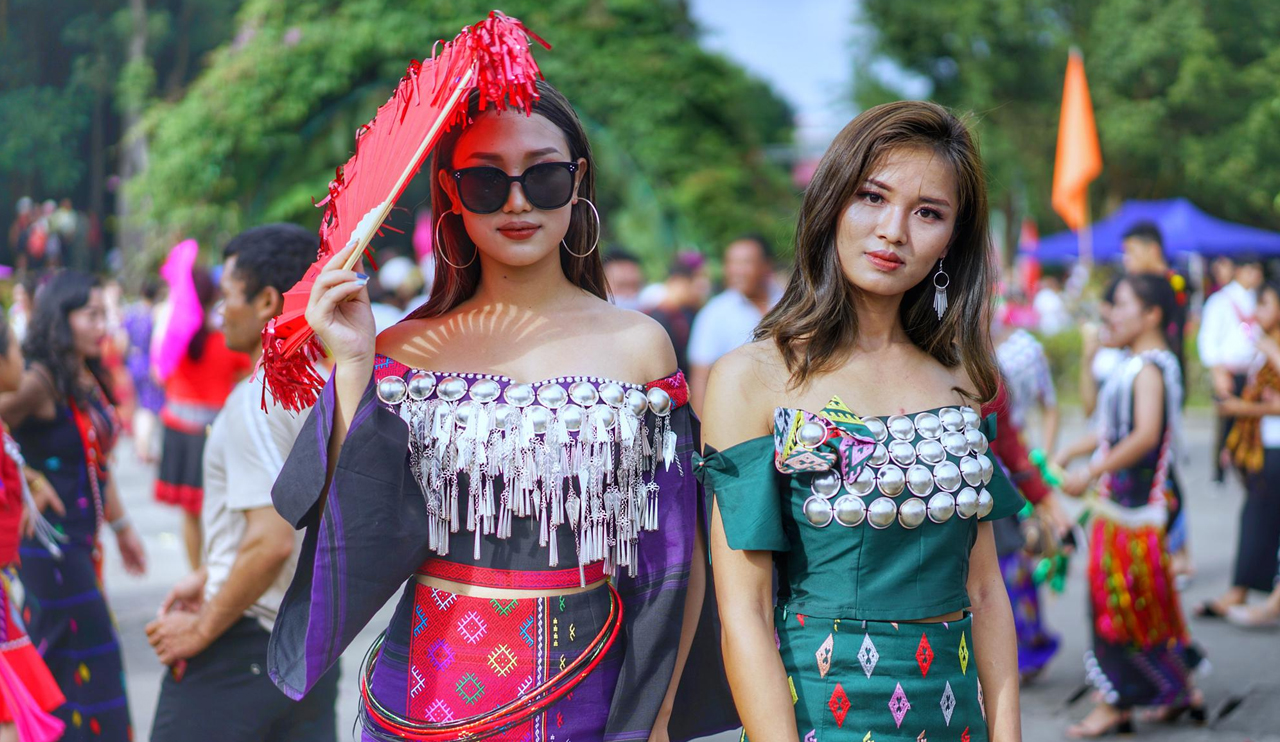
Behind the leaders, the participants organize themselves. Men carry long swords or spears. Women hold fans or handkerchiefs. The silver ornaments on the women’s clothes — the plates, the bells, the necklaces — catch the light and create a shimmering, jingling cascade of sound and color as they move.
There is no formal training required. There is no audition. As CGTN has reported, anyone can join the dancing at any time while it is ongoing. The steps are simple enough to follow: listen to the drums, watch the person in front of you, keep the rhythm. Yet the emotional power of moving in synchrony with thousands of other people is described by participants as overwhelming, even transcendent.
The Music: Drums, Gongs, and the Pulse of the Earth
The music of Munao Zongge is built on a foundation of large drums and bronze gongs. These instruments are hung from the sacred poles and played by musicians on a raised platform nearby. The beat is deep, steady, and insistent — a heartbeat amplified to fill an entire valley. When thousands of feet hit the ground at the same moment, the earth itself seems to vibrate.
The drumbeat is not merely musical. It is organizational. It tells the dancers when to step, when to turn, when to pause. In a gathering of 10,000 or 60,000 people, the drum is the only conductor. The fact that it works — that a single beat can coordinate the movements of a mass that large — speaks to something deep in human nature. Rhythm is the oldest technology of collective action.
Jingpo Traditional Costume and Silver Ornaments at the Festival
One of the most visually striking aspects of Munao Zongge is the clothing. The festival is an explosion of color, craftsmanship, and symbolic dressing.
Women’s Festival Attire: A Walking Treasury
Jingpo women wear black blouses with a vertical front opening, paired with barrel-shaped skirts woven in red and black wool with geometric patterns. Their legs are wrapped in cloth shin guards. But it is the silver that transforms the outfit into something almost otherworldly.
For grand occasions like Munao Zongge, women attach large silver plates and silver bubbles to the front, back, and shoulders of their blouses. They wear six or seven silver neck rings, a silver chain or string of silver bells, long silver earrings that extend past the chin, and thick engraved silver bracelets. The more silver a woman wears, the more capable and wealthy she is considered.
As Google Arts & Culture’s exhibit on Yunnan attire from the Yunnan Provincial Museum describes, some women also wear painted vine circles around their waists — circles covered in red or black lacquer. The more vine circles a woman wears, the more beautiful she is considered. This is a unique aesthetic tradition found nowhere else in China.
The silver spheres on the costume are not random decorations. According to CGTN, they represent dragon scales — an homage to a dragon from Jingpo folklore. When the women dance, the silver spheres swing and shake, creating dazzling visual patterns and a melodious, tinkling sound. This is the “Yinpao Dance” (银泡舞), a sub-tradition within the broader Munao Zongge that highlights the beauty and strength of Jingpo women.
Men’s Festival Attire: Warriors in Motion
Jingpo men dress in black and white garments and carry a tongpa (a traditional woven backpack) and a long knife. The knife is not just ceremonial — it is a core part of Jingpo identity, connected to their history as mountain-dwelling hunters and warriors. During the dance, men wield swords, spears, or bows and arrows with practiced ease, performing movements that demonstrate physical skill and courage.
Young men wear white turbans; older men wear black turbans. The contrast is striking against the riot of color in the women’s costumes. Together, the men and women create a visual tapestry that moves, shimmers, and sings.
The Symbolism of Munao Zongge Dance Formation and Patterns
The dance formation of Munao Zongge is not random. It carries encoded meaning at every level.
The S-Shape: Walking the Ancestral Migration Route
The most important pattern is the S-shaped or zigzag path that the dancers trace around the sacred poles. This path mirrors the markings on the Munao Shidong poles. It represents the long, winding journey that the Jingpo ancestors undertook as they migrated south from the Tibetan Plateau over many centuries.
As YunnanExplorer describes, the dance unfolds in two winding columns that spiral around four poles symbolizing mountains and rivers. The dance is understood to represent the Jingpo wanderings in search of a good home. Every twist and turn of the S-shaped path corresponds to a chapter in the Jingpo migration story — a river crossed, a mountain climbed, a valley settled and then abandoned.
When you dance the Munao Zongge, you are not performing choreography. You are reenacting history. You are honoring the suffering and perseverance of your ancestors. And you are doing it collectively, because the migration was collective. No single family traveled alone. The Jingpo moved as a people. The dance remembers this.
The Circle: Unity Without Hierarchy
The two winding columns eventually form a great, spiraling circle around the central poles. The circle is one of the oldest symbols in human culture. It has no beginning and no end. It has no head and no tail. In the context of Munao Zongge, it embodies unity, equality, and communal belonging.
Unlike many ceremonial dances around the world, Munao Zongge does not have a privileged center where the most important people perform. The Naoshuang lead from the front, but they are walking the same path as everyone else. The chief’s daughter and the rice farmer’s son follow the same drumbeat. This structural democracy of the dance is one reason why the name “dance in mass” resonates so deeply. The mass is not an audience. The mass is the dancer.
The Bamboo Fence: Keeping the Sacred Safe
The Munao dance ground is traditionally enclosed by a bamboo fence with only two doors. This boundary serves both practical and spiritual purposes. It keeps livestock and uninvited spirits out. It creates a defined ritual space — a temporary temple built not of stone but of rhythm and movement.
Why Munao Zongge Was Listed as China’s National Intangible Cultural Heritage
In 2006, the Chinese government added Munao Zongge to its national list of intangible cultural heritage. This recognition was not merely ceremonial. It reflected a growing understanding that the festival is an irreplaceable cultural resource.
The designation was based on several factors. Munao Zongge is a concentrated display of Jingpo ethnic culture and art. It integrates music, dance, painting, sculpture, costume, architectural craft, religious ritual, and social custom into a single event. No other Jingpo tradition brings all of these elements together at the same scale.
Longchuan County (陇川县) was specifically recognized as the most complete and representative area for the inheritance of Munao Zongge. It has the largest concentration of Jingpo people and the most standardized transmission of the festival’s traditions. This is where the oldest families of Naoshuang still live. This is where the poles are carved with the most care. This is where the drum patterns have been passed from grandfather to grandson for generations beyond counting.
The intangible heritage designation has brought increased funding, media attention, and infrastructure support to the festival. But it has also raised questions about how to protect a living tradition without freezing it in amber. The Jingpo themselves have navigated this tension with characteristic pragmatism. As Shang Deguang, a provincial-level inheritor of Munao Zongge, told China Daily: the festival was once celebrated only by Jingpo people, but in recent years, people from all over the world have come to join the grand carnival and dance together. The name “dance in mass” continues to expand in meaning.
How to Experience Munao Zongge Festival in Dehong Prefecture Yunnan
For travelers, attending Munao Zongge is a profound experience — but it requires planning. Here is what you need to know for 2026 and beyond.
When and Where the Festival Takes Place
The main Munao Zongge Festival is held annually around the 15th day of the first lunar month. In most years, this falls in mid-to-late February. The festival lasts three to five days, sometimes longer. The primary venues are in Longchuan County and Mangshi (the capital of Dehong Prefecture), though smaller celebrations take place in Jingpo villages throughout the region.
Getting to Dehong Prefecture
Dehong is located in the westernmost corner of Yunnan Province, along China’s border with Myanmar. The easiest way to reach it is by flying into Mangshi Airport (also called Dehong Mangshi Airport), which has regular connections to Kunming, the provincial capital. From Mangshi, Longchuan County is about a 90-minute drive to the south.
An alternative is to fly into Kunming Changshui International Airport and then take a domestic flight or a long-distance bus to Dehong. The overland journey from Kunming to Mangshi takes approximately 10 hours by highway, but the scenery — terraced rice paddies, misty mountain passes, and lush subtropical forests — is spectacular.
What to Expect at the Festival
Expect noise, color, warmth, and generosity. The Jingpo are famously hospitable. Visitors are offered rice wine, glutinous rice cakes, and other local foods. The air smells of roasted meat, incense, and tropical flowers. The drums begin early in the morning, and the dancing can continue well into the night.
You will be invited to join the dance. Accept the invitation. You do not need to know the steps. The rhythm will guide you. That is the entire point of “dance in mass.”
Travel Tips for Visitors
- Dress comfortably. You will be on your feet for hours. Wear sturdy, comfortable shoes.
- Respect local customs. Do not touch the sacred Munao poles. Ask permission before photographing individuals in ceremonial dress.
- Bring sun protection. February in Dehong is warm and sunny. Bring sunscreen and a hat.
- Book accommodation early. Hotels in Longchuan and Mangshi fill up quickly during the festival. Book at least a month in advance.
- Learn a few Jingpo phrases. Even a simple greeting will earn you smiles and warmth. “Kaja” is a common Jingpo greeting.
Munao Zongge Compared to Other Mass Dance Festivals Around the World
Munao Zongge is often described as one of the most spectacular mass dances on Earth. But how does it compare to other large-scale collective dance traditions?
| Festival | Location | Participants | Key Feature |
|---|---|---|---|
| Munao Zongge | Dehong, Yunnan, China | Up to 60,000+ | Winding S-formation guided by sacred poles |
| Inti Raymi | Cusco, Peru | Thousands | Inca sun festival with choreographed drama |
| Carnival of Oruro | Oruro, Bolivia | 28,000+ dancers | UNESCO-listed folk dance procession |
| Kecak Dance | Bali, Indonesia | Up to 150 performers | Chanting circle with no instruments |
| Notting Hill Carnival | London, UK | Millions attend | Caribbean parade with steel bands and mas |
What sets Munao Zongge apart is the absence of a stage. In Carnival of Oruro, dancers perform for crowds who line the streets. In Bali’s Kecak, there is a clear distinction between participants and audience. In Munao Zongge, there is no such division. Everyone is inside the circle. Everyone dances.
This structural feature — the mass as both performer and audience — is the clearest expression of what “dance in mass” truly means. It is not a mass watching a dance. It is a mass that is the dance.
The Cross-Border Significance of Munao Zongge for Kachin and Jingpo People
The Jingpo are not confined to one country. They are a transnational ethnic group spread across China, Myanmar, and India. In Myanmar, where they are known as the Kachin, their population is significantly larger than in China. The shared tradition of Munao Zongge — known as Manau in Kachin usage — serves as a powerful bond across international borders.
During the Dehong festival, Jingpo people from across the Myanmar border regularly travel to participate. As CGTN reported, Kachin participants from Myanmar have expressed deep emotional connections to the event. The festival is a space where political boundaries dissolve, at least temporarily, in the shared language of dance and drumbeat.
Dehong Prefecture shares approximately 500 kilometers of border with Myanmar. This proximity means that the cultural exchange flows both ways. Kachin communities in Myanmar hold their own Manau festivals — often on different dates and for different occasions — but the core elements remain recognizable: the poles, the drums, the winding columns, the collective movement.
The cross-border dimension of Munao Zongge raises important questions about cultural preservation in a politically complex region. The Kachin in Myanmar have endured decades of civil conflict, displacement, and human rights challenges. For many Kachin families, the Manau festival is not just a celebration but a defiant assertion of cultural survival. The fact that the dance continues — on both sides of the border, in spite of hardship — is itself a form of resistance and resilience.
The Role of Animism and Spiritual Beliefs in Munao Zongge
Before the arrival of Christianity and Buddhism, the Jingpo practiced animism — a belief system in which spirits (known as nat in related Burmese traditions) reside in all things. The sun, the river, the forest, the buffalo — each has a spirit that can bring good or bad fortune.
Munao Zongge is deeply rooted in this animist worldview. The four sacred poles are dedicated to the worship of the Sun God. The dance is understood as a form of spiritual communication — a way for the human community to speak to the forces that govern nature, fertility, and fortune. When the Naoshuang lead the dance, they are acting as intermediaries between the visible and invisible worlds.
The sacrificial ceremonies that open the festival — including offerings of wine and gifts — reflect this spiritual framework. Even today, when many Jingpo in China identify with secular or mixed religious perspectives, the animist foundations of Munao Zongge remain visible. The poles still honor the sun and moon. The bamboo fence still guards against unwelcome spirits. The drums still call the community into a state of collective connection that transcends the ordinary.
In Myanmar, where approximately 90% of Kachin identify as Christian, the Manau festival has adapted to coexist with Christian faith. The poles are still erected. The dances are still performed. But the explicit animist rituals may be modified or reinterpreted. This is a testament to the flexibility of the tradition — its ability to carry its core meaning (“everyone dances together”) across religious and political transformations.
How Munao Zongge Is Preserved and Passed Down to Younger Generations
Cultural continuity does not happen by accident. In the case of Munao Zongge, preservation depends on a network of designated inheritors, community organizations, and government support.
The Chinese government’s intangible cultural heritage system identifies specific individuals as representative inheritors at the national, provincial, and local levels. These inheritors — like Shang Deguang, a well-known provincial inheritor of Munao Zongge — are responsible for teaching the traditions to younger people, maintaining the accuracy of the ritual, and serving as living repositories of knowledge.
But formal designation is only part of the story. In Jingpo villages, the transmission of Munao knowledge happens within families and communities. Young people learn the dances by participating in them. They learn the drum patterns by listening. They learn the meaning of the pole symbols by asking their grandparents. The festival itself is the primary classroom.
In recent years, schools in Dehong Prefecture have begun incorporating Jingpo cultural education into their curricula. Students learn about the history, symbolism, and practice of Munao Zongge alongside their regular academic subjects. This institutional support helps ensure that even Jingpo youth who grow up in urban areas maintain a connection to their heritage.
Social media has also played a role. Videos of Munao Zongge — the swirling columns, the silver-clad dancers, the thundering drums — circulate widely on Chinese platforms like Douyin (TikTok’s Chinese counterpart) and Bilibili. These digital representations introduce the festival to audiences who may never visit Dehong, expanding the “mass” of “dance in mass” into the virtual world.
Modern Celebrations: What Munao Zongge Looks Like in 2026
In 2026, Munao Zongge continues to evolve. The core elements remain unchanged: the poles, the drums, the S-shaped formation, the mass participation. But the festival’s outer layer has expanded to include concerts, cultural exhibitions, culinary festivals, and business fairs.
Modern celebrations often feature performances by musicians from multiple ethnic groups. Cross-cultural exchange has become a proud feature of the festival. In previous years, indigenous groups from Taiwan — including the Amis people — have been invited to participate, bringing their own dance traditions to the Munao square. These exchanges reflect the Jingpo spirit of openness: the dance is for everyone.
Tourism infrastructure in Dehong has improved significantly. New hotels, better roads, and direct flights from Kunming have made it easier than ever for domestic and international travelers to attend the festival. At the same time, organizers have worked to ensure that the growth of tourism does not dilute the festival’s cultural integrity. The Naoshuang still lead. The poles are still carved by hand. The drums still set the pace.
The festival also serves as an economic engine for the region. The 200,000+ visitors who attend spend money on accommodation, food, transportation, and handicrafts. Local artisans sell silver jewelry, woven textiles, and traditional knives. The festival creates seasonal employment opportunities for thousands of residents.
Why the Name “Dance in Mass” Matters for Understanding World Culture
In a world that increasingly celebrates individual expression, Munao Zongge offers a different vision. It says: the most powerful form of expression is collective. The most beautiful dance is the one that includes everyone. The deepest truth is the one that a community discovers by moving together.
The name “dance in mass” is not just a translation. It is a philosophy. It reflects the Jingpo belief that community is not an audience for individual talent but the source and substance of meaning itself. When you join the Munao Zongge, you are not watching a culture. You are inside it. You are part of the rhythm. You are carried by the mass, and the mass is carried by you.
This idea has resonance far beyond Dehong Prefecture. In an era of social fragmentation, political polarization, and technological isolation, the concept of “dance in mass” — of finding unity through shared physical movement, shared rhythm, shared space — feels almost radical. It is a reminder that human beings evolved to move together. We are wired for synchrony. When tens of thousands of people follow the same drumbeat, something ancient wakes up inside us.
Practical Guide: Planning Your Trip to Munao Zongge Festival in Yunnan
If this article has inspired you to attend Munao Zongge, here is a condensed planning guide.
Best time to visit: Mid-to-late February (check the Chinese lunar calendar for the exact date of the 15th day of the first month each year).
Duration: Plan to stay at least 3 days in Dehong to fully experience the festival. Adding 1-2 days for regional exploration (Ruili border town, Menghuan Golden Pagoda, tropical forests) is highly recommended.
Budget: Dehong is affordable by Chinese tourism standards. Budget travelers can manage on ¥200-300/day for food and accommodation outside the peak festival days. Festival-period prices may be higher.
Language: Mandarin Chinese is widely spoken. English is limited outside of hotels. Learning a few basic Mandarin and Jingpo phrases will enrich your experience.
Health and safety: February weather in Dehong is warm and dry. Bring sunscreen, a hat, and plenty of water. The dancing is physically demanding — pace yourself.
Cultural etiquette: Accept all offers of rice wine graciously (even a small sip counts). Ask permission before photographing people. Remove your shoes if invited into a Jingpo home. Express genuine interest and respect, and you will be welcomed like family.
Final Thoughts: The Living Heartbeat of the Jingpo People
Munao Zongge is not a relic. It is not a museum exhibit. It is not a performance staged for tourists. It is a living tradition — a heartbeat that has been pulsing for centuries, carried south from the snowy peaks of the Tibetan Plateau to the subtropical valleys of Dehong, across international borders, through wars and famines and political upheavals, into the 21st century and beyond.
The name “dance in mass” tells you everything you need to know about the Jingpo spirit. They are a people who believe in togetherness. They are a people who encode their history in the patterns on wooden poles and in the winding paths of a collective dance. They are a people who welcome strangers into the circle and say: dance with us.
If you ever have the chance to stand in the Munao square in Longchuan County, surrounded by the thunder of drums and the shimmering silver of ten thousand costumes, do not hesitate. Step into the line. Follow the person in front of you. Let the rhythm take your feet. You are not watching the dance. You are the dance.
That is what “dance in mass” means.