
Every February 14, much of the world turns its attention to love. Cards are sent, roses are bought by the million, restaurants fill with couples, and chocolate sells in staggering quantities. Yet Valentine’s Day is far older and stranger than its modern, commercial face suggests, with roots running back through Victorian parlours, medieval poetry, and an ancient Roman festival, to a martyred saint shrouded in legend. This guide traces where Valentine’s Day came from, the meaning behind its familiar symbols, and the many different ways the day is celebrated around the world and at home today.

Who Was Saint Valentine?
The day takes its name from Saint Valentine, but pinning down exactly who he was is surprisingly difficult, because the early Church recognised more than one martyr by that name. The most popular legend concerns a priest in third-century Rome under the Emperor Claudius II. The emperor, the story goes, had banned marriage for young men, believing single soldiers made better fighters, and Valentine defied the ban by performing weddings for young couples in secret. Discovered and imprisoned, he is said to have healed his jailer’s blind daughter and, before his execution, sent her a farewell note signed “from your Valentine,” the phrase still written on cards today. He was martyred, by tradition, on February 14, around the year 269. How much of this is history and how much later legend is impossible to say, but the image of Valentine as a patron of lovers endured.
The Roman Roots: Lupercalia
Long before the saint, mid-February was already a season of fertility and ritual in Rome. The festival of Lupercalia, held from February 13 to 15, involved the sacrifice of animals, and young men running through the streets, and is sometimes said to have included a custom of pairing men and women by lottery. As Christianity spread, such pagan festivals were gradually reframed, and in 496 Pope Gelasius I established the Feast of Saint Valentine on February 14. Whether the Christian feast was deliberately laid over Lupercalia is debated by historians, but the timing helped fix mid-February as the moment associated first with fertility and later with romantic love.

How February 14 Became About Love
For centuries the feast was a religious observance with no particular romantic meaning. The link to love is usually credited to the medieval English poet Geoffrey Chaucer, whose poem of around 1382, the Parliament of Fowls, describes Saint Valentine’s Day as the day when birds gather to choose their mates. Writing in the age of courtly love, Chaucer and his contemporaries tied the date to the idea of romantic pairing, and the association spread. By the later Middle Ages, lovers were exchanging handwritten notes and tokens on the day, and the first surviving Valentine’s letter, written by a French duke imprisoned in the Tower of London, dates to 1415.
The Rise of the Valentine Card
The handwritten note slowly became an industry. By the eighteenth century, exchanging cards and verses on February 14 was an established custom in Britain, and printed cards with sentimental verses appeared to help the less poetically gifted. The real explosion came in the Victorian era, when cheaper printing and postage made elaborate lace-paper cards, embossed, perfumed, and decorated with cupids and hearts, hugely popular. In the United States, Esther Howland, often called the Mother of the American Valentine, built a successful business mass-producing ornate cards in the 1840s and 1850s.
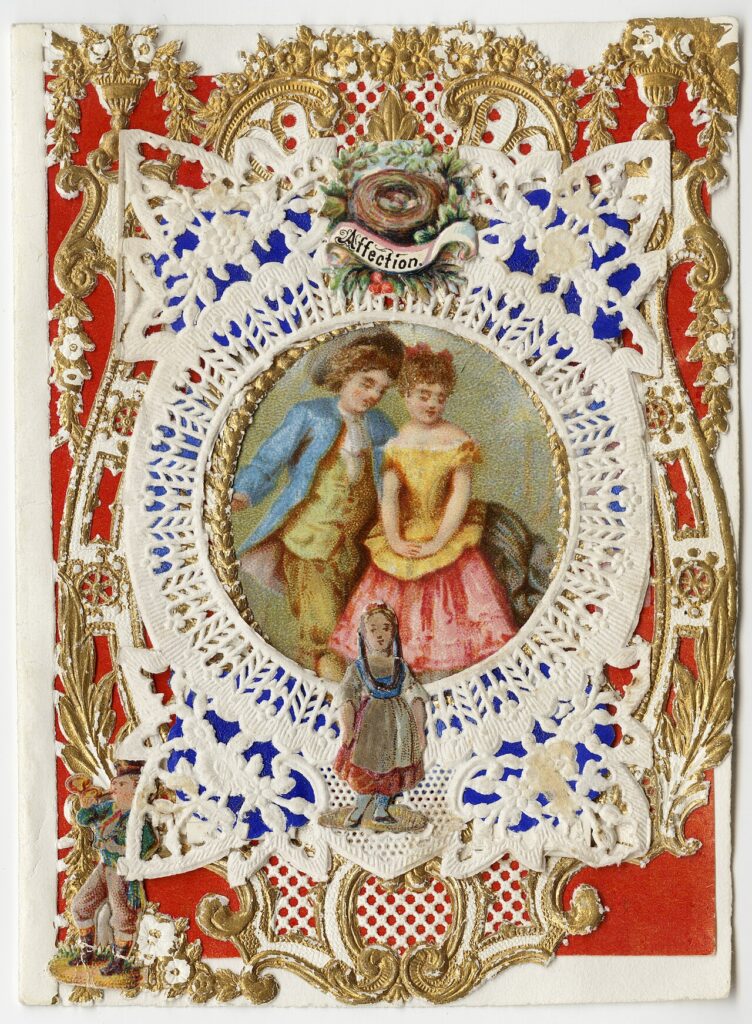
Not every card was sweet. The Victorians also sent “vinegar valentines,” insulting cards mocking the recipient, sometimes anonymously. But the sentimental card won out, and the Valentine became, after the Christmas card, one of the most exchanged greetings in the world. To send the right words yourself, see our collections of Valentine’s Day quotes and messages.
The Symbols of Valentine’s Day
Few holidays have such a recognisable visual language, and each symbol has its own history. The heart, long believed to be the seat of emotion, became the universal shorthand for love, its familiar shape only loosely resembling the real organ. Cupid, the winged boy with his bow, is the Roman god of desire, son of Venus, whose arrows make their targets fall helplessly in love; he descends from the Greek god Eros. Red roses are the flower of Venus and the colour of passion, which is why a dozen of them is the day’s signature gift. Doves, which mate for life, stand for fidelity and devotion, and the letter X used to mean a kiss traces back to medieval signatures sealed with a kiss on the cross.
Chocolate, Candy, and Sweets
Sweetness is central to the modern celebration. The heart-shaped box of chocolates was popularised in Britain by Richard Cadbury, who designed beautiful decorative boxes for the company’s chocolates in the 1860s, deliberately tying confectionery to the romance of the day.

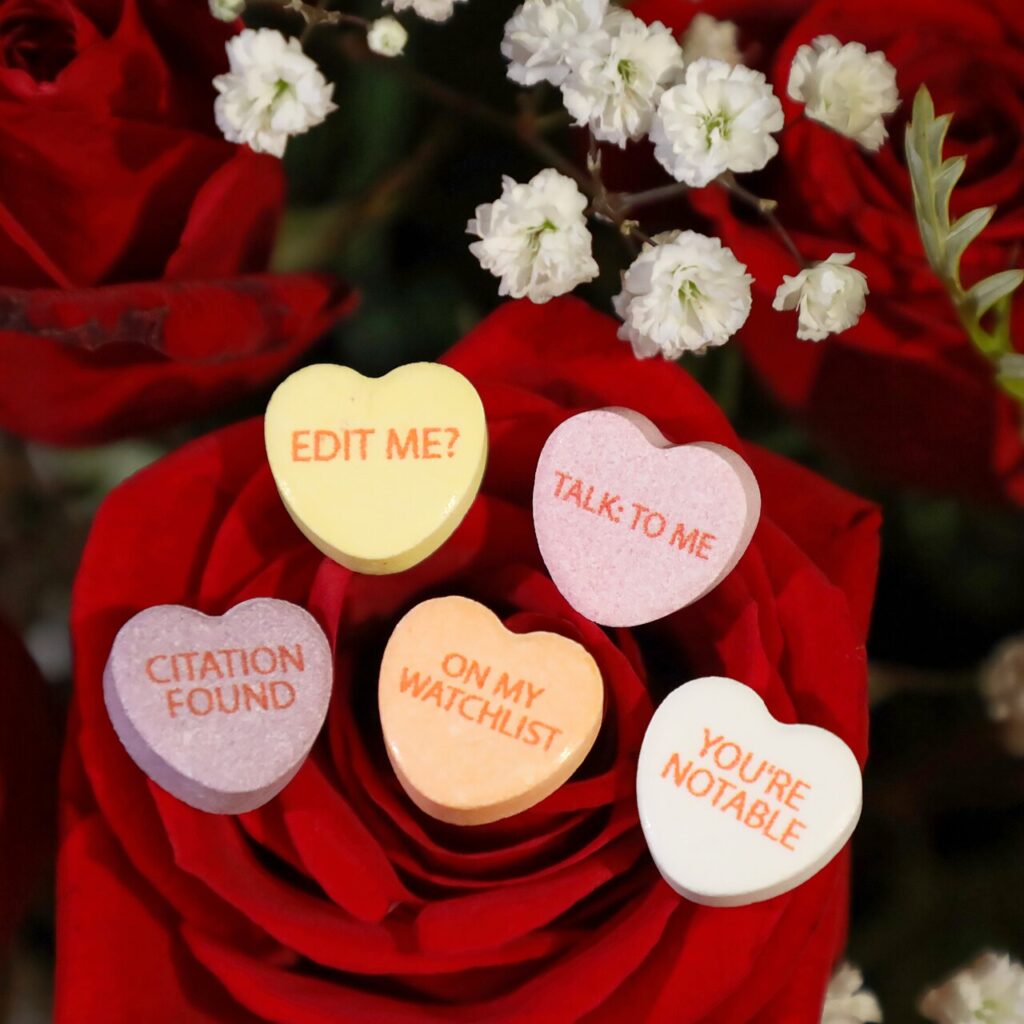
In the United States, the little pastel candies stamped with short messages, conversation hearts, became an inseparable part of the holiday, their printed phrases evolving with the times. Today chocolate and sweets are among the most given Valentine’s gifts of all, and the days around February 14 are some of the biggest of the year for confectioners.
How People Celebrate Today
The modern Valentine’s Day is a celebration of romance expressed mostly through gifts, gestures, and time together. Couples exchange cards and flowers, give gifts, and mark the day with a special date, whether a restaurant dinner or a romantic evening at home. The day has also broadened well beyond couples, with children exchanging cards at school, friends celebrating one another, and people treating it as a prompt to show affection of every kind. If you are planning your own celebration, our guides cover date ideas for every budget, planning a romantic evening at home, the best gifts for him, and a wider Valentine’s gift guide. To set the mood, there are romantic songs and Valentine’s movies, and for a night in, party ideas and Valentine’s trivia.
Valentine’s Day Around the World
Although it began in the West, Valentine’s Day is now celebrated globally, and many cultures have given it their own distinctive twist. In Japan, it is women who give chocolate on February 14, distinguishing between giri-choco, obligation chocolate for colleagues and friends, and honmei-choco, the heartfelt chocolate for a romantic interest; men reciprocate a month later on White Day, March 14.

South Korea follows the same pattern and adds Black Day on April 14, when single people gather to eat black noodles. In Wales, lovers traditionally mark Saint Dwynwen’s Day on January 25, exchanging intricately carved wooden lovespoons. Finland and Estonia celebrate the day as Friend’s Day, a broader festival of friendship rather than romance. Brazil skips February entirely, celebrating Dia dos Namorados on June 12. In Denmark, people send pressed white snowdrops and joking rhyming letters called gaekkebreve, and in the Philippines, February 14 has become a popular day for mass weddings, with hundreds of couples marrying together in public ceremonies. The same day, in other words, wears a different face in every country.
Beyond Couples: Friendship and Self-Love
One of the clearest modern trends is the widening of Valentine’s Day beyond romantic couples. The rise of Galentine’s Day, celebrated on February 13 as a festival of female friendship, has given those without a partner, and those who simply value their friends, a celebration of their own; our Galentine’s Day guide covers how to throw one. Many people now also treat the day as an occasion for self-care and self-love, especially those who are single, an approach explored in our self-love guide for singles. Families celebrate too, with children making cards and crafts; see our DIY Valentine’s crafts for kids.
The Commercial Question
No discussion of Valentine’s Day is complete without the perennial complaint that it has become too commercial, a “Hallmark holiday” manufactured to sell cards and chocolate. There is some truth to it: the day generates enormous spending, and the pressure to perform romance on cue can feel hollow. Yet the custom of marking a day for love is far older than any greeting-card company, and for many people the holiday is simply a welcome, if imperfect, prompt to express affection they might otherwise leave unsaid. Whether you embrace it wholeheartedly, celebrate it ironically, or ignore it entirely, the choice is part of the modern tradition.
The Many Saint Valentines
Part of what makes Valentine’s history so hazy is that there was almost certainly more than one Saint Valentine. Early Church records list several martyrs by the name, including a priest in Rome and a bishop of Terni, both associated with February 14, and their stories have blurred together over the centuries into the single figure we picture today. The Catholic Church, recognising the uncertainty, removed Saint Valentine’s Day from its general calendar of obligatory feasts in 1969, though he remains an officially recognised saint. His supposed relics are scattered across Europe: a flower-crowned skull said to be his sits in a Roman basilica, and other relics are venerated in Dublin, where a casket of them draws visitors hoping for luck in love. The real man, if there was just one, is lost to history, but the legend has proved far more durable than any fact.
The Language of Roses
The red rose became the flower of the day for good reason, but Valentine’s flowers speak a whole quiet language. In the Victorian craze for floriography, the “language of flowers,” every bloom and colour carried a coded message, letting lovers say what convention forbade them to speak aloud. Red roses declared deep, passionate love; pink spoke of admiration and gratitude; white meant purity and new beginnings; and yellow, more ambiguously, stood for friendship or even jealousy. The number of roses mattered too, with a single rose meaning love at first sight and a dozen the classic complete declaration. Much of this symbolism survives, which is why a careful giver still thinks twice before sending yellow roses to a romantic interest.
From Roman Festival to Hallmark Holiday
The journey of Valentine’s Day into a commercial juggernaut is largely an American story. Brought across the Atlantic by European settlers, the custom of exchanging cards took off in the nineteenth century, and Esther Howland’s mass-produced valentines helped turn it into a national habit. The twentieth century added flowers, chocolates, jewellery, and dinner reservations, and the greeting-card industry, led by companies like Hallmark, made the printed card a fixture, which is why critics dismiss it as a manufactured “Hallmark holiday.” Today Valentine’s Day is one of the biggest occasions of the year for florists, chocolatiers, restaurants, and jewellers alike, a multibillion-dollar season that nonetheless rests on that very old human impulse to mark a day for love.
Even More Ways the World Celebrates
The global variety goes well beyond the best-known customs. In Italy, Valentine’s Day was once celebrated as a spring festival, and the town of Terni, the supposed birthplace of one Saint Valentine, holds events in his honour. In Slovenia, an old tradition holds that on February 14 the birds of the fields propose to one another and marry, echoing Chaucer’s medieval verse. South Africa keeps a custom, descended from Roman Lupercalia, in which some women pin the name of their beloved on their sleeves. Ghana, one of the world’s leading cocoa producers, has rebranded February 14 as National Chocolate Day to promote its most famous export. Argentina celebrates a whole “sweetness week” in July, and in Iran, some mark an ancient Persian day of love called Sepandarmazgan. Each is a reminder that the urge to celebrate love finds its own local shape wherever it lands.
Valentine’s Day in the Digital Age
The way people express affection on February 14 has shifted with technology. Handwritten letters gave way to printed cards, and printed cards now share the day with text messages, social-media posts, and e-cards sent in an instant across any distance. Couples who met on dating apps mark their own milestones, long-distance partners celebrate over video calls, and the day generates a flood of online declarations, from heartfelt to humorous. The tools have changed completely, yet the underlying gesture, reaching out to say “I am thinking of you,” is exactly the one a third-century prisoner is said to have made with a note signed “from your Valentine.”
A Day for Children, Friends, and Even Pets
Modern Valentine’s Day has expanded far beyond romance. In many countries, schoolchildren exchange small cards with their whole class, learning the day as one of kindness and friendship rather than courtship, often with handmade crafts and sweets. Friends celebrate one another, the rise of Galentine’s Day being the clearest example, and a growing number of people include their pets in the festivities, treating beloved dogs and cats to gifts and attention. The day has become, in effect, a broad celebration of affection in all its forms, which is perhaps closer to its open-hearted spirit than a narrow focus on couples ever was.
Why Valentine’s Day Endures
For all the criticism of its commercialism and the pressure it can place on the single and the loved-up alike, Valentine’s Day has survived for centuries and shows no sign of fading. The reason is simple. Beneath the roses and the marketing lies a genuinely human need, to pause amid ordinary life and deliberately honour the people we care about. Cultures across the world have reached for some version of this, on some date, again and again. February 14 is just the form the impulse takes in much of the world today, and as long as people fall in love and value their friends, some version of the day will endure.
The Enduring Love Letter
Of all the day’s customs, the written declaration of love may be the oldest and the most durable. From the imprisoned duke’s verse of 1415 to the Victorian lace card to today’s text message, the act at the centre of Valentine’s Day has always been the same: putting feeling into words and sending it to another person. The medium keeps changing, but the courage and tenderness it takes to say “I love you,” in ink or in pixels, does not. It is worth remembering, amid the chocolates and the dinner reservations, that the simplest and most traditional Valentine’s gift of all costs nothing but honesty: a few heartfelt words, written down and given.
Marking the Day Your Own Way
There is no single right way to celebrate Valentine’s Day, and the best version is the one that suits the people involved. Some mark it with a grand gesture, others with a quiet evening at home; some celebrate romance, others friendship or simply themselves. Whether you are planning a date on any budget, choosing a thoughtful gift, hosting a Galentine’s gathering, or treating yourself with a little self-love, the day is yours to shape. Its long, strange history has only ever pointed in one direction: toward making time, in whatever form you like, to celebrate love.
A Day for Love, in Every Form
From a Roman martyr to a medieval poem, from Victorian lace cards to Japanese obligation chocolate, Valentine’s Day has been reinvented again and again across the centuries, and it continues to change. What endures beneath all the commerce and custom is a simple idea worth keeping: that it is good, now and then, to stop and tell the people we love that we love them. However you choose to mark February 14, whether with grand romance, a quiet gesture, or simply a kind word to a friend, that is the heart of it, and it always quietly has been, year after year. For the words to say it, see our guide to Valentine’s Day quotes, and to test your knowledge of the day, our Valentine’s trivia.
Frequently Asked Questions About Valentine’s Day
Who was Saint Valentine?
Saint Valentine was an early Christian martyr, most often identified as a third-century Roman priest executed around the year 269. By legend he secretly married young couples in defiance of an imperial ban and, before his death, sent a note signed “from your Valentine,” the phrase still used on cards today.
Why is Valentine’s Day on February 14?
February 14 was established as the Feast of Saint Valentine by Pope Gelasius I in 496, near the date of the older Roman fertility festival of Lupercalia. Its link to romantic love is usually credited to the poet Geoffrey Chaucer, who around 1382 tied the day to the mating of birds.
What are the symbols of Valentine’s Day?
The main symbols are the heart, long seen as the seat of emotion; Cupid, the Roman god of desire with his bow and arrows; red roses, the flower of Venus; doves, which mate for life and stand for fidelity; the colour red; and the letter X used to mean a kiss.
Why do we give chocolate on Valentine’s Day?
The custom was popularised by Richard Cadbury, who designed decorative heart-shaped boxes for chocolates in the 1860s, deliberately linking confectionery to romance. Chocolate and sweets are now among the most popular Valentine’s gifts of all.
How is Valentine’s Day celebrated around the world?
Customs vary widely. In Japan women give chocolate and men reciprocate on White Day; South Korea adds a Black Day for singles; Wales marks Saint Dwynwen’s Day with carved lovespoons; Finland and Estonia celebrate friendship; Brazil celebrates on June 12; and the Philippines holds mass weddings.
What is Galentine’s Day?
Galentine’s Day, celebrated on February 13, is a modern festival of female friendship, an occasion for women to celebrate their friends rather than a romantic partner.