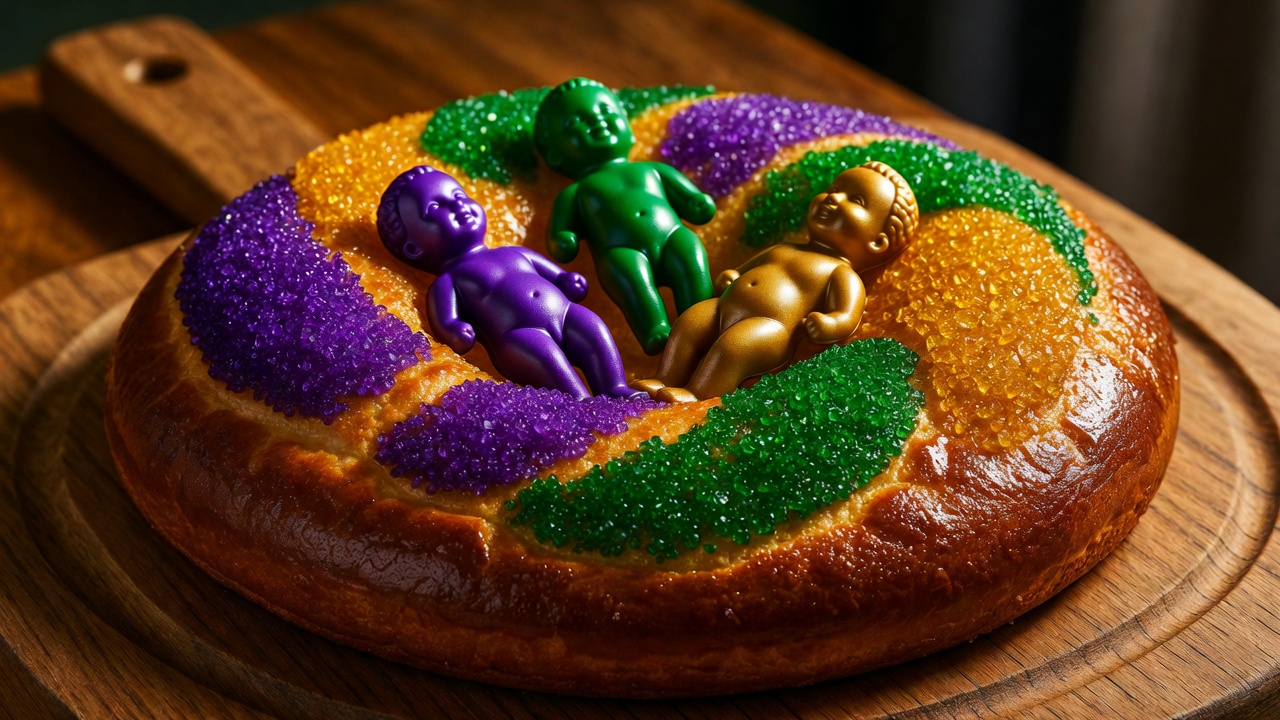
No Mardi Gras is complete without king cake, the ring-shaped, cinnamon-filled pastry decorated in purple, green, and gold and hiding a tiny baby inside.
This guide shares an authentic king cake recipe for your Mardi Gras celebration, with step-by-step instructions, the traditional colours, and the story behind the hidden baby.
What Is King Cake and Why Does It Matter?
King cake isn’t just dessert. It’s a ritual. A celebration. A sweet, doughy promise that Mardi Gras has arrived.
This iconic traditional Mardi Gras king cake traces its roots to French Catholic settlers in Louisiana. They brought the custom of celebrating Epiphany, the day the three kings visited baby Jesus, with a special cake. Over time, this European tradition transformed into something distinctly American. Something louder. More colorful. More delicious.
Today, the authentic New Orleans king cake remains the centerpiece of Carnival season. From January 6th through Fat Tuesday, bakeries across Louisiana sell millions of these oval-shaped beauties. But nothing compares to a homemade king cake from scratch.
Ready to bake your own? Let’s dive in.
The Rich History Behind This Beloved Mardi Gras Tradition
Understanding why we eat king cake makes baking one even sweeter.
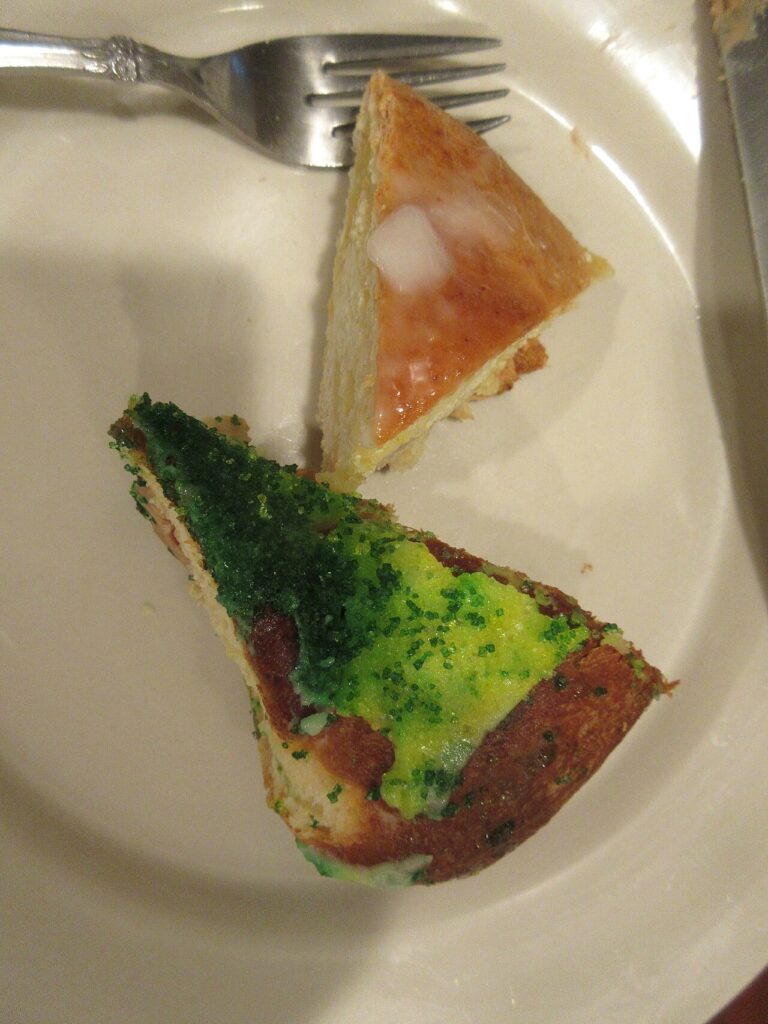
The name “king cake” honors the three biblical Magi. Purple symbolizes justice. Gold represents power. Green stands for faith. These colors have adorned king cakes since the 1800s.
But here’s the detail most people miss: king cake season has strict boundaries. You eat it only between Epiphany (January 6th) and Mardi Gras (Fat Tuesday). Eating king cake outside this window? That’s a Carnival crime in New Orleans.
The Tiny Plastic Baby Explained
Every traditional king cake with baby contains a small figurine hidden inside. Finding it brings luck, and responsibility. The person who gets the baby must host the next king cake party or buy the next cake.
This tradition connects to medieval European customs. Originally, a bean or coin hid inside. The plastic baby became standard in the 1950s. Today, some bakers place the baby underneath the cake for safety reasons.
Essential Ingredients for an Authentic King Cake Recipe
Before you start, gather everything. Mise en place matters with yeasted doughs.
Dough Ingredients
| Ingredient | Amount | Notes |
|---|---|---|
| All-purpose flour | 4 cups | Plus extra for dusting |
| Active dry yeast | 2¼ tsp (1 packet) | Room temperature |
| Whole milk | ¾ cup | Warmed to 110°F |
| Granulated sugar | ½ cup | Feeds the yeast |
| Unsalted butter | ½ cup | Softened |
| Eggs | 3 large | Room temperature |
| Vanilla extract | 1 tsp | Pure, not imitation |
| Salt | 1 tsp | Don’t skip this |
| Lemon zest | 1 tbsp | Fresh only |
| Ground nutmeg | ½ tsp | Freshly grated preferred |
Cinnamon Sugar Filling
| Ingredient | Amount |
|---|---|
| Light brown sugar | ¾ cup |
| Ground cinnamon | 2 tbsp |
| Softened butter | 4 tbsp |
Glaze and Toppings
| Ingredient | Amount |
|---|---|
| Powdered sugar | 3 cups |
| Whole milk | 3-4 tbsp |
| Vanilla extract | 1 tsp |
| Purple, gold, and green sanding sugar | ½ cup each |
Step-by-Step Instructions: How to Make King Cake from Scratch
This easy king cake recipe for beginners breaks down every step. Follow closely. Your kitchen will smell like a French Quarter bakery.
Step 1: Activate the Yeast
Warm your milk to 110°F. Too hot kills the yeast. Too cold won’t activate it.
Pour the warm milk into a large bowl. Sprinkle the yeast over top. Add one tablespoon of the granulated sugar. Stir gently. Wait 10 minutes.
You should see foam and bubbles. This means your yeast is alive and ready. No bubbles? Start over with fresh yeast.
Step 2: Make the Dough
Add the remaining sugar, softened butter, eggs, vanilla, salt, lemon zest, and nutmeg to the yeast mixture. Whisk until combined.
Gradually add flour, one cup at a time. Mix after each addition. The dough will become shaggy, then smooth.
Turn the dough onto a floured surface. Knead for 8-10 minutes. You want a soft, slightly tacky ball. It shouldn’t stick aggressively to your hands.
Step 3: First Rise
Place the dough in a greased bowl. Cover with plastic wrap or a damp towel. Let it rise in a warm spot for 1.5 to 2 hours. The dough should double in size.
Pro tip: Your oven with just the light on creates perfect rising conditions.
Step 4: Prepare the Cinnamon Filling
While the dough rises, mix brown sugar and cinnamon together. Set aside. Keep the butter softened and ready.
Step 5: Shape the King Cake
Punch down the risen dough. Roll it into a large rectangle, roughly 28 inches by 12 inches.
Spread the softened butter evenly across the surface. Sprinkle the cinnamon sugar mixture over the butter. Leave a one-inch border along one long edge.
Starting from the opposite long edge, roll the dough into a tight log. Pinch the seam closed.
Transfer to a parchment-lined baking sheet. Curve the log into an oval ring. Connect the ends by pinching them together firmly.
Step 6: Second Rise
Cover the shaped cake loosely. Let it rise another 45 minutes to one hour. The ring will puff up noticeably.
Step 7: Bake to Golden Perfection
Preheat your oven to 350°F.
Bake the king cake for 25-30 minutes. The top should turn golden brown. Internal temperature should reach 190°F.
Let it cool completely before decorating. Patience is hard here. But warm cake makes soggy icing.
How to Decorate Your Homemade King Cake
The decoration transforms this bread into a showstopper.
Make the Glaze
- Sift powdered sugar into a bowl
- Add milk one tablespoon at a time
- Stir in vanilla
- Mix until smooth and pourable
The consistency should coat a spoon but drip slowly. Adjust with more sugar or milk as needed.
Apply the Iconic Colors
Drizzle glaze generously over the cooled cake. Work in sections.
While each section is still wet, sprinkle colored sugars in alternating bands:
- Purple (justice)
- Gold (power)
- Green (faith)
Repeat the pattern around the entire ring. Don’t mix the colors, each section should be distinct.
Hide the Baby
Once decorated, slip the plastic baby into the cake from the bottom. Push it up through the bread until hidden. Some families place it underneath instead.
Delicious King Cake Filling Variations to Try
The classic cinnamon king cake recipe remains beloved. But modern bakers love experimenting.
Cream Cheese Filling (Most Popular)
This cream cheese filled king cake rivals any New Orleans bakery.
- 8 oz cream cheese, softened
- ½ cup powdered sugar
- 1 tsp vanilla extract
Beat until smooth. Spread over the dough before adding cinnamon sugar.
Praline Pecan Filling
Louisiana knows pecans. This filling proves why.
- 1 cup chopped pecans, toasted
- ¼ cup butter, melted
- ½ cup brown sugar
- 2 tbsp heavy cream
Mix and spread before rolling.
Strawberry Cream Cheese
For something fruity and fresh:
- 8 oz cream cheese, softened
- ½ cup strawberry preserves
- ¼ cup powdered sugar
Swirl together. Don’t overmix, you want ribbons of fruit.
Chocolate Hazelnut
A modern twist that kids adore:
- 1 cup Nutella
- ½ cup chopped hazelnuts
Spread and sprinkle before rolling.
Common Mistakes When Making King Cake at Home
Even experienced bakers stumble. Learn from their errors.
| Mistake | Why It Happens | How to Fix It |
|---|---|---|
| Dense, heavy cake | Yeast didn’t activate properly | Always check for bubbles before proceeding |
| Filling leaks out | Dough rolled too thin at edges | Keep consistent thickness |
| Cake browns unevenly | Oven runs hot | Use an oven thermometer; rotate halfway |
| Dry texture | Overbaked | Check at 25 minutes |
| Ring won’t stay closed | Ends not pinched firmly | Wet the edges before connecting |
| Icing slides off | Cake still warm | Cool completely first |
How to Store Your King Cake Properly
Freshness matters with yeasted breads.
Short-Term Storage
- Cover loosely with plastic wrap
- Keep at room temperature
- Best within 2-3 days
Freezing Instructions
- Bake but don’t decorate
- Wrap tightly in plastic wrap
- Add layer of aluminum foil
- Freeze up to 3 months
- Thaw overnight at room temperature
- Add glaze and sugars fresh
Never refrigerate king cake. Cold temperatures dry out the bread.
King Cake Around the World: Cousins of the Mardi Gras Classic
The New Orleans king cake belongs to a much larger family of celebration cakes baked across Europe and Latin America. Most of them share the same origin in the Christian feast of Epiphany on January 6, which marks the visit of the three kings to the infant Jesus. The shape, the hidden charm, and the idea of crowning a temporary “king” of the party travel from country to country, even when the dough and flavors change.
France: Galette des Rois and the Fève
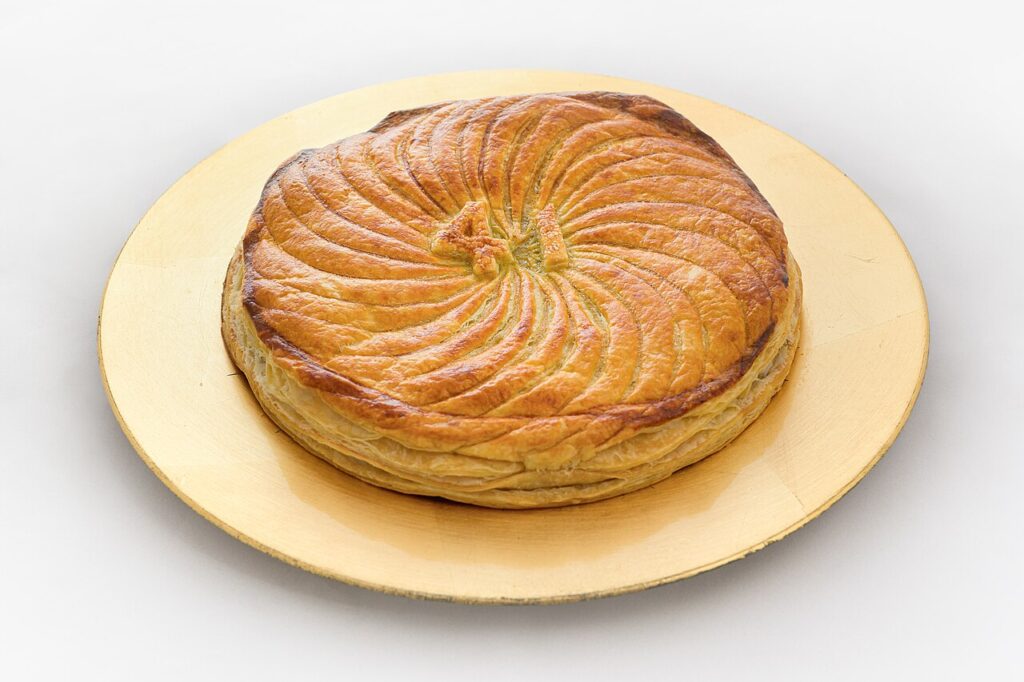
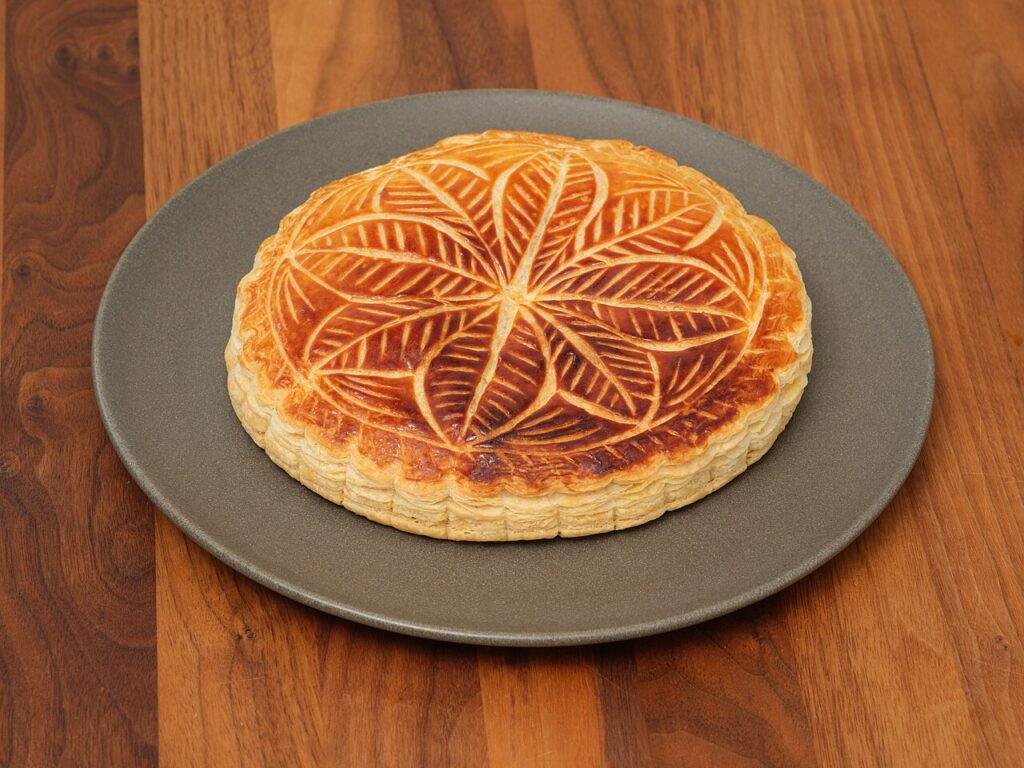
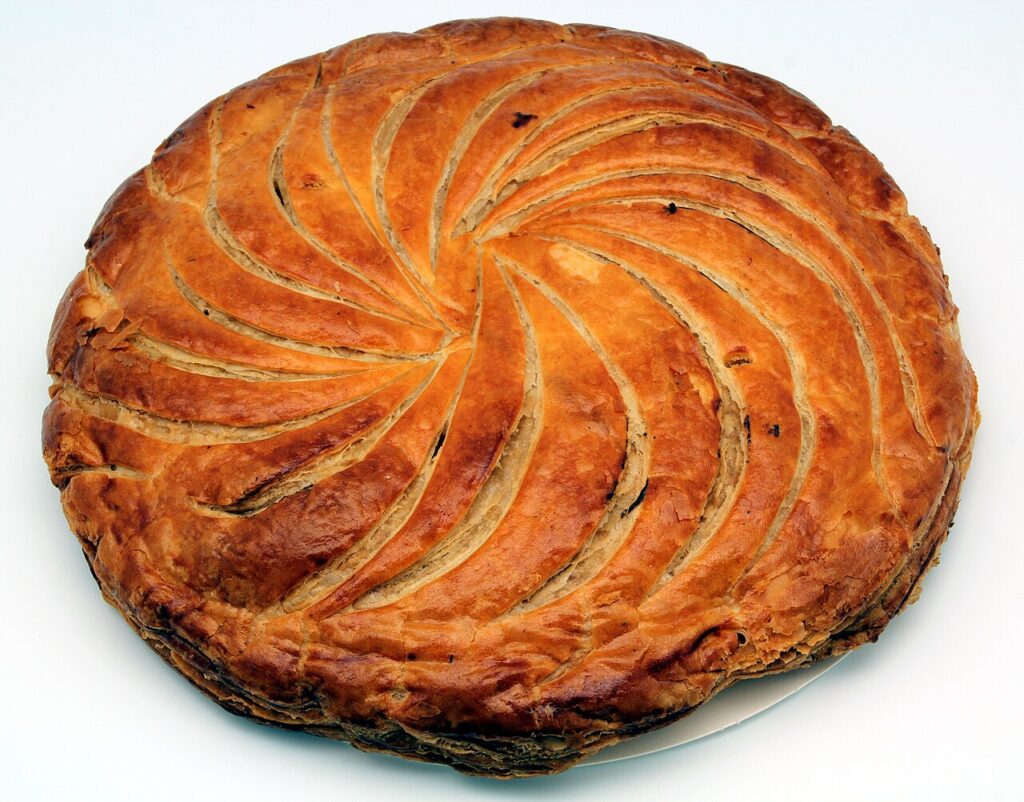
In northern France, the Epiphany cake is the galette des rois, a flat round of golden puff pastry filled with frangipane, a sweet almond cream. It looks nothing like the ring-shaped New Orleans version, but it carries the same hidden surprise: a fève. The word means “fava bean,” and centuries ago a real dried bean was baked inside. Today the fève is usually a small glazed porcelain figurine, and collecting them is a hobby in its own right. Whoever finds the fève in their slice wears a paper crown that comes with the cake and is named king or queen for the day. In southern France and parts of the Provence region, bakers make a different style entirely, a brioche ring studded with candied fruit that looks far closer to the New Orleans cake.
Spain and Latin America: Rosca de Reyes
The clearest relative of the New Orleans cake is the rosca de reyes, eaten on Three Kings Day across Spain, Mexico, and much of Latin America. “Rosca” means ring, and the cake is an oval or round loaf of sweet, slightly orange-scented bread decorated with strips of candied fruit and crystallized sugar. Hidden inside is a small plastic or porcelain figure of the baby Jesus. In Mexican tradition, the person who finds the figure is expected to host a follow-up gathering on February 2, Candlemas Day, and bring tamales for everyone. That obligation is a direct mirror of the New Orleans rule about the plastic baby, just attached to a different date and a different menu.
Greece, Bulgaria, and Beyond
Greece has its own version called vasilopita, eaten on New Year’s Day to honor Saint Basil rather than the three kings. A coin is baked inside, and the lucky finder is said to receive good fortune for the coming year. Bulgaria bakes a similar bread called banitsa for New Year’s, tucking in fortunes written on small pieces of paper along with a coin. The thread running through all of these is the same: a shared cake, a hidden token, and a moment of luck or responsibility handed to whoever finds it. The New Orleans king cake simply adapted the custom to Carnival season, stretching it from Epiphany all the way to Mardi Gras.
The King Cake Party and Its Unwritten Rules
In New Orleans and across the Gulf Coast, king cake is not just dessert. It is a social engine that runs from January 6 through Fat Tuesday. The cake comes with a small set of customs that locals follow without thinking, and knowing them helps you join in correctly if you are new to the tradition.
The central rule involves the plastic baby hidden inside. When the cake is cut and served, everyone checks their slice. Whoever finds the baby in their piece is responsible for the next cake, either by hosting the next gathering or by buying the cake for the following week. This keeps the season rolling, because each party guarantees another one. Offices, classrooms, and church groups lean on this rule to fill the weeks between Epiphany and Mardi Gras with a steady supply of cake.
A few practical points of etiquette are worth knowing:
- Warn guests that a baby is hidden inside so no one bites down on it by surprise. Many home bakers and bakeries now leave the baby out of the cake and tuck it underneath or hand it to the host to insert, specifically to avoid a chipped tooth or a choking hazard with children.
- The finder is supposed to accept the duty graciously rather than hide the evidence. Trying to dodge the next cake is considered bad form.
- King cake is strictly seasonal. Asking for one outside of Carnival season, before January 6 or after Mardi Gras, is a minor social faux pas in New Orleans. Bakeries usually stop selling them the day after Fat Tuesday.
Office king cake season has become its own ritual in Louisiana workplaces. Someone brings the first cake, the baby finder brings the next, and the rotation continues until Lent begins. It is a low-cost way to mark the weeks, and it explains why a single office can go through eight or ten cakes in a season.
Where to Buy Famous King Cakes if You Do Not Bake
Baking your own is rewarding, but New Orleans is home to bakeries that have built decades of reputation on this one cake. If you would rather buy, or you want to taste the benchmark before you bake, these are the names locals argue about every year.
- Dong Phuong Bakery in New Orleans East is a Vietnamese American bakery that became a phenomenon for its king cake. The dough is rich and slightly tangy, and demand is so high that the bakery runs a preorder system with daily limits during the season. It won a James Beard America’s Classics award in 2018, and its cakes routinely sell out within minutes of release.
- Manny Randazzo King Cakes in Metairie is a traditional favorite known for a moist cinnamon cake and generous filling options. The Randazzo family has been baking king cakes for generations, and the shop operates almost exclusively during Carnival season.
- Haydel’s Bakery is another long-running New Orleans institution, recognized for a classic braided cake and for releasing a collectible porcelain figurine with its cakes each year.
- Antoine’s Restaurant, the historic French Quarter fine-dining landmark, sells its own king cake and ships it, offering a more upscale take from one of the oldest restaurants in the country.
Nationwide shipping has made these cakes available far beyond Louisiana. Most of the major bakeries ship king cakes across the continental United States during Carnival season, typically packed unfrozen for two-day delivery or frozen for longer transit. Ordering early matters, because the most sought-after bakeries open a limited number of shipping slots and fill them weeks in advance. Expect shipping to add a significant cost on top of the cake itself, and plan to thaw a frozen cake fully before serving for the best texture.
Gluten-Free, Vegan, and Lighter Adaptations
A yeasted, butter-rich cake is not friendly to every diet, but the recipe adapts better than you might expect. The key is understanding what each ingredient does so you can swap it without losing structure.
Gluten-Free
Use a one-to-one gluten-free flour blend that already contains xanthan gum, which replaces the stretch that gluten normally provides. Gluten-free dough is stickier and will not develop the same elasticity, so it is easier to shape into a ring on parchment rather than kneading by hand. Expect a slightly denser crumb, and let the dough rise in a warm, draft-free spot since gluten-free batters can be slow to proof.
Vegan
Replace the butter with a plant-based block butter (not a spreadable tub, which has too much water), swap dairy milk for unsweetened soy or oat milk, and use a flax egg, one tablespoon of ground flaxseed mixed with three tablespoons of water per egg, to bind the dough. For the glaze, plant milk works in place of dairy, and the colored sugars are usually vegan already. Soy and oat milk both brown nicely and give the closest result to the original.
Lighter Versions
To cut richness without ruining the cake, reduce the butter modestly and replace part of it with unsweetened applesauce or Greek yogurt, which keeps the crumb moist. You can also thin the glaze so a little goes further, and lean on the colored sugar for visual impact rather than a thick layer of icing. Skipping a heavy cream cheese filling in favor of a simple cinnamon swirl also trims a meaningful amount of sugar and fat.
A Make-Ahead and Timing Plan for Your Party
Yeasted dough takes time, and the last thing you want is to be glazing a cake while guests arrive. Working backward from your serving time keeps the whole process calm. Here is a flexible plan you can adjust to your schedule.
- The day before: Mix and knead the dough, then give it a slow first rise in the refrigerator overnight. A cold, slow proof develops flavor and spreads the work across two days. You can also bake the entire cake a day ahead and store it unglazed, tightly wrapped, at room temperature.
- Party morning: If you refrigerated the dough, let it come to room temperature, then shape, do the second rise, and bake. If you baked the day before, simply glaze and decorate a few hours before serving so the icing sets but the cake stays fresh.
- Freezing further ahead: A baked, unglazed king cake freezes well for up to a month. Wrap it twice, in plastic and then foil, and thaw it at room temperature for several hours before glazing. Add the glaze and sugars only after thawing, never before freezing.
Always glaze and apply the colored sugar as close to serving as you reasonably can. Sugar drinks in moisture from the icing over time and can turn patchy or weep if it sits for a full day.
Serving Size, Portions, and What to Pour Alongside
A standard king cake baked in a large ring serves roughly 12 to 16 people in modest slices, which is part of why it suits offices and parties so well. Because the cake is a ring, the easiest way to cut it is into wedges across the band, working around the circle like a clock so every slice gets the same proportion of filling and glaze. For a big crowd, many people bake two smaller cakes rather than one giant one, which also makes shaping and even baking easier.
For pairings, the cake’s sweetness and cinnamon notes go best with something simple and a little bitter to balance it. Strong black coffee or a New Orleans-style chicory coffee is the classic match, and café au lait suits the brioche texture beautifully. For a non-coffee option, black tea works the same way. If you are serving it as part of a Carnival party rather than a morning treat, sparkling wine or a dry cider cuts through the richness without competing with the cinnamon. Keep the drinks on the less-sweet side, since the cake and its sugar topping already bring plenty of sweetness to the table.
More Mardi Gras & Carnival Guides
Explore the rest of our Mardi Gras coverage, and Carnival celebrations in other cities:
- Mardi Gras 2026: The Ultimate Guide (Start Here)
- Mardi Gras 2026 Calendar: When Parades Start
- 20 Traditional Mardi Gras Foods to Try
- Creative Mardi Gras Party Ideas
- DIY Mardi Gras Decorations: Purple, Green & Gold
- What to Wear to Mardi Gras: Costume Ideas
- Is Mardi Gras Family-Friendly? Best Spots
- Why We Throw Beads: Mardi Gras Traditions
- Mardi Gras vs. Fat Tuesday: The Difference
- What Is King Cake? Meaning of the Baby and Colours
- Rio Carnival 2026: Complete Guide (Brazil)
- Venice Carnival 2026: Complete Guide (Italy)
- Quebec Winter Carnival 2026: Full Guide (Canada)
- Nice Carnival 2026 Guide (France)
Frequently Asked Questions About King Cake
When is king cake season? January 6th (Epiphany) through Fat Tuesday. The date of Mardi Gras changes yearly but always falls 47 days before Easter.
What does finding the baby mean? Good luck! But also responsibility. Tradition says you host the next party or buy the next cake.
Can I make king cake ahead of time? Yes. Bake the cake a day ahead. Decorate the morning you plan to serve.
Is king cake sweet or savory? Traditional king cake tastes mildly sweet, like cinnamon roll bread. It’s not overly sugary despite the colorful toppings.
What’s the difference between king cake and coffee cake? King cake uses enriched yeast dough. Most coffee cakes use quick-bread batters. The texture differs significantly.
Can I use instant yeast instead of active dry? Yes. Skip the proofing step. Mix instant yeast directly with dry ingredients.
Serving Suggestions for Your Mardi Gras King Cake Party
King cake anchors the table. But what else should you serve?
Perfect Pairings
- Café au lait (New Orleans tradition)
- Chicory coffee
- Champagne or sparkling wine
- Hurricane cocktails
- Mimosas for brunch celebrations
Party Tips
- Slice the cake in front of guests
- Watch faces as people search for the baby
- Have a backup cake ready (someone always wants more)
- Play zydeco music
- Hang purple, gold, and green decorations
Final Thoughts: Why Homemade King Cake Wins
Mail-order king cakes from Louisiana bakeries have their place. But baking king cake at home creates something special. You control the freshness. You choose the filling. You experience the tradition fully.
This authentic king cake recipe delivers bakery-quality results. The brioche-like dough. The swirl of cinnamon. The ridiculous amount of colored sugar. It all comes together into pure Mardi Gras magic.
So preheat that oven. Gather your ingredients. Let the good times roll, straight from your kitchen.