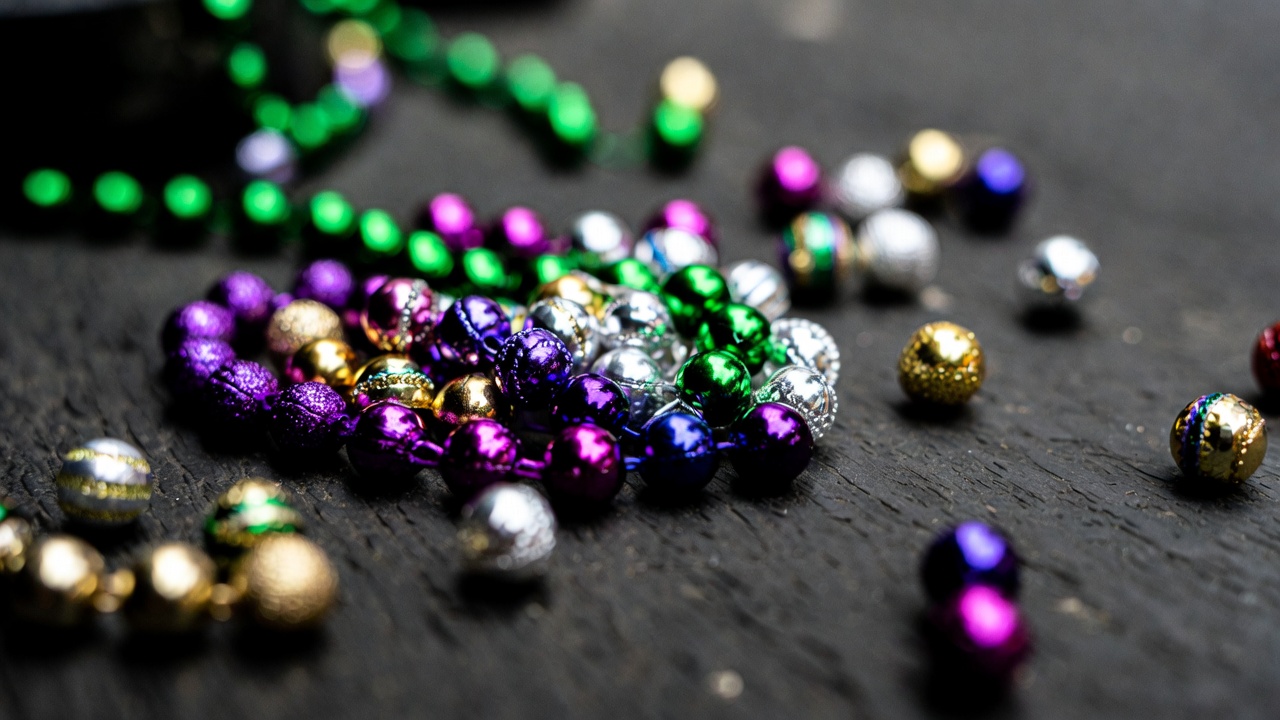
Throwing and catching beads is one of Mardi Gras’ best-known traditions, but there is real history and etiquette behind the colourful throws.
This guide explains why beads are thrown at Mardi Gras, the meaning of the Carnival colours, the history of the throws, and the etiquette every parade-goer should know.
The Surprising History of Mardi Gras Beads in New Orleans
The tradition of throwing trinkets during Mardi Gras began in the 1870s. Early krewe members tossed small gifts to parade-goers from their floats. These weren’t beads at first. They threw flour, candy, and small toys.
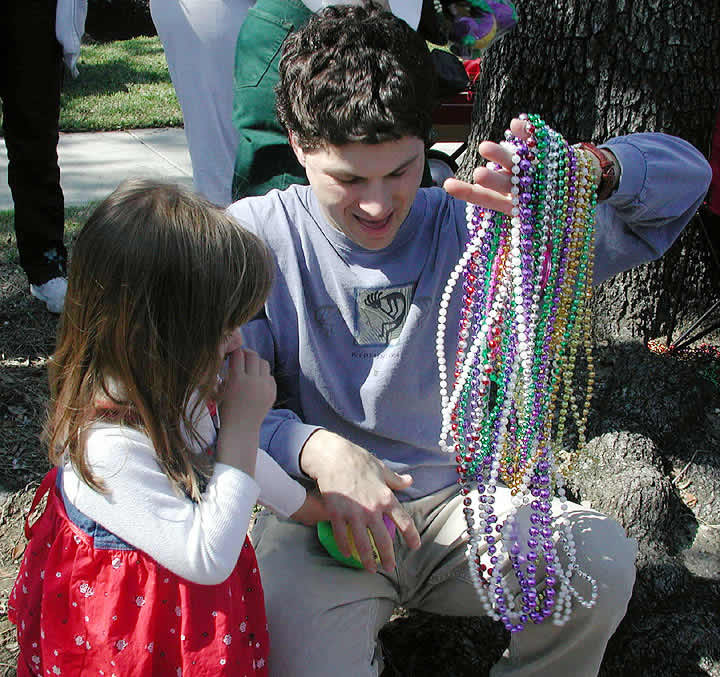
Glass beads from Czechoslovakia appeared around the 1900s. They were expensive and rare. Only wealthy krewes could afford them. Parade riders carefully selected recipients. A thrown bead meant something special.
The shift to plastic beads happened in the 1960s. Suddenly, everyone could participate. Costs dropped dramatically. Volume increased exponentially. The modern bead-throwing frenzy was born.
| Era | Type of Beads | Significance |
|---|---|---|
| 1870s-1900 | Small trinkets, candy | Exclusive gifts to chosen spectators |
| 1900-1960s | Czech glass beads | Expensive, meaningful tokens |
| 1960s-Present | Plastic beads | Mass participation, celebratory excess |
What Do Mardi Gras Beads Symbolize? The Deeper Meaning Behind the Throws
Mardi Gras beads carry more meaning than most tourists realize. The tradition connects to ancient customs of gift-giving before Lent. Catholics celebrated excess before 40 days of fasting. Beads became tokens of this final indulgence.
The colors tell their own story:
- Purple represents justice
- Gold symbolizes power
- Green stands for faith
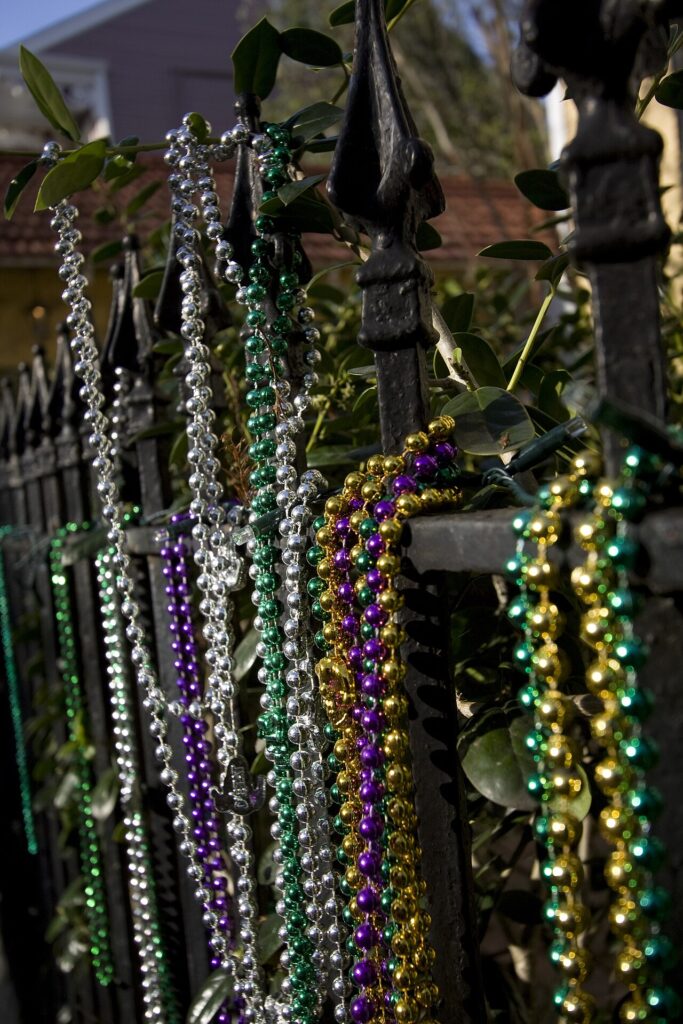
These three colors dominate Mardi Gras decorations. They were chosen in 1872 when the Rex krewe selected them for their parade. The Russian Grand Duke Alexis Romanoff was visiting. The krewe wanted to honor him with royal colors.
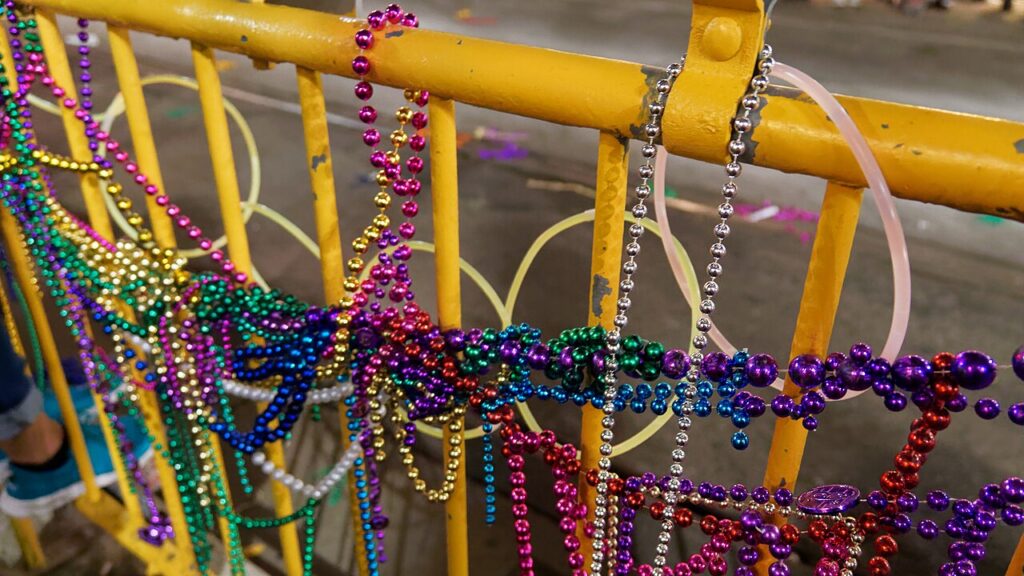
Today, catching beads creates connection. The thrower acknowledges you. You become part of the celebration. It’s a brief but meaningful exchange between strangers.
How to Catch Beads at Mardi Gras Parades: Tips from Locals
Want to know the secrets locals use to catch the best throws? Position matters more than anything else.
Best Spots for Catching Mardi Gras Beads:
- Arrive early , Claim your spot 2-3 hours before the parade
- Bring a ladder , Families with children get priority throws
- Stand at corners , Floats slow down at turns
- Make eye contact , Riders throw to people they notice
- Wear costumes , Creative outfits attract attention
The unwritten rule? Be enthusiastic but respectful. Wave your arms. Shout “Throw me something, mister!” This phrase has echoed through New Orleans streets for over a century.
Never grab beads off someone else’s neck. Never push children aside. These actions violate the spirit of Mardi Gras generosity.
Mardi Gras Bead Etiquette: The Unspoken Rules Every Visitor Should Know
Certain behaviors will get you noticed for the wrong reasons. Understanding proper Mardi Gras etiquette helps everyone enjoy the celebration safely.
| Do This | Don’t Do This |
|---|---|
| Say thank you when you catch something | Demand throws from riders |
| Share with children nearby | Hoard massive quantities |
| Help others retrieve dropped beads | Fight over fallen throws |
| Wear your catches proudly | Sell beads you caught |
| Respect personal space | Block others’ views intentionally |
The Ground Rule: Once beads hit the ground, they’re fair game. But good-natured negotiation works better than aggressive grabbing. A smile goes further than a scowl.
Riders notice rude behavior. They’ll deliberately skip over aggressive parade-goers. Kindness literally gets rewarded at Mardi Gras.
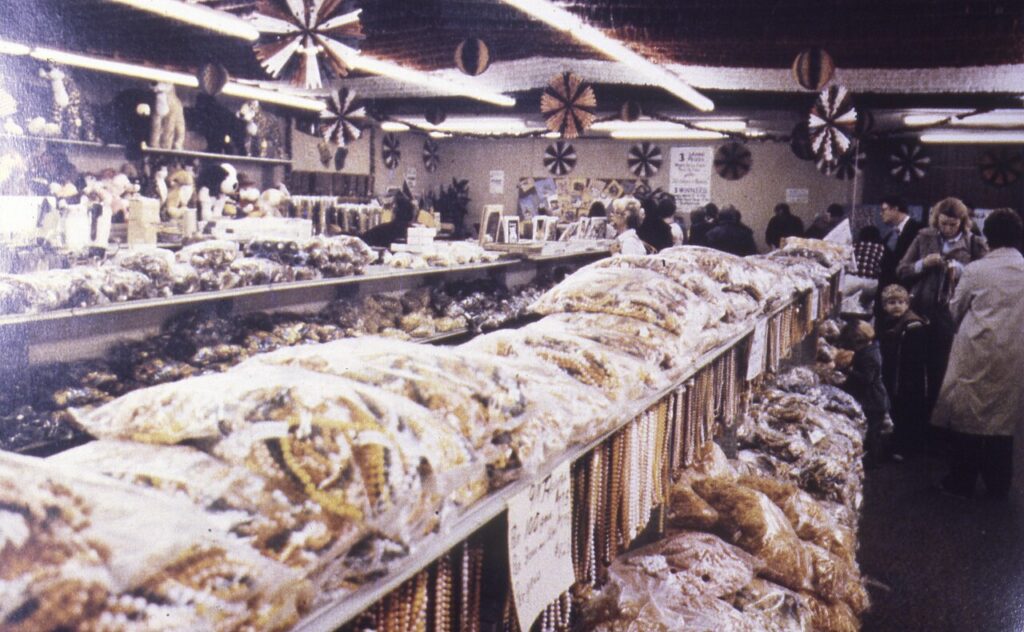
Different Types of Mardi Gras Throws: Beyond the Basic Bead Strand
Modern Mardi Gras parades feature far more than simple bead strands. Krewes compete to offer the most creative throws. Some items become instant collector’s pieces.
Popular Mardi Gras Parade Throws Include:
- Doubloons , Aluminum coins with krewe emblems
- Stuffed animals , Especially popular with families
- Decorated cups , Practical and collectible
- Light-up beads , Battery-powered LED strands
- Specialty medallions , Krewe-specific collectibles
- Hand-decorated shoes , Thrown by the Muses krewe
- Coconuts , The prized throw from Zulu
The Zulu coconut deserves special mention. Riders hand-paint and decorate real coconuts. They don’t throw them (safety reasons). They hand them directly to lucky recipients. A Zulu coconut is the holy grail of Mardi Gras throws.
When Did Throwing Beads at Mardi Gras Start? A Timeline of Traditions
Understanding the evolution helps appreciate modern celebrations:
1857 , The Mistick Krewe of Comus holds the first organized parade
1872 , Rex krewe introduces purple, gold, and green colors
1880s , First documented trinket throws from floats
1900s , Czech glass beads appear in parades
1920s , “Throw me something, mister!” becomes common phrase
1960s , Plastic beads revolutionize throwing volume
1970s , Doubloons gain popularity as collectibles
2000s , Sustainability concerns spark bead recycling programs
Today , Over 25 million pounds of beads are thrown annually
Are Mardi Gras Beads Bad for the Environment? The Sustainability Question
Modern celebrations create environmental challenges. Most plastic beads contain lead and other heavy metals. They clog storm drains. They pollute waterways. New Orleans spends millions on post-parade cleanup.
Eco-Friendly Mardi Gras Bead Alternatives:
- Biodegradable paper beads
- Recycled glass options
- Sustainable bamboo strands
- Fabric flower garlands
- Seed bead necklaces (plant them later!)
Several organizations now collect used beads for recycling. Arc of Greater New Orleans employs people with disabilities to sort and resell catches. Returning your beads helps the environment and supports the community.
Some krewes have pledged to use sustainable throws exclusively. The movement grows each year. You can participate by recycling beads at designated collection points throughout the city.
Best Mardi Gras Parades for Catching Beads in New Orleans
Not all parades offer equal catching opportunities. Some krewes throw more generously than others.
| Parade | Best Known For | Throwing Volume |
|---|---|---|
| Zulu | Hand-painted coconuts | Moderate |
| Rex | Traditional elegance | Moderate |
| Endymion | Massive throws, long route | Very High |
| Bacchus | Celebrity monarchs, quality items | High |
| Orpheus | Musical theme, generous throws | High |
| Muses | Hand-decorated shoes | Moderate |
| Krewe of Tucks | Toilet-themed humor | Very High |
Pro tip: The family-friendly parades in Metairie often throw more per person. Smaller crowds mean better odds. Consider venturing beyond the French Quarter for a more authentic experience.
What Happens to All Those Mardi Gras Beads After the Celebration?
The party ends. Ash Wednesday arrives. But millions of beads remain. Their journey continues long after Fat Tuesday.
Some beads get stored in attics. Louisiana homes contain generations of Mardi Gras memories. Grandparents show grandchildren their prized catches from decades past.
Other beads enter the recycling stream. Local nonprofits collect, sort, and redistribute them. The same strand might fly through the air multiple times over the years.
Sadly, many beads become waste. They hang from trees for months. They accumulate in gutters. They break into microplastics. This reality has sparked important conversations about sustainable celebration.
Planning Your First Mardi Gras Trip: Essential Bead-Catching Advice
Ready to experience the magic yourself? Here’s what seasoned Mardi Gras visitors recommend:
Before You Go:
- Book accommodations at least 6 months ahead
- Study the parade schedule carefully
- Pack comfortable shoes for standing
- Bring a clear bag for security checkpoints
What to Bring for Parade Day:
- Small backpack or tote for catches
- Water bottles (stay hydrated!)
- Snacks (parade routes lack food vendors)
- Portable phone charger
- Layers (February weather varies wildly)
Where to Stay: The Garden District offers parade proximity without French Quarter chaos. Magazine Street provides excellent viewing spots. Mid-City locations put you near Endymion’s spectacular route.
The Magic Lives in the Exchange
Mardi Gras bead throwing isn’t really about the plastic. It’s about connection. A stranger on a float sees you. They choose you. They throw. You catch. For one brief moment, you share joy with someone you’ll never meet again.
This simple exchange has repeated billions of times over 150 years. It connects generations. It welcomes newcomers. It defines what makes New Orleans celebrations unique.
So when someone asks why we throw beads at Mardi Gras, the answer is simple. We throw beads because celebration is better when shared. We throw beads because generosity creates community. We throw beads because some traditions need no explanation.
They just need participation.
The Signature Throws of New Orleans Krewes
While strings of plastic beads are the most common thing flying through the air on parade day, the most coveted catches are the specialty items that each krewe (the private organizations that stage the parades) is known for. These signature throws are usually limited in number, often handmade, and serious parade-goers plan their entire route around the chance to land one. Knowing which krewe throws what helps you decide where to stand and what to shout for.
Zulu’s Hand-Decorated Coconut
The Zulu Social Aid and Pleasure Club, which has rolled on Mardi Gras morning since the early 1900s, is famous for the “Golden Nugget,” a hand-decorated coconut. These are among the most sought-after throws in all of Carnival. Because thrown coconuts once caused injuries and lawsuits, the krewe stopped tossing them through the air decades ago. Today, riders hand the painted and glittered coconuts directly to people along the route, so getting one is about being in the right spot and making a genuine connection with a rider rather than catching anything.
Muses’ Glitter Shoe and Nyx’s Decorated Purse
The Krewe of Muses, an all-female krewe that parades on the Thursday night before Mardi Gras, throws a hand-decorated high-heeled shoe. Each shoe is individually crafted by a member, covered in glitter, sequins, and ornaments, and no two are exactly alike. The Mystic Krewe of Nyx, another women’s krewe, became known for its hand-decorated purses, which follow the same handmade tradition. Both items take members many hours to make, which is why they are given out sparingly and treated like trophies by those who receive them.
Tucks, Bacchus, Iris, and Orpheus
Other krewes have their own recognizable specialties. A quick guide to some of the best-known signature throws:
- Krewe of Tucks: Known for its humorous, irreverent tone, Tucks throws bathroom-themed items including decorated mini toilet brushes and toilet-paper rolls, a nod to the krewe’s tongue-in-cheek origins.
- Krewe of Bacchus: One of the largest super-krewes, Bacchus is recognized for its themed doubloons and elaborate throws connected to its celebrity monarchs and giant signature floats such as the Bacchagator.
- Krewe of Iris: The oldest all-female krewe in New Orleans is known for throwing decorated sunglasses, along with other handmade items.
- Krewe of Orpheus: Co-founded by musician Harry Connick Jr., this music-themed super-krewe is known for throws tied to its musical identity, including its illuminated signature floats like the Smokey Mary train.
How to Politely Get the Best Throws
Catching good throws is far less about aggression than newcomers assume. Riders have only a few seconds to choose who gets each item, and they tend to reward people who are visible, friendly, and easy to make eye contact with. A few small habits dramatically improve your odds without crossing any social lines.
- Make eye contact. Riders throw to faces, not to a sea of waving hands. Look directly at a rider and hold the gaze for a moment.
- Use the traditional call. “Throw me something, mister!” is the classic line, and shouting it with energy genuinely works. Calling out a rider’s specific item (“Nice shoes!” toward a Muses float) signals you know what they have.
- Position yourself well. Stand near the front of the crowd if you can, but not in the street. Spots near the start of the route, away from the most packed corners, often mean riders still have plenty to give.
- Bring kids forward. Riders love throwing to children, and families near the barricade tend to do well.
Just as important is what not to do. Do not climb on barricades or lean into the street, which is dangerous and may be illegal. Do not snatch an item out of someone else’s hands; the general rule is that a throw belongs to whoever it lands nearest, and feet trap beads that hit the ground. Avoid bringing your own beads to throw back unless you understand the local norms, and never throw anything at the floats or riders.
Purple, Green, and Gold: How the Colors Spread
The official Mardi Gras colors of purple, green, and gold appear on nearly every strand of beads, and they carry assigned meanings: purple for justice, green for faith, and gold for power. These colors are widely credited to the Krewe of Rex, the King of Carnival, who is said to have selected them in 1872 for the visit of Russian Grand Duke Alexei Alexandrovich. The “meaning” of each color was popularized later, in the 1890s.
From that single krewe, the color scheme spread across the entire celebration and eventually beyond New Orleans. Because the colors are so strongly tied to Carnival, they now signal Mardi Gras instantly on king cakes, decorations, and of course the beads themselves. When you sort a pile of throws by color, you are handling a tradition that started with one parade more than 150 years ago.
Collecting, Displaying, and Crafting With Beads
After the parades end, most people find themselves with far more beads than they can use, plus a handful of specialty throws worth keeping. Serious collectors treat the rare items, the Zulu coconut, a Muses shoe, a hand-decorated Nyx purse, as keepsakes and display them rather than store them in a box.
- Display the rare pieces. Shadow boxes, glass cases, and wall-mounted hooks turn signature throws into year-round decor. Coconuts and shoes are often dated by year so a collection tells a timeline.
- Repurpose the plastic strands. Common beads can be cut and reworked into wreaths, garlands, costume accessories, and craft projects. Schools and craft groups often welcome donations for art classes.
- Keep doubloons separate. The aluminum or wooden doubloons stamped with krewe themes are collectible in their own right and are easy to store in coin sleeves or display frames.
For the strands you do not want, resist the urge to throw them away. They can be reused next season, handed to friends heading to a parade, or, better still, recycled through a local program built for exactly that purpose.
The Arc of Greater New Orleans Recycling Program
One of the most meaningful things you can do with leftover beads is donate them to the Arc of Greater New Orleans, a nonprofit that supports people with intellectual and developmental disabilities. The Arc runs a long-standing Mardi Gras bead recycling program that collects, sorts, cleans, and repackages used beads, then sells them back to krewes and the public at a lower cost than new imported strands.
The program does double duty. It keeps enormous quantities of plastic out of the waste stream and out of the city’s storm drains, and the sorting and repackaging work provides paid employment to people with disabilities served by the organization. Donation bins appear around the New Orleans area during and after Carnival season, and visitors can drop off their unwanted beads before heading home. Buying recycled beads from the Arc is also a simple way to support the cause while stocking up for the next season.
Throw Safety and Crowd Awareness
Beads are fun, but a strand of heavy beads or a solid specialty item moving at speed can hurt, and parade crowds bring their own hazards. A little awareness keeps the day enjoyable, especially for families.
- Watch for heavy throws. Large bead clusters, doubloons, and items like cups or stuffed animals can sting or cause injury. Keep your hands up and your eyes on the floats so nothing catches you off guard.
- Mind the gap to the floats. Never reach under or beside a moving float for a dropped throw. Float wheels are a serious danger, and parade safety rules exist because of past tragedies.
- Protect children. Keep kids back from the curb edge, consider ladder seats designed for the purpose, and be ready for the sudden surges that happen when popular throws fly. A child on shoulders should be held securely.
- Manage crowd dynamics. The crush near the front can shift quickly. Agree on a meeting point with your group, keep valuables secured, and step back if a section becomes too tightly packed.
Treating throws as a shared celebration rather than a competition makes the whole event safer and friendlier. The riders are giving, the crowd is grateful, and a few sensible precautions mean everyone goes home with good memories and a tangle of beads to sort out later.
Mardi Gras Throws Beyond New Orleans
New Orleans gets most of the attention, but it was not the first American city to hold Mardi Gras. That distinction belongs to Mobile, Alabama, where masked celebrations date to the early 1700s and where the first organized parading society, the Cowbellion de Rakin Society, formed in 1830. Many of the customs later associated with New Orleans, including organized krewes and the throwing of trinkets to crowds, trace back to Mobile.
The signature Mobile throw is the MoonPie, the marshmallow and graham cracker snack made in nearby Chattanooga, Tennessee. MoonPies became the city’s defining catch in the 1950s after an earlier throw was banned for safety reasons. Krewes had been tossing boxes of Cracker Jack, and the hard boxes caused injuries when they struck spectators. The soft, individually wrapped MoonPie was adopted as a safer replacement, and it stuck. Mobile now goes through millions of MoonPies each carnival season, and the city even raises a giant illuminated electric MoonPie over downtown on New Year’s Eve.
Other Gulf Coast communities run their own versions of the celebration with regional flavor. Towns and cities across coastal Mississippi, Louisiana, Alabama, and the Florida Panhandle hold parades where the throws lean local. Common catches in these areas include:
- MoonPies, the standard in Mobile and much of coastal Alabama
- Bags of ramen noodles and packaged snacks in some smaller parades
- Stuffed animals, plastic cups, and beads, which remain universal
- Locally themed trinkets tied to a town’s industry or mascot
If you travel the Gulf Coast during carnival season, expect a friendlier, more family-oriented atmosphere than the crowds along New Orleans’ Bourbon Street, with the same generous spirit of tossing treats to anyone who shows up.
Doubloons: The Collectible Aluminum Throw
Among the most prized catches are doubloons, the lightweight aluminum coins that krewes toss alongside beads. The Krewe of Rex introduced the modern Mardi Gras doubloon in 1960, and the idea spread quickly to other organizations. Within a few seasons the doubloon had become a carnival staple, and an entire hobby of collecting them grew up around it.
What makes doubloons appealing is that each one is a small record of a specific parade. Krewes stamp them with their emblem, the parade theme, and the year, so a doubloon documents exactly which krewe threw it and when. Collectors prize older doubloons, limited runs, and pieces struck in special finishes such as anodized colors or heavier metals, and complete sets from a single krewe across many years can become genuinely valuable.
Catching doubloons takes a different technique than catching beads. Beads arc through the air and are easy to grab overhead, but doubloons are flung flat and low, so they spin out over the crowd and then slide along the pavement when they land. Reaching down to snatch one off the ground is risky, because dozens of other hands and feet are doing the same thing and fingers get stepped on. The classic local tip is to plant your foot flat over a doubloon the instant it lands, then bend down to pick it up only after the scramble settles. Stamping your shoe over the coin claims it without putting your hand in harm’s way, and most experienced parade-goers will respect a doubloon already covered by someone’s foot.
Wear closed-toe shoes if you plan to chase doubloons, and keep an eye on the street as floats pass rather than only watching the air above you.
More Mardi Gras & Carnival Guides
Explore the rest of our Mardi Gras coverage, and Carnival celebrations in other cities:
- Mardi Gras 2026: The Ultimate Guide (Start Here)
- Mardi Gras 2026 Calendar: When Parades Start
- 20 Traditional Mardi Gras Foods to Try
- Creative Mardi Gras Party Ideas
- DIY Mardi Gras Decorations: Purple, Green & Gold
- What to Wear to Mardi Gras: Costume Ideas
- Is Mardi Gras Family-Friendly? Best Spots
- Mardi Gras vs. Fat Tuesday: The Difference
- The Best Authentic King Cake Recipe
- What Is King Cake? Meaning of the Baby and Colours
- Rio Carnival 2026: Complete Guide (Brazil)
- Venice Carnival 2026: Complete Guide (Italy)
- Quebec Winter Carnival 2026: Full Guide (Canada)
- Nice Carnival 2026 Guide (France)
Frequently Asked Questions
Why are beads thrown at Mardi Gras?
Throwing beads and trinkets from floats is a long-standing Carnival tradition, with krewes tossing throws to the crowd.
What do the Mardi Gras bead colours mean?
The traditional colours are purple for justice, green for faith, and gold for power.
What is the etiquette for catching beads?
Cheer for the float riders, keep it friendly, watch out for children, and never step into the street.
When is Mardi Gras 2026?
Mardi Gras 2026 falls on Tuesday, February 17.